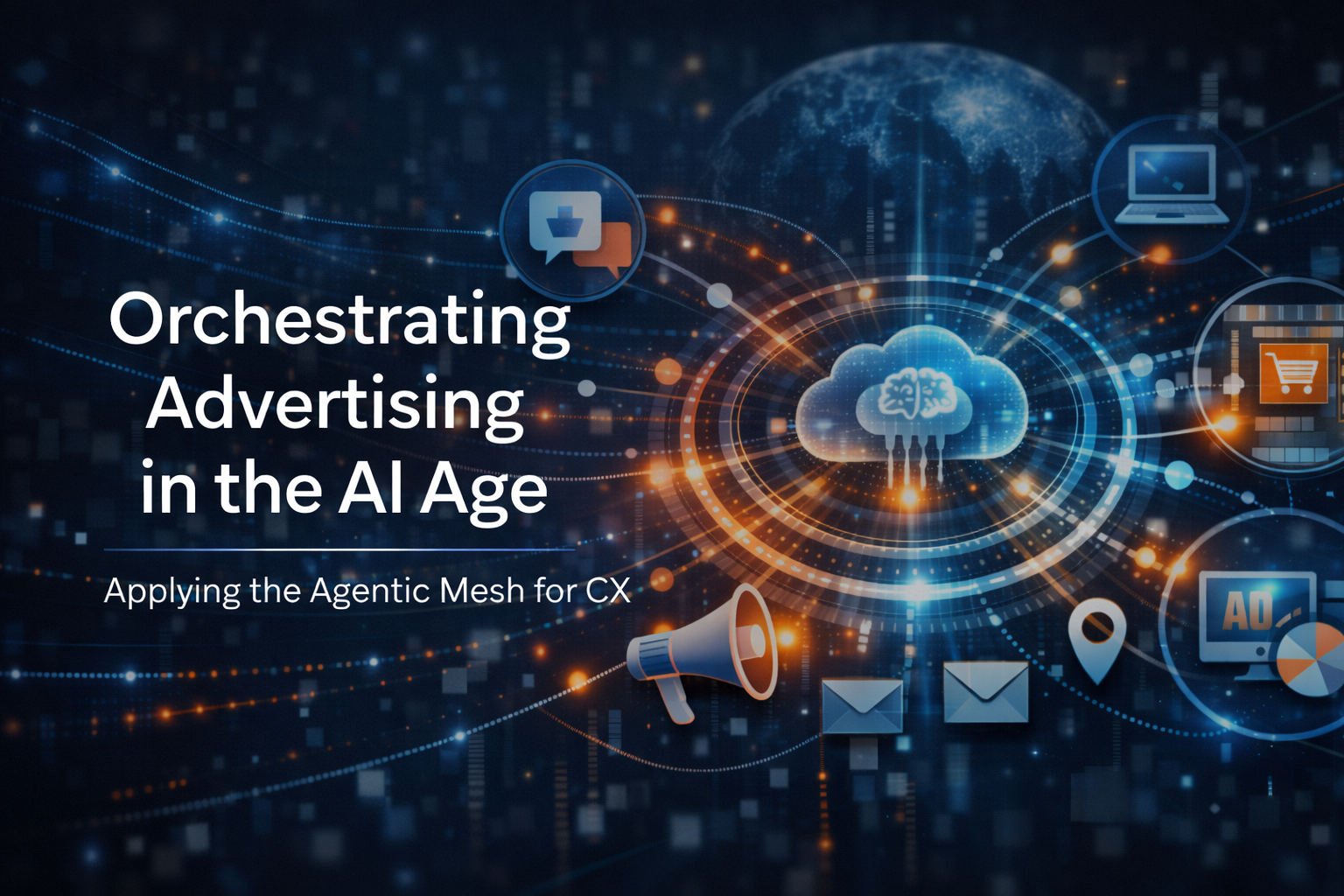
While AI-powered tools proliferate across the advertising (and every other) industry, most deployments remain isolated, unable to deliver the unified, cross-channel customer experiences that brands demand. IDC sees a critical gap in the market—fragmented AI products are failing to orchestrate branding and performance across the entire customer journey.
The solution lies in agentic mesh architectures for CX, where interconnected AI agents collaborate seamlessly, breaking down silos and enabling real-time, authentic engagement at scale. This shift is not just evolutionary; it is foundational for advertisers seeking to lead in the AI age.
Advertising’s agentic revolution
Let’s face it: Traditional adtech often feels fragmented, making campaign orchestration and audience targeting a challenge. This is only exacerbated by current AI deployments which often focus on single tasks and fail to capture the cross-functional nature of a client journey.
The agentic mesh for CX changes the game, deploying semiautonomous and autonomous AI agents that collaborate across departments and systems. For advertising professionals, this means:
- Real-time, cross-channel campaign management
- Privacy-compliant personalization
- Unified brand messaging at scale
Best practices for AI-driven advertising
Brands need to address the agentic mesh for CX framework as they look to effectively enable AI across their Ad-tech stack. In this regard several best practices emerge:
- Unified aata infrastructure: Build a standardized data foundation that integrates DMPs, CDPs, CRMs, and analytics platforms. This empowers agents to access real-time audience profiles, fueling dynamic creative optimization and attribution.
- Interoperability and standards: Design advertising agents for seamless workflow handoffs and data exchange using protocols like AdCP, OpenRTB, and IAB frameworks. This ensures compliance, scalability, and consistent campaign execution.Rapid adoption and risk management: Deploy agents for critical use cases—cross-channel attribution, creative optimization, and commerce integration. Regular risk assessments help mitigate errors, ad fraud, and ensure quality AI outputs.
- Upskilling and governance: Equip your teams for agentic AI by upskilling in programmatic buying, campaign optimization, and creative management. Clear governance and supervisory controls are essential for brand safety and regulatory compliance.
The agentic mesh advantage
Agentic AI isn’t just a buzzword—it’s transforming advertising operations by automating complex workflows, breaking down data silos, and enabling proactive, outcome-driven marketing. Industry leaders like Amazon Ads, Oracle, Adobe, and Salesforce are already embedding agentic mesh principles, even if under different monikers, to drive cross-functional collaboration and supervisory control.
The true test for brands in the AI era is not simply adopting new tools, but evolving from fragmented, siloed adtech to a fully autonomous, agentic ecosystem. This transformation requires real-time data integration, robust infrastructure, and clear protocols for agent interoperability—each a pillar of the agentic mesh advantage.
Brands that unify their advertising investments with cross-functional CX goals and KPIs, leverage no/low-code tools and agent cloning, and prioritize closed-loop measurement will accelerate their journey toward autonomous operations. Selecting partners committed to outcome-driven, agentic innovation is equally critical.
Ultimately, competitive advantage hinges on your ability to break down silos, upskill teams, and implement strong governance. Early adopters of agentic mesh principles will not only deliver consistent, brand-safe customer experiences at scale—they will define leadership in the AI age.
For more information on the Agentic Mesh for CX and how brands can apply it in the advertising context, check out: Applying the Agentic Mesh for CX to Advertising: Orchestrating Branding and Performance Across the Entire Customer Experience in an AI Age.