
The AI Supercycle is not a hype cycle. It is a once-in-three-decades technology expansion, defined by two sequential and overlapping waves.
We are witnessing the strongest global IT spending growth since 1996. 14% growth on a $4.2 trillion market. Unlike the internet and eCommerce boom that defined that era, this one is being driven by something more structurally transformative: artificial intelligence at enterprise scale.
IDC calls it the AI Supercycle. And at IDC Directions Singapore held on 21 May, 2026, IDC senior vice president, Sandra Ng, delivered a keynote that made one thing clear—the organisations debating whether to move are already falling behind the ones that already have.
Key Numbers:
- $4.2 trillion global IT market size
- 14% year-on-year IT spending growth, the strongest since 1996
- $110 billion projected AI infrastructure spend by end of 2026
- 36% compound annual growth rate (CAGR) for AI infrastructure through 2029
- 75% Asia/Pacific Japan (APJ) organisations that have deployed agentic AI in at least some initiatives
- 61% CEOs identifying agentic and generative AI at scale as their top new investment priority
- 45% APJ organisations citing vendor selection as their number one AI strategy priority
What Is the AI Supercycle?
The first wave, AI infrastructure and platforms, is already well underway. IDC projects $110 billion in AI infrastructure spend by end of 2026, with a compound annual growth rate of 36% through 2029. Compute, cloud, connectivity, and data infrastructure are being built at a pace and scale the market has not seen since the mid-1990s.
The second wave, and the one that will determine long-term competitive position, is AI applications and agentic workflows. This is where AI moves from infrastructure investment into operating model redesign, from procurement decisions into measurable business outcomes. A third curve, AI governance, trust, and compliance, is emerging in parallel and is fast becoming a revenue line in its own right.
As Sandra Ng framed it at IDC Directions: “The AI Supercycle is not one opportunity. It is three overlapping curves with different buyer profiles, sales cycles, and margin structures.”
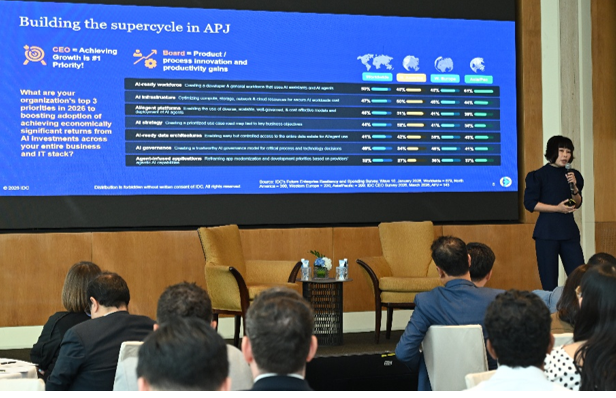
The question for every technology and business leader in APJ is which curve, or curves, your organisation is actively climbing.
APJ Is Not One Market. It Is Five Moving at Different Speeds.
One of the clearer analytical frames from the keynote is “one supercycle, five speeds”. Asia/Pacific is not a monolithic AI market, and the strategic implications differ materially depending on where your organisation operates.
- AI Superpower Built-Outs – China and Taiwan, competing at the infrastructure layer
- Legacy Modernisers – Japan and Korea, navigating AI adoption within established enterprise architectures
- Governance-led AI Enterprises – Singapore, Hong Kong, and ANZ, where regulatory frameworks are shaping the deployment sequence
- Digital Native Scalers – India, with scale, talent, and a growing domestic AI ecosystem
- Sovereign Stack Builders – Southeast Asia 5, where governments are becoming a new class of AI infrastructure buyer
For technology vendors operating across multiple APJ markets, a single AI narrative won’t resonate consistently. Localised, market-specific positioning, particularly around sovereign AI and governance, is not just a nice-to-have. It is a commercial imperative.
Where Is AI Budget Moving in APJ?
Presented at the Directions Singapore event, the data points to three areas attracting new and accelerating AI budget across APJ:
- Agentic AI and workflow automation is the fastest growing new budget category among tech buyers. Finance, procurement, HR, supply chain, and customer experience are the first use cases in motion. Three-quarters of APJ organisations have already deployed agentic AI in at least some tech-driven initiatives. 61% of CEOs identified agentic and generative AI at scale as their number one new investment priority.
- AI governance, risk, and compliance has moved from a legal consideration to a board-level priority. APJ regulators have moved faster than many vendors anticipated. The organisations treating governance as a competitive advantage, rather than a cost of compliance, are pulling ahead.
- Sovereign AI is creating an entirely new class of infrastructure buyer. Governments across APJ are building national AI capability. Local language models, domestic data residency, and supply chain compliance requirements are cascading down to mid-market and SME organisations in ways that create both complexity and opportunity.
What Should APJ Leaders Do Now?
IDC’s competitive moat map from the keynote sets out a clear sequence of actions across three horizons:
- Do now – credibility before you lose the room
- Do this year – differentiation before the market commoditises
- Bet on this – positioning before the next curve peaks
Frequently Asked Questions:
What is the biggest AI investment priority for APJ CEOs? Agentic and generative AI at scale. 61% of APJ CEOs identified it as their number one new investment priority in 2026.
What is the number one AI strategy challenge for APJ organisations? Selecting the right AI vendor partners. 45% of APJ organisations cite this as their top AI strategy priority, ahead of implementation, talent, and governance.
What should APJ tech leaders do now? Establish vendor credibility before the market commoditises. As Sandra Ng closed at IDC Directions Singapore 2026, “The vendors who win the APJ AI Supercycle won’t be the ones who moved fastest. They’ll be the ones buyers trusted first.”
Access the Full Insights
Explore IDC’s AI Vendor Strategy resources and uncover what’s defining the next era of enterprise AI — visit the page to get started.
Download an exclusive excerpt from IDC Directions Singapore, in which Senior Vice President Sandra Ng identifies the three AI opportunity curves that vendors and enterprise leaders must master to unlock value in this defining AI supercycle.
Looking to understand what the AI supercycle means for your market position, investment strategy, or go-to-market approach? Speak to our analysts.