

The AI assistant era is wrapping up.
Chatbots, copilots, summarizers—useful, yes, but that’s the warm-up act. What comes next is agentic AI: systems that don’t just respond to prompts but plan, reason, and execute work across your systems, data, and workflows, with or without human augmentation. Executives are putting agentic AI at the center of their business transformations, reimagining how people work with AI-powered workflows.
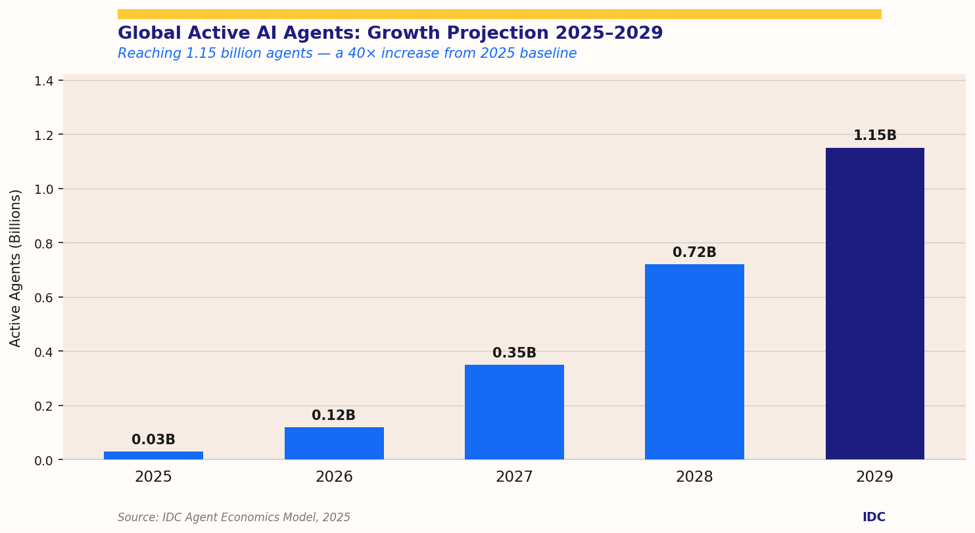
By 2029, IDC projects 1.15 billion active agents, 40 times the 2025 baseline, executing 217 billion actions per day.
The stakes are not theoretical
Business models, skills, economics, governance, compliance, and security requirements are changing rapidly—creating massive, rapidly evolving risks. The numbers bear that out:
- Up to 20% of G1000 companies could face legal and leadership fallout by 2030 from poorly governed agents.
- 60% of the G2000 will adopt a formal Agent Development Life Cycle by 2028.
CEOs, board members, and shareholders are demanding AI results now. Waiting will stifle market share, growth opportunities, and innovation. Early winners will widen their advantage by applying proven AI learnings across new use cases. In the AI economy, continuous learning creates speed and compounding results.
This isn’t an upgrade. It’s a new operating model
Where a copilot drafts an email, an agentic agent manages the entire workflow behind it: pulling data, making decisions, escalating exceptions, closing the loop. Autonomously. Persistently. Across systems. With or without human intervention. This requires executives to redesign processes with AI at the center, not bolted on, but as the heartbeat of every workflow.
IDC finds that by 2027, enterprises will need architectures that support synchronous movement of data, apps, workflows, and agents. If your current stack wasn’t designed for that, the clock is already running.
“Agentic systems introduce a fundamentally different risk profile than the AI tools most enterprises deployed in 2023 and 2024.”
The implications extend beyond architecture. Copilots operated under human supervision—every output reviewed, every action confirmed. Agents operate differently: they initiate, chain decisions, and act across systems in real time. A misconfigured agent doesn’t just produce a bad answer; it executes a bad decision, potentially at scale, before anyone notices. That shift from human-reviewed output to autonomous action is where governance frameworks built for the assistant era break down entirely. Governance, security, and orchestration are critical investment requirements, not an afterthought for effective and efficient AI outcomes. Governance and security must be built in from day one, the business and career risks are too high to treat them as afterthoughts. Every digital worker will be governed like a human employee.
Executives who recognize this distinction early hold a structural advantage. They’re not just deploying faster—they’re building the operational muscle, audit infrastructure, and trust frameworks required to scale safely. Those who treat agentic AI as a continuation of their copilot strategy will face compounding remediation costs as agent portfolios grow, and governance gaps widen.
The competitive divide forming now isn’t between companies that have AI and those that don’t. It’s between organizations that have learned to deploy agents with discipline and those still improvising. Speed without structure is exposure. Structure without speed is irrelevance. The executives navigating both are the ones establishing the terms.
Seven domains. One framework
IDC’s deployment framework surfaces seven domains where early decisions have outsized downstream impact. Get them right and you build momentum:
- Business outcomes
- Workflow design
- Data readiness
- Runtime architecture
- Governance
- Operating model
- Workforce
Each domain highlights key considerations for executives to gauge their deployment and governance readiness. After the self-assessment, the research provides deep dives into critical areas of transformation—software development, partner and AI infrastructure selection, and IT operations. These recommendations serve as a discussion guide for your agentic AI journey.
Key takeaways for executives
- Treat agentic AI as a new operating model, not an upgrade to your copilot strategy.
- Governance and security are now a competitive differentiator—not an IT compliance exercise.
- The 7-domain framework is your cheat sheet: use it to reduce deployment risk and extract compounding value.
- Early movers will set the terms. Waiting isn’t neutral—it’s a strategic concession.
Navigate your next move with confidence: Download the full IDC research, Leading Through the Agentic Deployment Era, for the complete self-assessment framework, domain deep dives, and actionable deployment recommendations.