

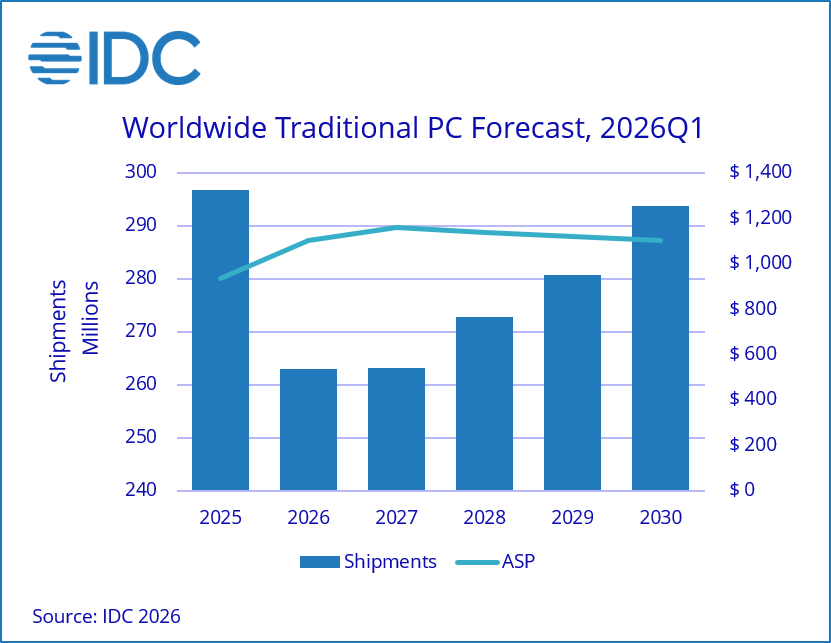
The global PC market is heading into a turbulent second half of 2026, and there’s no quick fix on the horizon. IDC now forecasts global PC shipments will decline 11.3% for the full year, with conditions worsening progressively through Q4, when shipments are expected to fall 20% year-over-year.
The culprit is a persistent memory shortage with no meaningful relief expected before the end of 2027. The knock-on effects are significant: prices are rising and PC manufacturers are struggling to maintain full product portfolios.
Pull-forward demand masked the problem, temporarily
The first quarter of 2026 offered a deceptively encouraging signal, with shipments growing 3% versus the same period last year. But that strength was largely borrowed from the future. Buyers, both consumer and commercial, accelerated purchases ahead of anticipated price hikes and product availability constraints.
“The anticipation of rising prices and of limited availability of some system configurations due to memory and other component shortages has led some end-users to make purchases earlier than anticipated,” said Jean Philippe Bouchard, Vice President of Devices and Consumers at IDC. “We’re not seeing any relief to the memory shortage situation before the end of 2027, which means prices will continue to rise and PC manufacturers will struggle to maintain full product portfolios for the foreseeable future.”
Some of that momentum is carrying into Q2, but the remaining quarters are expected to deteriorate gradually and sharply.
The MacBook Neo factor
One notable wildcard is Apple’s MacBook Neo, which has driven stronger-than-expected notebook demand and prompted IDC to revise its notebook forecast upward. But its ripple effects cut both ways.
“The introduction of the MacBook Neo is putting real pressure on the entire PC ecosystem,” said Jitesh Ubrani, research manager for IDC’s Consumer Devices Trackers. “We expect vendors to respond with a combination of new silicon, a more efficient OS from Microsoft, and aggressive promotional pricing.”
“The competitive pressure from the Neo is providing a partial offset to broader price increases, keeping some low-cost notebook options alive. But the overall trajectory for average selling prices (ASPs) is firmly upward. IDC forecasts ASP growth of 17% in 2026, and even as memory capacity expands over the next two years, pricing is unlikely to return to 2025 levels,” Ubrani added.
What to watch
The PC market is navigating a rare combination of structural supply constraints, macroeconomic headwinds, and platform-level disruption. For buyers, the window for favorable pricing is narrowing. For vendors, the challenge is sustaining portfolio breadth while managing component scarcity and competitive pressure from Apple’s latest hardware.
IDC tracks ongoing developments through its Worldwide Quarterly Personal Computing Device Tracker.