

When Kyndryl separated from IBM in 2021, it entered the market as a startup of 80,000 people. The scale was deliberate. Kyndryl launched as one of the world’s largest managed service providers from day one, with a mandate to help the world’s most critical systems run better and a mission to become an AI-first organization. The analyst relations function, led by Mark Terranova, Head of Analyst Relations for Kyndryl’s global technical practices, was central to that work from the start.
The motion was clear in theory: listen to the question, find the right analyst, deliver the insight. In practice, the volume made that model creak almost immediately.
“I don’t have one stakeholder,” Terranova says. “I have hundreds.”
Product teams wanted to know where markets were heading. Marketing needed independent validation for positioning. Executives needed fast, well-grounded answers before decisions got made without them. Every request was legitimate. Every one took time. And synthesizing a defensible point of view from IDC research, reading the reports, drawing the conclusions, translating the findings into something an executive could use, took weeks.
Decision-makers, Terranova notes, had stopped waiting for it.
The scale problem with traditional analyst relations
The challenge wasn’t a shortage of good research. IDC had long been Kyndryl’s first call for market sizing and independent validation. When a senior leader needed to know how large a market segment was, or how fast it was moving, IDC research was where that conversation started.
Traditional analyst relations runs on inquiry calls and relationship depth. A skilled AR professional knows which analyst to call, how to frame the question, and how to turn a conversation into a briefing document. That expertise is real and it takes years to develop. But it also runs sequentially, one stakeholder at a time, one research thread at a time, in an organization where the demand for intelligence was running in parallel across hundreds of conversations simultaneously.
“AI lets me respond to hundreds of people really fast,” Terranova says, “whereas before it would be one at a time. And again, I would get to them all if it would take me weeks.”
From relationship to platform
When Terranova joined the beta program for IDC Quanta, IDC’s AI platform built on its proprietary research and analyst intelligence, he recognized immediately what made it different from the general-purpose AI tools he had already been using.
The difference wasn’t the interface. IDC Quanta is built on a familiar conversational model, close enough to ChatGPT that his team picked it up without friction. That familiarity was deliberate, and Terranova sees it as a key part of what makes the platform usable at scale: his team had already spent nine months developing real prompt engineering skills, and Quanta’s interface met them where they already were.
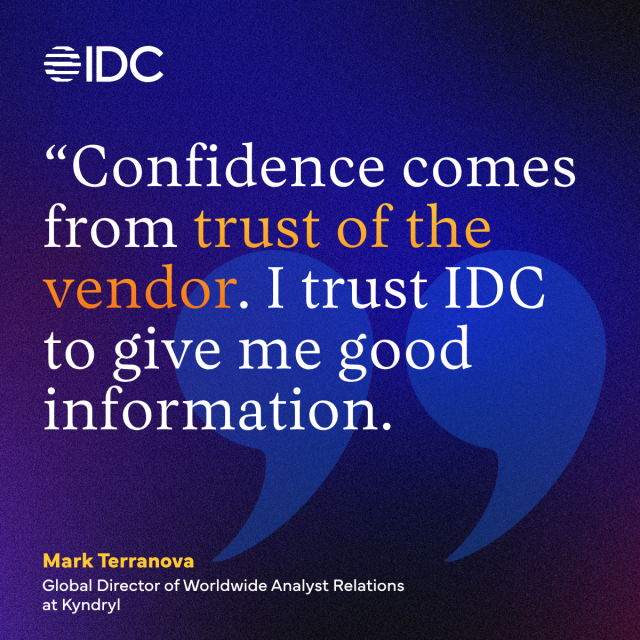
“The confidence comes from trust of the vendor,” he says. “I trust IDC to give me good information.”
That trust matters in a way that’s easy to understate. General-purpose AI tools crawl the open web, which means they surface a mix of analysis, marketing material, and noise with no way to know which is which. IDC Quanta draws from IDC’s proprietary research corpus. Every answer is grounded in specific reports. Every insight points back to the analyst work behind it.
For Kyndryl, an organization that stakes its market position on being a thought leader in managed services and uses independent research to validate that position with customers, the distinction is fundamental.
“Everyone in the world knows IDC is the best at counting things,” Terranova says. “When you want to know how big something is, or how large it’s going to be, IDC is where you start.”
Intelligence that interacts
What Terranova values most isn’t just the speed. It’s the kind of intelligence IDC Quanta produces.
The platform doesn’t return a lookup list. It engages with the question. He can ask about a topic, then ask follow-up questions, and the tool generates new answers based on what he’s actually trying to understand, not just a list of related reports to go read somewhere else.
“The tool allows me to script my answer to what I actually need it to be,” he says. “I can interact with it. AI needs to interact with the human. That’s how you get good answers.”
That quality has practical consequences for how Terranova’s team operates day to day. In a meeting where an executive asks a question he hasn’t prepared for, he can open a browser window, query Quanta in real time, and come back with five pieces of supporting research in minutes. Some inquiries that previously required scheduling a call with an analyst, and waiting for that call to happen, can now be resolved on the spot. The analyst conversation still has value for complex or strategic questions. Quanta narrows the list of situations where that conversation is actually necessary.
“I don’t need an inquiry for this,” he can now say. “Here’s the answer.”
A function redefined
Terranova sees what’s happening at Kyndryl as part of a larger, faster-moving shift across the industry. He’s direct about where it leads.
The analyst relations teams that build fluency with AI-led intelligence workflows now will be the ones that outpace their peers. The analyst remains essential. They still talk to customers, still generate the underlying research, and still bring the kind of judgment that no platform can replicate. But the idea that insight only travels through a scheduled inquiry call is already fading.
“Those that adopt this idea and this methodology and this work habit,” Terranova says, “they will succeed.”
For Kyndryl, that’s not a prediction. It’s the work already underway.