

As AI adoption accelerates across enterprises, organizations are learning a hard lesson: bolt-on training tied to individual use cases just won’t cut it. To win, organizations must treat AI literacy as a strategic enterprise-wide capability.
That means embedding AI training in culture, governance structures, onboarding and performance expectations. It also means moving beyond the pilot mindset and building systematic programs with sustained executive backing, role-based curricula and real change management discipline.
IDC research reveals the gap.
According to the IDC 2026 Global IT Skills Survey, just a third of global IT and business leaders say they’re fully ready to incorporate AI into daily work. Some 93% of IT leaders rank AI as the most important enterprise skill, yet many organizations have yet to embark on organization-wide AI training.
Meanwhile, companies charge on with their AI plans. That leaves a lot of employees improvising on the very tools their companies are betting on. Good intentions can’t substitute for real, organization-wide knowledge about what AI can and can’t do, and how to make the best use of it.
As the recent IDC study on Foundation AI literacy, the baseline competencies every employee needs to use AI responsibly and effectively, makes clear: AI training must be for everyone, not just technical teams. Scaling means moving past pilot- and use-case-specific training to a tiered curriculum that reaches the whole workforce. Start with the basics for all employees: what AI is and is not, responsible-use guidelines and the key risks, including bias, hallucinations, privacy and data leakage. Then show the upside, the opportunities for augmentation and productivity. Most employees arrive without a structured academic grounding in AI, so accessible, role-aware pathways matter.
Here are six practices that distinguish successful AI initiatives at global organizations.
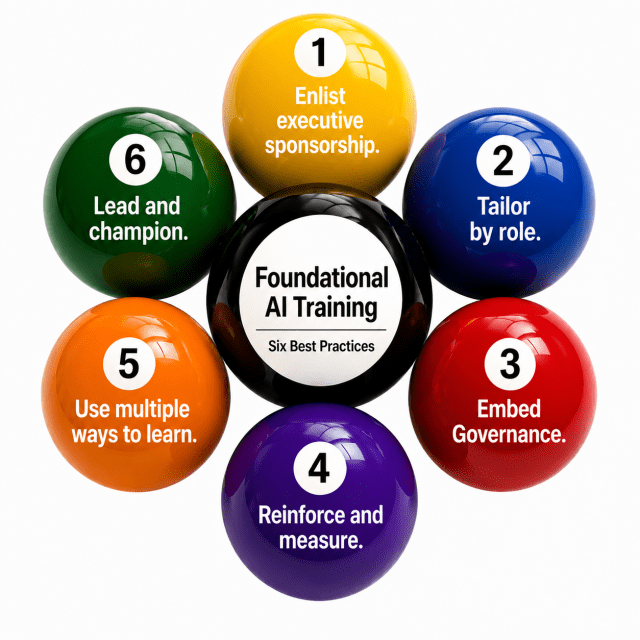
1. Enlist executive sponsorship
Successful programs begin with visible, sustained support from senior leadership. When a CEO or COO clearly signals that responsible AI use is a business priority, adoption accelerates. Position AI literacy as a strategic workforce capability, aligned directly with organizational objectives, risk frameworks and governance priorities. It should sit alongside AI governance and compliance efforts, not in a silo operating separately from them.
2. Tailor by role
Once the foundation is set, layer in role-based modules. Business leaders need strategic decision-making, oversight and risk awareness. Technical teams need implementation, validation and monitoring. Add scenario-based learning on top: realistic, sector-relevant case studies and high-impact use cases drawn from your own environment, in simulated settings where possible. The closer the training sits to the work, the better it sticks.
3. Embed governance
Responsible AI principles, fairness, transparency, accountability and privacy, shouldn’t be a standalone module. Weave them through the entire curriculum. Training should reinforce internal AI usage policies, data classification standards, escalation and oversight procedures and documentation expectations. Use real-world examples from your sector. Concrete evidence of real consequences — good and bad — is what makes governance stick.
4. Reinforce and measure
One-time training fails because AI capabilities, risks, and policies change continuously. Build periodic refreshers, knowledge checks, feedback loops and ongoing updates into the program, and embed reinforcement directly into daily workflows to lift retention. Then measure more than completion rates. Track behavioral change and impact. Adoption of approved AI tools, fewer policy violations, better documentation and productivity or quality gains can and should be tied to responsible AI use. Those metrics give you confidence that the program is actually working — and the evidence you need to sustain investment in it.
5. Use multiple ways to learn
Different formats reinforce different behaviors, and mature programs don’t rely on a single mode. They layer self-paced e-learning, live workshops, microlearning, hands-on labs and in-app guidance. Meeting people where they work, in the flow of the job, beats stacking one-off events.
6. Lead and champion
None of this scales without visible, sustained sponsorship from the top. When a CEO or COO signals that responsible AI use is a business priority, adoption accelerates, so position AI literacy as a strategic workforce capability aligned with organizational objectives, risk frameworks and governance priorities, not parked in a training silo. Treat it as a core, required competency for all staff, the way you treat cybersecurity awareness or data privacy training. Clear communication helps: emphasize AI as augmentation, the organization’s commitment to responsible use and how literacy supports mission, stewardship and risk management. Good change management reduces uncertainty. It also discourages shadow AI, people reaching for unapproved tools because no one showed them the approved path.
The takeaway is simple. Organizations that treat AI literacy as a strategic capability across the organization will be better positioned to close the gap between AI investment and AI output. Those that skip the discipline will see the gap between ambition and readiness widen. IDC’s Foundation AI Literacy study is a practical starting point. Read it to see how leading organizations are building the capability today.