I spent much of my career helping organizations operationalize customer and employee intelligence. During that time, I watched an entire industry emerge around dashboards.
Companies invested billions collecting customer feedback, employee sentiment, operational metrics, and business intelligence. Entire software categories were built around helping organizations visualize that information and drive action.
The model worked extraordinarily well.
Companies like Qualtrics, Medallia, Tableau, Salesforce, and many others helped define a generation of enterprise software. But over time, a pattern emerged.
The problem was never collecting the data; the problem was getting people to use it.
Organizations spent years trying to encourage executives, managers, and frontline employees to regularly log into dashboards, review reports, identify issues, and take action.
Adoption became a business problem unto itself. The intelligence existed, but the behavior did not.
The hidden cost of dashboards
The challenge with dashboards is simple: they require users to interrupt their workflow.
Every dashboard assumes a user will:
- Stop what they are doing.
- Open a separate application.
- Find the relevant information.
- Interpret it.
- Decide what to do next.
That process creates friction, and friction is the enemy of adoption.
Today, most professionals spend the majority of their time in a handful of environments:
- Teams
- Slack
- CRM platforms
- ChatGPT
- Claude
- Productivity applications
These have become the operating systems for modern work. Every additional application competes for attention against those environments, and most lose.
AI changes the equation
Large language models have created a new interface for work, allowing users to interact with intelligence through natural language rather than reports, dashboards, and portals. For the first time, intelligence no longer needs to live in a separate destination. Instead, it can travel directly to the user.
An executive can ask a question inside ChatGPT.
A seller preparing for a customer meeting can instantly surface market trends, competitive threats, and analyst insights directly within Salesforce.
A product leader can receive market insights through Teams.
A strategist can query complex research through an AI assistant.
The user never leaves their workflow, because the intelligence comes to them. This represents more than a user experience improvement: It’s about introducing a fundamentally different operating model.
The goal isn’t simply better intelligence. It’s reducing the friction between intelligence and action.
Why proprietary data matters more than ever
Many organizations believe AI itself is the competitive advantage. I believe the opposite.
As models become increasingly accessible, the differentiator will be intelligence.
Organizations that possess unique, proprietary, trusted data will have a significant advantage because they can combine AI with insights that cannot be found on the open internet. That’s exactly what makes this moment so rich with potential.
At IDC, we have decades of proprietary market intelligence: market sizing data, competitive positioning, technology adoption trends, vendor performance data, industry forecasts, and strategic research.
These are the datasets organizations use to make billion-dollar decisions. Historically, customers accessed that intelligence through reports, portals, and analyst interactions.
Today, AI allows us to reimagine how that intelligence is consumed.
From intelligence systems to decision systems
The next evolution is bigger than dashboards, and it’s bigger than reports. It’s even bigger than AI assistants.
The real opportunity is creating a technology intelligence layer that connects:
- Market intelligence
- Customer intelligence
- Operational intelligence
- Financial intelligence
- First-party enterprise data
When those signals come together, organizations gain a more complete view of their markets, customers, competitors, and business performance. At that point, we are no longer talking about a research platform, but a new decision system.
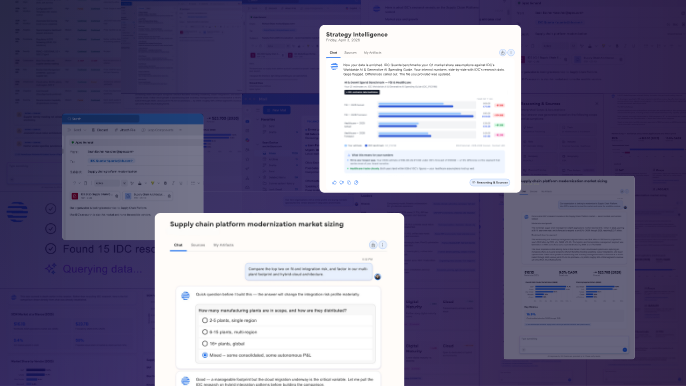
IDC Quanta was built around this idea: bringing trusted technology intelligence directly into the workflows where decisions are made.
The organizations that win in the next decade will not necessarily have the most data, but they will have the least friction between intelligence and action.