
Entry-Level Segment Contracts Sharply as ASPs Hit a Record US$315; Yet Market Value Grows at +1.7% Despite Volume Declines.
What Happened in India’s Smartphone Market in Q2 2026?
INDIA, August 11, 2026 – According to IDC ‘s Worldwide Quarterly Mobile Phone Tracker , India’s smartphone shipments declined 11.1% year over year to 33.2 million units in Q2 2026, as the ongoing global memory chip shortage kept component costs elevated and squeezed affordability across price bands. H1 2026 shipments fell to 64.2 million units, down 7.9% YoY, the lowest first-half volume in five years, even as market value grew 3.6% YoY. With average selling prices at record highs and vendors pulling back on discounts to protect margins, India’s price-sensitive buyers are likely to stay under pressure through the second half of the year.
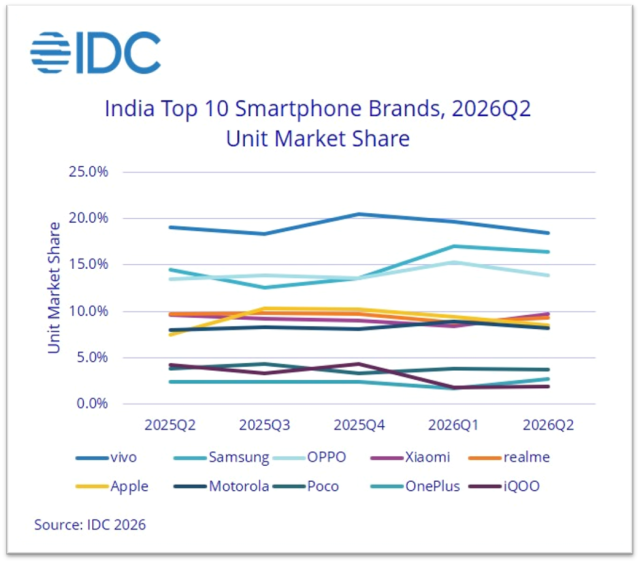
India Smartphone Market, Top 10 Brands
(Unit Market Share, Year-over-Year Growth, 2Q26/25)
| Brands | 2Q25 Market Share | 2Q26 Market Share | Year-over-Year Unit Change |
|---|---|---|---|
| 1.vivo | 19.0% | 18.4% | -13.9% |
| 2.Samsung | 14.5% | 16.4% | 0.4% |
| 3.OPPO | 13.4% | 13.8% | -8.5% |
| 4.Xiaomi | 9.6% | 9.7% | -10.0% |
| 5.realme | 9.7% | 9.3% | -14.2% |
| 6.Apple | 7.5% | 8.5% | 0.7% |
| 7.Motorola | 8.0% | 8.2% | -8.9% |
| 8.Poco | 3.8% | 3.7% | -12.3% |
| 9.OnePlus | 2.5% | 2.7% | -2.5% |
| 10.iQOO | 4.3% | 1.9% | -61.0% |
| Others | 7.7% | 7.4% | -16.2% |
| Total Market | 100.0% | 100.0% | -11.1% |
Why It Matters
Q2 2026 confirms this downturn isn’t spread evenly across the market. The memory cost surge is rewarding brands with scale and premium portfolios while hitting those anchored to low-end volume hardest.
- Apple: Shipments held largely flat, constrained by supply shortages on the iPhone 15, 16, and 17. Despite the shortage, the iPhone 17 remained the top-shipped device consecutively for Q1/Q2’26. Consumer demand remained strong at its core, though it cooled somewhat as affordability offers grew scarce.
- Samsung: Shipments stayed largely flat, placing it alongside Apple as one of the few brands that maintained ground in a shrinking market. A diversified portfolio and greater scale allowed Samsung to absorb rising costs without sacrificing volume or margins.
- Chinese brands: Faced the sharpest exposure, as their traditional strength in the low-end and mass-budget segments worked against them. Cost cutting and portfolio shifts toward higher-margin models were underway, but the harder challenge was convincing price-sensitive buyers raised on budget positioning to accept meaningfully higher price tags. With financing options narrowing the price gap between segments, several leading Chinese manufacturers saw sharper, double-digit declines as demand tilted toward brands with stronger scale and supply chain stability.
Market Dynamics: What Drove the Outcome?
The market’s Q2 2026 trajectory was driven by five key shifts playing out in tandem:
- Memory cost inflation continues to squeeze the entry-level tier toward irrelevance: The memory shortage kept pushing component costs higher across model lineup. Sustaining profitability in the sub-US$100 tier became increasingly untenable for brands, leading to fewer model launches and thinner channel support. Shipments in this segment fell 74.3% YoY in Q2 2026, with its share of the market shrinking from 15.6% to just 4.5%, reinforcing that the entry-level tier is fast becoming commercially unviable under the current cost environment.
- Uptick in 4G demand: Entry-level 5G devices have grown steadily costlier this quarter, pushing several brands to reintroduce or extend 4G models to hold their footing in the segment, lifting 4G’s share to 11.1% as a supply led stopgap move. Once that inventory runs dry, consumers will have little choice but to move up to costlier 5G models, making the current rise in 4G share a temporary cushion rather than a lasting fix for entry-level affordability.
- Upward migration reshapes the mid-market: Buyers priced out of entry-level shifted decisively into the mid-premium tier, with the US$400-600 band growing 60.3% YoY and nearly doubling its share from 4.8% to 8.6%. Meanwhile, the mass-budget segment (US$100-200), the market’s largest at 46.8% share, held comparatively steady with flat shipments, cementing its role as the new value anchor for cost-conscious buyers.
- Premium and upper-mid bands hold firm amid the broader pullback: The US$200-400 segment declined a modest 8.1% YoY, well below the overall market contraction The US$600-800 remained flat and US$800+ band slipped just 5.0% YoY, both gaining share as volumes consolidated away from the bottom of the pyramid. This resilience reflects sustained appetite among upgrade-led and aspirational buyers, who have largely stayed insulated from the affordability pressures reshaping the lower end of the market.
- Discount led channels lose ground, offline plays defense: Online channel shipments declined 19.8% YoY, with share slipping from 46.4% to 41.9%, as e-tailer led discounts and offers grew far scarcer than a year ago, a pullback felt most acutely as entry-level models eroded from the online mix and flagship devices saw no upfront discounting to drive volumes. Offline channel shipments held up considerably better, declining by just 3.6% YoY, as brands leaned on physical stores to manage the pricing pressure.
India Smartphone Market at a Glance – Q2 2026
- Total shipments: 33.2 million units (−11.1% YoY)
- Average selling price (ASP): US$315 (+14.4% YoY) — a record high
- Market value growth: +1.7% YoY despite volume decline
- Offline channel: 58.1% share (up from 53.6%); -3.6% YoY
- Online channel: 41.9% share (down from 46.4%); −19.8% YoY
- Top five brands: vivo (#1), Samsung (#2), OPPO (#3), Xiaomi (#4), Realme (#5)
Analyst Insight
“Q2 2026 saw average selling prices climb 14.4% year over year to a record US$315, with memory driven cost pressure showing up across the product lineup. This marks a sharp reversal from the same period last year, when early festive discounts and offers were rolled out to build momentum ahead of the season. This year, both brands and channels have leaned away from that playbook, thinning margins have left little room to use price as a demand lever, pushing prices higher instead of lower. Heading into the festive season, financing options will be key to keeping affordability within reach, alongside product differentiation in the mid-premium segment, to sustain consumer demand.” said Aditya Rampal, senior research analyst, Devices Research, IDC Asia Pacific.
*Figures in tables/charts rounded to the first decimal point.
IDC Outlook: What’s Next?
The second half of 2026 is set to be tougher than the first, as brands run out of the lower cost inventory that cushioned Q1/Q2 and face the memory shortage head on through the festive season. With discounting largely off the table, festive season demand will hinge on how well brands can substitute financing and product differentiation for the price cuts they can no longer afford.
- What could accelerate growth? Early signs of memory price stabilization, a wider rollout of financing and EMI schemes to bridge the affordability gap, and stronger-than-expected festive footfall in the mid-premium segment.
- What could slow it down? A memory shortage that runs longer than expected into 2027, further macro-economic headwinds, and entry level buyers deferring purchases altogether rather than trading up or shifting to second hand devices.
- What should readers watch next quarter? Whether the current 4G stopgap in the entry-level segment holds or runs dry, how far brands lean on offline and financing-led channels to offset the pullback in online discounting, and whether the mid-premium bands ($400-600 in particular) sustain their momentum once festive season buying concludes.
“Rising prices are now touching every corner of India’s smartphone market. Festive discounts, typically the trigger for purchases, look unlikely this year as cost pressure builds through H2 2026. Shipments are set to decline by over 15% in the second half, taking full-year volumes down to roughly 128-130 million units. Apple faces a similar supply led squeeze, with older iPhones set to get costlier and no attractive festive discounts expected like in previous years. As a result, iPhone shipments are likely to decline mid-single digits in 2026 from 14.3 million units in 2025. Demand hasn’t gone away, people are simply waiting longer to buy, and those planning an upgrade may want to move sooner rather than later, before prices go up further,” said Upasana Joshi, senior research manager, Devices Research, IDC Asia/Pacific.
Frequently Asked Questions
Why did the market decline despite strong mid premium demand?
The gains in the mid-premium bands simply weren’t large enough to offset the steep drop at the entry level. With memory costs squeezing margins, brands had little incentive to bring back the promotional offers that typically convert stocked inventory into actual sales, leaving supply sitting ahead of what end users were willing to buy this quarter.
Which brands benefited most in Q2 2026?
Apple and Samsung were the only two brands to hold shipments flat year over year, while Chinese brands broadly saw declines across the board. The top three rankings stayed unchanged, though Xiaomi moved up to fourth place on the back of affordable launches, edging past realme into fifth. Apple, despite falling out of the top five by unit shipments, continued to lead the market by value, with a 27.0% share that grew 22.2% YoY.
What risks could impact the market in H2 2026?
The core headwinds remain unchanged and are only building further, with memory costs staying elevated for longer, the rupee weakening further, and the mass-market segment losing viability as prices climb beyond what value conscious buyers can absorb. Whether the market stabilizes will depend less on brands cutting prices and more on how well they can lean on financing, exchange offers, and affordability-led schemes to keep demand moving through the festive season.
About IDC
International Data Corporation (IDC) is the technology intelligence layer of the AI economy. A global leader in research and data for more than 60 years, IDC’s expert analysts, proprietary datasets, and rigorous methodologies are trusted by business and IT leaders to guide critical business strategies and IT investments. Today, that intelligence is built into the tools and workflows where work gets done with IDC Quanta, making work sharper, teams faster, and businesses harder to beat.
Visit www.idc.com, subscribe to the IDC blog, or follow IDC on X and LinkedIn for the latest industry insights.
All product and company names may be trademarks or registered trademarks of their respective holders.