
On July 28, 2026, the FCC quietly added “advanced robotic devices” to its Covered List, the roster of tech it has flagged as a national security risk, blocking new equipment authorizations for foreign-made robots. The headlines were about humanoids, the walking machines from Chinese vendors like Unitree. Within 24 hours, the story took a stranger turn: the ban also covers your vacuum.
Ban, or something narrower?
Most coverage calls this a “ban,” and we will too, because that’s the word everyone is searching for. But read the fine print and it is more of a chokepoint than a wall: already-certified models can keep shipping new units, not just running out what’s already sold, though the FCC has reserved the right to revoke that status later, there is a Conditional Approval pathway that lets vendors keep selling if they shift manufacturing to the US, and a long list of exclusions, road, rail, aircraft, underwater vehicles, medical and mobility devices, and fixed industrial arms, sit outside the rule entirely.
The FCC’s definition sweeps in any foreign-made mobile robot over roughly 4.4 pounds that senses its surroundings, moves along the ground, and connects wirelessly, a description that fits a humanoid, a quadruped, and a robot vacuum, lawnmower, or window cleaner equally well. Already-certified models keep shipping new units, not just running out what’s on shelves. It’s the next hardware refresh that’s cut off.
IDC is launching research into Physical AI across four layers of the ecosystem: Infrastructure, Software and Platforms, Services, and Devices. Robotics sits inside Devices, and today it is, by a wide margin, the biggest draw in that layer. That is why a rule written around “robots” ripples so far. The figures below cover the robot categories IDC tracks in depth, household cleaning, professional and commercial, and humanoid, not the entire global robotics market. We ran those numbers against IDC’s latest worst-case scenario, current as of August 2026, and the results flip a lot of the conventional wisdom about who is actually impacted by this restriction.
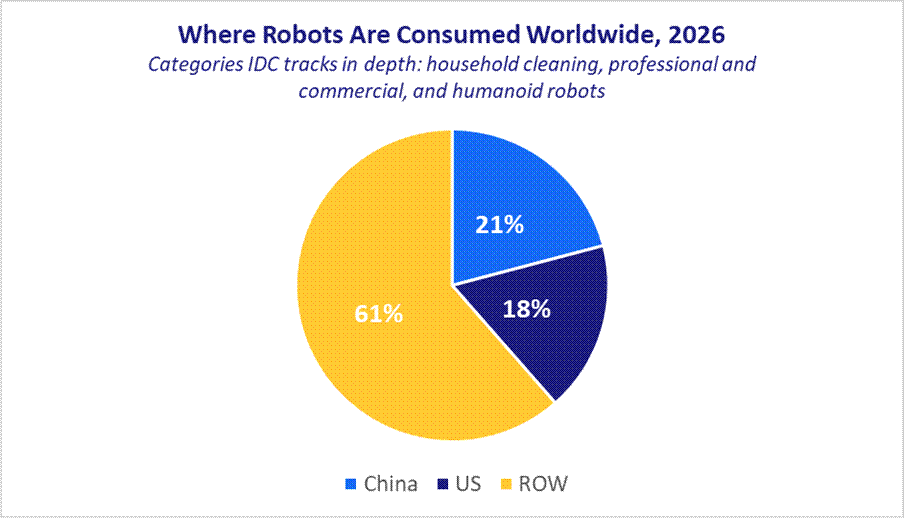
Source: IDC Worldwide Robotics Trackers, Q2 2026 (If Ban Stays Till 2030 Scenario). Household cleaning, professional and commercial, and humanoid robots combined, the categories IDC tracks in depth.
Within these tracked categories, Europe, not the US or China, is the largest robot market by consumption, at more than double America’s share. The US and China combined still do not outbuy the rest of the world here.
The US Hit, If the Restriction Holds
Put the US robot categories IDC tracks in depth on one chart, household cleaning, professional and commercial, and humanoid combined, and the picture is more forgiving than the headlines suggest: these categories still grow every year through 2030, just off a lower trajectory. The gap opens gradually, reaching about 4% below the published baseline in 2027 and 18% by 2030. On IDC’s baseline, this US total compounds at around 13% a year through 2030; under this scenario, that cools to 9%, a real deceleration, but nowhere close to the growth story stalling out.
Using IDC’s blended average selling price assumptions, that growth gap between the restriction scenario and IDC’s published baseline compounds into more than $6 billion in foregone US robotics revenue between 2026 and 2030, with the single worst year, 2030, alone accounting for above $2 billion of it.
That softer trajectory rests on a specific assumption: already certified models do not disappear. The FCC’s rule only blocks new equipment authorizations, so IDC’s scenario assumes overseas vendors keep selling models that cleared certification before the rule took effect, refreshing appearance, hardware configurations, and software features rather than filing for new authorizations. For household cleaning specifically, IDC expects those extended models to stay competitive at least through 2027, since US demand for the newest generation of features runs lower than in Europe or China, and expects vendors to lean harder on wet and dry vacuums, a category this rule does not touch, to offset lost robot vacuum volume while protecting their premium positioning. A sharper decline is still expected within two to three years once those extended product cycles run out.
Not Every Category Takes the Same Hit
The instinct is to assume this rule protects the humanoid and commercial robot builders it was written for, while consumer cleaning brands, already dominated by Chinese vendors, absorb the pain. The final numbers say the opposite. Look at each category’s own base case line against its own worst-case line, and the ones expected to benefit from this policy are the ones falling furthest behind where they would otherwise be:
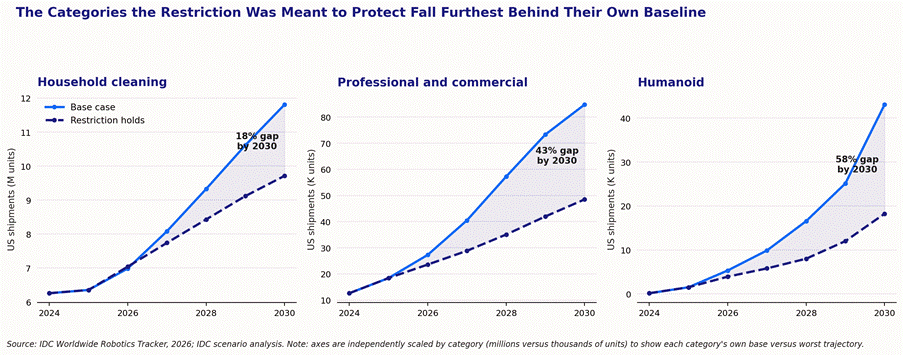
Source: IDC Worldwide Robotics Trackers, 2026 (If Ban Stays Till 2030 Scenario). Each panel uses its own scale (millions versus thousands of units) to show the category’s own trajectory, not a comparison of absolute volume across categories.
Household cleaning is nearly the entire US volume across these tracked categories, and it is also the most resilient category in relative terms, trailing baseline by just 4% in 2027 and 18% by 2030. Professional and commercial robots fall further behind, from a 29% gap in 2027 to 43% by 2030. The same lifecycle extension approach applies here too, incremental hardware and software upgrades on already deployed fleets rather than new authorized models, but higher stakes deployments and shorter replacement cycles make it a thinner cushion than in household cleaning, though a commercial robot’s higher price tag makes a real US manufacturing commitment worth pursuing for some vendors under the FCC’s Conditional Approval process.
Humanoid robots, the category this restriction was ostensibly designed to protect, see the deepest cut of all: a 41% gap in 2027 widening to 58% by 2030. Look at the dollars and it is starker still: nearly four out of every five dollars of the category’s projected 2030 US revenue evaporates under the worst case. Volumes are still small, which is also why the percentage swings look so dramatic, so this is not a story about finished robots piling up at customs. It is about how dependent even vertically integrating US builders, Figure, Apptronik, Boston Dynamics, still are on China for the motors, actuators, batteries, and rare earth materials that go into every unit. Overseas humanoid vendors have the same shelf life extension playbook available, keeping already approved units in the field and iterating through incremental hardware, software, and AI upgrades, but it buys far less cover here: IDC does not expect US based humanoid builders to reach scaled mass production until the end of 2028, so there is no domestic backstop ready to absorb the growth that foreign models can no longer supply. IDC estimates China accounts for 82% of global humanoid shipments today. Until US builders reach that scale, whatever badge sits on the chassis, the bill of materials behind it still reads China.
Europe Absorbs the Redirect, Not China
The scenario does not just subtract US demand; it has to send that displaced hardware somewhere. IDC’s model nudges professional and commercial and humanoid forecasts higher across EMEA and other parts of the world, particularly the UK, France, Germany, and Eastern Europe, as Chinese vendors redirect resources toward markets open to them. China’s own domestic forecast barely moves. It is a story about Europe, already the largest buyer of these tracked robot categories, getting a little larger still.
What It Means for Vendors
Reshoring consumer robotics specifically is unlikely given thin margins; this accelerates a supply chain diversification trend already in motion rather than starting a new one. Tesla sourcing its own AI chips for Optimus across TSMC and Samsung’s Texas fab is one model other vendors may follow: hedge the component that carries the most geopolitical risk, chips today, magnets and actuators next, rather than moving final assembly to the US.
Expect that hedge to widen the gap inside devices rather than close it. Humanoid and commercial builders have the margin and the government backing to build out US supply for the parts that matter most. Household cleaning vendors do not have that room, so the category most exposed today stays exposed, even as it turns out to be the one best riding out the restriction. And expect more vendors trying to maintain a US foothold to pair with independent US software partners rather than their own bundled stack, since a software partner is far cheaper to Americanize than an entire supply chain. Tennant’s hardware running on Brain Corp’s independent BrainOS is one example of that model.
The Bottom Line
The vacuum detail is what makes this restriction legible to a general audience, a strange, sticky hook for a story about industrial policy. But it’s not the point, and neither is the word “ban.” The point is that a single trade rule, applied evenly on paper, lands completely unevenly in practice, and not in the direction most people assumed.
Household cleaning, already dominated by foreign brands and squarely in the crosshairs, shrugs this off best. Humanoid robotics, the category built with US flags on the marketing decks, takes the deepest percentage hit, because protecting the badge on the finished robot does nothing to protect the motors, actuators, and rare earths inside it. And the biggest beneficiary of the US-China standoff is not the US or China, it is Europe, already the largest buyer of these tracked robot categories, absorbing the redirected volume without a policy of its own.
So, what does the restriction really mean? Not that the US is closing its doors to robots, and not that China’s lead breaks, because China was never actually leading global consumption in the first place. It means the market is quietly sorting into two tracks: mass market categories that keep growing around the US, and higher value categories where the appearance of protection outpaces the reality of supply chain independence. The vendors and the policymakers who read that correctly get a head start on everyone still parsing what the FCC actually wrote.
Update: See how IDC’s modeling holds up against outside expert debate in our follow-up, FCC Robotics Ban: Checking the Expert Debate
Getting a Head Start of Your Own
Reading this restriction correctly is one edge. Having a full view of where Physical AI is headed next is another. Two ways to build on it:
Upcoming Webinar: How the US Ban is Reshaping the Robotics Market: Global Robotics Outlook
The July 2026 restriction is already reshaping who wins in robotics — and not in the direction most people expected. Join IDC live on October 14 (11 AM EDT | 5 PM CET) for the full 2026–2030 forecast across humanoid, autonomous mobile, and commercial service robots, plus the regional and competitive shifts this policy is setting in motion. Can’t make it live? Register anyway — the recording will be sent to you after.
Fragmented data. Blind forecasts. Competitive gaps.
If any of that sounds familiar, you’re not alone — it’s what every robotics manufacturer, systems integrator, and enterprise tech leader runs into once they start taking Physical AI seriously. IDC is the only research firm covering the full value chain, platforms and software, infrastructure, services, and devices, as one coordinated program. Explore the Physical AI Hub to see the whole picture, or Contact us to talk through what it means for you