

SINGAPORE, 9 November 2026 – AI infrastructure spending in the Asia/Pacific excluding Japan and China (APeJC) region is entering its next phase of growth. IDC expects spending to increase by 67% YoY in 2026, driven by large-scale AI datacenter build outs by hyperscalers, global and regional neoclouds, specialized AI infrastructure providers and domestic cloud players. In addition, the growing emphasis on data sovereignty and localized AI inference should further broaden AI infrastructure demand. However, the pace of market expansion will depend on the availability of critical components, power and data center capacity, as well as organization’s ability to establish sustainable ROI and favorable total cost of ownership (TCO) for AI investments.
According to the latest IDC Quarterly AI Infrastructure Tracker, October release, AI server and storage markets in APeJC are projected to grow at a CAGR of 14.5% and 8.2% respectively between 2025 and 2030. Although service providers currently account for most AI infrastructure demand, enterprises are likely to play a more prominent role as AI adoption moves beyond experimentation and public LLM consumption towards more customized, production-grade AI deployments.
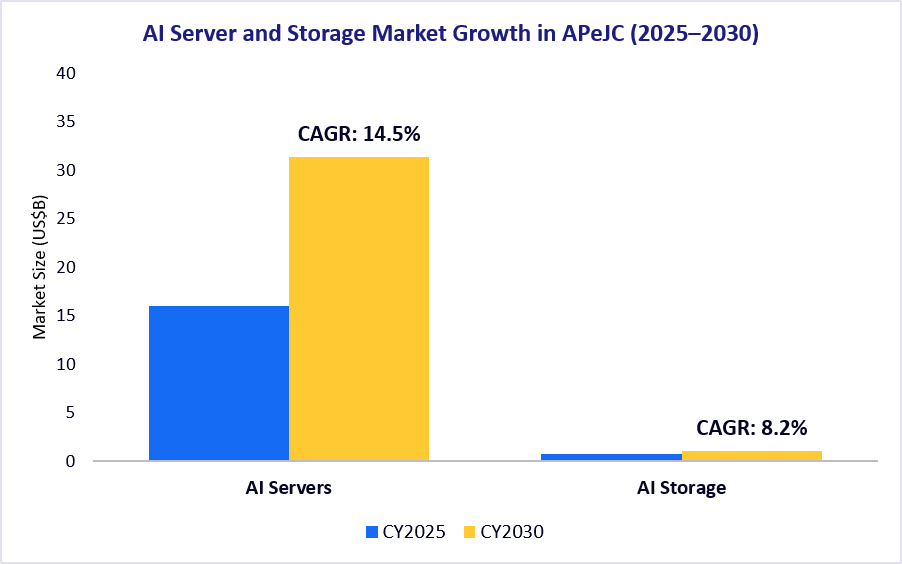
Key Trends Shaping the APeJC AI Infrastructure Market:
- Inference Goes Mainstream and Moves In-Country. Inference is emerging as a key driver for AI infrastructure demand as organizations move beyond model training towards deploying AI-powered applications, copilots, enterprise assistants and intelligent automation. IDC expects this shift to drive demand for a broader range of infrastructure, including GPU-accelerated systems and general-purpose CPU-based servers, with greater emphasis on inference efficiency. At the same time, data sovereignty, localization regulations, security and low-latency requirements are making the location of AI inference increasingly important, encouraging organizations to host and process AI workloads closer to where data is generated and consumed.
- Agentic AI Could Introduce a New Layer of Compute Demand. While widespread enterprise adoption of Agentic AI across Asia/Pacific is still a few years away, the technology has the potential to reshape enterprise compute requirements. Unlike conventional AI applications that primarily respond to user prompts, AI agents can independently execute tasks, coordinate workflows, interact with enterprise applications and process data across multiple systems. As these deployments move into production, they are expected to drive significant computing demand to support continuous execution, orchestration and application integration, broadening the AI infrastructure opportunity beyond accelerated computing.
- Uncertainty Around AI ROI, TCO and Token Economics Could Delay Enterprise Deployments. Despite growing investments in AI infrastructure, uncertainty around return on investment (ROI), total cost of ownership (TCO) and the economics of AI token generation remains a significant adoption barrier. The high capital expenditure associated with GPU infrastructure, coupled with ongoing power, cooling, model-serving and operational costs, makes it challenging for enterprises to establish clear business cases for large-scale AI deployments. Additionally, the cost of generating and serving tokens, particularly for complex reasoning models and agentic workloads, will influence how organizations evaluate the economics of deploying AI in-house versus consuming it through cloud and AI infrastructure providers.
Market Outlook
APeJC is increasingly positioning itself as an important destination for AI infrastructure investments, supported by the availability and scalability of power, relatively lower overall data center development costs, and rapidly growing domestic demand for AI. “AI infrastructure investment in APeJC is set to exceed US$32 billion by 2030, but the important point is not about how large AI infrastructure investments are, but by how effectively enterprises can monetize AI workloads, optimize token economics and scale the underlying infrastructure to support production-grade enterprise AI applications.”, said Avis Hong, associate research director at IDC Asia/Pacific.
Learn more about IDC’s predictions for the next five years at IDC FutureScape 2027 in Singapore on 13 November 2026, including IDC’s full view to 2030 in the session “AI Infrastructure Race: The Compute, Power, and Trust Stack Reshaping Asia/Pacific.” Visit the IDC FutureScape 2027 event website for more information and register for the event today.
*Asia/Pacific excluding Japan and China
About IDC
IDC Research (IDC) is the technology intelligence layer of the AI economy. A global leader in research and data for more than 60 years, IDC’s expert analysts, proprietary datasets, and rigorous methodologies are trusted by business and IT leaders to guide critical business strategies and IT investments. Today, that intelligence is built into the tools and workflows where work gets done with IDC Quanta, making work sharper, teams faster, and businesses harder to beat.