

Headlines about Europe’s economy rarely mention technology budgets, yet that is where buyers make some of their clearest choices. IDC’s Future Enterprise Resiliency and Spending (FERS) surveys show that 64% of Western European IT leaders expect a recession within the next 12 months, and tariff-driven IT cost inflation ranks among their top concerns. Only 41% expect 2026 growth to beat forecasts, compared with 58% of leaders worldwide. There’s one notable exception: AI; in fact, AI projects are the area most protected from budget cuts, and around 64% of European IT leaders have raised their AI budgets.
Our upcoming webcast will discuss these pressure points with a strategic framework: the triangle of innovation. Value for money of innovation is realized at the intersection of three variables that IT and business leaders can make decisions on:
- Resources – Who pays, builds, and runs AI: budget ownership, partner types, skills, and the reasons projects fail.
- Speed – How quickly organizations move from pilot to production: use of AI, GenAI, agentic AI, and physical AI, and how often projects stall.
- Strategic control – How much autonomy buyers keep or give up: sovereign AI, the trade-offs they accept, human oversight, and governance at scale.
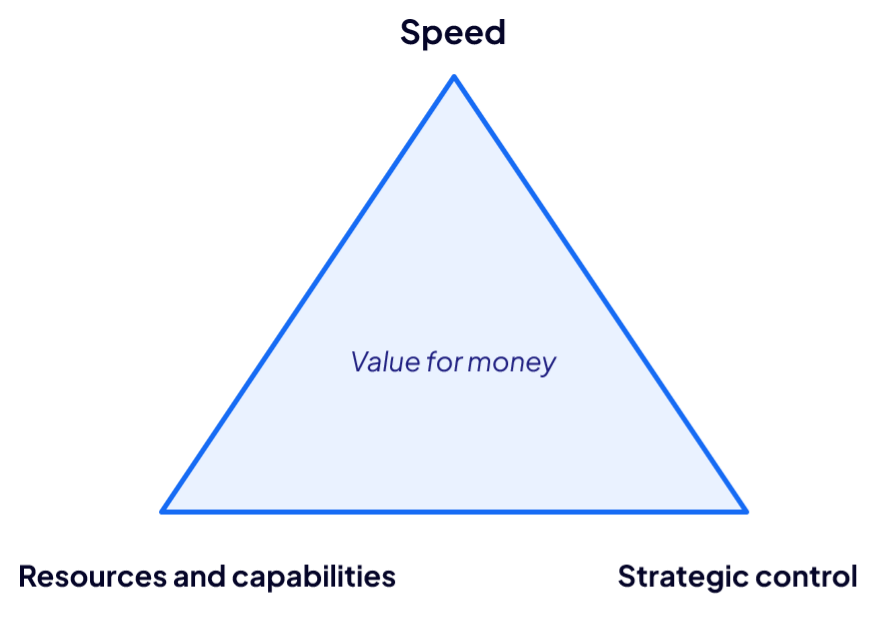
With infinite resources, one could maximize speed and strategic control; in reality, no organization maximizes all three, so every decision make needs to make practical trade-offs. IDC’s 2026 AI Business Trends Survey of 673 EMEA organizations shows that those decisions differ from one industry to the next.
Start with resources. Across EMEA, 59% of organizations had an AI project discontinued, missed, or cut back in the past 24 months, and poor data quality or integration was the most common cause at 38%. Each industry then has its own pain point. Among financial services firms, 41% say the return on investment fell short. Among manufacturers, 48% point to data quality. In energy and utilities, 44% cite low user adoption.
Speed shows the same variety. Manufacturing leads on physical AI[1], meaning AI that directs machines, robots, and sensors, with 33% of manufacturers already running it in production against 24% across EMEA. At IMTS in September 2026, that shift was easy to see on the show floor. In one demo, fleets of robots were connected and coordinated through a shared software layer instead of being run one by one, which is what turns separate machines into a system. In another, a small cell was building drones, with robots, tooling, and software working as one flexible unit rather than a fixed line. In both, the constraint was less than the machines than the data and software connecting them. Retail faces the same speed question from the customer side: AI moves forward when it improves a personalization, loyalty, or fulfillment metric. Retailers define success in terms of customer-centric outcomes and need to manage risks in terms of customer data protection[2].
Control is where Europe’s priorities stand out. Some 58% of EMEA organizations use sovereign AI, which keeps data, models, and operations under local legal and operational control, for all or critical workflows. Yet only 33% say they could govern hundreds of AI agents with today’s tooling. Governments are the most cautious. In IDC’s July 2026 survey of 69% of national civilian government agencies globally said generative and agentic AI touch 30% or less of their mission-specific tasks, and only 10% automate more than 40%[3]. The trade-offs buyers accept also vary. Manufacturers (41%) and governments (40%) are the most willing to rely on regional or specialist providers to gain sovereignty, while 32% of retailers would pay higher prices for it. Buyer organizations do not accept limited access to innovative capabilities as a trade-off for more sovereign control; at the very least, they demand transparency about when innovative features will become available in more restricted environments.
Technology suppliers that want to differentiate should consider six moves across the triangle. On resources, deliver through integrators and local partners, because European buyers rely on service providers to build and run agents more than their peers worldwide, and start to build packages that align pricing with business success criteria. On speed, help customers fix the data and infrastructure readiness first, so that pilots can be turned into production systems at scale. On control, make governance a product feature, with approval steps, audit trails, and easy override, and offer a choice of sovereign controls across the five layers of the AI stack: Hardware; Infrastructure Operations; Data Management; Implementation & Delivery (encompassing training data sourcing/model development/monitoring & evaluation/ deployment & inferencing); and Ecosystem-delivered AI Assets & Capabilities[4].
In 2027 European demand for AI is holding up while tolerance for ungoverned AI is falling. Join the webcast to see the industry-by-industry data. Register here.
[1] https://my.idc.com/getdoc.jsp?containerId=US54976226
[2] https://my.idc.com/getdoc.jsp?containerId=US54982726
[3] https://my.idc.com/getdoc.jsp?containerId=US54991526
[4] https://my.idc.com/getdoc.jsp?containerId=EUR153902925