
ASPs Climb 26.1% to a Record US$371, Yet Market Value Still Slips 3.3%
INDIA, November 17, 2026 – According to the IDC Worldwide Quarterly Mobile Phone Tracker, India’s smartphone market shipped 36.8 million units in Q3 2026, a 23.3% year-over-year (YoY) drop and the steepest quarterly contraction since Q4 2022. It was also the weakest festive quarter in a decade. Memory chip costs, pushed up by surging AI-driven demand, have stayed at record highs and tightened component availability, leaving vendors with little room to hold prices. With ASPs (average selling price) at record levels and few festive offers or discounts on the table, price-sensitive buyers held back purchases this season, and that pressure is likely to carry into Q4 2026.
India Smartphone Market, Top 10 Brands
| Brands | 3Q25 Market Share | 3Q26 Market Share | Year-over-Year Unit Change |
| 1.Samsung | 12.6% | 17.7% | 7.9% |
| 2.vivo | 18.3% | 16.8% | -29.9% |
| 3.OPPO | 13.9% | 13.3% | -26.5% |
| 4.Apple | 10.4% | 10.1% | -25.0% |
| 5.Motorola | 8.3% | 8.8% | -18.4% |
| 6.Xiaomi | 9.2% | 8.3% | -31.1% |
| 7.realme | 9.8% | 7.7% | -39.8% |
| 8.Poco | 4.3% | 4.5% | -20.6% |
| 9.OnePlus | 2.4% | 2.7% | -14.5% |
| 10.iQOO | 3.3% | 1.9% | -56.5% |
| Others | 7.5% | 8.2% | -15.3% |
| Total Market | 100.0% | 100.0% | -23.3% |
Why It Matters
Q3 is the most consequential quarter of India’s smartphone calendar, and this year it fell flat. A weak 1H26 left stock in the channel, brands front-loaded inventory ahead of price hikes, and the supply crunch limited what vendors could spend on festive offers, far thinner than in 2025, when discounting began as early as Q2. Aware of higher prices, channel partners cut back on sell-in, driving the steep drop in shipments.
- Apple: Apple regained the No. 4 position in Q3 2026, as the sharp decline across Chinese brands lifted its position in a shrinking market, even as Apple’s own shipments fell 25% YoY after a flat Q2. Supply shortages on the iPhone 15, 16 and 17, along with price increases around the September launches, weighed on volumes, and scarcer offers on older-generation iPhones cooled demand from aspirational buyers. Unlike earlier years, when new models trailed the previous generation in their opening quarter, the iPhone 18 Pro and Pro Max series contributed over 30% of Apple’s shipments, despite higher prices and no base iPhone 18.
- Samsung: Samsung was the only top 10 brand to grow in Q3 2026, with shipments up 7.9% YoY, while all others declined by double digits. It returned to No. 1 after 10 quarters, overtaking vivo. More controlled price increases than peers through 1H26, plus a broad portfolio and scale, helped it sustain volumes.
- Chinese brands: Chinese brands were hit hardest, as their reliance on entry-level and budget volumes limited their room to absorb higher costs. Rising ASPs led consumers to delay upgrades, and financing offers steered demand toward larger vendors with dependable supply, leaving several leading brands with double-digit declines. Most have, however, formed joint ventures with Indian manufacturers to scale up local production and benefit from government incentives, signalling their long-term commitment to India.
Market Dynamics: What Drove the Outcome?
Five shifts defined India’s smartphone market in Q3 2026:
- The sub-US$100 tier collapses as memory costs rewrite entry-level economics: With component costs at record levels, vendors found it nearly impossible to build a viable device at the bottom of the price ladder. Shipments below US$100 plunged 90.9% YoY to just 0.7 million units, and the tier’s share fell from 16.2% to 1.9%, a segment that has effectively left the market.
- 4G’s share edges up as 5G falls fast: 4G shipments declined 15.5% YoY against 24.1% for 5G, nudging 4G’s share up to 10.4% from 9.5%. The gain comes from 5G falling faster as vendors retained 4G options at entry-level price points, with no sign of renewed 4G demand.
- The US$200–600 corridor becomes the market’s new centre of gravity: The US$200–400 band held flat (+0.1% YoY) in a shrinking market, while US$400–600 surged 79.8%. Together they now account for 42.9% of shipments, up from 29.9%, helped by financing options that narrowed the price gap between bands. The US$100–200 mass-budget segment fell 21.3% YoY, yet its 40.6% share keeps it the single largest band.
- Premium splits in two: US$800+ stays resilient while US$600–800 loses footing: US$800+ shipments slipped only 0.4% YoY, lifting the band’s share to 11.0% from 8.5%. The US$600–800 band fell 52.4%, as supply constraints and scarcer offers on previous-generation devices weighed on this tier. Combined, the US$600+ bands held steady at about 14.6% of the market.
- The channel takes the correction: offline resets sharply, online holds firmer: Offline shipments fell 26.7% YoY, against 18.9% for online, trimming offline’s share to 53.9% from 56.4%. Offline absorbed most of the 1H26 stocking and faced a high Q3 2025 base (+21.8% YoY), and with festive offers far scarcer than last year and channel partners alert to higher ASPs, restocking slowed.
India Smartphone Market at a Glance – Q3 2026
- Total shipments: 36.8 million units (−23.3% YoY)
- Average selling price (ASP): US$371 (+26.1% YoY) — a record high
- Market value: (-3.3% YoY) despite record ASPs
- Offline channel: 53.9% share (down from 56.4%); -26.7% YoY
- Online channel: 46.1% share (up from 43.6%); −18.9% YoY
- Top five brands: Samsung (#1), vivo (#2), OPPO (#3), Apple (#4), Motorola (#5)
Analyst Insight
“Q3 2026 shows how far the memory crisis has reset the economics of India’s smartphone market. ASPs rose 26.1% YoY to a record US$371, yet market value declined 3.3%, as the volume contraction outweighed the price gains. India-based vendors such as AI+, Mivi and Boltt saw shipments surge on 4G and 5G devices at lower ASPs, but their volumes are too small to lift the market overall. Their long-term sustainability will depend on securing supply and on how they handle the price increases expected in Q4 and beyond,” said Aditya Rampal, senior research analyst, Devices Research, IDC Asia Pacific.
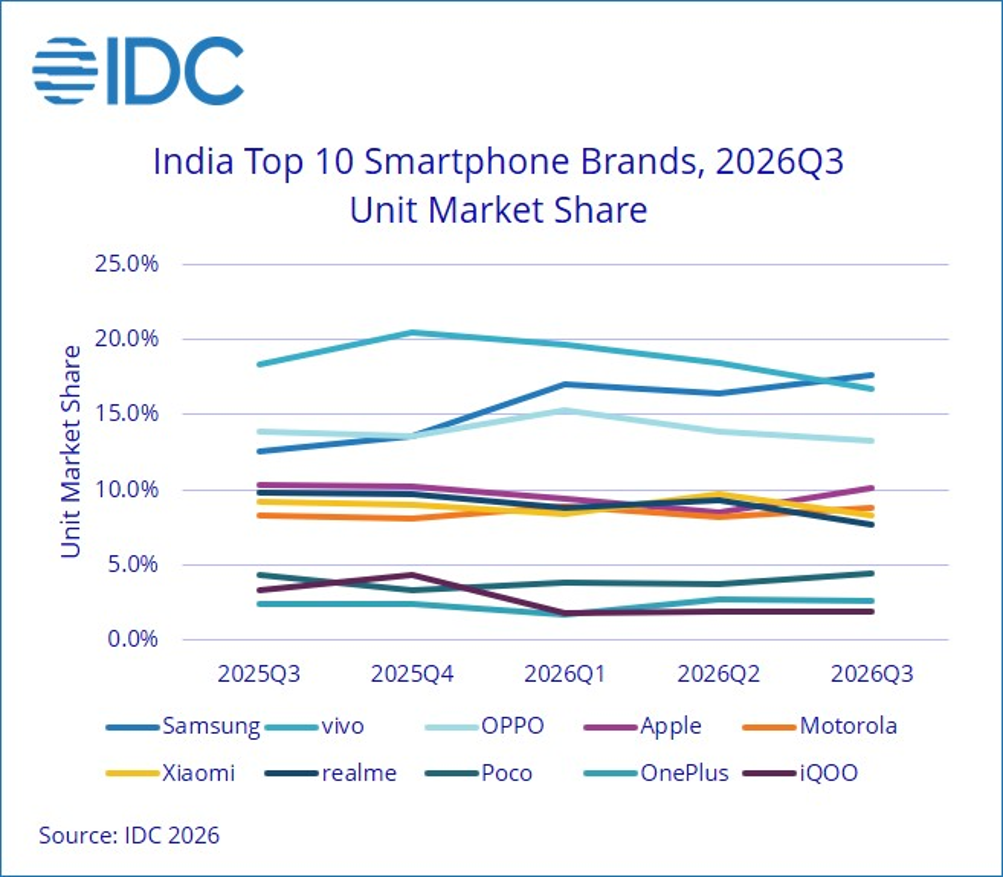
Note: This chart/table shows data by IDC’s Brand field. Company ranking may differ where Companies own more than one Brand. Figures in tables/charts rounded to the first decimal point.
IDC Outlook: What’s Next?
India’s smartphone market is expected to contract further in Q4 2026, as lower-cost inventory runs out and elevated memory costs keep pushing ASPs higher, making price a weak demand lever for brands. Second-hand devices will continue to gain demand, as despite higher prices there, they still help bridge the affordability gap left by costlier new devices. IDC expects growth to stay constrained through 2027, with any recovery unlikely before 2028.
- What could accelerate growth? Easing memory cost inflation and wider financing and EMI schemes would help. Sustained traction in the US$400–600 band would too.
- What could slow it down? Memory tightness extending beyond 2027 and channel inventory build-up if demand stays weak. Longer replacement cycles or deferred purchases would also weigh on it.
- What should readers watch next quarter? How fast channel inventory clears after the festive quarter and whether 4G’s rising share holds. Whether the US$400–600 band keeps its momentum matters as well.
“India’s smartphone market is headed for a sharper correction in Q4 2026, with shipments expected to decline 25%+ YoY and full-year volumes settling at 125–127 million units, 16–18% below 2025. Higher ASPs, thin discounts and longer replacement cycles kept demand subdued even through the festive period. Apple’s higher pricing reinforces the iPhone’s aspirational appeal, but the latest price increases will weigh on its volumes. Foldables will show growth as a category in 2026, led by Samsung, and Apple’s iPhone Duo adds to this momentum, though the segment remains too small to offset the broader decline,” said Upasana Joshi, senior research manager, Devices Research, IDC Asia Pacific.
Frequently Asked Questions
Why did the market decline despite strong mid-premium demand?
The US$400–600 band grew 79.8% YoY but added only about 1.4 million units, while the sub-US$100 segment alone lost about 7 million. With memory costs squeezing margins, brands had little room to fund the festive offers that normally convert channel stock into sales, so sell-in fell sharply as partners held back.
Which brands benefited most in Q3 2026?
Samsung was the only top 10 brand to grow, with shipments up 7.9% YoY, and it returned to the No. 1 position after 10 quarters. Apple’s shipments fell 25% on supply constraints and price increases, though the iPhone 18 Pro and Pro Max series contributed over 30% of its volumes. Chinese brands broadly recorded double-digit declines.
What risks could impact the market in Q4 2026 and beyond?
Memory costs are likely to stay elevated through 2027, and a weaker rupee adds further pressure on ASPs. Channel inventory build-up and longer replacement cycles could extend the downturn. Stabilization will depend less on price cuts and more on how well brands use financing and exchange offers to sustain demand, and how they differentiate mid-premium products.
-Ends-
About IDC
International Data Corporation (IDC) is the technology intelligence layer of the AI economy. A global leader in research and data for more than 60 years, IDC’s expert analysts, proprietary datasets, and rigorous methodologies are trusted by business and IT leaders to guide critical business strategies and IT investments. Today, that intelligence is built into the tools and workflows where work gets done with IDC Quanta, making work sharper, teams faster, and businesses harder to beat.
Visit www.idc.com, subscribe to the IDC blog, or follow IDC on X and LinkedIn for the latest industry insights.
All product and company names may be trademarks or registered trademarks of their respective holders.