最新の関税動向は、世界のテクノロジー・サプライチェーン全体にコスト圧力と不確実性をもたらしています。日本企業にとっても、部材調達・生産・組立・物流が複数国を跨ぐことが多い中、関税変更は価格戦略やサプライチェーン設計の見直しを迫る要因になり得ます。

IDCでは、Simon Ellis(製造・サプライチェーン担当 グループバイスプレジデント)と、Phil Solis(コネクティビティ/スマートフォン向け半導体担当 リサーチディレクター)が、最新の関税動向がテクノロジー・エコシステム全体の価格、製造戦略、長期投資判断に与える影響を以下のように議論しています。

原文:2026年2月25日公開(英語)|日本語版監修: 寄藤 幸治

直近の最大課題は「不確実性」

最高裁判所が過去の一部関税を「適法ではない」と判断する一方で、新たな関税が導入されつつあります。その結果、コストへの影響(エクスポージャー)は残り、より大きな課題として浮上しているのが予測不能性です。

「こうした事柄について、明確さがほとんどありません。月曜日に真実だったことが火曜日には真実ではなくなる。企業が取り組むべき構造的な対応は、数分、数時間、数日、数週間で終わるものではなく、数か月、場合によっては数年かかります。だからこそ、何が正しい判断なのかが見えにくいのです」
– Simon Ellis(IDC)

製造業やサプライチェーンのリーダーにとって、設備投資、調達先変更や地域的な分散といった構造的な意思決定は複数年単位の時間軸で行われます。政策の方向性が短期間で変わる環境では、企業は「進める/延期する/追加リスクを受け入れる」といった選択の中で、難しい判断を迫られます

変動局面で問われる「価格設定の慎重さ」

関税によるコスト影響は、スマートフォン、PC、サーバーに影響するメモリ価格の上昇など、他のコスト圧力の上に重なります。

「これらの関税が当面続くと考えるなら、その分を織り込んで価格は高くなるでしょう。価格を下げてから、また上げ直すのは難しい。あまりに混乱が大きすぎます」
– Phil Solis(IDC)

価格の意思決定は容易ではありません。コストが上がれば、通常は価格にも反映されます。一方で、コストが下がったとしても、価格が同じペースで下がるとは限りません。追加関税が継続する可能性がある環境では、企業は「いったん値下げして後で値上げに転じる」ことを避け、価格対応に慎重になりがちです。

国境を跨ぐ複雑性と「関税の積み上げ(Tariff Stacking)」

現代のテクノロジー製品は、最終製品になるまでに複数回国境を跨ぐことが一般的です。たとえば半導体が輸入され、モジュールに組み込まれ、サブシステムに統合され、最終製品として組み立てられる―という具合です。

各段階で追加のコスト影響が発生し得るため、関税は「積み上げ」の形でバリューチェーン全体の価格圧力を増幅させます。複雑なグローバル供給網を運用する企業にとっては、コスト管理とコンプライアンスの両面で、部材・製品がどの法域を通過したかを追跡・トレースする重要性が高まります。

効率とレジリエンスのバランス

パンデミック以降、企業はサプライチェーンの効率性とレジリエンスの間で、継続的な緊張関係に直面してきました。関税は、そのバランスに加わる新たな混乱要因です。

マルチソーシングや余剰能力の確保によってレジリエンスを高めれば、リスクは下がる一方で追加コストが生じます。テクノロジー領域の意思決定者は、「どこに柔軟性が不可欠で、どこは効率を優先できるのか」を見極める必要があります。

次の一手をどう選ぶか

主要な製造・インフラ投資は、10年、20年といった長期の時間軸で決まることが少なくありません。短期的に政策が揺れ動く環境では、長期計画は一段と複雑になります。

テクノロジーベンダー、製造業者、そしてテクノロジーバイヤーに共通する中心課題は、不確実性が続く中でも、規律ある意思決定を維持することです。

最新の関税動向が今後数か月のテクノロジー市場に与え得る影響について、IDCのより詳しい見解は、記事内の対談(動画)をご覧ください。

原文:2026年2月25日公開(英語)|日本語版監修:寄藤 幸治

関連する調査やご相談について

より詳細なインサイトや市場動向については、当社アナリストへお気軽にご相談ください

Let me share a conversation I had with the CIO of a reasonably large manufacturing company. The company has implemented the typical commercial software (ERP, CRM, HRIS, etc.) and has a team of 24 software engineers to design, build, deploy, and support the organization’s niche application needs. Under the direction of the CIO, the software engineering team has adopted a Vibe programming platform that has dramatically reduced the time and effort to create these niche applications. The CIO told me that it now takes about one-sixth of the time and effort to create an application than it did in the past.

This reduced time and effort to build an application has created a challenge for the CIO. The CEO of the company has reacted to this increased productivity by suggesting that the CIO can now get rid of five-sixths of the software engineering team. This is not something the CIO wants to do but he is struggling with how to rationalize leaving the software engineering team intact.

The CIO’s challenge is the same challenge that any organization faces when technology and process improvements increase the productivity of the people in the organization. What should the organization do with the time and effort capacity that the productivity creates?

In general, there are two ways to handle excess capacity that improved productivity creates. The correct way is to use that newly created capacity to improve growth. The incorrect way is to eliminate the newly found capacity by getting rid of the people whose productivity just increased. I’ll explain using a manufacturing example.

A manufacturing lesson in capacity and profit

The example organization makes concrete block. An analysis shows that the daily production of concrete block is heavily affected by the number of times each production line must be shut down to change over the block making machine. If the changeover involves both a mold and color change, the typical shutdown time is 45 minutes. If only a mold change is required, the shutdown time is 20 minutes. By analyzing and improving the changeover process, it now takes only 15 minutes for a color and mold change and 8 minutes for a mold change. The net result is, on average, a 2-hour increase in the daily production time for each manufacturing line. Improving the changeover process has created 2 hours of additional capacity for each line.

What should the company do with these hours? One choice (the incorrect choice) would be to reduce the hours of the staff. The organization could do this by consolidating production lines and laying off a percentage of the workforce. If the company does this, it will have reduced its costs by some percentage and increased its profits by a similar percentage.

Why is this the incorrect choice? Because the company is much better off using the newly found capacity to grow both revenue and profits by building more block — and continuing to operate the manufacturing line for the same amount of time as before. What does it cost the company to build an additional 2 hours’ worth of block per day on each production line? Just the cost of the raw materials used in the additional block. There is no increased labor cost because the staff is already “paid for” and now using the same amount of time to produce more block. As long as there is a demand in the market for more block, the additional 2 hours of produced block per line are the most profitable blocks the company creates. Even better, this lower-cost block grows revenue at a lower cost.

Clearing the backlog instead of cutting the team

Let me return to my conversation with the CIO of the manufacturing company. I asked him how many projects the company had on its niche application request list. He told me it was a backlog of two to three years. I next asked him how many projects had never been requested because the existing request list was so long or because the projects did not have sufficient value cases. How much longer would the application request list be if it did not take so much time or effort to build a niche application? He guessed the list would approximately double in size.

I recommended that he approach the CEO with the following reasoning about what to do with his 24 software engineers:

  • “By now being able to build and deploy applications with one-sixth of the time and effort than in the past, we should keep every member of the team and accelerate the building and deploying of every application currently on the list and gather every meaningful idea for other projects to add to the list.”
  • “If every project on the list creates value, then shortening the time to value delivers that value sooner and improves the profits and performance of the organization much more than cutting the newly found application delivery capacity would.”
  • “Without increasing costs (the company is already paying for its team of software engineers), the company can accelerate its growth and do it more profitably.”
  • “In fact, since it takes less time and effort to build and deliver an application, the threshold for what delivers value has also changed, and so projects that might not have been included on the backlog in the past might now belong on the backlog.”

The broader AI productivity question

And this thinking extends well beyond the use of Vibe programming.

Let’s suppose that a marketing team, using AI, can now create marketing campaigns and content in half the time it took pre-AI. The incorrect way to treat this newly found marketing team capacity is to cut the capacity by laying off 50% of the marketing team. What is an alternative that benefits the company more than cutting the marketing team? What would drive improved growth? What specific types of marketing campaigns and content? What could the marketing team do with its additional 50% capacity that it could not do before? How about campaigns and content targeting specific customer personas? Or, even better, specific customers? The team now has time to do things it never had before. With this capacity, what could it do to improve the growth of the organization? And remember that whatever the team does to improve the growth of the company comes at a much lower cost (the company has not increased the marketing team’s cost — just achieved improved results for that cost).

Lead with growth, not fear

There are certainly cases when cutting the capacity that comes from AI will make sense, but the initial reaction to improved productivity should be to identify ways to use the productivity to increase growth (at a similar cost). This might take some innovation cycles to realize what we could never do that we can now. But this seems to be worth the effort — in my experience, profitable growth is always a good thing.

Niel Nickolaisen - Adjunct Research Advisor, IT Executive Program - IDC

Niel Nickolaisen is an adjunct research advisor for IDC’s IT Executive Programs (IEP). He is considered a thought leader in the use of Agile principles to improve IT delivery. And he has a passion for helping others deliver on what he considers to be the three roles of IT leadership: enabling strategy, achieving operational excellence, and creating a culture of trust and ownership.

AI-powered cyberattacks are accelerating in speed and sophistication, forcing organizations to rethink how they approach security, data governance, and risk. As enterprises embed generative AI into everyday workflows, they are introducing new architectural complexity and new exposure points.

In this conversation, Grace Trinidad, Research Director for AI Security and Trust at IDC, explains why this moment in cybersecurity feels different, why many AI-driven attacks are still a people problem, and why data and identity management must come first in any AI strategy.

What makes this moment in cybersecurity so different?

What makes this time in cybersecurity so difficult and painful to navigate is the speed. Cyberattacks are happening at orders of magnitude greater scale. We are seeing more threats and more vulnerabilities.

At the same time, organizations are embedding AI and generative AI into their workflows. Those technologies introduce their own vulnerabilities that enterprises have not previously had to face. It creates an entirely different architecture layered on top of what organizations have already invested in to secure their environments.

A lot of organizations are trying to figure out what the right approach looks like right now.

How is generative AI changing the threat landscape?

Generative AI has changed the threat landscape primarily because of the speed at which attackers can deploy and automate attacks.

Phishing attempts look more professional. They are no longer filled with obvious grammatical errors or typographical tells. Generative AI has accelerated the speed of deployment and automated many aspects of attack creation.

Criminals are using the same technologies that enterprises are using. They can iterate on attacks and make them more sophisticated each time. It creates an ongoing arms race. As enterprises ramp up their defenses, attackers ramp up their sophistication. That dynamic is going to continue for the foreseeable future.

Is this primarily a technology problem or a people problem?

It is still largely a people problem.

Many generative AI-enabled attacks today are still phishing and social engineering attempts. The technology has improved, but the entry point is often human behavior and workflow gaps.

For example, in the 2024 Hong Kong deepfake incident, funds were transferred after a highly convincing voice and video deepfake impersonated a senior executive. The employee sensed a red flag, but there was no verification workflow in place for confirming high-level requests.

The recommendations in cases like this are often low-tech. Organizations should implement verification processes for high-value transactions. That might mean two real people must sign off. It could involve authentication codes or additional confirmation pathways.

Redundancy is the name of the game in AI. Clear verification workflows are critical.

What blind spots are organizations facing right now?

Many organizations believe it will not happen to them because they have not yet been targeted. It is still early days. We have not seen widespread, devastating breaches directly tied to generative AI adoption. But that does not mean the risk is not real.

At IDC, we focus on two pillars to improve AI security posture: data controls and identity management.

Organizations need to know where their data resides, how it is secured, and how it will be used in AI systems. Identity is foundational. AI security begins by identifying who is using a particular AI technology, which technology they are using, and what they are using it for.

Identity and access management is the foundation of AI security.

Does AI security replace traditional cybersecurity?

No. AI security does not replace traditional security. It is a layer on top of traditional security.

Organizations still need networking security, identity and access management, and all core cybersecurity components. AI security builds on that existing foundation.

This space will continue to evolve quickly. We are seeing acquisitions, buying activity, and rapid innovation. The trajectory will likely mirror what we saw with cloud adoption. What cloud security looked like in its early years is very different from what it looks like today. AI security will mature in a similar way.

Where should organizations focus right now?

Start with data.

Many early adopters are encountering roadblocks because their data was not ready. It was not properly tagged, secured, or governed. Early data decisions are incredibly important.

Organizations should clean and organize their data, eliminate data that does not provide value, and ensure it is properly protected before integrating it into AI systems.

At the same time, they should modernize identity and access management. Many AI security technologies require a robust identity framework to function effectively. Data and identity are the two pillars organizations should prioritize now.

How should leaders balance AI innovation with resilience?

There is growing tension between digital sovereignty and AI innovation.

Organizations want to enable AI and generative AI workloads, but they also want to be resilient and less dependent on external vendors. Cloud outages and infrastructure disruptions have made downtime extremely costly. Tolerance for outages is near zero.

At the same time, AI innovation and AI security rely heavily on platforms and vendors. Few organizations have all the components, talent, and infrastructure required to secure AI workloads entirely on their own.

This creates a risk conversation. Enterprises must determine what level of risk they are willing to tolerate. We are moving away from a philosophy of securing everything at any cost toward a more tailored, risk-centered approach.

That means cybersecurity strategies will look different depending on an organization’s risk appetite and operational priorities. Finding the right balance between innovation, security, and resilience is one of the defining tensions organizations face this year.

For more insights on this topic, check out BizTech’s recent interview with Grace Trinidad.

Christina Cardoza - Content Marketing Manager - IDC

Christina Cardoza is a Content Marketing Manager at IDC, where she specializes in brand content and social media strategy. With a background in journalism and editorial leadership, she has a proven ability to transform complex technology topics into clear, actionable insights.

中東での紛争激化は、すでに脆弱さを抱える世界のテクノロジー環境に対し、新たなマクロ経済・地政学的な変動要因をもたらします。

IDCは政治的な力学についてコメントしませんが、テクノロジー産業への影響は即時的で、定量的にも捉えられるものです。初期の地域インテリジェンスとIDCのマクロ経済モデリング・フレームワークに基づき、IDCはIT支出に対する主な影響要因を次の6つのベクトルとして整理します。エネルギー価格の変動、クラウドおよびデータセンターのレジリエンス(回復力)、ソブリン(主権)インフラの加速、サイバーセキュリティ、サプライチェーン、消費者および企業の投資心理の変化です。

本件は初期段階で急速に状況が変化しているため、IDCのシナリオ分析と予測は、中東に限定された戦争が3か月未満で終結するケースに主眼を置いています。現時点では、より長期に及ぶ場合のシナリオデータは公表しません。今後も状況を注視し、長期化の蓋然性がより明確かつ重要になった段階で、追加の分析を検討します。

紛争が最大3か月続く場合の「下振れシナリオ」では、IT支出への影響は測定可能である一方、相対的には中程度にとどまる見込みです。マクロ環境が弱含む局面でも、サービスプロバイダーはグローバル規模でのAIインフラ投資を引き続き積極的に維持する可能性が高いとIDCは見ています。短期の戦争は、クラウドサービスやエンタープライズソフトウェア需要への直接的影響は限定的ですが、再燃するインフレ圧力によってデバイスの更新(買い替え)や裁量的支出にブレーキがかかり得ます。
この下振れシナリオでは、2026年の世界IT支出成長率は、IDCのベースライン予測である約10%成長に対して、約9%成長に低下すると見込みます。戦争が長期化した場合は影響がより顕著になる可能性がありますが、現時点では予見が難しい状況です。
中東・アフリカ(MEA)地域のIT支出は2025年に1,550億米ドル(世界市場の4%)で、2026年は5%増が予測されています。これは、同地域のIT支出におけるデバイス比率が相対的に高く、メモリ価格上昇圧力の影響を受けやすいことから、世界平均より低い伸びとなっています。

紛争が3か月以内に収束する場合の「下振れシナリオ」では、MEAのIT支出成長率は2026年に3~4%へ低下し、短期的に企業・投資家心理へマイナスの含意が生じ得ます。国別の影響は、原油供給の力学などにより極めてまちまちとなる見通しです。長期化すれば影響はより大きくなります。

ただしIDCは現時点で、紛争は短期に終わり、混乱度合いも比較的低いというベースラインの前提を維持しています。AIインフラ展開、クラウド移行、継続中のデジタルトランスフォーメーション(DX)といった基礎的需要への影響は限定的である、という想定です。IDCは状況の進展に合わせて、継続的にモニタリング、およびアップデートを行う予定です。
以下は、IDCによる中東および世界のIT支出に関する短期~中期の構造化評価です。

原文:2026年3月2日公開(英語)|日本語版監修: 寄藤 幸治

1. エネルギー価格ショック:最も主要な波及メカニズム

紛争激化の直後、原油価格は7~8%上昇し、ブレント原油は70~80米ドルレンジへ向かいました。IDCのIT支出モデルでは原油価格のベースライン平均を65~75米ドルとしています。IDCのモデルは、3か月の紛争を前提に平均原油価格が75~85米ドルへ上昇すると想定し、さらに長期化した場合は100米ドル前後、またはそれ以上へ近づく可能性があると見ています。

供給側の懸念を増幅させているのが、アラムコの製油所生産停止で、報道ベースでは日量約50万バレルに影響が出ています。またカタール・エナジーは一時的にガス生産を停止し、欧州のガス価格は40~50%高となりました。戦争が長期化すれば、中東からのガス・石油への依存度が高い国々(日本を含むアジアにも波及し得ます)で投入コストが大きく上昇します。

エネルギー価格の変動は、2026年のIT支出前提に影響する最重要のマクロ波及経路です。エネルギー価格の上昇は新たなインフレ圧力を生み、中央銀行の金融政策にも大きな影響を及ぼす可能性があります。近年の高インフレ局面を経て、企業・消費者の信頼感は依然として脆弱である一方、IT製品もメモリ部材不足によるインフレ圧力を抱えています。価格上昇は、支出の先送りや配分見直しにつながり得ます。

IT支出への影響

グローバル(世界)
• エネルギー価格高は、データセンター運用、半導体製造(ファブ)、物流、製造のコストを押し上げます。
• インフレが長引けば利下げが遅れ、企業ITプロジェクトの資金調達環境がタイト化し、IT購買に対する企業・消費者心理も悪化し得ます。
• 投入コスト上昇により、AIやDX施策の優先順位見直しが起こり得ます。

中東地域
• 紛争長期化と防衛支出の増加が、原油高による余剰収入を相殺し、テクノロジー投資を先送りする可能性があります。
• 事業継続、サイバーセキュリティ強化、ソブリン(主権)インフラ導入など必須領域への支出が優先されます。
• 湾岸の富裕国では政府主導のDXプログラムが維持され得る一方、他国では優先順位の見直しが起こり得ます。

2. クラウド&データセンターのレジリエンスが戦略課題に

今回の戦争は、主要クラウド事業者のリージョンおよびアベイラビリティゾーン(AZ)が現実の戦闘地域で稼働するという、初めての事例となります。紛争初期に、あるグローバルクラウド事業者の複数AZにまたがる施設が相次いで攻撃を受けたことで、アーキテクチャのレジリエンスが示される一方、長期的紛争局面におけるクラウド環境の脆弱性も浮き彫りになりました。IDCは、クラウド、ストレージ、データセンター・アーキテクチャへの投資が優先事項になると見ています。ただし、データセンター建設は資本集約的で年単位の取り組みであり、建設費や資金調達コストの上昇、サプライチェーン摩擦が、実行のスケジュールを遅らせる可能性があります。

構造変化

• パブリッククラウドを利用する企業およびSaaS事業者にとって、マルチAZが最低限の標準となり、マルチリージョンはベストプラクティスとなります。
• 多国籍企業のクラウド配置におけるリスクモデリングは、国単位から、より広域のレジリエンスの枠組みへ拡張されます。

中東への影響

IDCでは以下のような影響が表れるものとみています。

• 冗長性を有する、自国資本のソブリンクラウドおよび国内データセンター投資の加速
• ハイパースケーラー(大手クラウド事業者)による、物理分離を伴うマルチAZ構成(例:単一AZから3-AZ設計へ)へのコミット強化

世界への影響

今回の事象は、以下のような事項に関する期待値の見直しを迫ります。

• クラウドのリカバリープランニング
• レジリエントなデータセンター基盤
• 地理的分散戦略
• インフラ投資判断に織り込まれるリスクプレミアム

長期的にはクラウド投資が増える可能性がある一方で、短期的には企業がアーキテクチャを再評価する中で、プロジェクトの進捗が遅れる場合があります。

3. ソブリン(主権)インフラと「戦略的自律性」

デジタル主権は、湾岸地域の各国が組織と市民のデジタル自己決定を重視する中で、この地域におけるクラウド戦略の主要潮流として、すでに定着しつつありました。紛争の初期段階においても、湾岸の政府、とりわけ資本余力のある国々は、俊敏性、レジリエンス、長期的な持続性を強化するため、ソブリン・デジタルインフラや分散クラウドモデルへの投資を加速する可能性があります。焦点は以下です。

• ソブリンクラウド・プラットフォーム
• 国家レベルのパブリックAIインフラ
• 政府機関によるサイバーセキュリティ強化と対応実務

各国は、より広い「戦略的自律性」への動きと整合する、重要インフラのレジリエンス・モデルの構築にも注力し、海外インフラ事業者への過度な依存を低減しようとします。代表的なモデルは次の通りです。

• Shared public:インフラ共有、運用はグローバル
• Dedicated public:占有リージョン、運用はローカルパートナーと共有
• National public:ローカルのクラウド事業者が保有、運用
• Managed private:顧客向けに事業者がホストし、事業者が管理
• Air-gapped private:分離(エアギャップ)された環境を顧客が運用

ただし財政要因は重要です。紛争初期だけでも数十億規模と推定される軍事支出は、予算配分のトレードオフを生みます。紛争期間が、ソブリンIT投資の加速を決めるのか、一時的な優先順位変更に留まるのかを左右します。

4. サプライチェーン:メモリ供給、スマート兵器、半導体への圧力

中東は、エネルギーの動脈であると同時に、物流・積み替え(トランシップ)拠点として、グローバル・テクノロジーサプライチェーンで重要な役割を果たしています。ホルムズ海峡の閉鎖、あるいは持続的な混乱は、頻度は低いものの影響が極めて大きいショックとなり、世界のIT市場へ実質的な影響をもたらし得ます。

ホルムズ海峡は、世界の原油輸送の約20%と、相当量のLNG(液化天然ガス)輸送を担います。同海峡が混乱した場合の最も即時的な影響は、エネルギーコスト増を通じて、欧州やアジア(日本を含む)におけるガス価格上昇、データセンター運用費増、半導体製造のエネルギーコスト増を招くことです。また、物流面では、保険料・航空/海上輸送費の上昇、消費者向けテクノロジーの組立・流通に向かう部材の遅延、アフリカや欧州の一部地域への出荷の停滞が見込まれます。

同海峡は、Jebel Ali(UAE)、Dammam(サウジアラビア)、Hamad Port(カタール)など湾岸主要港を支える航路でもあり、アフリカ、南アジア、欧州の一部地域への再輸出における重要ノードです(テクノロジー製品・部材を含む)。

世界のメモリ市場は、紛争激化以前から逼迫していました。本紛争は、タイトな需給環境をさらに悪化させ、世界のITハードウェア・エコシステムに波及し得ます。レノボのサウジアラビアでの製造拡張のような生産地域化の動きは、中東がグローバル・テックサプライチェーンで存在感を増していることを示しています。

主なリスクは次の通りです。

• 湾岸航路を通る物流の混乱
• 新たな製造ハブ立ち上げの遅延
• 保険・運賃コストの上昇

紛争が長期化すると、スマート弾薬やドローンシステムで先端半導体・メモリの軍事用途消費が急増し、国家安全保障の観点から半導体供給確保に向けた追加の国家介入が起こり得ます。これはDRAM/NAND価格、AIアクセラレータのメモリ構成、エンタープライズストレージ基盤コストに上押し圧力となり、AI導入を計画する企業がプロジェクト順序を見直す要因になり得ます。消費者デバイス価格もリスクに晒されます。

全体への影響は、戦争の期間と地理的な封じ込めに左右されます。数週間で収束すれば短期混乱の後に迅速な回復が見込まれますが、長期化すると地域・世界の市場条件により深刻な影響を及ぼします。

5. サイバーセキュリティ:即時の緊張上昇と構造的な支出増

地政学的な紛争は、サイバーリスクを実質的に高めます。国家支援や代理勢力によるサイバー活動は、軍事的緊張の高まりとともに増えることが多く、主な標的は以下です。

• エネルギーインフラ
• 金融サービス
• 通信
• 政府システム
• クラウド基盤およびSaaSプロバイダー

中東は高度持続的脅威(APT)の焦点地域であり、エスカレーションは攻撃頻度と高度化の両面を押し上げます。

直近のIT支出への影響

1)セキュリティ予算の加速
不確実性が高い局面でも、セキュリティは削減されにくい予算の一つであり、この文脈では増加する可能性が高いと考えられます。企業・政府は次の領域で支出を増やすでしょう。

• マネージド検知・対応(MDR)
• セキュリティオペレーションセンター(SOC)のモダナイゼーション
• ゼロトラスト・アーキテクチャ
• エンドポイント検知・対応(EDR)
• クラウドワークロード保護
• ID/アクセス管理(IAM)

2)インフラの堅牢化
重要インフラ事業者(エネルギー、公益、輸送)は次へ投資を増やします。

• OT(制御/運用技術)セキュリティ
• ネットワーク分離(セグメンテーション)
• エアギャップ型復旧環境
• バックアップ/サイバー復旧用ボールト

3)クラウドセキュリティの引き上げ
クラウドが戦略的標的になるにつれ、企業は次を進めます。

• CSPM(クラウドセキュリティポスチャ管理)への投資拡大
• マルチリージョンバックアップ戦略の拡充
• ハイパースケーラーに対し、レジリエンスやインシデント対応に関する透明性向上を要求

地域別の影響

中東

• 政府主導のサイバーセキュリティ・プログラムは拡大
• ソブリンなサイバー防衛能力への追加予算
• サイバーレジリエンスが国家DXに組み込まれる

世界

• 他地域に展開している多国籍企業は防衛投資を拡大
• サイバー保険コストが上昇し、リスク低減投資を後押し
• 防衛関連のサイバーセキュリティ/セキュア通信市場が成長

マクロ環境が弱含み、経済成長が鈍化しても、サイバーセキュリティは相対的に成長する領域となり得ます。紛争長期化のシナリオでも、セキュリティ投資は比較的底堅いと見込まれます。

6. 消費者向けテクノロジー支出と心理

消費者向けIT支出は、インフレの長期化とメモリ起因のデバイスコスト上昇で、すでに圧力を受けていました。紛争激化はこれに以下を上乗せします。

• 消費者心理の悪化(消費者信頼感は依然として脆弱)
• 投入コスト増によるデバイス価格上昇
• サプライチェーン混乱リスク

中東はJebel Aliなどを通じた積み替え拠点でもあるため、中東域内に加え、アフリカや欧州への物流にも波及します。供給網の混乱は、地域内外でPC、スマートフォン、各種デバイスの供給に影響する可能性があります。

また、高級不動産や観光といったエンターテインメントや高級品にかかわる産業では支出が一時停止し、関連する企業IT投資にも間接的影響が及び得ます。

中東域外でも、脆弱な消費者支出は、大幅または長期の価格上昇に耐えにくい状況です。エネルギーコスト上昇は、PC・タブレット・スマートフォン等の購入先送りを促す可能性があります。これらのカテゴリはメモリ供給不足によってすでに価格上昇が進んでおり、消費者が買い替えを待つ傾向をさらに強めるでしょう。

IT支出・投資への影響(IMPACT ON IT SPENDING & INVESTMENT)

AI投資:加速か、一時停止か?

投入コスト上昇とマクロ不確実性が、特に紛争長期化の場合、一部企業にAIの本番展開を再検討させる可能性があります。消費者心理と同様に、企業心理も依然として脆弱で不確実です。実体経済の減速が見え始めれば、短期的にプロジェクトの延期や縮小が起こり得ます。

一方で、ROIが実証され、測定可能な成果が迅速に効率改善をもたらす領域では、マクロでの逆風への対応としてAIがより積極的に導入される場合もあります。IDCの調査では、マクロ圧力への戦術的対応としてITを活用しようとする組織が増えている傾向が一貫して見られます。これは、外部環境の軟化兆候が見えた際に、IT支出削減が最優先の対応となりがちだった過去の景気後退局面とは異なる変化です。

総じて、比較的短期の紛争は多くの組織のAI/IT支出計画を大きく崩す可能性は高くありません。基礎需要は強く、近年の関税や他の地政学的対立といった外部ショックに対してもレジリエンスを示してきました。AIは引き続き優先度が高く、2026年はビジネスインパクトを高めるためのスケール展開が焦点となります。

最大のリスクは、紛争が長期化し、インフレ圧力とサプライチェーン混乱で資本・リソース制約が強まるケースです。AI支出は他投資より底堅い可能性がある一方で、最悪シナリオでは免疫ではありません。

相反する2つの力学

抑制要因(Constraining Forces)

• インフラコスト上昇
• 資金調達環境のタイト化
• メモリ不足

加速要因(Accelerating Forces)

• サイバーセキュリティ需要の増加
• 防衛関連のAI/アナリティクス投資
• 湾岸諸国におけるソブリンAI構想

どのような影響を受けるかは地域で異なります。

• 湾岸諸国:国家主導のAI投資が継続する可能性
• 欧州・アジア(日本を含む):マクロへの感応度がより高い可能性
• グローバル企業:ROI精査がより厳格化

IT支出の3シナリオ見通し(Three-Scenario Outlook for IT Spending)

IDCのIT支出予測は、最新のマクロ経済・業界データを反映し毎月更新されます。この月次予測には、テクノロジー市場と経済条件の変化に対する感応度の歴史的相関に基づくシナリオが含まれます。

直近のベースライン予測は2月27日に公表され、原油価格やサプライチェーン要因の一定の変動をすでに織り込んでいます。今回IDCは、地域紛争が最大3か月続く(シナリオ1)または2026年の大半まで続く(シナリオ2)場合の影響を評価するため、2つの新シナリオを作成しました。

数週間で収束する短期の混乱はあり得るものの、IDCは現時点で、2月27日時点の「Black Book」予測(※IDCの月次予測)を改定する計画はありません。短期で収束すれば、より速い反発と年内の投資・プロジェクト再開が見込まれるためです。状況は流動的であり、次回の定例予測リリースである3月30日までに、ベースライン前提が変わる可能性があります。

2つのシナリオのうち、より可能性が高いのは3か月以内に収束するケースです。この「数か月」続くケースでは、IT支出により明確な影響が出て、年間成長率が約1.0ポイント下押しされる可能性があります。影響の大半は、デバイスと裁量的プロジェクト支出に集中します。他の外部要因がない限り、サービスプロバイダーがAI投資計画を大きく縮小するとはIDCは見ていません。

2000年代初頭のイラク戦争など過去の軍事衝突と比べ、IT産業は過去20年で大きく変化しました。企業IT支出におけるOPEX(運用費)・サブスクリプション比率が高まり、インフラ投資のより大きな部分がサービスプロバイダー側に集中しています。

企業IT支出に対する主要リスクは、政治そのものではなくマクロ経済要因であり、とりわけ原油高の長期化が企業・消費支出と金融政策の両面に影響する点です。紛争が3か月を超えるシナリオ2では、ITプロジェクトやデバイス更新の先送りが増え、IT支出への影響は1.0ポイント超となる可能性があります。

MEAでは影響はより複雑で、政治動向の不確実性も相まって変動しやすい見通しです。ただし、地域のAI戦略投資は継続する可能性が高く、下振れ影響は主に企業・消費支出の先送りに集中するとIDCは見ています。

IDCのMEAにおける2026年ベースライン(5%成長)は、シナリオ1(数か月継続)では3~4%に低下し得ます。スマートフォン市場はメモリ価格上昇の影響もあり、もともと減少が見込まれていましたが、改善前に一段と悪化する可能性があります。スマートフォンはMEAのIT支出に占める比率が相対的に高く、これが2026年の地域成長率を押し下げる要因となります。

ただし、最悪シナリオで3か月を超えて長期化しても、地域のクラウド/AI導入の基礎需要は強く、状況が落ち着けば比較的速く回復する可能性があります。

3つのシナリオ(要約)

ベースライン:紛争が封じ込められる(数週間)

• 一時的な原油スパイク
• 地域プロジェクトの軽微な停滞
• 世界IT成長見通しの修正は最小限

シナリオ1:地域不安定が継続(3か月未満)

• 原油は85~95米ドルで推移
• インフレ圧力により世界IT成長は0.5~1.0ポイント下押し
• ソブリンクラウド構築が加速
• 消費者向けデバイス回復が鈍化

シナリオ2:エスカレーションとエネルギーショック(6~9か月)

• 原油は100米ドル超
• 金利正常化が遅延
• 消費者需要が大幅に縮小
• 企業はレジリエンス/サイバー/重要インフラへ再配分
• とりわけMEAでIT支出への影響がより顕著

IDCの戦略的見解(IDC’s Strategic View)

中東での戦争は単なる地域の地政学イベントではなく、デジタル経済のエネルギー依存、インフラのレジリエンス、サプライチェーンに対する構造的な試験といえます。

IDCが注視する主要テーマは以下です。

• エネルギー価格の持続性とインフレ軌道
• クラウド基盤リスクの再評価と冗長化投資
• 防衛需要と連動するメモリ市場の逼迫
• 防衛とDXの間で生じる政府財政のトレードオフ
• 消費者心理の変化とデバイス需要の価格弾力性

中東が直接の影響を受ける一方で、世界のIT産業も、エネルギーコスト、半導体供給、資本配分判断を通じて二次的影響を被ります。

短期的には、企業の意思決定は慎重姿勢とシナリオプランニングが中心となるでしょう。中期的には、本紛争が、ソブリンインフラ、サイバーセキュリティ、マルチリージョンのクラウドレジリエンスといった構造的投資を加速させる可能性があります。

IDCは、経済前提の変化に応じて支出見通しを精緻化し続けます。IT支出予測は、最新の市場データと動向を反映し、毎月月末の最終営業日に公表しています。今後数日~数週間のデータを注意深くモニタリングしていきます。

エグゼクティブサマリー(Executive Summary)

• 紛争激化は脆弱な世界のIT環境に新たなマクロ/地政学変数を追加する。IDCは政治ではなく、測定可能なテック市場への影響に注目
• 主な影響ベクトルは6つ:エネルギー価格変動、クラウド/データセンターレジリエンス、ソブリンインフラ加速、サイバーセキュリティ、サプライチェーン(メモリ/半導体/物流)、消費者/企業心理
• ベースケース:中東に限定され、3か月未満。長期シナリオのデータ公表は現時点では見送り
• 世界IT支出:ベースライン2026年約10%成長、下振れ(最大3か月)で約9%成長。弱含みは主にデバイスと裁量案件
• MEA IT支出:2025年1,550億米ドル(世界の4%)。2026年ベースライン約5%成長。下振れで3~4%成長、国別影響は混在
• エネルギーが主要な伝播経路:原油・ガスの変動が運用/投入コストを押し上げ、インフレを強め、資本をタイト化し、プロジェクトを遅らせ得る
• クラウドレジリエンスは必須:マルチAZ/国内冗長化/リスクモデリング拡張。短期は再評価でペース鈍化の可能性
• サイバーセキュリティは相対的にプラスの影響:MDR/SOC、ゼロトラスト、EDR、IAM、CSPM、OTセキュリティ、復旧環境への投資が加速

執筆者(Authors)

• Stephen Minton(Group Vice President, Data & Analytics, IDC)
• Laurie Buczek(GVP, Research, IDC)
• Rick Villars(Group VP, Worldwide Research, IDC)
• Lapo Fioretti(Senior Research Analyst, IDC)
• Andrea Siviero(Senior Research Director, MacroTech, Digital Business, and Future of Work, IDC)
• Thomas Meyer(General Manager and Group Vice President, IDC EMEA, IDC)
• Ashish Nadkarni(GVP/GM, Infrastructure Research, IDC)
• Simon Ellis(Program GVP, IDC)
• Ranjit Rajan(Research Vice President, Worldwide C-Suite Tech Agenda, IDC)
• Harish Dunakhe(Research Director, Software and Cloud, META IDC)
• Jebin George(Senior Research Manager, Software, Cloud, and Industry Transformation, IDC MEA)
• Jean Philippe Bouchard(Vice President, Data & Analytics, IDC)

原文:2026年3月2日公開(英語)|日本語版監修:寄藤 幸治

関連する調査やご相談について

より詳細なインサイトや市場動向については、当社アナリストへお気軽にご相談ください

Yukiharu Yorifuji - Group Vice President and Chief Research Analyst - IDC Japan

Yukiharu Yorifuji is Group Vice President and Chief Research Analyst of IDC Japan. In this role, Yorifuji is responsible for all the research area of IDC Japan, including hardware, software, services, and innovation accelerators. He had been engaged in IT and business services research for more than 12 years as a part of IDC services research team, such as market forecast, competitive analysis, and users' buying behaviors. He now makes a research of enterprises’ organization, talent management, and selection of the partners in Digital Transformation era, and introduces these results via reports and presentations. He has over 30 year experience in the IT industry in various roles including sales, marketing, and market analyst. Prior to joining IDC Japan, Yorifuji worked for a local consulting firm responsible for strategic projects including new business planning, corporate governance, and financial strategy for large companies. He also worked for Fujitsu where he was involved in international sales, marketing, and brand management. He holds a BA from Department of Social Science and MBA from International Corporate Strategy, from Hitotsubashi University, Japan.

The global cleaning robot market shipped 32.72 million units in 2025, up 20.1% year over year, according to IDC. While smart vacuum remain the largest segment, lawn mower robotics and window cleaning robots are the primary growth engines. Chinese brands now dominate multiple categories, reshaping global competition through AI-driven innovation, cordless upgrades, and rapid international expansion.

This blog highlights the structural shifts, competitive realignment, and strategic priorities defining the next stage of smart cleaning robotics.

Market Overview: Structural Shift Accelerates

According to IDC’s Worldwide Cleaning Robot Trackers:

The key trend is structural transformation. Growth is shifting from single-purpose indoor cleaning to multi-scenario intelligent automation spanning indoor and outdoor environments.

Smart Vacuum: Scale Meets Strategic Realignment

Smart Vacuum account for nearly three-quarters of total shipments. Growth was strongest in the Middle East & Africa (+95.6%) and Central & Eastern Europe (+40.3%), driven by expanding middle-class adoption and aggressive overseas expansion by Chinese brands.

The competitive landscape is shifting. Roborock maintained global leadership, ranking No.1 in major markets including the US and Germany, while Dreame expanded rapidly in Europe. Meanwhile, iRobot exited the global top five, reflecting deeper strategic divergence rather than temporary share fluctuation.

Two models are emerging:

  • Vertical expansion into full home robotics (indoor + outdoor)
  • Horizontal diversification into broader consumer electronics

Future leadership will depend on ecosystem strength and AI capability.

Window Cleaning Robots: High Growth, Low Differentiation

Window cleaning robot shipments rose 70.4% in 2025. Demand is fueled by high-rise living in China, large glass-window homes in Western markets, and rising safety and labor costs.

Ecovacs held over 50% global share. However, mid- and low-end competition is increasingly homogenized, characterized by similar product design and price-driven competition. Innovation is focusing on cordless design, stronger suction, and smarter navigation.

Lawn Mower Robotics: Cordless Disruption Reshapes the Market

Lawn Mower Roboticsgrew 63.8% YoY, the fastest among all categories. Wire-free models reached 1.32 million units, accounting for 66.2% of shipments and surging 182.4%, while traditional boundary-wires models declined 10.1%.

Adoption is accelerating due to mature RTK, vision, and LiDAR navigation, simplified installation and true out-of-box usability, DIY-friendly design for Western consumers, and cost advantages enabled by Chinese supply chains

Notably, the top six wire-free brands are all Chinese manufacturers, including Segway-Ninebot, Dreame, and Ecovacs, as AI-driven iteration speed erodes traditional garden equipment advantages.

Pool Cleaning Robotics: Intelligence Drives Premiumization

The pool cleaning Robotics market remained stable overall but is undergoing rapid upgrading. In-ground cleaners—the core segment—reached 2.75 million units, with cordless penetration rising to 55% (+32.8%).

Consumers increasingly expect autonomous navigation, stain recognition, app control, and smart home integration. Cleaning capability alone is no longer sufficient—intelligence now defines premium positioning.

Chinese manufacturers are leveraging cordless battery systems and AI navigation to challenge legacy players.

1. Chinese Brands Lead Innovation and Scale

Across Smart Vacuum, pool cleaning robotics, window cleaning robotics, and lawn mower robotics Chinese manufacturers are setting pricing benchmarks, accelerating cordless transitions, commercializing AI navigation, and scaling globally through e-commerce.

Supply chain depth and rapid iteration have become decisive competitive advantages.

2. Niche Segments Remain in Competitive Flux

Lawn Mower Robotics and Pool Cleaning Robotics are still in early intelligent transformation stages. Navigation technology, channel strategy, localization capability, and financial discipline will determine long-term winners.

Market concentration is not yet fixed.

3. AI Is the Long-Term Competitive Moat

AI is transforming:

  • Obstacle avoidance (scene understanding)
  • Path planning (targeted optimization)
  • Stain detection (adaptive cleaning)
  • Human-machine interaction (natural language control)

Companies that invest consistently in AI algorithms, data accumulation, and embodied intelligence will command higher margins and global leadership.

Strategic Recommendations for Industry Players

  • Capture niche growth windows while cordless and intelligent upgrades are still reshaping market structure.
  • Treat AI as core infrastructure, not feature marketing.
  • Build multi-category ecosystems that unify apps, data, and cross-device coordination to increase customer lifetime value.

Conclusion: From Appliances to Intelligent Platforms

2025 data confirms a decisive transition: home cleaning robots are evolving from standalone appliances into AI-powered home service platforms. With Chinese brands leading innovation and cordless technology accelerating adoption, the market has entered an era of all-scenario competition. Future growth will be defined less by shipment volume and more by intelligence, ecosystem integration, and global execution capability.

Ready to unlock the power of data? Connect with our IDC analysts today to transform insights into impact. Contact us now.

Claire Zhao - Senior Market Analyst - IDC

Claire Zhao is senior market analyst for Client System Research of IDC China. She is responsible for conducting research on the augmented reality (AR)/virtual reality (VR) market, and vertical analysis for the PC market. She started working for IDC China as a summer intern in 2019 as part of the Telecommunication group. Prior to joining IDC, Claire did some internships in the banking and insurance industries, and had some research experiences related to risk management, financial market, and data analytics. Claire graduated from Rensselaer Polytechnic Institute with a master’s degree in Financial Mathematics.

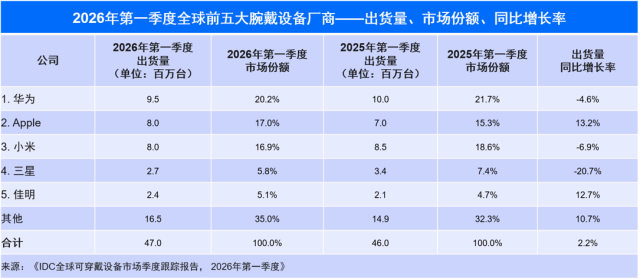
2025年中国腕戴设备市场出货量7,390万台,同比增长20.8%。国补政策与促销活动成为增长主引擎,这一趋势将延续至2026年。市场参与者如何应对政策驱动的新节奏?本文基于IDC最新数据,为您梳理市场变化与未来方向。

根据国际数据公司(IDC)最新发布的《中国可穿戴设备市场季度跟踪报告》,2025年中国腕戴设备市场出货量为7,390万台,同比增长20.8%。腕戴设备市场包含智能手表和手环产品。其中,中国智能手表市场出货量5,061万台,同比增长17.2%。手环市场出货量2,329万台,同比增长29.4%。这主要得益于国补政策的刺激以及多平台活动补贴的带动。在政策驱动的增长背后,市场呈现出哪些特点?头部厂商表现如何?2026年又将走向何方?本文将为您一一解读。

2025年中国腕戴市场发展的三大特点

根据IDC跟踪报告,2025年中国腕戴市场发展呈现以下三个显著特点:

特点一:政策驱动成为增长主引擎

2025年市场增长主要由国补政策驱动,销售节奏受政策与价格波动影响显著增强。这一趋势将延续至2026年,市场对促销及价格补贴的敏感度进一步提升。这意味着,政策和促销活动已经成为影响市场节奏的关键变量,厂商需要适应这一新的运行逻辑。

特点二:500-1000元价位段增速最快

500-1000元价位段是成人智能手表市场增速最快的区间。这一现象的形成有两方面原因:一方面受产品迭代与价格调整影响,另一方面千元档位产品促销也显著带动该价位段增长。随着智能手表市场技术日趋成熟,该价位段凭借高性价比,对消费者的吸引力持续提升。

特点三:渠道流转加快,库存结构优化

补贴政策和促销活动推动渠道流转速度明显加快,从库存角度来看,有效缓解了渠道压货压力,推动市场向更加良性的方向发展。其中线上销售增长更加明显,成为拉动整体销量、优化库存结构的重要动力。

2025年中国腕戴市场Top 5厂商表现

华为

2025年,华为在腕戴市场稳健领跑,稳居中国市场出货量第一。Watch GT 6系列首发骑行模拟功率,快速迭代并广泛铺货;Watch 5系列进一步夯实了其在中高端智能手表市场的领先地位;Watch Fit系列则凭借精致外观与出色性能,在轻运动场景中表现亮眼。

小米

小米第四季度发布智能手表新品Redmi Watch 6和全智能旗舰手表Xiaomi Watch 5。此次推出的全智能手表是小米可穿戴系列完善其产品在高阶智能手表领域布局,向中高端市场迈进的重要一步。

Apple

2025年Apple在中国市场增长迅速,主要得益于国补政策带来的价格优惠刺激。其下半年通过Apple Watch S11, Apple Watch SE3和Apple Watch Ultra 3全线产品更新也进一步带动出货。

步步高

2025年步步高旗下小天才儿童手表品牌整体表现稳健,持续领跑中国儿童手表市场,稳居出货量首位。品牌通过产品线下探、发力线上平台实现多元布局,且深耕线下渠道,巩固市场优势。

荣耀

2025年,荣耀在腕戴设备市场实现显著增长。其在智能手表领域持续完善产品布局,覆盖入门至中端主流价位段,并推出多样化外观形态产品,为消费者提供丰富选择。

2026年市场发展趋势展望

IDC报告指出,展望2026年,中国腕戴市场主要呈现以下发展趋势:

趋势一:转向结构优化的理性发展阶段

中国腕戴市场将转向结构优化的理性发展阶段。在新传感技术仍在孕育的周期下,政策与价格成为影响增长节奏的重要变量,市场对促销与补贴的敏感度持续提升,行业运行逻辑更趋市场化。

趋势二:市场结构进一步两极分化

市场结构将进一步呈现两极分化态势。入门级市场凭借天然的高性价比优势,持续吸引新增用户并有效激活换机需求;中高端市场则在促销活动与政策补贴的双重带动下,实现显著增长。

趋势三:端侧AI或将开启新时代

伴随高通推出首次搭载专用NPU的全新可穿戴旗舰平台,端侧高性能AI处理能力将有效提升,或将引领腕戴设备进入端侧AI时代。

IDC中国研究总监潘雪菲认为,腕戴市场仍需在健康场景上持续深耕,无创血糖监测等慢病管理功能将成为行业重要增长引擎,释放更大市场潜力。同时,端侧AI技术的应用将显著提升腕戴设备的算力水平,未来可进一步与智能耳机、智能眼镜等多类穿戴产品实现多模态协同交互,有望构建下一代自然交互生态,开启全新发展格局。

针对技术供应商和采购方的建议

针对技术供应商和采购方,IDC提出以下三点建议:

建议一:布局双轨产品矩阵,适配市场化增长节奏

面向两极分化的市场结构,同步强化入门级高性价比机型与中高端功能旗舰;灵活联动政策与补贴资源,优化定价与促销节奏,提升用户转化与换机周期管理能力,在理性发展阶段保持规模与利润平衡。

建议二:深耕健康场景,打造慢病管理核心增长引擎

重点投入血压、血糖等慢病监测技术研发和产品应用,推动产品健康监测能力升级;以专业健康功能构建差异化壁垒,将健康服务转化为长期用户粘性,成为驱动市场增长的新势力。

建议三:布局端侧AI与多设备协同,抢占下一代交互生态制高点

强化智能手表端侧AI高性能算力,提升设备独立处理与智能响应能力;积极推进腕戴设备与智能耳机、智能眼镜等多类穿戴产品的多模态协同交互,构建下一代自然交互生态,以生态化优势开启全新发展格局。

延伸阅读与沟通:

如需了解更多IDC相关研究或进一步与我们沟通,欢迎识别二维码与 IDC 联系,我们将安排专人与您对接,为您提供定制化的市场洞察与咨询服务。


如需了解IDC在智能终端领域的最新研究报告、数据产品及行业分析,请扫描二维码,在线获取完整研究目录与内容简介,助您精准把握市场脉动。

Sophie Pan - Research Director - IDC

Sophie Pan is a research director for the Client Systems Research team at IDC China. She is responsible for emerging technology device research, including wearable devices and smart home devices. Sophie has a deep understanding of the landscape and ecosystem development of the consumer Internet of Things (IoT) device market. She assisted the top-tier companies to formulate business strategies by conducting meticulous data analyses and uncovering opportunities and trends in the market. Prior to joining IDC, Sophie worked at a research consultancy and the IT hardware manufacturing industry, providing consumer research and market analysis services. Sophie holds a master’s degree in Integrated Marketing from the Florida State University in the USA.

The escalation of conflict in the Middle East introduces new variables into an already fragile global technology economy. While IDC does not comment on political developments, the economic transmission mechanisms into the IT sector are clear and measurable. The central question for technology leaders is not whether there will be impacts, but their depth, duration and derivative consequences. 

At this stage, our baseline assumption remains that the conflict is contained within weeks, with growth and recovery in the second half of the year. Under that view, global IT spending growth in 2026 remains near 10%, with only modest disruption to enterprise investment plans for the year overall. In the Middle East and Africa (MEA), where devices account for a larger share of spending, growth would track closer to 5%.  

However, the risk of a downside scenario is growing. The recent oil price spike could be the first stage of a broad-based economic slowdown. A conflict lasting up to three months would reduce global IT market growth by roughly one percentage point and push MEA expansion into the 3–4% range. A more sustained escalation beyond that 3-month timeframe would introduce materially greater downside risk, particularly through energy markets and inflation. If escalation continues in the coming weeks, the likelihood of that more severe slowdown will increase.

Energy Shock and Macroeconomic Transmission into IT Spending

Energy prices are the primary transmission channel into the technology sector. Oil volatility quickly feeds into inflation expectations, operating costs, and ultimately capital availability. Data centers, semiconductor fabrication facilities, global logistics networks, and advanced manufacturing operations are all energy intensive. Even modest increases in oil and gas prices raise operating expenditure across the digital infrastructure stack. If elevated prices persist, central banks may delay interest rate normalization, tightening financing conditions for enterprise IT projects. The risk is not an abrupt collapse in demand, but rather a measured slowing of discretionary spending and device refresh cycles as businesses and consumers absorb higher costs. 

This dynamic is particularly relevant for the MEA region.  A blockage of the Strait of Hormuz would constrain Gulf oil export volumes and limit revenue gains, even if prices rise. Prolonged conflict would also increase defense spending and heighten regional risk perception and uncertainty. Under growing fiscal pressure, governments and sovereign wealth funds may scale back or further recalibrate mega projects, with national transformation agendas reprioritized or phased. This could delay or downsize related IT investments. Stronger Gulf states may sustain digital transformation, but elsewhere spending is likely to shift toward mission-critical priorities as foreign direct investment (FDI) and sector activity soften. 

Infrastructure Resilience, Cloud Architecture, and Sovereign Digital Strategy

The conflict also marks a substantial shift for the cloud industry. For the first time, major hyperscale regions are operating within an active conflict zone. That reality changes how enterprises think about geographic risk. Multi-availability-zone architecture is rapidly becoming the minimum acceptable standard, and multi-region deployment is emerging as the default design for mission-critical workloads. Resiliency is no longer a compliance checkbox; it is a board-level concern tied directly to operational continuity for enterprises and for SaaS providers who use these same facilities. 

In the Middle East, this is likely to accelerate sovereign infrastructure initiatives. However, unlike such initiatives in other regions and countries, this may be different given the fragility of the region. Governments that were already pursuing digital sovereignty will intensify efforts to build nationally controlled cloud platforms, AI infrastructure, and cyber defense capabilities. However, it is highly likely that they may add a mandate for robust operational and disaster recovery to accompany sovereignty. In other words, these initiatives are not merely modernization programs; they are increasingly viewed as components of strategic autonomy. And that strategic autonomy needs service level objectives around business continuity if not present today. For now, fiscal trade-offs will depend on the duration of military engagement. A short conflict reinforces momentum. A prolonged one could create temporary budget competition between defense and digital investment. Add business continuity to the mix, and costs can go up significantly. 

Beyond infrastructure design, the region’s geographic position introduces supply chain considerations. The Strait of Hormuz remains a critical artery for global energy shipments, and Gulf ports function as essential transshipment hubs linking Europe, Africa, and South Asia. Any sustained disruption would ripple through three channels: higher energy input costs for semiconductor fabrication and data centers; increased freight and insurance expenses; and delays in technology component flows. 

Sector Impacts: Semiconductors, Cybersecurity, AI, and Consumer Technology

Semiconductor markets are especially sensitive. Memory supply was already tight entering 2026. A prolonged conflict could increase defense-related demand for advanced chips and memory used in smart munitions and autonomous systems. In extreme scenarios, governments could intervene to secure strategic semiconductor supply, placing additional upward pressure on DRAM and NAND pricing. That would elevate infrastructure costs for AI deployments and enterprise storage, reinforcing near-term capital discipline. 

While certain segments face pressure, cybersecurity spending stands out as structurally resilient. Geopolitical escalation typically coincides with heightened state-sponsored cyber activity targeting energy infrastructure, financial services, telecommunications networks, and cloud platforms. In such environments, organizations rarely reduce security budgets. Instead, they modernize detection and response capabilities, harden operational technology environments, and expand cloud and identity protections. Cybersecurity behaves counter-cyclically during periods of geopolitical stress, and this episode is unlikely to prove different. 

Consumer technology spending, by contrast, remains more vulnerable. Inflationary fatigue was already weighing on device demand, particularly in regions where smartphones represent a large share of IT expenditure. Higher input costs tied to memory and logistics, combined with deteriorating consumer confidence, could further delay refresh cycles. In downside scenarios, the device segment absorbs a disproportionate share of growth moderation. 

AI investment sits at the intersection of these forces. On one hand, rising infrastructure costs, memory constraints, and tighter capital conditions may encourage enterprises to scrutinize large-scale deployments. On the other, AI continues to be positioned as a lever for productivity and cost efficiency, particularly valuable in inflationary environments. Defense analytics, cybersecurity applications, and sovereign AI initiatives in the Gulf may even accelerate. Compared with prior geopolitical conflicts, today’s IT market is structurally different: a greater share of spending is subscription-based, hyperscale providers account for a larger portion of infrastructure capex, and AI is embedded within core transformation strategies. For these reasons, AI investment is likely to prove more resilient than traditional discretionary IT categories, though not immune in a prolonged energy shock. 

Under our baseline scenario of a contained conflict, disruption remains limited and largely temporary. A conflict extending for several months would shave approximately one percentage point from global IT growth, with most downside concentrated in devices and nonessential enterprise projects. A six- to nine-month escalation, accompanied by oil prices sustained above $100, would exert more pronounced pressure on consumer spending, capital markets, and project pacing globally. 

Strategic Implications for the Digital Economy

From IDC’s perspective, this conflict represents more than a regional geopolitical event. It is a stress test of the digital economy’s energy dependence, infrastructure concentration, semiconductor supply chain complexity, and cyber resilience. While immediate exposure is highest in the Middle East, second-order effects will flow globally through energy costs, capital allocation decisions, and hardware pricing. It is also true, seen in prior global disruptions, that technology ‘proves’ itself when the environment is turbulent or unpredictable. While the shorter-term impact of the Middle East conflict will put some downward pressure on IT investment growth, in the medium and longer terms it will likely be seen as another disruption that accentuates the importance of quick response and operational resiliency and reminder that these things are underpinned by continuing investments in modern IT tools  

Even in downside scenarios, three areas remain structurally prioritized: AI infrastructure, sovereign digital platforms, and cybersecurity. The principal risk to the IT industry is not structural demand destruction, but cost-driven moderation and selective reprioritization. As macroeconomic conditions evolve, IDC will continue to refine its outlook. 

Stephen Minton - Group Vice President, Data & Analytics - IDC

Stephen Minton is a group vice president with the IDC Data & Analytics group, focusing on ICT spending and macroeconomics. Mr. Minton is responsible for Worldwide ICT Spending programs, including the Worldwide Black Book, Worldwide 3rd Platform Spending Guides, and Worldwide Telecom Services Tracker. Mr. Minton's research expertise includes global ICT and economic analysis, and he tracks market data across hardware, software, services, telecom and emerging technologies. He is the author of papers that focus on the economic impact of IT, and is a regular speaker on the subject of IT spending. In 2002 he addressed the United Nations in New York, speaking to UN ambassadors on the subject of the Information Society. Mr. Minton previously worked with Digital Equipment Corporation (DEC), before joining IDC in 1998. Originally from Hartlepool in the North of England, he graduated from the University of Salford in 1995. He has also worked in the field of consumer market research with Millward Brown International.

Laurie Buczek - GVP, Research - IDC

Laurie Buczek is the Group Vice President of Executive Insights at IDC, where she spearheads the global research initiatives that shape the industry's understanding of digital business transformation, evolving buying behaviors, and technology investments. She leads IDC's premier research practices, including the CMO Advisory Practice, C-Suite Tech Agenda, and Digital to AI Business Transformation. As the principal analyst for the CMO Advisory Practice, Laurie advises senior marketing leaders on driving business growth through deeper customer connections and the strategic evolution of the marketing function, with a keen focus on AI's transformative impact. Her expertise and thought leadership empower executives to navigate the intersection of technology, business strategy, and customer engagement in today's dynamic digital landscape.

Rick Villars - Group VP, Worldwide Research - IDC

Rick is IDC's chief analyst guiding research on the future of the IT Industry. He coordinates all IDC research related to the impact of Cloud and the shift to digital business models across infrastructure, platforms, software, and services. He helps enterprises develop effective strategies for using their diverse portfolio of cloud investments and applications. He supplies early guidance on implications of critical innovations such as the shift to cloud-based control platforms for deploying/managing infrastructure, data, and code delivery as well as the emergence of AI as a critical IT workload and part of all IT products/services.

Lapo Fioretti - Senior Research Analyst - IDC

Lapo Fioretti is a Senior Research analyst in IDC Digital Business Research Group, leading the European Emerging Technologies Strategies research. In his role, he advises ICT players on how European organizations leverage new technologies to create business value and achieve growth and analyzes the development and impact of emerging trends on the markets. Fioretti also co-leads the IDC Worldwide MacroTech Research program, focused on the intertwined connection between the Economical and Digital worlds - analyzing the impact key MacroEconomic factors have on the digital landscape and viceversa, how technologies are impacting economies around the world.

Ranjit Rajan - Research Vice President, Worldwide C-Suite Tech Agenda - IDC

Ranjit Rajan leads IDC’s Worldwide C-Suite Tech Agenda program, advising technology vendors and providers on offerings, competencies, and go-to-market strategies to engage C-level decision makers - including CEOs, CTOs, CAIOs, CIOs, CFOs, and other line-of-business executives. His program analyzes C-suite technology spending and buyer behavior, delivering insights on leadership dynamics, business objectives, technology priorities, and adoption of emerging technologies such as AI and agentic AI. He is a frequent speaker at CxO conferences and often moderates panels and roundtables on technology strategies for C-suite executives. He regularly advises technology vendors, service providers, and telecom operators on market positioning, competitive strategy, and CxO engagement, and has worked with government and regulatory clients on Smart City initiatives, ICT policy, digital skills and innovation. Ranjit also serves as executive analyst for key customers in Middle East, Türkiye, and Africa.

Harish Dunakhe - Senior Research Director, Software and Cloud, META IDC - IDC

Harish Dunakhe leads IDC’s research & advisory practice for the software program in the Middle East, Africa, and Turkey (META) region. He is responsible for a team of research analysts and manages the delivery of insights in IDC’s software program and syndicated research. Harish and his team have expertise in studying technology trends to provide our clients with thought leadership and actionable insights. He is based in Dubai.

Andrea Siviero - Senior Research Director, MacroTech, Digital Business, and Future of Work - IDC

Andrea Siviero leads IDC's European Digital Business and Future of Work Research group. The group provides market research insights to foster a purposeful and fair adoption of technologies supporting digital societies, businesses and workforce and empower tech providers in strategic decision making, planning and go-to-market activities. Siviero also co-leads the IDC Worldwide MacroTech Research program, focused on the intertwined connection between the Economical and Digital worlds - analyzing the impact key MacroEconomic factors have on the digital landscape and viceversa, how technologies are impacting economies around the world.

Jebin George - Senior Research Manager, Software, Cloud, and Industry Transformation, IDC MEA - IDC

Jebin handles IDC's software, cloud, and industry-specific research for the Middle East, Turkiye, & Africa region. He is located at IDC's regional headquarters in Dubai and works closely with his team and other analysts to gain insights into digital transformation trends, analyze technology spending patterns, and advise technology suppliers and end-users.

Thomas Meyer - General Manager and Group Vice President, IDC EMEA - IDC

Thomas Meyer joined IDC in January 1999 and is currently responsible for managing IDC's Research Division in EMEA. This includes Practices focused on Digital Transformation, Cloud, Artificial Intelligence, IoT, Blockchain, Intelligent Process Automation and Accelerated Application Development as well as Core ICT (Software, Services, Infrastructure and Devices) and Industry-specific teams (Financial, Manufacturing, Energy, Retail, Healthcare, Government and Telco Insights)

Ashish Nadkarni - GVP/GM, Infrastructure Research - IDC

Ashish Nadkarni is Group Vice President and General Manager within IDC's worldwide infrastructure research organization. Ashish oversees seven global research practices: infrastructure software platforms, cloud and edge services, storage and converged systems, performance intensive computing, compute infrastructure and service provider trends, enterprise and emerging workloads, and the future of digital infrastructure. Additionally, he oversees two regional research practices: Canadian infrastructure solutions, and Latin America enterprise infrastructure and cloud services. Ashish and his team also curate BuyerView, an industry leading portfolio of primary research products that provide a voice of the IT buyer on technology and services adoption trends including cloud and edge services, artificial intelligence (AI), high performance computing (HPC), security and networking, xOps, and software development.

Simon Ellis - Program GVP - IDC

As Group Vice President, Simon Ellis currently leads the U.S. Manufacturing Insights, U.S. Energy Insights, and Global Supply Chain Strategies practices at IDC, specializing in advising clients on manufacturing/energy strategies, supply chain digital transformation, sustainability, cloud migration, network, and ecosystem design. Mr. Ellis works with end user companies, supply chain organizations and technology providers to develop best practices and strategies leveraging IDC quantitative and qualitative data sets. Within the Supply Chain practices, Mr. Ellis contributes extensively to the Supply Chain Planning and Multi-Enterprise Networks Strategies practice while also overseeing the Supply Chain Execution practices. These supply chain practices specialize in advising clients on supply chain network design, S&OP, global sourcing (Profitable Proximity and Low-Cost Sourcing), warehousing and inventory management, transportation, logistics, and more.

Jean Philippe Bouchard - Vice President, Data & Analytics - IDC

Jean Philippe (JP) Bouchard is Vice-President, Data & Analytics at IDC Canada. In this role, JP is responsible for leading the team of analysts delivering Continuous Intelligence Services, Trackers and custom research in the Future of Work and Mobility group, by providing insights on how technology is changing work culture, the workspace, and the workforce itself in Canada. JP’s team also provides insights on mobile phones, PCs, tablets, hard copy peripherals, 3D printing, wearables, AR-VR and consumer services.

It’s a common situation we’ve being seeing: you have fixed the data pipeline, you have hired or trained the talent, you have the executive mandate. The budget. The technology. The time and dedication even! And you are still wondering: why is your enterprise AI still underperforming? Why is it not scaling? The answer, turns out, may be hiding in in people’s heads.

Enterprise AI adoption has a well-documented data problem. IDC research consistently identifies data quality, data availability, and data silos as the top barriers to scaling AI across the organization. Globally, 89% of organizations acknowledge some level of data quality problem and at the same time, 52% of companies say data quality is the most important factor for AI projects success. Only 6% of CIOs admitted they completed all data initiatives and are ready to move to the next level of AI adoption. And 7 in 10 IT and business leaders cite data silos as one of the biggest challenges for AI adoption. We can see significant budgets being invested in data lakes, data governance frameworks, or MLOps infrastructure. And yet, more than a half of AI initiatives stall after the pilot phase: succeeding  at delivering impressive demos but failing to generate enterprise-wide value.

The data problem is real. But is the problem just about data readiness? There might be another knowledge crisis running quietly and often in the shadows. Most organizations do not see it coming until something goes seriously wrong. A major restructuring or a round of layoffs happens. A reorg that lets go of the wrong people. Suddenly, things that used to just work start breaking down. Processes that ran smoothly for years  become unreliable. New hires cannot figure out how their predecessors got results. That is the moment leadership realizes something important walked out the door. And if it was never captured, it is simply gone. This kind of knowledge is easy to overlook precisely because it is invisible when everything is going fine. It only shows up in the gap it leaves behind. Or when an AI project doesn’t scale.

There are things that cannot be put into a dataset

In the 60’s, philosopher Michael Polanyi articulated something that anyone who has tried to teach a skill to a machine, or an algorithm, or even to another human, knows intuitively: “We can know more than we can tell”. This is the essence of the Polanyi Paradox. It captures the idea that much of what we know, we know through experience, practice, and intuition rather than through rules we could ever fully write down. A master chess player cannot explain every instinct that guides a move. A skilled surgeon cannot put into words every micro-adjustment she makes mid-procedure. They just know and that knowing lives in them, not in any manual or dataset. The paradox is this: the knowledge that is often most valuable is precisely the knowledge that is hardest to transfer, document, or teach explicitly. That silent knowledge is often called tacit.

Organizations are similar. Tacit knowledge is everything an organization knows but has never written down. It is the senior underwriter who can sense a bad risk before she looks at a single data point. It is the way the logistics team re-routes shipments when two things go wrong simultaneously in a process that exists nowhere in any corporate workflow diagram but their heads. It is this unspoken understanding of which stakeholder actually needs to approve something, regardless of what the org chart says. It is decades of built-up expertise, accumulated judgment, pattern recognition, and impossible to document gut feeling. And it is embedded in people and informal process, not systems and databases.

AI models, algorithms, and systems learn and reference  from data. But tacit knowledge,  by definition, never makes it into the databases, structured or not. Which means, if organizations decide to look at the end-to-end transformational AI deployments, that often are training and deploying AI using an incomplete picture. At the same time, achieving success around unique use cases, where knowledge can easily be written down and transferred.

Three more problems?

The tacit knowledge gap is structurally difficult to manage for three reasons that reinforce one another.

  • First, Polanyi himself never bothered to assess what the proportion of tacit knowledge was. Organizations do not know how much tacit knowledge they have. Is it 25% of institutional knowledge? 60%? 90%? There is no universal answer, even if some management experts try to guess, and that uncertainty is itself a strategic liability. It is impossible to close a gap that cannot be measured. We can only assume that in knowledge-intensive industries, from professional services, to healthcare, to advanced manufacturing and financial services, the proportion of expertise that lives solely inside people’s heads is almost certainly larger than leadership assumes.
  • Second, and this is where the problem compounds beyond Polanyi’s original framing, tacit knowledge is not static. It evolves as markets shift, as teams learn, and, painfully, as people come and go. Every time a senior expert retires or an experienced employee leaves, a portion of that knowledge walks out the door permanently. The institutional knowledge base your AI was designed around last year may no longer reflect today’s reality. The power of silent expertise also fluctuates, it is particularly crucial in time of sudden changes, which means it will become even more critical when an organization decides for AI transformation.
  • Third, and something I can see among many experts I meet, tacit knowledge gaps may erode trust in AI. This is perhaps the most underappreciated consequence. When experienced professionals interact with AI outputs that feel off, like answers that are technically defensible but miss something important, they often cannot articulate exactly why. The AI passed every benchmark. The data was clean. But the output does not  fit the context that only an insider would know. The result: employees either spend hours manually verifying AI recommendations, and defeating the productivity case, or they quietly stop or avoid using the tools altogether. A smooth way to prove the business case wrong, if you’re asking me.

Is there hope? I don’t know, but we can try

There probably is no one ultimate way to address the Polanyi Paradox – that is, in a sense, the point. But organizations can – and should – take deliberate steps to reduce the gap and build AI systems that are more honest about what they do and do not know.

Companies need to design AI for collaboration, not replacement. The most effective AI deployments in mature organizations use human expertise to continuously refine models, tools, or applications behavior. This can be done through feedback loops, exception handling, or human-in-the-loop review. This, if done correctly, creates a mechanism for tacit knowledge to gradually surface and be encoded over time. AI will take over much of the work that can be fully defined and encoded, but in many situations it will only handle a limited part of the overall task.

Companies can start making tacit knowledge capture a design requirement, not an afterthought. Before deploying AI in any high-stakes domain, conduct structured knowledge extraction with domain experts. Techniques borrowed from cognitive task analysis (sounds heavy, but can be really fun!), may help surface decision logic that experts themselves did not know they were applying. This is not a one-time exercise; it needs to be embedded in how teams work and how processes are documented. This process also calls for factoring in potentially high cost and resistance, and prioritizing “easier” AI use cases unless the expected return is exceptionally high.

Organization should treat employee transitions as a knowledge continuity risk. Organizations frequently invest significantly in operational continuity planning. Knowledge continuity deserves the same approach. Structured offboarding, mentorship programs designed to transfer expertise rather than just tasks, and apprenticeship models can preserve hidden knowledge before it disappears.

Organizations must aim at making AI systems transparent  about uncertainty.  When building or procuring AI tools, organizations can define confidence thresholds that trigger human review rather than automated action (might not be great for an autonomous agentic part, but we need compromises). They can also test models specifically against edge cases and domain-specific scenarios where tacit knowledge would normally kick in and use those gaps to inform where human oversight is non-negotiable. It is less about an organization admitting  AI weakness and more about an organization designing guardrails around known blind spots.

The organizations that will extract the most value from AI over the next decade will be the ones that are honest about what knowledge they have actually managed to encode, even if, yes, we all agree we can never have all the knowledge. And those trying to close that gap systematically. For your AI to succeed and scale, data is necessary, but it is not sufficient. The missing variable is knowledge and all of it, not just the part that lives in organization’s databases.

Got a question? Drop it in here.

Ewa Zborowska - Research Director, AI, Europe - IDC

Ewa Zborowska is an experienced technology professional with 25 years of expertise in the European IT industry. Since 2003, she has been a member of the IDC team, based in Warsaw, researching IT services markets. In 2018, she joined the European team with a specific emphasis on cloud and AI. Ewa is currently the lead analyst for IDC’s European Artificial Intelligence Innovations and Strategies CIS.

2026年全国两会释放明确信号:“深化拓展人工智能+”与“打造智能经济新形态”,正成为ICT市场增长的双引擎。政府工作报告中强调的“促进新一代智能终端和智能体加快推广”、“推动重点行业领域人工智能商业化规模化应用”以及“实施超大规模智算集群、算电协同等新基建工程”,为企业级ICT市场的持续扩张提供了明确的政策方向。IDC基于最新发布的2026年V1版《全球ICT支出指南:行业与企业规模》(Worldwide ICT Spending Guide Enterprise and SMB by Industry)及《中国IT市场省级及云解决方案支出指南》(China Provincial Cloud Solutions Spending Guide),对中国ICT市场的结构性机遇进行了梳理。

基于上述指南的数据分析,IDC从市场格局、技术演进、行业赛道等维度,提炼出中国ICT市场的五大核心洞察:

洞察一:市场稳健增长,“深化拓展‘人工智能+’”成核心引擎

IDC《全球ICT支出指南:行业与企业规模》数据显示,2025年中国ICT市场投资规模为6889亿美元。展望未来,中国ICT市场支出将以7.8% 的五年复合年增长率稳步增长,到2029年有望突破9187亿美元。

从企业级视角来看,这一增长态势更为强劲。企业端的“‘人工智能+’深化拓展”战略正驱动着从基础设施到应用服务的全链条投入。IDC《全球ICT支出指南:行业与企业规模》预测,到2029年中国企业级ICT市场规模将达到5120亿美元,五年复合增长率13.3%,高于整体市场增速,成为推动新质生产力发展的关键力量。

洞察二:硬件为基,软件与服务引领智能化转型

IDC《全球ICT支出指南:行业与企业规模》数据显示,中国企业级ICT市场在硬件、软件、IT服务等多个领域展现出差异化的发展前景。

硬件:规模最大的“压舱石”。作为数字化转型的核心基础设施,硬件市场依然是当前中国企业级ICT支出中规模最大的组成部分,2025年占比超过五成。值得注意的是,AI训练和推理需求的爆发直接拉动了对GPU服务器、高性能存储及相关网络设备的投入,服务器和存储市场的投资到2029年有望实现24.4%的五年复合年增长率,成为硬件领域中增长最快的子市场。

软件:智能化转型的核心引擎。随着生成式AI的加速落地,软件正在成为企业智能化决策、业务流程自动化和数据治理的核心载体。IDC预测,2029年中国企业级软件市场规模预计达到933亿美元,五年复合增长率13.6%。其中,受到大模型发展的驱动,应用开发与部署市场成为软件市场中增长最快的子市场。

IT服务:不可或缺的赋能者。无论是在企业架构优化、系统集成,还是在智能化技术落地等关键环节,IT服务都扮演着至关重要的角色。IDC预测,2029年中国企业级IT服务市场规模将接近750亿美元。

洞察三:云部署模式分化,公有云领跑、私有云稳增

两会提出的“深化拓展人工智能+”行动正深刻影响企业技术路线的选择。IDC《中国IT市场省级及云解决方案支出指南》数据显示,2025-2029年间,三大部署模式的结构性变迁趋势愈发清晰。

公有云:增速领跑,占比突破四成。公有云是三大部署模式中增长最快的板块。IDC预计,2025年公有云支出规模达1018亿美元,占中国企业级IT市场总规模的44.2%;到2029年,这一规模预计将增长至2144亿美元,五年复合增长率高达23.4%。这一增长的核心驱动力首先来自互联网行业的持续投入,2025年其在公有云市场中的贡献占比超过50%;与此同时,传统行业的数字化转型也在加速推进,正在成为公有云市场增长的新动能。

私有云:规模持续扩大,占比稳步提升。私有云是中国企业级IT市场中占比持续提升的部署模式,2025年占比16.8%,到2029年预计提升至18.9%。私有云市场的高速增长,得益于AI工作负载的私有化部署需求激增。此外,数据安全政策的驱动,正推动大型国央企、金融机构等将核心业务系统向云原生架构加速演进。

传统IT:存量巨大,占比逐年收窄。尽管云计算的浪潮席卷各行各业,但传统IT部署模式依然在中国企业级IT市场中占据重要地位。2025年传统IT支出规模达900亿美元,占市场总规模的39.0%;到2029年,这一规模将增长至1193亿美元,但占比下降至29.0%。

洞察四:互联网行业领跑,企业级IT投资结构性分化

从行业维度看,IDC《中国IT市场省级及云解决方案支出指南》数据显示,互联网、金融、政府、制造、电信等行业的IT投资规模均位居前列。其中,互联网行业占据规模优势,金融与政府行业稳步推进数字化转型,而制造业则在政策强力驱动下,成为增长动能较为突出的领域之一。

互联网:份额领跑,AI驱动高增长。互联网行业依然是中国企业级IT市场投资占比最高的行业,2025年占中国企业级IT市场总规模的33.1%,并以25.2%的五年复合增长率高速增长,在各行业中增速最快。随着生成式人工智能进入商业化落地关键期,互联网企业从模型训练走向应用创新,对GPU服务器、AI加速芯片、高性能存储的需求持续井喷。

金融与政府:科技金融与数字政府双轮驱动。金融与政府行业在市场规模和增长态势上较为接近,2025年企业级IT支出规模分别占中国企业级IT市场总规模的12.3%和11.1%。在“科技金融”和“稳妥推进数字化转型”的导向下,金融机构正积极探索智能客服、风险管理、智能投研等AI在业务端的应用;政府行业则围绕“数字政府”建设,从政务云基础设施向“一网通办”、“一网统管”等创新应用持续延伸。

制造:增速领先,智能制造催生多元需求。两会报告中, “因地制宜发展新质生产力”及“实施新一轮制造业重点产业链高质量发展行动”被置于突出位置。制造业IT支出规模的五年复合增长率达13.3%。IT技术正在渗透到制造业全价值链,包括研发设计端的仿真软件,生产制造端的工业机器人、智能产线,经营管理端的ERP,以及产品服务端的远程运维等。

洞察五:区域与规模分化,超大型企业主导市场

两会报告中明确提出“深入实施区域协调发展战略、区域重大战略”,支持京津冀、长三角、粤港澳大湾区打造世界级城市群。IDC《中国IT市场省级及云解决方案支出指南》的分省数据,为量化评估这一战略下各省的数字经济活力提供了一把标尺。

从区域分布看,中国企业级IT市场呈现明显的梯度格局。中国七大区域中,华北、华东、华南三大区域在2025年的企业级IT投资规模合计占比超过85%,构成市场主力。聚焦省份层面,北京市以2025年33.4%的企业级IT投资占比成为全国企业级IT市场的绝对龙头;上海市在软件、IT服务、人工智能平台等投入上遥遥领先;广东省在电子信息制造业、智能硬件等领域积淀深厚,其中深圳IT支出五年复合增长率达15.2%。

从企业规模看,IDC《全球ICT支出指南:行业与企业规模》数据显示,超大型企业(1000+人)仍然是企业级ICT支出的主要力量,2025年占据超过五成的投资份额。超大型企业在智能算力、云原生平台、大数据平台等前沿领域的投入持续加码,为市场增长注入核心动力。

【IDC分析师观点】

IDC中国分析师张文蕙认为,2026年是“人工智能+”行动全面落地的关键之年。政策持续加码与市场需求释放形成合力,为技术供应商和行业用户创造了广阔空间。AI不再只是技术热点,而是重塑硬件、软件、服务及云部署模式的核心变量。展望未来,市场竞争将不再局限于单一产品的性能比拼,而是上升为算力、平台、生态的综合能力较量。对企业而言,既要把握AI赋能的确定性趋势,也要将AI能力与自身业务场景深度融合,在算力投入与价值实现之间找到平衡点。

IDC中国高级研究经理郭越认为,当前中国ICT市场保持稳健增长、结构升级、智能驱动的整体态势,在政策与产业双轮驱动下,AI 成为核心引擎,推动硬件、软件、服务协同共进,行业热点清晰聚焦。中国ICT市场中软件与信息技术服务业、云计算、智算中心等板块领跑增长,企业数字化与智能化需求旺盛,市场韧性强劲。人工智能从技术探索走向规模化落地,大模型、智能体、端云协同快速普及,带动芯片、服务器、操作系统、数据库、行业解决方案全栈升级,形成 “硬件筑基、软件赋能、服务变现” 的一体化发展格局。

备注:IDC《全球ICT支出指南:行业与企业规模》及《中国IT市场省级及云解决方案支出指南》数据中不包含企业运营技术支出(Operational Technology Spending)数据。

IDC《支出指南》致力于为IT厂商、行业用户和投资/金融机构在战略规划、产品研发、IT支出及投资规划等方面提供数据支撑。《支出指南》系列产品聚焦IT热门领域,从多个维度预测市场规模和增速,助力厂商发掘市场潜力;引导行业用户根据热点技术及应用场景进行IT规划;通过分析特定市场的发展前景,帮助投资和金融机构更好地做出决策。

IDC《支出指南》相关研究:

China Provincial Cloud Solutions Spending Guide

Worldwide ICT Spending Guide Enterprise and SMB by Industry

Worldwide AI and Generative AI Spending Guide

Worldwide Software and Public Cloud Services Spending Guide

Worldwide Security Spending Guide

如需进一步了解与研究相关内容或咨询 IDC其他相关研究,请点击此处与我们联系。

Wendy Zhang - Market Analyst - IDC

Wendy Zhang is a research analyst in the Data and Analytics group at IDC China. She is responsible for business operations and spending guide in China Enterprise Team. She provides dynamic forecasts of future China and global ICT market development. Wendy previously held research positions at ByteDance and Kingsoft Office, where she worked on global payment products and the WPS Cloud Platform, respectively. She conducted research on landscape and competitors of corresponding markets to provide market entry strategies. Prior to that, she was responsible for industry research for TMT companies at Capital Securities, providing stock price prediction and investment advice. Wendy graduated from the University of Wisconsin-Madison with an M.S. in Business Analytics and earned a B.S. in Economics from Beijing Normal University. She is an active leader in programs, including Deloitte data analysis program and entrepreneurship program. She speaks fluent English and Chinese.

Japan’s AI infrastructure market is entering a structural transformation.

According to IDC’s latest data, domestic AI infrastructure spending will reach over $5.5 billion in 2026, growing at least 18% year over year after a seven-fold expansion between 2022-2025. AI infrastructure is now a core pillar of Japan’s economic and industrial strategy.

What began as hyperscaler-driven expansion has evolved into national-scale economic infrastructure—measurable and structural.

Drawing on the IDC Quarterly Artificial Intelligence Infrastructure Tracker and the IDC Worldwide AI and Generative AI Spending Guide, three data-backed signals define Japan’s next growth phase.

1. How Fast Is Japan’s AI Infrastructure Market Growing?

Spending has increased seven-fold in three years, reshaping Japan’s infrastructure baseline.

The surge was initially catalyzed by government-backed cloud initiatives under the Economic Security Promotion Act, which accelerated large-scale GPU server deployments. Many of these national programs are now reaching completion, permanently raising Japan’s domestic AI compute capacity.

However, growth is no longer purely policy-driven. IDC forecasts that Japan’s AI infrastructure market will expand by 18% year over year in 2026, reaching over $5.5 billion in total spending. Looking further ahead, the market is expected to sustain strong momentum with a five-year compound annual growth rate (CAGR) of 13% through 2029, underscoring the structural and long-term nature of this expansion. Most notably, 2028 will mark a historic tipping point: AI infrastructure spending will exceed non-AI infrastructure spending in Japan.

AI is no longer experimental—it is becoming the primary driver of infrastructure investment in Japan.

2. Why Is AI Infrastructure Now a National Strategic Asset?

The scale and concentration of recent investments signal that AI infrastructure is being treated as a national strategic asset, distinct from traditional enterprise IT upgrades.

Japan is not simply expanding compute capacity.

It is building sovereign AI capability — including:

  • Domestic high-performance GPU clusters
  • National-scale data center expansion
  • AI-optimized infrastructure environments

The market has moved beyond hyperscaler build-outs toward long-term economic resilience and competitiveness.

AI infrastructure now underpins:

  • Industrial innovation
  • Enterprise competitiveness
  • National economic security

3. What Will Drive the Next Phase of Growth?

The next wave of expansion will be enterprise-led.

In 2026, enterprise AI infrastructure spending is forecast to grow 5% year over year, rebounding after large, one-time deals distorted prior-year comparisons.

More importantly, AI investment is shifting toward business-critical domains, including:

  • Sales and marketing optimization
  • Customer service transformation
  • Research and development acceleration

According to IDC use case data, AI spending is increasingly tied to revenue generation, product innovation, and competitive differentiation — not isolated efficiency experiments.

As AI workloads move from proof-of-concept to production, inference-heavy applications will further increase demand for:

  • Scalable infrastructure
  • High-availability architectures
  • Integrated AI lifecycle management

The market is transitioning from capacity build-out to operationalization at scale.

What This Means for Japan Enterprises and Vendors?

The question is no longer how fast AI infrastructure can be deployed, but how effectively it can be designed, integrated, secured, and operated at scale.

Enterprises must move beyond isolated pilots and architect AI systems for organization-wide deployment.

Vendors must evolve beyond hardware supply models toward ecosystem-based capabilities that include facilities integration, lifecycle support, managed AI capabilities, and infrastructure optimization.

The competitive battleground is shifting from capacity to capability.

The Bottom Line

Seven-fold growth in just three years is not a typical technology cycle—it is a redefinition of Japan’s infrastructure foundation. By 2026, the country’s AI infrastructure market will be defined by unprecedented scale, sustained structural growth, and rising national strategic importance. AI infrastructure is no longer a peripheral technology investment; it is rapidly becoming core economic infrastructure underpinning Japan’s long-term competitiveness and industrial transformation.

IDC’s Integrated View and Next Steps

IDC’s analysis draws on continuous, multi-layered data from the IDC Quarterly Artificial Intelligence Infrastructure Tracker  and  the IDC Worldwide AI and Generative AI Spending Guide. In March, IDC will publish the report Japan AI Infrastructure and AI-Focused IT Infrastructure Services Market Analysis 2026, providing deeper insight into user adoption trends, vendor positioning, and ecosystem transformation.

To understand market sizing, competitive dynamics, and strategic opportunities, contact IDC to access the latest data and engage directly with our analysts.

Note: Exchange rates applied: 2022 – 131 JPY:1 USD, 2023 – 141 JPY:1 USD, 2024 – 151 JPY:1 USD, 2025 onwards – 147 JPY:1 USD

Shinya Kato - Senior Research Manager, Enterprise Infrastructure, Data & Analytics, - IDC Japan

Shinya Kato is a Senior Research Manager at IDC Japan and is responsible for the data analysis and forecasting team of Japan enterprise infrastructure market. He analyzes the impact of product technology, service offerings, and marketing strategies on enterprise infrastructure market and provides market forecasts, focusing on the domestic enterprise storage systems market. Through understanding technology adoption trends, he also provides insight into emerging devices such as flash, accelerators, and quantum computing. In addition to researching the HPC and AI infrastructure markets, he is also investigating new consumption models such as Hardware-as-a-Service, to help stimulate the market. Prior to joining IDC, he spent more than 10 years at Silicon Graphics, which was later acquired by HPE, where he held various domestic positions in sales, marketing, and business development. He has covered a wide range of businesses, from infrastructure hardware and container-based data center facilities to digital asset management, industrial virtual reality, and software for media & entertainment. He also served as a product manager for enterprise internet security software and appliances at the emerging vendor. He holds a Bachelor of Economics degree from Rikkyo University.