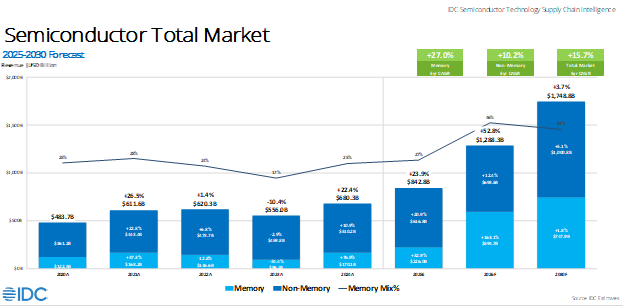
The global semiconductor market is undergoing a seismic transformation. IDC’s latest forecast projects the industry will surge past the $1 trillion revenue threshold in 2026, significantly ahead of prior expectations. The growth will be driven overwhelmingly by AI infrastructure investment, which is reshaping the entire market.
Total semiconductor revenues are forecast to reach $1.29 trillion in 2026, up 52.8% year over year from $842.8 billion in 2025. The memory segment is at the epicenter of this shift: DRAM revenues alone are projected to nearly triple in 2026 to $418.6 billion, driven by demand for high-bandwidth memory (HBM) and DDR from hyperscalers and AI infrastructure providers. Meanwhile, non-memory semiconductors are growing at a robust but more measured pace, reaching $693.5 billion in 2026.
In this post, we break down three forces reshaping semiconductors right now: why AI infrastructure has become the industry’s new center of gravity, what’s happening in memory markets and why it matters beyond the data center, and how other markets from automotive and IoT to mobile and PCs are navigating a market increasingly defined by AI.
Global Semiconductor Market: Selected Forecast (USD Billions)
Source: IDC Semiconductor & Semiconductor Applications Forecast, April 2026. A = Actual, E = Estimate, F = Forecast.
AI infrastructure: The engine of the supercycle
The single most consequential shift in the semiconductor market is the emergence of AI infrastructure as a structurally dominant end market. What began as a cyclical uplift in data center spending has evolved into a self-reinforcing investment cycle that is reshaping demand patterns across the semiconductor value chain.
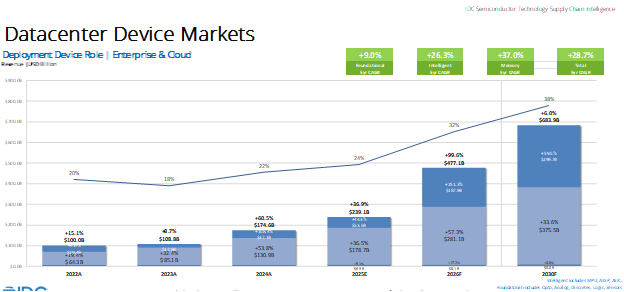
Hyperscale capital expenditure exceeded $100 billion for the first time in Q3 2025, and the i4 are expected to increase capex by 70% year over year to approximately $600 billion in 2026. IDC forecasts data center semiconductor revenues to reach $477.1 billion in 2026. By 2030, data center semiconductors will account for $843.2 billion, nearly half the total semiconductor market.
“The semiconductor industry has crossed a structural threshold. AI is no longer a demand catalyst — it is the demand foundation. The race to build out AI infrastructure is consuming silicon at a pace the industry has never seen, and the implications for memory, logic, and packaging are profound.” —Jeff Janukowicz, Research VP, Semiconductors & Semiconductor Manufacturing, IDC
Datacenter Semiconductor Revenue Decomposition
Source: IDC Semiconductor Applications Forecast, April 2026.
The $281 billion “intelligent” datacenter segment, encompassing CPUs, AI accelerators, GPUs, custom ASICs, and networking silicon, now constitutes the largest identifiable category within non-memory semiconductors. Spending is heavily concentrated among top-tier hyperscalers and a growing set of sovereign AI infrastructure programs, many of which have secured long-term supply agreements with leading chip manufacturers.
Three factors are keeping this growth self-sustaining rather than cyclical:
Compute intensity continues to rise. Generative AI and agentic workloads require far more compute density per rack than prior architectures, increasing the overall silicon footprint
Inference demand compounds on itself. Each new model generation increases the volume of inference, requiring ongoing hardware upgrades
AI is spreading beyond the data center. As enterprises, edge deployments, and client devices begin running AI workloads locally, demand becomes more distributed
Memory: From cyclical commodity to strategic constraint
If you want to understand what’s really happening in semiconductors right now, start with memory.
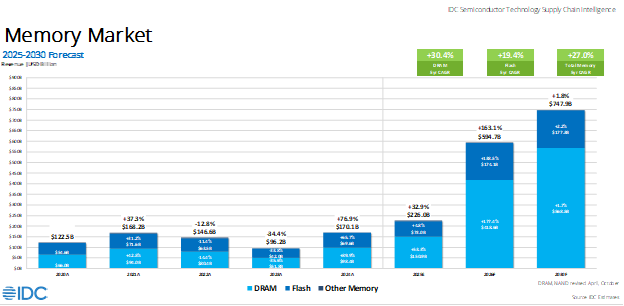
Total memory revenues rise from $226 billion in 2025 to $594.7 billion in 2026, and then to $790.4 billion in 2027. This is not simply a recovery cycle, it reflects a market that is being structurally repriced.
DRAM is where the shift is most visible. IDC forecasts $418.6 billion in DRAM revenues for 2026, up 177% year over year. This is not primarily a volume story driven by consumer devices. Hyperscalers are buying a fundamentally different, more expensive class of memory and are willing to pay a premium to secure supply. Each HBM chip also requires significantly more silicon real estate, further tightening the availability of other types of DRAM.
“The memory market is at an unprecedented inflection point, with demand materially outpacing supply. For an industry long characterized by boom-and-bust cycles, this time is different. The rapid expansion of AI infrastructure and workloads is placing significant pressure on the memory ecosystem. As a result, the market is shifting from a cyclical recovery following the 2023 downturn to a more structurally constrained environment, with clear implications for end markets.” — Jeff Janukowicz, Research VP, Semiconductors & Semiconductor Manufacturing, IDC
The HBM bottleneck
High-bandwidth memory has become the primary constraint in the AI accelerator supply chain. Most capacity is already pre-committed through 2026, with forward allocations extending into 2027. That capacity is concentrated in NVIDIA and AMD GPU platforms, along with a growing set of hyperscaler custom silicon programs.
The production economics are also very different. HBM relies on advanced packaging and stacking technologies, resulting in per-bit costs that are several times higher than standard DRAM.
Suppliers are investing aggressively to expand capacity, but the technical complexity and capital intensity mean meaningful new supply will not reach the market until late 2026 at the earliest.
NAND: AI drives storage demand
NAND Flash revenues are forecast to reach $174.1 billion in 2026, up 138.5% from 2025. AI infrastructure is again the dominant driver, with demand coming from training datasets, checkpoint storage, and high-performance inference environments.
Unlike DRAM, the NAND market is seeing broader repricing. Enterprise SSD prices have surged as hyperscalers secure supply, which is tightening availability across consumer and OEM channels.
Other markets: Navigating the shadow of the AI supercycle
While AI infrastructure dominates the headlines, the broader semiconductor market is facing a more nuanced environment.
Non-memory, non-datacenter revenues are projected at $406.3 billion in 2026. Several end markets are dealing with margin pressure, supply allocation challenges, and macroeconomic headwinds.
In mobile, semiconductor revenues are forecast to decline to $89.8 billion in 2026. The issue is not consumer demand, particularly for AI-capable devices, but cost pressure. Memory now represents a larger portion of the bill of materials, forcing OEMs to make difficult tradeoffs between margin, pricing, and product specifications.
Automotive is being shaped more by macro factors than AI. Tariffs, interest rates, and energy prices are weighing on demand. While the long-term outlook remains strong, 2026 reflects a period of near-term softness.
IoT shows a similar pattern. The segment is projected at $136.6 billion in 2026, with near-term pressure from inventory digestion and cautious spending. However, edge AI is beginning to create a new, higher-value demand category that will become more meaningful over time.
Source: IDC Semiconductor Forecast, April 2026.
Outlook: Path to $1.75 trillion
IDC’s base case projects semiconductor revenues reaching $1.75 trillion by 2030.
Several dynamics will shape that trajectory:
Memory pricing will normalize, but remain structurally higher than pre-AI levels
Non-memory semiconductors will continue steady growth, driven by AI adoption across devices and industries
Macro and geopolitical risks will remain important variables
What is clear is that the semiconductor market has undergone a fundamental shift.
“What the data makes clear is that the semiconductor market has undergone a permanent expansion of its addressable opportunity. AI infrastructure has reset the demand baseline, memory has repriced as a strategic asset, and the industry’s growth trajectory through 2030 is no longer contingent on a consumer refresh cycle.” — Nina Turner, Research Director, Semiconductors, IDC
IDC will be tracking how AI infrastructure investment continues to reshape semiconductor demand at Computex 2026.
Jeff Janukowicz - Vice President, Computing Systems Platforms and Technologies, Enterprise Infrastructure
Jeff Janukowicz is a Vice President within IDC’s enterprise infrastructure global research domain, and the global subdomain lead for the Computing Systems Platforms and Technologies subdomain. Jeff and his team deliver data-driven analysis, technology insights, market trends, and strategic guidance…
Nina Turner - Research Director, Computing Systems Platforms and Technologies, Enterprise Infrastructure
Nina Turner is Research Director within IDC's enterprise infrastructure global research domain, part of the computing systems, platforms, and technologies subdomain. Nina and her team cover the breadth of processors and architectures, from datacenters to client devices, including embedded use…
AI adoption is accelerating across EMEA, yet many organizations struggle to translate investment into measurable business value. This blog explores the structural challenges behind stalled AI initiatives and what differentiates organizations that successfully scale.
AI Adoption in EMEA: High Investment, Limited Business Value
AI adoption across EMEA has progressed significantly over the past 12–18 months, with organizations moving beyond experimentation into broader deployment phases. However, progress remains uneven.
IDC research shows that a substantial share of organizations are slowing down, scaling back, or refocusing their AI initiatives. This reflects a shift in priorities rather than a decline in interest. As macroeconomic pressures, regulatory complexity, and competing IT investments intensify, organizations are increasingly challenged to execute AI initiatives while demonstrating measurable business outcomes.
Why AI Projects Fail: The Execution Gap
The challenges that limit AI impact are consistent across industries, but particularly pronounced in EMEA.
According to IDC research, organizations continue to face difficulty in quantifying and demonstrating AI-driven ROI, alongside competition for resources and increasing regulatory uncertainty. According to IDC research, only 9% of EMEA organizations have been able to deliver measurable business outcomes from most of their AI-related projects over the past two years (Source: IDC Future Enterprise and Resiliency Survey, Wave 1, March 2026), At the same time, resistance to process change remains a persistent barrier, especially where AI requires cross-functional alignment and new ways of working.
These factors rarely cause projects to fail outright. Instead, they contribute to a gradual loss of momentum, where initiatives remain in pilot phases or are scaled selectively without broader organizational impact.
AI ROI: Why Proving Business Value Remains So Difficult
A central issue in AI adoption is the ability to measure value consistently.
IDC research highlights that AI impact extends beyond direct cost reduction to include indirect benefits such as productivity gains, revenue enablement, and risk mitigation. This makes it difficult to capture value using traditional ROI models.
As a result, many organizations lack a standardized approach to evaluating AI initiatives. This leads to fragmented decision-making, where use cases are assessed in isolation and scaling decisions are not consistently aligned with business priorities.
Without a clear framework for value measurement, AI initiatives often struggle to move beyond experimentation.
Scaling Enterprise AI: Why Moving Beyond Pilots Is So Hard
Scaling AI requires more than successful use cases. It requires integration into core business processes and operating models.
IDC research indicates that organizations face increasing challenges when moving from pilot to scale, particularly in relation to budget allocation, operational complexity, and governance requirements. While initial projects are often funded as innovation initiatives, scaling requires sustained investment in infrastructure, data, and ongoing operations.
This transition exposes structural gaps. Organizations that lack alignment between business strategy, data architecture, and execution models often struggle to scale beyond isolated successes.
AI Governance and Regulation in EMEA: Barrier or Opportunity?
Regulation is a defining factor for AI and broader technology adoption in EMEA.
According to IDC research, regulatory requirements around data protection, AI, and cybersecurity are significantly shaping how organizations approach AI deployment. While compliance increases operational and infrastructure costs, it is also driving more structured approaches to governance.
At the same time, organizations report benefits such as improved resilience, stronger ESG performance, and increased customer trust. This suggests that regulation is not only a constraint, but also a catalyst for more sustainable and trusted AI adoption.
Organizations that integrate governance early are better positioned to scale AI effectively.
AI and Workforce Transformation: Why the Human Factor Matters
AI transformation is not purely a technology challenge. It is fundamentally an organizational one.
IDC research emphasizes the importance of aligning AI initiatives with workforce capabilities, culture, and leadership. This includes reskilling, change management, and building trust in AI-driven processes.
Organizations that fail to address these elements often encounter slower adoption and limited impact. In contrast, those that integrate the human factor into their AI strategy are better positioned to realize long-term value.
The Evolving Role of the CIO in AI-Driven Organizations
As AI becomes central to business strategy, the role of the CIO continues to expand.
IDC research shows that digital leaders are increasingly expected to drive business value, support growth, and strengthen resilience. For instance, 42% of EMEA C-Suite leaders expect their CIO role to lead digital and AI transformation with a major focus on specifically creating new revenue streams (Source: IDC Worldwide C-Suite Tech Survey, September 2025). This requires a shift from a technology-centric role to a more strategic position aligned with business outcomes.
CIOs and digital leaders are therefore playing a critical role in connecting AI initiatives with measurable impact and ensuring alignment across the organization.
From AI Strategy to Execution: What Differentiates Leading Organizations
The current phase of AI adoption in EMEA is defined by execution.
Organizations that successfully scale AI tend to take a more structured approach, linking initiatives to business objectives, embedding governance early, and aligning technology with organizational change.
However, many organizations are still in transition. Key questions remain:
How can AI ROI be measured consistently across different use cases?
Which frameworks support scaling AI at the enterprise level?
What changes are required to align workforce and operating models?
How should the role of digital leaders evolve to effectively support AI-fueled business transformation? These questions will be explored in more detail in the upcoming webinar.
Drawing on insights from the IDC EMEA Digital Leader Playbook, the session will provide a practical perspective on how organizations across the region are approaching AI strategy and value realization.
Join the Discussion
For organizations seeking to move from AI experimentation to measurable business impact, understanding these dynamics is critical.
Watch the recording here to gain deeper insight into how leading organizations in EMEA are turning AI into real business value.
Martina Longo - Research Manager, Digital Business - IDC
Martina Longo is a research manager in the IDC Digital Business Research Group. In her role she advises ICT players on how European organizations create business value using digital technologies. She also leads IDC European Digital Native Business research, focused on those enterprises born in a modern technological world in a mix of start-ups, scaleups, and more mature digital natives. Within the European Digital Business Research, the European Digital Native Business, Start-ups and Scale-ups theme advises technology suppliers on the market dynamics and segmentation, business priorities, tech buying patterns and go to market approaches (sell to/sell with) needed to engage digital native organizations in Europe.
Hannover Messe 2026 ran from April 20 to 24 in Hannover, Germany, and it delivered. Under the theme “Think Tech Forward”, the show brought together over 130,000 visitors from more than 150 countries, 4,000 exhibitors, and 300+ start-ups across industrial automation, software, and hardware.
Brazil was this year’s partner country, and the event itself got a makeover: a new hall layout, a revamped thematic structure, and a brand-new Defense Production Park zone, reflecting just how much the scope of industrial technology has shifted.
Here are the Top 10 things I’m taking home, and yes, I’m happy to be challenged on any of them.
The user attention battle is quietly beginning
My deepest feeling coming out from the #HMI26 floor was to be the witness of the first deployments of the armies fighting for who controls the factory of the next decade. Most demos at Hannover Messe 2026 I was exposed to started with a chat box prompting the users. The question is how many of them can co-exist in a factory setup. My answer is as little as possible. The battle for the factory UI has hence started. It can turn out this way: one system as the front-end workers actually use, the others as solid back-end.
Context is the new competitive asset. Whoever owns it, then owns the process. And physics-aware data fabrics are the competitive moat
The differentiating capability in industrial AI is not model quality, but it is contextual depth. A physics-aware industrial data fabric that connects real-life physics, process history, sensor telemetry, operational and operator knowledge provides more competitive advantage than any algorithm running on top of it. Hopefully, manufacturers will define a technology journey built around data first, then context, then impact, but I fear the need to rush the deployment of industrial AI apps may result in missed opportunities in building the critical industrial model foundation.
MES stands for “Must Evolve Soon”
This application is the spine of the plant (because it acts as both the system of engagement and the system of record). But process flexibility is now its hardest test… Why? First, top-down. Advanced Planning and Scheduling applications are seeing accelerated adoption, driven by a new generation of algorithms capable of delivering real-time, context-rich, executable plans. As APS systems push dynamic re-sequencing into execution, MES must evolve fast enough to receive and act on what APS produces, or risk being seen as the weakest link. To this, it directly follows… the bottom-up pressure. Unstructured production cells (i.e. multifunctional robots, wireless machines, AMR-driven object routing) are going to be gradually replacing fixed lines. Customer requests are shifting toward rapid configuration, faster changeovers, and multifunctional automation. MES must evolve to accommodate less deterministic workflows, or lighter tools will fill the gap.
Forget upskilling. The connected worker is all about context generation and retention
The ability to bring anybody “to speed” has been so far one of the typical selling points for connected frontline worker platforms so far. But this is barely scratching the surface. The combination of AI-first vision systems, IIoT, RFID, RTLS, and mobile or wearable devices creates an ultra-visible data substrate that makes the factory transparent. On top of it, the layer of human-process interaction managed through connected worker platforms enables unprecedented levels of visibility on how people interact with process execution steps. This is truly the best material for AI-driven process improvement. This data gold mine is not just in the machine data. It is the analysis of what happens between the worker and the process.
The industrial metaverse is developing as a hyper-contextual decision-making environment
The exponential growth in data availability, combined with falling costs of modelling and representation, is unlocking use cases that were economically impossible two years ago. Hence, we can say that the “VCR” moment has arrived. Now we have the full capability to “zoom in and zoom out” and as well as “fast forwarding” the process for continous multi-scenario process planning and simulation, as well as “rewind” or playback the process for traceability and analysis.
Right-size AI now or face the potential consequences
The differentiating capability will be the agentic continuum, i.e. the unbroken intelligent chain across production execution. But building that chain responsibly requires confronting infrastructure and cost realities that vendor marketing may be now underplaying. Right-sizing AI and matching model scale and infrastructure to actual operational demand is a business continuity decision. The question is not “what is the most powerful model?” but “ do we need AI at all for this, and if the answer is “yes”, then “what is the appropriate model for this decision/process automation, in this operating environment?”
Manufacturing runs on deterministic sequences. Agentic AI is inherently non-deterministic. Reconciling these two realities is the governance challenge
Two distinct scenarios define the governance challenge. In the first, the desired output is well understood, and users can accept or reject an AI result without a care in the world about inspecting the internal process. In the second, the correct answer is uncertain, and full transparency into how the model generated its output is required before the result can be trusted. The challenge is how to gradually hand over large bits of process control to an agentic software layer that is stochastic in nature. Most manufacturing companies today are only comfortable approving small, incremental AI-driven changes, not because AI is incapable of more, but because the accountability and auditability frameworks for automating larger decisions do not yet exist.
So what?
What does this mean in practice? Three implications stand out.
Survive to Scale: Link the technology curve to the organisation curve
Technology is advancing faster than most organisations can absorb. The strategic risk for many manufacturers is not deploying too slowly, but it is scaling before the organisational substrate is ready.
Bring in the Naysayers: Organisational buy-in requires involving sceptics early, not convincing them late
There is a very nice saying that goes more or less as “Don’t let people saying that it can’t be done disturb the people who are already doing it.” But in this new venture, bringing the contrarians will be important. Creatin forums where sceptics stress-test plans with the utmost ferocity (before the market does it!) will be key.
Complexity demands simplicity: Focus on fundamental problems, not exhaustive use-case catalogues
Technology is evolving faster than any list can stay current. Vendors and manufacturers alike should resist chasing every new capability appearing on the horizon, and rather concentrate on first principle-based, core solutions that foster data integration for autonomy and decision-making improvement.
For a deeper look into Lorenzo’s research, visit our website. If any of these perspectives challenge your thinking or connect to your priorities, we would be glad to continue the discussion via our contact form.
Lorenzo Veronesi - Associate Research Director, IDC Manufacturing Insights - IDC
Lorenzo Veronesi is an associate research director for IDC Manufacturing Insights EMEA.
In this role, Veronesi leads the Worldwide Smart Manufacturing research program and supports all the IDC MI research services for EMEA, by looking at Digital Transformation drivers in multiple manufacturing industry sub-verticals. He is also often involved in consulting projects across the world for end-users, IT vendors and public authorities.
During the last decade his research has focused across key processes such as manufacturing operations management, supply chain management, and product lifecycle management in multiple manufacturing verticals, including - among others - automotive, aerospace, machinery, high-tech, chemicals, CPG, and fashion.
Before joining IDC, Veronesi worked as analyst in multiple projects including research in the industrial logistics sector and as advisor for public authorities in Italy.
Veronesi holds an MSc Degree in Regional Science at the London School of Economics and Political Science and has graduated cum laude at the Bocconi University in Milan.
IDC Directions 2026 brought together more than 700 technology and business leaders for a single day of focused, analyst-led intelligence on where enterprise AI is heading and what to do about it.
The scale tells part of the story: 82 IDC analysts, 56 speakers, and 29 sessions across marketing, data, emerging technology, and AI-ready infrastructure. The attendee response tells the rest. In IDC’s post-event attendee survey, 98% said the day was worth their time and 96% left with insights they could act on.
IDC built this year’s Directions around a question most technology executives are wrestling with right now: AI ambition is everywhere. How do you turn it into enterprise results? Every session pointed toward an answer.
Three Conversations That Set the Agenda
Chief Product & Research Officer Meredith Whalen opened with her keynote on the AI Supercycle, IDC’s term for the once-in-three-decades technology expansion cycle now underway, driven by AI infrastructure investment and the enterprise adoption wave that follows. The infrastructure buildout is already underway. The enterprise adoption wave is next. Whether your organization captures value as it shifts to new layers of the stack depends on decisions being made right now.
IDC CEO Lorenzo Larini brought the broader context into sharp relief. The volume of information is now growing at 17 petabytes per second. That’s not a backdrop — it’s the challenge. Making confident decisions in that environment requires a different kind of intelligence infrastructure, one built for speed and clarity rather than volume alone.
Vice President of Enterprise AI Strategies Alessandro Perilli put a number on what’s coming: by 2029, IDC forecasts that enterprises will collectively be running more than one billion AI agents. The organizations now designing cross-functional, multi-agent environments for orchestration and resiliency will have a structural edge over those that aren’t.
IDC Quanta: A New Platform for the AI Era
Directions was also where we shared more about IDC Quanta, our AI platform that puts IDC’s research and market intelligence directly into the tools enterprise teams already use. Built on 60+ years of IDC data and developed with input from more than 65 customers, Quanta is contextual, secure, and built to surface the signals that matter to your business before you think to ask.
Early access is now full. The next window is coming. Reserve your spot now to be first in line when it opens, and get exclusive updates as the platform evolves.
Whether you attended and want to revisit what you saw, or couldn’t make it and want to see what you missed: it’s all there. Sessions available include:
General sessions and mainstage keynotes
Breakouts across the Marketing, Data, Emerging Technology, and AI-Ready Infrastructure tracks
Analyst perspectives from across IDC’s research practice
The sessions were designed to give you something to take back to your team, your planning process, your next conversation about where to invest. They still will.
Ryan Smith is the Director of Content Marketing at IDC, where he leads brand-level content and social media strategy, aligning research insights with compelling storytelling to engage technology decision-makers. With a background in both IT and marketing, Ryan brings a unique blend of technical understanding and creative strategy to his work. He’s also a seasoned storyteller, speaker, and podcast host who believes the right message, told the right way, can drive both trust and transformation.
IT has never been an easy job for CIOs and their teams. There’s the day-to-day reality of running the business, keeping systems available, managing risk, supporting customers, and delivering new capabilities. At the same time, CIOs are expected to keep pace with both the evolution of existing technologies and the steady stream of new ones entering the market. Some of the toughest challenges aren’t technical. They come from friction across roles, overlap, turf, and unclear ownership across IT and the business.
AI accelerates both progress and pressure
AI can help on the technology front. It can accelerate development, improve productivity, and make it easier to keep up with change. But it’s also introducing a new set of challenges — ones that can quickly turn into operational issues if CIOs don’t get ahead of them. Most CIOs are already feeling pressure from multiple directions. Boards and executive teams have invested heavily in AI and expect results. Business units are under the same pressure — and they don’t always wait for IT. Sometimes they partner. Other times, they move ahead on their own. That dynamic isn’t new. What’s changing is how easy it has become for the business to build technology without IT.
From IT-led development to business-led build
A recent article in The Wall Street Journal noted that OpenAI is working with firms like Accenture, Capgemini, and PwC to expand adoption of its AI coding tool, Codex — which generates and updates code from plain-English prompts — across enterprises, with millions of weekly active users and growing enterprise uptake. OpenAI Chief Revenue Officer Denise Dresser was quoted as saying that OpenAI’s consulting partners will help bring Codex “into every single line of business.”
Tools like Codex allow users to generate and update code using natural language. But that framing understates what’s really happening. These tools can be used to build applications, automate workflows, and create AI-driven agents that execute tasks across the business. Adoption is moving quickly. Finance teams can build finance applications. Sales teams can build sales tools. Increasingly, they’re doing it using plain-English prompts.
How boundaries blur
For CIOs, the challenge isn’t the technology; it’s the breakdown of traditional boundaries. Business units have often stepped in when they felt IT couldn’t move fast enough. Most CIOs have heard some version of: “I’m trying to run a business here. Either get it done or get out of the way.” What’s different now is that the barrier to entry is gone. With tools like Codex, and the support of external partners, business units don’t just have ideas. They can build and deploy. That’s where turf skirmishes emerge.
Development is no longer confined to IT. It’s happening across marketing, finance, and operations — anywhere there’s a problem to solve and the motivation to act. Without clear alignment within the organization, that quickly turns into overlapping solutions, duplicated effort, and ambiguous responsibilities.
Left unmanaged, this leads to familiar issues: fragmented architectures, integration challenges, security gaps, and increased operational risk. IDC’s 2025 assessment of low-code and no-code developer technologies confirms this shift is already underway at scale. But handled well, it can unlock a level of innovation most organizations struggle to achieve through centralized IT alone.
What CIOs should do next
The CIOs who get ahead of this won’t try to shut it down. They’ll get in front of it and shape it. In IDC’s conversations with enterprise CIOs, this is one of the most common inflection points we’re tracking right now. A few practical steps can make a meaningful difference.
Build fluency inside IT
Your teams need to understand tools like Codex well enough to guide the organization. That may mean partnering with firms like Accenture or PwC to accelerate the learning curve. The objective is straightforward: be the team the business turns to — not the one it works around.
Enable fast experimentation — but define the path to scale
Business units should be able to prototype quickly. In many cases, they’re closer to the problem and can move faster. But prototypes need a clear path into production. IT’s role is to take what works and integrate it, secure it, and operationalize it so it can scale across the enterprise.
Define roles early, before they get defined for you
If you don’t establish clear roles across IT and the business, they will emerge on their own — and usually through friction. Align early on:
Who builds demos and proofs of concept versus test and production
Who owns ideation versus scaling out and running
How solutions move from idea to production
Without that clarity, turf issues don’t go away — they grow.
Balancing speed and control
This isn’t just about Codex. It’s about what happens when the ability to build technology moves beyond IT. The CIOs who succeed won’t focus solely on control. They’ll focus on enablement — creating the conditions for the business to move faster while ensuring the right guardrails are in place. That balance — between speed and structure, autonomy and accountability — will determine how effectively organizations turn AI investment into real business outcomes.
Jerry Johnston, an adjunct research advisor with IDC’s IT Executive Programs (IEP), founded GJ Technology Consulting, LLC, where he assisted global financial institutions and helped launch a UK startup bank. Johnston is an experienced financial services and consulting executive who…
An AI system flags a high-value customer for fraud and blocks a transaction. The customer churns within days. The business cannot explain why the decision was made.
A regulator asks for an audit trail of an autonomous workflow. The organization cannot trace how the outcome was generated.
These are not edge cases. They are early signals of a broader shift.
As AI systems move into core operations, decisions are faster, workflows are more autonomous, and consequences are more visible. What changes is not just scale. It is accountability.
The challenge is no longer whether AI works. The challenge is whether it can be trusted to work reliably, transparently, and at scale.
The new reality: scale without trust creates instability
Enterprise AI is entering high-stakes environments.
Decisions are automated
Workflows are autonomous
Data moves across systems and partners
This creates new pressure points:
Limited visibility into AI-driven decisions
Increasing regulatory and compliance exposure
Vulnerabilities across data, models, and agents
Erosion of customer and stakeholder confidence
Expectations are rising at the same time. Customers, regulators, and employees demand accountability, explainability, and control.
Without trust, scale introduces instability.
The shift: from AI adoption to trusted AI systems
IDC’s FutureScape 2026 predictions highlight a critical transition.
Organizations are moving from deploying AI systems to embedding trust into those systems.
This requires a new operating model:
Trust is built into workflows, not added after deployment
Governance operates continuously, not periodically
Security spans the full AI ecosystem, not isolated components
In practice, this means an AI-driven decision is no longer a black box.
A financial services firm deploying agentic AI for credit decisions can trace how a decision was made, validate the data used, demonstrate compliance, and apply human oversight where needed. That level of visibility allows AI to operate in regulated environments with confidence.
Trust, in this context, is operational.
To get there, organizations must move from principle to execution.
Charting the path: four moves to build trust and resilience
To succeed in this environment, leaders must take a deliberate approach to governance, transparency, security, and organizational readiness.
1. Embed governance into everyday operations
AI governance must move beyond policy frameworks.
Leading organizations are integrating governance directly into workflows through automated compliance checks, continuous monitoring, and embedded controls.
Without this: Governance becomes reactive. Issues surface after failure, increasing regulatory risk and slowing adoption.
2. Establish transparency and accountability at scale
Autonomous systems require visibility.
Organizations must ensure that AI decisions can be traced, audited, and explained, with clear ownership for outcomes.
Without this: Decisions cannot be defended to regulators, customers, or internal stakeholders, limiting the use of AI in critical operations.
3. Strengthen security across the AI ecosystem
AI expands the attack surface across data, models, and agent interactions.
Organizations are adopting unified approaches to security, risk, and compliance that operate continuously across the AI lifecycle.
Without this: Vulnerabilities scale with adoption, exposing organizations to breaches, manipulation, and operational disruption.
4. Build a resilient, AI-ready organization
Resilience extends beyond systems to people and processes.
Organizations must prepare for workforce shifts, system disruptions, and evolving regulatory requirements.
Without this: AI-driven operations become fragile, with disruptions cascading across workflows and slowing response to change.
The payoff: trust as a foundation for scale
When trust is embedded into AI systems, organizations unlock consistent and measurable impact.
They gain:
Confidence in scaling AI initiatives
Stronger relationships with customers and stakeholders
Faster adoption of new capabilities
Greater resilience in uncertain environments
Trust enables organizations to move forward with clarity and control.
From control to confidence
The agentic future introduces new forms of risk alongside new opportunity.
Organizations that cannot explain, govern, or secure their AI systems will encounter increasing friction as they scale. Those that embed trust into their operations will move with greater confidence, expand into higher-value use cases, and sustain performance over time.
FutureScape 2026 makes the trajectory clear.
AI adoption is accelerating. Trust will determine who can sustain it.
Those who operationalize trust will define the next phase of competitive advantage in the agentic economy.
Explore the FutureScape 2026 predictions behind trusted AI systems
FutureScape 2026 includes detailed research, analyst perspectives, and events that expand on building trust, resilience, and prosperity in the agentic future
International Data Corporation (IDC) is the premier global market intelligence, data, and events provider for the information technology, telecommunications, and consumer technology markets.
With more than 1,300 analysts worldwide, IDC offers global, regional, and local expertise on technology and industry opportunities and trends in over 110 countries. IDC’s analysis and insight help IT professionals, business executives, and the investment community make fact-based technology decisions and achieve their key business objectives.
企业看到了智能体但不知道如何落地
2026年初,OpenClaw(龙虾)这类开源智能体产品很快成为市场焦点,端到端任务执行能力对企业很有吸引力。但智能体(智能体)要在企业里真正用起来,在什么场景落地成了主要的卡点。企业认知到了智能体的能力,但回到自己的业务流中,不清楚哪些环节可以交给智能体去做,哪些场景最值得优先投入。IDC 2026年智能体企业用户的调研数据显示,仍有60%的中国企业处于了解评估和试点智能体的阶段,仅有18%的企业把智能体纳入了核心业务流(IDC Syndicated Survey 2026: China AI Agents Market 2026),企业仍然难以跨越从Copilot助理向Agentic AI转型的阶段。为了解决这一问题,IDC提出了一个从业务约束出发的智能体落地框架——COMPASS模型。
Zhenya Sun is a research manager for the IDC team focused on exploring the application of technology and industrial development of AI and AI agents. He is also responsible for providing clients with consulting services on technologies, products, and markets related to large language models (LLMs) and AI agents, as well as delivering speeches at industry conferences and internal seminars.
Before joining IDC, Zhenya served as a project management officer (PMO), responsible for internal and external strategic consulting, AI application research and advisory services, AI project framework standardization, management system construction, and technical training on AI applications. Prior to that, he also led initiatives in product development process optimization and user market analysis.
Zhenya holds a Master's Degree in Engineering Management with a specialization in Information Systems Engineering from the University of the Chinese Academy of Sciences.
面对 DeepSeek-V4 等基础大模型带来的技术变革与市场机遇,IDC 建议企业摒弃观望心态,按照评估、试点、落地、优化四阶段稳步推进,充分挖掘其商业价值。前期需结合业务痛点,聚焦长文本处理、代码开发、智能体应用等核心场景,盘点现有算力资源,结合自身规模选择部署模式,并测算 AI 使用成本与收益。其次开展小范围试点,按需选用适配的大模型版本,在核心业务场景短期测试,核验任务运行效果,对比原有方案排查问题并优化使用策略。最后持续跟进模型迭代升级,不断拓展应用边界,持续深化 AI 落地成效,全面赋能企业内部发展。
理性拥抱变革,平衡红利与风险
用户需警惕技术稳定性、本土算力适配等风险,避免盲目落地导致损失:百万上下文在极限场景下易出现信息遗漏、逻辑断裂,MoE 架构规模化部署易负载不均、引发服务中断,Agent 适配不成熟也会导致复杂任务失败。另外用户也需警惕算力适配风险,需重视从 CUDA 向本土生态的迁移成本和性能波动。
Anne Cheng is a research manager in IDC China whose research focuses on the AI and big data markets. She collaborates with IDC's regional and global consulting teams and is involved in the business development of related markets.
Prior to joining IDC, Anne had nearly four years of working experience in the IT/ecommerce and consulting industries, serving as consultant and business analyst. Her experiences made her familiar with industry data/customers and helped her gain deep insights into the business application scenarios.
Anne holds a master's degree in Statistics from the University of Missouri Columbia.
IDC Environmental Policy
International Data Group is committed to protecting the environment, the health and safety of our employees, and the community in which we conduct our business. It is our policy to seek continual improvement throughout our business operations to lessen our impact on the local and global environment. We are committed to environmental excellence, pollution prevention and to purchasing products that reduce the use of natural resources.
We fulfill this mission by a commitment to:
Encouraging all partners to share in our mission
Understanding environmental issues and sharing information with our partners
Recognizing that fiscal responsibility is essential to our environmental future
Instilling environmental responsibility as a corporate value
Developing innovative and flexible solutions to bring about change
Using our platforms and position in the IT industry to promote sustainability
Minimize air travel to help reduce our impact on the environment
Minimize use of materials and energy consumption in our offices
Create a working environment that efficiently uses our office space
Develop and maintain a hybrid working model that benefits both our employees and business partners
Encourage employees to measure, minimize and collaborate on reducing energy consumption at home and in the office
Engaging employees and promoting active participation in environmental and sustainability initiatives
Leaving?
You are about to leave this section. Do you wish to continue?