Hangzhou has always defied expectations. Once celebrated for the serene beauty of West Lake, it reinvented itself as the birthplace of China’s digital economy through the rise of Alibaba. Now, it’s doing it again — emerging as one of China’s most serious players in artificial intelligence and embodied intelligence.

That’s why IDC Directions 2026 is coming to Hangzhou for the first time.

In 2025, the added value of Hangzhou’s core digital economy industries reached RMB 678 billion — accounting for 29.5% of the city’s GDP, with annual growth of 9.3%, according to the Hangzhou Municipal Bureau of Statistics. That momentum outpaces the broader national trend for digital sectors, underscoring the city’s leading position as a regional innovation hub. This isn’t a city on the rise. It’s a city already there.

Why Hangzhou, and Why Now

IDC Directions Beijing and Shenzhen have long been the go-to forum for China’s ICT community — drawing hundreds of industry participants, delivering senior analyst insights on AI, cloud, cybersecurity, and emerging technologies, and offering one-on-one sessions where ICT leaders dig into their real challenges and growth opportunities. The 2025 edition alone attracted nearly 300 industry leaders, digital experts, and investors when it launched in Shenzhen.

Now, that same calibre of conversation is coming to the Yangtze River Delta — and Hangzhou is the right city for it.

Three things set Hangzhou apart:

  • A proven innovation ecosystem. Hangzhou is home to a dense mix of startups, scaled enterprises, and specialized industry clusters. It’s not an emerging hub — it’s an active one, with real deal flow and real decision-makers already operating here.
  • Leadership in tomorrow’s technologies. Robotics, intelligent computing, and smart home industries are growing fast here, and Hangzhou’s engineering and R&D capabilities have already been showcased on a national stage at the CCTV Spring Festival Gala. This is a city that builds things.
  • Strong institutional backing. The Hangzhou municipal government’s Future Industry Cultivation Action Plan (2025–2026) is already in motion, and major national gatherings — including the China (Hangzhou) Embodied Intelligent Robot Industry Conference and the National Artificial Intelligence Industry Development Conference — have firmly established the city as a destination for serious tech collaboration.

What to Expect at IDC Directions 2026 Hangzhou

What we can already say: Curated event sessions will center squarely on Hangzhou’s flagship strength sectors—robotics, smart home ecosystems, and intelligent computing—while linking local innovation to the transformative trends reshaping China’s broader ICT industry agenda.

The event will feature keynote and breakout sessions delivered by IDC China’s most senior analyst team, with deep expertise spanning enterprise AI, emerging technology, digital economy, and industry transformation across core verticals.

Featured discussion themes will dive into tangible, high-impact topics: the rapid commercial adoption of AI Agents, full-stack cloud and computing platform evolution fueled by open-source models such as DeepSeek, and projected industrial AI investment in China set to hit RMB 900 billion by 2028.

Beyond insightful content, the event will gather a high-caliber audience pool including enterprise CxOs, top tech solution vendors, industry innovators, and institutional investors from Hangzhou and across the Yangtze River Delta—covering Shanghai, Nanjing, Suzhou and surrounding tier-one innovation cities. It offers a chance to network with regional decision-makers, benchmark industry best practices, and align long-term business strategies with local growth momentum as well as the strategic priorities outlined in China’s 15th Five-Year Plan.

Join Us in IDC Directions 2026 in Hangzhou

IDC Directions 2026 Hangzhou is where the region’s most important technology conversations will happen. Whether you’re sharpening your AI strategy, exploring opportunities in robotics and embodied intelligence, or building the partnerships that will define the next phase of your business — this is where you need to be. Register now!

Elly Hao - Senior Marketing Manager, Demand Generation - IDC China

Elly Hao is Senior Marketing Manager, Demand Generation, at IDC China, where she drives data-backed, integrated marketing initiatives that deliver qualified leads and support business growth. A seasoned cross-functional collaborator, she has overseen key programs including the annual FutureScape campaign. This year, Elly is leading the marketing efforts for IDC Directions Hangzhou, a key strategic growth initiative.

Telecom operators are entering a new phase of digital infrastructure and AI monetization. That was the clear signal at FutureNet World in April 2026. The conversation is no longer about whether AI belongs in telecom. That question has been answered. The real question is which operators can turn experimentation into measurable commercial value reflected in P&L statements.

What is emerging is not simply a new set of AI use cases. It is a broader redefinition of what telecom providers can offer. For enterprise customers, the product is shifting from raw connectivity to orchestrated outcomes. The winners will not necessarily be the operators with the biggest AI infrastructure footprints or the most GPU capacity. They will be the ones that can combine connectivity, cloud, edge, automation, and governance into trusted, SLA-backed services.

That is the framing from IDC’s panel on April 23, 2026, “Unlocking New Revenue Opportunities by Monetizing AI and Digital Infrastructure” at FutureNet World London. The panelists were senior telecom executives: Emilio Varas Jiménez, Customer Fulfilment Head of AI and Operations Improvement, Vodafone; Franck Morales, Senior Vice President, Marketing and Business Development, Orange Wholesale International; Natali Delić, Chief Strategy and Digital Officer, Telekom Srbija; and Martin Rueckert, Chief AI Officer, Tallence AG.

AI monetization starts at home

External AI monetization has to be built on internal proof points. Before operators can credibly take AI capabilities to enterprise customers, they need to show they can deploy them inside their own business.

This matters because enterprise buyers are increasingly skeptical of AI promises not backed by operational experience. Telcos that can demonstrate AI-driven improvements in field service operations, assurance, employee productivity, and customer experience will be in a stronger position to package that expertise into enterprise services.

For telecom executives, this means the first monetization opportunity is often not a customer-facing AI product. It is the ability to refine, prove, and operationalize AI internally and then externalize that know-how as a service.

From connectivity to business outcomes

The enterprise buying center is changing. Businesses are looking beyond bandwidth or basic cloud access. They want guaranteed performance, sovereign routing, managed AI-enabled operations, and real-time decisioning environments that align with business risk and revenue goals.

This is especially visible in financial services, manufacturing, and retail, where latency, compliance, and uptime have direct commercial consequences. In these environments, value comes from combining multiple layers: network slicing, APIs, edge compute, AI orchestration, and managed service delivery.

Telecom providers are being pulled higher up the stack. The role of the operator is evolving from connectivity provider to orchestrator of digital infrastructure outcomes. 

Orchestration is becoming the real differentiator

Enterprises do not want to decide what runs in the public cloud, what belongs at the edge, and what must stay on-premises. They want those decisions handled for them, governed, compliant, cost-predictable, and reliable.

That changes the basis of competition. Operators that can orchestrate workloads across hyperscaler, edge, and on-premise environments build a durable market position. Those that cannot risk turning AI infrastructure into a commodity layer with limited pricing power.

The long-term value in AI and digital infrastructure will accrue to operators who can integrate, operate, and govern AI-enabled services at scale.

Edge AI will favour smaller, purpose-built models

For most real-time telecom and enterprise use cases, the requirement is not maximum model size. It is deterministic performance, low latency, and auditability.

That favors smaller, domain-specific models and, in some cases, non-transformer architectures, particularly in industrial automation, remote diagnostics, and real-time network decisioning.

This has major implications for investment strategy. Operators that assume the future of edge AI depends on pushing large language models closer to the endpoint may be overestimating both enterprise demand and the technical fit. In many scenarios, the commercial opportunity will come from deploying the right model, not the largest one.

Agentic AI remains one of the most talked-about areas in the market, but many enterprise pilots are still failing to reach production. [Source: attribute to panelist name or add IDC data reference.] The problem is not only technical capability. It is trust.

For agentic AI to be backed with an SLA, enterprises need confidence that decisions are bounded, explainable, and auditable. In regulated and mission-critical environments, free-form reasoning is not enough. Determinism matters. Governance matters. Standards alignment matters.

Telecom providers looking to monetize agentic AI should focus on domain-constrained deployment models. The path to commercial scale is likely to come from tightly scoped, standards-aligned agents that can operate within controlled decision environments.

Sovereign AI infrastructure brings opportunity and risk

Sovereign AI demand is real, particularly in regulated sectors, but that does not mean every operator should rush to build large-scale local AI factories.

There is significant capex risk in overbuilding. If utilization remains low or infrastructure cycles shorten faster than expected, operators could face stranded assets within three to five years. [Per panel discussion, April 23, 2026. Add IDC data reference if available.]

The more sustainable approach is hybrid and multi-cloud by design: combining hyperscaler or neo cloud computing, edge resources, and targeted sovereign deployments where regulation or national security requirements justify them. The key is to align infrastructure investment with verified demand rather than hype-driven positioning.

The bottom line

Telecom AI monetization between 2026 and 2028 will be defined less by model ownership and more by execution discipline. Operators that can prove value internally, orchestrate hybrid environments effectively, deploy trusted and auditable AI, and match infrastructure investment to real demand will be best positioned to capture new revenue and higher margins.

The market is past experimentation. The next phase belongs to operators that can industrialize AI as a commercial capability.

As enterprises move from AI pilots to full deployment, a harder problem is coming into focus. The bottleneck isn’t compute or tooling. It’s judgment. Without it, AI doesn’t make organizations smarter. It just makes them faster at making bad decisions.

Most workforce strategies haven’t caught up. When companies talk about the human skills employees need to work alongside AI, the conversation tends to collapse into the same shortlist: critical thinking, creativity, collaboration, growth mindset and so on. These are useful concepts, but they’re too vague to act on. And they are far removed from how human-AI work actually plays out.

Imagine an agent that has already triaged three incidents by the time a team lead logs in. What does critical thinking look like at that moment? What does creativity mean when a workflow designer must rearchitect a customer support process that can escalate, hand off, and learn from every interaction? Terms like “creativity” and “critical thinking” aren’t useful because they just aren’t actionable. Enterprises can’t assess them, teach them, or track whether anyone is getting better at them.

Breaking down the vague

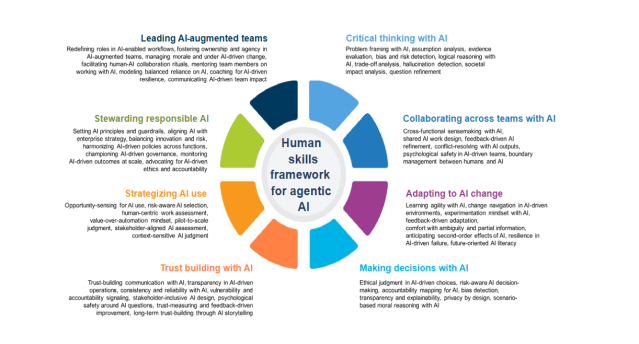
The IDC Human Skills Framework for Agentic AI identifies eight clusters of human capability that organizations need to build now. Each cluster unpacks into specific, trainable subskills, the kind IT leaders can assess, teach and track.

Take critical thinking. The framework breaks it down into problem framing, assumption spotting, hallucination detection, trade-off analysis and metacognition with AI, which is the habit of asking whether AI is quietly shaping your conclusions in ways you haven’t noticed. These are more than just soft skills, or human skills. They are operational disciplines.

The same logic applies to decision-making with AI. Leaders need to be able to map accountability for AI-driven choices, recognize when outputs introduce disparate impact, and make privacy-by-design decisions before agents touch sensitive data. The framework calls these out as distinct, learnable behaviors. They matter because humans must remain in the lead. But if they lack the analytical judgement to know when to accept AI outputs or push back on them, AI becomes just a mechanism for making bad decisions faster.

Human judgement is a guardrail

Most organizations think of AI guardrails as a technical problem, something the model team or the platform vendor handles. The IDC framework pushes back on that assumption.

Human judgment is a guardrail. When an agent recommends a configuration change and a senior engineer signs off without questioning the logic chain, that’s a failure of critical thinking. It has nothing to do with the model. When a team can’t explain an AI-assisted decision to a skeptical regulator, that’s a trust-building failure, not a communications problem.

The framework is built on the premise that humans need to be explicitly trained to catch the things AI will miss. And they must do it consistently, not just when they happen to be paying attention.

The hybrid role gap

Organizations are already creating hybrid roles that sit across IT, operations and the business. IDC is seeing the rise of workflow orchestrators, risk monitors, human-agent collaboration leads. These roles typically get staffed with strong technologists. The problem is that the skills those roles actually require (facilitation, change management, cross-functional sensemaking, storytelling) often aren’t part of a technologist’s development path.

The framework gives HR and L&D leaders a map for closing that gap intentionally. Because it’s modular, it can plug into existing competency models rather than requiring organizations to start from scratch.

Saying no is a skill, too. Employees need the discipline to decline AI-driven solutions that are too risky, too irrelevant and don’t fit the context. That is a trainable behavior that appears in the framework under the strategizing AI use cluster, alongside opportunity-sensing and pilot-to-scale judgment.

The inclusion is deliberate. Organizations stuck in perpetual proof-of-concept mode, or chasing automation for automation’s sake, need leaders who can push back on bad AI ideas as clearly as they can champion good ones. That requires analytical judgment.

What to do with it

The framework isn’t meant to be read once and filed. IDC’s guidance for technology buyers, appended to the research, emphasizes keeping it alive. As AI agents grow more capable and new use cases emerge, the skills and training examples need to update alongside them. A static competency model will age out fast.

The practical starting point: map a small set of critical behaviors to specific AI use cases. Avoid long competency lists. Equip managers to coach employees on AI use day to day in the flow of work. That’s a lot more effective than just pointing people toward courses. Build cross-functional squads that experiment with AI workflows and share what they learn.

The central bet the framework makes is that organizations succeeding with agentic AI won’t be the ones with the most sophisticated models. They’ll be the ones whose people know what to do when the model gets it wrong.

Gina Smith, Ph.D

Gina Smith, Ph.D - Senior Research Director, IT Skills for Digital Business

As a Senior Research Director at IDC, Gina Smith produces research in the IT education and skills sector. Her responsibilities include primary research, analysis, and the production of market insights worldwide. The New York Times bestselling author of Apple cofounder Steve Wozniak’s…

Enterprise software has always been built around the assumption that there will be a human sitting at the keyboard. Every design decision, every workflow, every pricing model has been optimized for people interacting with interfaces. That assumption is collapsing faster than most vendors anticipated. Vendors who don’t adapt won’t just lose market share. They’ll become infrastructure.

AI agents don’t care about your UI. They don’t appreciate an elegant dashboard or a well-designed navigation menu. What they need is data access, API depth, and integration reliability. That’s a fundamental shift in what enterprise software is actually for. And the numbers suggest it’s happening faster than most vendors anticipated.

The moment is now

When Anthropic launched the Model Context Protocol (MCP) in November 2024, it recorded roughly 100,000 downloads in its first month, a solid start for a new integration standard. When OpenAI adopted MCP in March 2025, monthly downloads jumped to 22 million within weeks. A more than two-hundred-fold increase in a matter of days. That’s not the adoption curve of an interesting experiment. That’s a standard taking hold.

Several vendors moved quickly. Salesforce launched the Agentforce Sales app inside ChatGPT in open beta in December 2025. Block, Pfizer, and Cloudflare all started running agent-driven workflows in production. The theoretical became operational, and the competitive dynamics of enterprise software reset while some vendors were still debating whether agents were real.

Own the agent or feed it

The most instructive thing happening right now isn’t any single vendor move. It’s the contrast between how different vendors are positioning for an agent-driven world.

Salesforce built Agentforce in 2024 as a proprietary agent harness: running inside the Salesforce ecosystem, optimized for sales and customer service, priced as a premium product. The logic was clean. Own the orchestration layer, control the experience, deepen customer commitment. Then in 2025, they pivoted toward MCP. An Agentforce MCP client entered beta. Salesforce-hosted MCP servers went into beta at Dreamforce in October 2025, with general availability in 2026. The Agentforce Sales app went live inside ChatGPT in December 2025. This is textbook hedging: they want customers in Agentforce, but they know external agents are coming regardless, so they’re making sure Salesforce is in the workflow either way.

Contrast that with a different posture visible across several ERP and back-office vendors: positioning the system of record as the agent destination, not the agent source. The pitch is openness. Rather than racing to own the AI layer, these vendors are investing in clean APIs and MCP compatibility so external agents can call their systems without friction, whatever model or orchestration layer the customer chooses. They’re not betting on owning the agent. They’re betting on being indispensable to it.

Two coherent bets on the same future. One side believes they can own the orchestration layer. The other believes the durable value sits in being the cleanest, most accessible system of record. Both could be right. What matters is that neither is waiting to find out.

From sandbox to production

Adoption at the enterprise level matters because it removes the theoretical from the conversation.

Block built an internal AI agent called Goose, running on MCP, that orchestrates workflows across internal systems and connects data warehouses to internal service registries. Cloudflare built an internally governed MCP platform that lets teams expose internal resources to agents without creating security exposure, with governance built at the protocol layer rather than bolted on afterward. Enterprises across financial services and life sciences are using MCP servers for controlled agent access to sensitive data under the same architecture. This pattern keeps surfacing: agents at the orchestration layer, enterprise systems as the data and execution layer, humans reviewing outputs rather than executing workflows.

These aren’t proofs of concept. They’re production deployments at sophisticated organizations. That pattern is consistent enough to call it a new architecture for enterprise computing, not just a trend.

The UX moat is gone

If agents become the primary orchestration layer (and the current trajectory points there), competitive advantage in enterprise software shifts from interface quality to data quality and API comprehensiveness.

A cross-application agent coordinating work across CRM, ERP, and HCM systems isn’t choosing platforms based on how they look. It’s choosing them based on how reliably they expose their capabilities and how trustworthy their data is. That’s existential for vendors whose moats are built on UX. And it forces a rethink of pricing, go-to-market, and product strategy from the ground up. If the primary user of your platform might be an AI rather than a human, who are you selling to? How do you price when consumption is driven by agent calls rather than seat count? These aren’t hypothetical future problems. Forward-looking vendors are working through them right now.

Make the call before the market does

Vendors best positioned for this shift are investing in API depth, clean data models, and MCP compatibility, and making a clear call on whether they want to own the orchestration layer or be the best-in-class system agents call. The vendors most exposed are still competing primarily on interface, without a coherent answer to the agent question.

The deeper divide: which vendors become the nerve center of the agent era, and which become the infrastructure those agents run on? Both are viable businesses. But they require completely different product strategies, pricing models, and customer relationships.

The window to make that choice deliberately is closing. Vendors who wait for the market to decide will find the decision has already been made.

Eric Newmark

Eric Newmark - Group Vice President & General Manager of IDC's SaaS, Enterprise Software, CX and Workplace Solutions Division

Eric Newmark is Group Vice President & General Manager of IDC’s SaaS, Enterprise Software, CX, and Workplace Solutions Division, which includes several teams of analysts covering SaaS, 18 enterprise application markets, software monetization, business platforms, marketplaces, and services firms focused…

There is no shortage of ways to get an answer quickly. A question into ChatGPT, a search across a few analyst portals, a summary pulled from a PDF someone emailed three weeks ago. In under ten minutes, you have something that looks like intelligence. 

The problem is what happens next. When that answer gets questioned, challenged, or presented to a board that wants to know where it came from. 

This is the AI answer gap: the widening distance between the speed at which AI tools can produce answers and the standard to which those answers must be held in real decision-making environments. It is not a technology problem. It is a structural one. And it is getting harder to ignore. 

Three failures hiding inside one problem 

The AI answer gap isn’t a single breakdown. It’s three distinct failures that tend to travel together, and that compound each other when they do. 

The speed-to-answer gap 

When a critical decision arrives: a market entry call, a board presentation, a competitive repositioning. How long does it actually take your team to ground it in trusted, defensible research? For most organizations, the honest answer is longer than it should be. 

In IDC’s conversations with enterprise technology leaders, the time between a strategic question and a confident, evidence-based answer is consistently measured in days or weeks, not hours. Teams spend that time searching: pulling reports, cross-referencing sources, building a coherent picture from fragments. 

The cost isn’t just time. It’s the decisions that get made on incomplete intelligence. 

The AI credibility crisis 

The intuitive fix is to use AI to speed up the research process. That introduces a second problem the first one obscures. 

Public AI tools are fast. They are also wrong in ways that are difficult to detect until the moment they matter most. Hallucinated citations. Outdated market data presented as current. Confident summaries of research that doesn’t exist. The pattern is consistent enough that “AI hallucination” has become a standard budget discussion item for enterprise technology teams. 

The deeper issue isn’t accuracy in isolation. It’s accountability. When a technology leader presents a recommendation to the CFO or the board, the question is never just “is this correct?” It’s “where did this come from, and can you defend it?” A fast answer with no traceable source fails that test regardless of whether it happens to be right. 

“An AI backed by IDC’s research gives me a lot more confidence in the answers.”
—
Phillip Langeberg, CTO, The Resorts Companies

Confidence isn’t just about accuracy. It’s about provenance. The ability to say: here is the answer, here is the source, here is the reasoning — and have all three hold up under scrutiny. 

The workflow intelligence barrier 

The third failure is the most underestimated. Even when high-quality intelligence exists: proprietary research, trusted analyst data, validated market sizing. It tends to live somewhere other than where decisions get made. 

A portal that three people have bookmarked. A PDF that gets forwarded by email. A report that someone read six months ago and summarized in a slide deck that may or may not reflect the current version. Intelligence that should be shaping decisions is instead sitting one context switch away from the people who need it. 

The result is a structural gap between the intelligence an organization has access to and the answers that actually inform its decisions. Closing the AI answer gap requires more than better data. It requires rethinking where intelligence lives. 

Why the gap is widening, not closing 

The intuitive assumption is that more AI tools mean better answers. The evidence suggests the opposite is happening. As the number of AI research tools available to enterprise teams has multiplied, so has the complexity of the research environment: more sources to reconcile, more outputs to verify, more decisions about which tool to trust for which type of question. 

Across IDC’s research with enterprise technology organizations, the pattern is consistent: the teams that make the fastest, most confident decisions aren’t the ones with the most tools. They’re the ones whose intelligence infrastructure is the most coherent, where trusted data, workflow integration, and traceability work together rather than separately. 

That’s a design problem. And it’s one that the current generation of AI research tools, built to maximize speed rather than defensibility, hasn’t been designed to solve. 

What closing the AI answer gap requires 

Addressing the AI answer gap doesn’t mean slowing down. It means building toward a different standard, one where speed and defensibility aren’t in tension. 

Three things distinguish intelligence infrastructure that closes the gap from infrastructure that widens it. First, answers need to be traceable: every output should be linkable to a source that can be examined, challenged, and defended. Second, intelligence needs to live where decisions happen, not in a separate system that requires deliberate effort to access. Third, the research base itself needs to be trustworthy at the source: proprietary, current, and built on a methodology that can withstand scrutiny. 

These aren’t aspirational standards. They’re the minimum bar for answers that are usable in a real decision-making environment. The organizations closing the AI answer gap are the ones treating them as requirements, not nice-to-haves. 

The path forward 

The AI answer gap is a structural problem, and structural problems require structural solutions. Adding faster tools to an incoherent intelligence infrastructure doesn’t close the gap. It accelerates it. 

IDC has spent six decades building the proprietary research base that enterprise technology decisions depend on. The next step is making that intelligence accessible where decisions actually happen, embedded in the workflows, the tools, and the moments where the AI answer gap currently lives. 

IDC Quanta is that platform. If you want to stay informed as it launches this summer, the link below takes you there. 

Ryan Smith - Content Marketing Director - IDC

Ryan Smith is the Director of Content Marketing at IDC, where he leads brand-level content and social media strategy, aligning research insights with compelling storytelling to engage technology decision-makers. With a background in both IT and marketing, Ryan brings a unique blend of technical understanding and creative strategy to his work. He’s also a seasoned storyteller, speaker, and podcast host who believes the right message, told the right way, can drive both trust and transformation.

When IDC CEO Lorenzo Larini chose China as one of his first major destinations as a new chief executive, he wasn’t following a script. He was reading the data. 

Four months into his tenure, Larini is heading to Beijing to see firsthand what IDC’s analysts have been tracking for years: a market in a fundamental shift that most Western executives are still processing from a distance. He asked to meet with robotics companies. He wanted to see the technology himself. For Kitty Fok, IDC’s Managing Director in China and a 20-year veteran of the market, that instinct signals something important. 

“The energy in China right now, the innovation, the change since COVID, it is something very different from six years ago,” says Fok. “I really want him to feel that after his visit.” 

If your mental model of China was formed before the pandemic, it is time for an update. 

What does it mean that China is now a technology innovation engine? 

China is no longer just the world’s manufacturing center. It is one of the most active technology innovation markets on the planet, and the products, platforms, and business models coming out of China are already reshaping global competition. 

That transformation was built on three structural forces IDC has tracked across its 77 dedicated China research programs: the scale of China’s manufacturing base, the size of its domestic population and the demand it generates, and the external pressures that have pushed Chinese companies to build solutions from the ground up. 

Chinese vendors now lead globally in smartphones and electric vehicles. Robotics is where this next wave becomes impossible to ignore. IDC’s newly launched research on embodied intelligence projects China’s robotics market growing from $1.4 billion today to $77 billion in five years. That is 94% compound annual growth, every single year. Chinese robots are already shipping to Asia Pacific, Europe, and North America. This is not a future trend. It is already happening. And when you build for a billion people first, export follows naturally.  

Now look at the software layer. Alibaba built one of the most sophisticated e-commerce and logistics networks in the world. TikTok changed how a generation consumes content. And last year, DeepSeek moved global markets. Not because it was built with the most advanced compute infrastructure available, but because it was built without it. 

“We couldn’t get enough GPU from Nvidia because of restrictions,” says Fok. “So we had to change. DeepSeek happened because we didn’t have enough compute power. We had to innovate and create a different algorithm.” 

Necessity is a very effective R&D strategy. Western companies not watching this closely are working from an increasingly incomplete picture. 

What is the Belt and Road Initiative and why does it matter for global business? 

China’s innovation story doesn’t stop at its borders. That’s where the Belt and Road Initiative comes in. 

Modeled on the ancient Silk Road, it is the Chinese government’s coordinated strategy to help Chinese companies expand globally. In practice, the government establishes diplomatic relationships in target markets, state-owned enterprises move in first and build infrastructure, and private Chinese companies follow with a path already cleared. 

“The government itself is meeting with governments along the Silk Road, creating a better environment,” says Fok. “The state-owned enterprises set up infrastructure. Then all the other Chinese companies can go along with that.” 

The result is a wave of Chinese companies entering markets in the Middle East, Africa, and Europe that operate differently from what Western incumbents are used to: greater pricing flexibility, faster customization, and business models most Western companies haven’t encountered before. If you sell into those markets, you have new competition. If you want to reach Chinese enterprises expanding globally, they are actively looking for IT partners who understand their destination markets. Both are opportunities most Western companies haven’t fully accounted for. 

What Western companies get wrong about China 

The most common mistake IDC has observed across decades of working with multinationals is treating China as a sales geography rather than a distinct market. 

“The first mistake is assuming that anything that works in the US can sell in China,” says Fok. “I have seen American companies translate their product catalog into Chinese and hope that it will sell. It does not work like that.” 

China is a hardware-centric market. Even security companies need to sell appliances, not just software. When AI arrived, buyers expected AI devices alongside AI services. The product, the messaging, and the go-to-market approach all need to be built for the market, not translated into it. 

The second mistake is chasing the wrong benchmark. The competitive density in China is real, but a multinational doesn’t need to win it all. 

The key is finding the right slice. IDC helps companies identify their real addressable market in China, not the theoretical total, but the segment where a multinational can realistically compete and win. 

What does IDC uniquely offer for China strategy? 

That ground-level intelligence is what IDC has been building for approximately 40 years in China. IDC was the first foreign company to receive a media license in the country. Kitty Fok has spent 20 of her 30 years at IDC working in the Chinese market. 

Today, IDC operates 77 dedicated China research programs and has more than 70 analysts based in China. IDC’s nearest Western competitor has roughly 20. That presence matters because China is not a single market. Its provinces operate at different levels of maturity, its industries are distributed unevenly, and understanding which segment is addressable for a foreign company requires people talking to buyers and vendors every week, not a global report applied from the outside. 

“Sometimes we need to talk to the headquarters of a multinational to help them understand why China needs a different strategy,” says Fok. “Why it needs to be more than a sales office. That conversation requires local knowledge, not just market data.” 

IDC’s China intelligence works in both directions: helping Western companies enter China with the right strategy, and tracking how Chinese enterprises are expanding globally so Western companies in those markets know what’s coming. 

The signal in Larini’s visit 

Which brings the story back to Lorenzo Larini. 

Japan and China are the two largest single markets for IDC in Asia, and Larini is visiting both within months of taking the role, alongside IDC CFO Tiziana Figliola.  

He’s not just scheduling meetings. He is looking to meet with robotics companies and see the technology firsthand.  

According to Figliola—who lived and worked in China prior to becoming CFO at IDC— making this visit with Larini is a signal of how seriously IDC is weighing China as a driver of its next phase of growth. “What Larini will find is not the China of 2019. The technology is different. The competitive landscape is different. The pace of change is different in ways that are hard to appreciate without being there,” said Figliola.

For Fok, Larini’s visit matters beyond IDC. Since COVID, many Western executives have quietly stepped back from China, and a six-year gap in direct engagement is a long time in a market moving this fast.

That is the invitation for any Western executive weighing a China strategy. Come and see it. And when you are ready to act on what you see, make sure the intelligence behind your decisions comes from people who have been watching this market for decades. 

IDC has 70 analysts in China right now. The data is there. The question is whether you are ready to use it. 

Ryan Smith - Content Marketing Director - IDC

Ryan Smith is the Director of Content Marketing at IDC, where he leads brand-level content and social media strategy, aligning research insights with compelling storytelling to engage technology decision-makers. With a background in both IT and marketing, Ryan brings a unique blend of technical understanding and creative strategy to his work. He’s also a seasoned storyteller, speaker, and podcast host who believes the right message, told the right way, can drive both trust and transformation.

Christina Cardoza - Content Marketing Manager - IDC

Christina Cardoza is a Content Marketing Manager at IDC, where she specializes in brand content and social media strategy. With a background in journalism and editorial leadership, she has a proven ability to transform complex technology topics into clear, actionable insights.

AI is reshaping how partner ecosystems create value. As automation absorbs traditional delivery work, partner-led growth is shifting toward influence, orchestration, and trusted advisory roles. Here’s what ecosystem leaders need to know for 2026. 

Artificial intelligence (AI) has moved from experiment to operating reality across the technology ecosystem. Models are scaling fast, agents are being embedded into platforms, and automation is absorbing activities that partners have historically delivered as billable services. For ecosystem leaders, this has created an uncomfortable question: where does partner value sit in an AI-driven world – and how does growth happen next? 

The short answer is that partners are not being disintermediated. But their role is being fundamentally rewritten. 

Across IDC’s 2026 partnering ecosystem research, partner advisory board discussions, and recent market analysis, a consistent pattern is emerging. AI is not eliminating partners – it is reshaping where, when, and how value is created across the ecosystem. This shift is happening faster than many organizations’ partner models, metrics, and engagement structures can keep up with. 

How AI Is Shifting Partner Value from Delivery to Decision Influence 

One of the clearest signals we see is that AI is absorbing many traditional partner value activities: configuration, basic implementation, tier-one support, and even elements of solution design. Agentic systems and AI-driven service layers are reducing friction and cost in these areas – but they are also compressing margins and undermining longstanding partner revenue assumptions. 

At the same time, customer expectations are changing just as quickly. Buyers are no longer navigating linear vendor-to-partner journeys, or making decisions through a single buying role. Instead, buying journeys are fragmented, non-linear, and shaped by multiple stakeholders across IT, business, finance, and operations. 

Influence is spread across a blend of direct and indirect touchpoints – platforms, marketplaces, peer communities, embedded AI recommendations, and trusted advisory relationships that cut across suppliers and traditional channel boundaries. 

In this environment, execution alone is no longer a sufficient source of partner differentiation. 

What customers increasingly need is help deciding where and how to apply AI, how to control risk and cost, how to curate models and agents, and how to operationalize them inside real business processes. That shifts partner value up the stack – from doing, to guiding; from delivering, to shaping outcomes. 

Why AI Is Raising the Bar for Partner Value in the Ecosystem 

Another consistent theme from partner advisory board discussions is that while AI lowers barriers to entry in some areas, successful AI adoption at customers is anything but “plug and play.” 

AI must be: 

  • Created and adapted for specific business contexts  
  • Curated across multiple models, tools, and platforms  
  • Governed for security, cost, compliance, and performance  
  • Controlled over time as usage, scale, and risk increase 

These are not one-off tasks. They require ongoing judgment, trust, and ecosystem coordination. In practice, this makes the partner role – particularly the trusted advisor role – more critical, not less, as the pace of change accelerates. 

The challenge is that many partner programs and metrics are still optimized for yesterday’s value creation logic: certifications, headcount leverage, implementation scale, or resale volume. As AI reshapes economics, these signals tell an increasingly incomplete story. 

AI-Driven Partner Transformation: What’s Changing in 2026 

All of this points to 2026 as a transition year. Not a collapse of partner models, but a period of accelerated partner transformation. 

We see clear divergence emerging: 

  • Partners who double down on execution alone face margin pressure  
  • Partners who invest in advisory, IP, ecosystem orchestration, and AI control layers are gaining influence  
  • Vendors and platforms that continue to treat all partners the same risk misallocating investment 

The opportunity now is to rethink ecosystem strategy through the lens of buyer influence, value creation, and AI-driven change, rather than legacy program structures. 

Ecosystem Strategy in 2026: Key Trends and Insights 

In our upcoming webinar, Ecosystem Strategy in 2026: Turning AI Disruption into Partner-Led Growth, IDC will bring together: 

  • 2026 partnering ecosystem trends  
  • Real-world partner advisory board insights  
  • Buyer journey and influence models  
  • Practical guidance on where focused ecosystem investment can drive sustainable growth 

This session is designed for leaders across cloud platforms, enterprise SaaS, GSIs, distributors, infrastructure vendors, and AI-driven ecosystems who are shaping partner and growth strategy for the years ahead. 

If you are navigating how AI is reshaping your ecosystem – and where partners fit next – this is a conversation you will not want to miss. 

If you have any questions about anything in this blog, please drop them in here.  

Stuart Wilson

Stuart Wilson - VP, WW Partnering Ecosystems, Alliances and Channels

Stuart Wilson is VP, Worldwide Partnering Ecosystems, Alliances & Channels at IDC. He leads IDC's research and advisory agenda focused on partnering ecosystems, strategic alliances, channels, marketplaces, and ecosystem-led growth. He currently leads IDC's EMEA Partnering Ecosystems research program and…
Andreas Storz

Andreas Storz - Research Director, Software Channels and Ecosystems

Andreas Storz is Research Director for IDC's Software Channels and Ecosystems program. Based in the US, Andreas focuses on the evolution of go-to-market models, new digital value chains and the wider impact on partner ecosystems, exploring how current and future trends will…

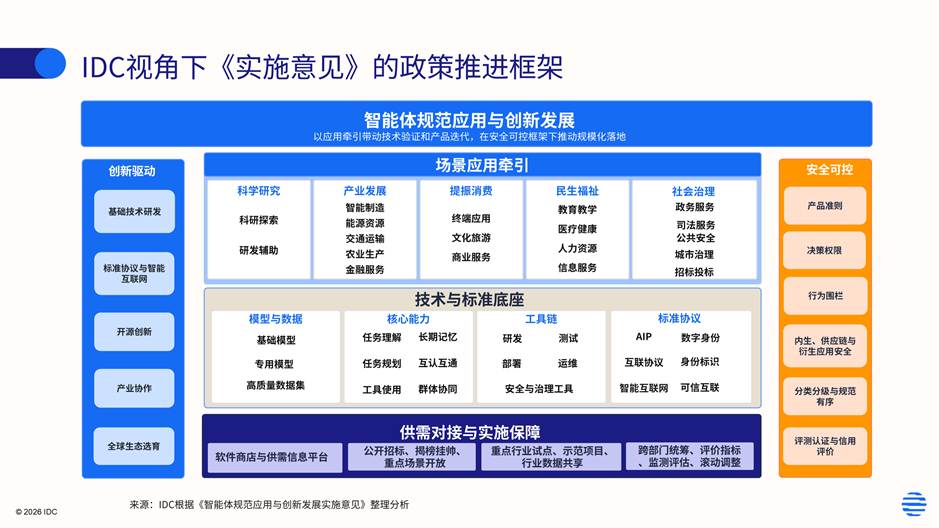
近日,国家网信办、国家发展改革委、工业和信息化部联合印发《智能体规范应用与创新发展实施意见》(以下简称《实施意见》)。这是国家层面首次针对智能体这一人工智能产品形态,给出覆盖技术底座、标准协议、场景应用、安全治理和产业生态的系统性政策框架。这意味着企业级智能体从过去的小规模技术试点阶段,正式进入以治理、协同和规模化为核心的新竞争周期。

从IDC的视角看,《实施意见》把技术底座、安全治理、应用牵引和创新生态构建成了一张全局路线图。技术与标准构成发展基础,分类分级与权限管控划定行为边界,五大类典型场景提供规模化落地入口,开源与供需平台则负责连接研发与市场。

在IDC预测中,2026年和2027年将是是中国企业场景中的活跃智能体数量增速最快的两年,单年同比增长超过200%,并将在2031年达到3.5亿个活跃智能体,2026-2031年CAGR达135.3%(《中国智能体规模预测,2026-2031》)。而《实施意见》这样的智能体国家顶层政策,也将进一步加速智能体走向规模化的应用。

活跃智能体数量增长反映的是企业部署广度,也会直接放大运行、权限、审计和治理压力。一个企业内部只有几个智能体时,治理方法更接近单个项目的管理;当Agent数量进入快速增长周期,治理就会变成IT架构问题。身份、权限、审计、工具调用、异常回退和跨系统协同,都会从项目交付细节变成平台能力要求。

《实施意见》放在这个阶段变化中看,正是把这些问题推到了产业议程前台,也让企业级Agent从小规模试点建设进入更正式的IT治理和产业协同框架。对企业来说,Agent会更快进入正式IT治理体系;对技术供应商来说,产品竞争也会从功能构建,延伸到运行、治理、评测和生态分发能力。

场景牵引推动Agent规模化复制

《实施意见》明确提出,要围绕科学研究、产业发展、提振消费、民生福祉和社会治理五大方向,打造19个典型应用场景。政策并没有停留在技术倡导层面,而是把智能体放进具体的任务环境里,通过典型场景牵引技术验证、产品迭代和应用落地。

智能体与上一阶段生成式AI应用的差别,就在于它需要进入业务环节端到端的完成任务。生成式AI更多围绕内容生成、知识问答和辅助分析展开,智能体则需要调用工具、访问系统、执行动作,并对结果产生影响。只有进入真实业务场景,任务边界、数据条件、系统接口、权限控制和结果责任才会被定义出来,才能真正落地出好用可用的智能体。

当前智能体在企业业务中的渗透率依然较低,仅有18%(IDC Syndicated Survey 2026: China AI Agents Market)。智能体没有在企业业务中真正规模化应用起来,核心在于缺少清晰的切入场景和可复用的落地路径。政策在这个角度提供了场景牵引,通过典型应用场景帮助智能体走向业务落地,并进一步形成规模化应用。

开发平台将会从构建工具延伸为运行和治理底座

《实施意见》在夯实发展基础部分提出,要提升智能体任务理解、任务规划、工具使用、长期记忆等核心能力,推动智能体互认互通和群体协同,同时完善底层框架、功能组件以及研发、测试、部署、运维工具链。

这与IDC观察到的,智能体平台厂商产品迭代的趋势高度吻合。2025年头部平台的产品形态已经从单纯的开发工具演进为涵盖规划、开发、测试、发布、观测、优化、治理的完整系统,企业也越来越关注智能体深入业务后,智能体是否是否可观测可治理,以及如何确保智能体执行任务的稳定性安全性(具体见IDC即将发布的《中国智能体开发平台市场份额,2025》中的重大市场变化章节);同时,智能体规模化进入企业之后,企业内部多种来源的智能体(应用内智能体、低无代码配置智能体、独立智能体、定制智能体)如何统一管理和协同也会成为企业下一个阶段的关键需求。

《实施意见》中关于工具链、互认互通、群体协同的部署,将把这些工程化能力进一步推向产品标配。这些要求会转化为智能体开发、测试、运行、观测和治理的一整套工程能力,并逐步沉淀为智能体开发平台的核心竞争力。

安全治理成为Agent进入业务流程的准入条件

《实施意见》用相当篇幅讨论产品准则、决策权限、行为管控、内生安全、供应链安全、应用衍生风险、分类分级治理与合规服务体系。安全合规既是政策关注的重点,也是企业实际落地中的关键门槛。IDC在2026年最新智能体调研中发现,62%的企业把数据权限与安全合规列为智能体跨系统执行的首要障碍;而在智能体平台引入目标上,58.7%的企业把治理与合规放在首位(IDC Syndicated Survey 2026)。

智能体只有安全可控,才能正在被企业放心的纳入业务流程中。因此智能体的权限治理、行为审计、决策追溯、安全护栏等能力需逐渐的沉淀为智能体或智能体平台的标准能力。在金融、医疗、政务、公共安全等高合规领域,这种能力更是智能体能否落地的前提条件。

标准化分发和生态将重塑智能体产业

《实施意见》在标准协议和创新生态部分提出,要建立智能体标准体系,加强智能体互联协议(AIP)等关键标准推广应用,探索建设智能体注册平台,提供数字身份管理、检索发现、能力声明等服务,并推动智能体软件商店和行业供需信息发布平台建设。

智能体标准体系的成熟会明显推进智能体,尤其是独立智能体的规模化进程。在IDC 2026年初的预测中,独立智能体是增长弹性最高的智能体形态之一,其爆发主要依赖标准协议和智能体生态的成熟(《中国智能体规模预测,2026-2031》)。AIP、注册平台、软件商店和供需平台逐步成型后,独立智能体的构建、分发和使用门槛都会随之下降,独立智能体尤其是像Xclaw这类智能体产品有机会更快进入企业规模化应用场景中。

行动建议

面向企业用户

  • 把安全治理能力列为智能体规模化前置条件。 企业应尽早建立场景分级、任务边界和权限管理机制。在金融、医疗、政务等高合规领域,应参考政策要求提前规划备案、检测、安全评估以及第三方权威评测,低风险场景也应建立合规自测和风险报告机制。
  • 建设智能体统一运营和协同体系。随着智能体的规模化应用,企业内部将同时存在多类智能体,因此企业在平台选型和架构规划中,需要提前考虑智能体注册、统一身份、统一权限、统一审计、统一成本管理和跨智能体协同能力。

面向技术供应商

  • 安全治理需成为产品基础能力。智能体安全治理相关的决策权限边界、行为管控、最小权限、全链路审计、异常检测和回滚机制等能力,会逐步成为企业采购时的核心指标。
  • 建立智能体全生命周期能力。智能体全生命周期涉及到的开发、测试、部署、运行、评测、优化和治理等均需建立起相应的平台级能力,为未来企业级智能体规模化运营提供支撑。
  • 构建异构智能体的统一管理能力。智能体规模化时代,企业智能体的来源多样,平台需要建立统一的智能体身份、权限、审计、成本和调度能力,帮助企业把分散的智能体管起来,建设企业级的智能体运行和治理入口。
  • 关注智能体标准协议和平台商店的建设。AIP、智能体注册平台、软件商店和供需平台会推动智能体的标准化分发。建议厂商提前规划产品路线,并参考政策要求开展第三方功能、性能、质量与合规评测。

分析师观点

孙振亚,IDC中国分析师:《IDC中国研究经理孙振亚表示,《实施意见》的出台,标志着中国智能体产业从技术和市场自发探索,进入政策框架下的规模化扩张阶段。政策一方面通过分类分级、决策权限、行为管控和合规服务体系,为企业部署智能体提供可预期的合规路径;另一方面通过标准协议、注册平台、软件商店、第三方评测和供需对接机制,为智能体走向跨系统协作和产品化分发铺设了基础设施。

与IDC同行,抢占智能体规模化的战略先机

《实施意见》的发布,标志着企业级智能体正式进入治理驱动、生态协同的新阶段。但对企业来说,仍然存在诸如“如何在自己的行业与业务中,识别高价值的智能体场景”、“如何在平台选型、安全治理、标准化对接等关键决策上少走弯路”等现实挑战。

IDC长期追踪全球与中国智能体市场的发展脉动,拥有覆盖技术供应商、企业用户、投资机构的多维研究体系。已发布《中国Agent基础设施平台/执行平台技术评估,2026》、《中国智能体规模预测,2026—2031》、《IDC Market Glance:中国AI Agent市场概览,1Q26》等智能体报告,即将发布《Agent企业最佳实践与场景精选(ROI视角)》、《中国智能体开发平台市场份额,2025》、以及针对Xclaw产品进行评估的《企业级通用Agent助手评估》等一系列重磅报告,并可为企业提供定制化的场景评估、平台选型与治理成熟度诊断服务。

欢迎您联系IDC中国智能体研究团队,获取最新研究成果,或与分析师进行交流。让我们助您在智能体规模化的浪潮中,走得更稳、更快、更远。

请点击此处与我们联系。

Zhenya Sun

Zhenya Sun - Research Manager

Zhenya Sun is a research manager for the IDC team focused on exploring the application of technology and industrial development of AI and AI agents. He is also responsible for providing clients with consulting services on technologies, products, and markets…

视角决定格局。​若仍将公有云安全视作单一的技术模块,便无法窥见其真正的战略全貌。

IDC 2025全球数据指明:公有云安全已跨越单纯的合规门槛,跃升为企业的数字生存底座。​ 它不再是隐匿于防火墙之后的附属插件,而是支撑AI规模化落地、护航业务出海、乃至抵御周期波动的核心底层资产。

三个信号值得认真对待:

  • 信号一:全球公有云安全支出超1100亿美元,增速超20%,是IT支出中最坚硬的赛道
  • 信号二:中国市场云安全收入增速普遍高于云基础设施本身增速,客户正在从为资源付费向为安全付费跨越
  • 信号三:随着AI业务场景的深化,云原生安全已成为大模型落地的隐性门槛,若缺乏深度集成的原生安全体系,企业很难安心地将高价值数据与应用托管其上

一、全球浪潮:安全正在重新定义云的价值

站在2026年的时间节点回看,公有云早已不再仅仅是企业的外挂资源,而是数字化生存的电力系统。

2025年,全球企业正在混合云和多云架构中疯狂奔跑,全球公有云安全市场连续多年保持每年20%以上增速,2025年支出飙升至1100亿美元。

在全球范围内,AWS、Microsoft Azure和Google Cloud等头部玩家正经历着前所未有的技术迭代。他们不再仅仅提供安全插件,而是通过硬件级隔离、身份边界重塑以及AI驱动的情报分析,将安全深度嵌入云原生底座。

与此同时,以Palo Alto Networks、CrowdStrike、Wiz和Zscaler为代表的安全巨头也在快速进化。他们正推动从单一工具向CNAPP云原生应用保护平台和代码到云(Code-to-Cloud)的统一平台转型,试图在多云环境中建立一道跨厂商、自动化的全栈防御屏障。

在这场技术长跑中,谁能率先解决复杂环境下的可见性真空,谁就将定义下一个十年的云安全标准。

二、中国实践:快速跟进与创新,但仍有差距

2025年,中国云计算市场规模持续扩大,云安全产品的营收增速普遍高于云基础设施本身的增速,显示出客户从买资源向买安全的意识跨越。

作为国内市场的领头羊,阿里云已将其安全产品线全面推向智能体时代,通过升级Agentic SOC,利用大模型实现了超过80%的安全事件自动响应。华为云演进为AI原生安全架构,通过其安全大模型实现对AI算力集群的实时监测。腾讯云充分发挥攻防领域的深厚沉淀,在内容风控、反欺诈、DDoS高防等领域形成了极高的市场占有率。

传统网安巨头正通过云地协同战略,在云安全管理平台C-SOC市场占据核心位置。深信服、奇安信等厂商通过与公有云厂商的深度技术绑定,成功实现了从卖防火墙硬件到卖云安全服务的转型。

但不可忽视的是,相比于全球安全厂商,中国安全厂商目前在公有云安全市场仍需发力。虽然在私有云和特定业务场景中展现了卓越的实战能力,但在全球化的SaaS安全标准、跨云的Agentless治理精度、以及安全左移的代码级闭环上,国内厂商仍有巨大的进阶空间。

三、商业启示:为什么公有云安全是好生意

海外巨头的成功路径为中国厂商提供了极具诱惑力的商业模板:

极致的用户粘性

安全业务之所以具备IT板块中最高的粘性,是因为它正逐渐从外部挂载的锁具演变为深度嵌入企业架构的神经系统。一旦部署,更换安全供应商不再是简单的卸载与重装,而是一场涉及底层策略重写、合规记录迁移以及全员操作习惯重塑的伤筋动骨式手术。

抵御周期的现金流

与传统网络安全硬件的订单式生存不同,Wiz和CrowdStrike的成功路径证明了SaaS化订阅模式在资本市场中的统治力。这种模式具有极强的抗周期属性,即便在经济下行期,企业可能会削减新员工入职或新业务线扩张,但绝不敢轻易关掉云端的安全防护。

掌握AI与全球化的通行证

在当前的全球技术格局下,拥有顶级的云安全能力已不再仅仅是为了防御黑客,它更是企业进军AI云和全球化市场的入场券。只有具备原生云安全能力的厂商,才能解决大模型在云端训练、推理过程中的数据投毒和提示词注入风险。中国厂商若能构建起符合国际主流标准的云安全体系,本质上就是为中国企业的全球化交付提供了一套合规标准化的底座。

四、IDC:不止于数据,更是决策指南

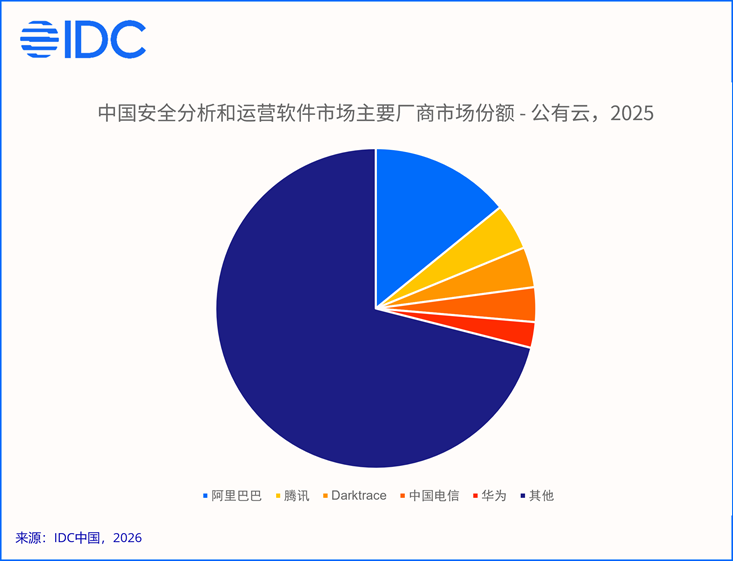
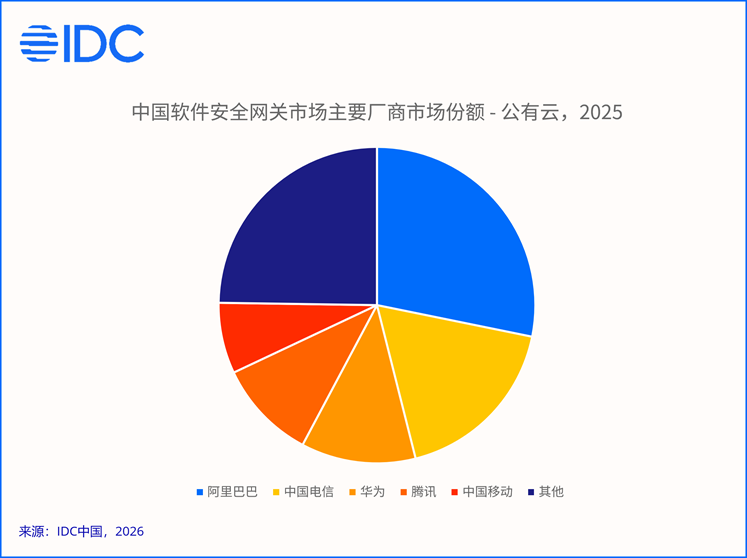
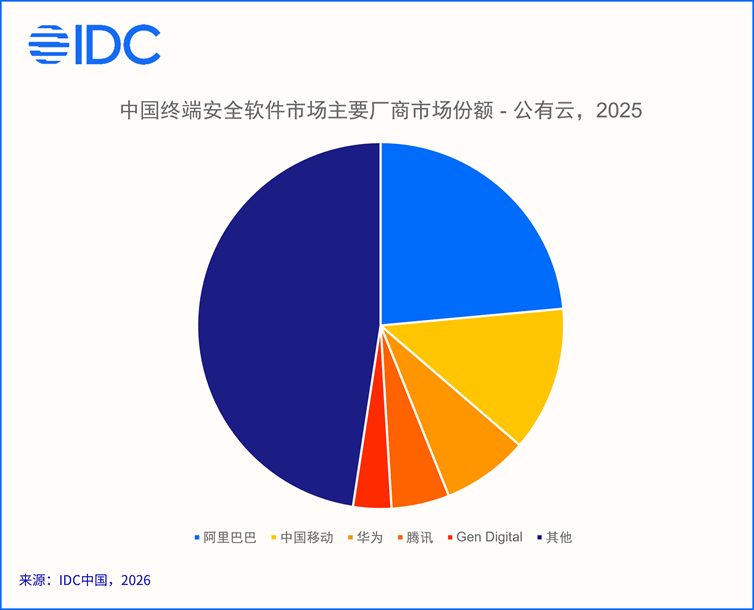
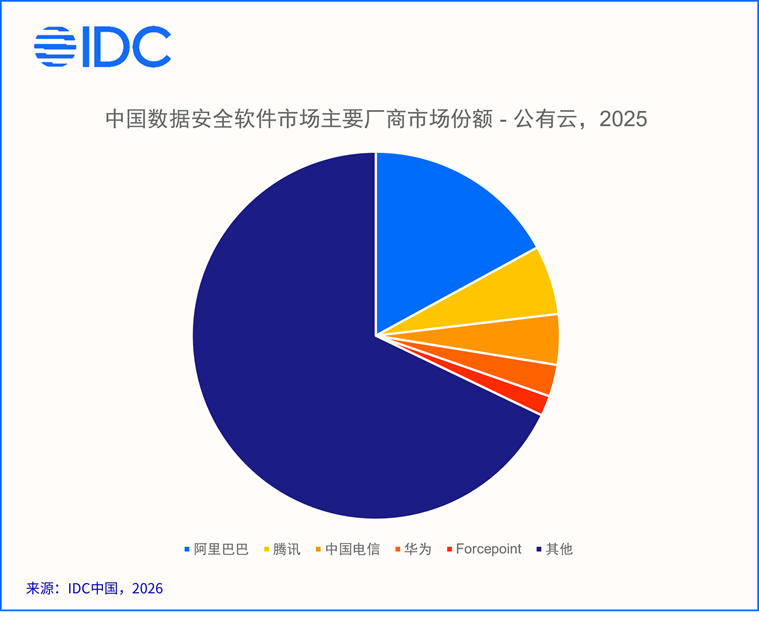
IDC已发布 《IDC中国半年度安全软件数据跟踪报告——公有云,2025H2》,其中包含公有云部署模式下的数据安全软件、终端安全软件、身份和访问控制软件、软件安全网关、安全分析和运营软件、漏洞管理软件等子市场的厂商数据跟踪。

上述商业逻辑的兑现,最终需要落地到真实的市场数据中加以验证。化繁为简,洞见未来。 本次报告透过公有云安全市场不同赛道中的厂商营收数据,为您剥离噪音、还原真相,助您在复杂的市场环境中精准锚定业务增长点与投资机遇。无论您是寻求赛道突围的企业,还是布局未来的投资者,皆能在此获取专属的行动指南。

具体而言,可以为不同角色的参与者提供以下支持——

云厂商:帮助您精准识别自身安全产品的市场位次,明确自身赛道定位与竞争位置。

安全厂商:帮助您应找准生态位,重点锚定高增长赛道,避免无效内卷;同时积极融入头部云厂商生态,通过技术集成与联运合作,借助云市场流量触达客户。

企业客户:为您提供了客观的供应商评价维度,帮助 CIO 识别哪些厂商在特定公有云安全领域具备长期投入和领先地位。

投资机构:报告是评估公有云安全景气度的核心参考,能够清晰展现公有云安全市场的天花板及各子市场的集中度,利用数据降低因信息不对称导致的投资偏差。

结语

公有云安全已经完成了从附加品到必需品的身份蜕变。在客户从买资源向买安全的意识跨越中,IDC 将持续通过系统性的研究,助力每一位参与者:看清坐标、捕捉先机、定义未来。

欢迎广大云厂商和安全厂商关注IDC公有云安全系列研究,如需进一步沟通或获取深度数据与战略洞察,请与IDC联系。

请点击此处与我们联系。

Joe Zhao

Joe Zhao - Senior Research Manager

Joe Zhao is a senior research manager of Enterprise Research for IDC China. He focuses on research and analysis of the China security market. Joe has more than 12 years of domestic and international work experience in ICT. Prior to…

2026年CHIMA大会上,一个变化已经非常明确:医疗行业的讨论重心,正在从大模型快速转向智能体。过去两年,行业关注的是模型参数、多模态能力、医学问答准确率,本质上是在验证“模型是否足够强”;而今年,几乎所有厂商都开始展示智慧诊疗、智慧服务、智慧运营等智能体矩阵,并强调与HIS、EMR、医保等核心系统的融合能力。

IDC认为,当前医疗AI最大的鸿沟已经不是模型能力,而是医院现有体系“接不住”智能体。行业竞争正从技术竞赛,转向流程、组织与承接能力的落地竞赛。

本文基于CHIMA 2026观察,IDC指出:技术供给已超前于医院承接能力;未来医疗AI的竞争,谁能够率先帮助医院构建Agent-ready的能力体系。

CHIMA释放新信号:医疗AI全面从“模型竞赛”转向“落地竞赛”

此次展会中,互联网平台、AI创业公司、基础设施厂商、安全厂商大量涌入医疗市场,行业从模型的参数比拼迅速转向Agent开发。许多厂商甚至已经不再强调自研医疗大模型,而是直接基于通用模型构建医疗智能体。会场中,各类智慧医院、AI中枢、全场景智能体方案层出不穷。

这意味着,医疗AI已经进入新的阶段。行业竞争正在从技术能力竞赛,转向围绕业务闭环、流程协同与组织能力的落地竞赛。

智能体落地,厂商与医院之间存在巨大的“数字鸿沟”

相对于展会上技术厂商层出不穷的智能体产品,医院关注的问题却依旧十分现实。纵观大会论坛与议题,医院讨论最多的仍然是数据治理、系统集成、算力不足、网络安全、医保合规等基础问题。相比厂商描绘的“全面智能化”,医院更关心的是系统是否稳定、数据是否打通、流程是否真正可落地。

同时,伴随着医疗大模型走向落地应用,医院用户逐步发现发现,即使模型已经足够强,AI依然很难真正进入核心业务流程。因此,目前医院实际引入的智能体,依然主要集中在病历生成、预问诊、报告解读等非核心场景。

这种明显的供给的错位揭示了当前医疗AI行业最大的矛盾:技术供给正在快速超前,但医院真实需求与承接能力并没有同步成熟。

问题根源:技术供给超前,但医院接不住智能体

过去医院信息化建设的核心目标,是实现业务电子化与线上化,因此形成了以HIS为中心的大量烟囱式系统。这种架构适合传统软件,却不适合智能体的部署及管饭应用。智能体需要实时数据流、跨系统协同、动态推理以及持续决策能力,但当前医院普遍存在数据孤岛、接口割裂、标准不统一的问题。因此,当前智能体落地的主要问题并不在于AI“做不到”,而在于医院体系“接不住”。

跨越鸿沟,构建“Agent-ready的能力”

医疗AI下一阶段的核心问题,已经不再是“还能做出多少Agent”,而是“如何让医院真正接得住Agent”。尤其对于技术厂商而言,下一阶段不应只是推出更多智能体,而是帮助医院构建能够承接智能体持续运行的Agent-ready能力体系。对此,IDC认为应该关注一下几点:

首先,厂商需要从“卖单点AI应用”转向“建设AI基础能力”。厂商需要熟悉医院的基础架构,拓展从底层基础设施到上层应用的全栈技术能力,将重点放在数据治理、统一接口、智能中台与安全体系建设上,帮助医院建立能够支撑多智能体运行的底座能力。

其次,短期聚焦高ROI场景,形成可量化的价值。在预算收紧的背景下,医院对AI的投入将更为审慎。厂商应主动协助医院识别那些流程相对独立、数据标准较高且业务痛点明确的场景,如病历生成、医保审核、医疗质控或患者预问诊,采取点状化的切入方式,率先形成可量化价值,从而推动医院主动升级Agent能力。

与此同时,立足长期发展,重构软件让智能体真正融入医院工作流。当前大部分智能体仍停留在单点工具阶段,但未来医院真正需要的,将是能够跨系统、跨科室协同运行的智能体网络,需要将智能体与软件深度交融。因此,厂商需要率先从软件设计底层进行变更,并加一验证,才更有可能成为下一阶段医疗AI市场的核心玩家。

最后,主动成为医疗用户的同行者。一方面,建立“临床+信息中心+厂商”的联合共创机制,主动帮助医院洞察痛点,个性化定制智能体,解决医院的实际问题;另一方面,构建多元化的合作模式,主动解决医院信息化预算短缺的问题,形成更可持续化的付费模式。

未来医疗AI的竞争,谁能够真正帮助医院完成智能化转型

因此,CHIMA 2026最重要的意义,并不是“智能体全面爆发”,而是行业开始意识到:医疗AI的核心挑战,已经从模型问题,转向流程问题、组织问题与体系问题。这也意味着,未来行业竞争的焦点,将不再是谁拥有更多Agent或更大的模型,而是谁能够真正帮助医院完成智能化转型。

本文与IDC研究报告
本文基于CHIMA 2026的一线观察,回答一个问题:为什么医院现在需要认真对待医疗大模型与智能体的落地?
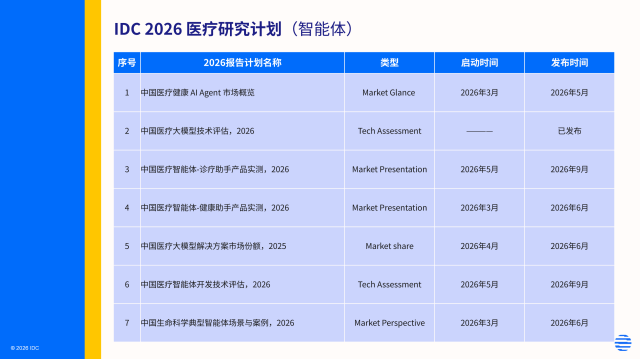
而关于“谁家的技术更强、如何评估、如何选型”的系统性答案,请参见IDC已发布的《中国医疗大模型技术评估,2026》(Doc# CHC53377725,2026年4月)报行。旨在帮助医院读者理解报告的背景、建立思考框架、明确自身准备工作的方向:

  • 主要医疗大模型厂商的技术能力深度对比
  • 分场景(病历、医保、质控、患者服务)的能力评估
  • 可解释性、幻觉控制、系统集成等关键维度的实测分析
  • 医院选型建议与ROI参考框架

IDC更多相关研究:

这一跨越是一场从底层到上层应用的整体变革,当前市场正处在从智能体的点状式应用到全面智能体化的转折期。作为行业的观察者,在迎接医疗智能体的全面到来之际,IDC也将研究也将聚焦智能体话题:

医疗AI正从模型能力竞争进入落地能力竞争的新阶段。IDC将持续跟踪智能体在医疗场景中的演进路径、组织适配与价值评估。如需了解报告更多信息,或就医疗AI落地策略、智能体成熟度评估、医院数字化转型路径等进行深度交流,欢迎与IDC联系。

请点击此处与我们联系。