Yanxia Lu is a research director, focusing on big data and artificial intelligence (AI). Her responsibilities include big data information management platform, and big data analytics and applications. She is also involved in research on AI technology and enterprise…
The foundational question for any vendor or service provider operating in Japan’s technology market today is no longer whether AI infrastructure will grow. That is settled. The question is how fast, in what form, and most importantly who will capture the value as Japan’s AI infrastructure market, consisting of servers and storage for AI, approaches and surpasses the ¥1 trillion threshold.
IDC’s latest data and forecasts provide a clear-eyed answer. What follows is the strategic view every vendor in this ecosystem needs to understand.
The road to ¥1 trillion: Three milestones that define the opportunity
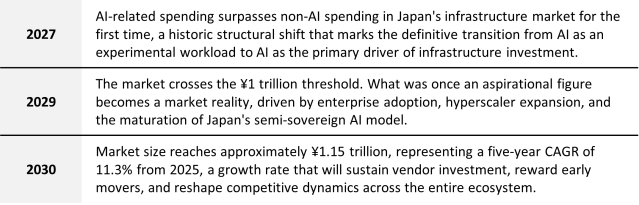
IDC projects Japan’s AI infrastructure market will follow a clear and compelling trajectory over the next five years. Three milestones stand out:
These are not optimistic projections. They are grounded in structural forces – government policy, enterprise digitalization pressure, hyperscaler commitments, and the irreversible integration of AI into Japan’s economic fabric – that show no signs of reversing.
Where we are today: The foundation that makes this possible
To appreciate the scale of what lies ahead, it helps to understand how quickly Japan’s AI infrastructure market has already moved. In 2025, the domestic market reached ¥670 billion. For accelerator-equipped servers alone, the three-year CAGR from 2023 to 2025 approached 200%, significantly outpacing the global average.
This growth was not accidental. It was driven by a deliberate convergence of government economic security policy and domestic capital mobilization. Under cloud-related policy frameworks designed to advance Japan’s technological sovereignty, domestically capitalized service providers and telecommunications carriers launched large-scale AI infrastructure buildouts at a pace rarely seen in the Japanese market.
Physically, the transformation is equally striking. Rack-scale systems and multi-rack liquid-cooled configurations are becoming the new standard. What was once a 2U GPU server is evolving into an infrastructure architecture where entire data centers are purpose-designed around AI workloads. The ¥670 billion market of 2025 is built on this foundation, and the ¥1 trillion market of 2030 will be built on what comes next.
The structural dynamics vendors must understand
Japan’s AI infrastructure market in 2025 is heavily concentrated in service providers, who accounted for 90.6% of total market spend. With that figure, three dynamics will shape the competitive landscape through 2030:
Hyperscalers will continue to expand. Their investment share surged from 39.8% in 2022 to 58.9% in 2025, a 19-point gain in three years. Alignment with hyperscaler platforms and roadmaps will remain a prerequisite for relevance in this market.
Domestic service providers will remain strategically critical. Other service providers including policy-backed Japanese service providers and telcos held 31.6% share in 2025, essentially unchanged from 31.8% in 2022 despite the hyperscaler surge. This is a resilient customer segment that values local trust, regulatory compliance, and sustained partnership over pure price competition.
Enterprise direct investment is the next growth frontier. At 9.4% of the market today, enterprise direct AI infrastructure investment has more than doubled in absolute terms since 2022, yet it remains nascent. Most large enterprises currently consume AI through generative AI services and SaaS platforms. As enterprises deepen their AI ambitions and move from consumption to ownership, direct infrastructure investment will accelerate. Vendors who build enterprise relationships now will be best positioned to capture this wave.
The semi-sovereign AI model: Japan’s defining strategic architecture
In April 2026, Microsoft announced plans to invest approximately ¥1.6 trillion in Japan between 2026 and 2029. Alongside this commitment came a plan to make AI infrastructure operated domestically by two partner companies available through Microsoft Azure, domestically built and owned infrastructure, connected to a global hyperscaler’s service layer.
This is what IDC describes as “Semi-Sovereign AI” and it is rapidly emerging as the defining model for AI infrastructure strategy in Japan. It represents a pragmatic and politically viable middle path: neither complete dependency on foreign hyperscalers, nor the prohibitive cost of fully independent domestic AI capability.
For vendors, this model is not a constraint. It is a structural opportunity. Semi-Sovereign AI creates a rich and expanding set of market roles in infrastructure design, systems integration, managed services, compliance, and the development of Japan-specific AI platforms. The vendors and integrators who understand this model deeply, and position themselves within it deliberately, will define the competitive landscape of Japan’s AI infrastructure market through 2030 and beyond.
What this means for vendors: Act now, not later
The policy-driven supply wave that built Japan’s AI infrastructure base is transitioning into a demand-driven growth phase. The central question is no longer whether the infrastructure exists, it does. The question is who helps enterprises put it to work, at scale, in ways that generate measurable business value. Three imperatives stand out for vendors competing in this market:
Accelerate enterprise engagement. The 9.4% enterprise share of today is the growth story of tomorrow. Vendors who invest in enterprise relationships, Japan-specific use cases, and ROI demonstration frameworks now will be positioned to ride the most significant demand wave of the decade.
Align with the Semi-Sovereign AI model. Understanding the interplay between domestic infrastructure owners, hyperscaler service layers, and government policy frameworks is not optional background knowledge. It is the strategic map for winning in this market.
Build for depth, not just scale. Japan’s market rewards vendors who demonstrate sustained local commitment, deep technical expertise, and an understanding of Japanese enterprise culture. The ¥1 trillion opportunity will not be captured by volume alone.
Shinya Kato is a Senior Research Manager at IDC Japan and is responsible for the data analysis and forecasting team of Japan enterprise infrastructure market. He analyzes the impact of product technology, service offerings, and marketing strategies on enterprise infrastructure market and provides market forecasts, focusing on the domestic enterprise storage systems market.
Through understanding technology adoption trends, he also provides insight into emerging devices such as flash, accelerators, and quantum computing. In addition to researching the HPC and AI infrastructure markets, he is also investigating new consumption models such as Hardware-as-a-Service, to help stimulate the market.
Prior to joining IDC, he spent more than 10 years at Silicon Graphics, which was later acquired by HPE, where he held various domestic positions in sales, marketing, and business development. He has covered a wide range of businesses, from infrastructure hardware and container-based data center facilities to digital asset management, industrial virtual reality, and software for media & entertainment. He also served as a product manager for enterprise internet security software and appliances at the emerging vendor.
He holds a Bachelor of Economics degree from Rikkyo University.
The Middle East War is no longer just a regional risk for technology leaders. It is becoming a global economic stress test — affecting energy prices, supply chains, inflation, business confidence, and IT budget decisions across Asia Pacific.
For CIOs, CFOs, and technology suppliers, the question is not simply whether IT spending will continue to grow in 2026. The sharper question is: which investments will still earn approval when volatility hits the budget?
That is the central signal from IDC’s latest webinar, Asia Pacific IT Spending Outlook 2026: Where to Win Amid Market Volatility. The market is not freezing. It is filtering.
In Asia Pacific, those pressures are showing up in practical ways. Higher oil and electricity costs can raise operating expenses. Supply chain disruption can increase hardware costs and delay availability. Currency and pricing pressure can make approvals harder. As uncertainty rises, organizations move faster into contingency planning.
The first effect is not always a budget cut. More often, it is hesitation. Organizations start asking which projects are necessary, which can be phased, and which need to prove value faster.
As I noted during the webinar:“IT spending is likely to remain more resilient than in previous downturns because AI investment continues to support both the IT industry and broader economic growth.”
Resilience matters. It keeps the outlook from becoming a slowdown story. But resilience does not remove risk. The longer energy prices and supply chain disruption remain elevated, the more likely selective delays become targeted cuts.
Budget rotation is the signal
The most important shift is not how much organizations spend, but what they are willing to defend.
In a more volatile environment, buyers are becoming more risk-averse. ROI thresholds are rising. Procurement cycles involve more stakeholders. Vendors are seeing longer deal cycles, greater pricing pressure, and less predictable pipelines.
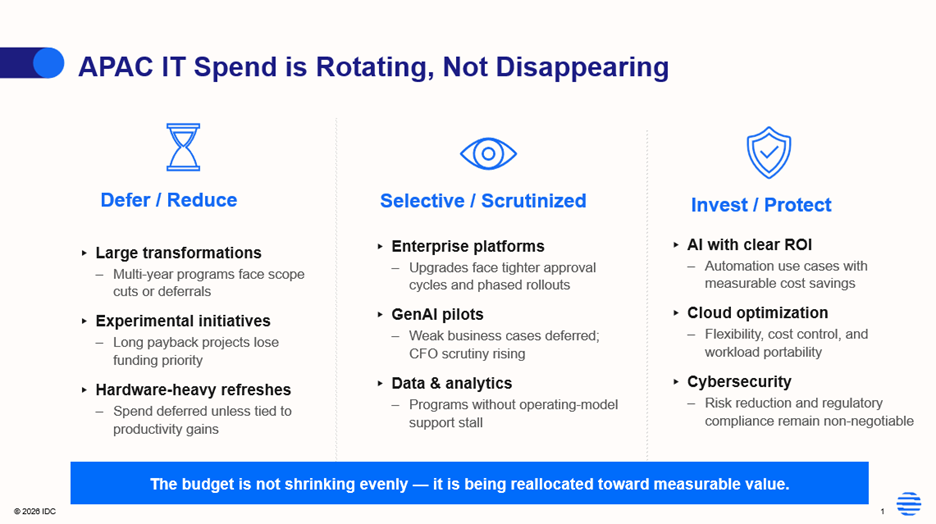
The visual above captures the core market signal: APAC IT spend is rotating, not disappearing.
Large transformations, experimental initiatives, and hardware-heavy refreshes are more likely to be deferred or reduced unless they are directly tied to productivity gains. Enterprise platform upgrades, GenAI pilots, and data and analytics programs are still in play, but they face tighter scrutiny and phased rollouts.
What remains protected? Investments tied to measurable outcomes. AI with clear ROI. Cloud optimization that supports flexibility and cost control. Cybersecurity that reduces risk and supports regulatory compliance. Infrastructure resiliency that helps organizations absorb disruption.
My colleague Vinayaka Venkatesh, summarized the shift directly:“The deals are not disappearing, but they are taking longer and require more effort to close.”
For technology suppliers, that line is the market cue. In 2026, vendors will not win by selling transformation in broad terms. They will win by helping buyers make the case for action now.
AI remains resilient, but proof matters more
AI remains central to the Asia Pacific technology agenda. IDC’s Asia/Pacific AI and GenAI spending outlook shows continued growth momentum as organizations invest in automation, productivity, and new business models.
But resilience does not mean every AI project gets a free pass.
One of the more important nuances from the webinar is the gap between AI infrastructure investment and enterprise AI execution. Hyperscalers and service providers continue to invest aggressively in AI infrastructure. At the same time, some enterprise AI initiatives are being de-scoped, delayed, or challenged on measurable outcomes.
This is where the “year of reckoning” for AI becomes real. AI use cases tied to cost savings, automation, customer experience, risk reduction, and operational efficiency will be easier to defend. Weak GenAI pilots, unclear operating models, or projects without a credible path to production will face more scrutiny from CFOs and cross-functional decision-makers.
AI for AI’s sake will not win the next budget cycle. AI with measurable business impact will.
What to remember for H2 2026 planning
As technology leaders plan for the second half of 2026, three takeaways matter most:
1. APAC IT spending is being disrupted, not derailed The Middle East War is creating real pressure through energy costs, inflation, supply chain disruption, and weaker business visibility. But priority investments continue to support the market, especially AI infrastructure, cybersecurity, resiliency, and cloud optimization.
2. Budgets are rotating toward measurable value Lower-priority initiatives, long-payback projects, and unclear business cases are facing delays. Investments that reduce risk, improve efficiency, support compliance, or deliver near-term ROI are better positioned for approval.
3. AI remains resilient, but the proof bar is rising AI investment remains strong, but enterprise projects need clearer outcomes, stronger business cases, and a faster path from pilot to production.
The path forward is not about spending more for the sake of momentum. It is about knowing where to spend, what to protect, and what to pause.
Register for the on-demand webinar
The Middle East War is the shock. Budget rotation is the signal. Measurable value is the next move.
Stephen Minton is a group vice president with the IDC Data & Analytics group, focusing on ICT spending and macroeconomics. Mr. Minton is responsible for Worldwide ICT Spending programs, including the Worldwide Black Book, Worldwide 3rd Platform Spending Guides, and Worldwide Telecom Services Tracker.
Mr. Minton's research expertise includes global ICT and economic analysis, and he tracks market data across hardware, software, services, telecom and emerging technologies. He is the author of papers that focus on the economic impact of IT, and is a regular speaker on the subject of IT spending. In 2002 he addressed the United Nations in New York, speaking to UN ambassadors on the subject of the Information Society.
Mr. Minton previously worked with Digital Equipment Corporation (DEC), before joining IDC in 1998. Originally from Hartlepool in the North of England, he graduated from the University of Salford in 1995. He has also worked in the field of consumer market research with Millward Brown International.
Vinayaka Venkatesh is a senior market analyst for the IDC Asia/Pacific IT Spending Team based in Bangalore, India. He currently works as a vertical analyst, covering multiple spending guides for Asia/Pacific (excluding Japan and China) (APEJC). He joined IDC in…
短期的には、リホストはリビルドに次ぐ2番目に大きなセグメントであり、メインフレームなどのEOL(End of Life)に対し早急な対応を要するに企業による支出が市場を牽引している——ただし既に成熟期を迎えており、今後はマイナス成長が予測されている。中長期的な成長機会は、アプリケーションのモダナイゼーション——リライト、リファクタリング、マイクロサービス化やクラウドネイティブアーキテクチャの採用——にある。
Masaru Muramatsu is a senior research analyst, responsible for research and analysis of the Japanese IT services market, including IT consulting, systems integration, business services.
Prior to joining IDC, Masaru worked to help digitalize local government in Japan, implementing software as a service (SaaS) in the education and taxation sectors. He also acquired experience in domestic and international sales/marketing with his work for a company that provided materials for electronic devices like smartphones, PCs, and printers.
Masaru Muramatsu earned a master’s degree in engineering from Chuo University, Japan.
For years, digital accessibility, the practice of ensuring that digital products and services can be perceived, understood, and used by everyone regardless of ability, was treated as a compliance checkbox. That framing is no longer adequate. AI is reshaping accessibility into a strategic capability, one that is adaptive, continuous, and embedded in how people work, interact, and innovate.
As AI-enabled work becomes the norm, accessibility is no longer about supporting a small subset of users. It is about ensuring that everyone, across physical, sensory, cognitive, and neurodiverse dimensions, can fully participate in increasingly digital and AI-mediated environments. In this context, accessibility becomes foundational to productivity, inclusion, and ultimately business performance. Accessibility is also part of company culture: involving disabled and neurodiverse individuals in co-design, not just testing, creates more robust and adaptable systems. Sustaining long-term impact also requires investment in skills and culture, training employees, fostering inclusive design practices, and making accessibility a shared responsibility across teams.
The opportunity: AI as a scaler of inclusion and innovation
AI introduces a powerful opportunity to rethink accessibility at scale.
First, it enables real-time content adaptation. Capabilities such as automatic captioning, transcription, translation, and alternative text generation allow organizations to dynamically tailor content to different user needs. AI can also adjust reading levels, restructure complex information, and personalize interaction styles, supporting a broader range of cognitive and sensory preferences.
Second, AI supports continuous accessibility operations. Traditionally, accessibility has relied on periodic audits and remediation efforts. AI-driven testing tools now allow organizations to embed accessibility checks directly into development pipelines, transforming accessibility into a continuous, iterative process aligned with DevOps cycles.
Third, AI helps democratize innovation. By making tools and workflows more accessible, organizations can engage a wider and more diverse talent pool, including neurodiverse individuals and those historically underserved by traditional work environments. This expands creative input, improves problem-solving, and strengthens organizational resilience.
Finally, AI enables data-driven accessibility insights. Organizations can use AI to analyze accessibility barriers, monitor usage patterns, and measure outcomes, linking accessibility directly to business metrics such as productivity, employee engagement, and customer satisfaction.
Taken together, these capabilities shift accessibility from a cost center to a driver of innovation and competitive differentiation.
The pitfalls: Bias, complexity, and the risk of scaling barriers
Despite its promise, AI also introduces significant risks that organizations must actively manage.
One of the most critical challenges is bias in AI models. Many AI systems are trained on data and designed by teams that lack diversity. This can result in outputs that unintentionally exclude or disadvantage certain groups, particularly people with disabilities or non-standard interaction patterns. Without deliberate inclusion in design and testing, AI can reinforce existing barriers or create entirely new ones. Feedback loops that combine AI-driven insights with real user experiences are essential to countering this risk.
Another risk lies in inaccessible AI-generated content. While generative AI can produce fluent and polished outputs, these may still fail accessibility standards through improper structure, missing semantic cues, or formats that are difficult for assistive technologies to interpret. Auto-generated captions, for example, are often not accurate enough for compliance purposes.
The rise of agentic AI systems (autonomous AI that acts across workflows and applications without direct human instruction at each step) adds further complexity. If poorly designed, they can propagate inaccessible processes at scale, embedding friction into core operations rather than eliminating it.
There is also a governance challenge. As AI becomes embedded across systems, organizations must ensure clear accountability, transparency, and control over how accessibility preferences are handled, how decisions are made, and how user data is used.
Perhaps most importantly, over-reliance on automation can create a false sense of security. AI can scale testing and detection, but human validation, especially by people with disabilities, remains essential to identifying real-world usability issues.
Recommendations: Turning intent into impact
Organizations that want to lead in AI-enabled accessibility should focus on four key actions:
Prioritize accessibility as a design principle. Move from reactive compliance to proactive, accessible-by-design systems embedded in AI-enabled platforms and services.
Establish proactive AI accessibility governance. Integrate accessibility into AI governance frameworks early, ensuring inclusive workflows and avoiding costly retrofits.
Design for workforce adaptability and inclusion. Extend accessibility strategies beyond compliance to support diverse employee needs, including neurodiversity, aging workforces, and varying cognitive styles.
Act early to mitigate risk and maximize value. Early investment reduces remediation costs, strengthens trust, and positions accessibility as a strategic differentiator rather than a regulatory burden.
AI is redefining digital accessibility as a core element of how organizations operate, innovate, and compete. Those that embrace accessibility as a strategic priority will not only meet regulatory requirements but also unlock broader talent, improve user experiences, and build more resilient AI systems.
Erica Spinoni - Senior Consultant, IDC4EU IDC European Government Consulting
Erica Spinoni is a Senior Consultant at the IDC4EU European Government Consulting unit. She led IDC’s EMEA-focused research for the Future of Work group, examining how AI, automation, and emerging workplace models are reshaping employee experience and productivity across the…
Amy Loomis, Ph.D. - Group Vice President, Workplace Solutions
Amy Loomis is Group Vice President for IDC’s worldwide Workplace Solutions. Amy leads a team of analysts focused on the evolving nature of human resources, skills development, collaboration, and leadership across the employee lifecycle. Her research into the Future of…
Melinda-Carol Ballou - Research Director, AI Assurance, ALM, Quality & Portfolio Strategies
Melinda Ballou delivers insights into the future of AI assurance, the impact of AI, ML and agentic adoption on agile and digital work, resilience, quality, product and software engineering, the role of technology in business and culture, and the evolution…
If you’ve spent the last few years talking to enterprise IT leaders about cost efficiency, you weren’t wrong. That was the conversation. But over the past few months, things have clearly shifted.
The outbreak of war in the Middle East, with its direct impact on people and organizations in the region, as well as broader effects on energy costs and IT manufacturing supply chains, is a primary driver. At the same time, early AI buildout pressures on memory supply were already raising concerns.
Today, when CIOs and their teams make technology decisions, the question is no longer, “How do we optimize spend?” It’s, “How do we keep the business running when things break?”
This shift shows up clearly in data from two major surveys on IT priorities and spending plans conducted in February and again in March. Concerns about hardware supply constraints have increased by more than 15%, and geopolitical risk is rising quickly. Meanwhile, traditional cost pressures, while still present, are starting to take a back seat.
This is not because cost no longer matters. It is because cost is now seen as downstream. If systems go down, supply chains stall, or cyber incidents escalate, cost becomes secondary very quickly.
What are IT leaders most concerned about in 2026?
When you talk to IT leaders today, the tone is different. There is more urgency, more realism, and more skepticism. They are thinking about exposure:
Where are we too dependent on a single cloud region?
What happens if a supplier cannot deliver?
How quickly can we recover from a cyber event?
Increasingly, they recognize that these risks are interconnected. A geopolitical event can disrupt supply chains, which impacts infrastructure, which affects applications, and ultimately hits revenue.
That is why IDC is seeing a clear pivot toward resilience.
Cybersecurity has moved to the top of the investment list globally, not just as a defensive measure but as a core part of keeping operations running. At the same time, organizations are accelerating investments in multi-region cloud architectures and backup strategies. Cloud security and multi-region resilience are now leading priorities across every major region.
IDC is also hearing from CIOs about a growing push to reduce dependency. CEOs are placing more focus on diversifying suppliers across all parts of the business. CIOs are responding by exploring sovereign cloud options and rethinking how and where infrastructure is deployed.
AI has not disappeared from the agenda, but it is being reframed. It is no longer just about innovation. It is about using automation and intelligence to keep systems stable under pressure.
Put simply, IT buyers are trying to build systems that can bend without breaking.
What does this shift mean for IT suppliers?
For suppliers, this shift creates both risk and opportunity.
The biggest risk is continuing to sell the way you did before. Leading with performance benchmarks, cost savings, or incremental features will not resonate the same way.
The opportunity is much bigger. Buyers are actively looking for partners who can help them navigate uncertainty. They are asking tougher questions:
What happens if this service goes down in one region?
How quickly can workloads move?
Where are the hidden dependencies?
How exposed am I if conditions worsen?
If you can answer these questions clearly and credibly, you move from being a vendor to becoming a strategic partner.
How should IT suppliers respond to rising resilience demands?
The challenge is that resilience means something different depending on where you sit in the ecosystem. The common thread is this: you must show how your offering performs under stress, not just under ideal conditions.
Cloud providers: How to prove resilience beyond scale
For cloud providers, this is a moment to rethink the narrative.
Scale and efficiency still matter, but they are no longer enough. CIOs want to know how your platform behaves when a region is disrupted, connectivity is constrained, or workloads need to move quickly.
This means making multi-region resilience the default, not an add-on. It also requires transparency about risk exposure and greater flexibility around sovereignty and localization.
In short, you are not just selling capacity anymore. You are selling survivability.
SaaS providers: Why continuity is now a core differentiator
SaaS providers are increasingly part of the critical path of operations. If your application goes down, the business feels it immediately.
Buyers want reassurance. They want to understand your disaster recovery posture, regional architecture, and dependencies. They want to know how their data is protected and how quickly services can be restored.
The vendors that stand out will clearly articulate how they maintain continuity, not just deliver functionality.
IT and professional services firms: From transformation to readiness
For services firms, the conversation has shifted from long-term transformation to immediate readiness.
Clients still care about transformation, but right now they need help answering urgent questions: Where are we exposed? What should we fix first? How do we prepare for multiple scenarios?
There is a real opportunity to lead with practical, actionable support. Rapid assessments, scenario planning, and resilience design are where clients need help now.
Speed matters. Clarity matters even more.
Communications providers: Why network resilience is now critical infrastructure
Connectivity has always been important. Now it is critical infrastructure in the truest sense.
Organizations are looking for redundancy, alternative routing, and, in some cases, entirely new connectivity models, including satellite and hybrid networks.
The differentiator is reliability under pressure. If you can demonstrate that your network keeps people and systems connected when other options fail, that becomes a powerful advantage.
Infrastructure vendors: Delivering certainty in uncertain supply chains
Hardware vendors are facing a different kind of scrutiny.
Availability and certainty in delivery are becoming as important as performance. Buyers want to know not just what the system can do, but whether they can actually get it, deploy it, and rely on it.
Transparency into supply chains, flexibility in configurations, and the ability to adapt to constraints are becoming key differentiators. In this environment, certainty is value.
Why IT buying decisions are shifting from optimization to assurance
Stepping back, what we are seeing is a shift in how technology decisions are made.
It is less about optimization and more about assurance. Less about peak performance and more about consistent operation.
The suppliers that win over the next six months will be the ones that can answer a simple but critical question:
What happens when things do not go according to plan?
From an enterprise IT leader’s perspective, that is no longer a hypothetical. It is the reality they are planning for every day. Resilience is no longer just a capability. It is the basis for trust.
What should IT suppliers do next?
If you are an IT supplier, now is the time to recalibrate how you engage with customers.
Start by pressure-testing your value proposition:
Can you clearly articulate how your offering performs under disruption?
Can you quantify how you improve resilience, not just efficiency?
Can you help customers understand and reduce their exposure?
Just as importantly, ground your strategy in real buyer insight.
IDC’s latest Future Enterprise Resiliency & Spending Survey (March 2026, Wave 2) provides a detailed view into how enterprise IT leaders across regions are reprioritizing risk, resilience, and investment decisions in response to geopolitical and supply chain disruption.
We encourage you to explore the survey findings to better understand:
Suppliers that align early with these shifts will be better positioned to engage, differentiate, and win. Because in this market, insight isn’t just helpful.
It’s your competitive edge.
Rick Villars - Group Vice President Worldwide Research
Rick is IDC's leading analyst guiding research on the future of the IT Industry. He coordinates all IDC research related to the impact of Cloud and the shift to digital business models across infrastructure, platforms, software, and services. He helps…
AI is not just changing job descriptions; it is actively rewiring how work is coordinated, controlled, and created, and it is doing so on multiple fronts at once, inside the same organization.
AI Is Transforming Work on Multiple Fronts Simultaneously
Some of our IDC Future of Work predictions bring this into sharp focus: by 2027, 40% of current job roles in large organizations will be redefined or eliminated, accelerated by GenAI adoption. At the same time, by 2030, around 70% of new job roles in Europe are expected to be directly enabled by AI technology. This is not a neat “old jobs out, new jobs in” swap. It is a systemic reconfiguration of how value flows through the enterprise. Yet most leadership frameworks still present AI scenarios as if they were mutually exclusive: automate to cut headcount, augment to boost productivity, redesign work for agility, or push toward autonomous operations.
When Automation, Augmentation, and Autonomy Collide
On the ground, those dynamics do not arrive one by one; they collide. In the same business unit, you may be cutting FTEs as routine tasks are automated and taken over by “digital colleagues,” while simultaneously hiring AI orchestrators, prompt engineers, and automation product owners to keep up with demand for AI-adjacent skills. You may be tearing up long-standing workflows as agentic systems reshape a significant share of knowledge work, at the same time as parts of your operation drift toward near-autonomous execution, powered by employees building personal agents and conversational workflows that quietly absorb whole segments of the process. These are not options on a slide; they are concurrent forces acting on the same organizational fabric. Treating them like menu choices is not workforce planning. It is misdiagnosing an organizational phase transition, a fundamental shift in the underlying architecture of how work happens.
From Role-Based Models to Capability-Based Architectures
The uncomfortable truth is that many leaders are still planning for roles, new and “to be eliminated,” while AI is reshaping the landscape at the level of capabilities and architecture. You can see the tension in three simple signals. A clear majority of European organizations have already deployed or are piloting automation to offset chronic labor shortages. A growing share of executives openly discusses replacing positions with automation, and many plan to substitute a measurable portion of their workforce with “digital colleagues.” Meanwhile, by the end of this year, a meaningful slice of frustrated knowledge workers with no formal development background will be building their own agentic workflows to change how they work, regardless of what HR’s role catalog says. When people can spin up an agent in a week, any static role taxonomy you publish today is out of date tomorrow. The center of gravity moves from “what roles do we have?” to “what capabilities can we compose, and how fluidly can we recombine them as AI matures?”
Why Traditional Role Models No Longer Hold
Role-centric models allow for some seriously wrong assumptions: that tasks are stable enough to bundle into jobs, that jobs are stable enough to plan around for three to five years, and that hierarchies are stable enough to govern how value flows. Agentic AI quietly breaks all three. Tasks fragment, recombine, and migrate between humans and machines in near real time. Work starts to look less like a tidy org chart and more like a living graph of capabilities, human, machine, and hybrid. In that context, planning headcount against static job descriptions is like trying to architect a cloud-native platform using only server rack diagrams.
Architecture Determines the ROI of AI
However, IDC’s Future of Work research also shows that when enterprises invest in digital adoption and automated learning technologies, they can unlock substantial productivity gains. The pattern across these findings is consistent: it is the architecture that determines the yield of AI, not just the tools themselves. If your workflows are fragmented, AI struggles to “see” the end-to-end journey it needs to transform. When critical data is locked in legacy systems, it cannot provide the rich, contextual recommendations you were promised. When governance is tuned for stability rather than experimentation, it throttles the learning cycles AI needs to be useful. Layer on top the reality that many organizations openly acknowledge they lack the capability support to implement automation effectively, and a clear picture emerges.
AI Amplifies Existing Organizational Weaknesses
In that environment, throwing more AI at the problem does not fix anything. It amplifies what is already there. Bad processes simply run faster. Poor decisions scale further. Shadow automation blooms in the gaps, as frustrated employees script around the constraints of the operating model. AI becomes an accelerant, not a cure.
Reframing the Strategic Question for Leaders
This is why the strategic question has to change. Instead of asking, “Which jobs will we automate?”, leaders need to ask, “Is our organization structurally able to absorb intelligence at scale?” Answering that requires moving from headcount planning to capability mapping, designing work around the interplay between human strengths, judgment, domain expertise, relationship-building, and machine strengths such as pattern recognition, generation, and orchestration. It means treating architecture as a product: standardizing interfaces, workflows, and data contracts so AI can plug into work without bespoke integration every single time. It means tracking how many workflows, decisions, and customer journeys are genuinely enhanced by AI, not just how many licenses have been bought. And it means steering reduction, augmentation, redesign, and autonomy as one coherent portfolio of change, not four disconnected projects.
Conclusion: The Real Stress Test Is Your Operating Model
AI is already changing jobs. The real test is whether your operating model can evolve quickly enough to harness that change, or whether AI will simply accelerate you toward the limits of the system you already have.
If you would like more information, drop your details in here.
Meike Escherich - Associate Research Director, European Future of Work - IDC
Meike Escherich is an associate research director with IDC's European Future of Work practice, based in the UK. In this role, she provides coverage of key technology trends across the Future of Work, specializing in how to enable and foster teamwork in a flexible work environment. Her research looks at how technologies influence workers' skills and behaviors, organizational culture, worker experience and how the workspace itself is enabling the future enterprise.
Key figures at a glance
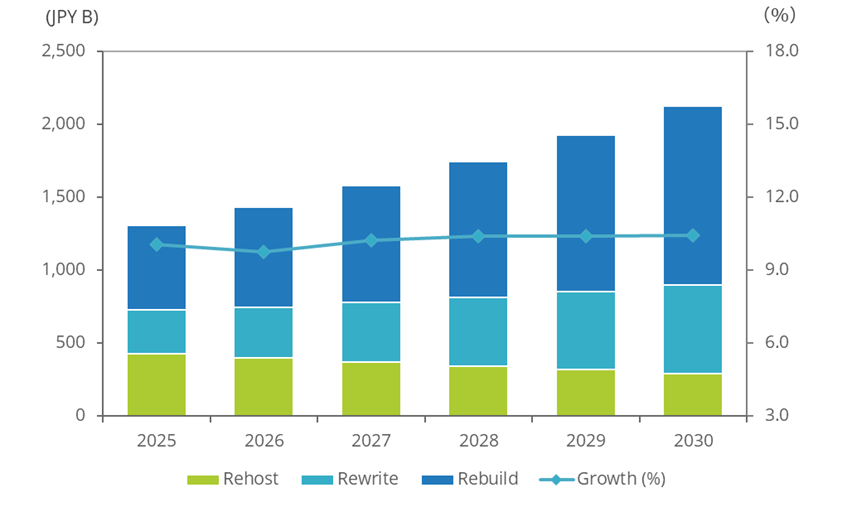
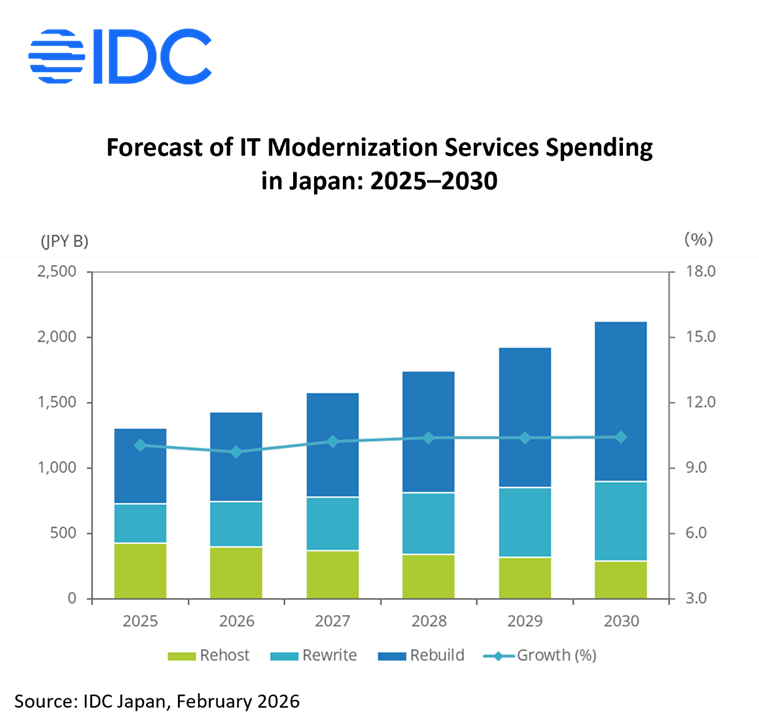
¥1,304B – IT modernization services market size, 2025
10.2% – Projected average annual growth rate, 2025–2030
¥2,123B – Forecast market size by 2030
~80% – Large and mid-sized enterprises still running legacy systems
Why Japan is outpacing the world
Japan’s IT services market is forecast to grow at a CAGR of 6.6% from 2024 to 2029, nearly double the global average of 3.6%. The answer is structural. Japan carries a uniquely heavy legacy burden, decades of investment in proprietary mainframe environments, complex bespoke systems, and a workforce that has long maintained them. Now, three forces are converging to make modernization unavoidable:
Fujitsu Mainframe Sunset – In 2022, Fujitsu announced the end of sales and support for its mainframe and UNIX server products around 2030. This single announcement put more than 1,000 enterprises on an irreversible countdown, accelerating timelines across the entire Japanese market.
AI Readiness Imperative – AI adoption presupposes tightly integrated data pipelines and modern business process architectures, exactly what legacy systems make impossible. Modernization is no longer optional for companies that want to remain AI-competitive.
Demographic Pressure – The generation of engineers who built and maintained Japan’s legacy systems is retiring. Organizations face a narrowing window to migrate knowledge and infrastructure before institutional memory disappears entirely.
Three paths to modernization
IDC segments IT modernization services into three execution types, each with distinct implications for services firms:
Rehost – Lift-and-shift to non-legacy platforms. Preserves existing application assets. The near-term entry point for enterprises constrained by budget or migration timelines.
Rewrite – Convert legacy source code to modern languages without changing business logic. A middle path for controlled transformation.
Rebuild – Redefine processes, data models, and architecture from the ground up. The highest-value, highest-complexity path.
Near-term, rehost is the second-largest segment after rebuild, driven by enterprises responding urgently to mainframe end-of-life deadlines — though it has already reached maturity and is forecast to decline. The mid-to-long-term growth opportunity lies in application modernization, rewriting, refactoring, and the adoption of microservices and cloud-native architectures.
What enterprises need from services firms
IDC surveyed large and mid-sized Japanese enterprises and found that organizations with significant legacy exposure do not simply want technical execution, they want transformation partners. Security remains a baseline expectation, but top-ranked needs now include business process redesign and cloud architecture strategy.
Demand signals also diverge meaningfully by sector:
Financial Services – Prioritizes cloud-native application development capabilities, the ability to innovate rapidly on modern infrastructure.
Manufacturing and Distribution – Prioritizes business process transformation, embedding efficiency and intelligence into operations, not just upgrading the underlying technology.
Across all sectors, IDC observes a consistent shift in enterprise expectations: business outcomes are becoming the primary purchase criterion. Technical competence is assumed; value creation is the differentiator.
How to build a winning position now
For services firms, the competitive imperative is clear. The service providers best positioned to win this market will do three things:
1. Codify your legacy modernization track record
Past engagements are an underutilized asset. Service providers should build structured libraries of business outcomes achieved, cost reductions, cycle time improvements, AI readiness unlocked and make these the core of their go-to-market narrative.
2. Develop industry-specific reference architectures for the AI era
Generic modernization pitches are losing traction. Enterprises want system architectures and implementation roadmaps calibrated to their sector, their regulatory environment, and their AI ambitions.
3. Invest in application modernization capabilities ahead of demand
The rehost wave is already approaching its peak. The high-margin opportunity – rewrite, refactor, rebuild – is building behind it. Service providers who develop deep cloud-native and microservices capabilities now will be the ones enterprises turn to in the second half of this decade.
About the IDC Report
IDC has published a comprehensive analysis of Japan’s IT modernization market: 2026 Japan IT Modernization Market Analysis. The report provides a medium-term market forecast for IT modernization of legacy systems — a primary growth driver in IDC’s Japan IT services market outlook. Legacy systems are characterized by aging and obsolescence, excessive complexity and scale, and a lack of transparency. It covers enterprises’ IT modernization trends and an analysis of the service vendors’ services trend. Market forecasts are segmented by service type, execution type (rehost, rewrite, rebuild), system type, and industry vertical. Together, these analyses offer a comprehensive view of shifting enterprise needs, emerging market opportunities, and the strategies and service offerings of leading vendors in Japan’s IT modernization landscape.
Masaru Muramatsu is a senior research analyst, responsible for research and analysis of the Japanese IT services market, including IT consulting, systems integration, business services.
The global semiconductor market is undergoing a seismic transformation. IDC’s latest forecast projects the industry will surge past the $1 trillion revenue threshold in 2026, significantly ahead of prior expectations. The growth will be driven overwhelmingly by AI infrastructure investment, which is reshaping the entire market.
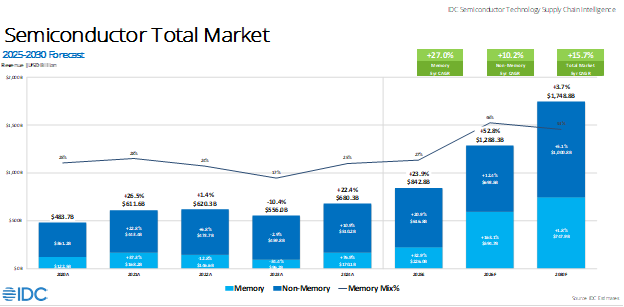
Total semiconductor revenues are forecast to reach $1.29 trillion in 2026, up 52.8% year over year from $842.8 billion in 2025. The memory segment is at the epicenter of this shift: DRAM revenues alone are projected to nearly triple in 2026 to $418.6 billion, driven by demand for high-bandwidth memory (HBM) and DDR from hyperscalers and AI infrastructure providers. Meanwhile, non-memory semiconductors are growing at a robust but more measured pace, reaching $693.5 billion in 2026.
In this post, we break down three forces reshaping semiconductors right now: why AI infrastructure has become the industry’s new center of gravity, what’s happening in memory markets and why it matters beyond the data center, and how other markets from automotive and IoT to mobile and PCs are navigating a market increasingly defined by AI.
Global Semiconductor Market: Selected Forecast (USD Billions)
Source: IDC Semiconductor & Semiconductor Applications Forecast, April 2026. A = Actual, E = Estimate, F = Forecast.
AI infrastructure: The engine of the supercycle
The single most consequential shift in the semiconductor market is the emergence of AI infrastructure as a structurally dominant end market. What began as a cyclical uplift in data center spending has evolved into a self-reinforcing investment cycle that is reshaping demand patterns across the semiconductor value chain.
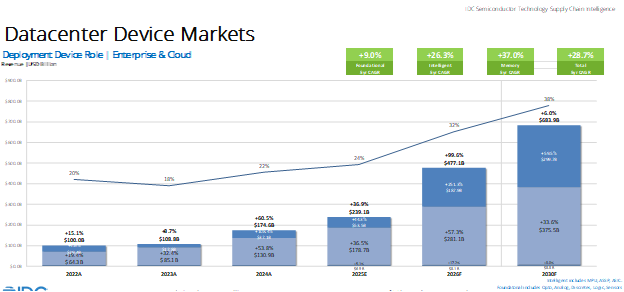
Hyperscale capital expenditure exceeded $100 billion for the first time in Q3 2025, and the i4 are expected to increase capex by 70% year over year to approximately $600 billion in 2026. IDC forecasts data center semiconductor revenues to reach $477.1 billion in 2026. By 2030, data center semiconductors will account for $843.2 billion, nearly half the total semiconductor market.
“The semiconductor industry has crossed a structural threshold. AI is no longer a demand catalyst — it is the demand foundation. The race to build out AI infrastructure is consuming silicon at a pace the industry has never seen, and the implications for memory, logic, and packaging are profound.” —Jeff Janukowicz, Research VP, Semiconductors & Semiconductor Manufacturing, IDC
Datacenter Semiconductor Revenue Decomposition
Source: IDC Semiconductor Applications Forecast, April 2026.
The $281 billion “intelligent” datacenter segment, encompassing CPUs, AI accelerators, GPUs, custom ASICs, and networking silicon, now constitutes the largest identifiable category within non-memory semiconductors. Spending is heavily concentrated among top-tier hyperscalers and a growing set of sovereign AI infrastructure programs, many of which have secured long-term supply agreements with leading chip manufacturers.
Three factors are keeping this growth self-sustaining rather than cyclical:
Compute intensity continues to rise. Generative AI and agentic workloads require far more compute density per rack than prior architectures, increasing the overall silicon footprint
Inference demand compounds on itself. Each new model generation increases the volume of inference, requiring ongoing hardware upgrades
AI is spreading beyond the data center. As enterprises, edge deployments, and client devices begin running AI workloads locally, demand becomes more distributed
Memory: From cyclical commodity to strategic constraint
If you want to understand what’s really happening in semiconductors right now, start with memory.
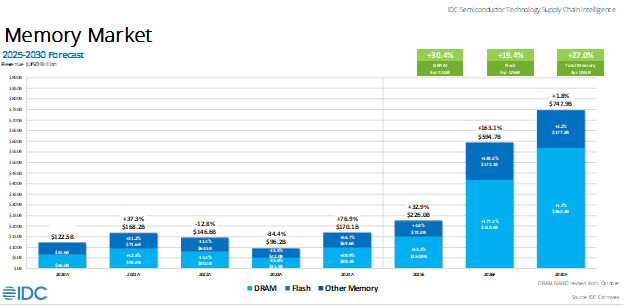
Total memory revenues rise from $226 billion in 2025 to $594.7 billion in 2026, and then to $790.4 billion in 2027. This is not simply a recovery cycle, it reflects a market that is being structurally repriced.
DRAM is where the shift is most visible. IDC forecasts $418.6 billion in DRAM revenues for 2026, up 177% year over year. This is not primarily a volume story driven by consumer devices. Hyperscalers are buying a fundamentally different, more expensive class of memory and are willing to pay a premium to secure supply. Each HBM chip also requires significantly more silicon real estate, further tightening the availability of other types of DRAM.
“The memory market is at an unprecedented inflection point, with demand materially outpacing supply. For an industry long characterized by boom-and-bust cycles, this time is different. The rapid expansion of AI infrastructure and workloads is placing significant pressure on the memory ecosystem. As a result, the market is shifting from a cyclical recovery following the 2023 downturn to a more structurally constrained environment, with clear implications for end markets.” — Jeff Janukowicz, Research VP, Semiconductors & Semiconductor Manufacturing, IDC
The HBM bottleneck
High-bandwidth memory has become the primary constraint in the AI accelerator supply chain. Most capacity is already pre-committed through 2026, with forward allocations extending into 2027. That capacity is concentrated in NVIDIA and AMD GPU platforms, along with a growing set of hyperscaler custom silicon programs.
The production economics are also very different. HBM relies on advanced packaging and stacking technologies, resulting in per-bit costs that are several times higher than standard DRAM.
Suppliers are investing aggressively to expand capacity, but the technical complexity and capital intensity mean meaningful new supply will not reach the market until late 2026 at the earliest.
NAND: AI drives storage demand
NAND Flash revenues are forecast to reach $174.1 billion in 2026, up 138.5% from 2025. AI infrastructure is again the dominant driver, with demand coming from training datasets, checkpoint storage, and high-performance inference environments.
Unlike DRAM, the NAND market is seeing broader repricing. Enterprise SSD prices have surged as hyperscalers secure supply, which is tightening availability across consumer and OEM channels.
Other markets: Navigating the shadow of the AI supercycle
While AI infrastructure dominates the headlines, the broader semiconductor market is facing a more nuanced environment.
Non-memory, non-datacenter revenues are projected at $406.3 billion in 2026. Several end markets are dealing with margin pressure, supply allocation challenges, and macroeconomic headwinds.
In mobile, semiconductor revenues are forecast to decline to $89.8 billion in 2026. The issue is not consumer demand, particularly for AI-capable devices, but cost pressure. Memory now represents a larger portion of the bill of materials, forcing OEMs to make difficult tradeoffs between margin, pricing, and product specifications.
Automotive is being shaped more by macro factors than AI. Tariffs, interest rates, and energy prices are weighing on demand. While the long-term outlook remains strong, 2026 reflects a period of near-term softness.
IoT shows a similar pattern. The segment is projected at $136.6 billion in 2026, with near-term pressure from inventory digestion and cautious spending. However, edge AI is beginning to create a new, higher-value demand category that will become more meaningful over time.
Source: IDC Semiconductor Forecast, April 2026.
Outlook: Path to $1.75 trillion
IDC’s base case projects semiconductor revenues reaching $1.75 trillion by 2030.
Several dynamics will shape that trajectory:
Memory pricing will normalize, but remain structurally higher than pre-AI levels
Non-memory semiconductors will continue steady growth, driven by AI adoption across devices and industries
Macro and geopolitical risks will remain important variables
What is clear is that the semiconductor market has undergone a fundamental shift.
“What the data makes clear is that the semiconductor market has undergone a permanent expansion of its addressable opportunity. AI infrastructure has reset the demand baseline, memory has repriced as a strategic asset, and the industry’s growth trajectory through 2030 is no longer contingent on a consumer refresh cycle.” — Nina Turner, Research Director, Semiconductors, IDC
IDC will be tracking how AI infrastructure investment continues to reshape semiconductor demand at Computex 2026.
Jeff Janukowicz - Vice President, Computing Systems Platforms and Technologies, Enterprise Infrastructure
Jeff Janukowicz is a Vice President within IDC’s enterprise infrastructure global research domain, and the global subdomain lead for the Computing Systems Platforms and Technologies subdomain. Jeff and his team deliver data-driven analysis, technology insights, market trends, and strategic guidance…
Nina Turner - Research Director, Computing Systems Platforms and Technologies, Enterprise Infrastructure
Nina Turner is Research Director within IDC's enterprise infrastructure global research domain, part of the computing systems, platforms, and technologies subdomain. Nina and her team cover the breadth of processors and architectures, from datacenters to client devices, including embedded use…
IDC Environmental Policy
International Data Group is committed to protecting the environment, the health and safety of our employees, and the community in which we conduct our business. It is our policy to seek continual improvement throughout our business operations to lessen our impact on the local and global environment. We are committed to environmental excellence, pollution prevention and to purchasing products that reduce the use of natural resources.
We fulfill this mission by a commitment to:
Encouraging all partners to share in our mission
Understanding environmental issues and sharing information with our partners
Recognizing that fiscal responsibility is essential to our environmental future
Instilling environmental responsibility as a corporate value
Developing innovative and flexible solutions to bring about change
Using our platforms and position in the IT industry to promote sustainability
Minimize air travel to help reduce our impact on the environment
Minimize use of materials and energy consumption in our offices
Create a working environment that efficiently uses our office space
Develop and maintain a hybrid working model that benefits both our employees and business partners
Encourage employees to measure, minimize and collaborate on reducing energy consumption at home and in the office
Engaging employees and promoting active participation in environmental and sustainability initiatives
Leaving?
You are about to leave this section. Do you wish to continue?