As 2026 planning accelerates, high-performing GTM teams are doing more than building campaigns. They’re stress-testing their positioning. Not just for alignment with internal priorities, but for resonance with evolving buyer expectations, stakeholder dynamics, and budget scrutiny. 

It’s not about tearing everything down. It’s about refining what’s already strong and spotting the subtle misalignments that weaken performance over time. 

Here’s what we’re seeing from top-performing marketing and strategy teams as they get ready for 2026: 

1. They’re building from buyer economics, not brand preference

The strongest value narratives in 2026 are rooted in how buyers think—not just what they want. That means anchoring messaging in: 

  • Business outcomes that map to line-of-business KPIs
  • Time-to-impact metrics relevant to finance, RevOps, and procurement
  • Proof points that connect product value to real spend categories and budget decisions

2. They’re aligning to who the buyer really is now

Your champion might still be in product or IT, but the buying committee has expanded. In many 2026 deals, procurement, RevOps, and CFOs are shaping final evaluations. And they’re asking different questions: 

  • “Where does this fit in the broader vendor stack?”
  • “What are the operational metrics tied to this investment?”
  • “How does this align with compliance and risk management goals?”

Messaging that focuses only on user value misses the table where decisions are made. 

3. They’re checking internal alignment before buyers do

Too often, what strategy wants to say, what sales is saying, and what analysts are saying don’t line up. And when those narratives diverge, the buyer journey slows or stalls. 

Leading teams are investing in shared narratives built on external signals, not just internal direction. Because when analyst commentary doesn’t match your positioning, buyers notice. And they move on. 

Want a deeper checkpoint?

This guide outlines the most common (and often hidden) signs of misalignment we’re seeing in enterprise GTM efforts right now, along with steps you can take to course-correct using IDC data. 

Because in this market, the risk isn’t messaging that’s “wrong.” It’s messaging that’s “just a little off”. 
Tech marketers are no strangers to low conversion rates, tight budgets, and the ongoing quest to create content that both informs and influences. Foundational assets like white papers and infographics still play a critical role in that journey, but even the most informative content often struggles to gain traction. 

It’s not that the content isn’t valuable. It’s that it’s not being seen in the right way, by the right people, at the right moment. 

The hidden cost of content that sits still

You invest in building authoritative, data-rich content. But if the only people who see it are those who download the full asset, you’re limiting its reach, and its return. 

Today’s marketing leaders are rethinking how they activate content. They aren’t replacing white papers, InfoBriefs, or foundational research assets, but amplifying them with visual formats that scale attention, spark engagement, and lead audiences back to the deeper story. 

That might mean turning key insights into short-form video narratives or extracting the most compelling stats into modular social tiles that spark curiosity and direct traffic back to the full story. 

The goal isn’t simplification. It’s strategic amplification with visual storytelling. 

Today’s buyer journey is social, visual, and fast

IDC’s global buyer research confirms what many B2B marketers already feel: decision-makers are consuming more content across more formats, and they expect relevance within seconds. 

That means:

  • Visual-first content that leads with a bold and clear message
  • Formats optimized for feeds, not files
  • Thought leadership that feels human, timely, and on-message
  • A content ecosystem where each asset earns its next audience

Think of it as a launchpad, not a shortcut

A well-crafted white paper still delivers depth. A research spotlight still builds credibility. What’s changed is how those assets drive pipeline activation. 

It’s not about doing more. It’s about making what you already do work harder to drive the engagement you need. 

Get more from every message

At IDC, we help marketing teams elevate their core content with formats built for the channels where attention lives. Our Video Portfolio and Infographic Social Tiles are designed to extend the reach, resonance, and ROI of foundational thought leadership assets. 

When your content is backed by data, delivered by experts, and formatted for how buyers actually consume, it doesn’t just inform. It moves. 

AI is quickly transforming what marketing teams are capable of: automating routine tasks, delivering instant insights, and powering deeply personalized customer experiences. But for all its promise, AI is only as effective as the people and processes guiding it.

And that’s where many organizations are hitting a wall.

As marketing strategies grow more complex and technology becomes more advanced, the internal capabilities needed to execute at scale haven’t kept pace. The result? A widening execution gap: the disconnect between what marketing promises and what teams are equipped to deliver.

Thirty-seven percent of CMOs say creating a unified omnichannel experience will have the greatest influence on their marketing strategy over the next 12-18 months, according to IDC’s 2025 Global Midmarket Tech CMO Priorities Survey.

Yet in practice, most teams lack the operational infrastructure to make that experience a reality. Defined roadmaps, repeatable processes, and specialized talent remain in short supply. Only 15% of CMOs say upskilling or hiring for new roles such as AI prompters, data scientists, or digital experience designers is a top priority.

That percentage is strikingly low given what lies ahead. Over the next two years, more than a quarter of digital marketing, journey orchestration, and campaign optimization tasks are expected to shift to AI.

This is the execution gap in action, and it is one of the four critical disconnects IDC has identified for marketing today.

screenshot of ebook

Skills gaps puts CMOs out of step with the C-suite

So where is the focus instead?

Currently, many teams are prioritizing customer retention and cost reduction — another of IDC’s identified disconnects. Looking ahead, priorities are expected to shift toward customer acquisition. But even then, areas like MarTech modernization, AI implementation, and upskilling continue to rank lower than expected, despite mounting pressure from the top.

Thirty-four percent of midmarket CMOs say their executive team expects modernization of MarTech, including AI integration, in the next 12 to 18 months.

The expectation is clear: marketing must lead with speed, precision, and scalable results.

CMOs acknowledge the need for bold. But without internal talent to support execution, strategies stall before they scale.

Meeting buyer expectations requires the right talent

This pressure isn’t just coming from the C-suite. Buyers are raising the bar, too.

Real-time personalization, seamless channel transitions, and responsive engagement are now baseline expectations. Meeting those expectations increasingly depends on AI. From automating workflows to dynamically tailoring content, AI enables marketing to deliver consistent, context-aware experiences at scale.

But without the right talent in place, AI’s promise remains unfulfilled. Personalization remains superficial. Campaigns stall. And performance suffers. Not because the strategy is wrong, but because the team isn’t equipped to deliver on it.

Technology alone won’t drive results

It’s tempting to think that new technology can make up for talent gaps. Just over 35% of midmarket CMOs believe AI-enabled marketing technologies have the greatest potential to help their organization achieve its marketing goals over the next 12-18 months, according to the Midmarket survey. However, AI doesn’t eliminate the need for skilled marketers. It magnifies it.

Automation can handle repetitive processes, but people are needed to:

  • Identify where AI adds value.
  • Interpret outputs and make context-driven decisions.
  • Integrate insights into broader strategies that reflect brand, buyer, and business needs.

That’s why it’s so concerning that skills development continues to lag. Without the internal capabilities to orchestrate and govern AI, even well-resourced marketing organizations risk underutilizing their investments. Execution doesn’t hinge on the tools in place; it hinges on the people who know how to use them well.

Redefining the skills that power modern marketing

Closing the execution gap means redefining what modern marketing excellence looks like. Roles in strategy, journey orchestration, campaign optimization, advertising, and creative will all have the most tasks delegated to AI/GenAI in the next two years. However, delegation doesn’t equal replacement. Instead, deeper fluency in the systems, data, and experiences that AI supports will be necessary.

In order to compete, teams must build capability in three key areas:

  1. AI and automation fluency: Knowing when to trust automation, how to fine-tune outputs, and when to step in and redirect AI-driven decisions.
  2. Data literacy and analytics: Understanding how to translate performance signals into actionable insights and aligning those insights with strategic business outcomes.
  3. Digital experience design: Creating cohesive, cross-channel journeys requires fluency in UX, content strategy, and personalization technologies.

CMOs who invest in developing these skills position their teams to execute at scale and lead in a rapidly transforming marketplace.

The execution gap widens every quarter you wait

The execution gap only compounds with time. The longer it goes unaddressed, the more it begins to show up in tangible ways: slower campaign activation, fragmented customer journeys, and a growing reliance on external vendors that reduce agility and inflate costs. Measurement and optimization also suffer, as internal teams struggle to connect AI-driven activity to business outcomes.

Meanwhile, AI isn’t going anywhere. In fact, the AI economy is predicted to reach $22.3 trillion globally by 2030, accounting for 3.7% of global GDP, according to IDC’s Macroeconomic Center of Excellence. That scale of transformation will require deliberate, enterprise-wide investment in people, process, and capability.

In a competitive environment where speed, efficiency, and relevance are already defining market leaders, the cost of inaction grows with every quarter. Organizations investing in execution readiness now are positioning themselves to lead.

And perhaps most importantly, the execution gap threatens marketing’s strategic credibility. As C-suite expectations continue to rise, leadership won’t be looking for plans. They’ll be looking for proof.

Solve your execution crisis today

Today, the marketing teams best positioned to deliver will be those with the skills to move quickly, adapt intelligently, and orchestrate AI-enabled experiences with precision. To do that, CMOs must act now to assess, address, and develop the capabilities their teams need to keep pace with evolving expectations.

Explore the four disconnects shaping marketing in 2025. Uncover the gaps holding back growth—and the strategies to close them. Visit our landing page to access insights, frameworks, and next steps for aligning with executive priorities and leading with confidence in an AI-driven market.

In Europe’s markets, strategic messaging must prove ROI and stay aligned across strategy, sales, analysts, and country GTM teams. 

Strategic Messaging in Europe’s Markets 

As 2026 planning accelerates, high-performing GTM teams at tech vendors across Europe know that campaigns alone won’t secure growth. They’re stress-testing positioning – not only for internal alignment, but for resonance with buyer expectations, stakeholder dynamics, and budget scrutiny. 

The fundamentals of effective messaging remain constant across regions: clear strategy, ROI proof, and alignment across functions. In Europe, however, an added layer of complexity must be addressed: messaging needs to resonate across fragmented national markets, languages, and governance models while staying consistent for buyers. 

What We’re Seeing from Top-Performing GTM Teams in EMEA 

  1. Building from buyer economics, not brand preference

The strongest value narratives in 2026 are rooted in buyer economics. For European GTM teams, that means anchoring messaging in: 

  • Business outcomes tied to line-of-business KPIs 
  • Time-to-impact metrics that satisfy budget scrutiny 
  • Proof points that link product value to spend categories and investment decisions 

IDC research shows that messaging built around use-case ROI increases renewal likelihood by 3.5x. For GTM teams competing across Europe, this ROI narrative must be credible at headquarters and adaptable in local markets. 

  1. Aligning to who the buyer really is now

Your champion may still sit in IT or product, but the buying committee has expanded. In 2026, procurement, finance, RevOps, and CFOs will shape final evaluations – and their questions go beyond features and functions: 

  • How does this investment impact budget and efficiency? 
  • Where does it fit in the broader vendor stack? 
  • Does it align with compliance and operational resilience goals? 

For European GTM teams, these dynamics don’t change, but multi-country decision-making adds friction. ROI messaging must stay consistent across borders, so what a buyer hears in Paris matches what they hear in Munich or London. 

  1. Checking internal alignment before buyers do

Too often, what strategy wants to say, what sales are saying, and what analysts are reporting don’t fully align. That slows the buyer’s journey or stops it altogether. 

In Europe, the risk of misalignment is multiplied: 

  • A message crafted centrally may not translate effectively in country execution 
  • Analyst commentary may highlight ROI drivers in one market that don’t match what buyers hear locally 
  • Country-level adaptations risk drifting unless anchored in a shared ROI-based strategic framework 

Leading European GTM teams are addressing this by creating aligned narratives validated against external signals. That way, strategy, sales, analysts, and country teams reinforce each other rather than pulling apart. 

Why It Matters for Tech Vendors in Europe

In fragmented markets, the risk isn’t messaging that’s “wrong.” It’s messaging that’s slightly off – between strategy, sales, and analysts, or between headquarters and local GTM teams.

The strongest European GTM teams in 2026 will be those that:

  • Keep strategic alignment as their foundation
  • Prove ROI under budget scrutiny
  • Adapt to country-level nuance without losing consistency

IDC’s role as the Trusted Tech Intelligence provider is to help tech vendors validate and align these narratives — ensuring that what strategy defines, what sales delivers, and what analysts echo are all part of one coherent story across Europe.

Want a deeper checkpoint?

We recently published a new guide “5 Signals Your Messaging Won’t Win in 2026”.  This guide outlines the most common and often hidden signs of misalignment we’re seeing in enterprise GTM efforts right now, along with steps you can take to course-correct using IDC data.

If you have a question about anything, please fill in this form.


Today’s marketing leaders are being asked to drive bold innovation, lead AI-powered transformation, and deliver measurable revenue gains – all on last year’s budget.

This might sound like a familiar challenge for many midmarket tech CMOs. Expectations have grown more strategic, yet financial support remains static.

Fifty-four percent of midmarket CMOs expect no increase in their marketing budgets, according to IDC’s 2025 Global Midmarket Tech CMO Priorities Study. But the pressure to demonstrate marketing’s impact on growth, acquisition, and customer experience remains.

This misalignment is more than a budgeting deadlock. It reflects a widening disconnect between executive demands and what resources marketing teams have to deliver.

In a landscape increasingly shaped by AI adoption, customer expectations, and competitive urgency, this gap is a structural barrier. And it is one that threatens marketing leaders’ ability to innovate, differentiate, and scale.

This is just one of four critical disconnects IDC has identified within marketing teams today. Left unaddressed, the misalignment between corporate visions and budgeting reality doesn’t just slow down marketing. It stalls enterprise growth.

screenshot of ebook

Budgets are buried in the pressure cascade

Today’s CMOs are navigating what IDC defines as the Pressure Cascade: a convergence of executive-level demands that place marketing at the center of enterprise transformation. Marketing leaders are now tasked with more than demand generation or pipeline contribution. They must also:

  • Drive innovation to acquire new customers and power growth.
  • Deploy AI programs to personalize and enhance the customer experience – with measurable results.
  • Deliver a coherent marketing strategy that aligns with existing data infrastructures.

These expectations reflect a clear shift in the CMO’s role in the organization. Yet the financial structure supporting this evolution remains stuck in the past. Budgets are still planned around yesterday’s definitions of marketing – not today’s enhanced, cross-functional transformation.

Why budgets aren’t budging

The data uncovered by IDC reveals the disconnect leading to the budget plateau. Thirty-two percent of marketing leaders believe the C-suite will prioritize cost optimization and ROI in the next 12-18 months.

Still, more than a third of CMOs are challenged to justify investments in brand marketing and awareness, while nearly a quarter struggle with measuring and proving the strategic value of marketing.

The difficulty of proving marketing’s worth within the organization is compounded by rising economic uncertainty, and complex executive demands limits CMOs’ ability to deliver on expectations. In an era when money is being directed towards tech modernization and AI initiatives, marketing can be left off the table.

Without budget flexibility or the data to frame marketing as a growth engine, leaders risk being constrained by outdated assumptions, even as the demands of the business move forward.

The strategic cost of standing still

Static or minimally adjusted budgets may seem manageable for now, but they create long-term strategic risk for the entire organization. When funding doesn’t keep pace with the expanding scope of marketing’s purview, critical initiatives can be delayed, scaled back, or abandoned entirely.

IDC research shows midmarket CMOs are under mounting pressure to develop areas that directly influence revenue and customer acquisition, such as AI-enhanced experiences, advanced personalization, and predictive analytics.

Without adequate resources, these high-impact opportunities are left underfunded. The result is a widening gap between organizations that execute bold strategies and those that are stuck in the past – losing revenue potential, market visibility, and the path to modernization.

When “making do” doesn’t do enough

In the absence of significant budget increases, many CMOs are doing their best to optimize what they have. IDC’s 2025 study shows the top two marketing priorities for the next 6-12 months are increasing revenue from existing customers (34%) and reducing costs or streamlining operations (31%).

While these are important goals, they take the focus away from the big-picture initiatives that drive new customer acquisition or enable advanced AI adoption. These adjustments can free up resources in the short term, but they don’t have the capacity to enable market-shaping campaigns.

Legacy systems, underfunded teams, and outdated, siloed technology make it difficult to deliver the personalization, speed, and insight modern buyers expect. Without meaningful reallocation toward initiatives that directly align with executive priorities, minor budget tweaks risk becoming an exercise in standing still – not moving forward.

What’s at stake: Agility, credibility, and the competitive edge

Failing to address the budget deadlock has consequences that go beyond marketing’s internal performance metrics. Without the resources to pivot, CMOs cannot respond quickly to market shifts or capitalize on emerging opportunities.

A lack of agility can erode marketing’s perceived value across the organization. Thirty-four percent of marketing leaders said demonstrating marketing’s strategic impact and ROI was their biggest challenge in establishing internal credibility and trust. Similarly, 26% said they faced difficulty proving marketing’s leadership role in driving business growth.

Without a larger budget to meet expanded expectations, teams are forced to spread limited resources across too many priorities. Results become harder to measure and even more difficult to defend. Over time, this fuels the perception that marketing is a cost center rather than a revenue driver.

Externally, the competitive risks are just as significant. Organizations that devote resources now to AI-enabled engagement, targeted acquisition, and data-driven personalization are setting themselves up for future success.

Those that delay investment risk falling into a reactive role – chasing market leaders instead of setting the pace. For midmarket CMOs, the ability to secure and strategically deploy a sizeable budget is tied directly to their ability to lead the competition.

Breaking the deadline: The path forward is strategic, not reactive

Flat budgets are more than just a financial plateau. Over time, they reduce marketing’s ability to deliver on executive priorities, limit the scope of innovation, and dull the organization’s competitive edge. In an environment where AI adoption, customer demands, and market shifts are accelerating, standing still is not an option.

CMOs who move beyond reactive, incremental thinking and approach budget planning as a strategic exercise are better positioned to meet heightened executive expectations. They have clear, data-backed business cases, resources aligned with company-wide priorities, and measure impact in terms of enterprise growth.

The budget deadlock is real, but so is the opportunity. With the right data, a disciplined approach to resource allocation, and a willingness to reframe budget conversations, marketing can reclaim its role as a growth engine, not a cost center.

The path forward isn’t asking for more. It’s about making every dollar work harder toward measurable, high-impact outcomes.

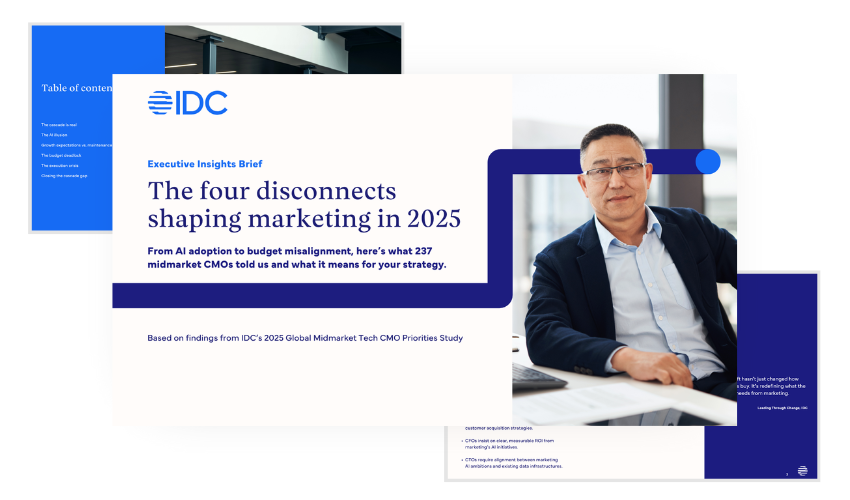
Break free from your budget deadlock. Access IDC’s Executive Insights Brief: The four disconnects shaping Marketing in 2025 for data-backed strategies to realign your marketing budget for growth – and more insights into the top challenges facing today’s CMOs.

In a world of economic uncertainty, rising rates, and AI disruption, one thing is clear: tech leaders aren’t pulling back, they’re planning smarter. 

That’s the pulse from IDC’s recent webinar on the state of tech spending and strategic planning for 2026. Whether you missed it or want the fast facts, here are five standout moments that unpack where budgets are moving, how buyers are thinking, and why IDC’s insights matter more than ever. 

1. Real growth is still there – just look through the inflation lens.

“When you adjust for inflation, you can see that real IT growth remains positive. Companies are still investing — but they’re more cautious and strategic in where the money goes.” 

 What it means: The market isn’t shrinking, it’s shifting. Decision-makers are moving from “grow at all costs” to “grow with clarity.” IDC’s inflation-adjusted forecasts reveal where that clarity lives. 

2. High rate, steady budgets: Tech is no longer discretionary.

“Even as interest rates have risen and borrowing costs go up, we’ve seen IT budgets hold steady. That’s because technology has become foundational, not discretionary.” 

What it means: Budgets aren’t breaking under pressure, they’re being reallocated with purpose. Foundational tech like cloud, data, and AI are becoming immune to cuts. 

3. Today’s breakthroughs started with the third platform.

“The Third Platform — cloud, mobile, social, and big data — was the foundation for the wave of innovation we’re seeing today. Every breakthrough you see now stands on that groundwork.” 

What it means: If you want to understand where we’re headed, start with how we got here. IDC’s long-range view helps you map innovation back to its roots and ahead to what’s next. 

4. Generative AI: Budget disruptor. Acceleration engine.

“Generative AI is already reshaping IT spending. We’re seeing budgets shift toward data platforms, model development, and governance, and it’s accelerating faster than any previous technology cycle.” 

What it means: GenAI isn’t coming; it’s here, and it’s redefining every spending curve. IDC breaks down where the money’s going, and how leaders are reallocating resources to stay competitive. 

5. The IT market just hit a trillion-dollar quarter, for the first time ever.

“For the first time ever, the IT market hit a trillion dollars in a single quarter. That’s a milestone and much of that momentum is being driven by AI investments.” 

What it means: This isn’t just hype. AI is driving the biggest IT investment cycle in history. The leaders shaping 2026 aren’t just watching the wave, they’re riding it. 

See what’s shaping 2026 before it happens.

IDC’s trusted tech intelligence helps you see the shifts before they land, so you can move first, move smart, and move with confidence. 

AI is no longer just a tool for productivity. It’s changing who makes buying decisions, how they evaluate vendors, and what they expect from every interaction. For analyst relations (AR) professionals, that means a new mandate: turning complex buyer insights into influence across executives, marketing, and sales teams.  

During IDC’s recent webinar, Turning Insights into Influence: Leveraging Buyer Behavior Research, Laurie Buczek, Group VP of Executive Insights and Thought Leadership Services at IDC, explored how AI and shifting buyer behavior are reshaping go-to-market strategies. At the end of the session, Laurie answered audience questions about the role of AI, how buying committees are changing, and what AR professionals can do to help their organizations succeed.  

How can AR professionals use AI, especially agentic AI, in their roles?

Start with secure, ring-fenced AI tools that are approved within your organization, and avoid external large language models (LLMs) that may compromise your IP. AI can help AR leaders: 

  • Synthesize analyst insights into key takeaways executives can act on. 
  • Draft executive guidance aligned to business goals. 
  • Offload repetitive tasks to agentic AI, such as generating AR plans, drafting key messages, or synthesizing analyst feedback. 

Think of AI as both an assistant (helping optimize content) and an agent (able to draft or manage elements of strategy that humans then refine and execute). 

How are buying committees using AI, and how shold vendors align with them?

Buying groups are expanding, and each persona approaches discovery differently. Increasingly, they start with AI-powered chat functions to research solutions. That means vendors must rethink how their content is created and structured. 

It’s no longer just about keywords and SEO. Content must be optimized for prompts, designed to answer the jobs-to-be-done that buyers will type into chat engines. In other words, organizations need to rebuild their content supply chain for an AI-first buyer journey. 

Many companies collect buyer insights but struggle to act on them. How can we ensure insights actually influence executives?

Too often, buyer insights live in a persona document or slide deck that gets shelved. AI can change this by: 

  • Implementing insights in real time through optimized buyer journeys and engagements. 
  • Measuring impact continuously: Using AI to track how journeys are performing and where optimizations are needed. 
  • Speaking the executive’s language: Turning insights into meaningful KPIs that demonstrate business outcomes. 

This helps AR professionals not just share insights but prove their value to leadership. 

Buyers rely on AI, but do they still trust peers and analysts?

Absolutely. AI doesn’t replace the importance of trusted experts and communities.  

Buyers are: 

  • Attending events to learn from peers. 
  • Visiting vendor websites for direct information. 
  • Turning to social communities and networks for validation. 

The takeaway: AR leaders should help their organizations influence across multiple channels: AI, digital platforms, peers, analysts, and social networks.

Learn more

The buyer journey is no longer linear. It’s omnichannel, AI-led, and persona-rich. For AR professionals, that means a new mandate: translate insights into influence across executives, marketing, sales, and peers. 

Christina Cardoza - Content Marketing Manager - IDC

Christina Cardoza is a Content Marketing Manager at IDC, where she specializes in brand content and social media strategy. With a background in journalism and editorial leadership, she has a proven ability to transform complex technology topics into clear, actionable insights.

AI is reshaping the way buyers behave. They move fluidly between digital and in-person channels, research on their own terms, and expect every interaction to feel timely and connected. Today, most buyers prefer digital-first engagement, and they notice when experiences fall short.

Even with strong teams and good intentions, it’s easy to miss the mark. Content lands out of sync. Signals slip by. Event engagement fizzles into fragmented follow-ups. The result? Stalled pipeline and missed opportunity.

That’s where orchestration comes in. To meet buyers where they are, and move at the speed and relevance they expect, sales and marketing teams need more than just campaigns. They need plays: repeatable, proven motions that turn insight into action.

Where should you start? Not every team faces the same roadblocks. Some struggle with nurture streams that stall. Others see event ROI fall flat. Some launches never hit stride. These plays are built to help you zero in on the challenges you’re facing right now and run the motion that will get you unstuck.

5 proven GTM plays to unlock growth

  1. Reignite a stalled nurture stream

When leads go quiet, it’s not the end of the story. It’s a signal. Too often, teams focus on chasing new contacts while overlooking the prospects already in their pipeline. By diagnosing drop-off points and re-personalizing the journey, marketers can convert dormant interest into qualified pipeline.

  1. Align event engagement with digital journeys

Events are high-investment moments, but without thoughtful orchestration, they fade fast. Buyers expect pre-, during-, and post-event interactions to feel connected. This play ensures event attention flows into a broader engagement journey instead of stalling out.

  1. Equip sales with signal-based content activation

Almost half of sales teams say they lack visibility into buyer intent. That leaves them pursuing leads without context. This play bridges the gap by translating signals, like demo requests or pricing page visits, into clear next-best actions. Sales gets the visibility and timing they need to act fast.

  1. Execute an orchestrated GTM launch

Great launches should feel like a single story, not a scatter of tactics. But aligning teams and channels is hard. This play brings marketing, sales, and operations together around a shared plan, message, and cadence so launches hit the market faster and with greater impact.

  1. Orchestrate the fully integrated omnichannel experience

This is where everything comes together.

Instead of relying on one-off tactics, this play builds an always-on GTM system that senses buyer signals, sequences interactions, and adapts across every channel. The result is a connected system that scales with buyers and keeps pipeline flowing

Your next move: Smarter, not bigger

Buyers aren’t waiting. They’re moving fast, guided by signals you might not even see. The good news? You don’t have to chase them. You can meet them there.

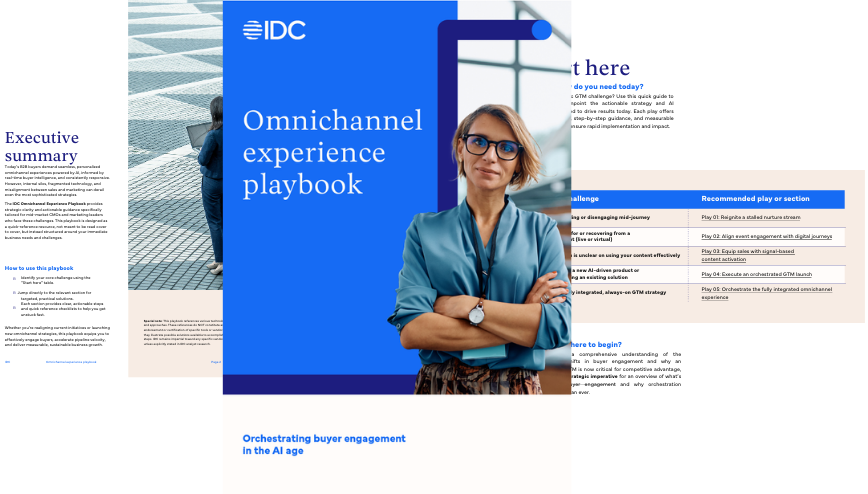
Whether you’re reigniting a stalled nurture, converting event attention into pipeline, or launching your next big solution, IDC’s Omnichannel Experience Playbook gives you the proven plays to move with forward with clarity and confidence.

And when you’re ready to accelerate, the AI Supplemental Guide shows you how to weave intelligence into every step, so your team isn’t just reacting to buyer behavior, but anticipating it, personalizing it, and orchestrating it across every channel.

Ready to move smarter? Download the full Omnichannel Experience Playbook to activate five proven GTM plays. Then explore the AI Supplemental Guide to see how intelligence, personalization, and integration can take every play further, keeping you not just in step with buyers, but one step ahead.

Christina Cardoza - Content Marketing Manager - IDC

Christina Cardoza is a Content Marketing Manager at IDC, where she specializes in brand content and social media strategy. With a background in journalism and editorial leadership, she has a proven ability to transform complex technology topics into clear, actionable insights.

Financial service providers benefit from large global fintechs as well as startups.

The role of fintechs

While the names of the vendors have changed, the impact fintechs have, both large and small, in shaping how we learn, transact and plan our financial journeys has not. 

Today’s customers are looking for many things when it comes to their financial relationships.  First and foremost is that they generally will start their process by doing their research online, whether it’s to compare rates, products, locations or reviews, they want to know the information ahead of time before taking things to the next level. 

Let’s look specifically at the banking industry. Consumers are savvy, and will be loyal if their expectations, both digitally and through employees, is being met.  That often starts right at the point of beginning a new relationship, and the importance of engaging a customer where they are, on any device, with relevant and personalized offers and messages. To do this, often times banks will look towards their core provider, an enterprise platform solution, or specialized vendors to develop solutions.  Large institutions may choose to build their own, but will often augment areas with prebuilt components in order to improve speed to market. 

IDC 2025 FinTech Rankings

IDC Financial Insights has been conducting its IDC FinTech Rankings research for over two decades. The research is a quantitative “state of the industry” measurement for financial services– and fintech-based revenue earned by the top 150 technology firms globally. The financial services industry is made up of banking, insurance, capital markets, and fintech firms that buy hardware, software, and services from third-party IT providers. Two major categories of IT companies are ranked: 

  • IDC FinTech Top 100: Solution providers that derive more than one-third of their revenue from the financial services and fintech industries and across no more than two additional key non-FSI industry verticals 
  • IDC FinTech Enterprise Top 50: Solution providers that support four or more key industries yet have sufficient revenue from the financial services and fintech industries to be ranked 

When one looks at the amount of budget earmarked for technology spend, again in hardware, software and services (not employees), IDC estimates that annually over USD 550 billion is spent by banks, capital market and insurance providers. To put that in perspective, that would make the IT spend by FSI equivalent to being one of the largest 25 in the world by nominal GDP, equivalent in size of the economy of Ireland.  

Finovate Fall themes and messages

As in year’s past, I have had the opportunity to see what the next generation of fintech providers are working on at the Finovate event in New York City. It was great to see so many exciting solutions spanning the banking and wealth management industries. While these fintechs only had a few minutes, seven to be exact, to demonstrate their solution, there were some themes that seemed to resonate with the solutions demonstrated. 

First, the importance of customer experience remains a key component of the demonstrated solutions, but glad to see that the importance of employee experiences has equaled in importance. The reality is that the industry has neglected the solutions supporting our employees, and often times they are being asked to support customers who are using modern technology with outdated interfaces and disparate platforms. Single sign in has been helpful, but there is much that needs to be done. 

Second, and to nobodies surprise is leveraging AI to automate and create efficiencies.  Our research would agree that the primary benefit of AI is to create efficiencies out of inefficient processes, but this does not always necessarily mean that it will automate a process. For example, using AI to begin a fraudulent transaction makes sense to gather as much information as possible, yet we are not ready to have AI actually execute the steps necessary to either disable a card or issue a refund. There still needs to be a human on the loop, whether it is the customer or the bank employee. 

And finally, there were solutions pitched that focused on identify management and improving security, particularly focused on money movement and maintaining compliance with existing and future regulatory requirements.  The idea, which is more refinement than innovation, is to embed fraud prevention within the solution, but ensure that the forensics are available to detect and deter actions by bad actors. 

Marc DeCastro - Research Director - Consumer Banking - IDC

Marc DeCastro is responsible for the consumer banking engagement strategy practice. Mr. DeCastro’s core research coverage includes the complete omni-experience journey for the retail customer, including branch transformation, digital product strategies, and onboarding. Based on his background covering the consumer banking space, Mr. DeCastro’s research also includes a particular emphasis on how consumer trends and habits are forming the next generation products and services that utilize current and emerging technology.

For nearly two decades, search engine optimization (SEO) dictated how brands achieved visibility online.

Ranking high on Google or Bing meant being found, considered, and chosen based on certain criteria. Marketers built entire playbooks around understanding algorithms, shaping content, and winning the top position on the results page.

That world is changing. The rise of generative AI (GenAI) has introduced a new discovery experience. It is one that doesn’t list websites, but delivers answers and tailored recommendations directly to the consumer.

Where SEO once determined rankings, large language models (LLMs) are now shaping which brands appear in conversations and product suggestions. Some models, like Perplexity.ai, make the buyer journey completely seamless from discovery to purchase.

This isn’t a technical adjustment. It’s a strategic reset.

To stay relevant, marketers must learn how to influence the systems consumers increasingly rely on. LLM optimization, a new approach to impacting search results, is quickly becoming marketing’s next imperative.

screenshot of ebook

The shift from “search” to “chat”

IDC forecasts companies will spend up to five times more on LLM optimization than traditional SEO by 2029. This significant budget reallocation signals a broader move from AI experimentation to complete AI integration.

The momentum is clear. In response to ChatGPT’s debut in late 2022, major technology companies have launched (or are developing) their own customer-facing LLMs. Investment is accelerating as well: IDC projects a 59% compound annual growth rate (CAGR) in GenAI spending between 2023 and 2028.

Consumers are moving just as quickly. Over 45% of people now use GenAI weekly, often for personal research and recommendations. The parallels to the early days of search are striking, but this time, implementation is happening in just a few years, not decades.

For CMOs, this means visibility, strategy, and budget will increasingly hinge on how well the brand is represented within LLM systems.

Why SEO alone isn’t enough

SEO was built for a search-first internet. Keywords, backlinks, and metadata drove rankings and reach. But the AI experience era is changing search in ways SEO alone cannot address.

Most major engines now feature enhanced search, where AI-generated summaries appear above traditional rankings. Even the best-optimized content is pushed further down the page. And when customers move directly to platforms like ChatGPT or Perplexity, they bypass ranked results entirely.

In this environment, the familiar metrics of SEO lose influence. A page may be perfectly optimized for keywords yet never shape how an AI model interprets or recommends a brand. Representation is increasingly determined by what the model ingests and prioritizes, not by where content appears in a list.

To remain discoverable, marketers must look beyond search engines. The question isn’t how to rank higher, it’s how to be recognized and represented in AI-powered responses.

Rewriting the rules of visibility

Generative AI has introduced a new standard for digital discoverability. LLMs don’t rank pages; they synthesize responses and recommend options. That means fewer opportunities for discovery, with higher stakes for inclusion.

This new environment is giving rise to practices like Generative Experience Optimization (GEO). GEO focuses on structuring content so it can be ingested and surfaced by generative engines. Research shows it works: brands that apply GEO practices can see up to a 40% increase in visibility within AI-generated responses.

But GEO is only the beginning. It’s a bridge to the broader discipline of LLM optimization: the ability to shape how models interpret, prioritize, and present brands across conversations, shopping experiences, and enterprise tools.

The growing consumer expectation for personalization makes this transition even more important. Customers now frame queries by values and preferences – for example, asking for sustainable brands, locally sourced products, or companies with strong ESG records.

Meeting these demands requires more than SEO tactics. It requires a full LLM optimization strategy to ensure your brand is consistently represented in the answers customers already trust.

Why this matters for marketing leaders

LLM optimization isn’t another channel shift. It’s a new foundation for reach and relevance.

Marketing leaders are under pressure to adapt to the new AI-powered paradigm:

  • Competitive urgency: Early adopters are already experimenting with how to shape generative answers. Just as first movers in SEO once dominated search results, those who adapt quickly will capture an outsized share in LLM-driven recommendations.
  • Customer experience: Generative platforms increasingly guide discovery and decision-making. If your brand is absent or misrepresented in these interactions, you won’t even be on customers’ radar.
  • Brand reputation: Because LLMs synthesize context, any inaccuracies or outdated information about your brand can quickly be amplified, displacing the identity you want to project.
  • Budget challenges: As resources are dedicated toward AI priorities, marketing leaders must demonstrate the value of investing in LLM optimization over long-established tactics.

It’s clear: waiting is not an option for marketing leaders. LLM optimization will determine which brands are consistently elevated in the channels where customers are discovering new products and solutions.

Preparing for the LLM era

As with AI adoption, implementing LLM optimization requires more than experimenting with new tactics It demands a deliberate transition in how marketing organizations approach visibility. IDC has identified three priorities for leaders preparing for this transition:

  1. Audit your brand presence in LLM systems. The way your brand appears in generative search defines the new baseline of representation. If you’re absent from LLM search results, you’ll be invisible to consumers.
  2. Create content optimized for GenAI models. Generative systems reward clarity and authority, not just keywords. The signals that once boosted a page in search rankings aren’t the same ones that will cause a brand to feature in an AI response. You must develop an integrated content strategy primed for ingestion and prioritization within LLMs.
  3. Devote training and resources to GenAI marketing. LLM optimization is not SEO by another name. Additional investment and a fresh mindset are essential to help marketing teams adapt to the new AI-driven content creation standards.

This is just the starting point. Full transformation will require cross-functional alignment, new success metrics, and a commitment to showing up where decisions begin.

The new strategic imperative

The shift from SEO to LLM optimization marks a new era of discovery where AI determines which brands are visible, trusted, and recommended. For marketing leaders, the risk of inaction is invisibility in the very channels where customers go for answers.

The opportunity is clear. Those who prioritize LLM optimization will shape how their brand is represented in an AI-first world, ensuring they have a voice in the conversations that drive decisions. The future of marketing is no longer just about rankings. It’s about investment, leadership, and earning consumers’ trust.

Dive deeper into how to prepare for the future of LLM optimization with IDC’s Four Disconnects Reshaping Marketing Today and Tomorrow. Explore the strategic frameworks, emerging roles, and high-impact actions that will define success in the LLM era.