A recent Forbes roundtable put eight robotics and supply chain experts in front of the exact question IDC’s modeling on the FCC’s new robotics rule was built to answer: does this restriction actually protect American robotics, or does it just look like it does? Forbes Senior Contributor John Koetsier’s panel landed on cautious, qualified support. Our modeling says the panel was directionally correct but lacked a significant detail IDC reporting uncovered: the category the rule was designed to protect, humanoid robotics, takes the deepest hit of any tracked segment through 2030, while the category assumed most exposed rides it out best. We laid out that full model, category by category, in a companion piece last week. This article checks three of the panel’s individual arguments against IDC’s own research, and asks the question that’s left over: if “protected” doesn’t mean “safe,” what does?

The Gap Between the Policy’s Intent and Its Effect

The FCC’s July 2026 rule blocks new equipment certifications for foreign-made mobile robots, including humanoids and quadrupeds, on national security grounds. The instinct is to read that as a straightforward win for US builders and the humanoid category generally. The reason it isn’t is what the rule can’t reach: the motors, actuators, batteries, and rare earth materials inside every unit, most of which still trace back to China regardless of where final assembly happens.

That’s the gap operations leaders now have to plan around. A trade rule can restrict where a robot is assembled. It can’t, on its own, restrict where the components inside it come from. Treating a “Made in America” label as a supply chain risk mitigant is the mistake this restriction quietly exposes.

What Did IDC Say?

Ryan Reith, group vice president at IDC, and Navkendar Singh, associate vice president at IDC, were two voices in Forbes’ roundtable, credited alongside the other contributors quoted in the piece. Their contribution walked through the scale of the rule’s financial impact, which robot category bears the brunt, why the country of assembly doesn’t settle the question, who stands to benefit as volume shifts elsewhere, and how vendors are likely to respond as the rule takes hold.

So what did the other panelists say, and how does IDC research support their perspectives?

How IDC Research Supports Panelists’ Perspectives

A leader at a robotics component supplier argued the rule serves a dual purpose: a national security measure today, and an incentive for domestic production tomorrow. IDC’s own research on Americas manufacturing (IDC #US53528026) confirms reshoring is real and accelerating. Still, the same research is candid about the gap between incentive and outcome: workforce shortages, hidden transition costs, and business cases that are “often more fragile than anticipated” are the actual execution risk, not the policy intent.

A leader at a robotics hardware and optics firm argued that trust, security, and long-term vendor support must come before country of assembly for enterprise buyers evaluating humanoid robots for critical operations. IDC’s own vendor assessment of autonomous mobile robots (IDC #US53016726) points in the same direction, independently advising buyers to weight vendor stability and multi-year service roadmaps over hardware price.

A third panelist called the rule “a sensible first step,” designed carefully enough that US companies could keep sourcing the best global sensors, motors, and computing while domestic supply grows around them. IDC’s own supply chain research (IDC #US50873823) points to a different outcome: what gets called “made in America” is usually “assembled in America,” with parts still coming from overseas, and IDC expects nearshoring activity to concentrate on final assembly rather than components for the foreseeable future.

What This Means for a Physical AI Business Case

The timing sharpens the stakes. IDC’s most recent research puts physical AI as the #2 AI investment priority for the next two years, just behind generative AI assistants (IDC #AP54804326, August 2026). “For operations leaders, this means governing it well from the start, extending vendor accountability across models, infrastructure, safety states, and human override,” says Stephanie Krishnan, associate vice president, Manufacturing and Supply Chain at IDC.

The Actual Takeaway

IDC’s own framing in Forbes says it more sharply: the market isn’t simply helped or hurt by this rule; it’s splitting into two tracks: mass-market categories that keep growing regardless, and higher-value categories where “the appearance of protection outpaces the reality of supply chain independence.” For a physical AI investment case, the practical version of that split comes down to one unresolved variable: whether a vendor’s component supply and service commitments hold up if the rule tightens, not what’s stamped on the finished unit.

Read the full expert roundtable on the FCC’s rule at Forbes: 8 Experts Weigh In On The FCC Foreign Robot Ban: Good Or Bad?

For IDC’s full category-by-category modeling behind this piece, including the cost forecast and regional breakdowns, see What Does the US Robotics Ban on Foreign Imports Really Mean?

Ryan Smith - Content Marketing Director - IDC

Ryan Smith is the Director of Content Marketing at IDC, where he leads brand-level content and social media strategy, aligning research insights with compelling storytelling to engage technology decision-makers. With a background in both IT and marketing, Ryan brings a unique blend of technical understanding and creative strategy to his work. He’s also a seasoned storyteller, speaker, and podcast host who believes the right message, told the right way, can drive both trust and transformation.

For much of 2025 and into 2026, some engineering teams measured AI success by tokens burned rather than value created, and a handful of companies even built internal leaderboards to track who used AI the most. According to a Washington Post Intelligence report by columnists Dan Gallagher and Kendrick Frankel, that era, nicknamed “tokenmaxxing,” is fading. Airbnb Chief Technology Officer Ahmad Al-Dahle described the shift on LinkedIn, as the Post’s coverage noted: his team tracked throughput and quality instead of token counts, and “usage took care of itself.”

That correction is good news for finance teams tired of chasing a moving number. It does not solve the harder problem underneath it. Most enterprises still cannot say, with confidence, who owns the AI bill, or what it will cost three months from now, a year from now, or three years from now. Token economics, or tokenomics for short, is the discipline meant to answer those questions: managing what AI, and especially agentic AI, actually costs to run, priced per million tokens processed rather than per software seat.

The Bill Nobody Planned For

The Post’s reporting makes the governance gap concrete. It reports that Uber’s chief technology officer told The Information the ride-share company had already exhausted its full-year AI budget by mid-April. It also cites data from a fintech firm showing blended token prices down roughly 50 percent year-over-year, a decline that hasn’t lowered bills so much as fed continuous reasoning loops behind the scenes, so cheaper tokens simply invite more of them.

What IDC’s Own Research Shows

IDC’s research shows the same pattern from the inside, not only from press coverage. In Effective Agent Cost Management: A Practitioner’s Framework for Planning, Sourcing, Implementation, and Operations (IDC #US54644126, June 2026), IDC found that engineering teams typically spot cost anomalies in real time but lack the budget authority to act on them, while finance holds that authority but often can’t detect a problem until a vendor invoice arrives weeks later. “Every dollar of wasted AI agent spend is a governance failure,” says Shari Lava, group vice president, AI, at IDC.

That gap is real, but governance can contain it. IDC’s most recent global cloud AI spending survey, fielded in April 2026 across the Middle East, Türkiye, and Africa, found that 61 percent of organizations exceeded their 2025 cloud AI budget, yet 83 percent of those overruns landed under 15 percent, evidence that early governance narrows overspend even when it can’t prevent it entirely (IDC #META54767326, August 2026). Visibility remains the harder half of the problem. IDC’s Worldwide Technology Buyer and Spending Outlook, based on a May 2026 survey of more than 1,400 IT leaders, found that difficulty budgeting for token- and inference-based pricing is now the single largest barrier organizations report when evaluating AI vendor pricing, ranking above even the unpredictability of usage costs itself (IDC #US54051126, July 2026). The problem is getting worse, not better.

Closing the Ownership Gap

Closing that gap is a shared job. IDC research on CFO-CIO dynamics finds the two roles hold converging influence over technology decisions but distinct, still-unreconciled mandates, and only one in five CEOs have created a separate AI budget line in the first place (IDC #US53393425, July 2025). Most AI spend is still sitting inside a budget category that was never built to isolate it, in the seam between whoever built the model and whoever has to answer for the invoice.

IDC’s governance framework treats that seam as fixable. It calls for naming a single accountable owner per AI workload before the first dollar is spent, building an ownership structure with real authority attached rather than a chart for the board deck, and reviewing token-volume variance as a standing agenda item in the quarterly FP&A cycle instead of waiting for a surprise. The Post’s own recommendations land in a similar place: treat AI spend like any other major budget category, actively monitored, with accountability clearly assigned.

CFOs who want the full framework, including the RACI model and budget governance checklist IDC built for practitioners, can find it in IDC’s ongoing AI Economics and Token Control research, available to IDC Quanta subscribers.

This piece references reporting from “AI tokenomics: Using the technology without busting the budget,” Washington Post/WP Intelligence, August 21, 2026.

Ryan Smith - Content Marketing Director - IDC

Ryan Smith is the Director of Content Marketing at IDC, where he leads brand-level content and social media strategy, aligning research insights with compelling storytelling to engage technology decision-makers. With a background in both IT and marketing, Ryan brings a unique blend of technical understanding and creative strategy to his work. He’s also a seasoned storyteller, speaker, and podcast host who believes the right message, told the right way, can drive both trust and transformation.
Rick Villars

Rick Villars - Group Vice President Worldwide Research

Rick is IDC's leading analyst guiding research on the future of the IT Industry. He coordinates all IDC research related to the impact of Cloud and the shift to digital business models across infrastructure, platforms, software, and services. He helps…

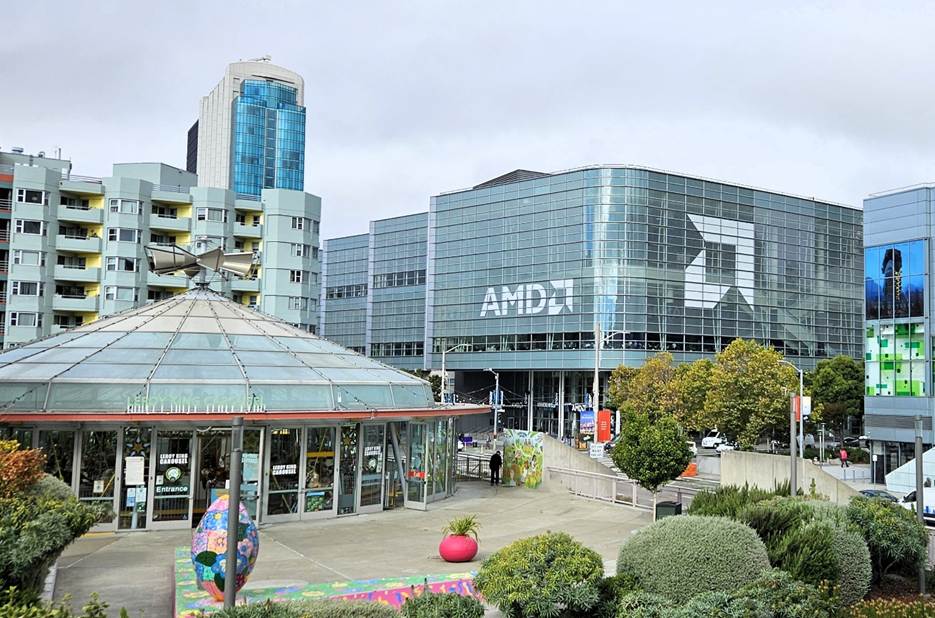
At AMD Advancing AI 2026, held on July 23, 2026, at the Moscone Center in San Francisco, California, AMD presented a broad AI strategy that spans cloud infrastructure, enterprise AI, client computing, robotics, and embedded systems. The event brought together developers, customers, ecosystem partners, and enterprise leaders to discuss how AMD’s end-to-end AI portfolio is evolving from silicon through software.

Financial Momentum Supports the AI Strategy

The announcements came shortly before AMD reported its second-quarter 2026 financial results. The company delivered record revenue of $11.5 billion, representing 50% year-over-year growth, while datacenter revenue more than doubled compared to the prior year. AMD attributed this growth to accelerating demand for EPYC processors, expanding Instinct deployments, and increasing AI infrastructure investments across the market.

A Vision Beyond Silicon

While hardware announcements often dominate AI events, the broader message from Advancing AI 2026 was AMD’s effort to create a unified AI development experience. The company’s strategy aims to enable developers to build AI applications on local systems, optimize them with a common software framework, and deploy them consistently across enterprise, cloud, edge, and robotics environments using the same foundational platform.

Building an Open AI Software Foundation

A key pillar of AMD’s strategy is its continued investment in open software. AMD reported that more than three million Hugging Face models run out of the box on AMD platforms, while many of the industry’s leading open-source AI projects now offer native AMD support. The company also highlighted significant growth in open-source contributions and ecosystem partnerships as part of its software expansion efforts.

ROCm Evolves from Platform to Development Ecosystem

AMD’s ROCm platform has evolved from a GPU programming environment into a broader AI software stack that supports frameworks, libraries, developer tools, and optimization capabilities. AMD positions ROCm as the common software layer that enables portability across its AI hardware portfolio, from client systems through hyperscale infrastructure.

Introducing ROCm.ai

Among the notable software announcements was ROCm.ai, an AI-driven development platform designed to help developers build, optimize, and deploy GPU applications more efficiently. ROCm.ai enables popular coding assistants such as Claude, Codex, Cursor, and Gemini to understand AMD hardware architectures and ROCm workflows natively, helping reduce the learning curve associated with GPU optimization.

AI-Assisted Performance Optimization

AMD also introduced capabilities that leverage AI to improve application performance. Through technologies such as Hyperloom, ROCm.ai can establish performance baselines, profile workloads, identify bottlenecks, tune serving configurations, generate optimized GPU kernels, and validate performance improvements. This represents a shift toward AI-assisted software engineering where optimization becomes increasingly automated.

Extending AI Development to the Desktop

AMD’s vision extends beyond the datacenter. With the Ryzen AI Halo developer platform and upcoming systems powered by Ryzen AI Max PRO 400 Series processors, AMD aims to make advanced AI development accessible on desktop-class hardware. These systems provide developers with local environments capable of running increasingly sophisticated AI workloads while maintaining compatibility with larger AMD compute environments.

Ryzen AI Halo developer platform, source: AMD, 2026

Developing Locally, Scaling Globally

A notable aspect of AMD’s approach is software consistency across deployment environments. AMD presented ROCm.ai as supporting systems that range from AI PCs and workstations to rack-scale AI infrastructure and datacenters. This approach creates a workflow where models can be developed and tested on local hardware before being deployed at cloud scale using the same software foundation.

Enterprise AI and Hybrid Deployment

AMD also highlighted a collaboration with Cisco designed to combine AMD AI inference platforms, including Ryzen AI Halo systems, with Cisco networking, security, observability, and management capabilities. The goal is to help enterprises deploy, govern, and manage hybrid and local agentic AI deployments while maintaining operational consistency across environments.

Extending AI into Robotics and Physical Systems

Another major theme of the event was AMD’s expansion into Physical AI. As AI moves beyond digital environments into machines that perceive, reason, and act in the physical world, AMD is positioning its technology portfolio to address robotics, industrial automation, healthcare, and autonomous systems. AMD estimates that the Physical AI silicon market could reach $200 billion by 2035.

Introducing the Kria AI Portfolio

To address this opportunity, AMD introduced the Kria AI solutions portfolio, extending its presence from traditional robotics control systems into higher-level robot intelligence. AMD describes this as bringing together perception, reasoning, decision-making, and control capabilities on a unified platform designed for demanding robotic workloads.

Ryzen AI Embedded X100 Series

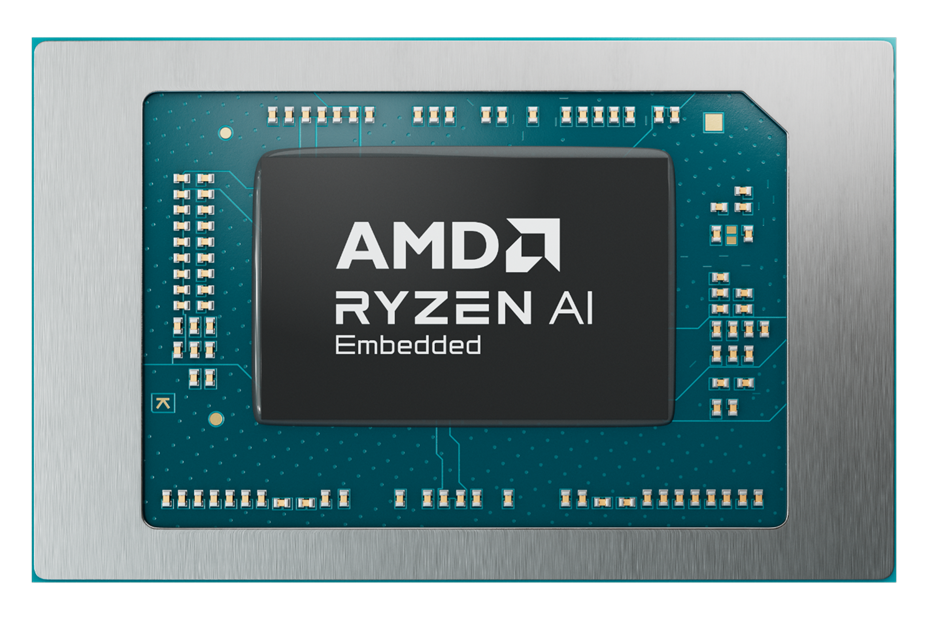
At the foundation of the portfolio is the new Ryzen AI Embedded X100 Series, which combines CPU, GPU, and NPU resources within a unified memory architecture. AMD positions these processors as platforms capable of supporting the simultaneous requirements of perception, reasoning, planning, orchestration, and real-time control that characterize modern Physical AI systems.

Ryzen AI Embedded X100 Series, source: AMD, 2026

The Kria AI Robotics Developer Platform

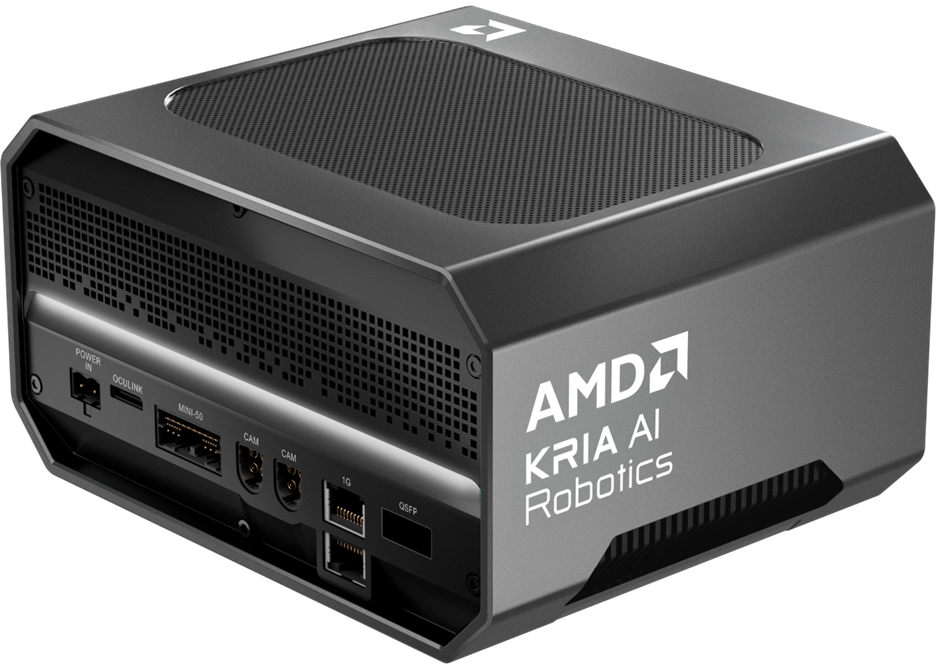
AMD also introduced the Kria AI Robotics Developer Platform, described as an open, turnkey robotics development environment that integrates CPU, GPU, NPU, and FPGA compute. The platform is intended to reduce development complexity while helping robotics developers move more quickly from concept and prototype to production deployment.

Kria AI Robotics Developer Platform, source: AMD, 2026

Bringing the Cloud Software Stack to the Edge

One strategically important aspect of AMD’s robotics announcements is software continuity. The new AMD Robotics Software Suite is built on ROCm, allowing developers to leverage familiar frameworks, tools, and workflows already used in cloud AI environments. AMD explicitly describes ROCm as both cloud-proven and embedded-ready, creating a common software layer between datacenter AI and Physical AI deployments.

Reducing Vendor Lock-In Through Open Standards

AMD repeatedly emphasized openness throughout its software and robotics announcements. The company highlighted support for open standards, familiar x86 development workflows, industry partnerships, and open-source technologies. In robotics specifically, AMD identified avoidance of vendor lock-in as a key priority among developers and positioned its software stack as an alternative built around portability and ecosystem flexibility.

Analyst Opinion and Conclusion

AMD’s Advancing AI 2026 announcements reflect a strategy focused on developer productivity, software consistency, and open ecosystem adoption. Rather than treating desktops, datacenters, edge systems, and robotics as separate markets, AMD is building a continuum in which applications can be developed locally, optimized through AI-assisted software tools, deployed at cloud scale, and extended into physical systems using a common architecture. This approach addresses a persistent industry challenge: the fragmentation between experimentation, production deployment, and edge execution.

Technical vision alone will not guarantee adoption, however. AMD continues to compete against an incumbent ecosystem built on years of developer investment, mature tooling, and deep integration with commercial AI applications, and shifting those established development priorities typically requires clear performance, cost, or business benefits. Pricing and total cost of ownership will matter as much as raw compute performance, particularly as enterprise buyers weigh software readiness, operational simplicity, and deployment timelines across the full lifecycle.

Success will likely depend less on hardware specifications than on ecosystem momentum: winning ISV certifications, application optimizations, framework support, and robotics middleware integrations may prove as important as introducing faster processors. The broader significance of Advancing AI 2026 is not that AMD is entering new AI segments, but that it is attempting to connect desktop, cloud, and physical AI through a common development model. Whether AMD becomes an increasingly influential platform provider across that continuum will depend on its ability to sustain software adoption and partner engagement alongside its hardware roadmap.

Mohamed Hefny

Mohamed Hefny - Senior Program Manager, Data and Analytics

Mohamed Hefny leads market research in EMEA on professional workstation PCs and solutions. He also reports on professional computing semiconductors, processors, and accelerators (CPUs and GPUs), as well as breakthroughs and trends related to the market. In addition, Mohamed is…
Malini Paul

Malini Paul - Senior Research Manager, Personal Computing Devices

Malini Paul is a research manager of Client Computing Devices team in Europe, with over 10 years of experience in the ICT industry. Currently based in London, she leads the Personal Client Computing Devices research program for Western Europe. She…

On July 28, 2026, the FCC quietly added “advanced robotic devices” to its Covered List, the roster of tech it has flagged as a national security risk, blocking new equipment authorizations for foreign-made robots. The headlines were about humanoids, the walking machines from Chinese vendors like Unitree. Within 24 hours, the story took a stranger turn: the ban also covers your vacuum.

Ban, or something narrower?

Most coverage calls this a “ban,” and we will too, because that’s the word everyone is searching for. But read the fine print and it is more of a chokepoint than a wall: already-certified models can keep shipping new units, not just running out what’s already sold, though the FCC has reserved the right to revoke that status later, there is a Conditional Approval pathway that lets vendors keep selling if they shift manufacturing to the US, and a long list of exclusions, road, rail, aircraft, underwater vehicles, medical and mobility devices, and fixed industrial arms, sit outside the rule entirely.

The FCC’s definition sweeps in any foreign-made mobile robot over roughly 4.4 pounds that senses its surroundings, moves along the ground, and connects wirelessly, a description that fits a humanoid, a quadruped, and a robot vacuum, lawnmower, or window cleaner equally well. Already-certified models keep shipping new units, not just running out what’s on shelves. It’s the next hardware refresh that’s cut off.

IDC is launching research into Physical AI across four layers of the ecosystem: Infrastructure, Software and Platforms, Services, and Devices. Robotics sits inside Devices, and today it is, by a wide margin, the biggest draw in that layer. That is why a rule written around “robots” ripples so far. The figures below cover the robot categories IDC tracks in depth, household cleaning, professional and commercial, and humanoid, not the entire global robotics market. We ran those numbers against IDC’s latest worst-case scenario, current as of August 2026, and the results flip a lot of the conventional wisdom about who is actually impacted by this restriction.

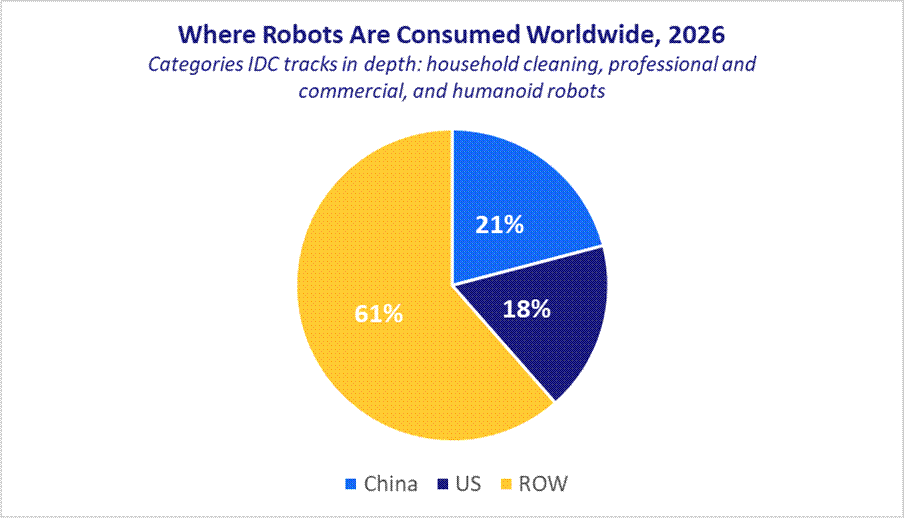
Where Robots are Consumed Worldwide 2026 chart - Shows China (21%) and US (18%)...the rest of the world (61%)

Source: IDC Worldwide Robotics Trackers, Q2 2026 (If Ban Stays Till 2030 Scenario). Household cleaning, professional and commercial, and humanoid robots combined, the categories IDC tracks in depth.

Within these tracked categories, Europe, not the US or China, is the largest robot market by consumption, at more than double America’s share. The US and China combined still do not outbuy the rest of the world here.

The US Hit, If the Restriction Holds

Put the US robot categories IDC tracks in depth on one chart, household cleaning, professional and commercial, and humanoid combined, and the picture is more forgiving than the headlines suggest: these categories still grow every year through 2030, just off a lower trajectory. The gap opens gradually, reaching about 4% below the published baseline in 2027 and 18% by 2030. On IDC’s baseline, this US total compounds at around 13% a year through 2030; under this scenario, that cools to 9%, a real deceleration, but nowhere close to the growth story stalling out.

Using IDC’s blended average selling price assumptions, that growth gap between the restriction scenario and IDC’s published baseline compounds into more than $6 billion in foregone US robotics revenue between 2026 and 2030, with the single worst year, 2030, alone accounting for above $2 billion of it.

That softer trajectory rests on a specific assumption: already certified models do not disappear. The FCC’s rule only blocks new equipment authorizations, so IDC’s scenario assumes overseas vendors keep selling models that cleared certification before the rule took effect, refreshing appearance, hardware configurations, and software features rather than filing for new authorizations. For household cleaning specifically, IDC expects those extended models to stay competitive at least through 2027, since US demand for the newest generation of features runs lower than in Europe or China, and expects vendors to lean harder on wet and dry vacuums, a category this rule does not touch, to offset lost robot vacuum volume while protecting their premium positioning. A sharper decline is still expected within two to three years once those extended product cycles run out.

Not Every Category Takes the Same Hit

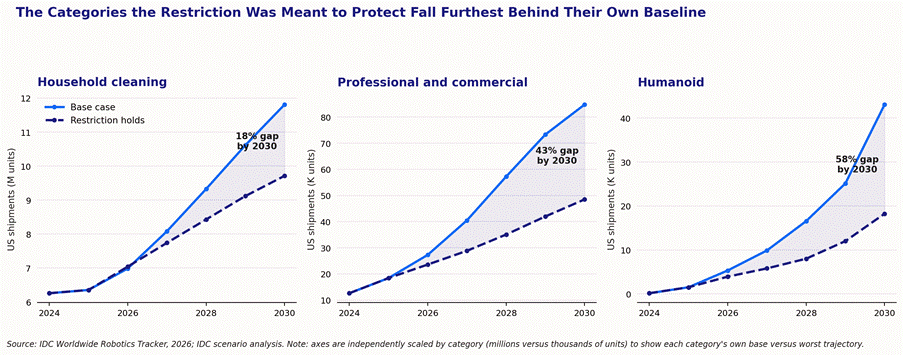
The instinct is to assume this rule protects the humanoid and commercial robot builders it was written for, while consumer cleaning brands, already dominated by Chinese vendors, absorb the pain. The final numbers say the opposite. Look at each category’s own base case line against its own worst-case line, and the ones expected to benefit from this policy are the ones falling furthest behind where they would otherwise be:

The categories the Restriction was meant to protect fall furthest behind their own baseline chart.

Source: IDC Worldwide Robotics Trackers, 2026 (If Ban Stays Till 2030 Scenario). Each panel uses its own scale (millions versus thousands of units) to show the category’s own trajectory, not a comparison of absolute volume across categories.

Household cleaning is nearly the entire US volume across these tracked categories, and it is also the most resilient category in relative terms, trailing baseline by just 4% in 2027 and 18% by 2030. Professional and commercial robots fall further behind, from a 29% gap in 2027 to 43% by 2030. The same lifecycle extension approach applies here too, incremental hardware and software upgrades on already deployed fleets rather than new authorized models, but higher stakes deployments and shorter replacement cycles make it a thinner cushion than in household cleaning, though a commercial robot’s higher price tag makes a real US manufacturing commitment worth pursuing for some vendors under the FCC’s Conditional Approval process.

Humanoid robots, the category this restriction was ostensibly designed to protect, see the deepest cut of all: a 41% gap in 2027 widening to 58% by 2030. Look at the dollars and it is starker still: nearly four out of every five dollars of the category’s projected 2030 US revenue evaporates under the worst case. Volumes are still small, which is also why the percentage swings look so dramatic, so this is not a story about finished robots piling up at customs. It is about how dependent even vertically integrating US builders, Figure, Apptronik, Boston Dynamics, still are on China for the motors, actuators, batteries, and rare earth materials that go into every unit. Overseas humanoid vendors have the same shelf life extension playbook available, keeping already approved units in the field and iterating through incremental hardware, software, and AI upgrades, but it buys far less cover here: IDC does not expect US based humanoid builders to reach scaled mass production until the end of 2028, so there is no domestic backstop ready to absorb the growth that foreign models can no longer supply. IDC estimates China accounts for 82% of global humanoid shipments today. Until US builders reach that scale, whatever badge sits on the chassis, the bill of materials behind it still reads China.

Europe Absorbs the Redirect, Not China

The scenario does not just subtract US demand; it has to send that displaced hardware somewhere. IDC’s model nudges professional and commercial and humanoid forecasts higher across EMEA and other parts of the world, particularly the UK, France, Germany, and Eastern Europe, as Chinese vendors redirect resources toward markets open to them. China’s own domestic forecast barely moves. It is a story about Europe, already the largest buyer of these tracked robot categories, getting a little larger still.

What It Means for Vendors

Reshoring consumer robotics specifically is unlikely given thin margins; this accelerates a supply chain diversification trend already in motion rather than starting a new one. Tesla sourcing its own AI chips for Optimus across TSMC and Samsung’s Texas fab is one model other vendors may follow: hedge the component that carries the most geopolitical risk, chips today, magnets and actuators next, rather than moving final assembly to the US.

Expect that hedge to widen the gap inside devices rather than close it. Humanoid and commercial builders have the margin and the government backing to build out US supply for the parts that matter most. Household cleaning vendors do not have that room, so the category most exposed today stays exposed, even as it turns out to be the one best riding out the restriction. And expect more vendors trying to maintain a US foothold to pair with independent US software partners rather than their own bundled stack, since a software partner is far cheaper to Americanize than an entire supply chain. Tennant’s hardware running on Brain Corp’s independent BrainOS is one example of that model.

The Bottom Line

The vacuum detail is what makes this restriction legible to a general audience, a strange, sticky hook for a story about industrial policy. But it’s not the point, and neither is the word “ban.” The point is that a single trade rule, applied evenly on paper, lands completely unevenly in practice, and not in the direction most people assumed.

Household cleaning, already dominated by foreign brands and squarely in the crosshairs, shrugs this off best. Humanoid robotics, the category built with US flags on the marketing decks, takes the deepest percentage hit, because protecting the badge on the finished robot does nothing to protect the motors, actuators, and rare earths inside it. And the biggest beneficiary of the US-China standoff is not the US or China, it is Europe, already the largest buyer of these tracked robot categories, absorbing the redirected volume without a policy of its own.

So, what does the restriction really mean? Not that the US is closing its doors to robots, and not that China’s lead breaks, because China was never actually leading global consumption in the first place. It means the market is quietly sorting into two tracks: mass market categories that keep growing around the US, and higher value categories where the appearance of protection outpaces the reality of supply chain independence. The vendors and the policymakers who read that correctly get a head start on everyone still parsing what the FCC actually wrote.

Update: See how IDC’s modeling holds up against outside expert debate in our follow-up, FCC Robotics Ban: Checking the Expert Debate

Getting a Head Start of Your Own

Reading this restriction correctly is one edge. Having a full view of where Physical AI is headed next is another. Two ways to build on it:

On-Demand Webinar: The Physical AI Era: Robots as Intelligent Partners
Robots are moving from single-task tools to genuine operational partners. Watch IDC’s on-demand session to see what that shift means for your next move in Physical AI. Recorded before the July 2026 FCC robotics restriction; some market projections may not reflect this policy change.

Fragmented data. Blind forecasts. Competitive gaps.
If any of that sounds familiar, you’re not alone — it’s what every robotics manufacturer, systems integrator, and enterprise tech leader runs into once they start taking Physical AI seriously. IDC is the only research firm covering the full value chain, platforms and software, infrastructure, services, and devices, as one coordinated program. Explore the Physical AI Hub to see the whole picture, or Contact us to talk through what it means for you


Ryan Reith - Group Vice President, WW Device Trackers - IDC

Ryan Reith is the Group Vice President for IDC's Worldwide Device Tracker suite, which includes mobile phones, tablets, wearables, and most recently AR/VR. His teams research focuses on the quantitative aspects of the mobile device industry, including market sizing, forecasting, vendor market share analysis, and technology trends. His current responsibilities include engaging with mobile device OEMs, supply chain, distributors, and the financial industry to discuss market trends and forward looking analysis.

Navkendar Singh - Associate Vice President - IDC

Navkendar Singh is a Associate Vice President with IDC India, based in Gurgaon. His research domains encompass deep-dive research and insights in and around mobile devices, smart homes, PCs, tablets, wearables, and the printing market in India, Bangladesh, and Sri Lanka. He is also involved in building IDC's successful channel research programs for these domains at city and state levels. Navkendar also leads research related to analyzing the role of devices, emerging business engagement models, the impact of emerging technologies on devices, and emerging personas related to Future of Work.