Display Glasses Carry the Market as Headset Demand Cools
Q2 2026 Performance: Glasses Offset a Headset Decline
Worldwide AR/VR headset shipments grew 5.1% year over year in Q2 2026, according to IDC’s Worldwide Quarterly Augmented and Virtual Reality Headset Tracker. Shipments declined 20.1% from the previous quarter as headset volumes weakened.
Extended reality glasses drove the growth, rising 79.8% year over year to capture 46.0% of the market. Mixed reality headsets still held the largest share at 49.3% but declined 22.3%. Meta raised prices on Quest 3 and Quest 3S in April to pass through higher memory chip costs. Virtual reality devices fell 37.6%, while augmented reality grew 14.1% from a small base.
Regional results diverged. The PRC grew 85.8% and Japan grew 88.2%, while the US and Western Europe declined 24.1% and 25.2%, respectively. Rising US inflation, driven by higher gasoline prices tied to the war with Iran, added pressure on discretionary purchases of higher-priced devices. The Middle East & Africa and Latin America more than doubled from small bases
| Product | Share 2025Q2 | Share 2026Q2 | YoY 2026Q2 |
| Augmented Reality | 1.8% | 1.9% | +14.1% |
| Extended Reality | 26.9% | 46.0% | +79.8% |
| Mixed Reality | 66.7% | 49.3% | -22.3% |
| Virtual Reality | 4.7% | 2.8% | -37.6% |
| Total | 100.0% | 100.0% | +5.1% |
Vendor Landscape: Meta Leads as Glasses Makers Gain Ground
Meta remained the market leader with 45.7% share, although its shipments declined 21.6% year over year. The company reported lower Quest sales offset by strong growth in AI glasses, which signals a shift in investment from headsets toward glasses. In mixed reality, Meta held 89.6% of the category, followed by ByteDance at 6.8% and Apple at 2.6%.
RayNeo ranked second with 12.0% share after growing 83.3%, and it led extended reality glasses with 25.2% of the category. XREAL placed third at 8.4% despite a 14.5% decline. Viture grew 95.8% to reach 7.5% share and held 63.4% of augmented reality. Rokid posted a 592.2% increase to capture 6.6%.
| Five-Period Market Share: Top 5 by Company, 2026Q2 (Units) | |||||
| Company | 2025Q2 | 2025Q3 | 2025Q4 | 2026Q1 | 2026Q2 |
| Meta | 61.2% | 69.3% | 67.7% | 57.4% | 45.7% |
| RayNeo | 6.9% | 5.4% | 6.8% | 9.3% | 12.0% |
| XREAL | 10.4% | 6.0% | 3.6% | 5.5% | 8.4% |
| Viture | 4.0% | 3.8% | 4.1% | 6.7% | 7.5% |
| Rokid | 1.0% | 2.7% | 4.0% | 4.9% | 6.6% |
| Others | 16.5% | 12.8% | 13.8% | 16.2% | 19.8% |
| Total | 100.0% | 100.0% | 100.0% | 100.0% | 100.0% |
| Source: IDC Quarterly Augmented and Virtual Rerality Headset Tracker, 2026Q2 | |||||
XR Market Outlook: Glasses Set the Pace
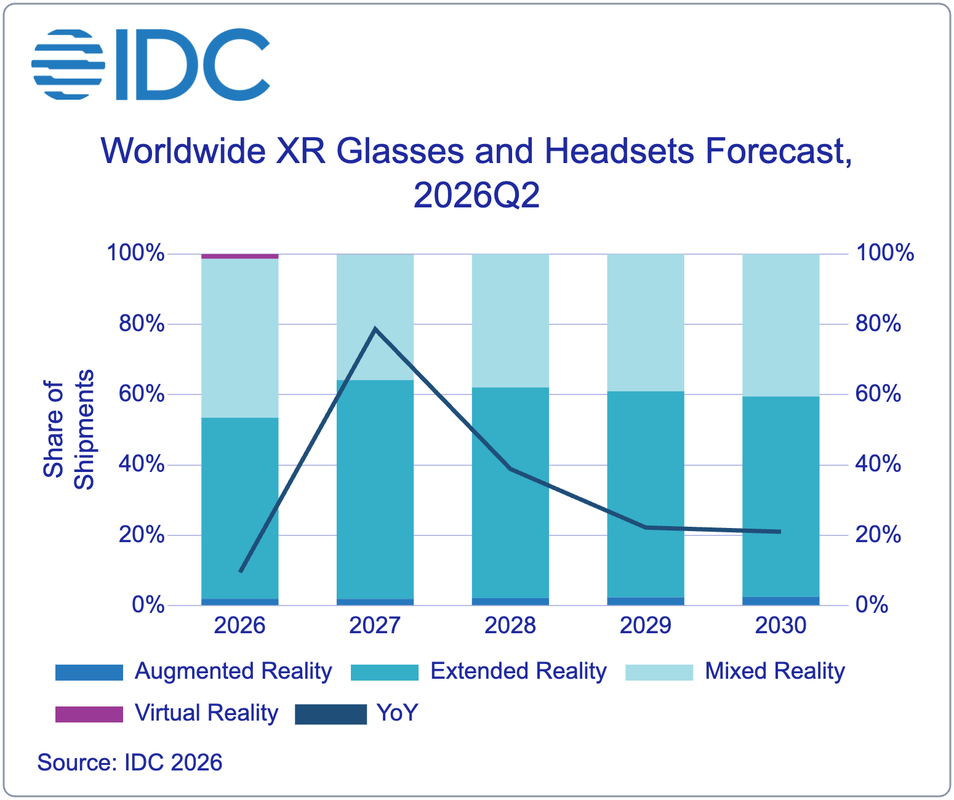
IDC forecasts the market to grow 9.5% in 2026, with Q3 2026 shipments expected to rise a modest 1.1% year over year. Growth is expected to accelerate to 78.6% in 2027 as new glasses reach the market, including XREAL’s Android XR-based Aura glasses scheduled for fall. The market is projected to expand at a 38.4% CAGR from 2026 through 2030.
Extended reality glasses are expected to grow 109.8% in 2026, with their share rising from 51.5% this year to 57.0% in 2030 at a 41.9% CAGR. Mixed reality headsets are forecast to decline 27.2% in 2026. Their share is expected to ease to 40.5% by 2030, at a 34.7% CAGR. Augmented reality is projected to post a 47.6% CAGR, while virtual reality is expected to fade from the market.
Cost pressure remains a key risk. Memory supply is expected to stay tight beyond 2027 because of AI demand, which keeps component costs elevated for both headsets and glasses. By region, the US is forecast to grow 17.3% in 2026 and to lift its share from 43.7% to 50.9% by 2030. The PRC is expected to grow 62.2% this year.