Worldwide Wearable Device Market, Q2 2026
Worldwide wearable device shipments reached about 148 million units in Q2 2026, up 2.7% year over year and 1.5% quarter over quarter, according to IDC’s Worldwide Quarterly Wearable Device Tracker. The market grew even though US consumer sentiment fell to a record low on higher fuel prices and inflation concerns, which put pressure on discretionary spending.
Earwear remained the backbone of the market. It accounted for 64.9% of shipments and grew 5.4% year over year. Wrist-worn categories weakened. Smartwatches fell 4.2% to a 25.0% share, and wrist bands declined 4.7% to 7.4% share. Rising memory and storage costs are increasingly passed on to consumers, and higher air freight costs linked to the Middle East conflict have squeezed margins and room for promotions.
Emerging form factors provided most of the momentum. Glasses grew 54.0% year over year to 1.7% share, supported by strong demand for AI glasses and new optical styles that broaden their appeal beyond sunglasses. Rings rose 37.6% to 0.8% share.
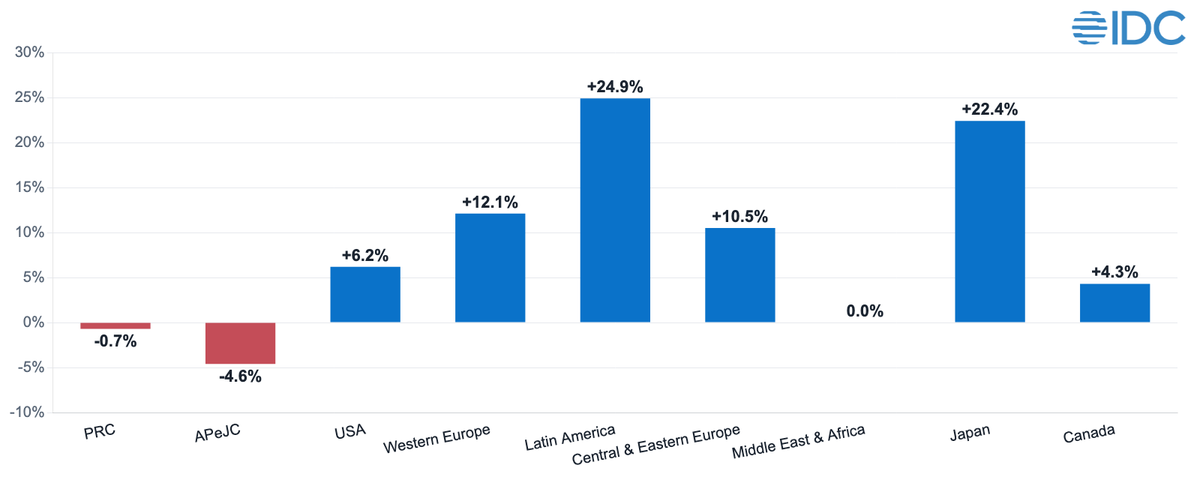
Regional performance was uneven. PRC, the largest region at 33.3% share, slipped 0.7%, and Asia/Pacific (excluding Japan and China) declined 4.6%. Latin America grew 24.9%, Japan rose 22.4%, Western Europe increased 12.1%, and the USA was up 6.2%. By operating system, RTOS devices held 91.4% share and grew 4.2%, while watchOS fell 13.6% and Wear OS dropped 24.5%.
Top 5 Wearable Device Companies
Apple led the market with 15.5% share and grew 8.9% year over year. Xiaomi followed with 11.7% share but declined 6.6%. Huawei grew 8.4% to 10.9% share and narrowed the gap with Xiaomi. Samsung held 6.8% share, down 2.9%, and Imagine Marketing rounded out the top five with 4.9%, down 3.3%.
Category leadership varied widely. Apple led earwear with 17.2% share. Huawei topped smartwatches with 18.8%, ahead of Apple at 17.2%. Xiaomi dominated wrist bands with 45.9%. Meta controlled 78.4% of glasses, and Oura held 67.0% of rings. Garmin led the remaining categories with 27.9% share after reporting record fitness results driven by advanced wearables and share gains.
| Five Period Market Share: Top 5 by Company, 2026Q2 (Units) | |||||
| Company | 2025Q2 | 2025Q3 | 2025Q4 | 2026Q1 | 2026Q2 |
| Apple | 14.6% | 18.9% | 21.0% | 18.1% | 15.5% |
| Xiaomi | 12.9% | 10.9% | 10.3% | 11.4% | 11.7% |
| Huawei | 10.3% | 7.8% | 7.9% | 10.6% | 10.9% |
| Samsung | 7.2% | 8.1% | 7.7% | 6.9% | 6.8% |
| Imagine Marketing | 5.2% | 7.6% | 3.7% | 5.0% | 4.9% |
| Others | 49.8% | 46.7% | 49.4% | 48.0% | 50.2% |
| Total | 100.0% | 100.0% | 100.0% | 100.0% | 100.0% |
| Source: IDC Quarterly Wearable Device Tracker – 2026Q2 (includes historical and preliminary data). Unit share. Figures may not sum to 100% due to rounding. | |||||
Wearables Market Outlook: Glasses and Rings Set the Pace
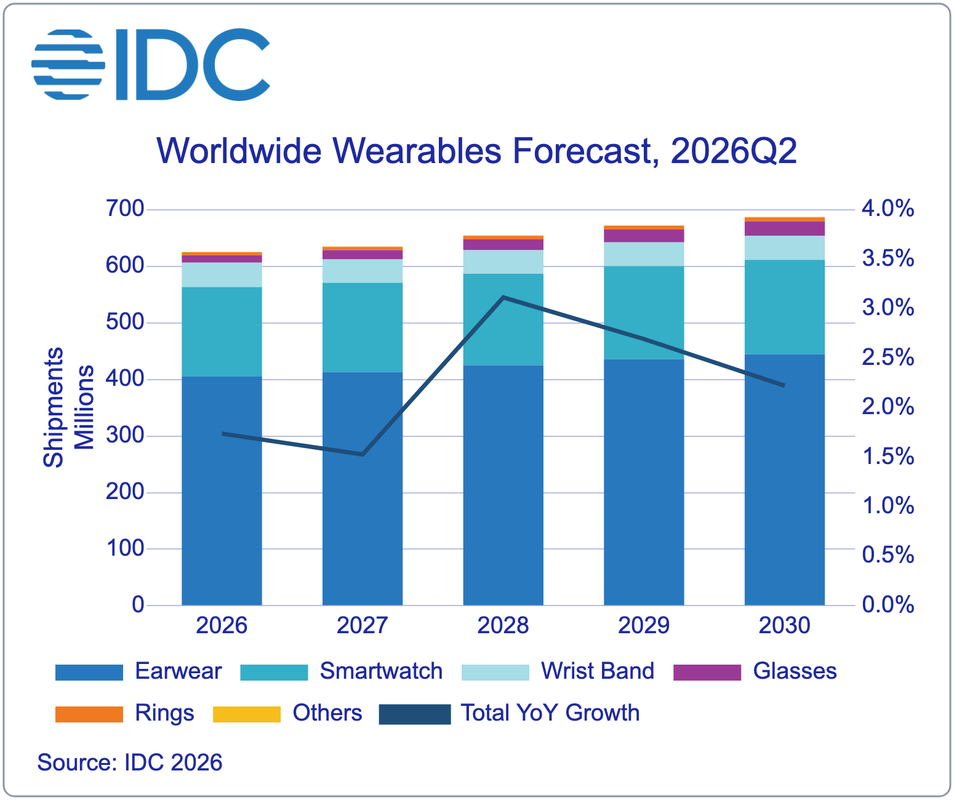
IDC forecasts wearable shipments of about 625 million units in 2026, up 1.7% year over year. Q3 2026 is expected to decline 2.8% year over year as higher component, logistics and tariff-related costs weigh on demand. The market is forecast to grow at a 2.4% CAGR from 2026 through 2030 and reach about 687 million units.
Earwear is forecast to grow 3.3% in 2026 and to hold roughly two-thirds of the market through 2030, with a 2.3% CAGR. Smartwatches are expected to decline 3.7% in 2026 and then recover to a 1.3% CAGR, as lengthening replacement cycles push buyers toward fewer but more premium purchases. Wrist bands are forecast to decline 1.1% in 2026, with a -0.3% CAGR.
Glasses are expected to be the fastest-growing category, up 35.2% in 2026 with an 18.1% CAGR, and their share is forecast to rise from 2.1% to 3.7% by 2030. Rings are forecast to grow 18.5% in 2026, with an 8.6% CAGR.
Among regions, PRC is expected to grow 3.2% in 2026 and post a 4.8% CAGR. Latin America is forecast to grow 8.9% and Western Europe 5.9%. The USA is expected to grow only 0.4% amid tariff uncertainty and spending concentrated in higher-income households, while Asia/Pacific (excluding Japan and China) is forecast to decline 3.9%.