Leo Li is a senior market analyst on artificial intelligence (AI) and big data for IDC China. He conducts research and analysis on AI and big data for the China and worldwide markets. He is also involved in regional and global consulting and business development in related markets.
Prior to joining IDC, Leo has in-depth working experiences in AI and a wide range exposure on various businesses in AI.
Leo holds a master’s degree in economics from Boston University.
Mr. Wu Lianfeng, the Vice President and Chief Research Analyst of IDC China, has more than 25 years of experience working in the IT industry. Since joining IDC in 2000, Mr. Wu has extensive research and consulting experience in the areas of overall ICT market, vertical industry market, Internet and new media, smart connected devices, software and service outsourcing, digital transformation, digital economy, and emerging technology, among others.
In recent years, Mr. Wu has been leading IDC China's digital transformation research and event. In 2017, he started to build the CXO circle excellence club, the vision of which is to help industry CXOs transform from good to excellent. Mr. Wu holds monthly offline activities and publishes daily articles that focus on digital transformation: business trends, technology trends, industry trends, organizations, and people role trends.
Mr. Wu also worked with IDC global analysts to lead China's annual ICT direction forum and Top 10 Predictions (IDC FutureScapes) forum, providing industry forecasts of the latest development directions and business opportunities. At the same time, Mr. Wu works with a team of analysts to explore and discover new research topics and build thought leadership in the ICT market. Recent research areas he has delved in include Future of Work (FoW), Future Industry, Smart City, and DevOps, among others.
Mr. Wu is also a guest speaker in all kinds of top ICT summit, CIO summit, and industry digital transformation summit. He gives nearly 50 speeches every year, which greatly promotes the application and development of digital technology in the industry.
Prior to joining IDC, Mr. Wu worked with China Academe Launch-vehicle Technology (CALT), China Hewlett-Packard Co. Ltd., Jardine Pacific (JOS) Information Technology Co. Ltd., accumulating 9 years of working experience in the field of IT and telecommunications.
Mr. Wu holds an MBA from the University of International Business and Economics in Beijing, a Master's degree in Engineering from China Academy of Launch Vehicle Technology, and a bachelor's degree in Engineering from the University of Electronic Science and Technology.
In the SMB world, a pivotal shift is underway. Small and medium-sized businesses (SMBs) are moving from technology experimentation to strategic adoption, with AI, generative AI (GenAI), and cloud technologies at the core of their competitive strategies. In 2026, IDC expects this momentum to continue, but with a clear caveat: SMBs will focus on highly pragmatic use cases that are easy to deploy and deliver measurable ROI.
AI-Driven Communications, Customer Engagement, and Marketing/Brand Awareness
AI and GenAI will become core tools for SMB marketing, enabling faster content creation, improved customer engagement, and more effective omnichannel brand building.
AI is rapidly becoming a practical tool for SMBs, particularly in communications and marketing. It’s no longer limited to internal chatbots or advanced analytics. SMBs are embedding AI into how they engage customers, manage marketing content and campaigns, and even make IT buying decisions.
GenAI is increasingly becoming SMBs’ “marketing sidekick.” Many small businesses already use it to generate content, refine campaigns, and maintain consistent brand messaging across channels. This shift is accelerating. Lengthy campaign launch cycles will give way to faster execution as GenAI becomes a standard tool for content creation, campaign optimization, and brand awareness at scale.
Hardware Gets Smarter
SMBs will increasingly invest in AI-ready and edge-enabled hardware to automate tasks and analyze data closer to where it is created.
Hardware is becoming a strategic enabler of AI adoption for SMBs. Businesses are investing in devices designed to support AI and edge computing, making it easier to automate workflows and generate insights in real time—without relying entirely on centralized IT systems.
From laptops with built-in AI capabilities to point-of-sale systems that detect trends instantly and edge servers that process data on-site, smarter hardware allows SMBs to act faster and compete more effectively with larger enterprises. However, to unlock the full value of these investments, SMBs will also need to modernize their underlying infrastructure to ensure long-term scalability and performance.
SMB Buying Behavior: GenAI and Cloud Marketplaces for Discovery
By 2026, SMBs will rely on GenAI tools and cloud marketplaces as primary channels for discovering, evaluating, and deploying IT solutions.
SMBs are changing how they research and purchase technology. Increasingly, they will turn to GenAI tools to explore IT solutions—using chatbots to ask questions, compare options, and quickly narrow down viable products. This approach can significantly reduce the time spent on initial research.
However, this shift comes with an important requirement: SMBs will need to invest in employee AI literacy. Effective prompt engineering and consistent fact-checking will be essential to ensure GenAI-driven research leads to sound decisions.
At the same time, cloud marketplaces are becoming central purchasing hubs. Rather than relying exclusively on traditional vendors or resellers, SMBs are browsing, comparing, and deploying solutions directly through these platforms. While this simplifies procurement, it also requires greater comfort with managing multiple vendors and integrating new tools rapidly.
FinOps and Finding Digital ROI
FinOps will become essential for SMBs seeking to manage AI and cloud costs while accelerating returns from digital investments.
As SMBs expand their use of AI and cloud services, cost management is becoming more critical. Financial operations (FinOps) is emerging as a must-have discipline—particularly for medium-sized businesses—to prevent budget surprises and maintain visibility into spending.
This comes alongside the fact that MBs are set to increase the speed at which they see returns from their digital investments, all thanks to the productivity gains made with AI and agentic AI. With smarter automation, sharper insights, and FinOps methodology, companies can deliver faster value while keeping a tighter grip on costs.
Navigating Security and Risk
Security, compliance, and risk management will increasingly determine which technology vendors SMBs trust and adopt.
Security and regulatory readiness are becoming decisive factors in SMB technology decisions. Rather than prioritizing feature breadth alone, SMBs are gravitating toward vendors that simplify risk management and compliance.
The growing complexity of global regulations and shifting trade requirements is also prompting many SMBs to reassess international expansion plans. As a result, trust, operational resilience, and simplicity are taking precedence—even if that means moving away from niche or overly complex solutions.
Next Steps for SMBs Going Into 2026
SMBs that succeed in 2026 will take a pragmatic, honest approach to assessing AI readiness across infrastructure, skills, and governance.
Looking ahead, SMBs will conduct clear-eyed evaluations of their digital maturity, identifying where infrastructure, talent, or governance gaps could limit the value of AI and cloud investments. This disciplined self-assessment is critical to unlocking innovation without increasing risk exposure.
With this renewed focus, IDC expects meaningful shifts in the SMB economic landscape as organizations double down on smart, secure, and outcome-driven digital transformation.
Katie Evans, Senior Director, Worldwide Small Medium Business (SMB) Research Program within the Digital Transformation space. Katie's core research coverage includes identifying and supporting the unique, evolving needs of the Very Small, Small and Medium Business technology buyer. Katie has a strong, SMB-focused research and writing background, having covered SMBs in the retail and ecommerce space for over 12 years. Most recently, her primary coverage area was researching the technology needs of SMB retailers and analyzing the vendor offerings on the market to meet those evolving needs. Katie has also conducted extensive writing and research on mobile and international ecommerce and has authored several custom reports for vendors serving SMBs.
Elisabeth Clemmons is a Research Analyst for IDC's Worldwide Small and Medium Business Markets program, where she covers the technology priorities, needs, challenges, and goals of small and medium businesses across the globe. Leveraging primary and secondary SMB research, she provides insights into technology trends and developments, buying patterns, market segmentation, and more. She additionally serves as an analyst for the Digital Economy Strategies research theme, covering the interrelationship between geopolitics, macroeconomics and the technology industry.
By 2028, 60% of enterprises will collaborate on data through private data exchanges or clean rooms, according to IDC’s 2026 FutureScapes predictions. This shift isn’t just a technical evolution—it’s a strategic one.
Why Data Collaboration Matters Even More Now
For years, we’ve called data the foundation of digital business. AI needs more and more data ‘fuel’ to train models, to ground outputs and to generate process and enterprise-specific responses. No one enterprise can create – or even independently curate – all the data it needs. It is time to lean into ecosystems (and data providers) who can expanding value through partnership. With new tooling this data is accessible securely and transparently between organizations in environments where governance is built in and privacy is preserved.
AI Demands Better Data
Generative and agentic AI systems thrive on diverse, contextual, high-quality data. Private data exchanges and clean rooms are emerging as the bridge between innovation and regulation—spaces where enterprises collaborate responsibly without exposing sensitive information. As highlighted in IDC’s Worldwide Data and Analytics 2026 Predictions, these environments are becoming essential bridges between innovation and regulation—spaces where collaboration is not only possible, but also safe.
Real-World Examples
Healthcare: Providers combine anonymized data sets to accelerate breakthroughs in personalized medicine.
Finance: Institutions partner to improve fraud detection while maintaining customer confidentiality.
Retail: Brands join forces to understand customers holistically, creating richer experiences without compromising trust.
A Mindset Shift
This isn’t just about technology—it’s about rethinking data strategy:
From owning all the data → to identifying the right data partners
From guarding information → to governing it
From isolation → to collaboration
Advances in privacy-enhancing technologies make this possible, turning fragmented information into collective intelligence.
Lead With Trust
Success in data collaboration depends on transparency, shared principles, and clear accountability. Organizations that invest now will strengthen AI outcomes and help define ethical, interoperable data standards for the next decade.
The goal isn’t just to manage data—it’s to make it meaningful.
In the agentic AI era, no organization operates alone. The future belongs to those who share wisely.
Lynne Schneider is Research Director leading IDC's Data Collaboration & Monetization, and Location & Geospatial Intelligence market research and advisory practices. Ms. Schneider's core research coverage in DaaS includes data sourcing and delivery services from traditional and emerging data providers along with evolving data aggregation and dissemination platforms. The breadth of coverage includes services that enable an organization to externally monetize data generated as part of the organization's ongoing operations, value-added information derived from this data, and the marketplace for combining data with other solutions. This research analyzes the supply and demand side business and technology trends of this emerging category.
In late 2025, the global semiconductor ecosystem is experiencing an unprecedented memory chip shortage with knock-on effects for the device manufacturers and end users that could persist well into 2027. DRAM prices have surged significantly as demand from AI data centers continues to outstrip supply, creating a supply/demand imbalance.
IDC was monitoring the memory situation as we prepared our November device forecasts, and we factored them into the update. The situation, however, has become more acute since publishing, and we feel it’s important we address the situation. Although we are maintaining our official forecasts as the situation is still evolving, we will offer here two downside risk scenarios that may play out in two critical markets: Smartphones and Personal Computers.
What’s causing the shortage? The memory market is at an unprecedented inflexion point, with demand materially outpacing supply. For an industry that has long been characterized by boom-and-bust cycles, this time is different. The rapid expansion of AI infrastructure and workloads is exerting significant pressure on the memory ecosystem. These AI workloads require large amounts of memory, and the shortage, in part, is driven by a reallocation of manufacturing capacity away from consumer electronics toward high-margin memory solutions to support AI. Instead of expanding conventional DRAM and NAND used in smartphones, PCs, and other consumer electronics, major memory makers have shifted production toward memory used in AI data centers, such as high-bandwidth (HBM) and high-capacity DDR5. This has restricted the supply of general-purpose memory modules and driven up prices across the board.
AI servers and enterprise environments require far more memory per system than consumer devices, so the AI build-out is pulling a disproportionate share of global capacity and creating shortages, as suppliers prioritize orders from hyperscalers and OEMs building AI servers. That dynamic has left less DRAM available for consumer devices, exacerbating price pressure in a tight market.
However, this is not just a cyclical shortage driven by a mismatch in supply and demand, but a potentially permanent, strategic reallocation of the world’s silicon wafer capacity. For decades, the production of DRAM and NAND Flash for smartphones and PCs was the primary driver for production. Today, that dynamic has inverted. The voracious demand for HBM by hyperscalers, such as Microsoft, Google, Meta and Amazon, has forced the three biggest memory manufacturers (Samsung Electronics, SK Hynix, and Micron Technology) to pivot their limited cleanroom space and capital expenditure towards higher margin enterprise-grade components. This is a zero-sum game: every wafer allocated to an HBM stack for an Nvidia GPU is a wafer denied to the LPDDR5X module of a mid-range smartphone or the SSD of a consumer laptop.
As a result, IDC expects 2026 DRAM and NAND supply growth be below historical norms at 16% year-on-year and 17% year-on-year, respectively.
The Crisis in the Devices Market
The result of this supply/demand imbalance is twofold: DRAM and NAND/SSD prices have risen sharply in recent months, and the availability of these components is limited, forcing device manufacturers to navigate a fluid situation.
The Potential Smartphone Market Impact
The global smartphone market, particularly Android manufacturers, is facing a threat in 2026. The industry’s decade-long trend of democratizing specs by bringing flagship features to affordable smartphones is reversing.
The cost structure of a smartphone is heavily dependent on the memory used. For a mid-range device, memory can represent 15-20% of the total bill of materials (BOM), while for a high-end flagship device, it is around 10-15%. As memory prices continue to surge, OEMs will likely have to raise prices significantly, cut specifications or both.
Different Vendors, Different Impacts
The impact of the shortage is highly asymmetric, creating winners and losers on supply chain resilience and vertical integration.
Manufacturers, whose business is mainly in the low end of the market, are likely to suffer significantly. The business models of vendors such as TCL, Transsion, Realme, Xiaomi, Lenovo, Oppo, Vivo, Honor or Huawei are based on thin margins. This increase in cost will hit their margins substantially, and they will have no other option but to pass the cost (or part) to end users.
In the high end of the market, Apple and Samsung face pressure but are structurally hedged. Its cash reserves and long-term supply agreements allow it to secure memory supply 12-24 months in advance. On the other hand, new flagship models in 2026 will likely have no RAM upgrades, sticking to 12GB for Pro models rather than increasing to 16GB. It is also unlikely that current models will see the same price erosion seen after the introduction of the latest model.
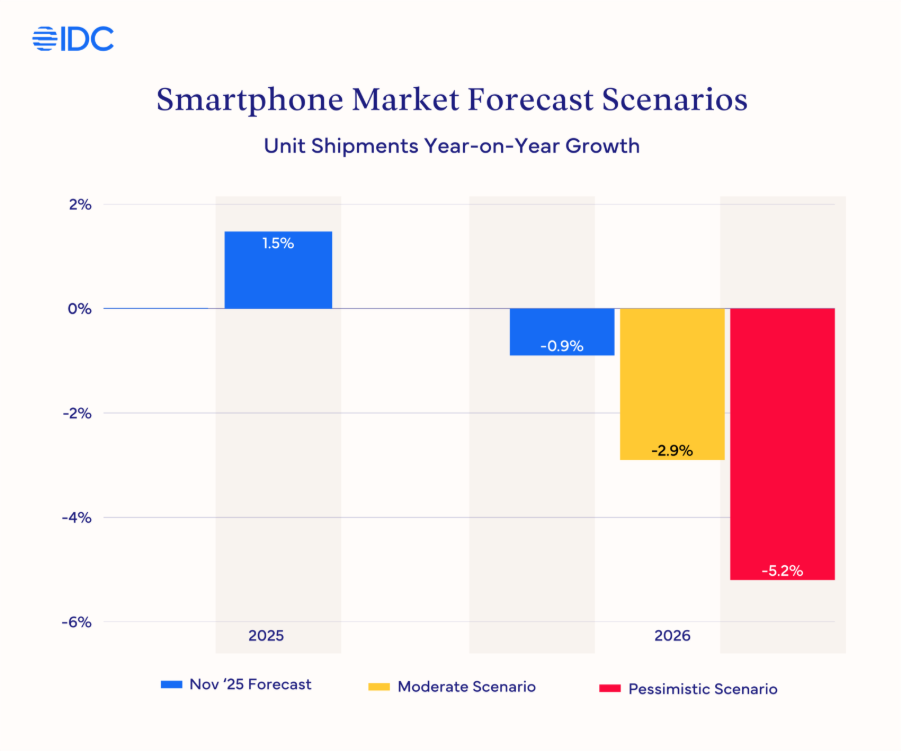
The cumulative effect of these pressures is a potential contraction in the global smartphone market alongside an increase in average selling prices (ASP). In 2026, in our moderate downside scenario, we could see the market contract by 2.9%. In our pessimistic downside scenario, it could be as bad as 5.2%. The severity of each scenario depends on how long this situation lasts.
At the same time, smartphone ASPs could rise by 3% to 5% in the moderate scenario, or by 6% to 8% in the pessimistic scenario. These price rises will be significantly higher in the low end of the market, where margins are extremely tight, and OEMs will have to pass the cost to end users.
But regardless of the severity of the scenario, longer replacement cycles are likely to occur in markets with rising costs causing lower purchasing power. By contrast, in more mature markets, consumers are likely to rely on financing and instalment plans to absorb higher prices.
While there could be significant downside risk to volumes in 2026, we expect 4Q25 to outperform our earlier projections as vendors stocked channels ahead of price increases.
Impact to the PC Market
If the smartphone market is facing pressure, the PC market is bracing for disruption. The timing of the memory shortage creates a perfect storm for the PC industry, colliding with the Microsoft Windows 10 end-of-life refresh cycle and the AI PC marketing push.
PC vendors are signalling broad price increases as cost pressures intensify into H2 2026. Lenovo, Dell, HP, Acer and ASUS have warned clients of tougher conditions ahead, confirming 15-20% hikes and contract resets as an industry-wide response.
PC vendors with larger shipment volumes should be better positioned to navigate current supply constraints, enabling them to capture market share from smaller and regional brands. Regardless of how much the total market size may be impacted, we expect vendor market shares to shift in favor of the largest vendors armed with inventory and greater leverage with suppliers.
White box as well as lower tier (often local) vendors, on the other hand, will bear the greatest burden of the shortage, and that would include DIY systems, oftentimes built by gamers. That in turn represents an opportunity for large OEMs to gain share from smaller assemblers in the gaming space by positioning pre-built systems as offering higher value.
The Impact on AI PC
The shortage threatens to derail the industry’s growth narrative around AI PC. IDC defines the AI PC as any PC with an NPU. Crucially, these devices tend to have more RAM (Microsoft’s Copilot+ PCs require a minimum of 16GB). As more small language models and large language models move on device, memory becomes even more important, with many higher-end systems shifting toward 32GB or higher. Just as the industry is seeing a need to add more RAM, it has become prohibitively expensive to do so, even if they can get supply. This will result in higher prices, lower margins, or a potential downmix in the amount of RAM in new systems at the worst possible time for this to occur.
As with smartphones, IDC is not changing its official PC forecast. Here again, we offer two potential scenarios for 2026.
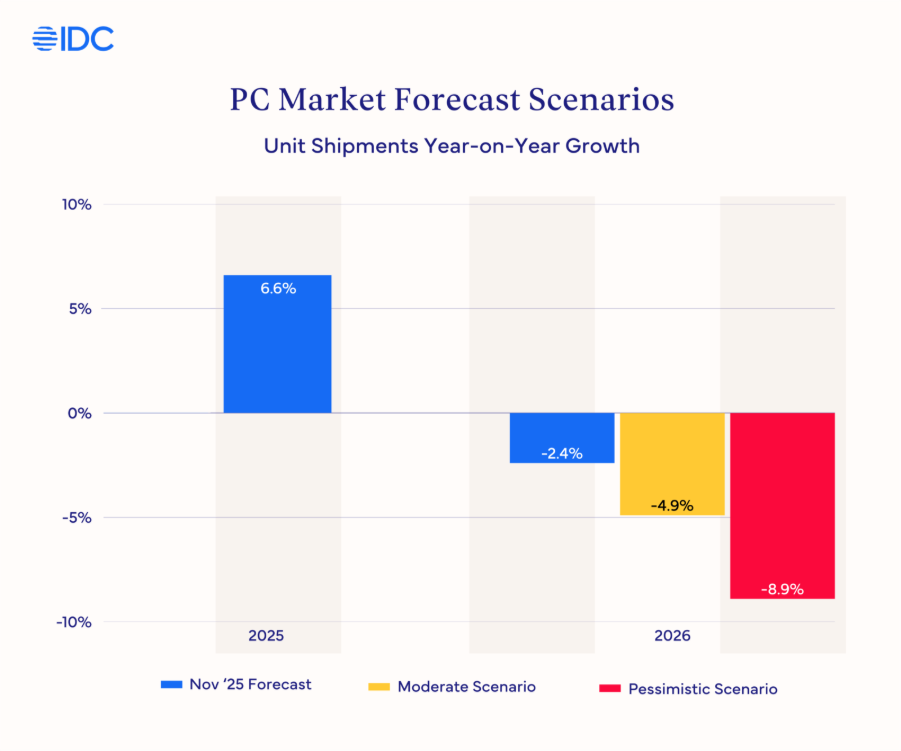
In the more moderate downside scenario, we could see the PC market contract by 4.9% compared with a 2.4% year-on-year decline in the November forecast. Under a more pessimistic scenario, the decline could deepen to 8.9%. The severity of each scenario will largely depend on how long the current supply constraints persist through 2026.
Under these downside scenarios, PC average selling prices would likely rise, increasing by 4% to 6% in a moderate scenario, and by 6% to 8% in a pessimistic scenario.
As with smartphones, channels are building inventory in advance to mitigate the impact of further price increases in the months ahead, which is expected to support stronger-than-expected forecast performance in Q4 2025, relative to the November outlook.
Conclusion
What began as an AI infrastructure boom has now rippled outward, with tightening memory supply, inflating prices, and reshaping product and pricing strategies across both consumer and enterprise devices. As the industry adjusts to this new reality, the smartphone and PC markets are bracing for a period of higher costs, altered product roadmaps, and slower volume growth. The severity and duration of the shortage will be determined by how quickly production capacity can expand and how effectively demand rebalances across segments.
For consumers and enterprises alike, this signals the end of an era of cheap, abundant memory and storage, at least in the medium term. The year 2026 is shaping up to be one in which technology becomes more expensive, driven by supply constraints rather than demand growth.
Francisco Jeronimo - Vice President, Data & Analytics - Devices - IDC
Francisco Jeronimo is VP for Data and Analytics at IDC EMEA. Based in London, he leads the research that covers mobile devices, personal computing devices, emerging technologies and the circular economy trends across EMEA. His team delivers data on personal computers, tablets, smartphones, wearables, PC monitors, PC gaming, enterprise Thin Client devices, smart home, augmented reality and virtual reality, and sales of used devices. He provides in-depth analysis of the strategies and performance of the key industry players.
Tom Mainelli heads the Device & Consumer Research Group, overseeing a wide array of hardware and technology categories that cater to both home and enterprise markets. His team's research spans PCs, tablets, smartphones, wearables, smart home devices, thin clients, displays, and virtual/augmented reality headsets. He also co-manages IDC's supply-side research team, which monitors display and ODM production across various categories. IDC's consumer research, anchored by the Consumer Market Model, employs regular surveys and proprietary models to forecast numerous consumer-focused activities and spending across hardware, software, and services.
As Group Vice President, Tom collaborates closely with company representatives, industry contacts, and other IDC analysts to provide comprehensive insights and analysis on a diverse range of commercial and consumer topics. A frequent speaker at public events, he travels extensively, enjoying every opportunity to engage with colleagues and clients worldwide.
Bryan Ma is Vice President of Client Devices research, covering mobile phones, tablets, PCs, AR/VR headsets, wearables, thin clients, and monitors across Asia as well as worldwide. Based in Singapore, Bryan provides insights and advisory services for both vendors and users, and coordinates his team of analysts in building IDC's core market data, analysis, and forecasts in these sectors. Bryan has been quoted in a number of publications, including The Wall Street Journal, The Economist, The Financial Times, BusinessWeek, The South China Morning Post, and The New York Times. He has been a featured speaker at numerous industry conferences and appears frequently as a guest commentator on television networks such as CNBC, Bloomberg, and the BBC.
Ryan Reith - Group Vice President, WW Device Trackers - IDC
Ryan Reith is the Group Vice President for IDC's Worldwide Device Tracker suite, which includes mobile phones, tablets, wearables, and most recently AR/VR. His teams research focuses on the quantitative aspects of the mobile device industry, including market sizing, forecasting, vendor market share analysis, and technology trends. His current responsibilities include engaging with mobile device OEMs, supply chain, distributors, and the financial industry to discuss market trends and forward looking analysis.
Jeff Janukowicz - Research Vice President, Solid State Drives and Enabling Technologies - IDC
Jeff Janukowicz is a Research Vice President at IDC where he provides insight and analysis on the SSD market for the Client PC, Enterprise Data Center, and Cloud market segments. In this role, Jeff provides expert opinion, in-depth market research, and strategic analysis on the dynamics, trends, and opportunities facing the industry. His research includes market forecasts, market share reports, and technology trends of clients, investor, suppliers, and manufacturers.
The global smart vacuum cleaner market didn’t just grow in 2025, it reorganized. Shipments reached 17.42 million units in the first three quarters of the year, up 18.7% YoY, with Q3 alone up 22.9%. Chinese brands; Roborock, Ecovacs, Dreame, Xiaomi, Narwal dominated the top five reflecting a structural shift powered by faster product cycles, ruthless price segmentation, and deep ecosystem plays. Consumers signaled what they value: AI-driven navigation, obstacle recognition, self-emptying docks, and seamless integration with voice and home platforms. Vendors that delivered those at mid-tier and entry-level prices won share while those that didn’t are now playing catch-up.
iRobot: A Pioneer That Missed the Turn
The news is unambiguous: iRobot filed for Chapter 11 and agreed to be acquired by its primary Chinese manufacturer, Shenzhen Picea Robotics, with the plan to take the company private and continue operations under Picea’s ownership. It’s an ending few expected a decade ago.
What caused the fall from grace? iRobot’s decline boils down to three things:
Tech posture: iRobot resisted LiDAR navigation for too long, opting for vSLAM (camera-based visual mapping) that proved less consistent in real-world homes and lighting conditions.
Price architecture: iRobot clung to premium pricing while rivals shipped better-specced mid/low SKUs globally.
Balance sheet & policy shocks: Debt refinancing and new U.S. tariffs raised costs just as competition intensified and the Amazon acquisition collapsed.
Market Implications
Innovation cadence beats incumbency – The winners executed rapid, visible upgrades such as the inclusion of LiDAR, AI, auto‑empty bases, low‑profile designs, and more. The pace of innovation sometimes led to multiple product releases a year while the laggards optimized margins and brand heritage. The market rewarded the former.
Ecosystems matter more than SKUs. Tight integration with Mi Home, Alexa, Google Assistant, regional retail, and services is now as important as suction ratings because it drives repeat purchase and lock‑in.
2026 Outlook: Five Predictions to Watch
AI Navigation Goes From ‘Specs’ to ‘Outcomes’. Expect vendors to market room‑level autonomy such as predictive pathing, dynamic no‑go zones, seasonal routines, rather than sensor acronyms. The winning KPIs will be coverage completeness, cleaning time, and failure‑free runs per week. Chinese leaders already test and iterate on these claims aggressively.
Platform Moats Deepen. Roborock/Ecovacs/Dreame will push first‑party apps and hubs into broader home control (air purifiers, mops, window cleaners). Xiaomi will double down on Mi Home stickiness. Other brands that can’t anchor a platform will lean on Amazon, Apple, and Google integrations and retail partnerships.
Design Improvements: Thin Is In — Smart vacuums are evolving to tackle real-world challenges with slimmer profiles that reach under low-clearance furniture, enhanced ability to clear taller thresholds, and AI-powered object recognition for hazards like cords, socks, and pet waste. These innovations are increasingly being brought to more affordable models, making advanced navigation and hands-off cleaning accessible to a wider audience.
Regionalization of Portfolios. MEA and parts of Europe will continue to outgrow North America, driven by tuned SKUs (tile/stone floor focus, water tank size, voltage standards) and offline retail investment. Brands that localize service and spares win loyalty.
Bottom Line (for 2026)
Expect Chinese brands to extend their lead, especially in Europe/MEA, on the back of holistic ecosystems and relentless iteration. Watch iRobot under Picea: it may emerge as a good-enough brand with improved navigation and cost structure, but it must earn back trust and relevance quickly. The consumer win continues: more capability at lower prices.
Jitesh is a Research Manager for the Worldwide Mobile Device Trackers, including Wearables, Augmented Reality (AR), Virtual Reality (VR), Tablets, and Phones. The team focuses on the market sizing, forecasting, and analyzing trends to provide insight into the competitive landscape of the worldwide mobile industry.
Prior to joining IDC in 2012, Jitesh was part of the Market Analysis and Intelligence team at Bell Mobility, one of Canada's largest telecom service providers, where his role focused on understanding smartphone adoption and usage as well as consumer purchasing behavior.
Mr. Ubrani holds a bachelor of commerce degree with a major in Economics from Ryerson University and is currently based in Toronto, Canada.
In 2026, the consumer technology landscape will not be defined by any single breakthrough, but by the convergence of many. Artificial intelligence, once a novelty, is becoming a companion. Agentic AI—systems that act on our behalf—will quietly weave itself into the fabric of daily life. From digital therapists to AI fashion designers, the consumer experience is evolving in ways that feel both exhilarating and uncertain.
How AI Is Reshaping the Everyday Consumer Experience
The Rise of Gaming as the New Social Platform
Let’s start with the familiar: social media and entertainment. For younger generations, gaming has surpassed traditional social platforms as the preferred means of connection. It’s not just about play; it’s about presence. Virtual worlds are becoming the new public squares, and the lines between creator and audience continue to blur. As AI-generated content continues to grow exponentially, the feed will soon feel less like a window into our friends’ lives and more like a reflection of the collective imagination: curated, algorithmically enhanced, and infinitely scalable.
AI Generated Content and the Search for Trust
But this abundance brings a new kind of scarcity: trust. When anyone can generate professional-quality content at the tap of a prompt, the question shifts from “Can I create this?” to “Can I believe this?” Consumers will increasingly gravitate toward authenticity and brands, creators, and platforms that prove what’s real. Paradoxically, the same technologies that blur the lines between truth and fiction may also help rebuild trust, as AI-driven verification and blockchain-based provenance tools become integral to the digital experience.
Emotional AI Companions and the Changing Definition of Care
Meanwhile, the definition of care is changing. Many consumers are already turning to AI companions for support and self-reflection, redefining what therapy and connection look like. This trend says as much about access and affordability as it does about comfort with machines. For some, these AI listeners will offer judgment-free emotional support; for others, they may highlight just how transactional our relationships with technology have become. The opportunity is enormous, but so is the ethical weight: How do we ensure empathy doesn’t become an illusion?
Home Cybersecurity Becomes a Daily Essential
Security, too, is being redefined. The home network, once a patchwork of passwords and devices, is fast becoming a managed ecosystem. Cybersecurity is emerging as a household utility—not an optional service, but a baseline expectation. The idea of paying a monthly fee to protect your family’s digital life will feel as natural as paying for electricity. Yet the same networks that safeguard us will also collect more behavioral data than ever before, creating a delicate balance between safety and surveillance.
AI in Fashion and the Future of Personal Identity
Elsewhere, new rituals of consumption are taking shape. In fashion, AI is learning our tastes faster than we can articulate them. Intelligent design systems are already shaping collections, anticipating preferences, and personalizing garments in real time. It’s a model that can cut waste and returns, but it also raises questions about identity and expression. When algorithms dress us, do they amplify individuality or narrow it to what the data thinks we want?
Augmented Reality and the Return of Local Connection
And then there’s augmented reality: the layer of digital context now emerging atop our physical world. Increasingly, consumers will engage with hyper-local AR experiences that blend art, culture, and commerce. The technology is no longer about novelty; it’s about connection. Imagine walking through your neighborhood and seeing local art, history, or community stories overlaid on the landscape. AR has the potential to restore a sense of place in an increasingly placeless digital age.
Deepening Human Machine Relationships
Threading through all of this is a new kind of intimacy between humans and machines. Emotional bonds with AI systems are deepening as interactions become more personal, responsive, and persistent. That reality alone should give us pause. For decades, technology has mediated our relationships with one another; now it is becoming one of those relationships. Governments and platforms alike are beginning to explore ethical and legal frameworks to protect people from exploitative or deceptive AI companionship. This is a necessary step as emotional computing becomes mainstream.
These shifts aren’t uniformly positive or negative. They reflect a world moving from transaction to immersion, from ownership to orchestration, from control to collaboration. The question for leaders across industries is not whether AI will shape consumer behavior—it already has—but whether we will shape it responsibly. The future consumer will demand more than convenience; they will demand confidence in privacy, authenticity, and purpose.
How Technology Providers Can Lead With Trust and Transparency
The crosscurrents of innovation, trust, and identity are strong. Navigating them requires clear strategy and steady ethics. Because in this next era, technology won’t just serve us—it will know us, represent us, and, increasingly, reflect who we are.
For technology vendors, the challenge is to lead with empathy and accountability. Consumers will reward brands that prioritize transparency, data stewardship, and meaningful engagement over novelty. For B2C and B2B2C innovators alike, the future belongs to those who design AI experiences that empower rather than manipulate, that personalize without intruding, and that build trust as deliberately as they build code. In a world of intelligent systems, trust will be the ultimate differentiator.
To explore these insights in greater depth, check out the IDC FutureScape: Worldwide Consumer 2026 Predictions. It offers a comprehensive view of how AI, trust, and emerging technologies are transforming the consumer landscape—and what technology vendors can do today to prepare for tomorrow.
Tom Mainelli heads the Device & Consumer Research Group, overseeing a wide array of hardware and technology categories that cater to both home and enterprise markets. His team's research spans PCs, tablets, smartphones, wearables, smart home devices, thin clients, displays, and virtual/augmented reality headsets. He also co-manages IDC's supply-side research team, which monitors display and ODM production across various categories. IDC's consumer research, anchored by the Consumer Market Model, employs regular surveys and proprietary models to forecast numerous consumer-focused activities and spending across hardware, software, and services.
As Group Vice President, Tom collaborates closely with company representatives, industry contacts, and other IDC analysts to provide comprehensive insights and analysis on a diverse range of commercial and consumer topics. A frequent speaker at public events, he travels extensively, enjoying every opportunity to engage with colleagues and clients worldwide.
Announced 5th December, these increases are set to take place from the 1st July 2026 and will impact most Enterprise subscribing customers at their next major agreement renewal. Using justification for increases based on additional features, functionality and AI elements, these increases affect customers of all types in all territories and currencies. These list price increases differ from the recently announced changes to automatic entitled volume license discounts and whilst pricing is still negotiable, list price increases will ultimately influence end customer pricing.
Microsoft 365 Suite
Current List Price
July 1st 2026 List Price
Increase %
Microsoft 365 E3
$36.00
$39.00
8%
Microsoft 365 E5
$57.00
$60.00
5%
Microsoft 365 F1
$2.25
$3.00
33%
Microsoft 365 F3
$8.00
$10.00
25%
Office 365 E3
$23.00
$26.00
13%
Business Basic
$6.00
$7.00
17%
Business Standard
$12.50
$14.00
12%
Pricing in other currencies and territories are expected to increase by similar deltas
Of specific note are the exceptionally large increases to Frontline Worker SKU’s, typically deployed by customers with shared computer environments, providing more cost-effective options for these users than Full User licenses, with the savings delta now significantly impacted by this price increase. Customers utilizing these products should carefully plan and consider their current position and forward strategy.
Whilst these price increases impact all customers, government customers specifically will see these increases in some cases split across a two-year period. The timing of actual impact may be dependent on agreement renewal timing.
What this means
For most customers subscribing to these products governed by a current Enterprise Agreement (EA) or Enterprise Agreement Subscription (EAS), Microsoft may look to assert increases on renewals after July 1st 2026 . Until renewal customers with these agreement types will typically have agreed pricing which will be unimpacted.
Whilst some of these increases look to be close to inflationary increases (E5), many enterprise customers already have negotiated discounts, and renewing customers would almost always see cost increases at renewal through the reduction of discounts and/or the ramping of discounts during the agreement term. This is important as these new list price increases may be levied in addition to discount reductions, therefore customers should expect larger increases than perhaps previously anticipated.
IDC Sourcing Advisory Services had already observed more restrictive discounting for Frontline Worker products and customers with these can expect to see large compound increases at renewal. We note that the F5 addon product is not currently in scope of these increases, however as this is an add-on product, customers will still be impacted overall.
With the removal of entitled discounts, the path is now clear for Microsoft to assert more aggressive unit cost increases, through both these list price increases and discount reductions
Also, customers with Unified Support face a double impact through these price increases, as their Unified Enterprise Base cost is calculated on a percentage of categorized product spend, and any product cost increases will result in Unified Support increases. These cost increases may not necessarily be co-termed to the wider renewal or when the price increases impact the customer, indeed these may come at a later date. Customers should look at the impact across agreements not only to budget but also to provide leverage for future negotiations.
What can Enterprise Customers do
Notwithstanding typical Microsoft renewal actions and strategies, customers should immediately consider the following;
Act early & Plan now – Customers should begin assessments now, and in some cases may look to shift contractual timelines, so as to mitigate some of these cost increases in the near term
Pricing is Negotiable – Whilst list prices might increase, Microsoft continues to incentivize customers and pricing is always negotiable.
Leverage – Customers can seek to leverage many aspects of direct and indirect Microsoft investments and strategic product adoptions in order to drive optimal pricing. Collating current investments and identifying future requirements, even seemingly unrelated ones such as Azure, will help to build an overall investment growth profile and negotiation leverage
Strategy – As always customers should develop a renewal strategy, aligned to their technology strategies, to drive optimal product selection, rationalization, adoption and negotiations. However, customers should now take a specific view on the potential impact of these increases and how this strategy may be influenced by, or equally influence, future Microsoft commercials
Frontline Workers – Where customers subscribe, or plan to subscribe, to Frontline Worker SKUs, careful impact assessment and value analysis might be undertaken with a view to identifying risks and opportunities for mitigation.
Early Renewal – Customers may consider renewing their current agreement early, prior to 1st July 2026, to maximize price protection, however should carefully balance this on the understanding that early renewal pricing may likely increase overall costs in the immediate term.
Extensions – Those customers with contractual Extension options with fixed pricing might plan to utilize these in order to extend price protection durations.
Alternatives – Where customers are egregiously impacted by the changes, or where the full functionality of the suites is not being leveraged, customers may choose to realign their requirements and potentially look to competitive solutions. These options may provide direct cost mitigation and/or give competitive leverage when commencing renewal discussions.
Benchmarking – With global variance in discounts and incentive funding customers should benchmark their Microsoft investments and renewals against their peers and the market to ensure they are cost optimal and provide independent justification for decisions and change.
Summary
In summary these price increases, in tandem with potential reductions in discounts, present some clear commercial cost challenges for many Microsoft customers, in some cases significant ones. For Enterprise customers pricing remains negotiable and those customers that act early and assess the impact of these changes may identify opportunities for successful mitigation and cost optimization.
IDC’s Sourcing Advisory Services (SAS) provides you with the industry’s most-recognized price benchmarks, analyst advice and IT optimization insight. With globally recognized expertise in Microsoft commercials, IDC supports customers around the world helping them to achieve commercial clarity and cost optimization. For more in depth information, advice and support to find out how IDC can support you with the above pleasecontact us.
Neil Stewart, IDCs Senior Research Director for the Sourcing Advisory Service, provides expert coverage and insight into the Software Procurement and Commercial Market for Global Customers. Focusing on Major Software Vendors, Mr Stewart provides research, data and competitive intelligence helping customers to optimise their Software Investments, providing research and commercial insight on optimal pricing, contract vehicles and terms, available concessions, and proven negotiation strategies. Where Vendors might be transitioning to new product offerings, or where customer requirements are yet to be fully developed, he also provides more consultative assistance and strategic insight helping organisations both right-size software services and product requirements, but also understand their ongoing investments, entitlements and contractual responsibilities.
The IT industry stands on the brink of one of its most transformative eras, triggering major consolidations in many long-standing sectors and the emergence of major new markets. IDC’s latest research shows that the infusion of autonomy, adaptability, and decision-making into products and services with agentic AI is redefining the very foundation of technology design, delivery, and value creation. It goes beyond an evolution in AI adoption. It’s a structural shift that will determine which technology providers lead in the emerging agent economy and which struggle to adapt.
Agent Use Will Surge 10x by 2027
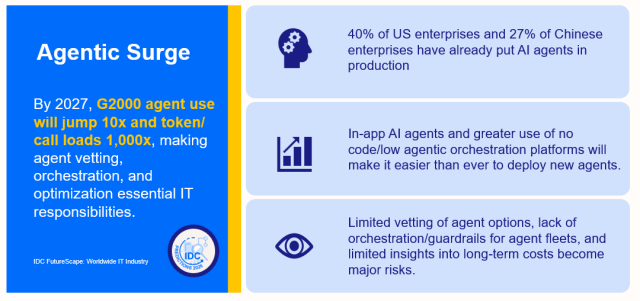
IDC predicts that by 2027, G2000 agent use will increase tenfold, with token and API call loads rising a thousandfold [FutureScape 2026; Category: Worldwide IT Industry; Prediction 2]. For technology providers, this is a customer adoption story and a capacity challenge. Every software provider, cloud platform, and hardware vendor will need to optimize compute delivery, token use/delivery efficiency, and orchestration tools to manage unprecedented scale. Vendors that help enterprises measure, govern, and contain the costs of agentic automation will become essential partners in the next phase of digital transformation.
The Coming Surge: Agents, Actions, and Industry Transformation
IDC developed our new Agent Economics Adoption and Delivery Model to provide a foundation for tracking the worldwide pace and scale of agent adoption by type of agent and to extend that tracking by geography and sector over the next 5 years.
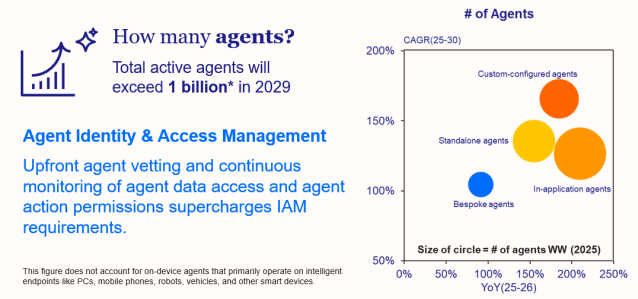
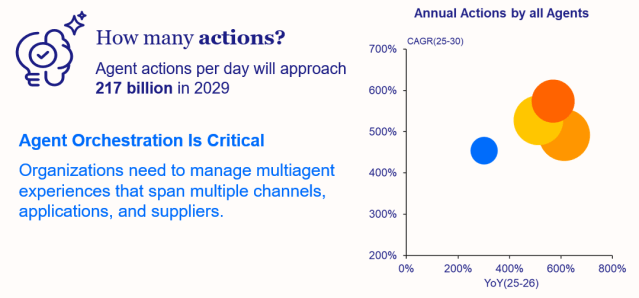
In our first release, IDC projects that the number of actively deployed AI agents will exceed 1 billion worldwide by 2029 which is 40 times more than in 2025. They will include in-application and standalone agents built and operated by cloud, software and services providers, but they will also include a growing number of custom-configured (no code/low code) and bespoke agents optimized to address the unique needs of individual enterprises.
More significantly, these agents will execute over 217 billion actions per day and consume 3.7 TeraTokens/Calls (3,700,000,000,000) daily to support this still rapidly expanding inferencing load. The token delivery cost worldwide for supporting all these agent actions will surpass $68 billion annually, but the cost to complete an ever more complex and sophisticated individual action will be 87% lower.
For the IT industry, this represents both a windfall and a reckoning. The software, infrastructure, and service providers who can enable this scale efficiently will dominate the market. Those who can’t because they are still tied to monolithic licensing models, siloed architectures, or restricted data practices will see margins shrink as automation commoditizes legacy value propositions.
Applications Become Agentic Platforms
A critical early driver of agent adoption and token load growth comes from IDC’s Worldwide AI-Enabled Enterprise Applications and Agents 2026 Predictions which forecasts that by 2027, agentic automation will enhance capabilities in over 40% of enterprise applications [FutureScape 2026; Category: AI-Enabled Enterprise Applications and Agents; Prediction 1]. This signals a new design imperative for the IT industry: applications are becoming actors, not just interfaces.
The winners will be those who transform products into platforms built on collaborative ecosystems of agents that anticipate user intent, orchestrate processes autonomously, and continuously optimize operations through feedback. This agentic pivot will blur the boundaries between software, infrastructure, and services delivery, pushing the entire IT industry toward modular, interoperable architectures.
Data Readiness Becomes a Competitive Advantage
Data is the lifeblood of the agent economy. IDC warns that by 2027, companies that fail to establish high-quality, AI-ready data foundations will suffer a 15% productivity loss as generative and agentic systems falter [FutureScape 2026; Category: Worldwide Agentic Artificial Intelligence; Prediction 1]. For technology providers, this means opportunity. The leaders will be those that offer the tools to unify data governance, enhance observability, and create federated architectures, fueling agents with trusted, real-time intelligence.
A New Tech Industry Transformation
For the IT industry, the coming years will bring a massive reallocation of value. Demand for hardware optimized for AI inference and training will surge. Cloud providers will see unprecedented pressure on network and compute resources. Software vendors will need to evolve beyond seat-based licensing toward models that measure value by actions, outcomes, and intelligence generated. Managed service providers, in turn, will need to automate their own operations with agentic platforms that deliver speed, transparency, and scale.
IDC’s research underscores that as agents proliferate; the IT industry must take on a new role: the orchestrator of autonomy. Providers will no longer just deliver technology; they will deliver the frameworks that govern intelligent digital resources by balancing efficiency, ethics, and economic sustainability.
Building the Foundation of the Agentic Economy
For technology providers, the time to act is now:
Engineer for scale and sustainability. Design architectures and platforms that can handle the exponential growth in agent numbers, actions, and token/call demand.
Reimagine pricing and delivery models. Move beyond seats and licenses to outcome-based models that reflect continuous, autonomous operation.
Champion data integrity. Invest in AI governance, observability, and interoperability to ensure agents operate with accuracy and accountability.
Embrace modularity and interoperability. Partner across ecosystems to create open, agentic frameworks that integrate seamlessly with others.
Lead with responsibility. As agents gain autonomy, establish ethical guardrails and compliance mechanisms that earn enterprise and public trust.
The IT industry has faced transformation before, from mainframes to client/server, to cloud, and now to AI-infusion. The question for every provider is no longer if this transformation will happen, but whether they will steer it.
For IT leaders and technology providers, the path forward is clear.
Design for orchestration. Deliver for scale. Govern for trust.
Success in agent economics will belong to those who can turn autonomy into advantage and help the world’s enterprises navigate this next great inflection point with confidence.
Rick is IDC's chief analyst guiding research on the future of the IT Industry. He coordinates all IDC research related to the impact of Cloud and the shift to digital business models across infrastructure, platforms, software, and services. He helps enterprises develop effective strategies for using their diverse portfolio of cloud investments and applications. He supplies early guidance on implications of critical innovations such as the shift to cloud-based control platforms for deploying/managing infrastructure, data, and code delivery as well as the emergence of AI as a critical IT workload and part of all IT products/services.
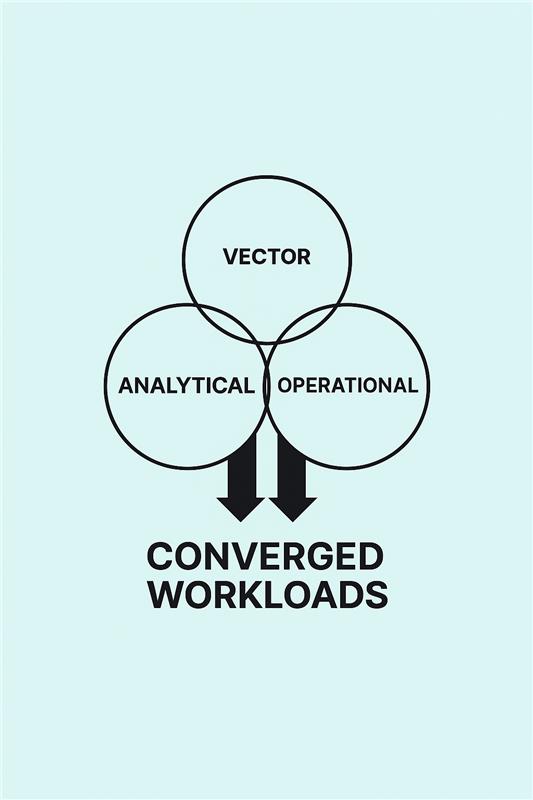
By 2029, 60% of enterprise data platforms will unify transactional and analytical workloads, powering agentic AI and enabling real-time, continuous intelligence.
In this post, I explain what converged workloads mean in practice, why adoption is accelerating, how vendors are packaging the approach, and what to prioritize as you plan the next phase of your database strategy.
What “converged” really means
Converged workloads bring transactions and analytics together so insight and action can occur simultaneously on the same data. Instead of exporting from operational systems to a separate analytics stack, with the copies, cost, and delay that entails, a converged approach runs both in one governed environment. The outcome is straightforward: decisions based on live data, not yesterday’s batch.
This shift turns databases from systems of record into systems of intelligence, where every transaction can be analyzed and acted on immediately. It forms the foundation for continuous intelligence in areas such as fraud prevention, asset health, and customer personalization.
Why it is accelerating now
Three forces are turning convergence from concept into practice. Cloud elasticity allows IT teams to right-size mixed workloads as demand changes, avoiding unnecessary cost and overprovisioning. Streaming and in-memory processing make it possible to ingest and analyze data as it arrives, significantly reducing latency. IDC research shows that 96% of enterprises are using or planning to use streaming for AI and analytics.
Bringing AI closer to the data further reduces pipeline friction. Seventy-five percent of organizations use or plan to use integrated vector databases to store and query embeddings for AI. Adoption of agentic patterns is also accelerating, with 53% of enterprises already running AI agents in production and another 28% planning deployments within six months.
A look at one approach in the market
Vendors are packaging convergence in different ways. Oracle’s approach connects Oracle AI Database 26AI, which serves as the operational system of record with in-database AI and vector search for real-time decisioning on multi-model data, and Oracle Autonomous AI Lakehouse, which provides the enterprise analytics and governance layer. The two work together to unify operational and analytical data. The lakehouse extends discovery and governance across environments, integrates with third-party catalogs, supports open engines and formats, and runs AI (including vector search) directly on lake tables. Real-time pipelines keep information synchronized across sources.
Across the market, the pattern is consistent: unify workloads, minimize data copies, keep analytics and AI close to where data resides, and apply governance end to end.
Other leading providers are taking similar paths, adding operational capabilities to lakes, analytical depth to transactional systems, and stronger governance across both.
What leaders should expect
Simplification and speed. Early wins come from fewer data copies and fewer ETL hops, which shorten time to insight and reduce integration work. Embedded automation, including self-tuning, anomaly detection, and workload management, shifts focus from maintenance to innovation.
Performance without trade-offs. Modern converged platforms are designed to analyze live operational data while preserving transactional responsiveness. In practice, that means fewer compromises between “run the business” and “analyze the business.”
Governance up front. As AI becomes operational, unified auditing, lineage, and policy enforcement are non-negotiable. Converged designs help by applying consistent controls in one place rather than stitching them together across multiple stacks.
A market tilting to cloud. Database spending continues to concentrate in cloud services. Public-cloud DBMS revenue is projected to grow at 18.3% CAGR through 2029, reflecting the shift to flexible, scalable architectures that support mixed workloads.
How to get started
Start with a few high-value, time-sensitive use cases. Fraud detection, predictive maintenance, and key customer interactions are strong candidates. Allow legacy systems to coexist while you validate latency, reliability, and governance controls.
Build governance and observability in from day one. Prioritize clear lineage, unified access policies, and end-to-end monitoring across both operational and analytical environments.
Choose AI-ready data platforms. Integrated retrieval and in-database AI reduce pipeline complexity and keep inference close to the data for faster insights.
Plan for Agentic AI. Establish real-time connections between converged data stores and agent frameworks, with clear policies for access, lineage, rollback, and audit.
Takeaways
Converged workloads are transforming databases from systems of record into real-time systems of intelligence. This shift is driven by cloud elasticity, streaming and in-memory processing, and AI that operates close to the data, with agentic AI emerging as the main demand signal. In the near term, expect simpler architectures and greater automation, but make governance and observability first-class priorities from the start. Begin with a few high-value, time-sensitive use cases, validate performance and controls, and expand as operating patterns stabilize.
As Research Director of Data Management within IDC’s AI, Automation, Data & Analytics practice, Devin analyzes market trends and vendor strategies shaping the Data Plane, including database management software and tools. He advises technology vendors and enterprises on product strategy, cloud and AI adoption, and the shift toward Agentic AI, delivering custom research, business value studies, and speaking engagements. His work focuses on providing clear, research-driven insights that support informed decisions and accelerate progress toward an AI-powered future.
IDC Environmental Policy
International Data Group is committed to protecting the environment, the health and safety of our employees, and the community in which we conduct our business. It is our policy to seek continual improvement throughout our business operations to lessen our impact on the local and global environment. We are committed to environmental excellence, pollution prevention and to purchasing products that reduce the use of natural resources.
We fulfill this mission by a commitment to:
Encouraging all partners to share in our mission
Understanding environmental issues and sharing information with our partners
Recognizing that fiscal responsibility is essential to our environmental future
Instilling environmental responsibility as a corporate value
Developing innovative and flexible solutions to bring about change
Using our platforms and position in the IT industry to promote sustainability
Minimize air travel to help reduce our impact on the environment
Minimize use of materials and energy consumption in our offices
Create a working environment that efficiently uses our office space
Develop and maintain a hybrid working model that benefits both our employees and business partners
Encourage employees to measure, minimize and collaborate on reducing energy consumption at home and in the office
Engaging employees and promoting active participation in environmental and sustainability initiatives
Leaving?
You are about to leave this section. Do you wish to continue?