Three key themes will dominate IT industry developments in the coming years:

  • Orchestrating a sustained expansion in AI agent use across the enterprise
  • Navigating major tech sector transformations driven by the IT industry’s own Agentic AI pivot
  • Taking early advantage of the fast-maturing technologies in quantum computing, next-generation connectivity, and physical AI devices to boost resiliency and business reach.

For CIOs, these converging forces signal a new leadership mandate.

IDC’s 2026 IT Predictions highlight ten developments that every enterprise should track closely. Together, they outline an ambitious yet attainable roadmap for the next five years.

1. From AI models to composite intelligence

By 2026, a renewed focus on explainability and reliability drives 70% of organizations to adopt composite AI, blending generative, prescriptive, predictive, and agentic technologies.

CIOs will need to integrate these diverse AI capabilities into cohesive systems that are transparent, auditable, and trustworthy. Building an AI governance foundation that tracks model lineage, set ethical guardrails, and ensures accountability is critical for scaling enterprise AI responsibly.

2. Orchestrating the agent explosion

By 2027, G2000 agent use will jump 10x and token/call loads 1,000x, making agent vetting, orchestration, and optimization essential IT responsibilities

The era of agentic orchestration is here. CIOs must prepare for exponential growth in autonomous agents that are interacting with individuals, critical data, and other agents. These agents will also be learning tasked with making more decisions, making continuous agent-vetting a vital task. Managing this complexity requires robust monitoring, explainability, and lifecycle control to prevent “agent sprawl” and ensure outcomes remain compliant and aligned with business goals.

3. Agents as the new interface

By 2028, 45% of IT product and services interactions will use agents as the primary interface for ongoing operations.

Agents are becoming the face of IT products and services, redefining how organizations consume technology. Procurement, service delivery, and user experience will be mediated by intelligent agents, transforming how value is assessed and measured. CIOs will need to lead on redefining enterprise architecture and user experience for this new agent mediated IT environment.

4. Measuring collaboration over productivity

By 2029, organizations that measure AI-human collaboration will have margins up to 15% higher than those focusing solely on productivity.

The leaders of tomorrow will not be those who automate the most, but those who collaborate the best. CIOs must foster environments where effective combined human creativity and agentic intelligence is critical. The leaders will those that prove best at defining collaboration metrics that quantify augmentation and innovation rather than simple cost savings.

5. Services become modular and autonomous

By 2029, 30% of global IT services will be delivered as modular, platform-enabled products, driven by demand for speed, transparency, GenAI, and Agentic AI-enabled autonomous service orchestration.

The services landscape is undergoing its own agentic transformation. Platform-enabled IT ecosystems with sophisticated AI orchestration will replace static service contracts with adaptive, API-driven delivery models. CIOs must evolve governance, procurement, and budgeting processes to support continuous, autonomous service improvement.

6. The cloud modernization imperative

By 2027, the massive computational and data demands of AI will compel 80% of organizations to modernize legacy cloud environments by shifting to new platforms specifically designed for AI workloads.

Legacy cloud environments—public or private—won’t sustain agentic scale. CIOs must migrate to AI-optimized infrastructure with GPU-rich, heterogeneous compute capacity and agile workload placement. The winners will be those who modernize their cloud strategy not just for scalability but for AI-driven elasticity and efficiency.

7. Data collaboration as the new competitive edge

By 2028, 60% of enterprises will collaborate on data via private data exchanges or clean rooms on a broad variety of use cases, including data federation for generative and agentic AI.

In the AI era, data sharing is no longer optional. It’s the foundation of competitive advantage. CIOs must identify and take full advantage of trusted data ecosystems from their tech partners. Prioritize solutions that balance sovereignty and privacy with the need for cross-industry innovation.

8. Quantum rediness becomes urgent

By 2030, quantum-accelerated supercomputing will be used by the US, EU, and China governments for solving 50% of complex defense and science-related problems, including breaking encryption schemes.

Quantum’s arrival will reshape the security landscape. CIOs must invest early in post-quantum resilience. Focus on testing hybrid encryption, revisiting identity and key management, and developing contingency plans for quantum-era threats.

9. Next-generation connectivity extends enterprise reach

By 2029, 75% of enterprises will adopt LEO satellite connectivity to complement terrestrial networks, enabling critical satellite D2C, D2D and highspeed broadband as part of a unified digital fabric.

Multi-orbit connectivity will define the next generation of connectivity for the distributed enterprise. CIOs should view LEO and 5G as strategic enablers of global edge-to-cloud integration—building network architectures that can adapt to dynamic workloads, accelerate geographic expansion, and reduce risks in a time of geopolitical instability.

10. Edge intelligence accelerates local decision-making

By 2030, 50% of enterprise AI inference workloads will be processed locally on endpoints or edge nodes, reducing cloud traffic and latency while supporting greater control over sensitive data.

As AI moves closer to the user, CIOs must rethink infrastructure, governance, and security models. Edge intelligence will reduce latency, enhance privacy, and create new opportunities for real-time, autonomous decision-making at the organization’s operational front line.

The CIO as navigator

These ten predictions reinforce a simple truth: the CIO is now the chief orchestrator of the intelligent enterprise. From agent governance to quantum readiness, success in this decade hinges on mastering the balance between innovation and integrity, automation and collaboration, scale and sovereignty.

The path ahead is complex but navigable. With a deliberate strategy, a modernized tech stack, and a workforce ready to collaborate with AI, CIOs can transform today’s turbulence into tomorrow’s advantage.

Rick Villars - Group VP, Worldwide Research - IDC

Rick is IDC's chief analyst guiding research on the future of the IT Industry. He coordinates all IDC research related to the impact of Cloud and the shift to digital business models across infrastructure, platforms, software, and services. He helps enterprises develop effective strategies for using their diverse portfolio of cloud investments and applications. He supplies early guidance on implications of critical innovations such as the shift to cloud-based control platforms for deploying/managing infrastructure, data, and code delivery as well as the emergence of AI as a critical IT workload and part of all IT products/services.

Do you subscribe to Netflix or own a Labubu plush toy (or bought one for your kids)? The influence of Netflix is clearly pervasive now, thanks to its several blockbuster productions like the Korean-produced Squid Game. Meanwhile, Pop Mart’s Labubu is ubiquitous and sought by celebrities from K-pop BlackPink’s Lisa to David Beckham. But how does Netflix’s well-known subscription model relate to Labubu? The short answer is the Experience Economy, and we will dive deeper into that idea below.

The subscription model was successfully leveraged by Samsung and LG for their hardware businesses, moving beyond the traditional use in media and entertainment. The success was seen in both home appliances and consumer electronics. LG achieved more than one trillion Korean won (US$714.3 million) in global sales from its subscription programs in 1H25 for its white goods and PC products. Meanwhile, Samsung launched the “AI Subscription Club” and the “New Galaxy AI Subscription Club” in Korea. The former, which is designed for home appliances, PCs, and tablets, generated over 100 billion Korean won (US$71.4 million) in monthly revenue.

Admittedly, Samsung’s “New Galaxy AI Subscription Club” is not a traditional subscription program, but it serves a similar purpose, that is, prompting the users to return the used products. Here’s how it works. Consumers buy smartphones outright or with an installment plan, and they have the option to subscribe to the program with a monthly fee that ranges from 5,900 to 8,900 Korean won (US$4-$6). The program promises cash payment of 50% of the device’s reference price if consumers return their used smartphones after 12 months (40% if returning after 24 months). The subscription program also includes various perks such as repair services, accessories, and discounts from Samsung’s cooperating partners.

Despite its non-traditional attribute as a subscription program, Samsung correctly tapped into the opportunities of the Experience Economy, where consumers are shifting away from ownership and valuing experiences over the practical benefits of products. By paying less than 9,000 Korean won (US$6) per month, consumers can look forward to an “upgraded experience” with a new smartphone in one or two years, with the purchase price reduced by the promised cash payment for their used devices.

“Samsung’s New Galaxy AI Subscription Club allows consumers to return their smartphones for a promised cash payment. This blurs the concept of ownership by gradually building a habit of returning used devices, a practice to which consumers are increasingly adapting,” said Jihae Kang, research analyst for Client Devices at IDC Korea. “Experience Economy tells us that product ownership no longer assures high customer satisfaction. Instead, customers place greater value on the memories or feelings a product offers. Ultimately, this strengthens the shift toward experience-driven consumption.”

To be sure, many financing plans also make new smartphones more affordable by letting consumers pay in instalments over as long as 36 months. This raises the question: what are the differences between financing plans and subscription models? From the smartphone OEMs’ perspective, the benefit of a subscription is to shorten the replacement cycles by prompting subscribers to replace their phones earlier. A good way to illustrate it is to take an example of a 24-month financing plan and a 3-year smartphone replacement cycle. The user may continue to hold the device after paying off the instalments. Nevertheless, Samsung’s subscription programs will encourage a phone replacement in one or two years as users return the devices for the promised cash payment.

Furthermore, for consumers, it could be mentally easier for some of them to get a subscription instead of another “loan,” especially if they are already burdened by a mortgage and/or car debt.

In the increasingly saturated and highly competitive smartphone market, building brand loyalty has never been more crucial. What a subscription program could also potentially achieve is to help keep consumers excited by ensuring they have first-hand experience with the latest products and technology in a shorter cycle. Essentially, it’s about constantly offering emotional value, which is what consumers are seeking nowadays and which shapes the fundamentals of the Experience Economy.

Therefore, the ultimate goal is to create the “Labubu effect,” which keeps the excitement among consumers and, in turn, leads to stronger customer stickiness and ideally creates a word-of-mouth effect or social buzz. And the subscription model could be used as a tactic to ensure consumers personally experience the latest products instead of only being flooded with information from social media or news sites.

“The typical 3- to 4-year smartphone replacement cycles are creating challenges for the smartphone OEMs,” said Will Wong, senior research manager for Client Devices at IDC Asia/Pacific. “It’s not only about selling fewer devices, but it’s also hard to keep users captivated.”

Of course, it won’t be an easy task to initiate the subscription model, especially since it changes the business model and probably the cash flow timing. Nevertheless, the favorable uptake of Samsung’s subscription programs indicates a positive potential beyond Korea, especially since economic challenges are turning global consumers into value seekers and prompting them to seek comfort and excitement (i.e., emotional value). Furthermore, the smartphone OEMs could generate hardware revenue as long as the subscribers are using the devices, which optimizes the predictability of earnings and customer lifetime value. And the most compelling potential is its long-term effect in bringing the technology excitement to the users and ultimately creating the “Labubu effect.”

Jihae Kang - Research Analyst - IDC

Jihae Kang is an Research Analyst with IDC Korea. She is responsible for research on the tablet, mobile phone, and enterprise client device markets in Korea. Her research coverage includes market sizing and forecasting with analysis based on the market trends, and the macroeconomic and social factors. She is also involved with local report programs such as Smart Connected Device. In addition, Jihae engages in Future of Customers and Consumers, and provides insights into and analysis of consumer views in the digital transformation era.

The EU’s Corporate Sustainability Reporting Directive (CSRD) aims to revolutionize corporate reporting via the transparent environmental, social, and governance (ESG) reporting of key performance indicators (KPIs), strategies, and monitoring. The CSRD’s impact has been substantial, with around two-thirds of EMEA companies reporting in accordance with the 2028 compliance deadline.

CSRD reporting standards — including more than 1,000 data points consolidated for certain industries — has elevated ESG data architectures to a new high and become an unspoken benchmark for ESG reporting globally.

Omnibus Simplification Package Creates Regulatory Uncertainty

In February 2025, the EU’s Omnibus Simplification Package was introduced, driven by the EU Competitiveness Compass, which aims to simplify sustainability reporting and reduce the administrative burdens on business and promote competitiveness. It presents far-reaching changes to the CSRD and other EU ESG regulations (e.g., the EU taxonomy, CSDDD, and CBAM). Key elements of the proposal include:

  • The number of companies mandated to report is reduced by 80% by increasing company size to >1,000 employees.
  • Small and medium-sized businesses are exempt from reporting but can adopt voluntary reporting standards (VSME).
  • Within the ESRS, fewer and more simplified datapoints (KPIs) have to be reported and some will become voluntary.
  • There will be no (mandatory) sector-specific ESRSs.
  • Implementation of CSRD for the second wave of companies (large EU-based companies) is postponed for two years.
  • The requirement for reasonable assurance is removed (only limited assurance required).

The proposal is under debate in the European Parliament and the European Council. A finalization — and thereby clarity for businesses — cannot be expected for several months.

At the same time, banks and other investors still require sustainability metrics for lending decisions and/or fund allocation to achieve their ESG targets and risk management. Consequently, even companies potentially now exempt from CSRD will face indirect ESG disclosure pressure, leading to a two-tier ESG reporting ecosystem: those who report for compliance and those who report for investors.

Finally, there is a small but growing number of companies that actually perceive sustainability (and ESG reporting) as a benefit, potential business growth driver and, thus, competitive advantage.

CSRD Maturity is Still Limited in EMEA

Our new research on the CSRD readiness of European businesses has shown that ESG regulation (and CSRD in particular) is still often perceived as a cost burden, as it requires additional resources, new skills, changes in data architecture and management, new technologies to be implemented — and a new level of collaboration across silos within the business and partner ecosystem.

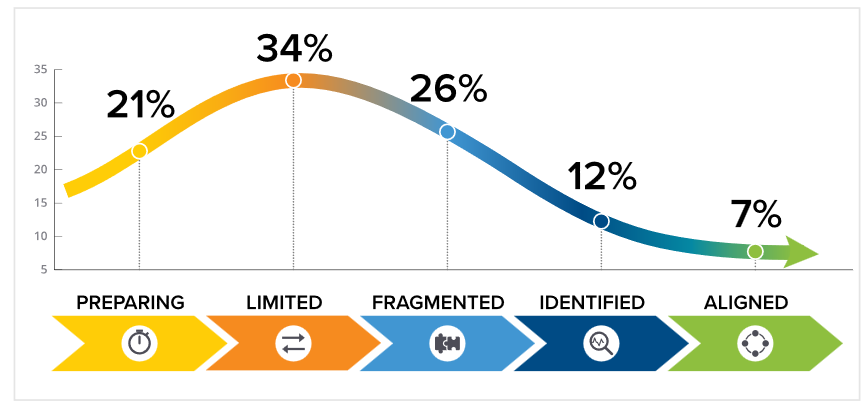
CSRD maturity is still limited among European businesses. Only one in five EMEA businesses is in the mature stages of CSRD readiness, currently publishing or finalizing their first-ever CSRD report. They have invested substantially in human and technology resources to hit the crucial milestone and are looking to leverage the CSRD data, processes, and expertise to further generate value for the business.

Our CSRD Readiness Report reveals that CSRD-mature organizations consider ESG/sustainability practices pivotal for fostering innovations that improve business resilience and customer satisfaction. They rely extensively on the support of external service and technology providers, particularly to develop CSRD/ESG reporting strategies, implement ESG data management platforms, and leverage AI/GenAI.

This creates ample opportunities for business service providers and technology vendors. But it is essential to understand market segment maturity levels as well as differences in challenges and requirements (e.g., by geography, industry, company size) so as to adequately adapt solution design and go-to-market strategies.

Sustainability Initiatives Generate Business Value for EMEA Companies

On a positive note, our research results illustrate that becoming more sustainable is clearly perceived as being increasingly important for enterprise value creation. A significant number of European companies are seeing real business benefits generated by sustainability initiatives.

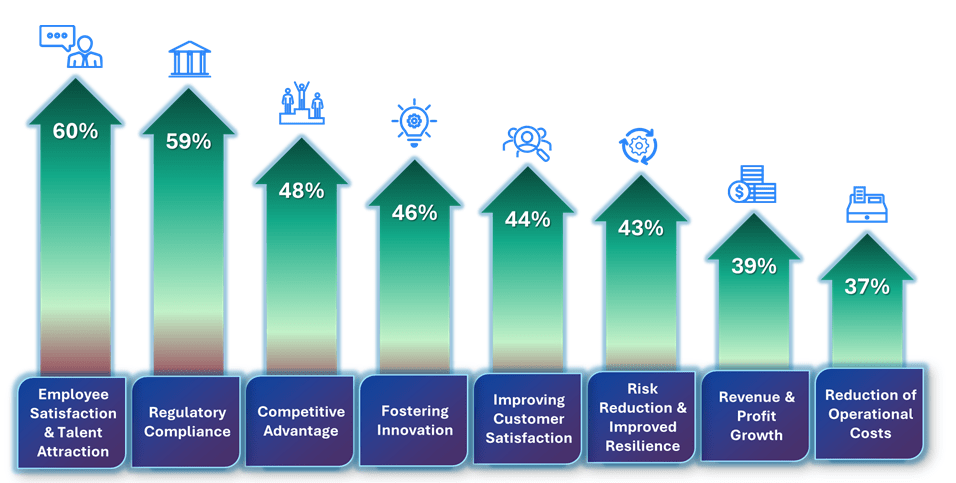
What business outcomes were achieved or are expected to be achieved within 1-2 years by your organization’s current or planned sustainability initiatives?

As shown in Figure 2, nearly half of EMEA companies see competitive advantages and innovation, and nearly 40% realized revenue and profit growth.

Interestingly, it is precisely these topics, innovation and growth, that European CEOs list at the top of their agenda for 2025 (as found in IDC’s February 2025 CEO Perspective on Technology Survey). So it comes as no surprise that investment in ESG/sustainability technologies remains among the top 3 technology investment priorities of European CEOs in 2025.

For technology and service providers, this implies that offerings increasingly need to focus on showcasing how sustainability solutions are geared toward these aspects. In particular, it will be critical to illustrate how CSRD reporting initiatives help to foster innovation and growth.

If you want to know more about our Sustainability research, visit our website here.

Katharina Grimme - Associate VP, Research and Practice Lead, EMEA Sustainable Strategies and Technologies - IDC

Katharina Grimme has more than 20 years' experience as an industry analyst and strategy consultant in the tech industry and is leading is leading IDC's Sustainability research in EMEA. With her expertise and passion for sustainable concepts for business, society, and digitization, she drives thought leadership at the intersection of sustainability and digital transformation.

The annual IDC Telco Forum: Barcelona was held Sunday, March 2, to kick off the Mobile World Congress (MWC) 2025.

During the event, IDC delivered presentations that addressed pivotal transformation and monetization opportunities in the telecoms sector, as well as our expectations for the industry’s development through 2030. Key executives and stakeholders across the telecoms ecosystem and technology sectors attended the meeting (previously known as the IDC pre-MWC Brunch).

Telecom Industry: A Massive Market Undergoing Bold Transformations

Spending by telecoms worldwide is projected to reach $1.375 trillion in 2025, accounting for 24% of the global ICT market. Meanwhile, telecom service provider CAPEX intensity is declining year on year but is expected to reach $309 billion in 2028. This shift reflects the focus of telcos on network efficiency and simplified, cost-effective operations.

The telecom industry is undergoing a profound transformation, driven by slowing mobile data growth, market fragmentation, and increasing financial pressures. As the industry evolves, telcos are shifting from being traditional connectivity providers to being full-stack technology suppliers that require structural changes to sustain profitability.

Market consolidation, workforce realignment, and strategic investments are now central to long-term success.

Reinventing the Business Model

To enhance efficiency and financial resilience, operators are consolidating in domestic markets and reassessing international operations. European regulators have approved key in-market mergers that come with network investment commitments, signaling a broader acceptance of industry consolidation.

Middle Eastern telcos are strategically acquiring stakes in European firms, capitalizing on stock market fluctuations to expand their influence. Operators are streamlining their international presence, divesting from underperforming markets and leveraging joint ventures to optimize scale and operational efficiency.

The Rise of LEO Satellite Partnerships

Satellite technology is playing an increasingly strategic role in telecom operations, addressing connectivity gaps where terrestrial networks are insufficient. The convergence of low Earth orbit (LEO) satellite networks with mobile infrastructure is gaining traction, particularly in the realm of direct-to-device (D2D) connectivity.

By forming alliances with satellite providers, telcos can extend their service footprint, unlocking new revenue streams in remote and underserved regions. Some LEO providers are partnering with chipset and device vendors to enable direct satellite connectivity on standard mobile devices. Efforts are underway to expand dedicated satellite frequency bands to support this growth.

Programmable Networking Gains Traction

The shift toward network programmability is pushing telcos to embrace API-driven ecosystems that enhance service agility and unlock new monetization opportunities. Network API monetization is becoming a key revenue stream, with operators engaging enterprise developers, aggregators, and cloud marketplaces to integrate network capabilities into digital services.

In the short term, quick-win APIs such as SIM swap and number verification are gaining traction. More advanced APIs, like quality on demand (QoD), hold greater long-term potential but remain a secondary focus.

The real value lies in combining multiple APIs, such as QoD with security or edge computing, to deliver differentiated, high-value solutions.

To scale these opportunities, multi-operator collaboration will be essential to ensure broad applicability across industries. Additionally, developers will require training and certification to fully leverage telco APIs, raising questions about who will provide this support.

As telcos expand their API strategies, they must also address a critical challenge: avoiding commoditization and securing a strong position in the evolving digital value chain.

AI Moves from Hype to Execution

AI is rapidly moving from theory to real-world deployment, transforming both network operations and customer engagement. GenAI is already driving measurable improvements in predictive maintenance, automated network management, and customer service.

The next stage of adoption will integrate task-specific AI agents to further enhance efficiency, streamline operations, and optimize service delivery. However, challenges persist: Security risks are the primary reason for GenAI project delays or abandonment (43%), while project costs rank lowest (10%), according to IDC’s 2024 Future Enterprise Resiliency and Spending (FERS) Survey.

Telcos are leveraging GenAI across two key areas: operational efficiency and customer experience. In network operations, AI-powered copilots assist with incident management, collaborative network operations, and intelligent field support, while SOC-NOC collaboration enhances user experience assurance. On the customer experience side, GenAI is improving business support systems (BSS) knowledge sharing, lead generation for enterprise markets, intelligent service recommendations, and complaint handling.

With adoption accelerating, telcos must address security concerns, workforce adaptation, and cost control to fully capitalize on GenAI’s transformative potential.

Telco Monetization Strategies

As traditional telecom value chains evolve, operators must rethink their approach to monetization. A customer-centric mindset, combined with rapid experimentation and continuous iteration, is essential to stay competitive.

Leveraging composable technology stacks is a key enabler of monetization. By adopting modular, API-driven architectures, telcos can achieve greater flexibility, enabling mass customization and cost-efficient service delivery. The transition to 5G standalone networks is further driving the need for new monetization models, particularly in network slicing and private 5G solutions that offer premium, differentiated services for enterprises.

AI and API monetization are expected to become major revenue contributors. The AI market is projected to grow from $235 billion in 2023 to $632 billion by 2028, with Telcos forecast to account for 6% of global AI spending.

Similarly, the telco API market is forecast to reach $6.7 billion by 2028, expanding at a 57.1% CAGR, with significant contributions from the Americas ($2.7B), Europe ($1.9B), and APAC ($2.1B). Industry-wide initiatives such as the GSMA Open Gateway — supported by 67 mobile operator groups across 265 networks and covering 75% of global connections — highlight the strategic importance of API-driven revenue growth.

Winning Strategies for Telcos

Service Play

Telcos must focus on select industry verticals, leveraging in-house capabilities and strategic partnerships to develop specialized solutions. The ability to deploy rapidly, monetize effectively, and refine value propositions based on market feedback will be key to success.

Platform Play

Connectivity remains central to telco operations, but its value proposition is evolving. Operators must enhance their offerings by prioritizing security, performance, and flexibility, ensuring that their networks support a broad range of enterprise use cases beyond basic connectivity.

Vertical versus Horizontal

Telcos must determine whether to pursue vertical or horizontal service models. A vertical approach focuses on industry-specific solutions, including private 5G, edge computing, network as a service (NaaS), and network slicing, providing tailored services to high-value sectors. In contrast, a horizontal approach emphasizes the development of scalable, reusable capabilities that can be deployed across industries, optimizing efficiency and cost structures.

META: The Emerging Digital Hub

The Middle East, Turkey, and Africa (META) region is emerging as a key digital hub, driven by large-scale infrastructure investments and regulatory support. Network expansion is accelerating, with increased investment in datacenters, subsea cables, and carrier-neutral facilities.

Strategic initiatives are enhancing regional interconnectivity, particularly in Africa and major hubs such as the UAE, Saudi Arabia, and Turkey. Favorable policies are enabling digital transformation, fostering internet traffic growth, and supporting the proliferation of digital services.

The Future of Telco Transformation

Sustained success in the telecom industry requires a shift toward platform-based, adaptable service models that serve multiple industries. As telcos position themselves as digital transformation enablers, they must balance efficiency, innovation, and strategic investments to remain competitive in a rapidly evolving landscape.

Key Takeaways

  1. Slowing mobile data growth necessitates new monetization strategies beyond traditional bandwidth expansion.
  2. Telco transformation must focus on efficiency, simplification, and adaptability.
  3. Attracting and retaining top talent is crucial to leveraging disruptive technologies.
  4. Collaboration across ecosystems is essential for both commercial and technical advancement.
  5. Energy efficiency is a strategic priority, directly impacting both OPEX and CAPEX decisions.


The telecom sector is entering a decisive phase. Those who embrace transformation will define the industry’s future.

If you missed the IDC Telco Forum: Barcelona session, you can watch the content in a webcast on March 12: MWC2025: Telco Transformation and Monetization in EMEA.

Masarra Mohamad - Senior Research Analyst, European 5G Enterprise Strategies - IDC

Masarra Mohamed is a senior research analyst specializing in analysing the connectivity and communications services markets, focusing on the changing networking requirements, trends, and competitive dynamics that support enterprises in their digital transformation. She explores how enterprise network strategies evolve to enable cloud, AI, and security.

When Amazon opens a new store, it’s never just about adding another retail location. The company’s recent launch of a beauty and personal care store in Milan (Amazon Parafarmacia & Beauty store, opened on February 12, 2025) offers fascinating insights into Amazon’s evolving retail strategy and suggests ambitious plans for the European market.

Beyond Digital: Why Physical Beauty Retail Matters for Amazon

Amazon’s choice to open a beauty store is telling. Beauty products represent a unique challenge in eCommerce: customers often want to test, try, and receive personal recommendations before purchasing. By tackling this challenge, Amazon addresses a critical weakness in its digital-first approach to beauty retail.

The Strategic Playbook Revealed

In a recent IDC Link, we discussed how Amazon’s new store prioritizes customer experience and personalization. Our visit to the store reinforced our idea of what Amazon is thinking:

  • Rather than focusing on immediate sales through frictionless checkouts (like Amazon Fresh stores), this location prioritizes customer experience and brand building.
  • The integration of “Place & Learn Stations”, interactive screens through which shoppers can access detailed product information, and a “Derma-bar”, where shoppers receive bespoke skin analysis and expert recommendations, signals Amazon’s understanding that beauty retail requires education and personalization.
  • The carefully curated selection of premium brands suggests Amazon is positioning itself to compete with high-end beauty retailers, not just mass-market stores.

The Bigger Picture: European Market Expansion

The Milan store serves as a strategic launchpad for Amazon’s broader European beauty ambitions. By establishing a physical presence in one of Europe’s fashion capitals, Amazon is:

  • Building credibility as the go-to retailer for the premium beauty sector.
  • Creating a showroom for brands to expand their sales across its European online platforms.
  • Developing a model that could be replicated in other key European markets.

Strategic Implications

Amazon’s physical retail journey began with Amazon Go in Seattle in 2018 and has been one of constant experimentation. The Milan beauty store reveals several key aspects of Amazon’s evolving retail strategy:

1. The company is willing to take a long-term approach, prioritizing customer experience over immediate sales.
2. The company is using physical locations as brand-building tools, not just sales channels.
3. Amazon is tailoring its retail approach to specific product categories rather than applying a one-size-fits-all solution.

We recently mentioned in a LinkedIn post how Amazon strategically leverages physical stores to compete with retail giants like Walmart in the U.S. market (as well as how Walmart is taking new revenue generation approaches from Amazon’s book). This beauty store opening represents another calculated move in the company’s evolving retail playbook.

What This Means for the Retail Industry

For other retailers, Amazon’s beauty store strategy offers important insights. The future of retail isn’t about choosing between physical and digital — it’s about understanding when and how to use each channel effectively. Amazon’s investment in an experience-focused beauty store demonstrates that even a (predominantly) eCommerce pure-play retailer recognizes the value of physical retail when used strategically.

The Milan beauty store is a window into Amazon’s thinking about the future of retail. As the company continues to evolve its omni-channel strategy, this store could serve as a template for how digital giants can effectively blend physical and digital retail experiences in specialized product categories.

If you are interested in knowing more about IDC’s Retail research, visit our website here.

Filippo Battaini - Research Manager, IDC Retail Insights, Europe - IDC

Filippo Battaini is Research Manager at IDC Retail Insights, responsible for the IDC Retail Insights: Worldwide Retail Experiential Operations Strategies program. Filippo’s research centers on the impact of technology as an enabler of omnichannel retail, including the digitalization of physical stores, online-offline integration, and omnichannel commerce architectures. Before joining IDC, Filippo worked at the global research and advisory firm Coresight Research, advising prominent companies and emerging retail technology providers on the transformative impact of technology in the retail sector.