

In mid-November, the digital world hit snooze all at once. Microsoft 365, the FAA’s air traffic network, AWS, Chase, United Airlines, Apple, and an NSA communications network all reported disruptions, as laid out in USA Today’s full list of the tech outages. Planes sat on the ground, inboxes went quiet, and payments stalled. The question worth asking is whether we were ready.
Digital is the spine
Digital transformation is a given. In IDC’s DXP Buyer and User Survey, 71.7% described themselves as mostly digital or AI-centric. Just 28.3% said they are only partly digital.
The spine of the modern world is made of code, networks, and clouds, so when it locks up, everything attached to it suffers.
Resilience works like an immune system
A healthy body has built-in defenses, and it keeps functioning while it fights an infection. A digital ecosystem needs both traits: protection against cyberattacks and physical disruption, and the ability to keep operating when something gets through.
IDC’s Cyber-Resilience Framework defines cyber-resilience as the capability to maintain operations through any disruptive event, whether a cyberattack, a provider outage, or a kinetic event. It assumes a breach will happen. The test is how fast the business recovers: IDC research shows that 70% of organizations that experience ransomware fail to recover without paying a ransom or suffering data loss.
Not every outage is an attack, but the lines are blurry
Most of these incidents do not appear to be cyber-related. Microsoft called its 365 outage a technical issue unrelated to cyber or AI agents. Chase cited a software bug in on-premises hardware, and the FAA ground stop was reportedly tied to a faulty router. Senior officials have told Congress the events were separate and not state-sponsored. The clear exception is Optimizely, where attackers exploited a vulnerability to plant malicious code in tools used by nearly 200 organizations.
There is a new wrinkle. Since Anthropic’s Claude Mythos Preview arrived in April 2026, frontier AI models have been finding vulnerabilities at machine speed. About 50 Project Glasswing partners reported more than 10,000 high or critical flaws in roughly a month. Discovery now outpaces remediation, which leaves the attack surface more exposed and drives more patches, and more change, into production.
Still, the world has learned to ask. Outages often carry a security thread, whether an actual attack or a security update gone wrong, as when a faulty CrowdStrike update crashed millions of Windows devices in 2024, and customers do not care about root cause.
Now add agentic AI. IDC’s Worldwide C-Suite Tech Survey found that security is the top challenge to implementing agentic AI, cited by 48% of respondents, and it ranks first or second in every functional role, from operations (52%), HR (50%), and finance (46%) to customer experience (44%), marketing (42%), supply chain (42%), sales (41%), and sustainability (38%). Yes, even sales and sustainability are worried, and the authors are especially excited to see those groups apparently getting some security awareness training. Maybe we won’t need so many FUD slides in the future?!
As agents embed in daily workflows, organizations must keep functioning if an agent, or any other technology, goes down.
Build it and test it before it makes headlines
Not only do resilient systems have to exist, they have to be continuously tested and proven, ideally before an outage takes place. Functions that need to be a part of this testing include:
- Isolated, immutable backups and a clean recovery environment, tested by restoring.
- Multi-region and multi-provider design, so one cloud region is not a single point of failure. When Iranian drone strikes damaged AWS data centers in the UAE and Bahrain in March, the damage spanned multiple availability zones, and AWS told customers to replicate their data to other regions. AWS has since said it cannot restore resources hosted exclusively in one affected UAE zone.
- Resilient connectivity, such as multipath networks and satellite links, which 35% of organizations in IDC’s Future Enterprise Resiliency and Spending Survey are funding.
- Staged rollouts with rollback plans, including for security tools and network gateways.
- Out-of-band communications, so teams can coordinate when email and chat are down.
- Manual fallback procedures for critical workflows, the kind airlines and banks lean on when a system disappears.
- Legacy system segmentation for fragile legacy and OT systems that require longer testing and patching cycles.
A disaster recovery drill is not enough. IDC advises validating recovery against the full range of disruption scenarios.
Four pillars, no weak links
IDC’s framework places cyber-resilience inside organizational resilience, which spans four risk pillars: Strategic, Financial, Operational, and Cyber. ITOps, SecOps, SOC, and NOC teams span all four.
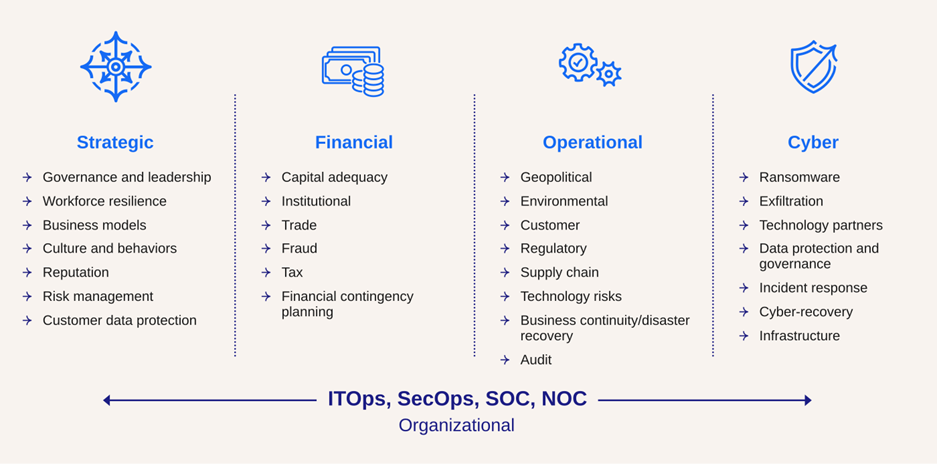
Source: IDC #US54817726, Figure 1
If you have watched The Weakest Link, you know the host’s send-off to the contestant who falls short: “You are the weakest link. Goodbye.” Disruption works the same way, minus the prize money. An organization with an excellent cyber program but no financial contingency plan still fails on the financial pillar.
The resilience questions are board agenda items
Cyber-resilience does not belong to the CISO or the CIO alone. Like the other pillars, it takes a team effort. Boards should be asking the C-suite questions like these:
- CISO: If a credential is compromised right now, how far can an attacker move laterally before we detect it, and what is our current mean time to detection (MTTD)?
- CISO: Are we running any sort of automated penetration testing capabilities to continuously detect and block potential cyberattacker pathways?
- CIO/CTO: If a major frontier AI model we use became unavailable, whether from a cyberattack, a network outage, or a national security issue, how would that affect our ability to function?
- CISO/CIO/CTO: Are the disaster recovery and business continuity plans in place? Have we tested the plan against the Minimum Viable Organization? If not, are we at least set up to address it during an attack?
- CISO/CDO/CPO: Do we have adequate data loss prevention and data access governance controls to keep critical data from being exfiltrated or accessed during an active attack?
- CISO/CPO: If we need to restore operations to another region (such as with the AWS data center in UAE) do we know what region we can restore to without violating data sovereignty requirements?
- COO: Same scenario as above. Different question. How much downtime would it take to move operations to a different region? When was the last time this rollover was tested?
- CFO: What would the true cost (operational, reputational, and regulatory) be if our recovery time objectives did not hold during a real incident?
- CRO: How much genuine risk reduction is our GRC program driving beyond compliance checkbox completion, and where exactly is the gap?
- CEO: If a major disruption hit tomorrow (cyberattack, provider outage, or geopolitical event), what is our confidence, based on real testing, that we would sustain minimal essential operations?
Your next step: Define the Minimum Viable Organization
Start with a group exercise. Bring business, IT, security, and operations leaders together and ask which functions must stand up during any disruption: ransomware encryption, a network failure, or a cloud provider outage. Decide what must be running after 1 hour, 1 day, 1 week, and 1 month. That list is your Minimum Viable Organization (MVO).
- Inventory critical functions. Name the processes, applications, data, and third parties each one depends on, including AI agents.
- Set time horizons. Sort functions by what must work at 1 hour, 1 day, 1 week, and 1 month.
- Build the defenses and systems that support them. Prioritize protection, observability, isolated recovery, and alternate connectivity.
- Test recovery, repeatedly. Time it, find the gaps, fix them, and report results to the board as you would any financial risk.
Prepare for the disruption, not the headline
The mid-November outages, to the extent that the public knows, were mostly not attacks.
This time.
The next one might be an attack.
Either way, the organizations that keep running during an attack or a disruption are the ones that decided in advance what belongs in their Minimum Viable Organization and proved they could bring it back.