
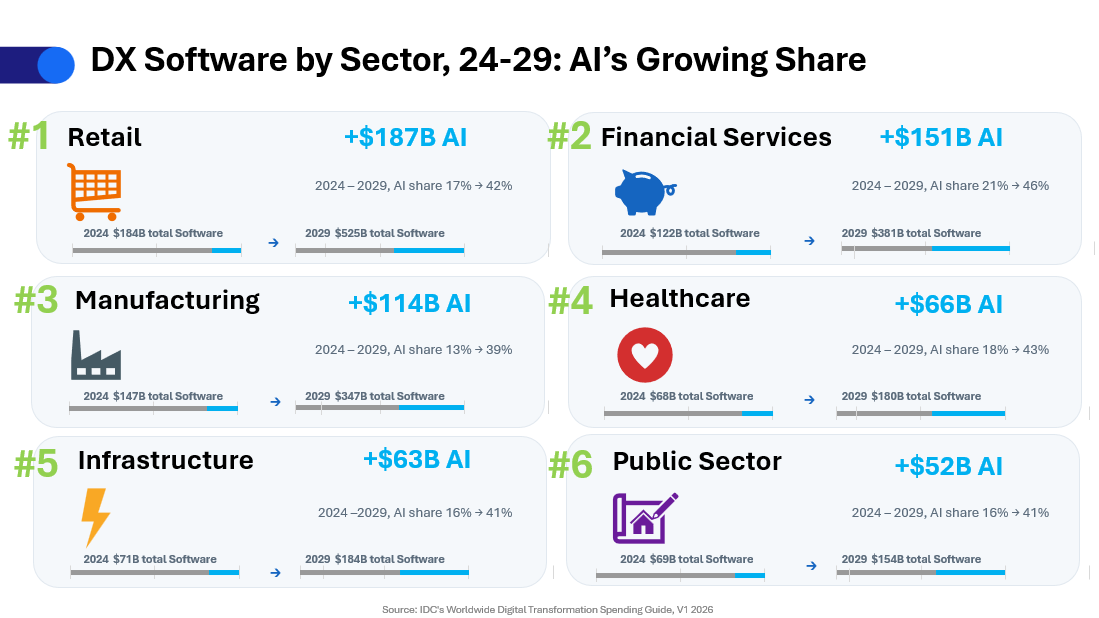
Global spending on digital transformation (DX) software is on pace to hit $640 billion by 2029, and where that money goes is shifting fast. IDC’s latest Worldwide Digital Transformation Spending Guide shows AI pulling value out of infrastructure and into applications, with the pace of that shift varying sharply by sector.
Software is becoming the primary engine of digital transformation
Digital transformation (DX) is the broad shift by organizations to embed technology into every layer of their operations, customer experiences, and business models. It spans hardware, services, and software. Data shows software is increasingly where DX investment is concentrating.
Among the three technology groups that make up DX spending, software is the fastest growing. Its share of total DX spend rises from 32% in 2026 to 36% by 2029, with a 21.7% CAGR, leading both services (10.6% CAGR) and hardware (19.8% CAGR). This momentum is increasingly driven by the scaling of AI, which is rapidly shifting value from infrastructure into applications and accelerating demand for AI powered software capabilities.
By 2029, AI will account for roughly 40% of worldwide DX software investment, which is a significant shift from today. The other 60% still flows into business applications, system infrastructure, and development and deployment platforms. The AI investments showing up across every sector in this analysis do not stand alone. They run on top of foundational layers already in place, and in many cases they depend on those layers to deliver value at all. Across the six sectors, the pace of AI adoption varies considerably, and that variation tracks closely with how mature the underlying software stack already is. AI is coming everywhere, but it is arriving on top of what organizations have already built.
Six sectors. Significant scale. Different priorities.
IDC’s Worldwide Digital Transformation Spending Guide (V1 2026) tracks DX software spend across six major industry sectors. Overall software investment is growing strongly in all six, and AI’s share within it is rising – but the pace, scale, and use case priorities differ considerably by sector. What drives DX spending in retail and services is not what drives manufacturing or financial services. Sector context matters.
“The growth in DX software is broad-based. This is not simply an AI spending wave. Organizations are investing across the full software stack to transform how they operate, and AI is an accelerating part of that — not the whole of it.” —Mariya Yahnyuk, Research Analyst, Data and Analytics
#1 Retail and services
The Retail and Services sector leads all sectors in total DX software spend. This sector covers both retailers and a range of activities such as hospitality, travel, services, and more. Customer management tops the list of investment priorities: engaging customers across every channel, in real time, with personalized and consistent experiences. Omnichannel commerce and service delivery platforms come second, as both retailers and service providers now operate across physical, digital, and mobile simultaneously.
The third priority is operational intelligence: energy management, workforce scheduling, and efficiency tools that apply equally to store environments and service operations. Many of these investments sit in the applications and infrastructure layers of DX software – the customer data platforms, workforce systems, and integration layers that make AI useful when it arrives. AI is projected to grow to 42% of this sector’s DX software spend by 2029, building directly on that operational foundation.
#2 Financial services
Financial services have the highest existing AI share of any sector, and the broader DX investment picture explains why it got there. Security leads the use case list: detecting cyber threats and preventing fraud are areas where software investment delivers clear, measurable returns, making them natural anchors for DX spending early. Automating core business operations comes next, as financial institutions replace manual, rules-based processes with systems that can adapt and scale.
The pattern here is integration. AI is being built into existing DX programs, the same core applications and infrastructure platforms institutions have been modernizing for years. That is why the spending is sustaining: it is tied to operational outcomes that financial institutions already care about.
#3 Manufacturing and resources
Manufacturing currently has the lowest AI share of any sector in DX terms, which also makes it one of the most interesting to watch. DX investment here is driven by very practical pressures: aging equipment, fewer experienced engineers, and increasingly complex supply chains. The largest spending area is autonomic operations, production environments moving toward systems that can monitor and adjust on their own, recovering from most faults without needing a person in the loop.
Self-healing assets and augmented maintenance follow closely. A third priority, less obvious but growing, is customer and client management: manufacturers are increasingly investing to understand and serve end customers directly, not just to optimize internal operations. Together, these priorities describe a sector using DX investment to reduce operational risk, extend asset life, and build closer market relationships.
“Manufacturing’s lower AI share today should not be read as lower ambition. The use cases driving DX investment are autonomic operations, asset health, customer proximity, that’s exactly where AI delivers durable, measurable value. The growth trajectory reflects that.” —Mariya Yahnyuk, Research Analyst, Data and Analytics
Three actions for technology providers
The DX software data carries clear implications for technology vendors and platform providers. These are not passive trends to monitor – they are signals that should shape how you position, sell, and support your customers.
Help your customers understand where they stand. Most organizations do not have a clear view of how their software investment compares to peers in their sector. Use sector-level DX spending data to show them where investment is concentrating, where they may be behind, and what use cases are driving results for similar organizations. Then recommend tools that fit where they are in their journey.
Make the case for platform integration using evidence. Organizations that rely on fragmented point solutions face growing complexity as DX programs scale, and slower AI outcomes as a result. Many of your customers have not made that connection yet. Use the spending data trends to show them concretely that platform integration is delivering better results and why consolidation is the more practical path forward.
Treat data readiness as a customer success issue, not a prerequisite. DX outcomes and AI outcomes depend on the quality and accessibility of underlying data. Offer data quality and governance support as part of the engagement, so customers build data readiness while the work is underway.
Want the full picture?
This analysis draws on IDC’s Worldwide Digital Transformation Spending Guide (V1 2026), which covers DX investment across all six industry sectors, further detailed by 27 industries, 12 technology markets, and geographies through 2029. The full research covers Healthcare, Infrastructure and Energy, and Public Sector in depth alongside the three sectors featured here.