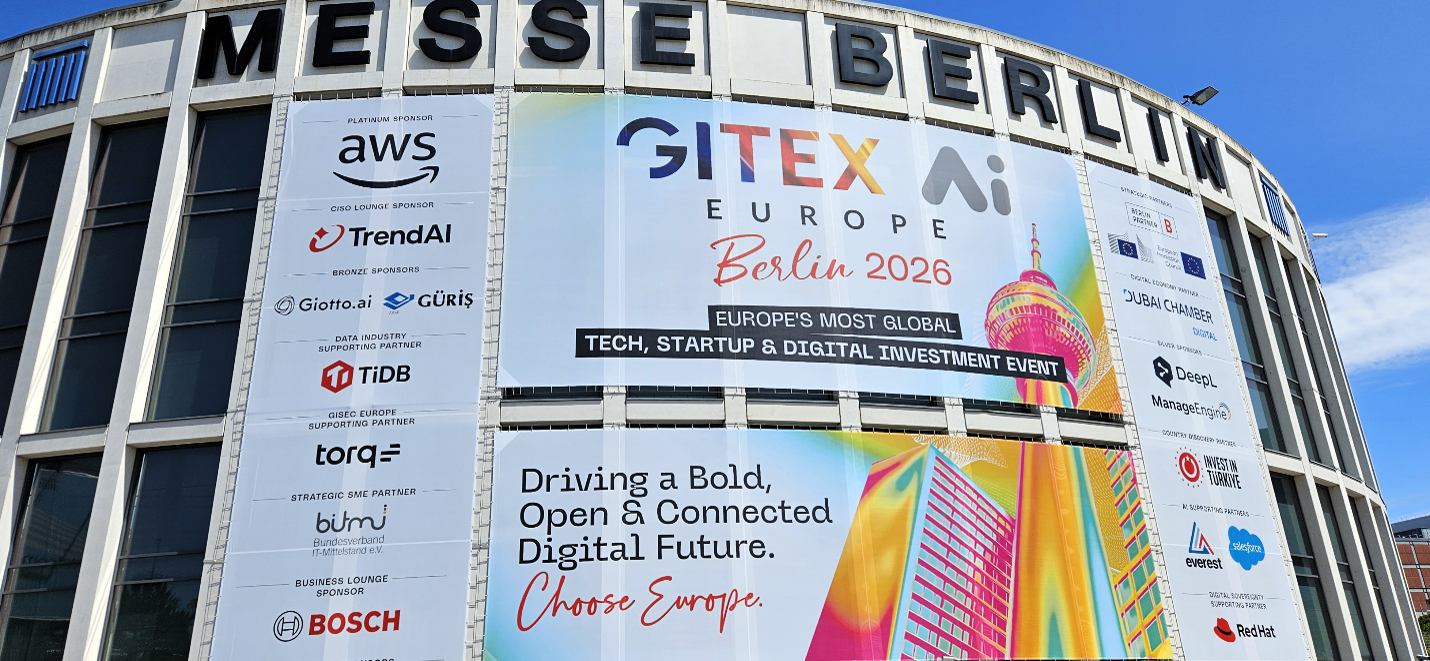
Now in its second year, GITEX AI Europe returned to Messe Berlin on 30 June–1 July 2026 as one of Europe’s largest tech, AI, and startup events. Sector coverage spanned AI & Robotics, Cloud Computing, Data & IoT, Cybersecurity, Digital Cities, Finance & Digital Assets, Industry 4.0 & Autotech, Intelligent Connectivity & Telecom, and Green Tech. The scale of Europe’s AI ambition is substantial, and GITEX AI Europe’s agenda reflected it directly: the European Commission’s InvestAI initiative aims to mobilize €200 billion in AI investment through 2030, building on 19 AI factories already operational across the bloc and up to five AI gigafactories planned, with data center capacity set to triple within five to seven years.
HPE showcases sovereign AI factories and agentic IT operations at GITEX AI Europe
As a Gold Sponsor at GITEX AI Europe in Berlin, Hewlett Packard Enterprise (HPE) cast itself as a key enabler of enterprise AI adoption, highlighting its vision for AI factories built on secure, scalable infrastructure and accelerated computing.
HPE holds a Leader position in the 2025 IDC MarketScape for Worldwide Private AI Infrastructure Systems. HPE’s presence built on its broader collaboration with NVIDIA, detailing developments in HPE Private Cloud AI, a co-engineered platform designed to simplify the deployment of generative and agentic AI while supporting sovereign AI requirements and large-scale GPU-based environments. HPE also pointed to AI-ready networking and security through its integrated HPE Aruba Networking and HPE Juniper Networking portfolio, reflecting growing enterprise demand for high-performance, zero-trust AI infrastructure. In addition, HPE promoted the integration of HPE GreenLake with HPE Morpheus Software to automate and orchestrate hybrid cloud environments, reinforcing its strategy of delivering unified, agentic IT operations intended to help organizations manage AI workloads while addressing governance, compliance, and data sovereignty requirements across Europe.
Korea Blockchain Pavilion
South Korea’s decision to bring a 23-company blockchain delegation to GITEX AI Europe in Berlin reflects a deliberate government strategy to position Korean blockchain technology within the European digital economy and expand market access beyond Asia. Led by the Ministry of Science and ICT (MSIT), together with the Korea Internet & Security Agency (KISA) and municipalities such as Busan and Daegu, the initiative established a dedicated Korea Blockchain Pavilion to showcase solutions matched to European priorities, including ESG systems, maritime logistics management, digital trust services, and online voting platforms. The program goes beyond exhibition space, incorporating investor outreach, startup pitching, and networking with approximately 200 European buyers, investors, and innovation stakeholders through partnerships with organizations such as KOTRA and AsiaBerlin. According to MSIT, the objective is to validate the technological competitiveness and commercial viability of Korean blockchain firms in Europe, build local cooperation networks, and create tangible business opportunities under a broader “Team Korea” approach to overseas expansion. The focus on practical, enterprise-oriented blockchain applications rather than speculative crypto use cases also fits Europe’s regulatory and digital transformation agenda.
Gcore and Everywhere AI
Founded in Luxembourg in 2014, Gcore presented itself at GITEX AI Europe 2026 as a European provider of edge AI, cloud, networking, and cybersecurity services, using the show to make its case as a sovereign alternative to traditional hyperscalers. Its message centered on the idea that enterprise AI success depends not only on models but also on resilient, secure, and sovereign infrastructure. Gcore demonstrated its “Everywhere AI” approach, enabling organizations to deploy AI workloads across public cloud, private cloud, on-premises, edge, and air-gapped environments while maintaining control over data location and compliance requirements. Gcore also emphasized security as a built-in infrastructure capability through integrated DDoS protection, WAF, API security, and bot management, alongside its AI Cloud Stack developed with partners including NVIDIA, Nokia, and VAST Data. Gcore positioned this proposition as aligned with key GITEX themes of AI scalability, cyber resilience, and digital sovereignty for regulated sectors such as finance, telecoms, and government.
SUSE’s sovereign AI platform across architectures and accelerated computing
SUSE positions itself as a globally-focused, European-headquartered alternative for open infrastructure and AI platforms, as sovereignty considerations increasingly factor into infrastructure decisions. At the show, SUSE demonstrated its capabilities as the software layer that bridges an increasingly diverse AI infrastructure stack, spanning traditional x86 platforms, emerging RISC-V architectures, Kubernetes environments, and accelerated AI infrastructure powered by GPUs. SUSE’s message centered on digital sovereignty and interoperability: enabling enterprises to deploy AI workloads across on-premises, hybrid cloud, edge, and air-gapped environments without vendor lock-in. A key highlight was SUSE AI Factory with NVIDIA, which combines SUSE’s enterprise AI and Kubernetes stack with NVIDIA AI Enterprise, NIM microservices, NeMo, Run:ai, and GPU operators to provide a production-ready AI platform with unified lifecycle management and governance. SUSE pointed to its long-term commitment to hardware openness through its partnership with Openchip, aiming to optimize SUSE Linux, SUSE Rancher Prime, Kubernetes, and AI platforms for European-designed RISC-V processors and accelerators, creating a sovereign end-to-end stack from silicon to AI applications. SUSE’s ambition here is to serve as a neutral platform layer connecting multiple processor architectures, AI accelerators, and software ecosystems from partners such as NVIDIA and AMD, giving European enterprises greater control over data residency, compliance, and AI operations.
Red Hat showcases open sovereign AI for the enterprise
In Berlin, Red Hat showed up as a key enabler of digital sovereignty, open hybrid cloud, and enterprise AI adoption. Through expert sessions, customer discussions, and demonstrations at Booth H1.2-B80, Red Hat highlighted how organizations can retain greater control over data, infrastructure, and AI while accelerating innovation. The company’s agenda focused on topics such as digital sovereignty, trusted AI governance, agentic AI, AI factories, cloud-native modernization, automation, observability, virtualization, and secure enterprise platforms powered by Red Hat OpenShift, Red Hat AI, Ansible Automation Platform, and Red Hat Enterprise Linux. This aligns closely with Red Hat’s recent announcements and public messaging: scaling agentic AI in production, expanding AI inference capabilities, advancing infrastructure automation with AI, enhancing OpenShift integrations and service mesh capabilities, so enterprises can deploy AI securely and compliantly across hybrid and multicloud environments.
The growing importance of RAM and storage in enterprise AI deployments
On the show floor, Memorysolution GmbH introduced itself as a specialized IT distributor and infrastructure provider, showcasing custom server solutions and enterprise data center technologies alongside key partners including AMD, ASUS, Supermicro, Kioxia, and Samsung Semiconductor. From its booth in Hall 1.2, Memorysolution highlighted its three core business units: IT Distribution, Industrial, and Custom Server Solutions, while attracting visitors with free AMD EPYC Infrastructure Reviews for organizations planning data center, AI, and high-performance computing (HPC) deployments. The showcase pointed to a critical reality of the AI era: memory and storage availability is a market-structure issue as much as a technology one. As AI models grow in size and complexity, demand for high-capacity, high-bandwidth RAM and fast storage is colliding with concentrated buying power among a small number of large purchasers, who shape pricing and allocation across the supply chain. This trend is further amplified by the industry discussion around “RAMMAGEDDON,” which points to growing pressure on memory resources as AI workloads increasingly compete for RAM capacity and performance. In this environment, companies such as Memorysolution describe themselves as suppliers of memory, storage, and server infrastructure intended to help enterprises build scalable AI platforms.
Cybersecurity evolves toward agentic operations
Cybersecurity remained a foundational theme across GITEX AI Europe 2026, reflecting the reality that AI adoption and cyber resilience are becoming inseparable. That urgency has a flip side: frontier models such as Anthropic’s Claude Mythos have shown they can autonomously discover, and in controlled settings exploit, software vulnerabilities at a scale no human team can match, meaning the same AI wave reshaping enterprise infrastructure is also reshaping the threat landscape defenders must cover. Trend Micro was a primary sponsor of the CISO Lounge at the event and used that platform to showcase its TrendAI Vision One solution, which focuses on the convergence of cyber risk exposure management and security operations. Trend Micro highlighted a unified approach spanning visibility and risk prioritization, paired with detection and response, across increasingly complex hybrid and multi-cloud environments.
A recurring discussion point was the emergence of “agentic cybersecurity,” where security teams are leveraging AI-driven automation to speed up threat detection and investigation, and sharpen response workflows. Rather than replacing analysts, these capabilities are intended to help security teams manage growing attack surfaces, accelerate decision making, and address skills shortages. Particular emphasis was placed on helping organizations navigate increasingly demanding regulatory requirements, including Europe’s Digital Operational Resilience Act (DORA) and the NIS2 Directive, both of which continue to influence cybersecurity investment priorities across the region.
This discussion illustrated a broader industry shift: as enterprises deploy more AI, they are simultaneously investing in AI-enabled security operations to manage the additional risks created by increasingly complex digital environments.
Exploring post-quantum cryptography (PQC) at GITEX AI Europe
Post-quantum cryptography (PQC) emerged as a key theme at the show, with both LuxQuanta and Quantum Optics Jena showcasing technologies designed to protect critical communications against future quantum-computing threats. LuxQuanta highlighted its commercially available NOVA LQ Continuous Variable Quantum Key Distribution (CV-QKD) platform, emphasizing recent progress from EU-backed initiatives such as QUARTER EuroQCI, which helped advance its technology from research-grade systems to deployment-ready solutions for telecom operators, governments, and critical infrastructure providers. LuxQuanta also pointed to the launch of the second generation of NOVA LQ and its recognition at GITEX Europe’s Supernova startup competition, which the company described as a sign of growing market validation for PQC-based networking.
Meanwhile, Quantum Optics Jena presented its entanglement-based quantum communication technologies, focusing on ultra-secure data transmission for AI infrastructure, data centers, telecom networks, and other critical systems. Drawing on its expertise in advanced photon sources and quantum key distribution, the company demonstrated how quantum-entanglement-driven cryptography can address “harvest now, decrypt later” risks while strengthening post-quantum security architectures. This is a risk to both network traffic and stored data, and few organizations have yet moved to mitigate it. Its participation adds to a growing roster of European deep-tech companies building quantum communication networks — though how quickly telecom operators actually move from established QKD approaches to entanglement-based systems remains an open question.
IDC’s take: Europe builds its AI infrastructure, layer by layer
Across two days in Berlin, GITEX AI Europe 2026 made one thing clear: how to build sovereign AI infrastructure is now well defined; the open question is scale. The conversations IDC had on the show floor pointed to real demand for sovereign approaches, but demand tempered by cost and complexity: a risk-based, value-driven approach looks more likely to prevail than blanket sovereign deployment, with IDC’s show-floor conversations pointing to cost tolerance for sovereign solutions capped at roughly a 10% premium over conventional approaches before custom alternatives become more attractive. The stack itself has to scale continuously, from client devices and edge deployments through private cloud platforms, up to the AI factories and gigafactories the European Commission has committed to funding across member states. At every layer, sovereignty and security were treated as design requirements, though how large the addressable market for sovereign-specific solutions ultimately becomes will hinge on that cost-value calculus.
Emerging technology had a strong presence alongside the infrastructure conversation. Post-quantum cryptography signaled that European deep tech is racing to get ahead of “harvest now, decrypt later” threats before large-scale quantum computing arrives. Enterprise blockchain, meanwhile, is finding a receptive audience in Europe’s regulatory environment, well outside the crypto-speculation narrative.
But the elephant in the room was hardware. The industry discussion around “RAMMAGEDDON” points to memory and storage supplies becoming a genuine constraint on AI ambitions as well as Enterprise IT expansion and modernization, and RAM was only the most visible symptom of a broader set of supply chain, networking, and energy supply challenges exhibitors kept circling back to. A sovereign AI strategy is only as good as the silicon, power, and connectivity available to run it, and GITEX AI Europe 2026 was a reminder that Europe’s AI infrastructure build-out is as much a physical-world engineering problem as it is a policy one.
Explore IDC’s Datacenter Facilities Services Markets and Strategies for comparative coverage of datacenter facilities providers worldwide: portfolios, coverage areas, competitive strategy, and where the market is headed next.
See where the leaders stand in the IDC MarketScape: Worldwide Private AI Infrastructure Systems 2025 Vendor Assessment : a full-stack, turnkey evaluation of private AI infrastructure vendors worldwide.