For years, the default answer to “where should security money go?” was the endpoint. Protect the laptop, protect the server, protect the company.
That answer has an expiry date, and IDC’s latest forecast puts it at 2030.
Japan’s security software market grew 14.3% in 2025 to ¥720.6 billion. IDC expects it to reach ¥1,399.4 billion by 2030, a 14.2% CAGR. That is roughly ¥679 billion of new annual spending in five years, and it will not land where the money lands today.

The ranking is about to flip
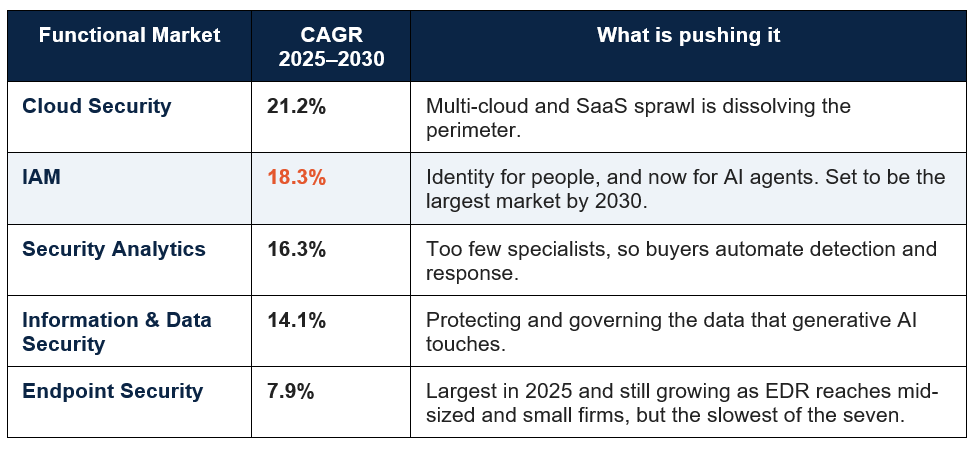
Endpoint Security was still the biggest functional market in 2025, up 8.5%, and EDR keeps spreading among mid-sized and small businesses. But its 7.9% CAGR is the slowest of the seven functional markets.
IAM is moving the other way. It grew 23.6% in 2025, the highest rate of any functional market, and IDC expects an 18.3% CAGR through 2030. Multi-cloud and SaaS have made identity far more complex to manage. Buyers who studied the intrusion paths in a string of high-profile breaches responded by tightening authentication and access control.
Perimeter defenses are failing to hold, so organizations are moving to verify every access. Authentication and access management sit at the center of zero trust, and that is where the budget follows.
Your next hire has no ID badge
Here is the part that should get every CISO’s attention.
IDC’s Japan AI Technology Usage Trends Survey found that 16.2% of Japanese companies with 100 or more employees that use AI systems already run AI agents in production. Count proof-of-concept projects and a majority have started.
An AI agent is not a chatbot. It reaches into business systems and data on people’s behalf. That means every agent needs its own identity, its own authentication and its own access controls, and the data it handles needs protecting. Each agent deployed is, in effect, a new identity to govern.
Attackers are using AI too, automating and accelerating phishing, account takeovers and intrusions. The pressure comes from both sides: defenders deploying agents, and adversaries weaponizing AI.
2027: the year it gets real
The market enters 2027 with momentum. First-half 2026 security software revenue in Japan reached ¥402.4 billion, up 15.8% from a year earlier, faster than 2025’s full-year pace. IDC Japan sees four forces shaping the year:
- AI agents move from pilot to production. Identity, authentication and access control for agents become a standard line in security budgets.
- Zero trust spreads past identity. Verify-every-access extends into networks and endpoints, so identity decisions start to reshape even the slower-growing endpoint market.
- Mid-sized and small businesses become a core market. Ransomware has moved down-market, and METI’s Security Countermeasure Evaluation Scheme gives these firms a clear baseline for how much protection is enough.
- Automation stops being optional. Security operations specialists remain in severe shortage, so spending shifts to AI-driven detection and response. Security Analytics grew 18.2% in 2025.
The road to 2030
Across the seven functional markets, growth is uneven, and the gap between leaders and laggards is wide.
Japan is tracking the global picture. Worldwide security software revenue grew 15.8% in 2025 to approximately $145 billion.
When competitors share data, security is the foundation
One more shift is coming into view. In Japan, Noetra, backed by 44 domestic companies, is building a national-scale AI computing infrastructure. Initiatives are emerging in which multiple companies, including competitors, handle highly sensitive field data on a shared platform.
IDC Japan’s Shinya Kato points out that data management and security frameworks for such initiatives are indispensable. Shared infrastructure only works if everyone trusts who, and what, can touch the data.
What leaders should do now
- Treat every AI agent as an identity. Plan authentication and access control for agents before they reach production, not after.
- Know your risks, then rank your fixes. Resources are limited. Use the SCS Evaluation Scheme as a baseline and spend where the exposure is greatest.
- Automate now. The talent shortage will not close by 2030. Invest in AI and automation for detection and response.
- Fund identity and data protection alongside endpoint. Not after it.

Want the numbers behind the story?
Contact IDC Japan for vendor-level revenue actuals through 2025 and market forecasts for 2026–2030 for the software and public cloud services markets in nine regions, including Japan, from the IDC Worldwide Semiannual Software Tracker.
Sources: IDC Worldwide Semiannual Software Tracker (November 2026 release); IDC Japan, “2026 Japan AI Technology Usage Trends Survey” (IDC #JPJ53497126, April 2026), conducted in February 2026 among Japanese companies with 100 or more employees that use AI systems.