
IDC conducted a survey of close to 400 CEOs across the world, supplemented by a number of one-on-one interviews, and identified five mandates to help business leaders scale their digital businesses in a rapidly changing digital world. Our survey data revealed that the number one concern is the economy – economic pressures, such as inflation, rising interest rates, and slowing demand.
Mandate #1: Redefine VUCA
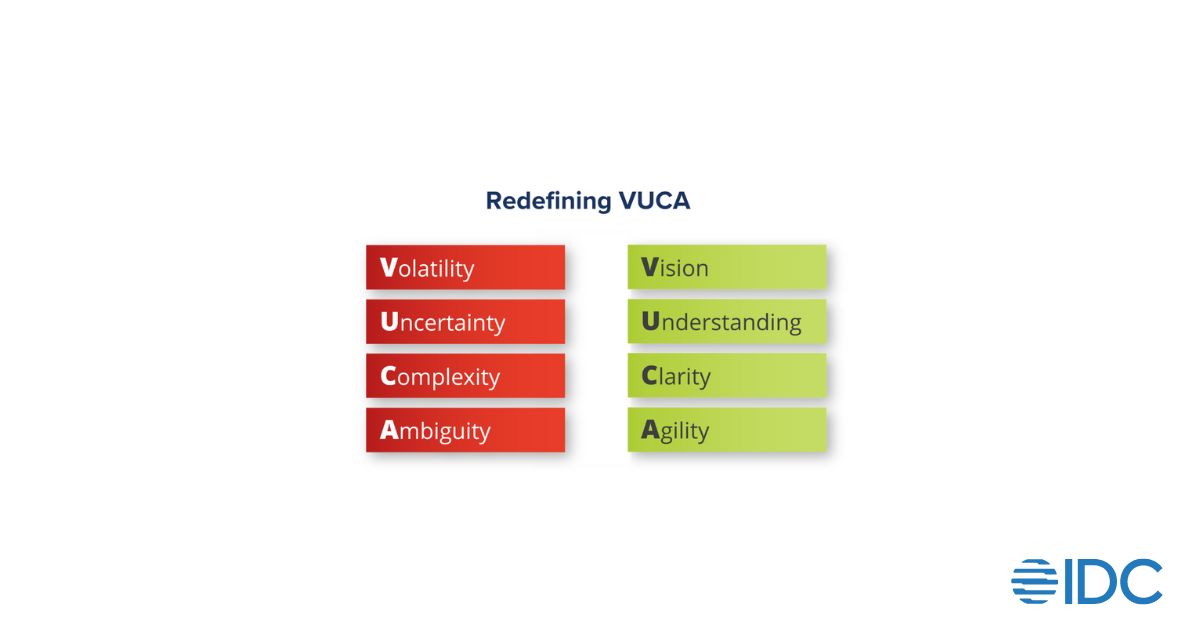
To forge a path forward for their organizations, many CEOs are redefining VUCA.
What is VUCA?
A concept that has gained wider awareness over the past several years, VUCA is an acronym for:
- Volatility
- Uncertainty
- Complexity
- Ambiguity
So… how are CEOs redefining VUCA for their businesses and their leadership teams?
In a recorded interview played during my IDC Directions 2023 presentation, Simon Paris, CEO of Finastra, talked about how his leadership team has addressed and adapted to the business and economic uncertainty of the last twelve months by redefining VUCA with… well, VUCA. Where his leadership team encountered volatility, they remained true to their vision. When faced with uncertainty, they focused more time on understanding. When complexity surfaced, they looked for clarity. And, when dealing with ambiguity, they employed agility to move forward.
Many CEOs have told us how adaptation is the key to survival as they deal with risks across the world.
- The CEO of a global telecoms organization discussed how his leadership team is trying to deal with the high interest rates and the higher cost of capital for customers and his own organization.
- A CEO of a Swiss-based train operator told us about the challenges posed by rising electricity costs that have added 15-20% to his cost base in 12 months.
- The CEO of Turkey-based multibillion dollar manufacturer is trying to navigate a difficult geopolitical environment and determine which markets to pursue.
- The CEO of a large Australian health insurance organization, talked about his company’s major investments in digital and how he and his leadership team are now focusing on closing digital business execution gaps.
- A CEO of a financial services software organization highlighted how is very focused on the imperative of closing the digital skills gap.
As IDC analyst Dan Vesset discussed in his Directions 2023 presentation, organizations must accelerate decision velocity to address many of these challenges. By leveraging new data value chains to accelerate decision velocity, organizations can conduct better multi-scenario planning, more accurately assess retention rates by geography, and determine when to onboard and offboard suppliers to drive profitability.
Mandate #2: Invest to Win
The next mandate is determining the right investment strategy. According to Michael Porter, the well-known business academic, the worst mistake organizations can make in a downturn is to make cuts across the board. With that in mind, CEOs are taking a more strategic view of investment opportunities.
In a clip played at IDC Directions 2023, Bas Burger, CEO of BT global, shared his thoughts with us. He discussed how companies that make investments during recessions – when times are tough – actually end up winning in the end and growing their market share. This is the philosophy he and his organization have adopted. So, growth, perhaps surprisingly, is the word of the year for CEOs in 2023, as they look for areas to invest in to keep teams motivated and investors happy.
The second most popular word is technology. Close to 90% of CEOs plan to maintain or increase technology investments in 2023 – focusing those technology investments on revenue-generating activities. IDC’s research shows that organizations that provide more advanced customer experiences are delivering close to double the business growth compared to their peers in the industry. IDC analyst Marci Maddox discussed the critical role of the customer data engine in her IDC Directions presentation.
IDC has forecasted that 40% of the revenue from the G2000 companies will come from digital products, services, and experiences by 2026. Already we are seeing some notable examples:
- Bank of America’s realized a 22% increase in mobile sales linked to a mobile usage surge
- Nike digital saw 34% growth in the last quarter
- Kroger is aiming to double its digital business by 2023
Mandate #3: Build Trust
As organizations start to build and operate their digital businesses, they will also need to build trust. It’s no surprise that security risk and compliance, which are at the heart of the Future of Trust framework, are a technology priority for CEOs in 2023. IDC analyst Grace Trinidad discussed the Future of Trust framework during her Directions 2023 presentation.
Some of the more progressive and strategic organizations are moving into ESG and privacy as they look to deliver outcomes – trusted governance, trusted ecosystems, and trusted enabled commerce – not only internally but increasingly externally into the ecosystem. But, they face some challenges and complexity as they look to build out trust for the digital business in a geopolitical context and operate in a global economy that is increasingly digital in nature.
As every organization grows its digital business and moves data and intellectual property (IP) across suppliers, customers, and partners in a digital ecosystem, various questions are being raised. What if a court in Europe demands data customer data for national security reasons? What if an organization has to ensure that customer data for customers in Saudi Arabia is processed and stored locally? What if it is the target of a state-sponsored cybersecurity attack going after patent information and IP. These digital sovereignty concerns and scenarios must be addressed as the next element of the future of trust framework that CEOs need to focus on to straddle the business and geo-political worlds.
Mandate #4: Reskill and Augment
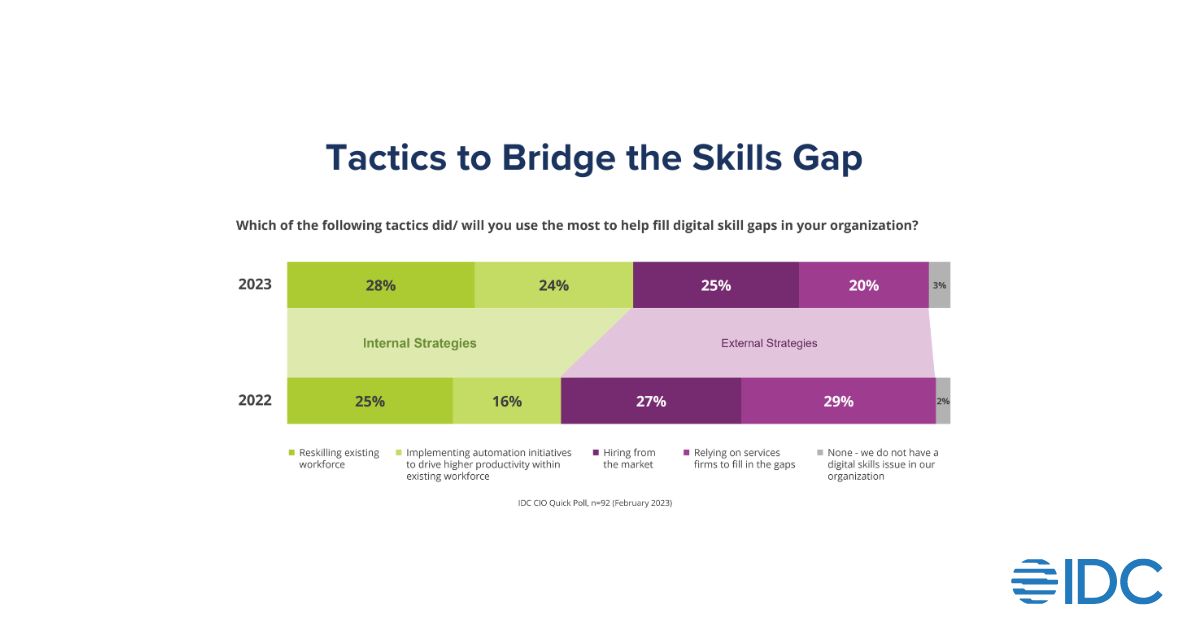
We are all witnessing a major talent overhaul, as companies across the world come to terms with hybrid working models. Companies are shifting from external approaches to hiring skills and using external service providers to strategies focused on reskilling and automation. As they reskill their organizations to deliver on the next phase of the digital business, organizations will need to connect reskilling to automation initiatives – the enterprise automation 2.0 strategy. IDC analysts Amy Loomis and Gina Smith discussed the IDC Skills Framework in their IDC Directions 2023 presentation.
Automation must be infused throughout the enterprise – across IT, business, and the software value chains. To accomplish this, IT and business leaders will need technology architectures that help them scale the approach across the organization. And, for these efforts to succeed, CIOs must raise their visibility and become key players – orchestrators of technology architectures, budgets, and stakeholders.
Mandate #5: Tech to Scale
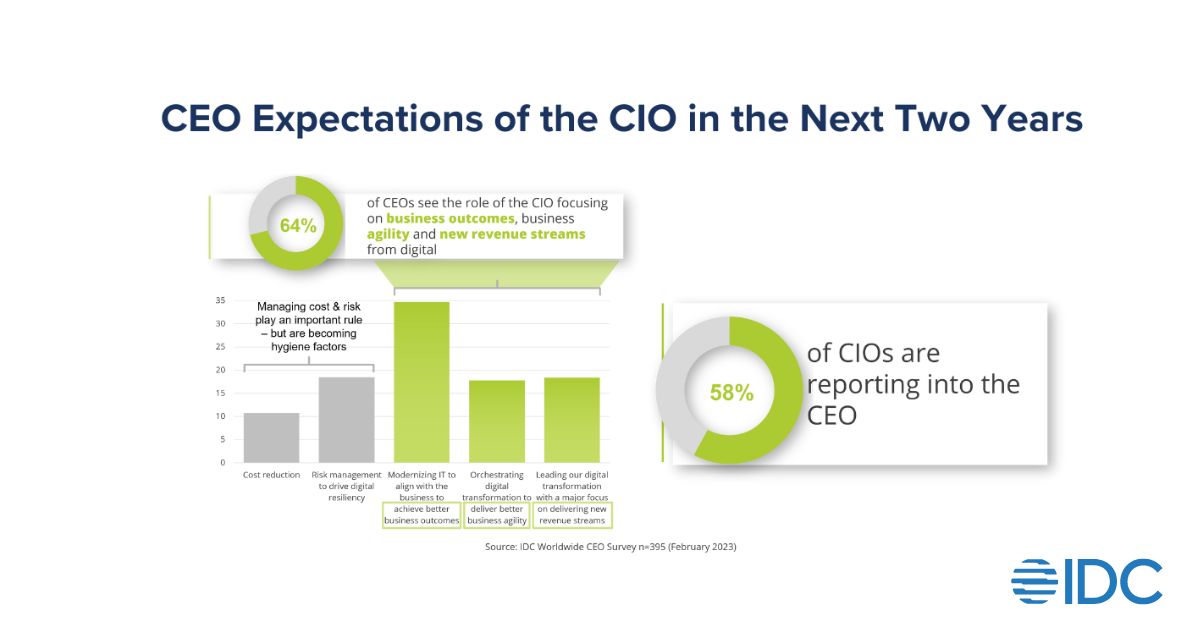
As CIOs take on these responsibilities, they must contend with spiraling cloud costs – 64% of CIO’s are spending more on cloud than originally budgeted. They need to optimize cloud investments, but must look beyond efficiency, which is really just an intermediate goal, and focus on creating sustainable value. Our survey data shows that in the next two years CIOs will move away from treating efficiency as an end-goal and look toward business outcomes, agility, and new revenue streams.
The more prominent role of the CIO is already reflected in changing organizational reporting structures. According to IDC survey results, 60% of CIO’s are now reporting directly to the CEO as they become more involved in business strategy and work with the entire C-Suite to redefine VUCA, accelerate decision velocity, make strategic investments, build trust, and reskill and augment their workforces.
Technology suppliers can play a key supporting role. With a focus on helping their customers achieve quantifiable business outcomes they can help organizations execute on these five mandates.
Interested in learning more? Download our eBook, Beyond Digital Transformation: What Comes Next?