

Picture physical AI and most people picture a humanoid robot walking through a warehouse or hospital hallway. That picture undersells the category by a wide margin.
IDC’s May 2026 Unified AI Platforms and Governance Survey ranks physical AI as the second-highest AI investment priority for the next 24 months, at 16.7% of respondents, trailing only generative AI assistants and copilots (19.2%) and ahead of agentic AI (14.2%), enterprise applications with embedded AI (14.0%), and traditional machine learning (12.0%).
IDC’s 2026 Worldwide CEO Survey found that 35% of CEOs ranked physical AI among their top three emerging technologies for investment over the next 12 to 24 months. The budget is moving faster than the definition.
IDC’s working definition is deliberately broad: physical AI is the convergence of AI algorithms, including machine learning, multimodal agentic systems, and computer vision, with physical systems, using real-world sensing, simulation, and data to perceive, interpret, and coordinate operations across physical environments.
Physical AI is not synonymous with humanoid robots: the form factor matters only when human geometry or spaces make it useful, and it extends beyond robots into buildings, vehicles, infrastructure, and homes. It is also distinct from conventional automation, which executes predefined logic under controlled conditions; physical AI must interpret changing states and act under uncertainty.
Four domains, one Loop
IDC sees physical AI as a horizontal market spanning four domains. Industrial applications focus on uptime, precision, safety, and throughput. Commercial applications extend into retail, hospitality, and logistics. Institutional applications cover healthcare and critical infrastructure, where regulation and mission assurance matter more than unit cost. Consumer applications bring the same logic into homes and mobility, though adoption is more sensitive to affordability and privacy.
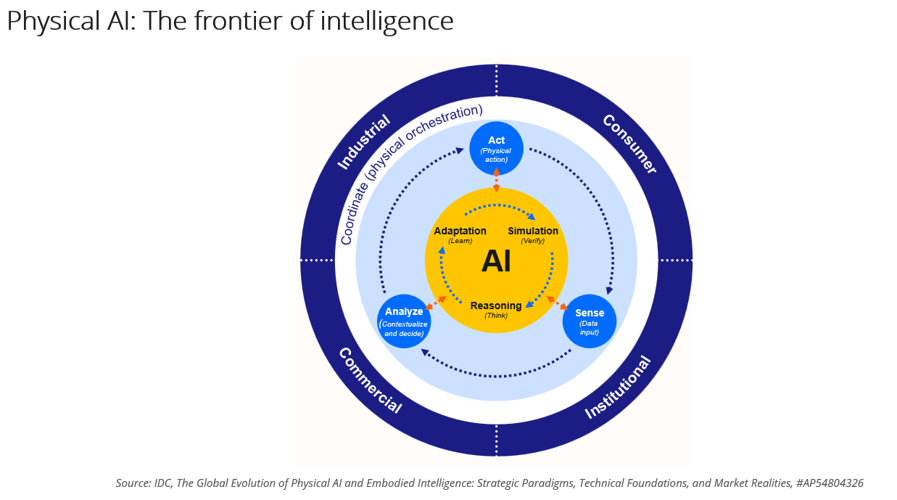
Across all four, the operating model is the same: sense, analyze, act, adapt. A conveyor or robot arm can sit inside a physical AI environment without being physical AI itself; an intelligent building system can qualify without a robot in sight.
The intelligence is in the loop, not the device.
The stack behind the devices
That distinction changes the market map. Physical AI is not a market of robotics vendors; it is a full-stack ecosystem spanning operational applications, fleet orchestration, embodied models, simulation, silicon, edge infrastructure, cyber-physical security, and services. Four interfaces determine where integration costs and vendor lock-in concentrate:
- Device-software: sensor and actuator data
- Application-agent: task requests and autonomous execution
- Edge-cloud: where intelligence runs
- Infrastructure-orchestration: how systems coordinate across sites
Buying physical AI is therefore a site-readiness, data-readiness, and operating-model decision long before it is a device purchase.
Where the near-term value concentrates
Humanoid forecasts signal investor interest, not market size. A humanoid can be impressive and still fail procurement on cost, safety, or shift-length grounds.
The clearest early ROI is in warehouse automation, infrastructure inspection, and hospital logistics, where buyers can weigh integration, downtime, training, and maintenance against measurable outcomes. Industrial use cases anchor the category: adaptive assembly, vision-based inspection, and predictive maintenance.
Consumer physical AI will scale more slowly than the attention it receives: a home has a much lower tolerance for failure than a warehouse, and near-term opportunities favor cleaning, lawn care, and smart-home actuation over a general-purpose home robot.
The global picture
Industrial robotics remains the installed base most physical AI extends. The International Federation of Robotics recorded 542,076 industrial robot installations globally in 2024, with Asia accounting for 74% of new deployments, led by China, giving Asian manufacturers a feedback advantage in operational data and edge-case exposure at scale.
Policy is competing as much as technology. In July 2026, the FCC added foreign-produced advanced robotic devices, including humanoids and quadrupeds weighing more than roughly 2 kilograms, to its Covered List, blocking new foreign models from US market entry without a national security clearance tied to domestic production. The rule is framed as country-neutral, but the underlying determination cites Chinese robotics directly, making it trade and security policy as much as technology policy.
Europe regulates first and scales second: the EU AI Act’s high-risk obligations phase in through 2027 and 2028. China treats embodied intelligence as industrial strategy rather than a research topic, and Japan, Korea, Singapore, and the Gulf and ASEAN markets each bring their own mix of demographic pressure and governance posture. A deployment plan built for one region rarely transfers cleanly to another.
Governance is part of the product
For physical AI, the question is not whether AI is inherently safe; it is whether a specific system can operate within an approved envelope for a specific application. ISO 10218-1:2025 and ISO 10218-2:2025, updated in February 2025, raise the bar for industrial robot safety and cybersecurity.
IDC recommends four evidence loops for governing physical AI:
- Pre-deployment validation
- Runtime assurance
- Cyber-physical security
- Post-incident learning
An unsafe action is a failed intelligence outcome regardless of how accurate the underlying model is. Governance belongs in the architecture from the first pilot, not bolted on before launch.
The question worth asking before the device arrives
The most useful lens for buyers is a portfolio view, not a form-factor view: categorize use cases by environmental structure, safety exposure, and operational value, and only then decide whether a robot, vehicle, drone, or building system is the right vessel.
Before committing capital, assess five things:
- Is the business case quantified?
- Is the site and data environment ready?
- Is the split between onboard, edge, and cloud intelligence defined?
- Are runtime monitoring and human override designed in?
- Is ownership clear across the OEM, integrator, software provider, and operations team?
That last question is becoming particularly important. Between the OEMs, hyperscalers, and industrial software vendors supplying the technology and the plant teams running it sits an increasingly important layer: engineering and operational technology services. These partners bring together strategic advisory, edge-network engineering, digital-twin validation, IT/OT integration, safety engineering against standards such as IEC 61508, and cybersecurity hardening, work that does not end at deployment since physical AI systems may operate for 10 to 15 years.
Physical AI therefore creates a different kind of procurement decision. The question is not simply, “Which device should we buy?” It is “Can we build and operate the system around it?”
Skipping ahead to the device does not skip the work; it just moves the work to after the purchase order is signed.
Key takeaways
- Physical AI is now IDC’s second-highest AI investment priority (16.7%) for the next 24 months, but budget is outpacing agreement on scope and buying criteria.
- Near-term value concentrates in warehouse automation, infrastructure inspection, and hospital logistics, not humanoid form factors.
- A widening patchwork of US, EU, and Chinese policy means a deployment plan built for one region rarely transfers cleanly to another.
- Governance and engineering/OT services, not the device itself, determine whether a physical AI investment succeeds over its 10-15 year operating life.
Go deeper
For the full analysis of physical AI’s market structure, vendor landscape, and adoption patterns across all four domains, read IDC’s The Global Evolution of Physical AI and Embodied Intelligence: Strategic Paradigms, Technical Foundations, and Market Realities.
Connect with IDC’s physical AI research team to build a readiness assessment for your organization’s next deployment decision. Explore the Physical AI Hub to see the whole picture, or Contact us to talk through what it means for you.