Have you ever wondered why sustainability has become such a buzzword lately? From our conversations within the Information, Communication and Technology (ICT) industry, IDC discovered that this is one part due to pressures from stakeholders (e.g. investors, regulators, end-user, eco system partners and clients) and the other due to the opportunities sustainability initiatives can offer. In fact, an IDC survey conducted in 2022 has seen these drivers of sustainability initiatives as a 50/50 split among enterprises worldwide.
Companies that have chosen to proactively integrate sustainability into their business strategies and operations have not only reduced waste and optimized costs, but also improved cost effectiveness and efficiency in operations, created new revenue streams for sales, helped human resources attract and retain talent and drove and enabled product and services innovation.
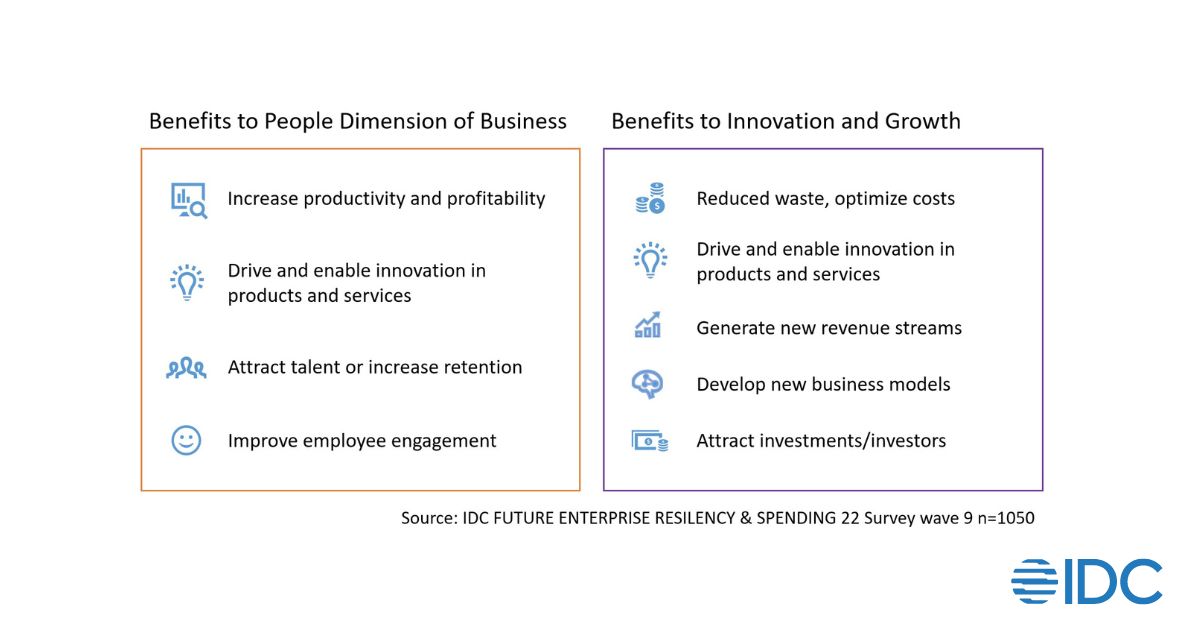
In the Asia Pacific region, enterprises that have undertaken sustainability initiatives have seen the most benefits in the people dimension of business operations. This includes attracting and retaining talent, driving innovation and increasing productivity. The people dimension is a fundamental yet often elusive key factor for success in the execution of strategies. The link between sustainability and people dimension means that organizations can leverage on sustainability initiatives to enhance outcomes from other existing strategies especially transformative ones that cut across various aspects of an organization’s operations, such as the case in digital transformation strategies.
An Opportunity for Human Resources
Sustainability’s ability to influence a person’s choice of employment is important for organizations in the region because of the widespread skills shortages in the ICT workforce. According to a 2021 study of the International Labor Organization (ILO) on The Future of Work in ICT, the shortage of talent in Asia Pacific is partly attributable to rapid changes in technology, the prominence of digital transformation strategies in companies since the pandemic, and technology’s impact on work and the skills to do certain jobs. An IDC report sees IT skills shortage affecting 60-80% of Asia Pacific organizations.
Sustainability’s capacity to produce positive outcomes in recruitment and retention stems from altruism. Sustainability principles are founded on the United Nation’s Sustainable Development Goals (previously called Human Development Goals) that are fundamentally connected to what matters most to a person. It is human nature to gravitate towards a community of people or entity (as in the case of companies) that shares the same values as the person. In a 2021 Global Environmental, Social & Governance (ESG) Business Services Buyer Value Survey, IDC noted that younger generations such as Millennials and Generation Z value all three pillars of ESG as important and are factors for their decision-making in associating themselves with a particular brand or an organization.
An Opportunity to Innovate
A value derived from sustainability is its capacity to ignite creativity and innovation in organizations. Sustainability initiatives centered on circularity for instance require companies to revisit and reconfigure product designs to accommodate the requirements of reduce, recycle, or repurpose value of parts and packaging materials. An example of the impact of circularity in product design is the emergence of eco-smartphones such as those sold by tech startups like Nothing, Fairphones, Teracube, and Shift and specific brand models of Apple and Samsung. There are also eco-SIM cards deployed by telecoms company, Globe, in the Philippines which is made from 100% recycled materials, including the plastic waste from refrigerators.
Another prime example of product design innovation ignited by sustainability is the reengineering in datacenters and reimagining of how they are built. Apart from the sector’s shift to cleaner sources of fuel for power and cooling, and the use of recycled and recyclable parts, the more innovative datacenter designs include the underwater “clouds in the ocean” of Microsoft that can reportedly reduce carbon dioxide (CO2) emissions by around 40%.
For service companies, sustainability presents an opportunity to innovate how they deliver services to clients. Sometimes defined as the future of work this could mean automation of mundane and repeatable tasks to free up resources for faster, high-value customer service, digital delivery of services to reduce carbon footprint, or the application of hybrid work, green workspaces and SMART buildings.
An Opportunity for Demand Growth
Probably the most obvious opportunity brought by sustainability is its impact on market demand. Sustainability initiatives inevitably lead to demand for new tools and services that can specifically meet its requirements. Just on data alone, sustainability has created a need for ESG-related professional business services such as carbon footprint measure, ESG data security, audit, and reporting.
Sustainability has also expanded the use cases of existing technologies. Blockchain technology for example is now used to verify sustainable sourcing. In the energy sector for instance, Blockchain technology is used to confirm renewable energy utilization sources in enterprises for eligibility on carbon credits, financing and for ESG reporting. This use of Blockchain in energy attribution tracking is done in Singapore from utilities provider SP Group. Other expanded uses cases emerging from sustainability are digital twins, used for sustainability simulations, or AI, used for human rights tracking.
Clearly, sustainability can be an opportunity for companies to enhance their human resource strategy, accelerate product and service innovation and expand the scope of their market.
If you have any questions on how solutions providers like you can maximize the opportunities that sustainability brings, we are here to help. Find out more today and learn how IDC research and services on sustainability can help you.