Application, platform, infrastructure and services each follow their own dynamics. IDC analysts Ewa Zborowska and Carla Arend explain where European demand is heading and how vendors can position for it.

Europe’s AI market is worth $105 billion, and customers are busy building their own AI stack, layer by layer, reshaping each one as they go. For vendors, the interesting question is not whether this market will grow, but where exactly the money is heading in the AI stack and how to position for it.

That was the topic of a recent webinar, where Ewa Zborowska and Carla Arend looked at AI deployments in the cloud versus on-premises, which AI platforms are winning and why, how the application layer is being reshaped, and whether AI sovereignty is realistic.

AI Application Layer: Embedded AI and Outcome-Based Selling

AI adoption has moved well past the pilot stage, and the application layer is changing first. Customers increasingly want AI as a feature of the software they already own rather than as a standalone product, alongside targeted investments in specific use cases. As buyers struggle to prove the return on AI, vendors will need to sell the outcome rather than the model, and embed AI features in the workflows customers already run.

AI Platforms and Agentic Architectures: The Fastest-Growing Layer

The fastest-growing part of the stack sits one layer below, in AI platforms and developer tooling. This layer decides which models, data and guardrails an enterprise can use at all, and it is being transformed by agentic architectures, where multi-component builds replace single-model integrations. The vendors who land the agentic build early have the chance to own the runtime, and to hold on to it through data gravity and governance. Customers will not settle on a single platform, which makes that early position even more valuable.

AI Infrastructure and Sovereignty: Cloud, On-Premises or Both?

Infrastructure tells a different story from the one many expect. In addition to the constraint imposed by raw GPU supply shortages, locality and energy supply increasingly play a role, so the title question has a clear answer: AI will not live in the public cloud alone. Customers will choose a mix of deployments that reflects where their data must sit and what power is available. Vendors competing here will do better selling sovereign capacity and efficiency than selling price per unit of compute. Sovereignty itself is turning from a debate into a deployment, yet there is still no single definition of it. Vendors may label AI as sovereign, but it is the customers who decide what that actually requires, and we will look at what that means for cloud providers, telcos and anyone selling into sovereign requirements.

AI Services: Getting Customers from Pilot to Production

Running across every layer are services, because few buyers get from pilot to production alone, and that is exactly where adoption tends to stall. Automation is also resetting expectations, with buyers now looking for the same work faster and cheaper. Services providers who lead with fast, automated delivery, price on outcomes and SLAs, and keep customers through governance and managed AI operations will be best placed.

What This Means for Vendors in the European AI Market

Across all of this there is opportunity at every layer, and every layer has its own dynamics. Vendors who understand those dynamics will be much better placed to grow.

If you missed our recent webinar The European AI Stack, the on-demand recording takes you through every layer in detail, including what AI sovereignty means for cloud providers and telcos. Watch it at any time here.

For your go-to-market planning, our new IDC playbook tests six common assumptions about the European AI market, from market size to buyer behaviour, against European data and sets out what to do differently. Download the eBook here.

Carla Arend

Carla Arend - Associate Vice President, Cloud and Datacenters, Enterprise Infrastructure

Carla Arend is Associate Vice President within IDC’s enterprise infrastructure global research domain and part of the cloud and datacenters services subdomain. She leads IDC’s Worldwide cloud adoption research. In this capacity, she leads a team of analysts that provides…
Ewa Zborowska

Ewa Zborowska - Research Director, AI, Europe

Ewa Zborowska is an experienced technology professional with 25 years of expertise in the European IT industry. Since 2003, she has been a member of the IDC team, based in Warsaw, researching IT services markets. In 2018, she joined the…

EMEA enterprises have stopped debating whether AI matters. The harder question – can they run it at scale, on budget, with trust intact – is where the next 12 months will be decided.

Ambition is no longer the constraint

Ask a CEO in EMEA whether AI will reshape their business model and you get near-unanimity: 99% of EMEA CEOs told us AI gives them a chance to reinvent how their organization makes money over the next three to five years. AI strategy now sits alongside security as one of the two topics boards want to hear about beyond the numbers.

So the interesting story isn’t appetite. It’s what happens after the mandate lands. Agents are already in production across cybersecurity, IT, HR, and customer service – not in a lab, in the business. And 95% of EMEA enterprises say they’re running agents in production today – which tells you about reach, not readiness.

Which raises the question every CIO and CFO in the region is now asking each other: what does this actually cost, and can we control it?

The execution gap is the real story

Our maturity benchmarking tells a blunter story than the boardroom optimism suggests. Roughly two-thirds of EMEA organizations are still in the early stages of AI maturity. EMEA matches the rest of the world on ambition – but not on maturity. The gap isn’t interest. It’s capability.

And it shows up in money. Enterprises are running over budget on agent spend, then increasing it anyway because standing still costs more. The pressure is showing up in four places at once: nobody can trace AI cost back to a specific workflow, nobody has staff for AI FinOps, pricing models are opaque, and agent usage across functions is outrunning governance.

Capping spend is not the same as controlling it. That distinction is where the next wave of value – and the next wave of disappointment – will be decided.

Funded ambition plus lagging capability equals stalled deals. Deals shrink, cycles stretch, and the organizations that close the gap win the cycle.

What separates the organizations pulling ahead

The pattern among AI-fueled enterprises is remarkably consistent, and it’s less about models than most people expect. Value-driven AI rather than bolt-on features. A funded roadmap with defined outcomes rather than a portfolio of pilots. Governance built in, not retrofitted. A modular platform with shared, connected data. And a continuous learning loop that adapts as evidence arrives.

There’s one more, and it’s the one that surprises people: the human premium lasts. Trust and human judgment don’t get automated away – they get more valuable. When we asked what agents are actually judged on before scale-up, reliability came first, and accuracy a close second. Raw execution speed ranked below both.

Agentic ROI, in other words, is a discipline – not a calculation.

Where we go deeper

In our upcoming webinar, we’ll open up the full data set behind this picture: the EMEA agent adoption curve out to 2030. What agents actually cost enterprises per month today. Where the extra AI budget is being pulled from. The use cases already widely deployed by function. And the capability gaps customers most want closed.

If you’re building the business case, pricing the workflow or writing the governance framework this planning cycle, this is the evidence base to bring with you.

Navigate your next move with confidence. Join us – and bring your hardest questions.

Source: IDC Worldwide CEO Survey, March 2026; IDC Future Enterprise Resiliency & Spending Survey, Wave 4, August 2026; IDC MaturityScape Benchmark: The AI-Fueled Organization 2.0, May 2026; IDC Early Adopter Agentic AI Use Case Study, March 2026.

Lapo Fioretti

Lapo Fioretti - Senior Research Analyst, AI-Fueled Business Strategies

Lapo Fioretti is a Senior Research analyst for IDC's AI-Fueled Business Strategies team. In his role, he is the lead for Europe, Middle East and Africa AI-Fueled Business Strategies research, examining organizations' digital and AI maturity, key priorities and use…

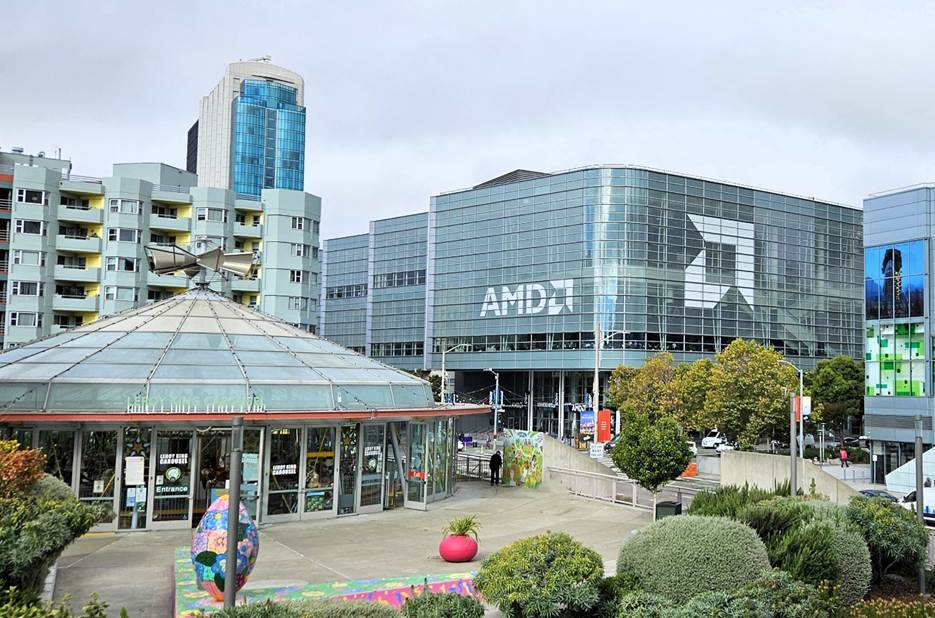
At AMD Advancing AI 2026, held on July 23, 2026, at the Moscone Center in San Francisco, California, AMD presented a broad AI strategy that spans cloud infrastructure, enterprise AI, client computing, robotics, and embedded systems. The event brought together developers, customers, ecosystem partners, and enterprise leaders to discuss how AMD’s end-to-end AI portfolio is evolving from silicon through software.

Financial Momentum Supports the AI Strategy

The announcements came shortly before AMD reported its second-quarter 2026 financial results. The company delivered record revenue of $11.5 billion, representing 50% year-over-year growth, while datacenter revenue more than doubled compared to the prior year. AMD attributed this growth to accelerating demand for EPYC processors, expanding Instinct deployments, and increasing AI infrastructure investments across the market.

A Vision Beyond Silicon

While hardware announcements often dominate AI events, the broader message from Advancing AI 2026 was AMD’s effort to create a unified AI development experience. The company’s strategy aims to enable developers to build AI applications on local systems, optimize them with a common software framework, and deploy them consistently across enterprise, cloud, edge, and robotics environments using the same foundational platform.

Building an Open AI Software Foundation

A key pillar of AMD’s strategy is its continued investment in open software. AMD reported that more than three million Hugging Face models run out of the box on AMD platforms, while many of the industry’s leading open-source AI projects now offer native AMD support. The company also highlighted significant growth in open-source contributions and ecosystem partnerships as part of its software expansion efforts.

ROCm Evolves from Platform to Development Ecosystem

AMD’s ROCm platform has evolved from a GPU programming environment into a broader AI software stack that supports frameworks, libraries, developer tools, and optimization capabilities. AMD positions ROCm as the common software layer that enables portability across its AI hardware portfolio, from client systems through hyperscale infrastructure.

Introducing ROCm.ai

Among the notable software announcements was ROCm.ai, an AI-driven development platform designed to help developers build, optimize, and deploy GPU applications more efficiently. ROCm.ai enables popular coding assistants such as Claude, Codex, Cursor, and Gemini to understand AMD hardware architectures and ROCm workflows natively, helping reduce the learning curve associated with GPU optimization.

AI-Assisted Performance Optimization

AMD also introduced capabilities that leverage AI to improve application performance. Through technologies such as Hyperloom, ROCm.ai can establish performance baselines, profile workloads, identify bottlenecks, tune serving configurations, generate optimized GPU kernels, and validate performance improvements. This represents a shift toward AI-assisted software engineering where optimization becomes increasingly automated.

Extending AI Development to the Desktop

AMD’s vision extends beyond the datacenter. With the Ryzen AI Halo developer platform and upcoming systems powered by Ryzen AI Max PRO 400 Series processors, AMD aims to make advanced AI development accessible on desktop-class hardware. These systems provide developers with local environments capable of running increasingly sophisticated AI workloads while maintaining compatibility with larger AMD compute environments.

Ryzen AI Halo developer platform, source: AMD, 2026

Developing Locally, Scaling Globally

A notable aspect of AMD’s approach is software consistency across deployment environments. AMD presented ROCm.ai as supporting systems that range from AI PCs and workstations to rack-scale AI infrastructure and datacenters. This approach creates a workflow where models can be developed and tested on local hardware before being deployed at cloud scale using the same software foundation.

Enterprise AI and Hybrid Deployment

AMD also highlighted a collaboration with Cisco designed to combine AMD AI inference platforms, including Ryzen AI Halo systems, with Cisco networking, security, observability, and management capabilities. The goal is to help enterprises deploy, govern, and manage hybrid and local agentic AI deployments while maintaining operational consistency across environments.

Extending AI into Robotics and Physical Systems

Another major theme of the event was AMD’s expansion into Physical AI. As AI moves beyond digital environments into machines that perceive, reason, and act in the physical world, AMD is positioning its technology portfolio to address robotics, industrial automation, healthcare, and autonomous systems. AMD estimates that the Physical AI silicon market could reach $200 billion by 2035.

Introducing the Kria AI Portfolio

To address this opportunity, AMD introduced the Kria AI solutions portfolio, extending its presence from traditional robotics control systems into higher-level robot intelligence. AMD describes this as bringing together perception, reasoning, decision-making, and control capabilities on a unified platform designed for demanding robotic workloads.

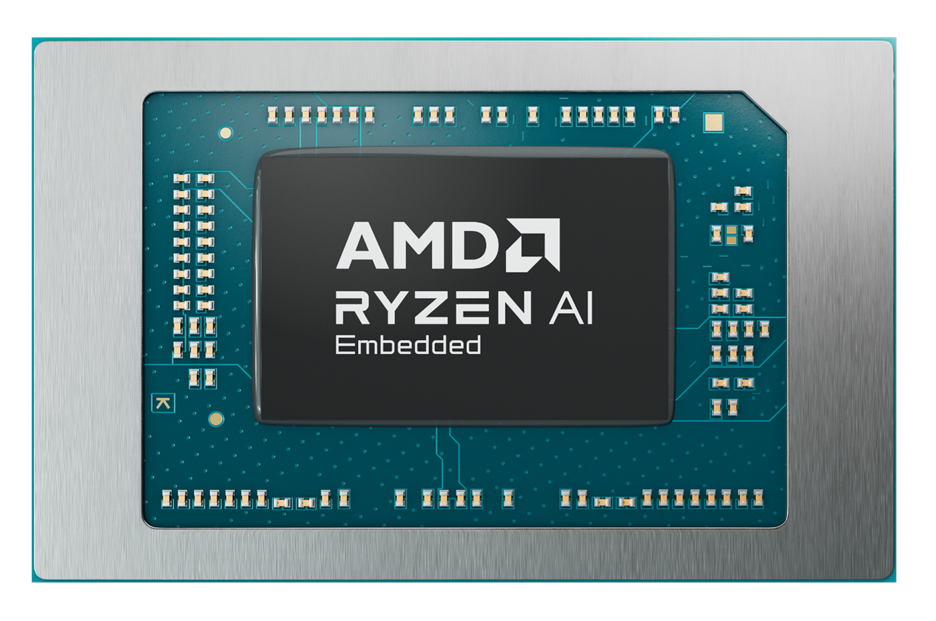
Ryzen AI Embedded X100 Series

At the foundation of the portfolio is the new Ryzen AI Embedded X100 Series, which combines CPU, GPU, and NPU resources within a unified memory architecture. AMD positions these processors as platforms capable of supporting the simultaneous requirements of perception, reasoning, planning, orchestration, and real-time control that characterize modern Physical AI systems.

Ryzen AI Embedded X100 Series, source: AMD, 2026

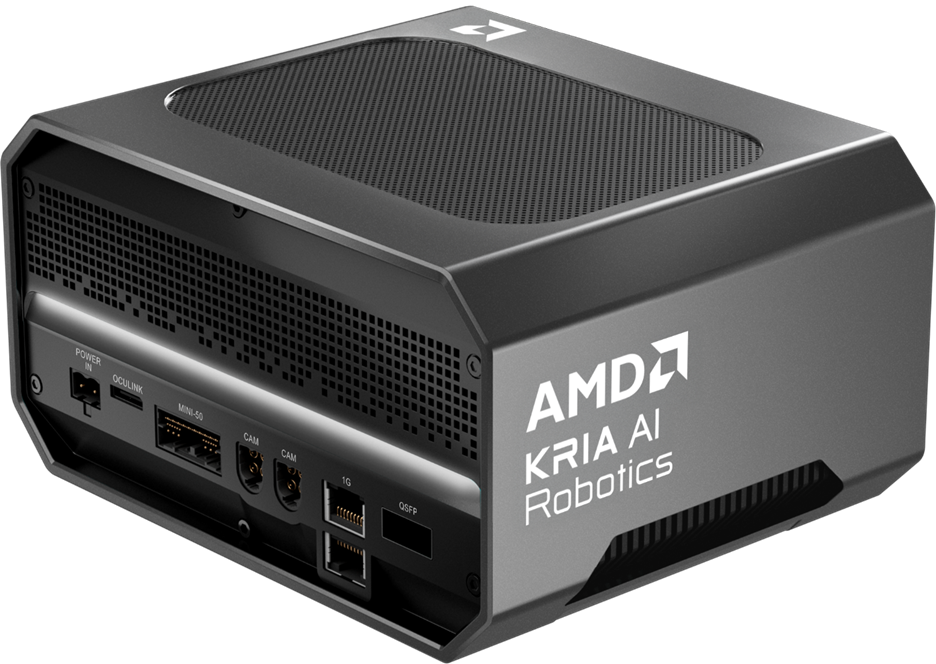
The Kria AI Robotics Developer Platform

AMD also introduced the Kria AI Robotics Developer Platform, described as an open, turnkey robotics development environment that integrates CPU, GPU, NPU, and FPGA compute. The platform is intended to reduce development complexity while helping robotics developers move more quickly from concept and prototype to production deployment.

Kria AI Robotics Developer Platform, source: AMD, 2026

Bringing the Cloud Software Stack to the Edge

One strategically important aspect of AMD’s robotics announcements is software continuity. The new AMD Robotics Software Suite is built on ROCm, allowing developers to leverage familiar frameworks, tools, and workflows already used in cloud AI environments. AMD explicitly describes ROCm as both cloud-proven and embedded-ready, creating a common software layer between datacenter AI and Physical AI deployments.

Reducing Vendor Lock-In Through Open Standards

AMD repeatedly emphasized openness throughout its software and robotics announcements. The company highlighted support for open standards, familiar x86 development workflows, industry partnerships, and open-source technologies. In robotics specifically, AMD identified avoidance of vendor lock-in as a key priority among developers and positioned its software stack as an alternative built around portability and ecosystem flexibility.

Analyst Opinion and Conclusion

AMD’s Advancing AI 2026 announcements reflect a strategy focused on developer productivity, software consistency, and open ecosystem adoption. Rather than treating desktops, datacenters, edge systems, and robotics as separate markets, AMD is building a continuum in which applications can be developed locally, optimized through AI-assisted software tools, deployed at cloud scale, and extended into physical systems using a common architecture. This approach addresses a persistent industry challenge: the fragmentation between experimentation, production deployment, and edge execution.

Technical vision alone will not guarantee adoption, however. AMD continues to compete against an incumbent ecosystem built on years of developer investment, mature tooling, and deep integration with commercial AI applications, and shifting those established development priorities typically requires clear performance, cost, or business benefits. Pricing and total cost of ownership will matter as much as raw compute performance, particularly as enterprise buyers weigh software readiness, operational simplicity, and deployment timelines across the full lifecycle.

Success will likely depend less on hardware specifications than on ecosystem momentum: winning ISV certifications, application optimizations, framework support, and robotics middleware integrations may prove as important as introducing faster processors. The broader significance of Advancing AI 2026 is not that AMD is entering new AI segments, but that it is attempting to connect desktop, cloud, and physical AI through a common development model. Whether AMD becomes an increasingly influential platform provider across that continuum will depend on its ability to sustain software adoption and partner engagement alongside its hardware roadmap.

Mohamed Hefny

Mohamed Hefny - Senior Program Manager, Data and Analytics

Mohamed Hefny leads market research in EMEA on professional workstation PCs and solutions. He also reports on professional computing semiconductors, processors, and accelerators (CPUs and GPUs), as well as breakthroughs and trends related to the market. In addition, Mohamed is…
Malini Paul

Malini Paul - Senior Research Manager, Personal Computing Devices

Malini Paul is a research manager of Client Computing Devices team in Europe, with over 10 years of experience in the ICT industry. Currently based in London, she leads the Personal Client Computing Devices research program for Western Europe. She…

Ask an AI vendor to prove its own security, and a good one will show you the architecture: where tenant isolation lives, what screens a file before it reaches the model, who verifies the rating. That’s the review IDC Quanta walked through in Five Questions to Ask Before You Trust an AI Vendor’s Security Claim.

There’s a second review most security teams skip. Every AI vendor runs on other vendors: cloud infrastructure, identity providers, monitoring tools, backup services. Their compliance claim is a chain, not a single link. If any vendor in that chain is weak, unverified, or simply unnamed, the vendor’s own SOC 2 report describes a foundation nobody actually inspected.

Four Questions for Your Vendor’s Vendor List

A security team doesn’t need a hundred-point audit to close this gap. Four questions do most of the work:

  • Can you name every vendor in your security stack, by domain?

  • Which certifications does each of those vendors carry, and can I verify them independently?

  • What happens if one of those vendors fails a certification renewal?

  • Who owns the relationship with each vendor, and how is that relationship reviewed?

A vendor with real architecture behind its claims answers all four without hesitation. A vendor that reframes the question (“we’re SOC 2 compliant, so this doesn’t apply”) is telling you it hasn’t looked.

What “Zero Trust” Actually Means Once You Name the Vendors

Most vendors describe their security stack as “zero trust” and stop there. That word does no work on its own. It becomes checkable the moment a vendor names who’s actually running each layer, and what’s actually at stake if one of them underperforms.

IDC Quanta’s stack, published in its Security Overview, names 24 vendors across 11 security domains: endpoint protection, identity and access, network security, monitoring, cloud security, and more. SentinelOne and JAMF handle endpoints. Entra ID and AWS IAM handle identity. Zscaler and Check Point sit in the network layer. Sumo Logic and 7AI, a 24/7 managed detection provider, staff the monitoring seat.

The Compliance Chain Nobody Audits

Here’s the harder question: does the vendor’s own infrastructure carry the certifications it claims to inherit? A vendor can be SOC 2 compliant on paper while running on infrastructure partners who aren’t, and the sales deck will never mention the difference.

IDC Quanta’s infrastructure runs on AWS (SOC 1, 2, 3, and ISO 27001), Azure (SOC 2 and ISO 27001, 27017, and 27018), and Snowflake (SOC 2 Type II, ISO 27001, and PCI DSS). The other tools in the stack, including Datadog, Grafana, and the identity and observability vendors, each carry their own SOC 2 certification. That’s the extended fourth-party layer, the vendors your vendor depends on, that most procurement checklists never reach. It asks whether that whole dependency chain is compliant too, with proof you can actually see, rather than stopping at the vendor’s own certificate.

Want to see more? Visit the IDC Quanta product page.

Where Quanta Stands

Quanta’s own answers are published at a public link, so a security team can verify them independently instead of taking this piece’s word for it. The 24-vendor, 11-domain stack is named in the Security Overview, along with the certification each infrastructure and tooling partner carries. BitSight rates Quanta at 800 out of 900 as of July 2026, an externally verified number rather than a self-reported one. The vendor relationships behind that score sit with the same security team that owns tenant isolation and the pen-test cadence covered in the first piece, so the fourth-party review and the first-party review are never separated internally.

See IDC Quanta for Yourself

Compliance chains are only as strong as their weakest, least-verified link. A security review that stops at the vendor’s own SOC 2 report has checked one link and called it a chain. Ask for the vendor list next. Quanta’s is posted at trust.idc.com, verifiable in the time it takes to read this sentence rather than the weeks a typical security questionnaire takes to clear.

Book a demo to have all your questions answered about IDC Quanta and the security that protects you and your data.

Ryan Smith - Content Marketing Director - IDC

Ryan Smith is the Director of Content Marketing at IDC, where he leads brand-level content and social media strategy, aligning research insights with compelling storytelling to engage technology decision-makers. With a background in both IT and marketing, Ryan brings a unique blend of technical understanding and creative strategy to his work. He’s also a seasoned storyteller, speaker, and podcast host who believes the right message, told the right way, can drive both trust and transformation.

Ask a vendor if your data is safe and you’ll get a yes. Every vendor says yes. In IDC’s advisory conversations with enterprise security teams, that’s the pattern that comes up again and again: the review process collects reassurance. It rarely collects evidence.

Enterprises that get this right don’t stop at a compliance label. They check for automated evidence and audit trails. They look at model monitoring and explainability. And they weigh a vendor’s actual implementation track record: real deployments, real customers willing to go on record. That’s exactly the review your own IT and security team will run on any AI vendor before signing off, whether that vendor is IDC or anyone else.

The Review That Isn’t a Review

A typical vendor questionnaire asks:

  • Do you encrypt data at rest?

  • Do you have SOC 2?

  • Is there an incident response plan?

These are yes/no questions, and yes/no questions get yes/no answers, regardless of whether the underlying control actually holds up under pressure. A security review that can be passed with a checklist only proves one thing: someone filled out a form correctly.

What “Compliant” Actually Means Depends on Who’s Asking

SOC 2 Type I confirms controls exist on a given day. Type II confirms they held up over a period of months. Both show up as “SOC 2 compliant” on a sales page. Neither tells you whether tenant data can bleed across customer environments, whether prompt injection is screened before it reaches a model, or whether your data trains anything. Compliance frameworks are a floor, not a finding.

Download the IDC Quanta Security Brief before your IT Security asks for it.

Architecture Beats Attestation

The security teams that get this right stop asking whether a vendor is compliant and start asking to see it. Show me the encryption key management setup. Show me where tenant isolation is enforced: application-layer controls that keep one customer’s data from ever touching another’s, not just a policy written down on paper. An architecture diagram is harder to fake than a checkbox. Then ask what happens to an uploaded document in the sixty seconds before it reaches the model. Is it screened for prompt injection, meaning malicious instructions hidden inside the file itself, before the model ever sees it?

Five Questions That Change the Conversation

Five questions is a short list on purpose. Security teams don’t have time to run a hundred-point audit on every AI vendor pitching them this quarter.

  1. Where, specifically, is tenant isolation enforced?

  2. What happens to a file between upload and model ingestion?

  3. Is customer data used to train any model, yours or a third party’s?

  4. Who verifies your security rating, and how often?

  5. What’s your actual pen-test cadence, confirmed against the audit log rather than the sales deck?

Want to see IDC Quanta in action? Book a Demo now.

Where Quanta Stands on Those Five Questions

Your own IT and security team will ask us these same five questions before Quanta clears procurement, so we might as well answer them here. And yes, we’re aware of the obvious catch: IDC also owns Quanta, so treat this section exactly like we just told you to treat every vendor’s answers. Verify it. Every spec below is published at trust.idc.com and open for a security team to check.

  1. Tenant isolation is enforced at the application layer. Token-derived identity and SQL scoping keep one customer’s data invisible to every other Quanta user.

  2. Every file uploaded to Quanta passes malware scanning and prompt-injection detection before it ever reaches the model. That’s the same sixty-second window this piece just asked every vendor about.

  3. Customer data trains nothing. Not Quanta’s models, not a third party’s. That’s a permanent commitment, built into the platform rather than a setting anyone could quietly change.

  4. Who verifies the rating? BitSight does, continuously. Quanta scored 800 out of 900 as of July 2026. SOC 2 Type I is compliant today. SOC 2 Type II and ISO 27001:2022 are both actively in progress.

  5. The pen-test cadence is confirmed against the audit log: annual third-party testing plus continuous vulnerability scanning, backed by a 24-vendor, 11-domain zero-trust stack with a monitoring team watching around the clock.

The Path Forward

None of this requires a bigger budget or a longer questionnaire. It requires asking for evidence. Vendors with real architecture behind their claims will show you exactly where each control lives, Quanta included. Pointing back to the checklist is what’s left when there’s nothing else to show. to show.

If you want to run this exact review against Quanta, the specs, certs, and policies are self-serve at trust.idc.com.

Ryan Smith - Content Marketing Director - IDC

Ryan Smith is the Director of Content Marketing at IDC, where he leads brand-level content and social media strategy, aligning research insights with compelling storytelling to engage technology decision-makers. With a background in both IT and marketing, Ryan brings a unique blend of technical understanding and creative strategy to his work. He’s also a seasoned storyteller, speaker, and podcast host who believes the right message, told the right way, can drive both trust and transformation.

This is the final post in Meet IDC Quanta, a short series showing what the product actually does, starting with the portal, then your inbox, and now when you’re already working in Claude.


Imagine you’re the account executive on a procurement software deal, and leadership on the buyer’s side just reached out: they want twenty minutes before the broader vendor review starts. Real conversation. No marketing slide deck, no long product tour. They’ll expect you to know their IT spending trajectory, where the competitive field is moving, and why now is the moment to act.

A fast reply won’t cut it here. You need an actual plan, reports pulled, trackers cross-referenced, findings stitched together. You could do that by hand, or you could open the AI tool sitting in front of you and ask it to build the whole thing.

One tool, every surface you’re already in

Most people assume IDC Quanta is a portal you visit. It’s actually a fabric: the same IDC intelligence, methodology, and research base, running everywhere you work. That’s Claude Chat, Cowork, and Code. It’s Claude for Chrome and the Microsoft Office add-ins, too. The deepest workflow integration lives in Cowork, which is where both scenarios below happen. One connection, live through Claude’s MCP integration (the open standard that lets Claude connect directly to outside data sources), with an IDC skill built in to handle the jobs sellers and buyers actually run.

You don’t switch tools to get IDC data into your work. You just ask.

Ask for the plan

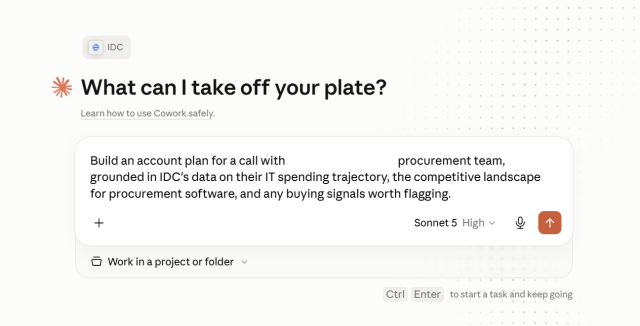
Open Cowork and type it straight to Claude:

Build an account plan for a call with <your target account’s> procurement team, grounded in IDC’s data on their IT spending trajectory, the competitive landscape for procurement software, and any buying signals worth flagging.

Claude Cowork meets IDC Quanta MCP connector 1

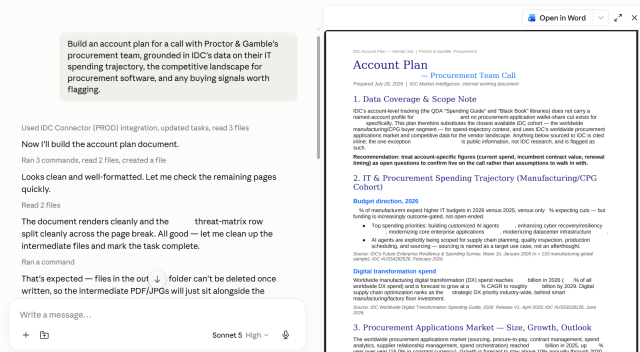
Claude comes back with a couple of quick multiple-choice questions, like which vertical cut or which time horizon. Pick your answers, and it gets to work. A few minutes later, a fully structured account plan is sitting in a Word document. Spending trends are mapped out. Competitive positioning gets a clear read. Buying signals surface where they matter. The kind of document that used to take an analyst half a day now takes the length of your coffee.

Claude Cowork results from IDC Quanta Query

Watch it show its work

Here’s the part that actually matters. Open the document and you’ll notice something most AI tools never bother to do: it tells you which parts came from where. IDC-sourced data sits clearly apart from what Claude reasoned on top of it. Nothing blends together into an unlabeled wall of confident-sounding text.

That distinction is the whole point. When your VP asks where a number came from, you’re not guessing. You can point to the line and say exactly what it is: IDC research, or Claude’s synthesis. The document already told you.

Same intelligence, the other side of the table

Now flip seats. You’re the buyer, evaluating procurement software vendors, and you need an independent shortlist, not a vendor’s pitch deck dressed up as analysis.

Same tool, same Cowork window. Ask Claude:

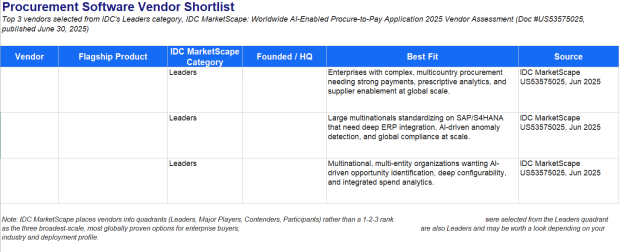
Give me a shortlist of the top three options based on IDC’s worldwide procurement applications research, and generate an Excel evaluation scorecard I can share with my team.

Claude builds the scorecard from the same shortlist of the three vendors actually leading the field, sourced from IDC’s Worldwide Procurement Applications Market Shares, 2025 (IDC #US53723426, June 2026). The IDC-grounded data and Claude’s analysis are labeled separately again. Your team sees exactly what’s evidence and what’s reasoning, no matter which side of the deal they’re sitting on.

Everything You Need, in the Tab You’re Already In

Our first blog showed you a portal built for hard questions with real citations. Our second blog put that same intelligence in your inbox. This closes the series on the biggest move yet: IDC Quanta living inside the tools you use, Claude included, where the work happens. A seller and a buyer can each walk into the same negotiation better prepared, neither one leaving the screen in front of them.

If you’re already using Claude, the IDC Quanta connector is one prompt away. If you’re not yet a customer, book a demo and bring the account you’re working right now.

Ryan Smith - Content Marketing Director - IDC

Ryan Smith is the Director of Content Marketing at IDC, where he leads brand-level content and social media strategy, aligning research insights with compelling storytelling to engage technology decision-makers. With a background in both IT and marketing, Ryan brings a unique blend of technical understanding and creative strategy to his work. He’s also a seasoned storyteller, speaker, and podcast host who believes the right message, told the right way, can drive both trust and transformation.

This is the second post in Meet IDC Quanta, a short series showing what the product actually does, starting with the portal, then your inbox, then wherever you’re already working in Claude.


It’s 4:47 PM. You’re prepping for tomorrow’s board meeting, and a question just landed that wasn’t on your list: how does your cloud infrastructure position compare to what’s shifted in the market over the last two quarters. You could open a portal, log in, run a search, filter by date, read three reports, and synthesize an answer. Or you could pull up your phone in the elevator.

Most executives don’t have a research workflow. They have an inbox. IDC Quanta was built on that premise: the fastest tool for a time-pressed leader is the one they never have to open, because it’s already open.

What it actually does

IDC Quanta in email lets you ask a question and get a sourced IDC answer back in about 60 seconds. It works the way you’d already expect email to work, which is exactly the point.

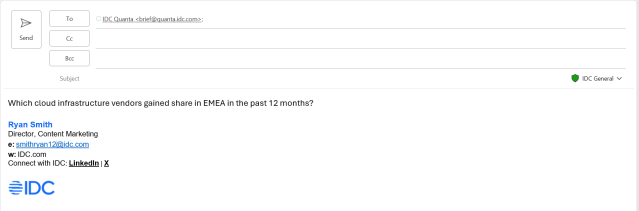
  1. Compose an email to brief@quanta.idc.com, from your phone, your laptop, whatever’s in front of you.

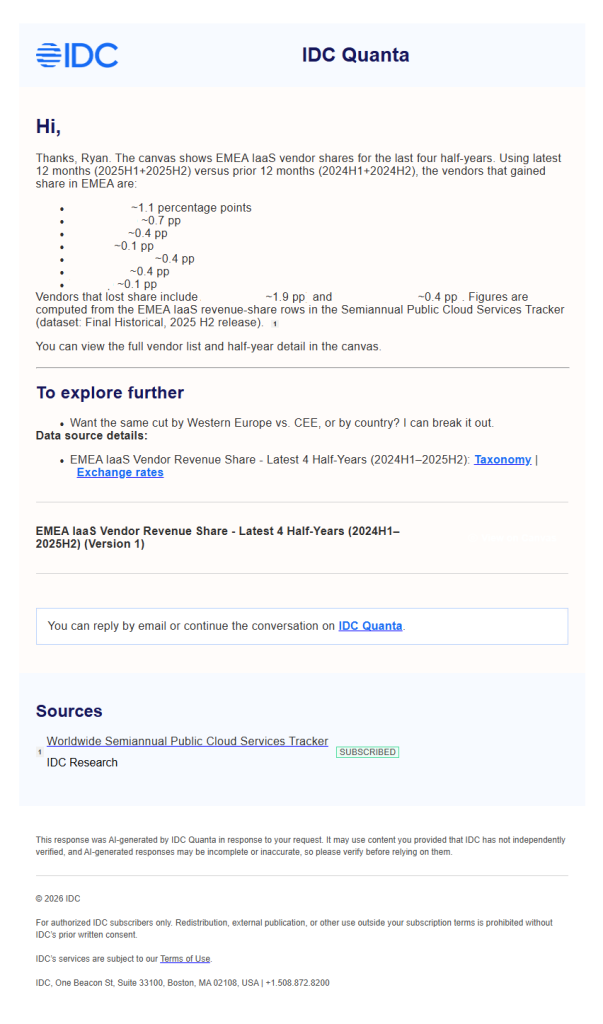
  2. Ask the question in plain language. No query syntax, no keyword tricks. “Which cloud infrastructure vendors gained share in EMEA in the past 12 months?” is a complete request.

  3. Send it, and keep moving. A structured, sourced answer arrives in about 60 seconds, fast enough that you can send the question walking into a meeting and have the answer before you sit down.

  4. The reply carries its own receipts. Every claim in the answer traces to a specific IDC source. If you want to go deeper, “View in IDC Quanta” drops you straight into the full portal conversation, context intact.

No login screen to remember, no new app for IT to vet. And no tab-switching mid-meeting. The intelligence comes to the inbox. The inbox doesn’t change to accommodate it.

Where this earns its keep

The mechanic is simple. What makes it valuable is what it replaces across a week of an executive’s actual work:

  • Before the call.
    A prospect meeting is in twenty minutes and you need a current read on their competitive positioning. Email the question on your way to the conference room. The answer’s there before you sit down, cited and ready to use.

  • Benchmarking your own thinking.
    Attach a competitive deck or account plan to your email along with your question. IDC Quanta reads it alongside its own research base and flags where your internal view and IDC’s tracked data disagree. You’re getting your own analysis checked against the numbers.

  • The follow-up nobody has time to chase.
    Someone asks a sharp question in a meeting and the honest answer is “let me get back to you.” Now that follow-up takes one email and about a minute. Who else on your team wishes they had that?

  • Board and investor prep, compressed.
    The night-before scramble for one more data point doesn’t need the whole deck reopened. One email, one sourced answer, dropped straight into the slide.

Why this isn’t just a fast AI reply

A lot of tools will answer an email question with confidence. Confidence isn’t the same as being right, and it isn’t the same as being defensible in a room full of people who will ask where the number came from. Every IDC Quanta answer draws on IDC’s research base: 1,000+ analysts across 100+ countries, tracking 15B+ data points and 800K+ companies annually. That’s the citation trail behind every answer. It’s what makes an answer dropped in your inbox worth repeating in the room.

Get it in your inbox

If you’re already an IDC Quanta customer, brief@quanta.idc.com is live. Send the question you didn’t have time to research properly and see how fast a sourced answer actually moves.

If you’re not yet a customer, request a demo, and we’ll show you what it looks like when your inbox starts acting like a research team.

Ryan Smith - Content Marketing Director - IDC

Ryan Smith is the Director of Content Marketing at IDC, where he leads brand-level content and social media strategy, aligning research insights with compelling storytelling to engage technology decision-makers. With a background in both IT and marketing, Ryan brings a unique blend of technical understanding and creative strategy to his work. He’s also a seasoned storyteller, speaker, and podcast host who believes the right message, told the right way, can drive both trust and transformation.

At the IDC Quanta launch webinar, Jamie Fiorda, SVP of Product Marketing at IDC, laid out why the gap between how fast markets move and how fast organizations understand them is becoming the defining challenge for companies trying to act before conditions shift again. He also laid out where AI-powered intelligence tools fit into closing it.

Fiorda’s starting point was access: who actually gets to use the intelligence a company already has. In most organizations, the market intelligence a company already invests in tends to serve a narrow slice of the business (a research team, maybe a strategy analyst or two), while the insights that could sharpen decisions elsewhere in the company never reach the people making them.

That’s the pattern Fiorda described: intelligence that exists, but sits in a portal most of the organization has no reason to open. The problem isn’t the quality of the research. It’s that the value of it is being rationed by who has access, right as every function in the business is under pressure to move faster on planning that used to have more runway.

Positioning AI as an Intelligence Layer, Not Another Tool

Fiorda’s case for IDC Quanta wasn’t framed as a new subscription or a new dashboard to learn. It was framed as infrastructure: a layer that sits beneath the tools an organization already uses, making the intelligence within them actionable and defensible.

Organizations already have plenty of AI tools. What most of them can’t do is prove their answers are trustworthy. That gap shows up largest in finance: nearly a third of global enterprises still run their finance analytics function with no formal structure at all, department by department, which is exactly where an M&A assumption or a market-sizing input gets challenged first by a board, an investor, or an auditor. Fiorda’s argument centers on embedding intelligence directly into the workflows where strategy is developed, backed by a source a leadership team can point to when that challenge arises.

What This Looks Like Across a Business

Fiorda walked through what that shift means function by function, not as a feature list, but as a picture of how fast an organization can move when intelligence isn’t gated to one team.

A market intelligence team doesn’t change what it does, just how quickly it does it: sizing markets and benchmarking with intelligence flowing directly into the tools they already use.

Finance picks up a use case that’s often entirely new: market sizing inside their own models, risk analysis, revenue validation, all backed by third-party data at the point of decision. IDC research points to real upside here: cognitive technologies applied across due diligence and predictive analytics are projected to drive a 25% increase in M&A returns by 2027, largely because AI-enabled screening surfaces viable targets faster than traditional methods can.

Product gains competitive benchmarking and roadmap validation the same way. Marketing builds segmentation and messaging grounded in actual demand trends instead of assumptions a real shift for CMOs navigating today’s pressure to justify every dollar: IDC research found 52% are already leaning harder into scenario-based planning and 41% report increased pressure to justify marketing ROI, both signs that assumption-driven messaging is no longer good enough. And sales walks into a room with validated, current talking points instead of a battlecard built last quarter.

The strategic point is that all five are pulling from the same source of truth, at the same time, without waiting on each other.

The Question Leaders Must Consider

Fiorda’s close reframed the pitch as a single question for leadership to sit with: if the intelligence an organization already values could reach five functions instead of one, what would that be worth? It’s worth sitting with the scale of that gap: IDC research shows nearly 60% of Chief Data Officers say their organizations need to rethink how they use analytics in decision-making, and only about a third of executives are active users of the intelligence tools already in place. That’s not just a research quality problem. It’s strategic value sitting untouched, simply because of where information lives.

In a landscape changing this quickly, the organizations that move fastest will be the ones where that research actually reaches every team that needs it.

Learn More

Organizations already working with IDC can talk to their account team about which teams could get access next. Those exploring IDC Quanta for the first time can request a demo at idc.com/quanta to see where this fits for your team.

Ryan Smith - Content Marketing Director - IDC

Ryan Smith is the Director of Content Marketing at IDC, where he leads brand-level content and social media strategy, aligning research insights with compelling storytelling to engage technology decision-makers. With a background in both IT and marketing, Ryan brings a unique blend of technical understanding and creative strategy to his work. He’s also a seasoned storyteller, speaker, and podcast host who believes the right message, told the right way, can drive both trust and transformation.

Today we launched IDC Quanta. I led the strategy behind it, working closely with our product, research, and engineering teams to turn a point of view into something real. I want to share what building it taught me about the state of AI adoption, not just at IDC, but everywhere.

The number that started it

By 2029, there will be a billion AI agents running inside enterprises worldwide. That translates into an enterprise running thousands of agents. The investments to prepare for that future are already taking place. Hyperscalers are increasing AI infrastructure spend from $54 billion in 2023 to $800 billion by 2029 to create inference capacity at that scale. Enterprises are spending $400 billion on AI platforms, apps and services this year, headed toward a trillion by 2029.

Most enterprises can’t orchestrate at that scale today. Most vendors can’t fully support it yet either. A billion agents means the entire IT industry, vendors and enterprises together, has a massive amount of infrastructure, governance, and orchestration work still ahead of it before that number is something to be excited about instead of something to be worried about. We didn’t want IDC standing outside that work, measuring it from a distance. We wanted to build the intelligence layer that helps our clients get through it. That’s the thinking behind Quanta.

The gap we kept running into

Earlier this year, we ran our global AI maturity benchmark. In the U.S., the largest single group of organizations, 39%, sits at what we call the AI Pivot stage. They’ve moved past ad hoc experimentation. They have momentum and intent. But they’re still reacting to use cases as they surface instead of executing against one enterprise strategy.

That gap comes down to a problem our team designed against from the start: islands of AI. Fragmented experimentation across functions that makes enterprise-level orchestration nearly impossible. Half of organizations have an AI roadmap defined at the functional level. Finance has one. IT has one. Marketing has one. They don’t connect. There’s no shared prioritization and no way to see where one function’s work could accelerate another’s.

The reason this is more than a coordination problem is because agents don’t respect functional boundaries. A customer service agent needs data from CRM, from order management, from your knowledge base. An operations agent touches supply chain, finance, and procurement. The moment you deploy agents that work across functions, a fragmented roadmap becomes an architectural blocker. It’s why 42% of CEOs plan to hire a Chief AI Officer in the next year. They’re looking for someone who can see the whole board, not just their own function’s piece of it.

We had our own version of this problem to solve. For decades, IDC’s model was research in one place and data in another, and clients had to hunt across both to get a full picture. Quanta brings our research and our data together in a single platform, so that fragmentation stops being something you have to solve every time you come to us.

The curve nobody wants to admit they’re on

For the past three and a half years, enterprises have struggled to prove the ROI on their AI use cases. Now we have runaway token costs arriving at the exact moment everyone is lining up to deploy agents.

IDC recently published a report on effective agent cost management. In the report, the team showed cost per action spikes early in almost every deployment, before value catches up. We call that phase High Anxiety. Value climbs slowly the whole time, crossing cost at what we call the Strategic Alignment phase. Past that point, cost keeps falling and value keeps climbing. That’s the payoff phase.

Most organizations in this industry are still on the wrong side of that curve. The token economy conversation isn’t about whether AI is worth the spend. It’s about how long it takes you to get through the High Anxiety phase. The organizations pulling ahead are the ones treating ROI as a discipline, not a one-time calculation. A cost model that only counts inference will undercount true total cost of ownership by 30 to 60%. The shift that matters is treating tokens like a raw material, the way a factory tracks cost per unit, instead of like a technology bill.

That framework is one example of the kind of intelligence Quanta is built to deliver. Not a report waiting to be opened weeks after it would have mattered. Something you can reach directly at idc.com, or through connectors built into the platforms your team already uses, so the intelligence shows up where the decisions and execution happens instead of sitting in a document.

Why I’m telling you this today

Quanta didn’t come from spotting a market opportunity from a distance. It came from our team solving the exact problem I just described, for our own organization, alongside the people who build and research this every day.

For decades, our model was simple: we publish research, and you come find it. That worked when the pace of decisions making was slower. It doesn’t work anymore, not with a billion agents coming and the decisions being made this year that companies will live with for years. We built Quanta to work two ways. Come to idc.com directly for grounded, evidence-based answers. Or reach that same intelligence through connectors already built into the platforms your team uses, so you’re not switching context.

I’m proud of what we’re launching today. But the thing I actually want you to take from this is the reminder that the gap between where your organization is and where it needs to be closes the same way ours did: someone has to own the whole board, and go get the intelligence instead of waiting for it to come to you.

Meredith Whalen - Chief Research Officer - IDC

As IDC's Chief Product, Research & Delivery Officer, Meredith Whalen leads the company's global product, research and data, and delivery organizations. Under her leadership, IDC delivers cutting-edge intelligence to the world's leading technology vendors, enterprises, and investors as they navigate the evolving AI economy. Meredith sets the strategic direction for IDC's global analyst community, shaping research methodologies and agendas that generate industry-leading data and actionable insights to drive high-impact business decisions. With more than 20 years at IDC, Meredith has been a catalyst for some of the company's most transformative initiatives. She founded IDC's Industry Insights and Tech Buyer business units and pioneered the industry's first comprehensive business use case taxonomy. She also led the creation of IDC's DecisionScape methodology-a strategic framework that empowers organizations to better plan, implement, and optimize their technology investments. A recognized thought leader and sought-after speaker, Meredith regularly delivers keynotes at major global technology events and advises senior executives on the trends shaping the future of business and technology. Meredith holds a B.A. with honors from Wellesley College and an MBA with honors from Babson College's F.W. Olin Graduate School of Business.

Why scaling AI and proving ROI are now the real challenge for European organizations.

What comes next is far less straightforward.

For some time, the European AI narrative was fairly comfortable: lots of enthusiasm, plenty of pilots, and just enough regulatory drama to keep things interesting. Companies could experiment broadly, point to a few wins, and call it a strategy.

IDC’s recent research, based on a survey of 200+ European organizations conducted in late 2025, tells a story that is a tad inconvenient for anyone still in “innovation exploration” mode: more than half of European companies report that over 50% of their AI projects have already delivered measurable business outcomes. This is no longer a single pilot result; it is becoming a pattern. And patterns have a tendency to change expectations.

Europe is past the “AI is interesting” phase, but not quite at “AI is effortless” either. Most organizations are somewhere in the messy middle: proof points, momentum, but still unable to explain why that momentum is not turning into something more systematic. Nearly 9 in 10 say their ability to scale AI has improved. And yet, a large portion is operating with what you might call partial discipline. They are moving forward, but without the playbooks, governance structures, and execution models that make scaling feel less like controlled improvisation.

The technology was never the hard part of AI scaling
European organizations are not struggling to build AI. They are struggling to absorb it. When asked what most prevents them from realizing the full potential of their AI investments, the top answers were competition with other transformation priorities, regulatory uncertainty, resistance to process change, difficulty proving ROI, and budget pressure. None of these are technology problems. The blockers are organizational, political, and structural. Throwing more engineering at them will not help.

This is, in fact, a sign of progress. Europe’s AI constraints have shifted from technical feasibility to enterprise commitment, which means the technology has largely done its job. The hard part now is everything surrounding it: sponsorship that survives the next budget cycle, processes redesigned after years of inertia, and ROI demonstrated clearly enough to compete with every other initiative in the budget allocation process. AI is now being tested as a business program, and business programs depend on organizational discipline.

But can organizations measure AI ROI and business impact?

European organizations are no longer just tracking model performance or project completion. Operational efficiency, user adoption, business KPIs, and financial outcomes are all on the scorecard now. This removes a certain flexibility that AI teams might have previously enjoyed. A technically elegant deployment that nobody uses is no longer a qualified success. It is simply not a success.

The encouraging news is that many organizations are starting to respond, with a clear move toward formal business metrics and ROI logic built in from the start.

The gap is widening

Europe’s AI market is entering a separation phase. This is the point where the gap between organizations that can operationalize AI and those still generating isolated use cases starts to widen. The organizations pulling ahead are building the necessary connective tissue: prioritization discipline, outcome measurement, and governance that works at speed. Meanwhile, those still in exploration risk producing impressive narratives about their AI journey while actual business outcomes remain limited.

For enterprise leaders, IDC research is clear about what separates the scalers from the stragglers:

  • Stop treating AI as a project portfolio. Projects create motion; systems create lasting value.
  • Build measurement in from day one, not just as good practice, but because organizations that cannot prove value will lose internal budget competition to those that can.
  • Treat governance as a speed advantage. Organizations that build compliance into reusable controls will move faster, not slower, than those handling it case by case.

For vendors and service providers, the message is equally clear: more features are not the answer to executive skepticism. Proof of business impact is becoming a primary buying criterion. The ability to show how value will be measured, attributed, and reviewed matters more than model benchmarks.

Want to go deeper?
These dynamics are part of a broader shift shaping IT investment across EMEA in 2026. In our recent webcast, IDC analysts explored where growth is materialising, how AI maturity is evolving from pilots to scaled deployment, and what separates organisations that are successfully operationalising AI from those that are not.

If you missed it, the session is now available on demand. Watch it here and get the full data-driven perspective for your strategy.

Ewa Zborowska - Research Director, AI, Europe - IDC

Ewa Zborowska is an experienced technology professional with 25 years of expertise in the European IT industry. Since 2003, she has been a member of the IDC team, based in Warsaw, researching IT services markets. In 2018, she joined the European team with a specific emphasis on cloud and AI. Ewa is currently the lead analyst for IDC’s European Artificial Intelligence Innovations and Strategies CIS.