

A century ago, electricity moved into factories and homes far faster than anyone could reliably deploy or meter it. The wiring went in first, then came circuit breakers, safety codes, and accurate billing. Mostly after fires, blackouts, and disputed invoices forced the issue. Enterprises are living a corporate version of that same lag with agentic AI right now, and IDC’s new Perspective, Crossing the Agent Economy’s Cost Governance Gap, puts hard numbers on exactly how wide that gap has become.
How much is already wired into the business
The adoption number alone should settle any lingering debate about pilots versus production. According to IDC’s Future Enterprise Resiliency and Spending Survey (FERS Survey) Wave 4 conducted in July 2026, 95% of enterprises worldwide now run at least one company-funded agent-enabled workflow in production, and the average organization is running roughly 11 of them in different functional areas. This is not an early-adopter statistic. It is an installed base to be managed and extended, and it’s concentrated most heavily in IT ops and software development (71% of organizations), followed by customer service/support (43%), and supply chain and procurement (36%).
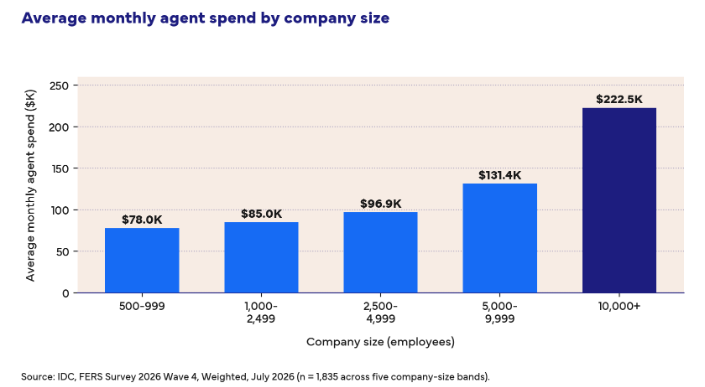
The spend backing this growing footprint is real money in action today, not a rounding error to be modeled later. Enterprises with visibility into their own agent costs (most do) report average monthly spend on agent inference and related orchestration services of $117,558, well over $1 million a year annualized, and IDC’s forecasts for agent adoption show this is the early chapter of a much longer story. The population of active agents used by organizations is projected to reach 2.5 billion by 2030, nearly 80 times what it was in 2025. Those agents will be completing 459 trillion actions a year versus 48 billion today. None of this is justification for slowing down, however. The innovation case for agentic AI is real, and enterprises have proven they can carry the initial load. The question IDC is now addressing is whether the meters and breakers enterprises rely on are keeping pace with the expansion and what tech leaders can do to avoid the bad outcomes.
The overrun is a visibility problem, not a discipline problem
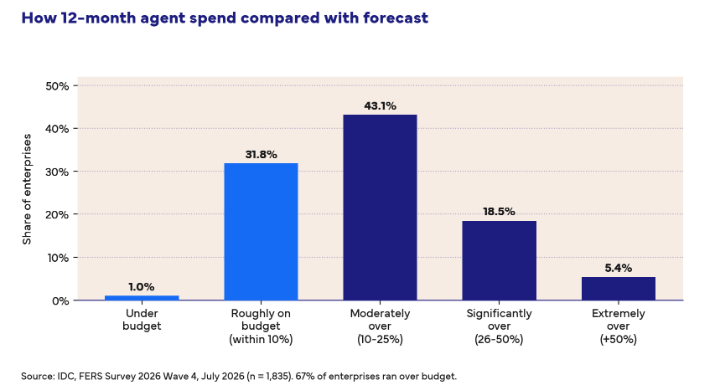
They are not keeping pace yet, and the data shows exactly where the gap sits. 67% of enterprises ran over their agent spend budget by more than 10% in the past 12 months, including 24% that ran significantly or extremely over forecast. Breaking that overrun down by severity tells the real story: 43.1% ran moderately over budget by 10% to 25%, 18.5% ran significantly over by 26% to 50%, and 5.4% blew past forecasts by more than 50%. The functional area leading agent adoption, IT and software development, is also the function most often cited for the worst overruns, which suggests enthusiasm and budget discipline are moving in opposite directions inside the same teams.
The consequences are not abstract. Roughly half of over-budget organizations deferred other important IT projects to stay within budget, and 43.1% proactively reduced headcount to compensate. Agent overruns are already crowding out other technology investment and, in a meaningful share of cases, jobs. Underneath it all sits a genuine paradox: 61.8% of organizations rate their own cost governance as “defined” or “optimizing,” yet only 45.4% have real-time dashboards tracking token consumption and cost by workflow. An area where two thirds of organizations believe their governance is mature and two thirds also missed budget is an area where self-assessment and outcomes have stopped tracking each other.
IDC created a framework to attack this exact issue. In Effective Agent Cost Management: A Practitioner’s Framework for Planning, Sourcing, Implementation, and Operations, we offer a short list of fixes that will matter more than any anticipated model price cuts:
- Name a single accountable owner for agent spend, per workflow, before the next budget cycle, not after the next overrun.
- Replace the monthly invoice review with real-time cost visibility. A once-a-month snapshot cannot manage a cost surface that moves by the hour.
- Fund cost governance as an engineering discipline, with engineering time attached, since the controls that work best (model routing, prompt caching, agentic loop guardrails) are built, not written into a policy memo.
- Consider capping any single vendor’s share of inference spend, generally below 40%, and keep a second option warm as pricing and terms keep shifting quarter to quarter.
Cost is one thread, not the whole fabric
It would be a mistake to treat agent cost as a standalone finance problem, and IDC’s companion framework, Autonomy on a Leash: A Framework for Agentic AI Governance , explains why. As my colleague Duncan Brown puts it, “organizations that wait to implement governance until after deployment are not avoiding cost. They are only deferring it and compounding their risk while they wait.”
IDC’s framework maps 12 IT domains, including FinOps and cost management, against five operational governance pillars: explainability and auditability, identity and access control, human oversight architecture, systemic agent governance, and continuous monitoring. Cost sits primarily under continuous monitoring, but it never sits there alone. The same organizations running over budget are also the ones where non-human identities already outnumber human ones, and where only 44% of organizations have implemented a policy for agent identity despite 92% calling it critical.
This is the deeper point underneath the spend numbers. An overrun and a governance gap are usually the same failure, seen from two different desks. IDC’s research on organizational governance maturity finds that enterprises with real accountability models, documented oversight, and real-time observability are on track for operating margins up to 15% higher by 2029 than those chasing AI productivity gains alone. Governance, built well, is not the brake on the innovation described above. It is the breaker box that lets an enterprise run agentic AI at full power without finding out where the short circuit was only after the fire.
Navigate the next move with confidence
None of this is an argument for slowing down incorporation of agentic AI into the business. It’s an argument for tech leaders to take the central role in scaling it well, before finance, legal, or a public incident does it for them. IDC created its two frameworks for this exact leadership moment.
Effective Agent Cost Management: A Practitioner’s Framework for Planning, Sourcing, Implementation, and Operations gives you the concrete controls to build a cost plan your CFO can sign off on.
Autonomy on a Leash: A Framework for Agentic AI Governance gives you the governance architecture to build a program your board can stand behind. Pull both apart, map them against your own agent population, and assign owners and dates to what they recommend.
The tech leaders who do that now are the ones who end up wiring their business for agentic AI safely, rather than explaining after an incident why they didn’t. IDC built these frameworks, and the research behind them, to be a trusted advisor for exactly this kind of work, from the first pilot through enterprise-wide rollout. Bring us the plan you’re building, and let’s navigate your next move with confidence.