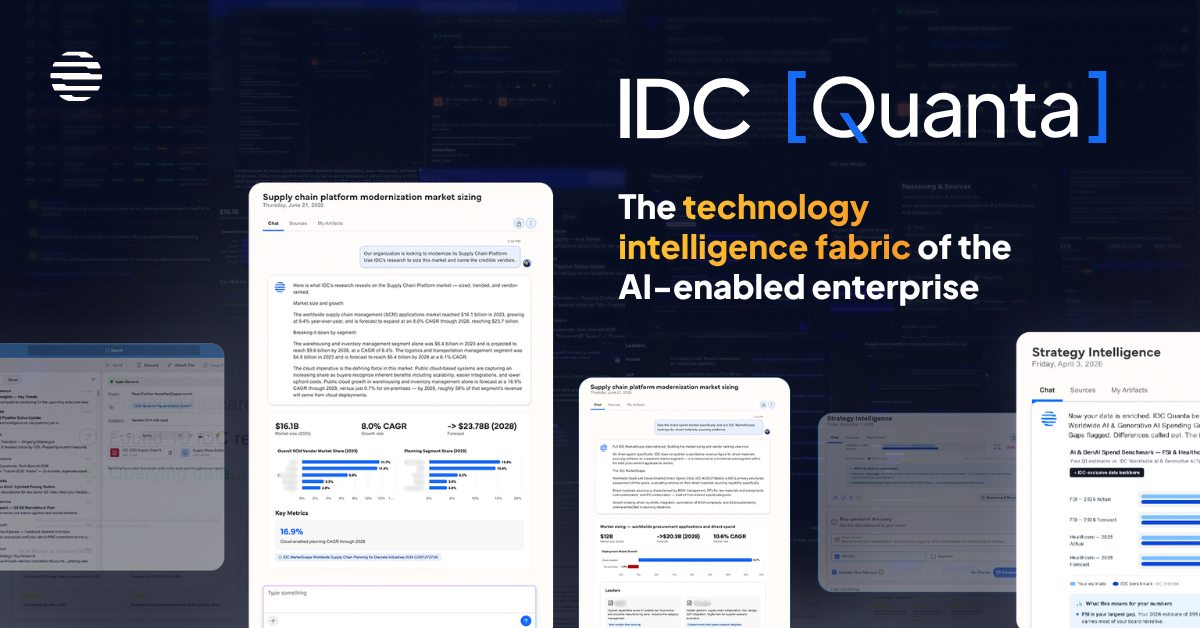
Today we launched IDC Quanta. I led the strategy behind it, working closely with our product, research, and engineering teams to turn a point of view into something real. I want to share what building it taught me about the state of AI adoption, not just at IDC, but everywhere.
The number that started it
By 2029, there will be a billion AI agents running inside enterprises worldwide. That translates into an enterprise running thousands of agents. The investments to prepare for that future are already taking place. Hyperscalers are increasing AI infrastructure spend from $54 billion in 2023 to $800 billion by 2029 to create inference capacity at that scale. Enterprises are spending $400 billion on AI platforms, apps and services this year, headed toward a trillion by 2029.
Most enterprises can’t orchestrate at that scale today. Most vendors can’t fully support it yet either. A billion agents means the entire IT industry, vendors and enterprises together, has a massive amount of infrastructure, governance, and orchestration work still ahead of it before that number is something to be excited about instead of something to be worried about. We didn’t want IDC standing outside that work, measuring it from a distance. We wanted to build the intelligence layer that helps our clients get through it. That’s the thinking behind Quanta.
The gap we kept running into
Earlier this year, we ran our global AI maturity benchmark. In the U.S., the largest single group of organizations, 39%, sits at what we call the AI Pivot stage. They’ve moved past ad hoc experimentation. They have momentum and intent. But they’re still reacting to use cases as they surface instead of executing against one enterprise strategy.
That gap comes down to a problem our team designed against from the start: islands of AI. Fragmented experimentation across functions that makes enterprise-level orchestration nearly impossible. Half of organizations have an AI roadmap defined at the functional level. Finance has one. IT has one. Marketing has one. They don’t connect. There’s no shared prioritization and no way to see where one function’s work could accelerate another’s.
The reason this is more than a coordination problem is because agents don’t respect functional boundaries. A customer service agent needs data from CRM, from order management, from your knowledge base. An operations agent touches supply chain, finance, and procurement. The moment you deploy agents that work across functions, a fragmented roadmap becomes an architectural blocker. It’s why 42% of CEOs plan to hire a Chief AI Officer in the next year. They’re looking for someone who can see the whole board, not just their own function’s piece of it.
We had our own version of this problem to solve. For decades, IDC’s model was research in one place and data in another, and clients had to hunt across both to get a full picture. Quanta brings our research and our data together in a single platform, so that fragmentation stops being something you have to solve every time you come to us.
The curve nobody wants to admit they’re on
For the past three and a half years, enterprises have struggled to prove the ROI on their AI use cases. Now we have runaway token costs arriving at the exact moment everyone is lining up to deploy agents.
IDC recently published a report on effective agent cost management. In the report, the team showed cost per action spikes early in almost every deployment, before value catches up. We call that phase High Anxiety. Value climbs slowly the whole time, crossing cost at what we call the Strategic Alignment phase. Past that point, cost keeps falling and value keeps climbing. That’s the payoff phase.
Most organizations in this industry are still on the wrong side of that curve. The token economy conversation isn’t about whether AI is worth the spend. It’s about how long it takes you to get through the High Anxiety phase. The organizations pulling ahead are the ones treating ROI as a discipline, not a one-time calculation. A cost model that only counts inference will undercount true total cost of ownership by 30 to 60%. The shift that matters is treating tokens like a raw material, the way a factory tracks cost per unit, instead of like a technology bill.
That framework is one example of the kind of intelligence Quanta is built to deliver. Not a report waiting to be opened weeks after it would have mattered. Something you can reach directly at idc.com, or through connectors built into the platforms your team already uses, so the intelligence shows up where the decisions and execution happens instead of sitting in a document.
Why I’m telling you this today
Quanta didn’t come from spotting a market opportunity from a distance. It came from our team solving the exact problem I just described, for our own organization, alongside the people who build and research this every day.
For decades, our model was simple: we publish research, and you come find it. That worked when the pace of decisions making was slower. It doesn’t work anymore, not with a billion agents coming and the decisions being made this year that companies will live with for years. We built Quanta to work two ways. Come to idc.com directly for grounded, evidence-based answers. Or reach that same intelligence through connectors already built into the platforms your team uses, so you’re not switching context.
I’m proud of what we’re launching today. But the thing I actually want you to take from this is the reminder that the gap between where your organization is and where it needs to be closes the same way ours did: someone has to own the whole board, and go get the intelligence instead of waiting for it to come to you.