
IDC FutureScape China Event Reveals: AI Is a Full Rewrite of IT and Business
BEIJING (November 19, 2026) – IDC Research, Inc. (IDC) predicts that by 2027, CFOs and CIOs at China’s 2,000 largest enterprises will shift 40% of new AI spending away from pilot-justified initiatives toward pre-deployment cost and business-outcome baselined releases. The prediction is part of IDC FutureScape 2027, the company’s annual forecast for enterprise technology leaders, and IDC presented it today at The Great Rewrite: IDC FutureScape 2027 China event to more than 300 business decision makers and technology leaders from China and international technology communities. It focused on the AI supercycle, AI infrastructure, physical AI, and industrial AI, while examining in greater depth the AI investment and data governance.
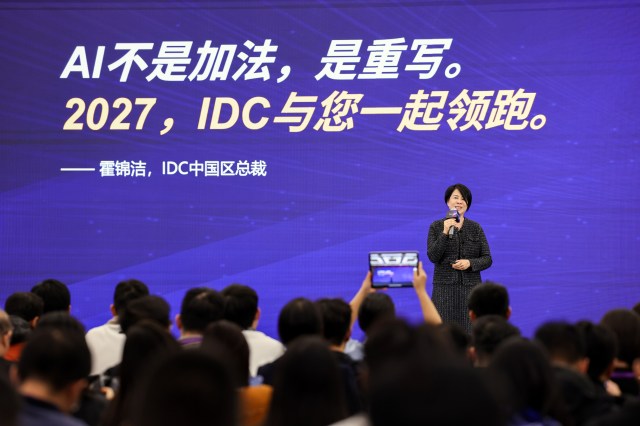
In her opening keynote, Kitty Fok, managing director of IDC China said “AI is not an add-on but a rewrite of what sits underneath IT and business, from the infrastructure to the organization. The deeper competition of the AI supercycle will hinge on how AI can continuously create measurable, sustainable business value in real-world scenarios.” IDC predicts that by 2028, 42% of leading enterprises worldwide will restructure their agent and application assets. 1
In his presentation, Zhenshan Zhong, group vice president of IDC, shared IDC’s key prediction that 40% of production-grade agents at Chinese enterprises will possess self-evolution capabilities by 2028, enabling them to continuously improve the capabilities and assets their operations depend on—including prompts, memory, knowledge, skills, tools, workflows, and models—based on task records, evaluation results, and human feedback, thereby reducing the costs of agent deployment tuning and ongoing maintenance. Meanwhile, in the era of agent scaling, enterprises will place greater emphasis on agent security and controllability. By 2028, 70% of production-grade agents at top 500 Chinese companies will have independent non-human identities, obtain temporary least-privilege permissions on a task basis, and maintain complete records of authorization, actions, and lifecycle.2
Thomas Zhou, vice president of IDC China, shared the latest trends in AI infrastructure: facing sustained growth in computing demand from large models and agents, competition in AI infrastructure has shifted from single-chip performance benchmarks to a system-level contest among chips, super node interconnect architectures and green data center integration. A new generation of computing facilities must rely on super nodes to break through traditional cluster communication bottlenecks and combine power-compute coordination with low-carbon design to deliver high-density computing efficiently and sustainably. IDC predicts that by 2030, 75% of enterprises will shift part of their business to specialized clouds and private AI factories to mitigate costs.3
In his keynote, Dr. Antonio Wang, vice president of IDC China, proposed that we are in an era where the physical AI cycle and the AI Supercycle resonate at dual frequencies and that by 2030, China’s device market shipments will reach 930 million units. AI devices will account for 300 million, with a five-year compound annual growth rate (CAGR) of 16.5%. Meanwhile, embodied intelligence-driven robots are moving from functional devices to task-oriented terminals; autonomous execution capabilities are reshaping product value and market growth. By 2030, global smart robot shipments will approach 63 million units, with a five-year CAGR of about 12.8%, and China’s shipments will approach 13 million units. Physical AI is reshaping the terminal ecosystem, enabling every device not only to run efficiently but also to understand and serve people, acting and protecting autonomously in the real world. 4
Yanze Du, senior research manager at IDC China, shared how AI is rewriting IT and business across industry, robotics and intelligent supply chains. He noted that toward the 2027 AI economy cycle, manufacturing is beginning a bottom-up rewrite of factory paradigms. Industrial agents and humanoid robots are accelerating into production and logistics sites, driving autonomous operations across production lines and supply chains. Physical AI closes the loop across device perception, decision-making, and execution, reshaping shop-floor production, operations and maintenance, quality inspection and logistics processes. IDC predicts that by 2030, as agentic AI moves from advising to deciding, 75% of large manufacturers will treat physical AI as the necessary execution layer, capturing a 25% gain in process efficiency. 5
In his presentation, Lianfeng Wu, vice president and chief analyst of IDC China combined China’s macroeconomic trajectory with enterprise investment trends. This is to systematically interpret ICT market size and spending structure, digital and intelligent transformation investment directions, and AI application scenarios and market opportunities in the financial industry. He also shared several key IDC 2027 predictions. On the shift in the structure of AI funding, with AI-enablement being the foundation for improvements in centralized business process functions and revenue expansion in lines of business, IDC predicts that 65% of AI funding will be outside a single IT budget by 2027. He also highlighted a shift in how agent value is assessed and that by 2027, CFOs and CIOs at China’s 2,000 largest enterprises will shift 40% of new AI spending away from pilot-justified initiatives toward pre-deployment cost and business-outcome baselined releases. 6
At the close of the event, Grace Han, vice president of IDC China said, “IDC’s forward-looking research insights can help enterprises identify target markets, win customer mindshare with trustworthy content in the GEO era, and ultimately drive business growth”. 7
OnDemand videos of the event presentations will be released progressively. Please follow IDC’s official channels for updates.
About IDC
IDC Research, Inc. (IDC) is the technology intelligence layer of the AI economy. A global leader in research and data for more than 60 years, IDC’s expert analysts, proprietary datasets, and rigorous methodologies are trusted by business and IT leaders to guide critical business strategies and IT investments. Today, that intelligence is built into the tools and workflows where work gets done with IDC Quanta, making work sharper, teams faster, and businesses harder to beat.
Visit www.idc.com, subscribe to the IDC blog, or follow IDC on X and LinkedIn for the latest industry insights.
Press contacts
IDC Media Relations: press@idc.com. Members of the media can request the complete set of 250 predictions at the same address.
Footnotes:
1 Presentation at the IDC FutureScape 2027 China Event: Leading the AI Supercycle (Kitty Fok, managing director of IDC China)
2 Presentation at the IDC FutureScape 2027 China Event: The Great Rewrite: AI Overview (Zhenshan Zhong, group vice president of IDC)
3 Presentation at the IDC FutureScape 2027 China Event: Rebuilding the Compute Layer (Thomas Zhou, vice president of IDC China)
4 Presentation at the IDC FutureScape 2027 China Event: Physical AI: From Roadmap to Reality (Dr. Antonio Wang, vice president of IDC China)
5 Presentation at the IDC FutureScape 2027 China Event: Rewriting the Factory Floor (Yanze Du, senior research manager at IDC China)
6 Presentation at the IDC FutureScape 2027 China Event: Follow the Money: From Digital to AI Economy (Lianfeng Wu, vice president and chief analyst of IDC China)
7 Presentation at the IDC FutureScape 2027 China Event: IDC Multiplier: Your Complete Path to Growth (Grace Han, vice president of IDC China)