

There is a well-established playbook for calculating the return on an IT investment. Define a baseline, model the efficiency gains, project the cost savings, and present a number to the CFO. For most technology investments, that approach works.
Agentic AI breaks it.
Unlike conventional software deployments, agentic AI (systems that execute multi-step tasks autonomously, make real-time decisions, and interact with external tools and other agents) does not deliver a fixed, predictable output in exchange for a fixed, predictable input. Agents learn. They adapt. They make decisions autonomously across multi-step processes, interact with other systems and other agents, and generate value or risk that compounds in ways traditional ROI models were never built to capture.
According to IDC research, 42% of organizations worldwide already report that assessing the ROI of their digital and AI investments is difficult or even impossible.
The top barriers: limited visibility into long-term impact, undefined or inconsistent baseline metrics, and the absence of a dedicated AI value office or task force. Agentic AI does not solve these problems. It amplifies them.
The answer is not to stop measuring. It is to measure differently.
Why agentic AI demands a new value framework
The core challenge is that agentic AI value is nonlinear. A single agent interacting with a customer, a data pipeline, and a back-office process does not generate a tidy productivity percentage. It generates outcomes shaped by adoption quality, autonomy boundaries, feedback loops, and the quality of the data and processes the agent operates within.
Costs present an equally complex picture. Agentic AI spending spans LLM and SLM licensing, API calls, token consumption, and cloud infrastructure, but the larger drivers are often orchestration and governance. IDC’s framework identifies agentic AI cost as fundamentally behavioral, shaped by how agents are prompted, how often they invoke external tools, and how closely they are supervised. Assuming linear cost scaling is one of the more expensive mistakes an IT leader can make.
Risk adds a third dimension. In agentic systems, failures propagate. A misconfigured decision boundary in one agent can cascade across steps, tools, and downstream processes in ways that static risk models do not account for.
A six-pillar framework for maximizing business value
To address this, IDC has developed the Agentic AI Business Value Maximization Framework, a structured approach built around six pillars, with governance as the thread running through all of them.
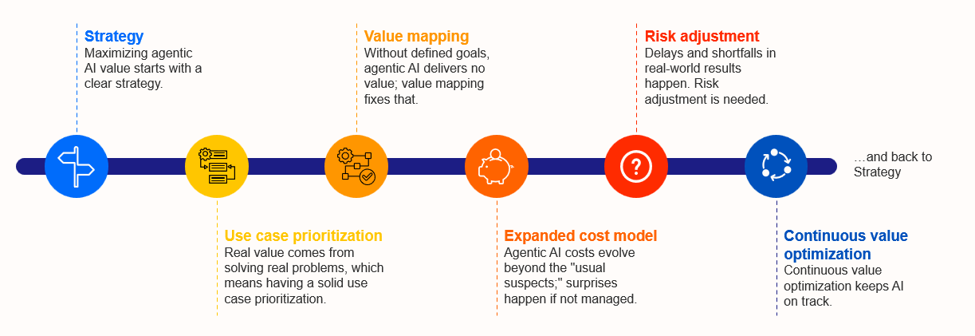
Strategy. Agentic AI introduces autonomous decision-making, so strategy must define where autonomy is permitted and where it is constrained. The output is not a vague aspiration toward “better productivity.” It is a multi-time horizon road map with metric owners, shared across the organization, and tied explicitly to investment prioritization. Organizations that treat agents as tools rather than autonomous actors are setting themselves up for governance failures, not productivity gains.
Use case prioritization. Not every problem is an agentic problem. Deploying agentic AI on narrow, siloed tasks that deterministic automation handles perfectly well wastes investment and adds unnecessary complexity. IDC’s framework introduces prioritization dimensions specific to agentic contexts: multi-step reasoning requirements, dynamic decision-making needs, orchestration complexity, and the degree to which autonomy itself generates value. The output is a ranked, feasibility-adjusted use case portfolio, not a list of technically interesting experiments.
Value mapping. Value mapping anchors agentic AI investments in clear business outcomes and prevents the aimless experimentation that inflates AI budgets without delivering measurable results. Critically, agentic AI value is not static. It compounds as agents learn, adapt, and expand scope. Value mapping must account for the learning curve, not just immediate efficiency gains, and must incorporate non-financial drivers such as sustainability and customer trust alongside traditional financial metrics.
Expanded cost model. IDC’s framework calls for a dynamic total cost of ownership model that distinguishes capital expenditure from continuous, AI-specific operational costs, and that gives FinOps, legal, and financial governance teams the visibility they need to manage the complex, usage-based economics of agentic AI.
Risk adjustment. ROI for agentic AI should not be presented as a single point estimate. It should be scenario-based, tied to adoption trajectory, output quality, and timing assumptions, all assigned to explicit owners with documented confidence levels. Risk should be treated as dynamic, updated as real data replaces estimates, and modeled for the interdependencies that make agentic system failures systemic rather than isolated.
Continuous value optimization. IDC’s lifecycle analysis of agentic deployments finds that without active tuning, agent performance degrades as context shifts and edge cases accumulate. Sustained value requires treating agentic AI as an ongoing lifecycle management challenge, not a project to be completed and handed off to operations. That requires a dedicated Centre of Excellence with a strong governance cadence, defined standards, and the organizational mandate to enforce continuous optimization.
From framework to action
IDC’s Agentic AI Business Value Maximization Framework is designed to deliver six concrete outputs: a multi-time horizon autonomy road map, a ranked use case portfolio, a business value calculator, a dynamic TCO model, a scenario-based risk evaluator, and an agent lifecycle governance model. These are not aspirational deliverables. They are the minimum set of instruments an organization needs to manage agentic AI as a business investment rather than a technology experiment.
IDC’s framework analysis indicates that organizations that build this infrastructure now will extract more value from current agentic deployments and will be structurally better positioned to scale as the next wave of capability arrives.
Get in touch
If you are a Technology Provider and want to learn more about how IDC’s Business Value Consulting practice can help you build a rigorous, defensible framework for measuring and communicating the value of your agentic AI solutions, or explore ROI-focused go-to-market and lead generation tools backed by IDC research, reach out to start the conversation.
If you are a Technology User and want to learn more about how IDC’s Business Value Consulting practice can help your organization measure, justify, and maximize the business value of your agentic AI investments, reach out to start the conversation.