This is the first post in Meet IDC Quanta, a short series showing what the product actually does, starting with the portal, then your inbox, then wherever you’re already working in Claude.
Try this with any AI tool:
What are the top three risks facing enterprise AI platform vendors in 2026, and which competitors are best positioned to capitalize on each one?
You’ll probably get citations back. Most AI tools search the web now. What you’ll get is a mix: a Reuters piece here, a vendor blog there, maybe a content site optimized to rank for exactly this kind of question. Nothing wrong with any single link, but there’s no consistency to it, and no way to know which source actually did the work versus which one just ranked. An answer built from whatever surfaced that day isn’t the same as an answer built from one accountable research program.
Here’s what happens when you ask IDC Quanta instead.
Type the question. Watch what loads.
Log into the portal with your existing enterprise credentials. No new account, no IT ticket, no new password to forget. Your workspace is fully isolated the moment you’re in: your queries, your context, your documents, visible to no one else.
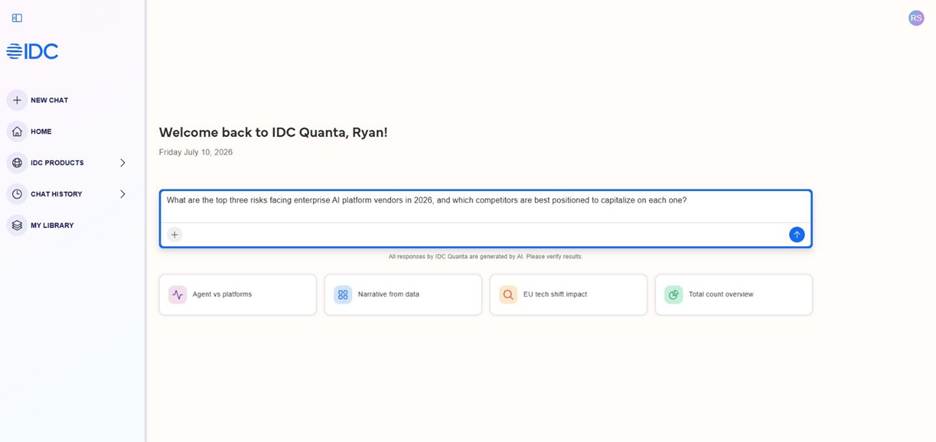
Type the question. What comes back is grounded in one research program you can vet: structured, specific, and cited to a named IDC analyst deliverable. That’s what sets it apart.
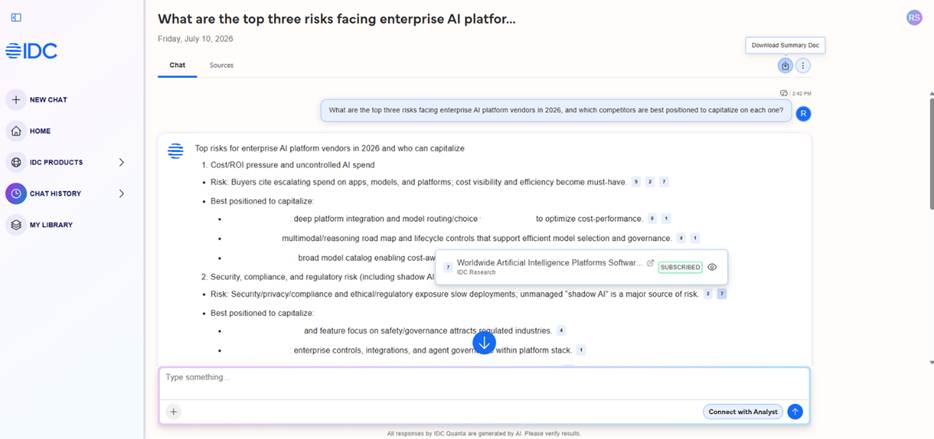
Click the citation. That’s not a footnote.
This is the moment that changes the conversation: hover over a citation, click it, and the underlying IDC document opens. It opens the actual research: an analyst name, a date, the real document.
When the CFO asks where that market-share number came from, you don’t say “our AI said so.” You say “IDC, Q2 2026,” and you show them.
That citation isn’t pulled from a single report, either. It draws on IDC’s research base of 1,000+ analysts covering 100+ countries, backed by more than 15 billion data points tracked annually.
Already did the analysis? Make Quanta argue with it.
Most strategy teams aren’t starting from a blank page. Upload the competitive brief your team already spent weeks building and ask IDC Quanta to validate it. It flags factual conflicts, calls out numbers that need clarification, and hands you specific, actionable edits. Multiple agents work the problem in the background: one interpreting intent, one querying IDC’s research directly, another cross-validating every citation against it.
This is the part that’s genuinely rare: an AI tool willing to disagree with your own document, backed by evidence, in minutes instead of days.
Your document doesn’t stick around.
Once Quanta’s done validating, your uploaded document is auto-deleted after 90 days. No exceptions, no separate opt-in required. None of this asks you to trust a black box. Every upload is scanned on the way in, encrypted with AES-256, and when the time is up, it’s gone for good. IDC Quanta trains on none of it: what you upload is yours, full stop. The platform holds SOC 2 Type I certification today; Type II is underway. The analysis happens fast; the data doesn’t linger.
Ask once. Get it every time after that.
Some questions come up every month. They’re the ones your board keeps asking. Set up a scheduled prompt on any response, and IDC Quanta delivers the latest answer on that cadence automatically. No re-asking, no remembering to check back. The question stays live; you just get the updated answer.

It remembers, so you don’t start over.
IDC Quanta also carries context forward automatically: your role, your sector, the competitors you track. Ask again next week and you’re not re-explaining who you are or what you care about. Each question builds on the last one, and the more you use it, the more precisely it already knows what you need.
Stop guessing. Start citing.
If you already have IDC Quanta, this isn’t hypothetical. Go ask it your next hard question and click the first citation you see. If you don’t have it yet, book a demo and bring a real one.
This is the first post in the three-part Meet IDC Quanta series — next up: your inbox.