The fitness tracker on your wrist has quietly been turning from an electronic watch with a few cool features into something closer to a medical device, and AI is accelerating this change. Sensors such as those tracking heart rate, sleep, and body temperature have been increasing in accuracy for years, but for the most part the data they produce has been interesting yet largely non-actionable. What does the average user really get out of knowing their heart rate is 65 bpm and their readiness score is 80 out of 100? AI is changing that. For the first time, this vast and increasingly accurate data stream can be analyzed at scale, and the insights that are emerging are quietly revolutionary.

Detecting illness Before symptoms appear

Research has documented that even a common illness can produce early warning signs a full day before a person feels ill. Some of the most common signals are elevated core temperature and disrupted sleep patterns, both of which today’s smartwatches can already detect. So why does a single day’s warning matter? Because you may already be contagious. For nurses, doctors, and others who care for vulnerable people, the implications are striking. Imagine a doctor working in a small practice, seeing 25 patients a day. They’re uniquely exposed to infection, and when infected, uniquely positioned to pass it on to the most vulnerable people they treat. Now imagine that doctor had been wearing a device that flagged the infection, so they didn’t spend the day passing their illness to every patient who came in. Multiply this across a national healthcare system, and the number of preventable infections and deaths each year would be significant. AI improves this by making detection more accurate. Sleep patterns and core body temperature fluctuate for many reasons, including alcohol, caffeine, a heavy meal before bed, and jet lag, all of which create noise. But as AI evaluates ever larger volumes of data with increasing accuracy, that noise becomes easier to see through, and false positives and false negatives continue to decrease.

The longer horizon: Alzheimer’s and chronic disease

But why settle for a single day’s warning when wearable devices might soon detect the onset of illness years, even decades, before the first noticeable symptom? A 2025 review of sleep research links Alzheimer’s and other forms of dementia to detectable changes in sleep patterns more than a decade before recognizable symptoms begin. The link appears to run through deep slow-wave sleep, the part of the sleep cycle where the brain clears out metabolic waste, including the proteins that clump into Alzheimer’s plaque. Newer treatments can now help remove this plaque buildup and slow the disease’s progression, extending a person’s healthy lifespan. While major wearable manufacturers don’t yet claim to detect Alzheimer’s, Apple Watches have tracked sleep-cycle stages since 2022, and that measurement has grown more accurate over time. If that trend continues, it seems likely that Alzheimer’s will be detectable through a smartwatch within the next several years.

The data problem AI solves

These use cases are just the beginning. Sensors on smartwatches grow more precise with each generation, and hundreds of millions of people wear them every day. IDC’s Worldwide Quarterly Wearable Device Tracker counted 164 million smartwatches sold worldwide in 2025 alone. That volume of health data would have been unmanageable in 2020; analyzing it at any meaningful scale or accuracy would have verged on impossible. But with the buildout of data centers and advances in AI, today’s models can process this data efficiently, surfacing patterns no human could have spotted. If a person’s near-continuous stream of health data spanning years could be matched with their health records, and that approach scaled to tens of millions of people, the resulting insights would be substantial. Faint warning signs never considered before could be matched to the diseases they precede, long before the first noticeable symptom emerges. Integrating constant health monitoring and early detection into the medical system would shift it from reacting to emergencies to preventing them. Catching issues early is almost always the cheaper option, both financially and in terms of suffering. It’s the difference between finding cancer early, when a minor procedure can treat it, and finding it once it has spread, requiring grueling chemotherapy and years of costly treatment.

The barriers worth naming

Clearly there are legal, ethical, and logistical barriers to tracking a person’s health data for years, especially when matching it to their medical records. Many people will justifiably have concerns about companies accessing their health data, viewing the risk of data leaks and Big-Brother-style surveillance as not worth the upside. But many people already buy these devices for the health benefits they believe they offer, and deeper integration would only make that benefit more powerful. Data accuracy and AI hallucinations remain real concerns, but both sensor quality and AI reliability have improved rapidly and should continue to do so.

Where this is heading

In the long run, it seems inevitable that wearable devices and AI-generated insights will be deeply integrated into healthcare. Today’s system relies on overworked doctors who know little about the patient in front of them, glancing at a medical history before deciding how to proceed. Instead, healthcare should run on a system that holds a deep well of medical data on each patient, understands their individual baseline, and uses that data to inform diagnosis and next steps. That shift would turn healthcare from a point-in-time reaction to a crisis into a continuous, preventative system, one that saves both money and lives.
Frederick Stanbrell

Frederick Stanbrell - Research Analyst, IDC Europe Wearables

Frederick Stanbrell joined IDC in 2022, as an associate research analyst based in London, leading the European Wearables tracker. As head of the European Wearables tracker he collates guidance, tracks market trends and provides insight and forecasts into the region,…

The headlines from InfoComm 2026 said the industry moved “from rooms to experiences.” We’ve been observing this transition for a while. But what’s more relevant to anyone who buys, runs, or just sits in meeting rooms is that the room has become another device on the corporate network, and that changes who is in charge of it. 

For years, the meeting room was the thing on the wall you hoped would just work. InfoComm 2026 in Las Vegas, the pro AV industry’s big annual show, made the case that those days are over. The room is no longer a fixed installation. Yes, it is becoming an experience, but it also bears a striking resemblance to something IT knows all too well, a textbook case of AV/IT convergence: a managed device, bought like an endpoint, run like part of a fleet, and increasingly able to collect data about the people inside it. 

The industry has agreed on the theme: outcomes, not spec sheets, now drive what companies spend on collaboration technology. Buyers want rooms that simply work and that prove their value. But what’s worth exploring is how they get there. What is different in how a meeting room is bought, run, and governed? And who ends up operating it? 

Let’s look at some numbers. Attendance at InfoComm 2026 fell about 9% year on year. What rose was the share of buyers in the room. AVIXA (the Audiovisual and Integrated Experience Association, which owns and produces InfoComm) reported that end users made up 37% of attendees, a record, up from 35% last year and 29% in 2024. So fewer people came, but more of them were the ones who sign the purchase order. What they found was a transitioning market: value is continuously moving away from hardware and installation labor toward software, cloud, and AI. 

Three groups of announcements at the show summarize this: one each for how a room is bought, how it is run, and how it is governed. 

Your next room upgrade starts with the chip that runs on-device AI 

For years, a room upgrade meant better cameras, microphones, and displays. InfoComm 2026 reframed it as a decision about processing power. HP introduced its Poly Studio Room Compute, and Cisco showed new endpoints, built on an operating system called RoomOS 26 that it developed with NVIDIA, that run AI agents directly on the device rather than in the cloud, an approach some now call edge AI. 

Cisco leaned hardest on this point, and the argument threaded through the entire show: the features that do real work in a meeting, not just record it, need on-device AI processing, so a room built on incompatible or aging hardware simply cannot run them. In other words, AI in the meeting room is no longer only a software question. It’s about hardware. Perhaps the more uncomfortable part for most buyers is that a lot of the equipment bought in the last few years may not run the features now being sold, which turns a routine refresh into a spending decision that requires a business case. 

Enter the agentic AI 

Think about what happens today when a meeting room misbehaves. Someone files a ticket and waits for a technician. Well, according to InfoComm 2026, you will soon be asking an AI assistant to sort it out. 

Several vendors connected their room systems to AI assistants using the Model Context Protocol, the open standard that companies are adopting to let AI act on their other software. Neat’s version runs on your own network and works with assistants like Claude or Cursor, so the assistant can see what is wrong in a room, change the settings, and resolve common problems without specialist knowledge or a site visit. Others are taking their own routes to the same idea: Shure, the show’s headline partner, is moving beyond hardware with ShureCloud, which manages devices centrally and adds an AI assistant for troubleshooting and support, while Cisco has connected Microsoft’s Copilot to Webex. Related tools now watch over rooms from many brands, and across Teams, Zoom, Google Meet, and Webex, from one place. 

Why should anyone outside AV care? Because this is the same move toward AI agents that is happening across the workplace, only now reaching the meeting room, and the payoff is both money and time saved: fewer call-outs, fewer help-desk tickets. It also pushes the firms that install AV toward ongoing service instead of one-off projects. However, it is still early. Most of this was shown as a capability, not a full rollout, and whether “agentic” lives up to the label is still unproven. 

So the room is now collecting data. But who governs it? 

The moment a room becomes “intelligent”, it starts producing data: who was in it, who spoke, and how the space was used. That makes it interesting to a lot more people. HR, legal, and security now have a stake in it, alongside IT, and each comes at it from a different angle. 

HR sees a room that can log who attended, who spoke, and how much, and wants to reassure employees that this isn’t being used against them and retain their trust. Legal sees the recordings and transcripts as personal data: information that carries consent, retention, and residency obligations, and that can be pulled into discovery if a dispute arises. Security sees a networked device sitting in on confidential conversations and asks the obvious questions, namely who can access that data, where it is stored, and how much bigger a target the room has become. IT, which used to own the room outright, now runs it on behalf of all three. And there is still no security standard written specifically for AI in these systems, and general ones like NIST cover only part of it. 

The industry’s early answer is to keep the processing and the data inside the room rather than sending it to the cloud, which helps with privacy and with rules about where data is allowed to live. Those questions are climbing the data governance priority list for IT and security teams this year, and writing the policy before you roll rooms out widely saves you the harder job of untangling it later. 

The room reads you now. Time to read the room. 

The meeting room is now bought like any other endpoint, run as part of your device fleet, and governed as a data source. That is a long way from the box on the conference-room wall. 

What to do before your next upgrade:  

  1. Ask which AI features run on the hardware you already own, and what you would need to buy for the rest.  
  1. Before you believe any “agentic” pitch, run a small pilot and hold it to a measurable result, such as fewer support tickets.  
  1. And before you scale, decide who owns the data the rooms collect.  

Do that, and the answer to who operates your meeting rooms, AV, IT, or an AI agent, becomes all three, working alongside. The companies that treat the room that way will get the most out of what vendors are now building. 

Navigate your next workplace technology decision with the evidence to back it. Explore IDC’s Intelligent Workplace research, forecasts, and analyst guidance, or speak with our analysts. 

Gala Spasova

Gala Spasova - Senior Research Manager, Europe Smart Office and EMEA Content & Knowledge Management Strategies

Gala Spasova is a senior research manager in IDC's Future of Workplace & Imaging team. Her research focus is on Hybrid working, Smart Office technology and Content & Knowledge Management Strategies in EMEA.  Spasova is also part of the European…

随着AI和智能体在企业业务、生产和办公场景中的广泛应用,零信任网络访问(ZTNA)解决方案不仅要防护传统用户和设备,还需针对AI模型、自动化智能体、API调用等新型主体进行身份认证、访问控制和行为审计。AI和智能体已成为新的访问与攻击面,ZTNA架构必须扩展至“人+设备+AI Agent”统一治理,防范AI身份伪造、越权访问、提示注入等新型风险。

与此同时,AI技术正深度赋能ZTNA解决方案。通过行为分析、风险建模、自动化策略生成和智能响应,AI显著提升了ZTNA的动态风险感知、异常检测、自动化运营和复杂场景下的安全决策能力。AI不仅是防护对象,更是能力跃迁的驱动力,使ZTNA成为智能体时代企业安全治理的核心平台。

零信任理念已成市场普遍认知

在全球数字化转型、云化和远程办公常态化的推动下,企业IT架构正快速从传统集中式数据中心模式,演进为覆盖云、多云、SaaS、边缘计算与第三方生态的分布式体系。业务边界、访问边界和数据边界不断模糊,传统“内外网边界”安全模型逐渐失效。攻击面扩展至终端、API、云工作负载、供应链及AI应用生态,网络安全风险高度动态化和复杂化。身份滥用、会话劫持、权限滥用成为主流攻击路径,“身份即边界”成为行业共识。

零信任理念(ZTNA)以“永不信任、持续验证”为核心,通过身份、设备状态、行为上下文和风险态势的动态访问控制,替代静态信任模型,成为企业安全架构升级的主流方案。中国企业对零信任的认知度和接受度已广泛提升,ZTNA逐步成为企业现代安全访问控制的主流方案。

中国ZTNA市场规模与竞争格局

近日,国际数据公司(IDC)发布了针对中国零信任网络访问(ZTNA)解决方案市场的一系列报告:

  • IDC MarketScape:中国GenAI赋能的零信任网络访问解决方案2026年厂商评估
  • 中国零信任网络访问解决方案市场份额,2025
  • 中国零信任网络访问场景之软件定义边界市场份额,2025
  • 中国零信任网络访问场景之终端安全市场份额,2025

通过这些研究对中国ZTNA整体市场和主要细分市场的规模、产品发展现状和技术发展趋势,以及市场主要代表厂商的能力和特点进行了全面介绍。有如下洞察:

1. 中国ZTNA技术能力发展现状

  • 厂商ZTNA解决方案相关的各项基础能力建设已经趋于成熟。国内主流安全厂商已基本具备身份认证、终端可信接入、应用级访问控制、动态权限管理、细粒度审计以及持续风险评估等核心能力,并逐渐形成覆盖身份、终端、网络与应用的一体化零信任架构。
  • 中国ZTNA市场正加速向安全访问服务边缘(SASE)方向演进。随着企业业务环境向多云、SaaS与分布式办公架构发展,单一ZTNA能力已难以满足企业对统一安全接入与持续安全运营的需求。越来越多厂商开始将ZTNA与SWG、CASB、SD-WAN、数据安全、终端安全以及安全运营能力进行深度融合,构建统一SASE平台,实现跨网络、跨云、跨终端环境的一体化安全访问控制。
  • 中国ZTNA市场正在进入“AI赋能ZTNA”的新阶段。当前,基于机器学习、行为分析与GenAI能力的智能检测、动态风险评估、自动化策略生成以及安全事件分析,已经在众多安全场景中取得显著效果,推动安全体系从“人工驱动”向“智能驱动”加速演进。与此同时,AI正在显著提升安全产品的实时分析能力、自动化运营能力和复杂环境下的风险感知能力,逐渐成为安全产品竞争力的重要核心。
  • AI自身安全问题成为国内技术提供商重点关注的新方向。当前,行业已经开始围绕AI身份管理、提示注入防护、模型调用安全、敏感数据保护等领域持续加大研发投入,希望构建面向“人+设备+智能体”的新一代安全体系。从目前中国市场发展阶段来看,AI自身安全能力与ZTNA体系之间仍未实现充分融合,大部分厂商对于AI智能体身份治理、AI行为持续监测、模型调用链审计以及AI最小权限控制等能力支持仍相对有限。

2. 中国ZTNA市场规模发展现状

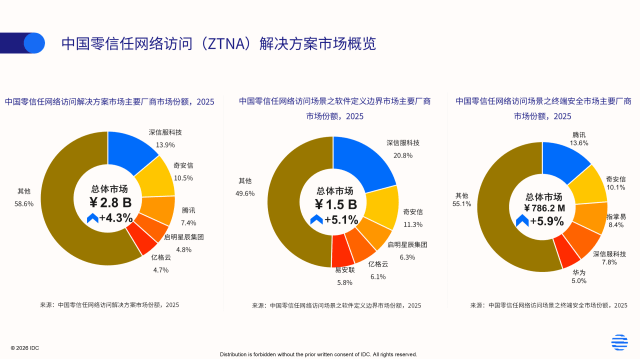
虽然近几年受到宏观环境的影响,中国整体网络安全市场承压明显,但ZTNA市场仍然凭借厂商不断完备的技术演进以及企业级客户的真实需求增长保持稳定增长态势。从市场规模来看,2025年中国零信任网络解决方案市场的整体规模达到27.6亿元,其中软件定义边界(SDP)依旧是最主要的ZTNA实现方式,市场规模为15.4亿元,零信任终端安全继续保持快速增长,市场规模为7.9亿元。深信服科技、奇安信、腾讯、启明星辰集团、亿格云、易安联、指掌易、华为等厂商在ZTNA市场占据重要的市场影响力。

IDC的调研发现,中国企业对零信任理念和ZTNA的认知度与接受度已广泛提升,ZTNA逐步成为新一代统一访问控制与身份安全体系的重要基础能力。主要技术提供商的ZTNA基础能力建设已经已覆盖远程办公、互联网暴露面治理、第三方接入、云原生、工业互联网及AI应用访问等复杂场景。同时,中国ZTNA市场正加速向SASE平台化演进,满足多云、分布式办公和AI应用生态下的统一安全接入与持续运营需求。IDC《中国智能安全访问服务边缘市场预测,2026—2030》报告数据显示,中国SASE市场在未来5年将保持快速增长,年均复合增长率为25.9%,市场规模在2030年将达到48.7亿元。

在另外一本《IDC MarketScape:中国GenAI赋能的零信任网络访问解决方案2026年厂商评估》报告中,IDC从能力、战略和营收等多个维度对国内市场主要的ZTNA解决方案技术提供商进行了全面评估,充分展现厂商各自的能力、优势和挑战,并最终选择阿里巴巴、持安科技、从云科技、缔盟云、华为、吉大正元、南凌科技、奇安信、启明星辰集团、山石网科、深信服科技、腾讯、网宿科技、易安联、亿格云、中国电信、竹云、指掌易入选本次报告(按拼音首字母顺序排列)。

ZTNA技术发展趋势:AI场景的双向驱动

结合今年的市场研究,IDC对ZTNA解决方案的技术发展趋势有如下判断:

  • AI赋能ZTNA能力升级:国际与中国技术提供商普遍将AI/GenAI技术深度嵌入ZTNA体系。AI驱动行为基线建模、动态风险评估、自动化策略生成、智能事件分析与响应,显著提升安全事件分析、预测和处置的智能化水平,降低人工运维负担。
  • 智能体安全防护:随着大模型、智能体、MCP、API等新型主体广泛应用,ZTNA需扩展至“人+设备+智能体”统一治理。技术提供商需要加大AI身份管理、访问控制、提示注入防护、模型调用安全、敏感数据保护和行为审计等研发投入,防范AI身份伪造、越权访问、提示注入、敏感数据泄露等新型风险。
  • 平台化与生态化融合:ZTNA正加速与SASE、IAM、安全运营、数据安全等体系深度融合,向一体化安全访问与运营平台演进。技术提供商将强调开放集成能力,支持多云、SaaS、分布式办公、AI应用等复杂场景下的统一安全管控。
  • 行业场景化与持续运营:针对政府、金融、能源、制造等重点行业,技术提供商需要提供定制化ZTNA/SASE方案,强化与云服务、终端安全、身份安全、SaaS等生态伙伴协同。ZTNA/SASE产品从单点部署转向长期治理与持续运营,提供全生命周期服务。
  • 数据安全与合规:技术提供商普遍将数据安全能力原生嵌入ZTNA架构,支持敏感数据识别、分级管理、全流程追踪、动态脱敏、泄密溯源水印及多渠道外发管控。AI助力数据行为监测、异常识别和自动化响应,推动数据安全防护从被动防御向主动治理转型。

因此,AI既是防护对象,也是能力跃迁的驱动力。未来,ZTNA将逐步演进为AI时代统一安全控制平面的关键组成部分。技术提供商需积极拥抱AI赋能,强化平台能力和生态协同,持续提升产品智能化和运营服务能力,以应对高度动态化的业务与攻击环境。

IDC建议

IDC中国网络安全市场高级研究经理赵卫京认为,在企业数字化、云化与AI化持续深入的背景下,ZTNA正在与SASE、IAM、安全运营及数据安全等体系深度融合,向平台化、智能化方向发展。GenAI与智能体的快速普及,也在从‘AI赋能安全’和‘保护AI自身安全’两方面重塑ZTNA解决方案。当前,中国ZTNA市场整体已进入规模化落地阶段,厂商基础能力逐渐成熟,但在AI与安全的融合、统一运营以及复杂场景适配等方面仍面临挑战。未来,ZTNA将逐步演进为AI时代统一安全控制平面的关键组成部分。”

进一步交流

AI攻防规则已变。IDC深耕大模型安全与智能体治理研究,助您量化风险、重构防线。欢迎联系IDC,获取最新洞察与定制化咨询,共探破局之道。

Austin Zhao

Austin Zhao - Senior Research Manager

Austin Zhao, senior research manager of IDC China, focuses on research and analysis of the China network security market. He provides intelligence and consulting services to both local and multinational cybersecurity vendors. Austin has deep insights into the China network…

办公和协同软件市场正在经历从“AI助手”向“AI Agent”和“AI原生工作流”的剧烈转型。各组织正快速从孤立的AI试点项目,转向企业级规模化部署,从根本上重塑人力与智能系统之间的工作分配模式。这一转型凸显了人类独有的核心能力——判断力、创造力与关系管理能力,而AI智能体则负责处理常规性、重复性及知识密集型任务。进入2026年,这个市场的硝烟已经从简单的对话框延伸到了企业的核心业务链条中。OpenClaw这样的AI Agent开源项目的流行标志着AI原生的智能化工作平台在企业数字化转型中的加速落地:其以多Agent驱动、自动化流程和深度生态集成为核心,极大提升了团队协作效率和创新能力。AI Agent不仅重塑了智能化工作平台的用户体验,还推动了市场对AI驱动工作流、安全合规和开放集成生态的高度关注。

国际数据公司(IDC)于2026年6月发布的《中国智能化工作平台In-App AI Agent评估, 2026》对于智能化工作平台领域中的AI助手/Agent能力进行评估,希望通过对中国市场中主要产品技术提供商的产品评测以及对最终用户的客观访谈来帮助市场更加全面地了解中国智能化工作平台AI能力的发展现状,能力特点和应用情况以及未来的技术发展趋势。IDC定义的智能化工作平台是指通过整合企业通讯、协同办公应用、生产力工作套件以及AI助手/AI Agent等数字化工具,帮助个人和组织高效、有效地完成任务或工作,实现目标的综合性平台。评估的内容包括智能办公能力、AI Agent流程自动化能力、集成和跨平台能力、基安全合规/Agent执行安全能力、行业解决方案和客户、AI生态建设等维度。

IDC通过这次评估观察到,智能化工作平台头部厂商的AI能力已经迈向逐渐成熟的发展阶段。领先厂商已经能够支持智能写作、会议纪要生成、文档总结、知识库问答、数据收集和分析、日程与任务建议、跨应用信息检索,以及基于用户指令调用部分办公工具完成稍有难度的任务。这说明AI能力正在从辅助内容生产,逐步走向办公流程中的任务协同。但是从一些评估维度来看,AI Agent流程自动化能力、Agent执行安全和AI生态建设整体得分偏低,说明该领域仍在快速探索阶段。模型稳定性、任务理解能力、流程编排能力、权限控制机制、执行边界管理以及生态伙伴协同机制尚未完全成熟,不同厂商之间的能力差异也比较明显。总体来看,当前市场的竞争核心正在从传统协同工具转向AI驱动的平台能力。未来市场竞争的关键,将不再只是AI功能的数量,而是厂商能否让AI Agent真正进入企业业务流程,并在可控、安全、可审计的前提下实现规模化应用。

基于本次评估情况和对未来趋势的判断,IDC认为,未来中国智能化工作平台市场将有以下发展趋势:

1. AI原生与多Agent驱动的智能化工作平台将成为主流

未来的智能化工作平台将以AI为核心驱动力,原生集成多模态协作、智能代理(Agent)、自动化、知识管理等能力。AI不仅承担任务自动化、智能推荐、内容生成,还将通过多Agent协作实现流程编排、知识流转和业务决策支持。IDC预测,企业将逐步从“AI插件”过渡到“AI原生”平台,AI与人、AI与AI之间的协作将成为提升创新力和敏捷性的关键。Agentic协作将推动企业从单一任务自动化迈向端到端的智能业务流程重塑。

2. 多模态与可视化协作体验持续深化

随着智能化办公场景的复杂化,智能化工作平台正快速融合文本、语音、视频、视觉画布、手势等多种交互方式。可视化协作(如数字白板、流程画布、可视化工作流)和“多人游戏化”体验成为主流。根据IDC全球调研数据,82%的企业认为视觉协作显著提升了创新与决策效率。未来,平台将进一步支持XR、智能硬件(如AI眼镜)、多语言和无障碍访问,实现全员、全场景的沉浸式协作体验。

3. 数据治理、信任与合规成为平台落地前提

随着AI和多方协作的深入,数据安全、隐私保护、合规和AI治理成为平台采购和部署的核心考量。平台需支持细粒度权限,权限继承自动化,数据驻留,合规认证(如GDPR、ISO等),合规审计可追溯,并通过透明的数据政策和治理机制建立员工与组织间的信任。IDC强调,信任是数字协作的基石,缺乏信任的协作空间难以实现持续创新和高效运营。

4. AI治理与FinOps兴起

随着数字员工增多,企业开始担心“AI乱花钱”或“AI越权”。因此,海外出现了专门审计AI Token消耗和AI安全合规的工具。Token成为财务成本,企业开始像审计水电费一样审计AI的Token消耗量。厂商需要推出更精准的ROI分析工具,用来证明AI助理到底帮员工省了多少时间。

5. 平台化与低代码深度融合

智能化工作平台正在从沟通和流程工具,升级为企业统一的工作入口。它可以通过连接ERP、CRM、HRM、财务和供应链等系统,把组织协作、业务流程和数据处理整合到同一界面中。与此同时,低代码能力将与AI和AI Agent深度结合。业务人员可以用自然语言描述需求,由AI辅助生成表单、流程、报表和轻量级应用;AI Agent则可以根据业务规则自动触发流程、分派任务、同步数据和提醒异常。

分析师观点

IDC
中国助理研究总监李昭表示,AI在办公场景中的演进,正在从“提升个体效率”加速走向“重构办公执行体系”。以OpenClaw为代表的新一代Agent框架,已不再局限于知识问答、内容生成、沟通协作、会议助手、数据和表格处理、日程规划等传统助手能力,而是进一步具备跨应用调用、连续任务执行和自主编排流程的特征,这标志着企业办公AI正从“会说”走向“会做”。软件不再只是工具,而是数字员工。AI Agent不再是被动响应,而是具备了规划能力,能自主跨应用完成复杂任务。与此同时,近期市场变化也表明,Agent的价值正在快速释放,但其规模化落地已不再只是技术问题,而是进入“技术能力、治理能力与成本模型”三重约束并行的新阶段。

进一步交流

如果您希望进一步了解Agent在企业软件中的落地路径、市场演进趋势或对自身业务的具体影响,欢迎与IDC分析师团队联系(点击此处)。IDC将基于持续的市场跟踪与研究,提供更具针对性的洞察与建议,支持企业与厂商在这一轮变革中做出更有前瞻性的决策。

Lizzie Li

Lizzie Li - Associate Research Director

Lizzie Li is Associate Research Director of IDC China's Enterprise System and Software Research that focuses on research and analysis of the China Datacenter, Cloud Computing, and IT infrastructure markets. She also provides intelligence and consulting services in customized projects for…

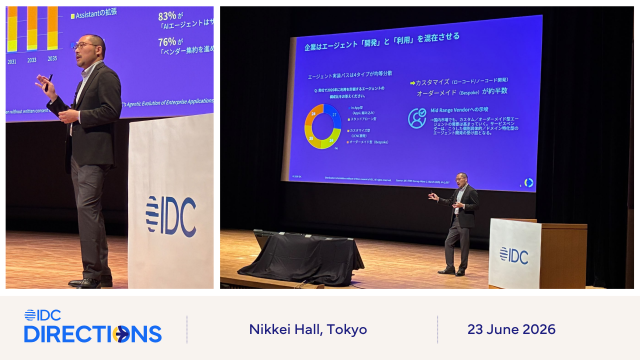
この記事でわかること:AIスーパーサイクルとは何か、そして日本にとって何を意味するのか。AIベンダーと日本企業のバイヤーの間にある最大のギャップとは何か。AIはB2Bテクノロジーの購買意思決定をどう変えているのか。

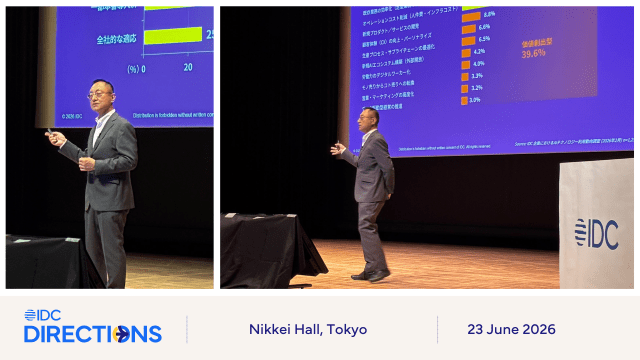
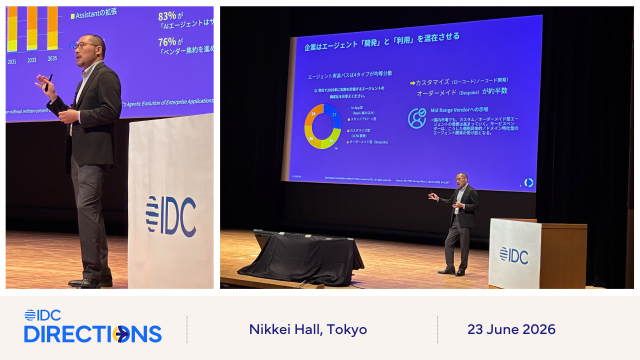
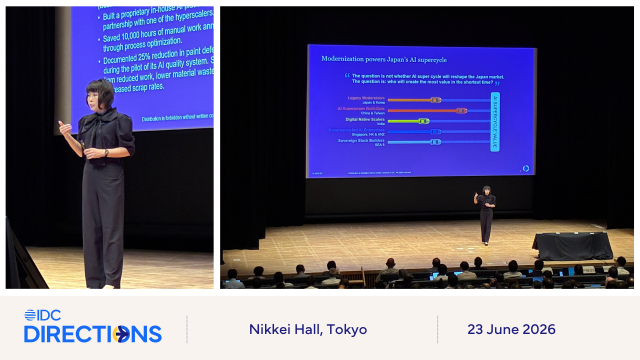
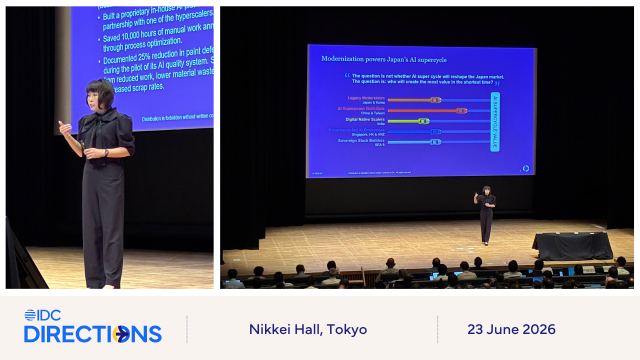
2026年6月23日、IDC Directions Tokyo 2026の会場には特別な熱気が漂っていた。日本のAIの転換点は、もはや「近づいている」段階ではなく、「すでに到来した」——それを物語る空気だった。IDCシニアバイスプレジデントのSandra Ngが伝えた中心的なメッセージは、警鐘であり、同時に進むべき道筋でもあった。彼女は率直にこう語った。問うべきは、AIが日本市場を変えるかどうかではない。誰が最短時間で最大の価値を生み出せるか、なのだ。

IDC Directions Tokyo 2026には約400名が参加し、そのうち65%が部長職以上。単なる情報収集の場ではなく、意思決定者が集う場となった。アナリストとの1対1セッションは軒並み満席となり、フロアから相次いだ質問の多さが、議論の核心を突いていたことを物語っている。

スーパーサイクルは現実だ。そして日本は、いま追う立場にある

何が起きているのか、そのスケール感を伝える数字がある。2025年、世界のIT支出は4兆2,000億ドルという市場規模の中で14%成長した。これは1996年以来、最も高い成長率だ。ただし当時、同じ14%成長が適用されていた市場規模はわずか7,000億ドル。桁がまるで違う。(出典:IDC Worldwide Black Book、2026年3月31日)

これこそがAIスーパーサイクルだ。中国・台湾・インドが「AIスーパーパワー・ビルドアウト」や「デジタルネイティブ・スケーラー」として競争を加速させる一方、IDCは日本を韓国とともに「レガシー・モダナイザー」と位置づけている。つまり、AIの価値にたどり着くまでの道筋が、モダナイゼーション(近代化)を必ず経由する市場ということだ。これは不利な条件ではなく、日本ならではの戦略的な立ち位置である。

日本のAI市場も、この勢いをそのまま映し出している。国内のAIインフラ支出は2026年末までに90億ドルに達し、2029年にかけて年平均24%(CAGR)で成長する見通しだ。AIサービスは2030年までに80億ドル、2025年比で3.2倍に伸びると予測されている。さらにアジア太平洋地域のCEOの61%が、エージェント型AIと生成AIの大規模活用を、新規投資の最優先分野に挙げている。(出典:IDC Worldwide AI and Generative AI Spending Guide、Forecast V1 2026;IDC CEO Survey、2026年3月)

ベンダーとバイヤーの間にある断絶が、双方にとって損失になっている

ここから議論は、耳が痛いが避けて通れないテーマへと移った。

Sandra Ngは、日本企業のバイヤーが本当に求めているものと、テクノロジーベンダーが実際に提供しているものとの間にある、4つの根本的なギャップを指摘した。

ギャップ①——ビジネスケースの明確さ
バイヤーが求めているのは、自社の業界に根ざした成果であり、グローバル共通の一般的なベンチマークではない。「日本のメーカーにとって、これは具体的に何を意味するのか見せてほしい」——このニーズは、海外の事例紹介スライドを並べるだけでは満たせない。

ギャップ②——AIの総所有コスト
このテーマは、通常の議論よりもう一段深く掘り下げる必要がある。日本でAIを導入する際の隠れたコスト——データ準備、システム統合、継続的なモデルメンテナンス、METIガイドラインへの準拠状況の監視、チェンジマネジメント——は、表示されている技術価格に対して50〜70%以上も積み上がるのが当たり前になっている。これを事前にはっきり示さないベンダーは、CFOとの商談で信頼を失っている。

ギャップ③——AIガバナンスへの準備
日本の規制環境は、決して名目だけのものではなく、独自の色合いを持つ。金融庁のAIガイダンス、METIのAIガバナンスフレームワーク、個人情報保護法(APPI)——いずれも高い基準を求めている。バイヤー側の動きの速さは、多くのベンダーのガバナンス対応が追いつけていないほどだ。

ギャップ④——「実例を見せてほしい」という瞬間
日本企業のバイヤーが求めているのは、国内のリファレンス顧客、導入までの具体的な期間、そして数字で示せる成果だ。海外の成功事例ではない。それを提示できないベンダーは、検討リストから静かに外されていく。

日本のトップ企業は、実際にどう動いているのか

これらのギャップは、机上の話ではない。2025〜2026年にIDCが実施したCxOへのヒアリングからは、日本を代表する先進企業がこの課題にどう向き合っているか、具体的な姿が見えてくる。

  • トヨタは、ハイパースケーラーのパートナーとともに自社開発のAIプラットフォームを構築し、年間1万時間分の手作業を削減した。AIを活用した品質システムによって塗装の不良率を25%減らしたことも、実績として記録されている。
  • 東京海上は、METIと金融庁のガイダンスを踏まえ、文書・画像分析へのAI導入に先立って、透明性・人による監視・バイアス排除・データ保護・運用面での信頼性という5つの柱からなるAIガバナンスポリシーを先に公表した。ガバナンスを先に固め、導入はその後——これが、日本の規制当局がいま求めている順序だ。
  • ヤマト運輸は、160万社の法人顧客と4,000社を超える物流パートナーからなるサプライチェーン全体に、AIによる最適化を導入した。80ルートに及ぶ中継拠点の最適化を通じて、人件費65%削減、温室効果ガス排出量42%削減を目標に据えている。

いずれも実験段階のパイロットではない。数字として記録された成果を伴う、本番環境での導入だ——まさに、バイヤーが求めているリファレンスストーリーそのものである。

バイヤーは、すでにAIを使ってあなたの会社を調べている

Sandra Ngのプレゼンテーションの中でも、とりわけ印象的だったデータがある。世界のテクノロジーバイヤーの84%が、「今後12ヶ月でAIが自社の技術購買のやり方を変える」と答えているのだ。(出典:IDC B2B Technology Buyer Survey 2025、WW n=406)

購買までの流れそのものが変わりつつある。今の順番はこうだ:AI検索 → ベンダーのウェブサイトで確認 → 同僚やピアによる検証 → チャネルパートナーへの相談 → 候補リストの確定。CIOやCFOがChatGPTやGoogle Geminiを使って調査したとき、あなたのブランドとソリューションが明確に浮かび上がらなければ、競争に参加していたことすら知られないまま、選考から外れているということになる。

だからこそ、AEO(Answer Engine Optimization:回答エンジン最適化)とGEO(Generative Engine Optimization:生成エンジン最適化)は、もはやマーケティングの実験ではなく、事業の存続を左右する能力になっている。2027年までに、日本企業の35%が体系的なAIガバナンスを整備すると予測されている。AIが生成する回答の中で、露出度が高く、信頼され、戦略的に進めているベンダーには、時間とともに積み重なる優位性が生まれる。(出典:IDC FutureScape 2026 – AI-Fueled Business Strategies、Japan)

エージェンティックAI:次の競争フロンティア

業界全体で起きている転換が、なぜスピードが重要なのかを裏付けている。IDC Japanの植村 卓弥が強調したように、AIスーパーサイクルは今、投資の第2波——インフラ構築からエンタープライズアプリケーション・サービスの採用へ——に入りつつある。エンタープライズ向けAIプラットフォーム・アプリ・サービスへの世界の支出は、2026年の4,000億ドルから、2029年には1兆ドルに達する見込みだ。(出典:IDC Worldwide AI and Generative AI Spending Guide V1 2026)

注目すべきは、調査対象バイヤーの83%が「AIエージェントによってサプライヤーの乗り換えが以前より容易になった」と回答していることだ。市場がコモディティ化する前に、成果ベースの関係をいま築いておけるベンダーこそが、次の競争優位を決めることになる。

今すぐ取るべき3つのアクション

Sandra Ngが最後に示したフレームワークは、シンプルで、すぐに動き出せる内容だった。

今すぐ行うこと:
一般的なベンチマークは捨て、日本国内のリファレンス顧客1社、指標1つ、導入タイムライン1つに置き換える。GTMのピッチを、CIOだけでなく購買委員会全体を意識した内容に組み直す。AIの中での自社の見え方(検索可視性)のギャップを、今すぐ修正する。

今年中に行うこと:
ROIの透明性を競争力の武器にする。実際に導入できるエージェント型ワークフローのストーリーをつくる。AIが生成する回答の中で引用されるよう、AIに最適化されたサードパーティコンテンツに投資する。

長期的に投資、実施すること:
AIガバナンス、トラスト、コンプライアンスを、新たな収益の柱として位置づける。あるいは、コンプライアンスを単なる話題ではなく、実際の成果として提供できるベンダーになる。カテゴリー、ペルソナ、地域ごとに「アンサーシェア」の計測を始める。SEO+AEO+GEOを組み合わせた、重層的なディスカバリー戦略を実行する。(出典:IDC C-suite Survey、2025年9月、APJ、n=300)

日本のAIスーパーサイクルは待ってくれない

日本のAI市場でリーダーの座を確立するための窓は、今現在は開いている——ただし、それが開いたままでいる保証はない。実験段階からいち早く成果ベースの導入へ進む企業、4つのギャップを埋めるベンダー、そしてAI主導の購買ジャーニーの中で自社を見つけてもらえる組織。これらこそが、日本のテクノロジー市場の次の時代をつくっていく。

東京で始まったこの対話は、大阪へと続く。

2026年7月28日開催のIDC Directions Osakaでは、日本のAIスーパーサイクルが各業界をどう再編しているのか、次の価値創出の波がどこで生まれるのか、そしてあなたの組織がその一歩先を行くにはどうすればよいのかを、データとともにさらに深く掘り下げます。今すぐIDC Directions Osakaにご登録ください。席数には限りがあります。

Note:本記事は2026年7月1日に英語で公開されたブログの抄訳です。原文は以下からご覧いただけます:https://www.idc.com/resource-center/blog/japans-ai-supercycle-is-here-are-you-ready-to-lead-it/

Mike de la Cruz - Corporate Communications Director - IDC Asia/Pacific

Mike de la Cruz is Corporate Communications Director for Asia Pacific at IDC, bringing over 25 years of career experience in marketing and communications for the information technology industry. He shapes and amplifies IDC's research-driven narratives, positions executives and analysts as authoritative industry voices, builds relationships with top-tier technology and business media across the region, ensures consistent brand voice and positioning, develops content that drives audience engagement, and leverages social media and digital communications to extend IDC's reach.

On June 22, 2026, the White House made quantum computing a formal US national priority, releasing two executive orders that position quantum computing and post-quantum cryptography at the center of US industrial policy and national security strategy.

The urgency is evident in the data. IDC surveyed 535 US government organizations and found that 32% are currently running quantum computing pilots; among federal agencies specifically, that figure rises to 49%, with another 40% planning to launch pilots within the next 12–24 months. This is no longer theoretical exploration; it reflects active government commitment to quantum technology development.

Two executive orders target quantum computing

The first executive order, “Ushering in the Next Frontier of Quantum Innovation,” establishes the Quantum Computer for Application Development and Discovery Science (QC-ADDS) program. This initiative directs the Department of Energy, in coordination with Defense, Commerce, and intelligence agencies, to develop quantum computing systems capable of solving problems beyond classical computing capabilities. Potential applications include climate modeling, advanced signal processing, and defense logistics optimization.

The timeline is demanding: the Department of Energy must publish technical specifications within 90 days and explore private-sector partnership models within 180 days. The Pentagon is directed to field at least three quantum sensor projects by September 2028. The order also addresses critical infrastructure gaps, including stronger protections for domestic quantum supply chains, expanded counterintelligence measures for quantum technology, and a mandate for a government-wide quantum workforce strategy.

The second executive order addresses the defensive imperative: “Securing the Nation Against Advanced Cryptographic Attacks.” It confronts a specific and present threat: adversaries may be collecting encrypted US data today, banking on the ability to decrypt it once large-scale quantum computers become operational.

This tactic is known as “harvest now, decrypt later”: the practice of stockpiling encrypted data today in order to decrypt it later, once the technology catches up. It demands immediate action.

The order establishes a comprehensive post-quantum cryptography (PQC) migration strategy with clear deadlines. All high-value federal assets and high-impact systems must adopt PQC for key establishment by December 31, 2030, and for digital signatures by December 31, 2031. Federal contractors face identical compliance timelines, enforced through updates to the Federal Acquisition Regulation. NIST will begin pilot migration on its own systems by the end of 2027.

Quantum computing investment and market growth

These orders arrive at an inflection point for quantum technology.

IDC’s Worldwide Quantum Computing Forecast, 2025–2029 projects total spending will reach $17.3 billion by 2029, representing a 43% compound annual growth rate. Government investment has been a primary driver, with quantum spending increasing 37% between 2024 and 2025—gains attributed to advances in error correction and modular quantum architectures.

These executive orders follow the Department of Commerce’s May 2026 announcement of $2 billion in CHIPS Act funding for quantum manufacturing, signaling a pivot toward industrial-scale ecosystem development beyond early-stage research funding. Priority investment areas include manufacturing, packaging, cryogenics, and control systems: the engineering challenges that will determine whether quantum computing can achieve scalable commercial deployment.

Three factors that will determine quantum policy success

The effectiveness of these executive orders depends on three elements:

  • Funding continuity: Executive orders require sustained appropriations and bipartisan Congressional support to insulate quantum policy from electoral cycles. Organizations must prioritize use cases that deliver measurable return on investment within 12–24 months. Academia and private industry must also establish collaborative partnerships to share investment risks and accelerate development.
  • Organizational readiness and talent: The 90-day deadline for technical specifications will clarify the government’s near-term expectations. More fundamentally, both government and industry face significant quantum talent shortages. The current dependence on a limited number of advanced research centers and specialized technology companies represents a strategic vulnerability that must be addressed through coordinated workforce development.
  • Federal contractor preparation: The PQC compliance mandate for federal contractors, with its December 2030 deadline, has the potential to reshape procurement standards across the broader IT industry. Technology vendors and systems integrators that have already established quantum centers of excellence or actively participated in federal quantum pilots are positioned to realize competitive advantages.

What’s next for quantum computing policy

These executive orders represent a sustained commitment to transition quantum computing from the experimental phase toward operational deployment. The combined focus on innovation (QC-ADDS), defensive security (PQC migration), and supply chain development signals a comprehensive approach to quantum technology as critical infrastructure.

For agencies and contractors, the near-term deadlines are now fixed: publish technical specifications, hit PQC migration milestones, and build the workforce needed to run quantum and classical systems side by side.

Massimiliano Claps

Massimiliano Claps - Research Director

Massimiliano (Max) Claps is the research director for the Worldwide National Government Platforms and Technologies research in IDC's Government Insights practice. In this role, Max provides research and advisory services to technology suppliers and national civilian government senior leaders in…
Ruthbea Yesner

Ruthbea Yesner - Group Vice President, Worldwide Public Sector

Ruthbea Yesner is Group Vice President, Worldwide Public Sector, leading IDC's research teams for the Health and Life Sciences and Government and Education. Her teams deliver research and advisory services on the technologies, strategies, and business models shaping healthcare, life…

Most organizations still pick a security framework the way they did in 2022: find the biggest name, check the box, move on. That approach hasn’t survived contact with the last three years, three new regulations, a finalized quantum-cryptography standard, and an entirely new AI threat surface later.

The current situation: A framework landscape transformed since 2022

Choosing the right security framework has never been more consequential or more complex. When IDC last published comprehensive guidance on this topic in 2022, the landscape was manageable: a stable set of well-known frameworks and a relatively predictable regulatory backdrop. The intervening years have fundamentally changed both dimensions.

Four structural shifts now define what buyers must navigate:

  • NIST CSF 2.0 (February 2024) introduced a formal Govern function, its first major revision in a decade, elevating cybersecurity from an operational discipline to a board governance obligation and broadening scope to all organizations regardless of size or sector.
  • DORA (EU 2022/2554) became fully applicable in January 2025, imposing mandatory ICT risk management and third-party oversight obligations on approximately 22,000 EU financial entities.
  • PQC standards were finalized: NIST released three post-quantum cryptography standards in August 2024 (FIPS 203, 204, 205), transforming quantum readiness from a theoretical concern to an operational imperative.
  • AI has created a new risk surface: NIST published a draft Cyber AI Profile (IR 8596) in December 2025, extending CSF 2.0 specifically to AI-related cybersecurity risks. Organizations that have deployed AI, particularly agentic AI or LLM-integrated workflows, must now factor AI governance into framework selection.

The wrong framework choice, one that exceeds organizational maturity, understates regulatory obligation, or ignores supply chain exposure, produces worse security outcomes than a well-adopted, properly scoped, simpler framework. The good news: there are strong options. The challenge: the decision is more complex than it was three years ago.

Decision-making criteria and methodology

Security framework selection is a risk management decision, not a technical checklist, requiring input from legal, compliance, finance, operations, and the board. IDC’s 2026 methodology starts with crown-jewel data classification, then splits into regulated and non-regulated tracks, now including universal AI governance and quantum-readiness branches. Key criteria include data classification, regulatory obligations, threat landscape, and AI adoption footprint. Organizations deploying agentic AI face risks that general-purpose frameworks don’t address, while harvest-now-decrypt-later (HNDL) exposure demands cryptographic roadmap planning alongside traditional control mapping.

Additional criteria round out the methodology: third-party risk (CSF 2.0’s Govern function and DORA Article 28 set the compliance floor), PQC readiness (FIPS 203-205 are finalized, with 2030 as a planning horizon), and organizational maturity (smaller organizations should start with CIS Controls IG1 rather than overreaching). Budget discipline favors phased, risk-prioritized roadmaps supported by cyber risk quantification. Finally, multi-framework interoperability and GRC technology support are now prerequisites: manual evidence collection across concurrent regimes such as CSF 2.0, ISO 27001, HIPAA, and DORA is no longer sustainable at scale.

Regulated versus non-regulated organizations: Two different journeys

Regulated organizations

For regulated organizations, the regulator largely determines the framework; strategic focus shifts to execution. Key questions: How can multiple simultaneous requirements (DORA + ISO 27001; HIPAA + NIST 800-53) be satisfied without duplicating evidence work? Which GRC platform best automates cross-framework mapping? How should gap closure be sequenced within the budget? Have ICT third-party providers been assessed against CSF 2.0 Govern, DORA Article 28, and NIST 800-161? Mature organizations typically adopt a “framework stack”: CSF 2.0 or ISO 27001 as backbone, NIST 800-161 for high-risk vendors, plus industry-specific overlays.

Non-regulated organizations

Non-regulated organizations must perform more active analysis, with the right starting point depending on maturity. Early-stage or SMB organizations should adopt CIS Controls v8 Implementation Group 1, 56 safeguards achievable with limited staff, mapped to NIST CSF 2.0 for growth. Mature programs or those facing elevated threat exposure should adopt NIST CSF 2.0 or ISO 27001:2022, both of which include a Govern function that supports board-level accountability and SEC disclosure readiness. All non-regulated organizations, regardless of status, should evaluate the AI Governance and Quantum Readiness branches given their present-day risk implications.

AI and quantum: Two criteria that didn’t exist in 2022

Artificial intelligence: risk surface and governance obligation

AI has added two urgent dimensions to the framework selection process. Offensively, adversaries use LLMs for convincing phishing, automated vulnerability discovery, and direct attacks via model poisoning and prompt injection. Assess whether your framework addresses AI-enabled detection and response. Defensively, organizations deploying AI in production, especially autonomous agentic AI, face authorization, auditability, model integrity, and supply chain risks that general-purpose frameworks don’t address. The NIST Cyber AI Profile (IR 8596, December 2025 draft) extends CSF 2.0 across three risk areas and should serve as a supplementary governance layer. Shadow AI and SaaS-embedded AI remain largely unmeasured exposures requiring dedicated governance tooling.

Post-quantum cryptography: from theory to operational imperative

PQC standards are finalized: NIST published FIPS 203, 204, and 205 in August 2024, with a fourth HQC-based standard selected in March 2025. The harvest-now-decrypt-later threat is present today: adversaries are collecting encrypted data now to decrypt once quantum computing matures, creating real exposure for organizations holding financial, healthcare, or critical infrastructure data. NSA’s CNSA 2.0 mandates 2030 migration for National Security Systems; commercial organizations should treat this as a planning horizon, not a start date. Immediate actions include completing a cryptographic inventory, prioritizing long-lived data systems, evaluating vendor PQC roadmaps, and considering hybrid cryptographic approaches.

Essential guidance for the technology buyer

A well-adopted, properly scoped framework always outperforms a theoretically superior one that exceeds organizational capacity. Buyers should structure stakeholder conversations, including legal, compliance, finance, and the board, around the 10 decision criteria, treating AI governance and PQC readiness as first-order, not future-state, considerations. Conduct a cryptographic inventory now and evaluate AI footprint against the NIST Cyber AI Profile. Address third-party risk per CSF 2.0, NIST 800-161, and DORA Article 28. Favor frameworks with strong cross-mapping, invest in automated GRC technology, and adopt cyber risk quantification for CFO-ready budget conversations. Build a phased, five-year roadmap, closing highest-risk gaps first, and recalibrate annually.

“The right security framework is a critical factor in adequately managing security risks, not only those present today, but also those that could emerge in the future. The 2026 landscape demands that organizations evaluate AI governance and post-quantum cryptography readiness as first-order criteria, not future-state considerations.” —Philip D. Harris, Research Director, Cybersecurity GRC Solutions, IDC

Guidance for the technology supplier and services provider

The security framework market is in structural transition, and suppliers calibrated to 2022 are selling into a market that no longer exists. Multi-framework compliance automation is now the dominant selection criterion, making unified control libraries across CSF 2.0, ISO 27001, HIPAA, and DORA essential. Suppliers should build DORA as a named capability, establish AI governance credibility now while the Cyber AI Profile remains in draft, and develop a PQC advisory practice anchored to cryptographic inventory services. Value propositions should be reframed financially for CFO-influenced procurement, while midmarket buyers increasingly favor managed compliance wrappers. Roadmap priorities span CSF 2.0/DORA now, Cyber AI Profile alignment in 2027, and full PQC/EU CRA support by 2030.

Philip D. Harris, CISSP, CCSK

Philip D. Harris, CISSP, CCSK - Research Director, Governance, Risk, and Compliance (GRC) Solutions

Phil Harris is Research Director for GRC Solutions at IDC, where he develops and promotes IDC's point of view on risk, advisory, privacy, and compliance services and software. He conducts research on business strategies and the impact of relevant offerings…

Global spending on digital transformation (DX) software is on pace to hit $640 billion by 2029, and where that money goes is shifting fast. IDC’s latest Worldwide Digital Transformation Spending Guide shows AI pulling value out of infrastructure and into applications, with the pace of that shift varying sharply by sector.

Software is becoming the primary engine of digital transformation

Digital transformation (DX) is the broad shift by organizations to embed technology into every layer of their operations, customer experiences, and business models. It spans hardware, services, and software. Data shows software is increasingly where DX investment is concentrating.

Among the three technology groups that make up DX spending, software is the fastest growing. Its share of total DX spend rises from 32% in 2026 to 36% by 2029, with a 21.7% CAGR, leading both services (10.6% CAGR) and hardware (19.8% CAGR). This momentum is increasingly driven by the scaling of AI, which is rapidly shifting value from infrastructure into applications and accelerating demand for AI powered software capabilities.

By 2029, AI will account for roughly 40% of worldwide DX software investment, which is a significant shift from today. The other 60% still flows into business applications, system infrastructure, and development and deployment platforms. The AI investments showing up across every sector in this analysis do not stand alone. They run on top of foundational layers already in place, and in many cases they depend on those layers to deliver value at all. Across the six sectors, the pace of AI adoption varies considerably, and that variation tracks closely with how mature the underlying software stack already is. AI is coming everywhere, but it is arriving on top of what organizations have already built.

Six sectors. Significant scale. Different priorities.

IDC’s Worldwide Digital Transformation Spending Guide (V1 2026) tracks DX software spend across six major industry sectors. Overall software investment is growing strongly in all six, and AI’s share within it is rising – but the pace, scale, and use case priorities differ considerably by sector. What drives DX spending in retail and services is not what drives manufacturing or financial services. Sector context matters.

“The growth in DX software is broad-based. This is not simply an AI spending wave. Organizations are investing across the full software stack to transform how they operate, and AI is an accelerating part of that — not the whole of it.” —Mariya Yahnyuk, Research Analyst, Data and Analytics

#1 Retail and services

The Retail and Services sector leads all sectors in total DX software spend. This sector covers both retailers and a range of activities such as hospitality, travel, services, and more. Customer management tops the list of investment priorities: engaging customers across every channel, in real time, with personalized and consistent experiences. Omnichannel commerce and service delivery platforms come second, as both retailers and service providers now operate across physical, digital, and mobile simultaneously.

The third priority is operational intelligence: energy management, workforce scheduling, and efficiency tools that apply equally to store environments and service operations. Many of these investments sit in the applications and infrastructure layers of DX software – the customer data platforms, workforce systems, and integration layers that make AI useful when it arrives. AI is projected to grow to 42% of this sector’s DX software spend by 2029, building directly on that operational foundation.

#2 Financial services

Financial services have the highest existing AI share of any sector, and the broader DX investment picture explains why it got there. Security leads the use case list: detecting cyber threats and preventing fraud are areas where software investment delivers clear, measurable returns, making them natural anchors for DX spending early. Automating core business operations comes next, as financial institutions replace manual, rules-based processes with systems that can adapt and scale.

The pattern here is integration. AI is being built into existing DX programs, the same core applications and infrastructure platforms institutions have been modernizing for years. That is why the spending is sustaining: it is tied to operational outcomes that financial institutions already care about.

#3 Manufacturing and resources

Manufacturing currently has the lowest AI share of any sector in DX terms, which also makes it one of the most interesting to watch. DX investment here is driven by very practical pressures: aging equipment, fewer experienced engineers, and increasingly complex supply chains. The largest spending area is autonomic operations, production environments moving toward systems that can monitor and adjust on their own, recovering from most faults without needing a person in the loop.

Self-healing assets and augmented maintenance follow closely. A third priority, less obvious but growing, is customer and client management: manufacturers are increasingly investing to understand and serve end customers directly, not just to optimize internal operations. Together, these priorities describe a sector using DX investment to reduce operational risk, extend asset life, and build closer market relationships.

“Manufacturing’s lower AI share today should not be read as lower ambition. The use cases driving DX investment are autonomic operations, asset health, customer proximity, that’s exactly where AI delivers durable, measurable value. The growth trajectory reflects that.” —Mariya Yahnyuk, Research Analyst, Data and Analytics

Three actions for technology providers

The DX software data carries clear implications for technology vendors and platform providers. These are not passive trends to monitor – they are signals that should shape how you position, sell, and support your customers.

Help your customers understand where they stand. Most organizations do not have a clear view of how their software investment compares to peers in their sector. Use sector-level DX spending data to show them where investment is concentrating, where they may be behind, and what use cases are driving results for similar organizations. Then recommend tools that fit where they are in their journey.

Make the case for platform integration using evidence. Organizations that rely on fragmented point solutions face growing complexity as DX programs scale, and slower AI outcomes as a result. Many of your customers have not made that connection yet. Use the spending data trends to show them concretely that platform integration is delivering better results and why consolidation is the more practical path forward.

Treat data readiness as a customer success issue, not a prerequisite. DX outcomes and AI outcomes depend on the quality and accessibility of underlying data. Offer data quality and governance support as part of the engagement, so customers build data readiness while the work is underway.

Want the full picture?

This analysis draws on IDC’s Worldwide Digital Transformation Spending Guide (V1 2026), which covers DX investment across all six industry sectors, further detailed by 27 industries, 12 technology markets, and geographies through 2029. The full research covers Healthcare, Infrastructure and Energy, and Public Sector in depth alongside the three sectors featured here.

Mariya Yahnyuk

Mariya Yahnyuk - Research Analyst, Data and Analytics

Mariya Yahnyuk has been a research analyst in IDC’s Worldwide Data and Analytics team since 2022. Yaknyuk supports the development of IDC's Spending Guide portfolio, assuring alignment with technology and market changes, relevancy, and business value for customers Mariya directly…

Key questions answered in this article: What is the AI supercycle and what does it mean for Japan? What are the biggest gaps between AI vendors and enterprise buyers in Japan? How is AI changing B2B technology buying decisions?

The energy in the room at IDC Directions Tokyo 2026 on June 23 said it all: Japan’s AI moment is no longer approaching — it has arrived. And the central message from IDC’s Senior Vice President Sandra Ng was both a wake-up call and a roadmap. The question, as she put it bluntly, is not whether AI will reshape the Japan market. It is: who will create the most value in the shortest time?

IDC Directions Tokyo 2026 brought together close to 400 attendees, with 65% at Director level or above, a room full of decision-makers, not just observers. Analyst 1-on-1 sessions were fully booked, and the volume of questions from the floor made one thing clear: the conversation was hitting a nerve.

The Supercycle Is Real and Japan Is Playing Catch-Up

To understand the scale of what is happening, consider this: global IT spending in 2025 is growing at 14% on a $4.2 trillion market base, the strongest IT spending growth since 1996. Back then, that same 14% growth rate applied to a $700 billion market. The numbers are in a different league entirely. (Source: IDC Worldwide Black Book, 31 March 2026)

This is the AI supercycle. While regions like China, Taiwan, and India are racing ahead as “AI Superpower Built-Outs” or “Digital Native Scalers,” IDC positions Japan alongside Korea as a Legacy Modernizer, a market where the path to AI value runs directly through modernization. That is not a disadvantage. It is a specific strategic imperative.

Japan’s AI market reflects this momentum. Domestic AI infrastructure spend is expected to reach $9 billion by end of 2026, growing at a 24% CAGR through 2029. AI services are projected to hit $8 billion by 2030 or 3.2x the 2025 figure. Moreover, 61% of CEOs in Asia Pacific named agentic and generative AI at scale as their number-one new investment priority. (Source: IDC Worldwide AI and Generative AI Spending Guide, Forecast V1 2026; IDC CEO Survey, March 2026)

The Vendor-Buyer Disconnect Is Costing Everyone

Here is where the conversation got uncomfortable and important.

Sandra Ng identified four persistent gaps between what enterprise buyers in Japan need and what technology vendors are actually delivering:

Gap #1 — Business case clarity. Buyers want outcomes grounded in their industry, not generic global benchmarks. “Show me what this looks like for a Japanese manufacturer” is a very different ask from a global case study slide.

Gap #2 — Total cost of AI ownership. This one deserves more attention than it typically gets. Hidden AI implementation costs in Japan — covering data preparation, system integration, ongoing model maintenance, compliance monitoring with METI guidelines, and change management, routinely add 50–70% beyond the headline technology price. Vendors who do not address this upfront are losing trust at the CFO conversation.

Gap #3 — AI governance readiness. Japan’s regulatory environment is real and specific. The FSA AI guidance, METI’s AI governance framework, and the Act on Protection of Personal Information (APPI) set high standards. Buyers are moving faster than many vendors’ governance answers can keep up.

Gap #4 — The “show me” moment. Japanese enterprise buyers want a local reference customer, a deployment timeline, and measurable outcomes, not a global success story. Vendors who cannot produce this are losing shortlist positions.

What Japan’s Leading Enterprises Are Actually Doing

These gaps are not theoretical. IDC’s CxO conversations in 2025–2026 point to concrete examples of how Japan’s most forward-thinking companies are navigating them:

  • Toyota built a proprietary in-house AI platform with a hyperscaler partner, saving 10,000 hours of manual work annually and documenting a 25% reduction in paint defects through AI-assisted quality systems.
  • Tokio Marine responded to METI and FSA guidance by publishing a 5-pillar AI governance policy first, covering transparency, human oversight, bias elimination, data protection, and operational reliability, before deploying AI for document and image analysis. Governance policy first, deployment second—this is the sequence Japan’s regulators now expect.
  • Yamato Transport used AI-driven supply chain optimization across 1.6 million corporate customers and 4,000+ logistics partners, targeting a 65% reduction in labor costs and a 42% cut in GHG emissions by optimizing relay points across 80 routes.

These are not pilots. These are production deployments with documented outcomes—exactly the reference stories buyers are demanding.

Your Buyers Are Already Using AI to Research You

One of the most striking data points from Sandra Ng’s presentation is that 84% of global technology buyers agree that AI will change how their companies buy technology in the next 12 months. (Source: IDC B2B Technology Buyer Survey 2025, WW n=406)

The buying journey has already shifted and it looks like this: AI discovery → vendor website check → peer and colleague validation → channel partner consultation → shortlist. If your brand and solutions do not surface clearly when a CIO or CFO uses ChatGPT or Google Gemini to research a purchase decision, you are being eliminated before you even know you are in the running.

This makes Answer Engine Optimization (AEO) and Generative Engine Optimization (GEO) business-critical capabilities, not just marketing experiments. By 2027, 35% of Japanese organizations are projected to have unified, coordinated AI governance in place. The vendors who are visible, credible, and well-structured in AI-generated answers will have a compounding advantage. (Source: IDC FutureScape 2026 – AI-Fueled Business Strategies, Japan)

Agentic AI: The Next Competitive Frontier

The broader industry shift reinforces why speed matters. As highlighted in the presentation by IDC Japan’s Takuya Uemura, the AI supercycle is now entering its second investment wave — moving from infrastructure build-out to enterprise application and services adoption. Enterprise AI platform, app, and services spend globally is projected to grow from $400 billion in 2026 to $1 trillion by 2029. (Source: IDC Worldwide AI and Generative AI Spending Guide V1 2026)

Critically, 83% of buyers surveyed agreed that AI agents are lowering switching barriers between suppliers. The vendors who lock in outcome-based relationships now, before the market commoditizes, will be the ones defining the next competitive moat.

Three Moves That Matter Right Now

Sandra Ng’s closing framework was direct and actionable:

Do now: Replace generic benchmarks with a single Japan reference customer, one metric, one timeline. Map your go-to-market pitch to the full buying committee, not just the CIO. Fix your AI discoverability gap immediately.

Do this year: Make ROI transparency your competitive weapon. Build deployable agentic workflow stories. Invest in AI-optimized third-party content that earns citations in AI-generated answers.

Bet on this: Position into AI governance, trust, and compliance as a revenue line, or become the vendor that makes compliance an outcome rather than a conversation. Start measuring your share of answer by category, persona, and geography. Execute a layered discovery strategy: SEO + AEO + GEO. (Source: IDC C-suite Survey, September 2025, APJ, n= 300)

Japan’s AI Supercycle Will Not Wait

The window to establish leadership positioning in Japan’s AI market is open—but it will not stay open indefinitely. The enterprises that move from experimentation to outcome-based deployment, the vendors who close the four gaps, and the organizations that make themselves discoverable in AI-powered buying journeys are the ones who will define the next era of Japan’s technology market.

The conversation that started in Tokyo continues in Osaka.

Join us at IDC Directions Osaka on July 28, 2026 to go deeper on how Japan’s AI supercycle is reshaping your industry, what the data says about where the next wave of value will be created, and how your organization can get ahead of it. Register for IDC Directions Osaka today. Seats are limited.

Mike de la Cruz - Corporate Communications Director - IDC Asia/Pacific

Mike de la Cruz is Corporate Communications Director for Asia Pacific at IDC, bringing over 25 years of career experience in marketing and communications for the information technology industry. He shapes and amplifies IDC's research-driven narratives, positions executives and analysts as authoritative industry voices, builds relationships with top-tier technology and business media across the region, ensures consistent brand voice and positioning, develops content that drives audience engagement, and leverages social media and digital communications to extend IDC's reach.

国际数据公司(IDC)最新研究显示,AI超级周期带来的不仅是技术代际的更迭,更是一场深层次的组织范式变革。以智能体为核心驱动力的新型生产力形态——OPX(One-Person X),正在悄悄影响传统的企业组织逻辑,并对PC等终端硬件市场产生结构性的拉动效应。

AI超级周期下的组织重构

以智能体为代表的AI超级周期带来的不仅是技术迭代,更是一场生产力供给的结构性变革。当智能体从“辅助工具”进化为能够独立执行与产出的“生产力单元”,组织形态的底层逻辑必然随之重构。国际数据公司(IDC)最新研究将这一变化命名为OPX(One-Person X)——AI时代以单人为核心决策单元的新型组织范式,其核心共识可概括为:少数人负责决策与价值判断,AI智能体集群承担执行与产出。

基于这一框架,OPX下辖两种落地形态:OPC(One-Person Company),即以个人为核心决策者、AI智能体为生产力引擎的企业级组织形态;OPE(One-Person Expert),面向个人专业服务领域。其中,OPC是AI重构商业组织最具颠覆性的形态。IDC对其的定义是:以个人为核心决策者,AI智能体/工具为核心生产力,至少可在单一任务环节独立完成业务,人工负责审核、判断与异常处理,最终实现传统需多人团队才能完成的商业闭环。从组织规模看,OPC可以是1个人,也可以是10人以内的轻量化团队

OPX的运作模式催生了一套独特的硬件需求:7×24小时不间断运行(无专职运维,中断即停业)、全生命周期高性价比(设备与算力成本均需可控)、端到端自动化闭环(任务接收、拆解、执行无需人工干预)、多设备无缝协同(跨终端业务连续性刚需)、无人值守下的远程管理与自进化,以及数据隐私与端侧主权保护。在这一需求图谱中,手机承担移动交互,云端提供弹性算力,而本地AI推理、多任务编排与端侧数据保护均依赖本地算力,这使得PC设备,尤其是AI PC、AI主机设备,正成为OPX工作流的本地中枢。

OPX驱动的PC出货量近160万台

根据 IDC 最新预测,2026 年中国 PC 市场总出货量约为 4,038万台,同比微降 6.1%,整体大盘小幅收缩。但在结构层面,以 OPX(一人公司/超级个体)范式驱动的 PC 需求正在形成一个独立的增长极。IDC预测,2026年由OPX驱动的PC市场出货量近160万台。

IDC 认为,OPX 对 PC 市场的拉动效应正在经历从 “边缘增量”到”结构性力量” 的转变。尽管 160万的出货量仍属早期,但考虑到 OPX 的增速逻辑,即存量企业业务扩张、设备换机周期叠加、AI Native 工具链持续成熟。这一力量的上升值得重点关注。我们判断,OPX 有望在未来 3-5 年内成为 PC 市场增长叙事中不可绕过的结构性变量。

OPX对PC市场的影响集中体现在两个核心维度:采购逻辑的多元化和换机节奏的两极分化。首先,采购逻辑正在走向多元化。传统企业PC采购长期由人员规模驱动,OPX则打破了这种一一对应关系,设备需求开始更多地由任务负载而非人头数定义,一个创业者同时运行多台设备处理不同任务流的情况在特定场景下已成为现实。其次,OPX的换机节奏呈现两极分化态势。驱动快速换机一侧的力量来自OPX业务机会的不可预见性,当核心设备直接承载产出,AI技术的代际迭代持续抬高硬件准入门槛,不具备新能力的旧设备将在特定场景中丧失竞争力,都可能迫使OPX为抓住机会而在短期内高频地更新设备。另一方面,OPX极致追求效率与性价比敏感又构成了强大的延缓效应。

IDC建议

在采购触达方面,OPX群体的决策路径迥异于传统企业客户——信息获取以与AI结合的评测内容、技术社区和同行口碑为核心,购买决策由个人独立完成,无需IT部门审批,购买渠道偏向个人消费路径。这意味着,针对OPX组织形态,厂商需要结合AI相关的内容做精准触达,可能包括评测合作、社区运营、KOL口碑建设,将成为撬动OPX客群的杠杆。

在产品策略方面,OPX在消费级价格、企业级可靠性与AI原生能力之间提出了三元要求。面向OPX群体的产品设计,不宜简单地在现有企业或消费产品线上做加减法,而应从OPX的实际业务场景和工作流出发,重新定义产品配置与服务组合。

在服务创新方面,OPX用户缺乏IT部门的缓冲,设备故障直接等同于业务中断。这种脆弱性定义了一个高付费意愿的服务市场,快速响应维修、备用机备援、数据恢复保障等“个人级紧急兜底”服务,有望成为PC后服务市场增长最快的板块之一。

AI超级周期带来的不仅是技术迭代,更是生产力供给的结构性变革。OPX之所以值得PC产业持续关注,根本在于生产力的最小单元正从“企业”转变为“个人+AI智能体”。产业的价值链条正从以硬件为中心的线性供给,转向围绕“个人生产力闭环”的软硬服一体化。

进一步交流

IDC中国终端系统研究团队将持续追踪OPX范式下的硬件需求演变与市场机会。如需获取更详尽的PC市场季度追踪数据、OPX用户画像深度分析,或定制化的市场策略咨询,欢迎随时与IDC中国团队取得联系。让我们共同探讨,如何在“一人即公司”的时代,重新定义计算终端的价值边界。如对其他研究内容感兴趣,也可与我们保持沟通。