Emily Zhang is Research Manager for IDC’s Services technology data in China and leads IDC’s PRC IT Services research. Her coverage spans IT consulting, cloud managed services, and AI-related service offerings. Emily delivers data and insights from both tech provider…
Sophie Pan is a research director for the Client Systems Research team at IDC China. She is responsible for emerging technology device research, including wearable devices and smart home devices. Sophie has a deep understanding of the landscape and ecosystem…
Although WWDC is a developers’ conference, this year’s keynote was primarily a statement of intent about Apple’s future and demonstration of its AI credibility.
The most important announcement this year was the new Siri AI. Apple rebuilt it from the ground up, trying to make AI feel native, useful and invisible across devices people already own. The winning AI experience for consumers will not be the loudest or most technically complex. It will be the one that understands context, respects privacy, works reliably across apps, and reduces friction without forcing users to change behavior.
Apple has rarely been about being first to a trend. It has been about waiting for the ability to embed technology far enough into hardware and silicon to change how people actually behave. Much has been made about Apple being behind on AI, and the company certainly had failed to deliver on promises made back in 2024. But consumers are wary of AI, and what the company demonstrated at WWDC this year seems ready to meet them where they are today.
What is the new Siri AI?
The center piece is a rebuilt Siri, dubbed Siri AI, and the detail that matters most is what sits underneath it. Apple was emphatic on one point: this third generation of foundation models is its own work, trained on its own data. Yes, the company worked with Google to develop the model family, and Apple refined four of the five models using outputs from Gemini’s frontier models. But the models, the training data, and the privacy architecture all belong to Apple. And while some of the broader Apple Intelligence capabilities, such as image generation, will run on Google’s Cloud Platform on NVIDIA chips, none of the new Siri AI runs on Gemini’s chat infrastructure.
The new Siri AI also arrives as a standalone app across iPhone, iPad, Mac, and Vision Pro with an iMessage-style interface, persistent conversation bubbles and a full chat history synced through iCloud. Users can attach images and documents and switch between quick voice commands and a deeper chatbot mode. The visual signature has changed too. Instead of the edge glow that has signaled Siri for years, the assistant now lives inside the Dynamic Island, expanding the pill to show prompts and a glowing search state. The “All Systems Glow” tagline was a tease of exactly this. The effect is that Siri AI feels part of the hardware rather than something that hijacks the screen.
What can Siri AI do?
One of the stronger Siri AI demos is write with Siri AI. Startups like WisprFlow have built entire businesses around helping people dictate clean text on an iPhone instead of thumbing out long passages. Siri AI goes further, picking up on your writing style, proofreading on its own, and producing complete drafts. Assuming it performs the way Apple showed it, the company has pulled off a familiar trick: baking in for free the kind of capability users have been paying outside vendors to get.
Siri AI appears to finally do what Apple suggested it would be capable of doing back in 2024. It reads personal context across emails, photos, messages and files, understands what is on screen, and executes multi-step tasks across apps. That personal context is a unique advantage that Apple has over competing AI services. While services such as OpenAI’s ChatGPT and Anthropic’s Claude are collecting contextual data on their users now, Apple has that data going back many years. It’s a true advantage, but one that Apple must leverage carefully as it continues to hammer on its privacy and security promises.
Understandably, then, Apple is being cautious with this Siri AI rollout. It is shipping the new feature as a preview, gated behind a waitlist even among those receiving the live developer betas. We expect many of the advanced parts of the stack to arrive across later 27.x updates rather than at launch.
What other OS improvements did Apple announce?
Beneath Siri AI, the various OS updates are where most users will experience benefits. Across each device Apple has worked to enhance app launches, speed up performance, and smooth animations. It added a slider so users can change the opacity of the Liquid Glass interface. And on macOS 27, specifically, it addressed a wide range of complaints around last year’s additions, from fixing the corner radius of windows to removing extraneous menu icons.
Safari gains Organize Tabs, which sorts open tabs into topics such as shopping, travel and work. Shortcuts have been rebuilt so you can describe a multi-step automation in plain language, and have it assembled for you, which finally makes the feature accessible to people who were never going to script it.
The camera and photo upgrades in iOS 27 are where Apple Intelligence becomes very tangible and will likely get the fastest recognition from consumers outside of Siri. Photos adds two generative tools: Extend, which fills in scenery beyond the original frame, and Reframe, which shifts the perspective of spatial photos after capture. The Camera app gains a Siri AI-powered Visual Intelligence mode that reads a nutrition label and logs calories and macronutrients straight into Health or pulls a phone number and address off a business card into Contacts. Wallet can now scan a physical ticket or membership and generate a digital version, and a new bill-splitting feature tied to Apple Cash lets you photograph a receipt, assign items to people, and send payment requests with tax and tip handled automatically, approved from your wrist if you like. The bill-splitter launches in the United States first because of the Apple Cash dependency.
What is Apple’s AI Strategy?
Apple’s strength has never been to ship new technologies for the sake of shipping. It has been to package complex technology into experiences that feel polished and trusted. This year’s Apple Intelligence announcements follow that logic. The new Siri AI, with a richer understanding of the user, smarter Shortcuts, visual intelligence in the camera, improved writing and image tools, and more capable on-device intelligence all point to the same strategic direction: Apple wants AI to become part of the operating system, not a separate destination only available through an app.
Siri AI is central to that ambition. For years, voice assistants were useful but limited. They answered basic questions, controlled simple settings and handled routine commands. What Apple is now proposing is genuinely different: an assistant that can understand what is on screen, read what is actually happening across apps, and execute multi-step actions on behalf of the user. If Apple delivers this well, Siri AI stops being a feature and becomes a new interaction layer for all of Apple’s current devices and eventually future categories of hardware.
Will Siri AI improve Apple’s long term growth or upgrade cycle?
The iPhone remains the center of Apple’s ecosystem, but growth increasingly depends on making the installed base more valuable, more loyal and more difficult to leave. A better Siri AI and a more capable Apple Intelligence layer make Apple devices harder to leave by making them work together in more personal and contextual ways. A Siri AI experience that works the same way across every device is an advantage other vendors will find difficult to replicate and gives Apple the upper hand.
It also gives Apple a stronger upgrade argument, especially as the best AI experiences will depend on newer hardware. The argument is even more pronounced for iPhone 15 and older users, who lack all access to Apple Intelligence. Any users that may have resisted upgrading due to inflationary pressures and economic uncertainty have a compelling argument to upgrade. For Apple this means continued upgrade momentum in 2026, despite a very strong upgrade cycle last year.
The announcements around Apple platforms reinforce this point. The operating systems are not being reinvented visually this year. They are being refined around performance, usability and embedded intelligence. That is the right move. After a major design transition, Apple needed to show maturity. The company is signalling that AI will improve everyday tasks: managing information, searching, automating workflows, editing photos, understanding documents, using the camera, and moving between apps with less effort.
Why is 2026 a pivotal year for Apple?
The bigger strategic question is execution. The AI features Apple showed this week weren’t groundbreaking. And the word “agentic” was rarely uttered. Apple isn’t chasing the hype around AI; it’s focused on delivering a polished AI experience rather than an experimental one. Consumers will not judge Apple Intelligence by model sizes, partnerships or technical architecture. They will judge it by whether Siri AI understands them, whether actions work, whether personal context feels useful rather than intrusive, and whether the experience is consistent across devices.
This is therefore a high-stakes year for Apple. If the new Siri AI works as shown, Apple Intelligence could become one of the most important ecosystem upgrades since the App Store matured into a services platform. It would deepen loyalty, increase the value of newer devices and reposition Apple’s operating systems around personal intelligence.
But the margin for disappointment is narrow. Apple has chosen a user-first AI narrative. Now it must deliver against it. The keynote created confidence; the real test will come when these features reach millions of users. Delivering on what was shown on stage is critical, because for Apple the risk is not that users misunderstand the strategy. The risk is that they understand it perfectly, try it, and feel the experience falls short. However, the announcements today make me feel that Apple is ready to excite its users with its intelligence capabilities.
How does WWDC position Apple for leadership transition to John Ternus?
This was also Tim Cook’s last WWDC keynote, and what he announced at every single WWDC keynote over the years reflected his leadership: disciplined, ecosystem-first, privacy-led, and making technology useful at scale. Apple has never been about being first to a trend. It has been about waiting until technology is embedded far enough into hardware and silicon to change how people actually behave. This is what Apple showed at WWDC26.
This is also a defining platform moment for John Ternus as he prepares to take over as CEO. He will inherit a company with one of the strongest hardware platforms in the world, but the next chapter will be defined by how intelligently that hardware works for users. For a leader with deep hardware DNA, the opportunity is to make Apple Intelligence feel inseparable from Apple devices.
WWDC 2026 gives Ternus a clear strategic runway: more personal devices, more contextual software, more intelligent services and a tighter link between silicon, hardware and AI. If Apple delivers the experience with the reliability, elegance and trust users expect, this could be remembered as the moment Siri AI and Apple Intelligence moved from the background of Apple’s product lineup to the center of its future.
Francisco Jeronimo - VP, Data and Analytics, Devices, IDC EMEA
Francisco Jeronimo is VP for Data and Analytics at IDC EMEA. Based in London, he leads the research that covers mobile devices, personal computing devices, emerging technologies and the circular economy trends across EMEA. His team delivers data on personal…
Tom Mainelli - Group Vice President, Device & Consumer Research
Tom Mainelli heads the Device & Consumer Research Group, overseeing a wide array of hardware and technology categories catering to both home and enterprise markets. His team's research spans PCs, tablets, smartphones, wearables, smart home devices, thin clients, displays, and…
Nabila Popal is Senor Director with IDC's Data & Analytics team, specializing in Mobile Phones, PC Monitors and other consumer devices. Ms. Popal is responsible for the global research and quality and timely delivery for her respective technologies, coordinating with regional…
In my last blog, I explained that when your CMDB is a mess, AI makes that mess happen faster. The same principle applies when your Managed Service Provider (MSP) gets there first. MSPs are now moving fast. AI is now embedded across service delivery operations. IDC research shows how AI is shifting IT services away from labor-led delivery toward platform-led, outcome-based models. The smarter MSPs get to know your environment, the harder it becomes to challenge their pricing.
When MSPs deploy AI across service delivery, their per-unit costs fall. But contract rates rarely follow. Buyers who maintain an independent, cost-enriched CMDB can verify MSP-reported usage, identify idle resources, and negotiate from evidence rather than estimates. The good news is that the same data foundation that protects you in IT Service Management can also protect you commercially.
What MSPs are actually deploying
Every major MSP now has an AI platform. The table below shows what the leading providers are running and what it means for buyers.
Provider
Platform
What It Does
Accenture
AI Refinery for Industry
Builds and deploys industry-specific AI agent solutions using NVIDIA’s AI stack, now targeting over 50 solutions across telecommunications, financial services, and insurance.
Atos
Polaris AI
Delivers agentic AI capabilities for IT engineering and business functions.
Capgemini
GenAI Operations
AI-powered service desk and infrastructure intelligence. In 2026, Capgemini joined OpenAI’s Frontier Alliance to build and scale agentic AI workflows across enterprise operations.
Deloitte
Zora AI
Agentic platform for business finance functions, leveraging NVIDIA AI.
DXC Technology
OASIS
Connects the entire IT estate into a single trusted view, using AI agents and human expertise to anticipate issues and act before they affect the business.
EY
EY.ai Agentic Platform
Leverages NVIDIA AI to enhance tax, risk, and finance operations.
Fujitsu
Kozuchi AI Agent
Enhances operational productivity across managed infrastructure contracts.
IBM
Consulting Advantage / watsonx Orchestrate
Deploys AI agents across HR, finance, and IT workflows, with a catalog of over 150 pre-built domain-specific agents and multi-agent interoperability across SAP, AWS, and other enterprise platforms.
Infosys
Agentic AI Foundry (part of Infosys Topaz)
Published case data shows 30–40% reductions in ticket volume for specific engagements.
KPMG
KPMG Velocity
AI-powered business transformation platform built for consultants.
Kyndryl
Agentic Service Management
Combines a maturity model, structured assessments, and implementation blueprints to help enterprises move from traditional service operations to autonomous, intelligent workflows at scale.
McKinsey
LegacyX
Accelerates legacy infrastructure modernization using agentic AI.
PwC
Agent OS
A new operating system for orchestrating AI agents across enterprise functions.
TCS
WisdomNext
Enterprise AI platform delivering automation across managed services delivery with integrated AI orchestration capabilities.
Wipro
WeGA Studio / WEGA
Provides pre-built accelerators, domain frameworks, and agentic AI toolkits across software engineering, cloud, data, and enterprise applications, with NVIDIA AI Enterprise integrated throughout.
This list is not intended to be exhaustive.
Agentic AI refers to AI systems that can autonomously plan and execute multi-step workflows. They do not just generate responses; they act on them. IDC research confirms that leading platforms now share a common architecture covering agent orchestration, model services, knowledge management, enterprise integration, and governance. This is no longer experimental. It is becoming the standard delivery model.
For buyers purchasing the same services under existing contracts, the commercial question at renegotiation is straightforward: if your MSP’s delivery costs are falling, are your contract rates falling with them? In most cases, the answer is no. MSPs are actively working to demonstrate additional value to justify maintaining or increasing their rates, and the ones doing it well have the data to back it up. Buyers who lack independent data do not.
What this means for managed services pricing
IDC survey data shows that 55% of IT buyers expect AI-powered managed services to cost more than traditional providers, while 37% expect prices to fall. Both sides of that picture matter.
Factors pushing prices up
Agentic platforms are enabling always-on, outcome-based service models, which support premium pricing for higher-value outcomes, particularly in business process services. Demand is also growing for orchestration, governance, and multi-agent operations across IT and business functions. MSPs are also expanding into new customers and workloads, including mid-market segments that were previously too expensive to serve.
Importantly, not all customers will adopt premium agentic services. MSPs need to recoup their platform investment costs across a broader base, which adds further upward pressure on pricing across the board.
Factors pushing prices down
AI agents now handle monitoring, triage, root cause analysis, and remediation within defined boundaries, reducing reliance on people for routine tasks. Platform efficiencies compress the cost per unit of work, and performance in predictable scenarios is becoming more consistent.
Net impact for MSPs
AI platforms are compressing MSP delivery costs while enabling premium pricing for outcome-based services. The net result is stronger margin for MSPs, and a real commercial case for buyers who can prove what they’re actually using.
Important context for IT buyers
AI platforms are not free for MSPs to build and run. Infrastructure, integration, specialist skills, and ongoing maintenance all carry significant costs. Buyers should find out whether AI investment is listed as a separate line item or is absorbed into base rates at renewal.
The commercial model is also shifting.
IDC research projectsthat by 2029, 30% of all service provider contracts will be outcome-based, driven by the changes agentic AI is introducing.
Traditional time-and-materials and consumption-based pricing do not map well to how agentic services are actually delivered, which is one reason outcome-based models are gaining ground. Buyers who understand this shift and write contracts that reflect it will be better placed to share in the productivity gains, rather than fund them.
Where IT buyers are still losing ground
Three problems consistently arise at contract renewal.
1. Accepting the MSP’s usage data
Most organizations have no independent, current view of their own environment. IDC PeerScape research found that organizations regularly discover assets MSPs keep billing for even after they leave active use. Old virtual machines, unallocated storage, and devices that were never decommissioned are common examples. When the MSP’s AI platform generates usage reports, most buyers have no external check, so they accept the numbers.
2. Paying for unused infrastructure
In one financial services organization I worked with, a pre-renewal audit found 50 virtual machines switched off for more than three months, and 15 terabytes of storage with no active application attached. The MSP was billing for all of it. Removing those items from scope saved 48,000 euros a year.
3. No basis to challenge per-unit pricing
MSP contracts priced per virtual machine, per device, or per terabyte are only negotiable if the buyer can independently verify what is actually in use. Without that, the MSP’s numbers go unchallenged. This is also one of the reasons outcome-based pricing deserves serious consideration. When delivery is driven by AI agents rather than headcount, per-unit pricing often fails to reflect the true cost or value of the service.
The answer is still the same
IDC’s research on agentic AI in services concludes that the providers who win will be those who prove value transparently and build trust through governance, portability, and accountability. Buyers have a role to play in demanding exactly that.
Build an independent source of truth. A well-maintained, cost-enriched CMDB is your foundation.
IDC TechBrief research confirms that accurate, continuous discovery supports contract oversight, SLA validation, and audit readiness. Organizations with mature configuration data achieve service management costs 10 to 15% lower than comparable organizations that do not, and they get 2.5 times more value from their AI investments.
Run a pre-renewal audit. Start 90 to 120 days before contract expiry, using independent discovery tools such as ServiceNow Discovery or Dynatrace. This lets you verify MSP-reported usage, identify idle resources, and challenge billing for unused infrastructure before you reach the negotiating table.
Get the contract language right. Include the right to conduct your own audits, tie billing to verified active use, and build in scope reduction mechanisms. Ask directly how AI deployment costs and efficiency gains will be shared. Providers who cannot answer that question clearly are worth watching.
Push for outcome-based models, and define outcomes broadly. Buyers who request transparent pricing, clear ownership terms, and outcome-based commercial structures will be better placed to capture value rather than pay for it. But make sure the outcomes you measure go beyond technical metrics. An MSP can meet every SLA target and still fail to deliver real business value. Build business outcomes, not just service desk targets, into the contract from the start.
The bottom line
IDC forecasts cumulative AI economic value of $22.5 trillion between 2025 and 2031. The MSPs listed here are investing heavily to capture their share of the market. The platforms they are building are not just delivery tools. They are becoming the primary way MSPs own the workflow and outcome layer in managed services.
IT buyers with accurate, independent data about their own environments are in a much stronger position to participate in that value rather than fund it. An accurate, cost-enriched CMDB is not an IT housekeeping exercise. In the age of AI-driven managed services, it is a commercial imperative.
Tom Collins - Research Director of Global IT Sourcing & Benchmarking - IDC
Tom Collins is IDC's Research Director of Global IT Sourcing & Benchmarking, advising organizations on IT cost management, sourcing strategy, and technology procurement.
The way business buyers find and evaluate solutions has changed more in the last two years than in the previous two decades. The arrival of AI-powered search hasn’t just added a new channel. It has reorganized where discovery happens, who shapes the shortlist, and whether a brand even gets a chance to be seen.
During a recent IDC expert panel, Addressing the Pipeline Conversion Gap, analysts examined the shift from traditional ranked search to AI-facilitated discovery and beyond.
To capitalize on this new mode of discovery and capture the market before competitors, CMOs, digital marketing leaders, demand gen managers, and B2B marketers must pivot from search engine optimization (SEO) to a new discipline: answer engine optimization (AEO).
AEO is not SEO with a new name
AEO and SEO operate on fundamentally different logics. The SEO pipeline was built on a clear sequence: optimize pages for keywords, earn backlinks to build domain authority, and win placement in a ranked list on Google or Bing. The buyer clicks your link. From that point forward, you control the experience.
AEO, also called generative engine optimization (GEO), operates entirely differently. Large language model (LLM) chatbots like Gemini or ChatGPT synthesize an answer before the buyer even sees the options. Brands that get cited in AI-generated responses aren’t necessarily those with the best keyword density. They’re the ones with a deep, authoritative, and interconnected content infrastructure.
In SEO, keywords signal relevance. In AEO, context and content depth establish authority. An LLM evaluating whether to cite your brand isn’t scanning meta titles. It’s assessing whether your information ecosystem is comprehensive enough to trust.
Treating AEO as an extension of existing SEO practice is the most common and most costly mistake marketers are currently making.
Most organizations aren’t ready for the shift
According to IDC Research Director Roger Beharry Lall, only 35% of organizations have enterprise-wide content capabilities. That means nearly two-thirds of B2B brands are structurally unprepared to succeed in the AEO environment.
Enterprise-wide content capability means more than a well-maintained website. It means product information management (PIM) systems that are integrated and externally surfaceable. Engines must be able to parse your digital asset management (DAM) libraries. Knowledge bases and technical documentation need to be connected to public-facing repositories.
Most marketing teams have optimized their digital presence for ranked search engine performance. AEO requires something more: deep connection layers into your full data stack, exposed to the platforms buyers are now using to form their views. That demands cross-functional reach that most demand gen teams haven’t had to develop before.
And that’s only the half you can control.
Reputation is the new discoverability asset
The “dark funnel” describes the portion of B2B buyer discovery that happens inside AI systems, beyond a brand’s direct control. In the traditional B2B discovery model, channels like communities, social, PR, ratings and reviews, and advertising reached buyers directly. In the emerging model, those same signals flow through AI first. The buyer receives a synthesized view of your brand, one that draws on everything the internet says, not just what lives on your domain.
Buyers asking an LLM about your company aren’t just getting your FAQs and product specs. They’re getting a response built from analyst citations, peer review websites, press coverage, forum discussions, and social media. All of it beyond your control.
For CMOs, the implication is significant. Reputation management, earned media, analyst relations, and community presence are no longer solely the domain of PR. They are the foundations for AEO.
The window for early movers is real
Most organizations haven’t begun to address AEO, which is precisely what makes this moment significant. The brands investing in it now are doing so before the field gets too crowded. That won’t be true for long.
In IDC’s conversations with CMOs this year, the organizations moving on AEO now share one trait: they’re planning 12-month content infrastructure investments, not 90-day campaigns. AEO isn’t a campaign. It rewards consistent, long-term investment in how a brand shows up across the information environments buyers use, not just the ones you control.
One area to watch closely: in-LLM advertising. The field is still in its early stages, but all the major platforms are working out how to monetize their models. When they do, the data a user prompt carries, who the buyer is, what problem they’re solving, how urgently they need it. That data will give advertisers a level of unprecedented targeting precision, at exactly the moment a purchasing decision is beginning to form.
When advertising models mature, they have the potential to shift meaningful control back to the CMOs and marketing leaders who are positioned to capitalize on it.
Fixing the funnel for the age of AEO
The pipeline conversion problem doesn’t start at the qualification stage. It begins the moment a buyer asks an AI chatbot which vendors to consider and your brand doesn’t appear in the answer. Fixing the bottom of the funnel matters. But the organizations that will succeed in the AEO era are those shining a light on the dark funnel and investing in discoverability at the top.
IDC’s latest expert panel explores how AI is reshaping buyer behavior across discovery, evaluation, and purchase, and what marketing and revenue leaders must change to remain competitive.
International Data Corporation (IDC) is the premier global market intelligence, data, and events provider for the information technology, telecommunications, and consumer technology markets.
With more than 1,300 analysts worldwide, IDC offers global, regional, and local expertise on technology and industry opportunities and trends in over 110 countries. IDC’s analysis and insight help IT professionals, business executives, and the investment community make fact-based technology decisions and achieve their key business objectives.
There is a well-established playbook for calculating the return on an IT investment. Define a baseline, model the efficiency gains, project the cost savings, and present a number to the CFO. For most technology investments, that approach works.
Agentic AI breaks it.
Unlike conventional software deployments, agentic AI (systems that execute multi-step tasks autonomously, make real-time decisions, and interact with external tools and other agents) does not deliver a fixed, predictable output in exchange for a fixed, predictable input. Agents learn. They adapt. They make decisions autonomously across multi-step processes, interact with other systems and other agents, and generate value or risk that compounds in ways traditional ROI models were never built to capture.
According to IDC research, 42% of organizations worldwide already report that assessing the ROI of their digital and AI investments is difficult or even impossible.
The top barriers: limited visibility into long-term impact, undefined or inconsistent baseline metrics, and the absence of a dedicated AI value office or task force. Agentic AI does not solve these problems. It amplifies them.
The answer is not to stop measuring. It is to measure differently.
Why agentic AI demands a new value framework
The core challenge is that agentic AI value is nonlinear. A single agent interacting with a customer, a data pipeline, and a back-office process does not generate a tidy productivity percentage. It generates outcomes shaped by adoption quality, autonomy boundaries, feedback loops, and the quality of the data and processes the agent operates within.
Costs present an equally complex picture. Agentic AI spending spans LLM and SLM licensing, API calls, token consumption, and cloud infrastructure, but the larger drivers are often orchestration and governance. IDC’s framework identifies agentic AI cost as fundamentally behavioral, shaped by how agents are prompted, how often they invoke external tools, and how closely they are supervised. Assuming linear cost scaling is one of the more expensive mistakes an IT leader can make.
Risk adds a third dimension. In agentic systems, failures propagate. A misconfigured decision boundary in one agent can cascade across steps, tools, and downstream processes in ways that static risk models do not account for.
A six-pillar framework for maximizing business value
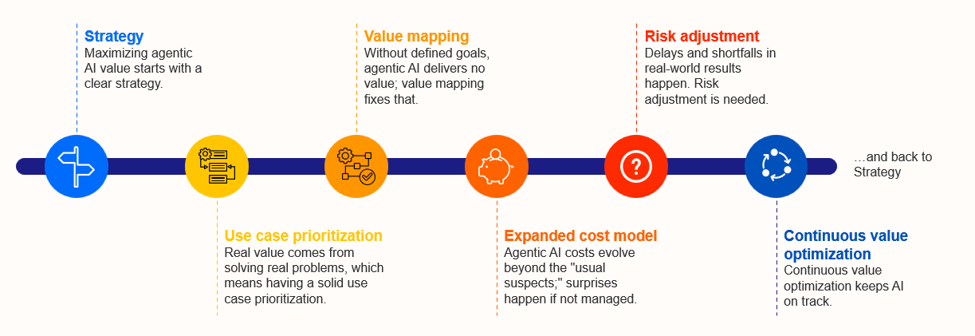
To address this, IDC has developed the Agentic AI Business Value Maximization Framework, a structured approach built around six pillars, with governance as the thread running through all of them.
Strategy. Agentic AI introduces autonomous decision-making, so strategy must define where autonomy is permitted and where it is constrained. The output is not a vague aspiration toward “better productivity.” It is a multi-time horizon road map with metric owners, shared across the organization, and tied explicitly to investment prioritization. Organizations that treat agents as tools rather than autonomous actors are setting themselves up for governance failures, not productivity gains.
Use case prioritization. Not every problem is an agentic problem. Deploying agentic AI on narrow, siloed tasks that deterministic automation handles perfectly well wastes investment and adds unnecessary complexity. IDC’s framework introduces prioritization dimensions specific to agentic contexts: multi-step reasoning requirements, dynamic decision-making needs, orchestration complexity, and the degree to which autonomy itself generates value. The output is a ranked, feasibility-adjusted use case portfolio, not a list of technically interesting experiments.
Value mapping. Value mapping anchors agentic AI investments in clear business outcomes and prevents the aimless experimentation that inflates AI budgets without delivering measurable results. Critically, agentic AI value is not static. It compounds as agents learn, adapt, and expand scope. Value mapping must account for the learning curve, not just immediate efficiency gains, and must incorporate non-financial drivers such as sustainability and customer trust alongside traditional financial metrics.
Expanded cost model. IDC’s framework calls for a dynamic total cost of ownership model that distinguishes capital expenditure from continuous, AI-specific operational costs, and that gives FinOps, legal, and financial governance teams the visibility they need to manage the complex, usage-based economics of agentic AI.
Risk adjustment. ROI for agentic AI should not be presented as a single point estimate. It should be scenario-based, tied to adoption trajectory, output quality, and timing assumptions, all assigned to explicit owners with documented confidence levels. Risk should be treated as dynamic, updated as real data replaces estimates, and modeled for the interdependencies that make agentic system failures systemic rather than isolated.
Continuous value optimization. IDC’s lifecycle analysis of agentic deployments finds that without active tuning, agent performance degrades as context shifts and edge cases accumulate. Sustained value requires treating agentic AI as an ongoing lifecycle management challenge, not a project to be completed and handed off to operations. That requires a dedicated Centre of Excellence with a strong governance cadence, defined standards, and the organizational mandate to enforce continuous optimization.
From framework to action
IDC’s Agentic AI Business Value Maximization Framework is designed to deliver six concrete outputs: a multi-time horizon autonomy road map, a ranked use case portfolio, a business value calculator, a dynamic TCO model, a scenario-based risk evaluator, and an agent lifecycle governance model. These are not aspirational deliverables. They are the minimum set of instruments an organization needs to manage agentic AI as a business investment rather than a technology experiment.
IDC’s framework analysis indicates that organizations that build this infrastructure now will extract more value from current agentic deployments and will be structurally better positioned to scale as the next wave of capability arrives.
Get in touch
If you are a Technology Provider and want to learn more about how IDC’s Business Value Consulting practice can help you build a rigorous, defensible framework for measuring and communicating the value of your agentic AI solutions, or explore ROI-focused go-to-market and lead generation tools backed by IDC research, reach out to start the conversation.
If you are a Technology User and want to learn more about how IDC’s Business Value Consulting practice can help your organization measure, justify, and maximize the business value of your agentic AI investments, reach out to start the conversation.
Andrea Siviero - Vice President, AI-fueled Business Strategies
Andrea Siviero leads IDC’s AI-Fueled Business Strategies Global Research Group, which examines how AI and other Emerging Technologies accelerates digital maturity, enables new business models, delivers measurable business value (ROI), supports practical use cases, and strengthens the organizational capabilities required…
When Kyndryl separated from IBM in 2021, it entered the market as a startup of 80,000 people. The scale was deliberate. Kyndryl launched as one of the world’s largest managed service providers from day one, with a mandate to help the world’s most critical systems run better and a mission to become an AI-first organization. The analyst relations function, led by Mark Terranova, Head of Analyst Relations for Kyndryl’s global technical practices, was central to that work from the start.
The motion was clear in theory: listen to the question, find the right analyst, deliver the insight. In practice, the volume made that model creak almost immediately.
“I don’t have one stakeholder,” Terranova says. “I have hundreds.”
Product teams wanted to know where markets were heading. Marketing needed independent validation for positioning. Executives needed fast, well-grounded answers before decisions got made without them. Every request was legitimate. Every one took time. And synthesizing a defensible point of view from IDC research, reading the reports, drawing the conclusions, translating the findings into something an executive could use, took weeks.
Decision-makers, Terranova notes, had stopped waiting for it.
The scale problem with traditional analyst relations
The challenge wasn’t a shortage of good research. IDC had long been Kyndryl’s first call for market sizing and independent validation. When a senior leader needed to know how large a market segment was, or how fast it was moving, IDC research was where that conversation started.
Traditional analyst relations runs on inquiry calls and relationship depth. A skilled AR professional knows which analyst to call, how to frame the question, and how to turn a conversation into a briefing document. That expertise is real and it takes years to develop. But it also runs sequentially, one stakeholder at a time, one research thread at a time, in an organization where the demand for intelligence was running in parallel across hundreds of conversations simultaneously.
“AI lets me respond to hundreds of people really fast,” Terranova says, “whereas before it would be one at a time. And again, I would get to them all if it would take me weeks.”
From relationship to platform
When Terranova joined the beta program for IDC Quanta, IDC’s AI platform built on its proprietary research and analyst intelligence, he recognized immediately what made it different from the general-purpose AI tools he had already been using.
The difference wasn’t the interface. IDC Quanta is built on a familiar conversational model, close enough to ChatGPT that his team picked it up without friction. That familiarity was deliberate, and Terranova sees it as a key part of what makes the platform usable at scale: his team had already spent nine months developing real prompt engineering skills, and Quanta’s interface met them where they already were.
“The confidence comes from trust of the vendor,” he says. “I trust IDC to give me good information.”
That trust matters in a way that’s easy to understate. General-purpose AI tools crawl the open web, which means they surface a mix of analysis, marketing material, and noise with no way to know which is which. IDC Quanta draws from IDC’s proprietary research corpus. Every answer is grounded in specific reports. Every insight points back to the analyst work behind it.
For Kyndryl, an organization that stakes its market position on being a thought leader in managed services and uses independent research to validate that position with customers, the distinction is fundamental.
“Everyone in the world knows IDC is the best at counting things,” Terranova says. “When you want to know how big something is, or how large it’s going to be, IDC is where you start.”
Intelligence that interacts
What Terranova values most isn’t just the speed. It’s the kind of intelligence IDC Quanta produces.
The platform doesn’t return a lookup list. It engages with the question. He can ask about a topic, then ask follow-up questions, and the tool generates new answers based on what he’s actually trying to understand, not just a list of related reports to go read somewhere else.
“The tool allows me to script my answer to what I actually need it to be,” he says. “I can interact with it. AI needs to interact with the human. That’s how you get good answers.”
That quality has practical consequences for how Terranova’s team operates day to day. In a meeting where an executive asks a question he hasn’t prepared for, he can open a browser window, query Quanta in real time, and come back with five pieces of supporting research in minutes. Some inquiries that previously required scheduling a call with an analyst, and waiting for that call to happen, can now be resolved on the spot. The analyst conversation still has value for complex or strategic questions. Quanta narrows the list of situations where that conversation is actually necessary.
“I don’t need an inquiry for this,” he can now say. “Here’s the answer.”
A function redefined
Terranova sees what’s happening at Kyndryl as part of a larger, faster-moving shift across the industry. He’s direct about where it leads.
The analyst relations teams that build fluency with AI-led intelligence workflows now will be the ones that outpace their peers. The analyst remains essential. They still talk to customers, still generate the underlying research, and still bring the kind of judgment that no platform can replicate. But the idea that insight only travels through a scheduled inquiry call is already fading.
“Those that adopt this idea and this methodology and this work habit,” Terranova says, “they will succeed.”
For Kyndryl, that’s not a prediction. It’s the work already underway.
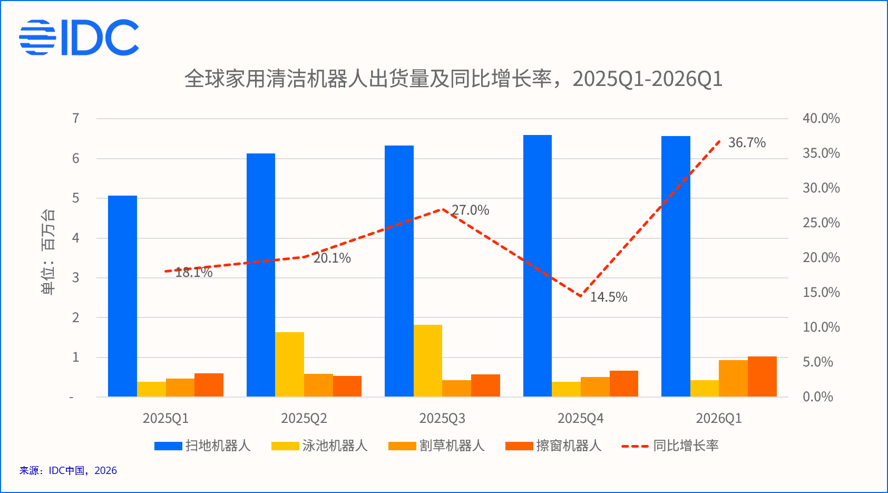
一季度为泳池机器人市场全年淡季,泳池机器人(含地上泳池清洁机器人、地下泳池清洁机器人、水面漂浮器)市场出货42.6万台,同比增长8.8%。在地下泳池清洁机器人,无缆产品占比提升至66.7%。国产厂商市场份额加速提升,产品布局聚焦高端赛道。与割草机器人产品类似,泳池机器人电机、电池、密封组件、传感器、整机组装均由国内供应链主导,产能充足、交付周期短,可以极大程度支持厂商海外市场出货。IDC观察到,伴随海外泳池机器人传统旺季到来,泳池机器人出货在未来两季度将保持稳定增长,供给层面,国内厂商依托完善的全链路供应链、成熟的电机与锂电配套,成本管控优势突出,叠加无缆方案、水下 AI 导航等前沿技术落地带来的产品力升级,在中高端产品线上竞争力持续走强。依托跨境电商与海外线下渠道持续深耕,国产品牌全球出货占比稳步抬升,市场份额延续提升趋势。
Claire Zhao is a Research Manager for Client System Research of IDC China. She is responsible for conducting research on the augmented reality (AR)/virtual reality (VR) market, and vertical analysis for the PC market. She started working for IDC China as…
The persistent presence of unauthorized device channels in the Middle East and Africa (MEA) is frequently mischaracterized. To many observers, the grey market appears to be the product of loose regulatory frameworks, complex trader networks, or opportunistic supply chain manipulation.
IDC data tells a more straightforward story. The grey market in MEA runs on basic supply and demand. When official channels cannot serve a population’s actual demand, others move in to fill the gap.
The global chasm: Extreme per-capita underserving
The device shortage in MEA becomes uniquely striking when examined through a global, per-capita lens. IDC shipment data across all major regions shows that MEA is not merely underserved relative to developed markets. It ranks last among every significant global region in per-capita notebook availability.
Using 2024 global population figures and IDC shipment data for the same year, the table below shows notebook shipments per capita.
Notebook Shipments Per Capita, 2024 (Per 1,000 People)
What stands out in MEA is the sheer size of the gap. While the United States moves 206.9 notebooks per 1,000 people (30 times higher than MEA) and Western Europe ships 117.8 per 1,000 (17 times higher), MEA sits at a fraction of those figures. Even Latin America, a developing market facing its own distinct affordability challenges, ships 30.3 units per 1,000 people, which is 4.4 times higher than MEA.
Western Europe alone ships more PCs annually than the entire Middle East and Africa combined, despite MEA holding a population of over two billion people. When official channels deliver far less than the population requires, the structural inadequacy creates an unavoidable supply crisis.
The shipment story: Stagnant supply vs. accelerating demand
The fundamental driver of this imbalance is a stark divergence between flat allocation and a rapidly growing, increasingly digital population.
Flat official supply: From 2020 to 2024, MEA PC shipments remained essentially flat, moving from 12.2 million units to 13.7 million units, a marginal gain of 1.5 million units over four years. In contrast, the Asia-Pacific (APeJC) region expanded its shipments by 3.8 million units (a 10.2% growth rate) during the same period.
The demands of a two-billion-person market: The MEA region encompasses 73 countries (54 African nations and 19 Middle Eastern countries). A current allocation of 13.7 million units per year serves less than 1% of this population annually.
Strong macroeconomic drivers: The region’s projected growth rate sits at approximately 5.2% for 2025 [IDC projection]. Demand is accelerating via comprehensive government digitalization programs, bulk educational procurement initiatives, rapid SMB expansion, and a younger, digitally native population that views computing access as a basic utility.
Major global manufacturers systematically prioritize shipments to developed markets where margins are higher and procurement infrastructure is established. This leaves MEA as a highly fragmented market served by thin authorized retail channels that cannot lower prices to match what price-sensitive institutional or individual buyers can afford. That gap is where the grey market steps in, not as a parasite, but as a rational market correction.
The 13,500-kilometre journey: The economics of arbitrage
A recent market visit illustrates how this alternative supply chain functions in practice. A pallet of 20 factory-sealed, genuine laptops, originally destined for an Australian hospital, surfaced on a hand cart rolling through Dubai’s Deira trading district, its original shipping labels and valid serial numbers still completely intact.
This journey from Sydney to Dubai illustrates the economic mechanics of diversion:
Institutional discounting: Large public entities, hospitals, and universities in developed nations secure substantial volume discounts. A bulk order in Australia might secure a per-unit price well below retail. These price differentials give market players an incentive to rebalance and ship to a better-margin market.
Authorized MEA barriers: These deep institutional discount tiers are unavailable to commercial distributors in MEA, who are bound by strict brand pricing floors that keep devices uncompetitive.
The arbitrage opportunity: Intermediaries leverage the gap between the Australian institutional discount and the going rate on Dubai’s grey market (USD 700 to USD 790).
Estimated Gross Margin: approximately USD 85 per unit
Multiplied across dozens of weekly consignments, the business model is sustainable. The air freight corridor remains highly resilient. Even when global freight rates fluctuate, the 30% acquisition discount provides traders with more than enough margin to absorb premium shipping increases.
Dubai as the velocity hub
Dubai’s position as the primary grey market distribution hub for EMEA is backed by 40 years of established trader networks, pragmatic customs infrastructure, and highly liquid wholesale buyer bases. A consignment arriving at Dubai International Airport can be cleared, moved to a warehouse, broken down, and partially distributed within 24 hours. From there, onward shipments rapidly penetrate markets across Africa, South Asia, and the wider Middle East where authorized retail channels either do not exist or are priced out of reach.
Strategic imperative for manufacturers: Serve or cede
The grey market does not generate demand. It responds to the structural scarcity that authorized channels fail to address. Schools in Nairobi, government agencies in Cairo, and SMBs in Dubai must navigate an environment where official channels systematically under-allocate hardware relative to the population.
Hardware manufacturers looking to reduce grey market activity face two clear strategic choices:
Option 1: Restructure supply and pricing. Find avenues to lower official pricing floors and aggressively scale shipment volumes directly to MEA to close the per-capita gap with other developing regions like Latin America.
Option 2: Cede the market volume. Accept that alternative grey channels will continue to fill the supply vacuum, maintaining visibility and resilience as an essential supply mechanism for the region.
A rapidly digitalizing region of two billion people cannot be sustainably served by 13.7 million authorized notebooks per year. Until global allocation models change or official pricing adapts to local realities, the mathematics of scarcity ensures that the grey market will remain a fixture of the MEA tech ecosystem.
Isaac Ngatia - Senior Research Analyst, Mobile Handsets, Systems & Infrastructure Solutions, Middle East & Africa
Based in Dubai, Isaac T. Ngatia is a senior research analyst within IDC's Personal Computer Trackers team for the Middle East, Turkey, and Africa (META), where he is responsible for conducting all annual, semi-annual, and quarterly research on PCs and…
Last week, a select group of senior print and imaging executives gathered in London for IDC’s Print and Imaging Leadership Dinner. During this invitation-only evening, a conversation unfolded between IDC analysts and the people shaping the industry, moderated by IDC’s Sandra Ng.
What came out of that dinner? Some of the discussions reaffirmed what many already suspected. But some of the insights revealed will fundamentally change how forward-thinking vendors approach the next 18 months. Here’s a taste of what was discussed, and why you’ll want to be in the room for one of IDC’s executive dinners next time.
The buying committee has expanded, and most vendors are still selling to the wrong people
Two years ago, a print deal sat with IT and procurement. That’s no longer the world we’re operating in. IDC’s 2026 European Print Survey, covering 2,000 organisations across eight markets, revealed that the stakeholder landscape has shifted dramatically. The conversation that used to happen in one room now happens in four.
The implications for how vendors structure their go-to-market approach are significant, and the dinner surfaced a very specific playbook that the those gaining the most ground are already executing. We’ll leave the details for the briefing room.
Security just overtook cost reduction as the #1 investment driver in print.
A striking 24% of European technology buyers now cite security and compliance as their primary reason for investing in print. That puts it ahead of both cost reduction and productivity.
This is more than a repositioning opportunity, as it moves the conversation to a different level within the organization, with a different buyer. Those in the room heard exactly which messaging reaches the CISO, which regulatory triggers are opening budgets right now, and where the hardware story needs to evolve to stay relevant.
IDC predicts that 40% of worldwide new office MFP shipments will be classified as AI MFPs by 2027. The vendors with a credible roadmap published today will be the ones with a strategic seat in 24 months. Those without one are already behind.
The buyer has already formed a view before your sales team picks up the phone
This was the session’s sharpest insight, and the one most likely to keep vendor CMOs up at night.
GenAI-sourced web traffic grew 1,200% between 2024 and 2025. Two in three searches today end without a single click. Buyers are shortlisting vendors, forming preferences, and making preliminary decisions inside AI assistants, before they’ve seen your website, opened your brochure, or taken a sales call.
IDC’s Gala Spasova gave a demonstration that stopped the room. When major AI assistants were asked the questions a head of digital workplace would actually type, around 30 vendor names came back consistently. Not a single print OEM appeared. When the question became print-specific, all the familiar names showed up.
The print category is owned. The workplace category, where your buyers are actually looking, is invisible.
What it takes to change that, and how fast it compounds once you do, was laid out in detail at the dinner. The short version: it’s not pay-to-play, and the window to act is narrow.
Three places the money is actually moving in 2026, and the 12–18 month window you can’t afford to miss
IDC analysts Jacqui Hendriks and Gala Spasova mapped out three near-term growth areas where European buyer investment is already building, from value-add software and services through to Intelligent Document Processing and a sustainability play that changes both the buyer and the budget.
The most time-sensitive of these? A three-way alliance opportunity, vendor, channel, certified refurbisher, that’s unserved by the larger SIs and telcos, but not for long. European refurbished device shipments grew 28% in 2025. Demand is running well ahead of vendor readiness. The potential of such a model was discussed at the dinner in some detail.
The commercial model shift that separates the winners
The evening closed with a discussion on what’s actually different about the vendors capturing European growth. It’s not just what they’re selling. It’s the contracts they’re willing to sign, the conversations they’re prepared to have, and the partnerships they’re building now.
Roberto Alunni and Phil Sargeant laid out, with uncomfortable precision, the behaviours that distinguish vendors gaining ground from those defending yesterday’s revenue. Some of it is replicable quickly. Some of it takes 18 months of investment to build. All of it was on the table.
Were you in the room?
If you weren’t at IDC’s Print & Imaging Leadership Dinner, or if you’re wondering how to get on the guest list for the next executive dinner, now is the time to reach out. Events like this are where the defining conversations happen: the information and insight that doesn’t make it into LLMs and the strategic debates that shape how the market moves, alongside networking and the connections that open doors.
Whether your focus is European print and imaging, AI-driven workplace transformation, digital sovereignty, channel partnerships, or any of the many other topics shaping the European technology landscape, IDC brings together the senior leaders and the research to drive the conversation forward.
To find out more about IDC’s European print and imaging research programme, or to join the conversation at our next event, contact your IDC representative or simply fill in our contact form.
IDC’s European print and imaging research covers 2,000 organisations across Czech Republic, France, Germany, Italy, Poland, Spain, the UK and the Nordics, across 15 verticals. The 2026 European Print Survey data underpinning this dinner is available to IDC clients and select briefing participants.
Phil Sargeant - Senior Program Director, Imaging and Hardcopy Devices and Document Solutions, European Region
Phil Sargeant is IDC’s leading expert in the field of imaging, hardware devices and document solutions. As senior program director, he researches and reports on the key aspects of the multifunction, production and large format printer markets and is also…
Gala Spasova - Senior Research Manager, Europe Smart Office and EMEA Content & Knowledge Management Strategies
Gala Spasova is a senior research manager in IDC’s Workplace & Imaging team. Her research focus is on intelligent workplace and management. She explores the intersection of technology, sustainability, and workplace transformation, and how they can create positive social and…
Roberto Alunni - Senior Research Director, EMEA Data & Analytics
Roberto Alunni is a Senior Research Director at IDC for imaging, print, and document solutions research across the EMEA region. He is responsible for strategic and operational implementation and leads an international analyst team. He is a specialist in imaging…
Sandra Ng - Senior Vice President, WW and APJ Research
Sandra Ng is Senior Vice President at IDC and the Global Domain Leader for Devices, Consumers, Imaging, and Japan. Based in Singapore, she advises technology buyers and vendors worldwide on technology investments, financial priorities, and go-to-market strategies. She leads a…
IDC Environmental Policy
International Data Group is committed to protecting the environment, the health and safety of our employees, and the community in which we conduct our business. It is our policy to seek continual improvement throughout our business operations to lessen our impact on the local and global environment. We are committed to environmental excellence, pollution prevention and to purchasing products that reduce the use of natural resources.
We fulfill this mission by a commitment to:
Encouraging all partners to share in our mission
Understanding environmental issues and sharing information with our partners
Recognizing that fiscal responsibility is essential to our environmental future
Instilling environmental responsibility as a corporate value
Developing innovative and flexible solutions to bring about change
Using our platforms and position in the IT industry to promote sustainability
Minimize air travel to help reduce our impact on the environment
Minimize use of materials and energy consumption in our offices
Create a working environment that efficiently uses our office space
Develop and maintain a hybrid working model that benefits both our employees and business partners
Encourage employees to measure, minimize and collaborate on reducing energy consumption at home and in the office
Engaging employees and promoting active participation in environmental and sustainability initiatives
Leaving?
You are about to leave this section. Do you wish to continue?