For years, B2B marketing revolved around the funnel. Awareness led to consideration, then to decision. It was a clean, linear model that helped teams structure campaigns and measure success. But that model was built for a predictable buyer, and today’s buyers don’t follow the same rules.

Modern B2B buyers are using AI tools to guide their own discovery, compare vendors, and evaluate fit long before they ever engage with sales. They expect interactions to be immediate, relevant, and personalized. They’re in control of how, when, and where they move.

AI doesn’t just influence how buyers behave. It has become the connective tissue of the entire journey, reshaping how decisions are made and how marketers respond.

From linear funnels to living journeys

AI has replaced the static funnel with something dynamic: a constantly adapting journey that reflects intent in real time. IDC predicts that 62% of traditional demand generation will be AI-led by 2028, transforming engagement into an orchestrated system that continuously learns and evolves.

The sequence is no longer awareness to conversion. Buyers move between exploration, validation, and decision at their own pace, sometimes looping back, sometimes skipping ahead. The buyer journey has become a network of decisions powered by data and context. That shift in buyer behavior demands a new kind of marketing system—one that can interpret, predict, and act in real time. This is where AI becomes the orchestrator.

AI as the new orchestrator

AI reads the signals that marketers used to miss. It detects intent in real time by tracking actions like page visits, content engagement, chat interactions, and sentiment changes. It connects these dots instantly and determines what should happen next.

This orchestration isn’t about replacing the marketer. It’s about giving teams the intelligence and agility to meet buyers where they are.

  • AI-triggered journeys adapt automatically based on engagement and readiness.
  • Dynamic segmentation updates audiences as intent changes.
  • Predictive models identify in-market buyers early and route them to sales faster.

Orchestration is only effective when every interaction feels personal. As AI takes control of timing and delivery, marketers must ensure it also enhances relevance.

The personalization mandate

Buyers expect relevance across every touchpoint. IDC research shows that 69% of buyers engage only with content that feels personalized. This expectation extends beyond targeted emails or landing pages. It includes every conversation, chatbot, webinar, and digital ad.

AI enables that scale of personalization by unifying data across systems and continuously learning from buyer behavior. It helps marketers build cohesive experiences where every message feels timely and specific to the individual’s needs.

Personalization creates opportunity, but it also raises expectations around responsibility. As experiences become more automated, buyers want assurance that AI operates transparently and ethically.

Trust as the foundation

With automation advancing, digital trust has become the new measure of loyalty. Buyers want to understand when and how AI is being used, what data informs personalization, and how it is managed ethically.

The brands that communicate openly about their AI use will earn confidence and stand out. Trust is the foundation. Building on it requires marketers to evolve their role—from storytellers to orchestrators of growth.

The new role of marketing

In this AI-driven era, marketing’s role has expanded from awareness generation to full journey orchestration. The modern marketing organization connects product, sales, and customer experience through a single source of buyer intelligence.

Every signal, every conversation, and every piece of content becomes part of a coordinated system designed to move buyers forward with clarity and confidence.

The traditional funnel structured marketing. AI now defines how growth happens.

Ready to see where your strategy stands?

Christina Cardoza - Content Marketing Manager - IDC

Christina Cardoza is a Content Marketing Manager at IDC, where she specializes in brand content and social media strategy. With a background in journalism and editorial leadership, she has a proven ability to transform complex technology topics into clear, actionable insights.

In 2026, the connected devices landscape stands at an inflection point. What was once a conversation about incremental innovation in laptops, tablets, and smartphones is evolving into a larger story of intelligence, autonomy, and sustainability. Across organizations large and small, devices are no longer passive tools; they are becoming active participants in productivity, security, and decision-making. This transformation brings new challenges — shifting supply chains, emerging sustainability standards, and rising demand for trust and transparency.

The next few years will redefine how enterprises think about device strategy. Major shifts are already underway in how, where, and why devices are built and deployed — reshaping not only technology choices but also broader approaches to resilience, sustainability, and security.

Intelligent, sustainable, and secure devices

The age of intelligent endpoints has arrived. Devices are gaining the ability to learn, adapt, and act on behalf of users. Increasingly, AI will live not just in the cloud but on the device itself — enabling real-time performance optimization, contextual responsiveness, and stronger security. This evolution reduces reliance on centralized processing and cuts latency for mission-critical tasks. Imagine a PC that understands your work patterns, adjusts to your environment, and autonomously mitigates potential threats without human intervention.

For IT teams, this shift signals a move toward distributed intelligence and new management paradigms. Devices will act as secure nodes within a broader ecosystem, each with a defined role in data processing and protection. The challenge will be managing that complexity while maintaining consistency and compliance.

At the same time, the environmental footprint of technology has become a defining factor in device strategy. Sustainability is no longer a differentiator; it’s an expectation. As organizations work toward carbon neutrality, the devices they purchase — and how those devices are produced, used, and retired — directly influence their ESG performance.

Resilience, regionalization, and responsibility

Geopolitical and trade disruptions are accelerating the reconfiguration of global supply chains. Device manufacturers are diversifying production footprints and sourcing across regions to reduce risk and increase flexibility. This isn’t just about avoiding disruption — it’s about enabling faster delivery, shorter lead times, and more predictable procurement cycles.

For enterprise buyers, regionalized manufacturing can mean greater stability and a wider range of device configurations. Yet it also demands new approaches to vendor relationships, procurement planning, and lifecycle management. Agility will be as important as cost efficiency.

As devices grow more intelligent, they are also becoming more self-aware. Future systems will dynamically adapt to user behavior, time of day, or location — tuning performance for productivity or enforcing stricter security protocols when risk is detected. This is the dawn of the context-aware enterprise, where devices themselves become front-line defenders against threats.

But with autonomy comes responsibility. The proliferation of on-device AI introduces new challenges around governance, data integrity, and trust. Organizations will need oversight frameworks to ensure models remain accurate, unbiased, and secure over time.

For IT departments, this transformation represents both opportunity and obligation. The opportunity lies in achieving greater resilience, performance, and employee productivity through intelligent, secure devices. The obligation lies in managing those devices responsibly — with clear governance, compliance, and lifecycle policies.

For technology vendors, success will hinge on transparency and adaptability: building devices that are trustworthy, sustainable, and aligned to enterprise AI strategies. For technology buyers, the next few years will require a holistic view of procurement that considers total lifecycle value, not just acquisition cost.

No single innovation will define the future of connected devices; rather, success will depend on how organizations balance intelligence, sustainability, and responsibility.

The commercial technology landscape is evolving rapidly. IDC FutureScape: Worldwide Connected Devices 2026 Predictions explores how AI-driven intelligence, resilient supply chains, sustainable manufacturing, advanced security, and edge innovation are reshaping the global device ecosystem. The report connects these shifts to broader market and workforce trends, helping leaders across industries turn transformation into opportunity and chart their next move with confidence.

To explore the full set of predictions shaping the agentic-AI era, visit the IDC FutureScape 2026 Resource Center.

Tom Mainelli - Group Vice President - IDC

Tom Mainelli heads the Device & Consumer Research Group, overseeing a wide array of hardware and technology categories that cater to both home and enterprise markets. His team's research spans PCs, tablets, smartphones, wearables, smart home devices, thin clients, displays, and virtual/augmented reality headsets. He also co-manages IDC's supply-side research team, which monitors display and ODM production across various categories. IDC's consumer research, anchored by the Consumer Market Model, employs regular surveys and proprietary models to forecast numerous consumer-focused activities and spending across hardware, software, and services. As Group Vice President, Tom collaborates closely with company representatives, industry contacts, and other IDC analysts to provide comprehensive insights and analysis on a diverse range of commercial and consumer topics. A frequent speaker at public events, he travels extensively, enjoying every opportunity to engage with colleagues and clients worldwide.

This year’s IDC FutureScape centers on a global shift taking place across the technology industry: the agentic pivot. Over the next few years, agentic AI is expected to enter every layer of the enterprise, transforming how businesses and industries operate.

IDC predicts that agentic automation will enhance the capabilities of more than 40% of enterprise applications by 2027, laying the foundation for next-generation AI operating models and reshaping one-third of business processes and workflows.

The tech industry has always been effective at helping businesses adopt AI. Today, 42% of enterprises already have AI agents in production, and another 40% plan to follow in the next year. But easier deployment does not guarantee effective use.

“Their ability to further use and leverage agents is limited by basically the need to vet all the growing range of options that they’re getting, to preset guardrails for orchestration and workload and data security of these growing fleets of agents, and a lot of concerns about the long-term costs of operating agents,” Rick Villars, Group Vice President, Worldwide Research at IDC, said in a recent webinar about the tech industry’s agentic future.

As IT leaders move further into the agentic future, the focus must shift from adoption to purposeful application, using agents to transform operations, partnerships, and business models.

The tech industry’s own agentic transformation

Innovation is no longer just about new platforms or products; it’s about how technology interacts with itself.

For enterprise customers, this means the way they engage with IT environments will change dramatically. Every device, application, and platform will soon include an agentic layer capable of self-management and adaptive interaction.

The most strategic IT leaders will take a deliberate approach, understanding where autonomy adds value, where human oversight remains essential, and how this transition affects governance, cost, and security.

“Whether it’s hardware, software packages, services contracts, this is going to be one of the most fundamental things that you need to prepare for in the next several years,” said Villars.

One visible area is in IT Ops, where automation is evolving into autonomy.

Rethinking IT operations: From automation to autonomy

Most enterprises have achieved a high degree of automation for Day 0 and Day 1 operations such as provisioning, configuration, and deployment. But the real complexity begins at Day 2, when systems are live, serving customers, and generating revenue.

This is where agentic AI changes the game.

“Unlike traditional IT automation and rules-based type systems, agentic AI can continuously learn from events, adjust strategies in real time, and escalate these issues for human judgment and decision-making. This means that future AI agents will take on more and more operations of these day-two tasks,” said Jevin Jensen, Research Vice President, Infrastructure and Operations at IDC.

By 2030, IDC expects AI agents to handle hundreds of operational processes simultaneously, significantly reducing human involvement in repetitive work. The result is greater efficiency, resilience, and scalability. Organizations that adopt this hybrid model will be able to manage complex digital ecosystems without losing control.

To get there, IT leaders must set clear guardrails, define escalation paths, and ensure every agent’s decisions can be audited and explained.

As internal operations become more autonomous, the same logic is reshaping the services ecosystem. The way technology is delivered and paid for is changing just as quickly.

Services become products and outcomes become the measure

The agentic pivot is also transforming how IT services are designed and delivered. For decades, service engagements were built from scratch and customized for each client. That model is rapidly evolving.

“Most IT services were delivered as projects, custom-built engagements for each client. And that model still matters, but the economics are changing now. And with AI and automation accelerating both development and delivery, enterprises want faster, more predictable results, and providers are looking for ways to scale expertise without rebuilding it each time. And that’s giving rise to what IDC refers to as service as a product,” said Lars Goranson, Vice President, Research, Worldwide Services at IDC.

For enterprise buyers, this shift changes how partners are evaluated. The key questions become:

  • What reusable IP or frameworks are you bringing to the engagement?
  • Have you validated them internally as “customer zero”?
  • How will success be measured and shared?

By 2029, IDC predicts that 30% of global IT services will be delivered as modular, platform-based products, and 30% of contracts will tie payment to business outcomes rather than inputs.

In this new landscape, transparency builds trust, and trust becomes a differentiator. Providers that share their experiences and lessons learned will stand out as credible, accountable partners.

As automation scales across platforms and services, a new challenge emerges: managing the growing number of agents operating across the enterprise.

Managing the agent surge

As adoption accelerates, organizations face a new challenge: agent sprawl. IDC forecasts a tenfold increase in the number of agents within large enterprises and a thousandfold increase in the actions and data calls they perform.

That scale introduces both complexity and cost. Each agent consumes compute, interacts with data, and performs actions that must be tracked, governed, and optimized.

Enterprises that act now will have the advantage. That means:

  • Creating a central registry of agents and their roles.
  • Applying FinOps for AI principles to monitor usage, token consumption, and ROI.
  • Establishing orchestration frameworks so agents collaborate rather than compete across systems.

Without this discipline, organizations risk repeating the inefficiencies of early virtualization and multi-cloud sprawl. The winners will be those that can scale autonomy while maintaining oversight.

As agents multiply, governance and trust become essential.

Governance and trust: The foundation of the agentic enterprise

As agents gain independence, governance becomes a leadership priority. The more decisions AI systems make, the more critical it becomes to ensure they are made safely, transparently, and within defined boundaries.

Agentic AI also introduces new considerations for data sovereignty and collaboration. IDC expects data clean rooms—secure environments where organizations can analyze shared data without exposing it—to become foundational to multi-enterprise AI strategies.

“Organizations that underinvest in time, money, and training of AI governance, including transparent frameworks, these guardrails, auditability, and fail-safe escalation mechanisms, will be more vulnerable to these unexpected outages,” said Jensen.

Strong governance does not end inside the enterprise. It extends to every partner in the ecosystem and is redefining what CIOs should expect from technology providers.

The new CIO–provider dynamic

In this new era, IT leaders will need more than vendors. They will need partners who can lead by example.

IDC recommends that CIOs expect three things from every technology partner:

  1. Transparency about how they are using agentic AI internally and what they have learned.
  2. Operational guardrails for cost, data, and security across multi-agent systems.
  3. Human alignment, with a clear commitment to using AI to amplify human capability.

Partnerships built on these principles will reduce risk and accelerate innovation, helping organizations learn faster and execute with confidence.

Navigating the agentic future

Agentic AI is redefining how software is built, how services are delivered, and how humans and machines collaborate.

For IT leaders, success will require both boldness and balance:

  • Boldness to reimagine how work gets done.
  • Balance to govern what is automated, protect what is human, and demand accountability from partners.

Those who approach the agentic pivot with transparency, trust, and financial discipline will turn disruption into direction and set the pace for the next era of enterprise technology leadership.

Learn more about the trends shaping the tech industry’s agentic pivot in the IDC FutureScape 2026: The Agentic Pivot in the Tech Industry webinar.

Christina Cardoza - Content Marketing Manager - IDC

Christina Cardoza is a Content Marketing Manager at IDC, where she specializes in brand content and social media strategy. With a background in journalism and editorial leadership, she has a proven ability to transform complex technology topics into clear, actionable insights.

Artificial intelligence (AI) is flooding the world with information, raising expectations for instant answers, and reshaping how decisions are made. But faster answers don’t always mean better ones.

At IDC, we’ve been listening closely to what our customers are telling us in this moment. You want speed, but not at the expense of trust. You want tools that make it easier to access IDC intelligence, but without losing the rigor, depth, and human judgment behind it. You want insights you can act on, not just more materials to sift through.

Information is everywhere — but intelligence you can trust is not. Your choices have been a tradeoff between speed and credibility. Our goal is to change that.

The next chapter of trusted intelligence

For more than 60 years, IDC has set the standard for how the world measures, forecasts, and understands technology markets. Our intelligence spans more than 11.5 billion proprietary data points and over 115,000 pieces of published research across more than 500 technology domains and 110 countries. That depth of expertise is why leading global businesses turn to IDC to help them make confident decisions that move their organizations forward.

Now, we’re building on that foundation to unleash the true power of trusted technology intelligence in the AI era.

Our three-part AI ecosystem

Our vision is clear: combine the speed of AI with the depth and credibility of IDC intelligence.

And we’re approaching it with one principle at the center: you, our customers.

It’s a promise that demands action, not just intent. For IDC, it has meant a year-long effort to simplify how we work, rethink the products we create, and formulate a new approach for how we deliver. And it’s what makes our approach to AI innovation unique.

Rather than simply bolting generative AI tools onto existing platforms, we are going beyond the “AI as UX” approach and re-engineering our foundation to meet you where you work, on your terms, without compromising IDC’s time-tested rigor or quality.

Our new intelligence ecosystem includes three connected components:

1. AI Intelligence Platform: 
IDC’s new AI intelligence platform will make our proprietary data, research, and analyst insight conversational, contextual, and workflow-ready so you can move from question to decision faster and with more confidence than ever before.  

2. Direct Access via APIs: 
You’ve told us you want easier, more integrated access to IDC data and research. We’re making that possible through enhanced APIs and AI usage rights, so you can securely and responsibly integrate our intelligence directly into your organization’s advanced analytics, AI tools, and related workflows – expanding access to more users across your business.

3. Strategic Partnerships: 
We’re also expanding how and where you can access IDC intelligence by partnering with leading enterprise platforms to embed IDC insights directly into the applications and tools where business decisions happen every day. 

Together, these elements form an open ecosystem that makes IDC intelligence faster to access, easier to integrate, and simpler to apply. It shifts the long-standing industry dynamic from requiring you to come to us for insights, to bringing essential intelligence to you, exactly when and where you need it.

AI-fueled, human-driven

IDC’s approach to innovation is deliberate: AI-fueled but human-driven.

Our analysts see what AI can’t yet: the signals through the noise, the implications behind the data, and the “why” that turns information into strategy. Every AI capability we build is designed to amplify that human advantage and backed by years of unbiased, evidence-backed expertise from analysts who deeply understand the business of technology. The result? Answers that not only fuel faster decisions, but better ones.

We’re also using AI to strengthen how our own teams work by standardizing research processes, automating routine tasks, and freeing our experts to focus where it matters most: with you, turning intelligence into action.

This is how we’re empowering better outcomes: accelerating insight and broadening access without compromising quality, and helping every customer stay ahead of change with intelligence they can trust.

What’s ahead

We’re grateful for the feedback from our customers, the curiosity of the broader tech community, and the ingenuity of our IDC teams, which have helped bring this vision to life.

In the months ahead, we’ll share more about our expanded API capabilities and new partnerships, and the upcoming launch of IDC’s AI intelligence platform.

Watch this space for more in Q1 of 2026 — the next chapter of trusted tech intelligence is just beginning.

Genevieve Juillard - Chief Executive Officer - IDC

Genevieve Juillard is the Chief Executive Officer of IDC, responsible for leading the company’s global strategy, operations, and growth. A proven operator with nearly two decades of experience, she is known for building high-performing teams and driving transformational change across complex, data-driven businesses.

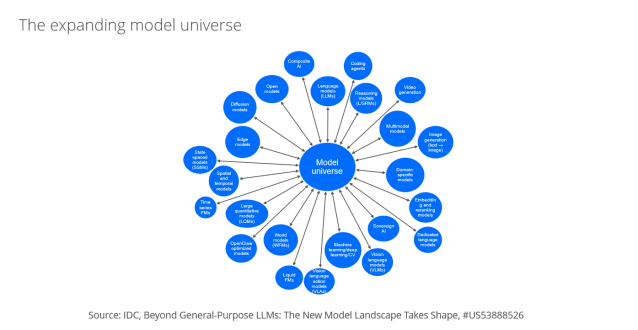
Since the arrival of ChatGPT in late 2022, the dominant AI technology narrative was that large, general-purpose “foundation models” could serve many use cases: everything from writing software code to creating marketing plans, summarizing meetings, analyzing contracts, and more.

But as we approach 2026, the tide is shifting, and it is becoming apparent that to serve targeted business use cases optimally, AI models work best when they are at least somewhat specialized. What’s more, even providers of state-of-the-art AI models are actually delivering their products and services as “mixtures of experts” (MoEs): collections of task-specialized models hidden behind a unified front-end, where each request (prompt) is routed to the specialized model that fits best.

The shift: From model selection to model orchestration

Before the rise of GenAI, choosing the best AI model architecture was a key step to success in driving an effective outcome. Even now, in GenAI implementations, many teams spend significant time trying to find the “best model” to serve a given use case. Teams scour model benchmarks, run tests, compare outputs, select a winner, and optimize around it.

However we are currently seeing an explosion of innovation and engineering advances in AI models, and what might be “best” today might very well not be best in six months (or even next month). What’s more, agentic AI systems demand flexibility. Different tasks that agents are being called on to execute are likely to require different kinds of capabilities.

Model routing enables teams to build systems that evaluate incoming requests and automatically route them to the model best suited to the job; or even combine models in sequence to produce an optimal outcome.

Why this matters: Performance, cost, and trust

The value of model routing is about more than insulation from technology entropy; it’s also about optimizing performance, cost and trust.

  • Performance: Model routing enables systems to boost accuracy and reliability by dynamically selecting the most context-appropriate model rather than forcing a generalist to handle every request. In addition, models can be selected based on where they run – at the edge, on premises, in a public cloud, for instance – due to the impact on latency as well as cost.
  • Cost control: With routing, workloads can be distributed intelligently between premium proprietary models, where needed, and efficient open-source alternatives.
  • Governance and trust: Enterprises can enforce compliance and sovereignty by ensuring certain data types are always processed by approved, region-specific, or private models.

How leaders should prepare

So what does all this mean for leaders trying to put model routing into practice? It starts with shifting mindset, strengthening oversight, and designing for flexibility from day one.

  • Adopt a multi-model mindset. Stop optimizing around a single model and start designing architectures that can host and switch between many.
  • Invest in AI governance and observability. Model routing introduces another layer of technology, and you will need monitoring systems that track system performance, quality, and cost across every route and over time.
  • Explore blends of open and proprietary models. Understand that state-of-the-art proprietary models can deliver great results, but cost and flexibility can suffer. Open models – which are massively easier to specialize, and offer deployment flexibility – may fit individual use cases very well.

IDC perspective: Routing is the road to scale

For businesses, delivering AI value at scale is about using a variety of levers to optimize results – it’s not about leveraging ever-larger models. Model routing is one of the main levers that will become increasingly important.

As businesses confront the crosscurrents of data sovereignty, compute costs, and model diversity, routing architectures provide a key tool to navigate complexity. Model routing helps organizations treat AI-powered automation as a distributed, orchestrated capability, rather than a monolith. Those who master routing will move faster, spend less, and innovate more safely. Those who don’t will watch their single-model strategies stall under the weight of their own limitations.

Download IDC FutureScape 2026: AI & Automation Predictions to explore how routing, orchestration, and agentic architectures will redefine the enterprise technology stack.

Neil Ward-Dutton - VP AI, Automation, Data & Analytics Europe - IDC

Neil Ward-Dutton is vice president, AI, Automation, Data & Analytics at IDC Europe. In this role he guides IDC’s research agendas, and helps enterprise and technology vendor clients alike make sense of the opportunities and challenges across these very fast-moving and complicated technology markets. In a 28-year career as a technology industry analyst, Neil has researched a wide range of enterprise software technologies, authored hundreds of reports and regularly appeared on TV and in print media.

In the fast-moving world of tech distribution, having the right insights at the right time is critical. That’s why the GTDC Summit APJ 2025 is the premier gathering for leaders in the Asia-Pacific channel. Held in Singapore November 17-18, it’s where strategy meets intelligence, and where IDC and CONTEXT are showing up to bring both.

The Event That’s Redefining the Channel

GTDC Summit APJ brings together global vendor and distributor leaders for two days of high-impact conversations, networking, and insight, including plenary sessions, ESG-focused discussions, and strategic advisory councils. This isn’t just an event, it’s a signal of where the industry is going next.

From in-depth discussions on ESG priorities to closed-door sessions with the leadership, the agenda is packed with moments that matter. And it all happens in the heart of Singapore’s cultural district.

See why this summit matters and who you’ll meet there.

IDC + CONTEXT + GTDC – Distribution Intelligence in Action

Earlier this year, IDC, the Global Technology Distribution Council (GTDC), and CONTEXT formed a landmark global alliance to deliver something the tech industry has never had before: a single, standardized view of sell-through performance across Asia Pacific, North America, Europe, and the Middle East.

CONTEXT, as a market intelligence leader in EMEA, brings deep expertise in distributor panel management and data normalization. GTDC contributes daily invoiced sales data from its network of leading distributors. And IDC connects it all with rigorous forecasting, market modeling, and analyst-driven insight.

Together, this partnership offers vendors and distributors a 360-degree global perspective, accurate, consistent, and actionable.

At the GTDC APJ Summit, this initiative comes to life. You’ll have the chance to meet directly with IDC, CONTEXT and GTDC leadership to explore how this intelligence model applies to your business in Asia Pacific and beyond, and to schedule a 1:1 session to see the platform in action.

  • Discover how IDC’s analytics platform integrates with GTDC member data
  • Explore how CONTEXT’s distributor panel expertise enhances regional visibility
  • Understand what the sell-through signals reveal about emerging APJ trends
  • Learn how to use this new insight layer to fine-tune tactical and strategic decisions

It’s the kind of clarity this market has been missing, and at this Summit, you’ll see exactly how it can work for you.

See how this global data alliance is transforming distributor intelligence.

Meet Us There

IDC and CONTEXT will be on-site, ready to share insights, preview new market data, and connect 1:1 on how we can help you navigate your next move in APJ and globally. Whether you’re a vendor, distributor, or ecosystem leader, this is your opportunity to:

  • Tap into global sell-through insights shaped by trusted analysis
  • Benchmark your business across regions and categories
  • Align with IDC and CONTEXT experts on how to act on what’s next

The distribution landscape is evolving fast. The insights are finally catching up. Visit Singapore this November and discover how IDC and GTDC are shaping the next chapter of channel intelligence, and how you can apply these insights to sharpen your 2025 distribution strategy.

Because seeing the future clearly starts with the right data and the right partner.

As organizations navigate an era defined by economic uncertainty, geopolitical shifts, and relentless technological change, one truth stands out: the future belongs to those who can harness AI, automation, and sovereignty to build resilience, drive innovation, and unlock growth. The theme of this year’s IDC EMEA FutureScape predictions  webcast – The Agentic Business Future – is about technology; but also readiness, governance, and a human-centered approach that transforms ambition into measurable business value. 

IDC defines the Agentic Business Future as a fundamental transformation of enterprise operations, customer experiences, and business models driven by the widespread adoption of AI agents and agentic workflows. Agentic workflows are processes involving AI agents capable of planning, using tools, perceiving their environment, and remembering past interactions to improve performance. These agents autonomously execute complex tasks, make decisions, and interact in human-like ways, enhancing operational efficiency and decision-making. Unlike traditional AI, agentic AI can collaborate, trigger actions, and adapt dynamically, underpinning new operating models and real-time orchestration across the enterprise. 

Our IDC European CIO Xchange Survey (2025) reveals that 85% of EMEA CIOs are already exploring agentic use cases or piloting intelligent agents within isolated departments. The challenge now is to move beyond pilots. Scaling AI means modernizing architectures, consolidating fragmented systems, and enabling data to flow freely – securely and responsibly – across hybrid and sovereign clouds. 

Why This Future Matters

IDC’s latest CEO survey reveals what’s keeping leaders awake at night: digital business execution gaps, economic pressures, and geopolitical risks. For EMEA CEOs, driving digital initiatives and leveraging AI for competitive advantage are top priorities. In fact, 50% believe AI will reinvent their business model within the next 3–5 years. Yet ambition alone isn’t enough. Without foundational readiness and robust governance, organizations risk falling short of ROI targets: by 2026, we expect that half of AI-fueled digital use cases will fail to meet ROI expectations. 

Five Imperatives for the Agentic Future

  1. Reimagining Digital Value 
    Economic headwinds and global instability are forcing organizations to rethink business models and redefine digital business value. Competitive advantage will increasingly hinge on how effectively companies integrate AI into their core strategies – not as a bolt-on, but as a driver of transformation. 
  2. Architecting for Scale 
    Scaling AI requires more than enthusiasm; it demands modernization and hybrid architectures that overcome tech debt and fragmentation. IDC research shows EMEA IT spending grew 13% in 2025, signaling strong investment momentum. But without a clear architectural vision, these investments risk becoming sunk costs. 
  3. Building Trust Everywhere 
    Trust is non-negotiable. Governance frameworks, responsible AI, and sovereignty are critical for compliance and risk management. Recent geopolitical shifts have accelerated this trend, with 61% of EMEA organizations favoring sovereign clouds for AI workloads. This isn’t just about regulation — it’s about ensuring resilience in a volatile world. 
  4. Leading Through Change 
    Technology alone doesn’t deliver transformation; leadership culture and organizational agility do. The AI pivot requires leaders who can embed innovation into the DNA of their organizations, fostering adaptability and collaboration across every layer. 
  5. Empowering the Workforce 
    The future of work isn’t just automation — it’s augmentation. Three out of four EMEA employees expect their jobs to be impacted by AI by 2026, underscoring the urgency of talent development. Organizations that invest in upskilling and human-machine collaboration will be best positioned for sustainable success. 

Find out more

The Agentic Business Future is not a distant vision; it’s unfolding now. But success requires moving beyond hype to measurable outcomes. The organizations that thrive will be those that combine technological ambition with governance, trust, and human-centric leadership.  

Join IDC’s senior regional analyst team for FutureScape 2026 webcast on December 3, where we will unpack these imperatives — backed by data, case studies, and practical guidance to help digital leaders design for resilience, agility, and growth in an increasingly complex environment. Register now here.  

If you have a question, you can submit that in our form here.  

Below are a couple of related eBooks:  

The manufacturing industry is no stranger to artificial intelligence. Process manufacturing sectors such as chemical, pulp & paper, oil & gas, food & beverage have embedded AI routines into their systems for decades to automate workflow and product processes. But this represents only one dimension of AI adoption in manufacturing, Across the broader industry, significant opportunities remain, especially in three key areas:

  • enabling the adoption of cloud platforms and applications,
  • making sense of the massive amounts of data from connected assets and products,
  • and augmenting the workforce 

Our 2026 Manufacturing Industry FutureScape explores how these opportunities are reshaping the sector while accounting for existing challenges and investments. Manufacturers are navigating the need to deploy cloud platforms and applications consistently across production sites, extend digital twins of products and assets across the value chain, and upskill a workforce that faces both resource and digital skills constraints. These dynamics are redefining competitiveness across the industry and shaping the key trends driving our predictions for the next five years.

AI adoption remains cautious—but accelerating.

There is slow adoption of GenAI and Agentic AI across manufacturing overall, perhaps because, as one manufacturer said, “it is [perceived as] taking away the fun part of being an engineer—problem solving.” Yet it now sits at the top of the CIO, Chief AI Officer, and VP of Manufacturing’s agenda, driven by the realization that these capabilities will only make engineering, R&D, production, and operations better. Our survey data shows that process manufacturing organizations are more mature than discrete manufacturing industries, both of which are far ahead of the energy sector. Early GenAI and Agentic AI use cases focus on design augmentation, procurement optimization, guided customer service, and enterprise quality assurance.

Data is both a challenge and a catalyst.

Manufacturers are deluged by data, and as data fabrics and foundations mature, AI adoption will accelerate—driving automation, process optimization, and workforce efficiency. It also helps that manufacturers are finally embracing cloud-based infrastructure and applications, which will make multimodal and ecosystem-driven innovation more attainable. Despite this momentum, cloud in the industrial space will likely remain a hybrid approach over the long term, varying by industry, due to regulatory and IP management concerns.

Sustainability and the energy transition take center stage.

The energy transition is underway for manufacturing and energy organizations, with a focus on (a) greenfield and brownfield facility design and sustainability, and (b) supply chain efficiency and optimization. Organizations are exploring how to integrate BIM (building information modeling) and MOM data with point-cloud scans and models of both new and legacy facilities to improve energy efficiency in buildings—which notoriously account for 30–40% of global CO₂ emissions. Scope 3 emissions regulations (which hold manufacturers accountable for environmental impacts beyond their direct operations), combined with growing customer demand, are driving investment in supply chain visibility, analytics, and optimization.

Software-defined automation becomes mission critical.

Software-defined automation for products, assets, and facilities is becoming mission critical, and low-code development tools play an increasingly important role in improving data and process flow, analytics, and collaboration. Organizations need a rapid, streamlined way to update and create new software that enhances data movement, analytics, ecosystem collaboration, and overall operations. This approach must also integrate with traditional full-code software development tools used for products and assets to ensure enterprise-wide quality and consistency.

Industry ecosystems drive innovation and resilience.

Industry ecosystems continue to drive innovation and business performance, particularly in meeting regulatory compliance and advancing sustainability and circularity. Manufacturing and energy organizations have recognized that they operate more effectively through extended ecosystems that include diverse external skills, resources, and expertise across marketing and sales, R&D and engineering, production, supply chain, and customer or field service. IDC’s four years of global survey data on industry ecosystems show that organizations taking this approach are better able to share data internally and externally, accelerate innovation, and meet customer, consumer, and citizen needs.

2026 manufacturing industry predictions

Building on these trends, IDC’s 2026 Manufacturing Industry FutureScape identifies 10 key predictions that highlight how AI will reshape operations, supply chains, and workforce strategies across the manufacturing ecosystem over the next five years.

  1. Software-defined factory: Driven by the potential of autonomous operations, by 2029 30% of factories will configure and manage control systems centrally utilizing open, virtualized, software-defined automation platforms.
  2. Autonomous production scheduling: By 2026, over 40% of manufacturers with a production scheduling system in place will upgrade it with AI-driven capabilities to start enabling autonomous processes.
  3. Agentic IT/OT connectivity: By 2027, 40% of all operational data will be integrated across applications and platforms autonomously due to increased standardization and the use of AI agents purpose-built for specific data.
  4. Cross functional circular field service: To close the loop between service and design, by the end of 2026 45% of G2000 OEM and aftermarket firms will use AI to connect field and engineering data, improving product and service quality.
  5. Predictive industrial data security: To counter data model poisoning risks, 75% of large manufacturers will use AI-enabled OT cyber defense by 2029, autonomously flagging low-level threats and cutting detection times by 60%.
  6. Human/robotic skills transfer: By 2028, firms that fail to design closed human-robot skill loops will face 20% higher downtime and retraining costs, and reduced efficiency compared with peers that implement bidirectional training.
  7. Agentic product/process simulation: By 2028, 65% of G1000 manufacturers will use AI Agents in conjunction with design and simulation tools to continuously validate design changes and configurations/ variants against product requirements.
  8. Connected worker reskilling platforms: By 2027, over 50% of manufacturers will utilize AI-enabled knowledge management tools to re-/upskill their workforce and foster collaboration across industry ecosystems.
  9. Hybrid AI industrial focus: By 2030, 60% of manufacturers will leverage AI Agents to build data models and manage hybrid-cloud workloads, ensuring knowledge sharing and collaboration that lowers cost of quality by 2%.
  10. Industrial model management: By 2027, 60% of manufacturers will leverage hyperscaler ecosystems to build, deploy, & scale new AI solutions, unlocking the value of their data and accelerating transformation.

The road ahead for manufacturers

Looking at everything as a whole, we begin to see how AI is becoming foundational to manufacturing strategy. But realizing this potential requires deliberate action, cultural change, and sustained investment.

Manufacturers today face the challenge of managing two overlapping transformations: the migration to cloud and the adoption of AI. Cultural and structural barriers remain—reluctance to share data across teams and ecosystems, uncertainty about AI’s impact on jobs, and uneven governance models all slow progress. Yet, as with past technology shifts, those who evolve will lead.

Success in this next phase requires a pragmatic, use case–driven approach. Organizations should begin experimenting with AI while establishing centers of excellence, building strong data governance frameworks, and investing in training and enablement. For IT and business leaders alike, industry-specific foundation models will be key to enabling effective and trusted use of generative, agentic, and predictive AI that can address increasingly complex industrial challenges.

The potential upside is immense. AI offers the ability to accelerate automation, strengthen data flow, and augment workforces that face ongoing skills shortages. Leading manufacturers are already treating AI as a core element of digital transformation—integrating it with cloud platforms, big data analytics, AR/VR, and emerging technologies such as blockchain.

It is only a matter of time before AI becomes deeply embedded across the manufacturing sector. The question is no longer if—but how fast manufacturers can scale adoption to unlock new value, improve resilience, and redefine what’s possible in the next industrial era.

Jeffrey Hojlo - Research Vice President - IDC

As Research Vice President, Future of Industry Ecosystems, Innovation Strategies, & Energy Insights at IDC, Jeff Hojlo leads one of IDC's Future Enterprise practices at IDC - the Future of Industry Ecosystems. This practice focuses on three areas that help create and optimize trusted industry ecosystems and next generation value chains in discrete and process manufacturing, construction, healthcare, retail, and other industries: shared data & insight, shared applications, and shared operations & expertise. Mr. Hojlo manages a group focused on the research and analysis of the design, simulation, innovation, Product Lifecycle Management (PLM), and Service Lifecycle Management (SLM) market, including emerging strategies across discrete and process manufacturing industry such as product innovation platforms and the closed loop digital thread of product design, development, digital manufacturing, supply chain, and SLM. He also manages IDC's North American Energy Insights group, with a focus on key topics such as energy transition & sustainability, distributed energy resource management, and digital transformation in the Oil & Gas and Utilities industries.

B2B engagement is at a turning point, and buyer expectations are accelerating faster than most organizations can adapt. Static campaigns, siloed systems, and disconnected handoffs no longer match the ways customers want to interact with brands.

This urgency is reflected in the market. By 2027, IDC projects companies will spend $150 billion on AI-related infrastructure, platforms, and services to compete on delivering highly personalized customer experiences.

For CMOs, this level of investment underscores a simple reality: engagement has become a decisive factor in growth, loyalty, and competitive differentiation.

To succeed in the new B2B landscape, leaders must understand:

  • How buyer expectations have shifted
  • The principles that guide effective marketing teams
  • The new AI-driven rules of engagement
  • What it looks like to put those rules into practice.

Three shifts in buyer expectations

Today’s B2B buyers are digitally fluent, AI-assisted, and more self-directed than ever. They research, compare vendors, and evaluate solutions on their own terms, often without speaking to sales until late in the process. Marketing must now own the entire journey, not just the top of the funnel.

Three shifts define this new reality.

  1. Customers expect personalization powered by real-time data to make every interaction relevant. Nearly 70% of buyers say personalization influences whether they engage with content.
  2. Buyers are relying on AI-driven tools and insights to shape decisions, with 77% of B2B buyers depending more on AI tools than traditional search engines.
  3. Trust, transparency, and agility determine brand credibility. Brands risk losing over 79% of customer loyalty by 2026 if they fail to implement digital trust practices for AI transparency and ethical data handling.

These shifts have redefined the baseline for engagement. Omnichannel orchestration isn’t just about connecting campaigns, it’s about creating journeys that grow with the buyer, foster trust, and make every interaction feel relevant.

Core principles to guide marketing teams

To meet these expectations, CMOs are embracing three guiding principles:

  • Buyer intelligence requires building a full picture of the customer journey by integrating intent signals across content, events, demos, pricing activity, and social interactions. With deep insight into the buyer experience, teams can deliver omnichannel engagement that adapts in real time instead of relying on static campaigns.
  • Intentional transitions ensure consistency across touchpoints. Consider a buyer who attends a webinar: in a standard scenario, they receive generic emails that ignore the details of the session. A strong, omnichannel approach references the session topic, offers related resources, and provides sales with context for the next conversation.
  • Cross-functional alignment creates a unified relationship with the buyer. Marketing and sales must act on the same intelligence. Integrated platforms, shared dashboards, and common definitions of success allow teams to orchestrate experiences that feel coherent across every channel.

By following these principles, marketing leaders can create the foundation for adaptive, buyer-centric engagement that moves the needle from discovery to loyalty.

The new AI-driven rules of engagement

AI isn’t just enabling marketing efficiency, it’s reshaping how buyers experience brands. New rules now define how engagement must be delivered.

  • Dynamic personalization

Static nurture paths no longer resonate with digital-first buyers who expect experiences to adapt instantly to their behavior. Instead of generic follow-ups, leading strategies trigger personalized interactions that build on a potential customer’s last action.

IDC research shows that 80% of buyers say personalized communications make it feel like a brand cares about them, a reminder that personalization isn’t just a tactic, it’s an avenue to build trust. In an omnichannel world, this means tailoring not only what content is delivered, but where and how it appears across touchpoints.

  • Conversational engagement

Modern buyers don’t want to wait for gated PDFs or delayed responses: they expect dialogue in real time. By 2026, 65% of individuals will engage with brands through GenAI, signaling a shift from static content toward dynamic, two-way engagement.

The challenge is scaling these conversations authentically. Successful organizations embed conversational AI into their omnichannel strategy, ensuring digital dialogues seamlessly transition to well-informed live sales interactions when the time is right.

  • Proactive trust and transparency

As AI becomes more integral to both the sales and buying process, buyers need clarity from brands about how AI is used. They want to know when they’re interacting with a computer or a person and how their data is being handled.

IDC research shows only about a quarter of marketing executives currently prioritize enabling trust-based marketing practices. This is a gap, and an opportunity. Brands that lead with transparency and governance will differentiate themselves in a market where credibility pays off in loyalty.

Together, these rules highlight a new reality: AI is no longer behind the scenes. In an omnichannel, buyer-led world, it is the front line of customer engagement, shaping perceptions, guiding decisions, and determining loyalty.

Practical examples of modern engagement

Principles and rules matter only when they are translated into action. These examples show how these elements work together in real-life scenarios to create connected, intelligent, omnichannel experiences that resonate with today’s buyers.

  • Turning missed clicks into seamless journeys

A buyer abandons a demo request form. Because transitions are thoughtfully designed, the system triggers a tailored follow-up referencing the product they explored and suggests next steps. Instead of losing the lead, the personalized interaction builds momentum and draws the buyer back in.

  • Powering conversations with insight

A buyer exploring pricing models engages with a GenAI chatbot. The bot responds with context drawn from centralized buyer intelligence (previous site activity, firmographic data, or content downloads) and then routes the conversation to a live expert when needed. This blend ensures the AI-driven dialogue is relevant, accurate, and supports the sales team with the knowledge they need to close the deal.

  • Building trust across the organization

A buyer interacting with AI-generated recommendations accesses the brand’s AI and data protection policies. Because the entire organization operates under consistent governance standards, transparency is embedded in every practice, reinforcing credibility and ensuring every department is in alignment.

These examples show the path to buyer-centric engagement isn’t about isolated touchpoints. It’s about executing the plays that create connected moments – where personalization, communication, and trust work together across the omnichannel journey.

The CMO’s mandate for engagement

For marketing leaders, the imperative is to orchestrate engagement by aligning the principles and rules, grounding every journey in intelligence, designing AI interactions with intention, and aligning teams and buyers around shared trust.

The rules of engagement have shifted, and buyers are moving quickly. Those who adapt now will define what success looks like in B2B marketing, building buyer journeys that not only meet expectations but set new ones.

Discover IDC’s Omnichannel Experience Playbook and learn how to align your marketing organization with the new rules of engagement and future-proof your GTM strategy. You’ll find game-changing plays and an accompanying AI Supplemental Guide to operationalize intelligence, build trust, and build winning customer experiences.