
For most CMOs, Q1 begins with a familiar reassurance: We’ll move fast. We’ll see what works. We can adjust.
That logic used to hold. But in 2026, it does not.
Q1 is no longer a learning quarter. It is the point where go-to-market direction begins to harden financially, operationally, and organizationally. By the time early results appear, budgets have already been deployed, teams aligned, and market narratives established. What feels flexible in January often becomes difficult to change by March.
That makes Q1 the most dangerous time of the year to be directionally wrong.
Commitment now happens earlier than most teams realize
In Q1, commitment accelerates faster than most teams expect.
Budgets move from plan to spend early in the quarter. Teams align around specific markets, messages, and motions. Enablement, content, and tooling go live. Leadership begins to form a point of view on what is working and where to double down.
Once that momentum builds, reversal becomes slow, expensive, and difficult to execute, even when later evidence points in a different direction. Direction often locks before performance data can meaningfully challenge it.
In previous years, this transition happened more gradually. Today, compressed buying cycles and pressure to show early momentum have shortened the window for reconsideration.
Directional risk outweighs execution risk in Q1
When Q1 underperforms, reviews often focus on execution. Messaging missed the mark. Campaigns ramped too slowly. Sales conversion lagged.
Those explanations miss the deeper issue.
The most damaging Q1 failures start with direction. Once a market is prioritized early in the year, everything organizes around that choice. Budget, headcount, content strategy, enablement, and leadership attention align behind it. When signs later point to underperformance, the cost of changing course extends beyond spend and into organizational friction.
Directional GTM risk occurs when early investment is committed to markets that lack buyer urgency at a time when internal alignment is hardest to unwind. In that environment, strong execution can still reinforce the wrong decision.
Pipeline arrives too late to protect early decisions
Many GTM plans still rely on pipeline as the primary validation mechanism. Teams launch, monitor early indicators, and plan to optimize based on what they see.
The limitation is timing.
Pipeline reflects reality only after investment, alignment, and momentum are already in motion. Early Q1 bets rarely fail loudly. They show up as steady but unremarkable performance that consumes budget while quietly limiting upside.
By the time pipeline confirms a mistake, recovery is no longer quick. The cost of change has already compounded.
Buyer behavior accelerates the cost of early mistakes
Buyer behavior has shifted in ways that further compress the margin for error.
B2B buyers now signal urgency digitally, often before vendors engage directly. Markets with active demand surface quickly. Markets that require education or reframing absorb spend without producing early signal.
This dynamic changes how Q1 investment behaves. Markets where buyer urgency already exists convert earlier. Markets without urgency require sustained spend before traction appears.
Early-year investment into the latter carries outsized risk. When urgency is absent, activity increases, but momentum does not.
Strong CMOs reduce risk by narrowing earlier
High-performing CMOs face the same uncertainty as everyone else. The difference is how they manage it.
They narrow focus earlier in the quarter. They pressure-test direction before scaling. They recognize that optionality decreases rapidly once execution is underway.
Rather than spreading investment across multiple attractive opportunities, they concentrate resources where buyer urgency is already visible and defensible. Early success is measured by signal quality, not volume. Clarity about what to delay is as important as clarity about what to accelerate.
In Q1, focus functions as a form of risk management.
The decision that shapes the rest of the year
As pressure builds to show early momentum, the most dangerous assumption leaders make is that there will be time to fix a wrong bet.
Q1 does not determine the entire year, but it sets the constraints under which the rest of the year operates. Early market choices shape where credibility accumulates, where teams invest effort, and where recovery remains possible.
In 2026, the most damaging Q1 GTM failure is committing to the wrong direction before market signals arrive. Once momentum builds, correction becomes increasingly costly.
The question is not whether teams can execute.
It is whether they are pointed in the right direction before execution begins.
Validate direction before momentum locks in
In a quarter where speed matters, confidence matters more.
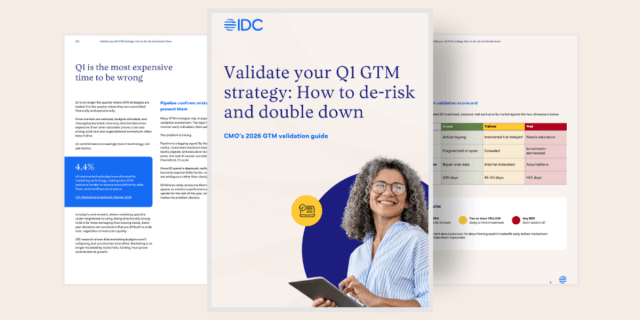
IDC’s GTM Validation Brief helps marketing leaders pressure-test where to commit early in Q1 and where to wait. It uses buyer-side evidence and market signals to validate direction before budgets, teams, and narratives harden.
This approach is not about caution. It is about capital discipline. Early momentum should compound growth, not trap it in the wrong places.
Download the GTM Validation Brief to validate your Q1 GTM strategy before direction locks in.