I recently attended a tech vendor conference and an analyst from another company presented on how we should all be “customer obsessed“. This set me thinking in a Carrie Bradshaw (from Sex in the City) kind of way: is customer obsession really a good thing?

When I think about obsession, I think about Glenn Close in Fatal Attraction, boiling bunnies and doing other strange non-functional things. The Clint Eastwood film Play Misty for Me is equally unsettling.

Google defines obsession as “a persistent disturbing preoccupation with an often unreasonable idea or feeling” which is consistent with the above observations. Meaning, too much focus on one thing can severely damage everything else. For example, former British Prime Minister Liz Truss’ obsession with her growth agenda revealed a lack of balanced thinking that had calamitous consequences.

Balancing the Books

There are good reasons why the most important financial statements are “balance sheets” and “profit and loss”. They are designed to show a balanced, objective and factual view of the business performance and viability. There is no room for an emotionally charged item such as “customer obsession” in these documents.

The most famous management framework of the 1990s was Kaplan and Norton’s “Balanced Scorecard”, which suggested good management is about balancing the needs of four constituents:

  • Customers
  • Finance
  • Internal staff and process management
  • Innovation and learning

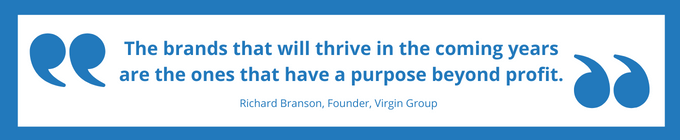
Jim Collins’ extensive research on top performing companies in the book Good to Great revealed that “success comes from many tiny, incremental pushes in the right direction”. Richard Branson gleefully puts customers second in importance, putting his own staff in first place.

The old idea that “the customer is always right” has thankfully largely been debunked. The customer is sometimes right, but not necessarily always. As Steve Jobs said, “It’s not the customer’s job to know what they want.” Henry Ford famously said of the Ford Model T car’s success: “If I had asked people what they wanted, they would have said faster horses.”

Conformance to Customer Requirements Is Key

As any quality manager will tell you (spoiler: I used to be a quality instructor), quality is about conformance to customer requirements, not about customer obsession. Really listening aggressively and taking customer requirements seriously and then harnessing the power of your organisation to deliver on those requirements is the real trick to customer experience and customer success.

Contrary to what some corporate executives may believe, this success does not come overnight by announcing that you are a customer-obsessed company. Actions (and investments) speak louder than words. You need to be fully committed to customer experience (CX) for the long term to build an end-to-end customer-centric organisational culture. This is how Amazon and John Lewis have created powerful and successful brands that are synonymous with excellent customer experiences and customer service.

Since its founding in 1999, customer success has been one of the five Salesforce “core values” (the other four being trust, innovation, sustainability and equality). This is Salesforce’s “Balanced Scorecard”, which is customer centric, not customer obsessed. This balanced customer focus has enabled Salesforce to surpass SAP as the world’s leading enterprise software applications company — despite SAP having a 27-year head start.

The Bottom Line

I can understand the allure of the customer obsession idea. Some might believe that the customer obsession phrase will differentiate their CX from their competitors in an “ah, look, this proves our CX is better” sort of way. I believe the opposite is true.

Customer obsession puts a dangerous false expectation of primacy in the mind of the customer, pressure on customer-facing staff to bow to unreasonable customer demands and the opportunity for competitors to heap derision on your well-meaning intentions.

My advice: Customers don’t want to be obsessed over, so don’t creep them out with a feeling of unhealthy over-attentiveness. Seek to serve them better, not obsess over them. Keep a laser-beam focus on customer requirements, CX and EX (employee experience) and leave the idea of obsession on the film set or on the perfume counter. Build customer-centricity and customer success into your mission, vision and values and then operationalise your execution, using technology and positive employee attitudes and senior management support as your key enablers.


For more information, head over to https://www.idc.com/eu and drop your details in the form on the top right.

Bauma is one of the world’s biggest trade fairs for construction machinery and mining machines. It takes place in my hometown, Munich, and this was my first visit to the show. I was very impressed. Not just because there is a lot of very big construction machinery, but also because digitalisation is happening there. In this blog post, I will briefly share my key takeaways on digitalisation (in particular) and sustainability (in passing).

Digitalisation Is All About Utilising Machine Data

When it comes to digitalisation, construction machinery manufacturers are primarily concerned with harnessing the data generated during the use of their machines. For example, data can be used to automatically generate reports on how accurately special drilling machines have drilled the holes. This is particularly relevant when there are specific documentation requirements. Data can also be used to remotely monitor machine condition and performance in visualised dashboards.

Data-Based Services: Still Only a Moderate Share of Revenues

I asked manufacturers about customers’ willingness to pay for these data-based services. Their replies were mixed, as it strongly depends on the investment volume and the costs incurred in the event of a machine standstill. The competitive situation also plays a role in whether customers simply expect these data-based services as an add-on free of charge. My general impression is that the share of revenues accounting for data-driven (connected) services is still fairly low on average, but there are exceptions.

The Drivers of Investments in Data-Driven Services Are Most Likely Not the Customers

Interestingly, it’s often not the client itself that drives investments in data-driven services, but rather the client’s customers or other stakeholders. In road or tunnel construction, for example, it’s often the clients who demand that certain drilling documentation be available. Or financial stakeholders who demand the use of data-based machinery monitoring services.

Lack of Skills

Software is becoming an increasingly important component of every machine. It’s quite a challenge for manufacturers of large construction machines to meet the demand for the necessary software skills. It seems these manufacturers are seen more as large plant and metal manufacturers and — compared with smaller industrial machinery manufacturers — less so as potential employers for programming talents.

From Egosystems to Ecosystems

While machine manufacturers are promoting their own digital platforms — such as Herrenknecht (which manufactures tunnel boring machines, and its Herrenknecht.Connected customer portal) and Liebherr (one of the largest construction machine manufacturers in the world, and its MyLiebherr portal) — the longer-term goal seems obvious: connecting all those different machines via a single data communication standard. This makes a lot of sense. In factories and construction or mining sites where there are different machines it makes sense for the construction machine industry to agree on a common data format for machines from different vendors.

Communication Standardisation — Still a Long Way to Go

Machines in Construction 4.0 (MiC 4.0) is a working group in the German Mechanical Engineering Association (VDMA) whose goal is to develop a uniform, cross-manufacturer and machinery-independent communications form for the entire construction process. I believe there is still a lot of work ahead as it’s not just about communication among construction machines on sites — it’s also about ensuring secure connections from the edge to the cloud, which, from my perspective, would also require collaboration with cloud hyperscalers such as AWS and Microsoft or cloud-based IoT platforms and connector providers.

Sustainability Drives Investments in Electric Vehicles

A lot of vendors were exhibiting products with electric motors. This is driven by the need to develop construction machines that generate fewer CO2 emissions. Besides cutting emissions, electric vehicles are also low maintenance and are quieter than vehicles with combustion engines. This makes them suitable for low-noise areas such as near hospitals and at construction sites in the city.


For more information, please contact Stefanie Naujoks, or head over to https://www.idc.com/eu and drop your details in the form on the top right.

ICT Governance – Does the New Environment Mean You Need to Make Changes?

Thursday 27th October 2022 17:00 CET

Recent IDC research shows that ICT Governance is a growing area of concern for Digital Leaders. New facets such as API, IoT and data governance are expanding becoming recognized as business issues. The success of ICT governance – making the right decisions at the right time – can, increasingly, make a huge difference to the success of the whole organisation. The concepts of Agile and Pervasive Governance should be part of your thinking and be incorporated urgently into your organisation. In this session topics we expect to cover are:

  • Is your current governance structure really fit-for-purpose?
  • Given the importance of IT in the future of your organisation are the right people involved in your Governance processes?
  • How do you really build an agile pervasive governance structure?
  • Do you really need to change anything or are sure your processes are right?

Are Business Process Discovery Tools Worth the Cost and the Effort?

Thursday 24th November 2022 17:00 CET

Every business initiative needs a solid business case. Back in the day when businesses grew by intuition rather than by design there was scope for experimentation and IT had to “catch up” and provide the systems to match the processes that were already in place.

In this session we will look at the rise of tools discover how your organisation actually works and can serve as a template for the changes that should be made to obtain the best business return.

In this session we expect to discuss:

  • The reality of using business process tools,
  • The impact of tools on business agility and successful ROI,
  • The challenges of implementing these tools and the changes they imply to the way the organisation functions.

Web3, The Metaverse and the Bight Distributed Future. Why It Really Is Something to Consider Today, or Maybe Not?

Thursday 8th December 2022 17:00 CET

Will going to work as an avatar be any different from a video meeting today. I cannot imagine going back to purely voice calls for my meetings with clients – will we feel the same in a few years about being present in the Metaverse?

From a business perspective how could a distributed economy where commerce has moved into the virtual world change your organisation? Is there going to be an advantage to being a first mover in your industry? How do you explain the importance, or lack of importance, of this area to you less digital knowledgeable collegues?

In this session we will discuss the how we should approach this topic:

  • Developing a presence in the Metaverse – is it a priority?
  • Are Web3 wallets and apps going to survive hype, regulation and cyber-crime,
  • Managing the complexity increased distributed data,
  • The security, sovereignty issues around the use of these technologies?


We hope you will join us.

 If you already receive invitations to our sessions, I hope to see you there. If you would like to join this community, please email us at mdowd@idc.com.


https://www.idc.com/eu/digital-leadership-advisory

https://www.linkedin.com/groups/8992748/

We were delighted to host the third quarter IDC Digital Leadership Think Talk of 2022 on September 29. Around 40 digital leaders from across Europe joined the call to share their challenges, successes and experiences of data and how it is managed within their organisation.

Marc Dowd and Tracy Keeling from the IDC Executive Advisory team led the discussions.

All About Data

At the start of the session, Marc Dowd set the scene by asking the audience to think about how they manage data access, secure data as it is transferred, manage data cleansing, data integrity, duplication, building data culture, and how to align the business and IT with data.

Our first CIO contributor explained that you need a data glossary as well as a data catalogue as everyone will have a different definition of what they believe data is and what it involves. Secondly, it is important to have a clear view of the data types, including human and machine created data, and how to manage it via stewardship.

Another contributor described how they had also used data journey maps to show where data comes into or is generated by the organisation and how it is transformed and stored as live or archived and allocated ownership to the people closest to the data mainly within the business. This helps them to manage the difference with dealing with your own data versus external data, which may have to be given back to the owner in some cases or returned to you by the vendor at the end of a contract if moving to another product.

Ownership and Management

This sparked a lot of comments from other CIOs on the call — one spoke about democratization to give bounds to data by starting with regulatory rules and GDPR, then you can decide who can have access, how they can access it, and how long it should be kept.

Our next contributor, from the government industry, responded to the question on whether data stewardship is an IT function or business function.

They compared IT to a car leasing company that provides the asset with a set of rules. It is up to business owner to drive the car (or use the data) in the way they want. This was reiterated by another member who mentioned the exception — that machine-generated IoT data, by far their biggest source, is managed by technical teams.

A further comment was around data management in government. One CIO felt it depends on the size of the organisation and that it should sit in IT, but only if the organisation is not too large. If it is a private sector organisation, they felt it was best to push ownership towards the business side, with business ownership of the quality of the data. IT could then manage the system side of where data sits and flows.

Another member from the pharmaceutical industry explained the segregated model they use. One area was where they have a local person who is responsible for data from local trials, while a central team provides governance and IT provides the infrastructure for it to demonstrate and manage its integrity.

Practical Examples

The discussion then moved towards practical examples. We discussed low code/no code and how data was managed within this. Although they worked differently to standard applications, the participants agreed they still need system architects to create a reliable system.

An example of this was an AI low code/no code chatbot solution for doctors. Another contributor highlighted the complexity by explaining that they can consume data from 25 different sources. The healthcare business stakeholders were responsible for the quality of data and set up content checkers to ensure that what the doctors created was understandable.

Another CIO said they asked an important question before they created the data — do they really need the data they intend to collect or create? Once you have established what you need and why it is important, you have to check the quality of the data. The example discussed was around automated systems that are taught about relationships between entities and how to eliminate bias in algorithms for better quality data. Another person mentioned the need to have independence in the process and diversity in the people designing/reviewing algorithms for automatically generated data.

The conversation continued, demonstrating the wide range of data management strategies and use cases. The exchange of information demonstrated the value of these meetings and the value of peer conversations and experience.

Moving to Best Practices

One contributor talked about how they started their data journey with a small step. For example, if you are exploring data mesh or data virtualization, it is best to start with PoC in one region. If successful, you can productize across the whole company with a business change champion to face off to other areas of the business.

To achieve better data governance, you could either “blame” the risk compliance teams, etc., to get business to develop and stick to data governance rules (stick), or you could also explain to business the value they will get from smart use of data (carrot).

Another idea discussed involved getting line of business leaders to “sell” the data initiative to the rest of the organisation, then go back to IT to provide the tools. Sometimes, the result is that too many business-focused colleagues will ask for access — but that is a good problem to have.

Marc Dowd asked about approaches to governing the demand pipeline for data work, prompting several responses. One was if the business becomes super excited about new data streams, etc., you need a steering committee to prioritise data investments based on business return. Some contributors had set up monthly reviews with a data governance board and an executive committee making the final decision.

We discussed the “carrot or stick” approach and which one the contributors used in their businesses. The biggest “stick “is regulatory, often requiring a separate analytics platform gathering data from many systems, including people and machine generated data for compliance.

Just as important, even for the quality of data and even if there is a big “stick”, is that business users need to understand the value of the exercise, with one comment with a quote from Simon Sinek’s work to “repurpose the why”.

It was felt that leadership needs to understand that data-based decisions are better than pure intuition and be informed enough to know all measures are in place to trust the data. And they need to spread that belief throughout the organisation to promote data as an integral part of business operations.

As we ended the session, it was clear that the challenge of data was difficult as it involved not just the creation and journey through the organisation, management, and storage, but also the challenges around ownership and corporate culture to make data interesting and engaging to optimise its management and use to create insight.

The IDC CIO Advisory team would like to thank everyone who came to the call for their input. It is always inspiring to hear from those working with data challenges across the business. We hope this session was valuable and provided many takeaways for you.

Our next session will look in more detail at ICT governance — Does the new environment mean you need to make changes? We will be looking at new trends such as Agile and Pervasive governance.

If you already receive invitations to our sessions, I hope to see you there. If you would like to join this community, please email us at mdowd@idc.com.


https://www.idc.com/eu/digital-leadership-advisory

https://www.linkedin.com/groups/8992748/

What is Good Content Marketing?

Good content marketing engages your target audience and compels them to move along your buyer journey. It is not enough, however, to simply produce a lot of content. In fact, 80% of content that is created, is not consumed. A strong digital content marketing strategy needs to consider how to provide relevant and personalized content to the end user, with a goal of driving more leads and shortening your sales cycle.

To see success with digital content marketing efforts, it should have the following traits:

  1. Quality content that establishes your credibility as a brand
  2. Conveys thought leadership within your industry
  3. Appeals to your market at every stage in their journey: explore, evaluate, and purchase

The problem is, many B2B marketers are encountering common agitations with their digital content: not seeing enough traffic and not generating enough leads, it takes a long time to develop quality content and it’s a challenge to prove its effectiveness.

“Without orchestration, customer interaction is “noise”.”

Laurie Buczek, Research Vice President, CMO Advisory Practice, IDC

“80% of content that is created is NOT consumed.”

Jason Cunliffe, – Group VP, Content Marketing Services, IDC

How to Create Compelling Marketing Content That Converts

Your content must provide a unique perspective on your business, industry trends and challenges. Quality content that is steeped in research and offers a level of personalization, not only establishes your credibility as a brand, but delivers on your buyer’s needs and becomes a strong demand generator. Make sure that your content strategy addresses the specific concerns of your target personas, and is delivered in various, high-production digital formats. One way to ensure your content marketing plan provides the research your buyers are in search of, is to capitalize on the market intelligence and insights that IDC’s content marketing services can provide.

The Most Effective Content at Each Stage of the Buyer Journey

IDC’s 2022 B2B Tech Buyer survey studied buyer communication and content preferences and behaviors at each stage of their journey. It’s clear that today’s buyers are embracing interactive content but also expect a blend of physical and digital experiences.

Why IDC Content Marketing Services is the Right Fit for Tech Vendors

IDC’s marketing content is research-based and provides your target personas with the market intelligence they’re looking for online. We support your content marketing strategy and help you stand out with data-driven insights from the most influential tech analysts, worldwide. For greater flexibility and speed to market, our content can be licensed or, you can select customized content that focuses on the value that your business delivers to its end users and elevates your thought leadership.

IDC’s Campaign Content Bundles Engage, Nurture and Generate Leads

IDC research-based assets provide relevant information to engage and educate your target audiences in support of your initiatives through the stages of the buyers’ journey. We have created three bundles, that can fill your content calendars quickly and easily, with content your buyers are searching for online.

IDC Fuels your Digital Marketing Campaigns with Content that Performs

Fill your content calendar quickly and effectively. Ask us about our content bundles today.

At IDC, we have been talking about the micro and macro-economic environment and classifying them as the winds of change. We talk about the headwinds associated with the pandemic, skills shortages and supply chain constraints coming at organizations. What we saw only one year ago, however, is that these headwinds were offset by tailwinds, which we saw as consumer demand, government stimulus and the drive to become a digital business. This is not what we see today.

When the winds of change become storms of disruption

Today, we are faced with record inflation, a tumbling stock market and an economy teetering on the brink of a global recession. These winds of change are coalescing into one big storm of disruption. Given this storm, it is critical for you to think about your planning in three periods, this year.

  1. Near term. Tech vendors need to help your customers slice through the storms of disruption, especially since their traditional IT cost cutting playbook is a lot different in as “as a service economy”.
  1. Mid-term. We believe companies will continue to invest in digital throughout the recession, but there will be a shift in what they invest in as they focus on scaling their digital business.
  2. Long term. We are seeing a fundamental change to the way the global economy is being shaped and the way technology is being used to support the digital economy. It is critical for tech vendors to understand this future and navigate your customers through it.

Near term planning: slicing through the storms of disruption

The big question on everyone’s mind is the economy. The US economy shrank in the first half of the year. However,  we are at a 50-year low for unemployment. But, purchasing power of those wages has decreased as inflation hits a 40-year high.

During this time, we have been tracking enterprise buyer sentiment globally, especially as it relates to IT spending. IDC’s latest global Future Enteprrise Resiliency Survey (FERS) shows 72% of tech buyers and decision makers believe there will be a recession in the coming year; the majority believe the recession is beginning now or will take place in the first half of 2023, with many tech leaders in North America believing we are in a recession right now.

It does not matter whether or not the National Bureau of Economic Research declares a recession, because  the perception of tech buyers becomes our reality. If tech buyers believe a recession is coming, they will act rationally to adjust their tech spending to align with an anticipated drop in revenue.

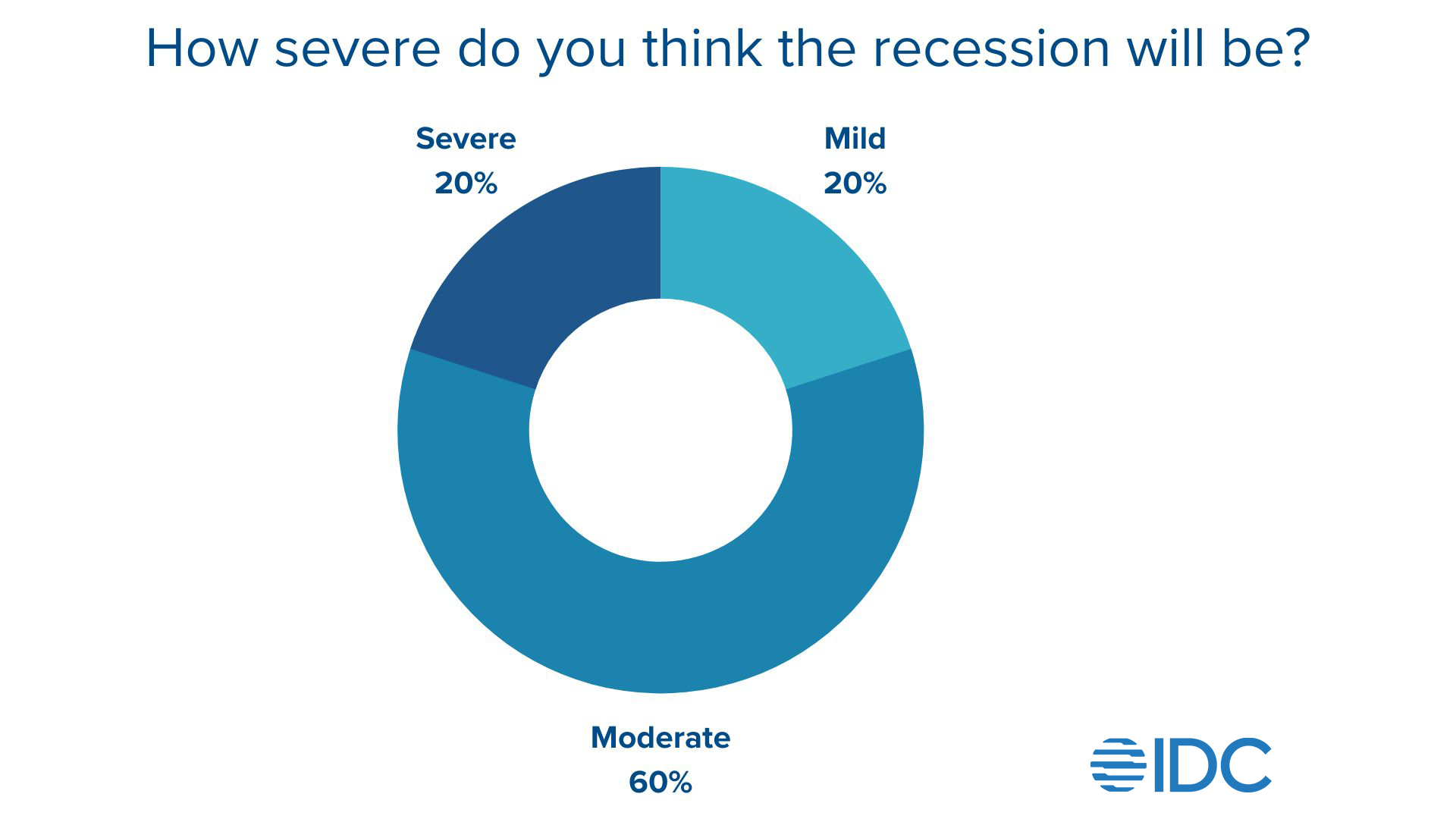
The extent to which tech buyers decrease their IT spending will depend on how severe they perceive the recession will be. According to IDC’s latest FERS data, 55% of enterprise tech buyers believe there will be a moderate recession that will last 6-9 months. But this sentiment varies by region:

  • North American buyers tend to be most optimistic with one third anticipating a mild recession
  • Asia Pacific buyers tend to be in the middle of road with 60% anticipating a moderate recession
  • Western Europe buyers are most pessimistic with 30% anticipating a severe recession

Based on this current outlook, we have run a downside scenario for Worldwide IT Spending in 2023. In this scenario, IT spending is expected to grow 4% in 2023, compared to our current forecast of 6.3%. Our research shows buyers are not planning to make wholesale cuts across all tech categories. Rather they will be selective about where they cut.

We believe previous recession playbooks will not be as effective as technology increasingly becomes sold and delivered “as a service” and used to drive digital business models.

In the past, the playbook consisted of 3 key maneuvers:

  1. Delay capital expenditures by extended PC and infrastructure upgrades
  2. Cut labor costs, especially contract staff
  3. Delay the launch of new IT projects by a year

Why won’t these maneuvers have the same impact in an “as a service” and digital economy?

  1. While enterprise will delay capital expenditures, it will not have as much of an impact as more of the IT budget is made up of operating expenses via “as a service” contracts. In fact, a recession could drive organizations towards more OPEX-based infrastructure expenditures sooner than they had planned, as they seek alternatives to potential CAPEX budget cuts.
  2. Organizations are less likely to cut labor as there continues to be a skills shortage, especially around security and digital skills. Our research shows 42% of organizations increased their use of contract labor to address shortages in labor.
  3. Delay the launch of new IT projects by a year. As technology is more closely tied to digital business goals like new revenue streams, organizations will only cut those projects with the lowest business impact. For example, a manufacturer may keep their connected products project because it is tied to 2023 revenue stream. But they may delay a project to experiment with the metaverse in their augmented maintenance program because the business impact is not clearly defined.

What tech suppliers can expect in 2023:

  • Enterprises will increasingly set up and utilize IT FinOps teams to optimize cloud spend. According to our Cloud Pulse survey, 2/3rds of organizations report they are overspending on cloud by 30% or more.
  • They will renegotiate XaaS contracts to embed price certainty. For example, they may negotiate a 4-year contract, as opposed to 3 years, to lock in the price or the price increase.
  • They will eliminate SaaS tools that provide redundant functionality. For example, if they have both Zoom and Teams, they may eliminate one.
  • They will reprioritize their open projects with the lens of short-term business impact.

Don’t miss similar blogs, where we discuss the recession on tech markets, planning and how to scale digital business.

Related Reading:

  • Technology Strategy Research and Insights: Ms. Whalen’s international team of 1,100 analysts leverage research and advisory services to empower business transformation for the Global 2000, and counsel technology suppliers on creating effective offerings for the digital economy. Meredith Whalen (idc.com)

  • IDC’s Guide to market sizing in an overheated economy:  Download our free guide to help you build a resilient strategic plan that helps you respond faster to change.  

Meredith Whalen - Chief Research Officer - IDC

As IDC's Chief Product, Research & Delivery Officer, Meredith Whalen leads the company's global product, research and data, and delivery organizations. Under her leadership, IDC delivers cutting-edge intelligence to the world's leading technology vendors, enterprises, and investors as they navigate the evolving AI economy. Meredith sets the strategic direction for IDC's global analyst community, shaping research methodologies and agendas that generate industry-leading data and actionable insights to drive high-impact business decisions. With more than 20 years at IDC, Meredith has been a catalyst for some of the company's most transformative initiatives. She founded IDC's Industry Insights and Tech Buyer business units and pioneered the industry's first comprehensive business use case taxonomy. She also led the creation of IDC's DecisionScape methodology-a strategic framework that empowers organizations to better plan, implement, and optimize their technology investments. A recognized thought leader and sought-after speaker, Meredith regularly delivers keynotes at major global technology events and advises senior executives on the trends shaping the future of business and technology. Meredith holds a B.A. with honors from Wellesley College and an MBA with honors from Babson College's F.W. Olin Graduate School of Business.

The energy transition is gaining momentum as utility organizations aim toward net zero emission goals. The power sector has large influence on the energy transition as utilities and power companies continue to build out additional renewable and distributed energy resources energy resources and environmentally clean paths to electrification. Utilities and independent power producers are making significant investments to diversify their energy portfolios, and consequently these investments will force the energy industry as a whole to vastly improve its digital capabilities.

The utilities and power sector produce some of the highest CO2 emissions across the globe. The energy transition: the movement away from fossil fuels and the investment in renewable and cleaner forms of energy, has put utility and power companies under scrutiny, but it has also put these companies in a position to lead in efforts to reduce global CO2 emissions and establish a cleaner future for the energy sector.

Distributed energy resources will play a huge role in the efforts towards net zero emission for the utility sector. The proliferation of distributed energy resources (DERs) globally has spurred investment and research and development (R&D) efforts in creating innovative technologies that can enable utility distribution networks to manage dispersed and cleaner forms of energy in the most optimal and economical manner. Distributed energy resource management systems (DERMSs) are becoming essential software offerings to help manage the power grid.

In addition to the continued growth of utility connected renewable energy resources such as wind and solar farms, utility distribution operators are now being challenged with growing number of customer-owned DERs that can impact their utility footprint such as rooftop solar, battery storage, and electric vehicles. The expansion of DERs along with the environmentally conscious choices electric customers pursue in the ways they consume, produce and, in some cases, sell excess energy back to their utilities to participate in wholesale and distribution-level power markets is changing the traditional centralized utility system model to one that is more complex, customer driven, and decentralized.

Electricity end users and utility customers will be key in advancing the energy transition and further developing the DERMS market. Currently, one of the fastest-growing DERs is rooftop solar. Rooftop solar plus the ability to effectively manage energy storage will be a cornerstone for any DERMS.

Electricity customers’ participation in the energy transition can be driven by being incentivized to own DERs and participate in clean energy utility programs which can increase the impact on demand response and the increased adoption of electric vehicles which in turn will drive growth and contribute to the inevitable need for DERMSs.

Keep in mind a DERMS is not a one-size-fits-all product. Every utility, distribution system operator, DER owner, operator, and market participant will have their own unique set of needs and circumstances as it relates to distributed energy resource management. Many utilities may be at vastly distinct stages of maturity from a technology and distributed energy resource market penetration standpoint. Utilities will need to understand immediate needs and also be able to forecast and have a vision for future obstacles and challenges in managing DERs. Most DERMS offerings are built to be flexible and can be bought in modules, providing buyers the option to purchase what is needed now and for the near future while having the opportunity to purchase additional modules that may become more important down the line. The trends and evolution of the energy transition, growth in DERs and DERMs will be interesting to track and analyze with the utility and power sector as focal point in the world’s progress toward a cleaner energy future.

For more content that dives into the technologies that are responsible for progressing the world toward a cleaner tomorrow, watch the video, “Energy Insights: Utilities”. Click the button below to watch the video.

John Villali - Sr. Research Director - IDC

John Villali is a Senior Research Director for IDC Energy Insights, primarily responsible for thought leadership in the area of digital strategies for the energy and utilities sector. Villali has an impressive background in power, natural gas and oil markets. Villali's expansive experience within the energy industry allows him to provide superior market insights by having first-hand experience understanding the needs and ambitions of energy industry customers. Villali's areas of expertise and focus of his research include: power, natural gas and oil supply, demand, and fundamental drivers of price, commodity trading risk management, transmission congestion analysis, energy sector digital strategies, demand management and demand response, energy policy, generation, transmission, distribution, asset valuation, asset performance management, energy storage, renewable energy, distributed energy resources and the energy transition. BACKGROUND Villali's skillsets stem from a deep history in the North American power and natural gas markets. That experience has given him the ability to expertly evaluate and communicate the intricate challenges that face the energy industry today. Previous to working at IDC, Villali worked as a Principal Consultant, with a concentration on global wholesale and retail power markets at DNV-GL. Before his time at DNV-GL, he was Head of Americas Power at Thomson Reuters, supporting their Commodities and Energy division. Villali has additionally held senior energy industry roles at other prominent businesses such as: Cambridge Energy Research Associates (now part of S&P Global), RWE Trading Americas, Genscape (now part of Wood Mackenzie), and the Science Applications International Corporation. EDUCATION/INDUSTRY ACCOMPLISHMENTS Some of Villali's energy industry accomplishments include a vast practice and study of wholesale power market fundamentals, integrated electric resource planning, statistical analysis of electric utilities generation output, and the impact of renewable energy and demand-side management (DSM) on global electric power markets. Villali has extensive experience building energy market analytic products for commodity traders. In his time at Thomson Reuters Villali and his team were awarded the Energy Risk's Innovation of the Year for creating and launching a Brazilian wholesale power market trading tool. Villali's educational background includes a Bachelor's Degree in Economics and a minor in Sociology from the University of Massachusetts at Amherst.

During the summer in Spain religious pilgrims head west for the Camino de Santiago and come November smart city pilgrims head east for the World Smart City Congress in Barcelona. It is the premier global Smart City event held in the city that can arguably claim to have started the movement. 

Last year I wrote a post-event blog likening it to Santa Claus’s Smart City Grotto and expressing concern at the lack of blue-collar solutions. This year I hope I will find:

  • Blue Collar Smart City Solutions. The world is arguably in a more challenging situation than it was last year, with energy probably the greatest concern for the economically vulnerable, and cities are being asked to do more with less funding. Nothing new in that. However, Covid has not gone away, and the majority of local authority spending was already used on social care and health. Cities need to find ways to tackle energy poverty, including changing citizens’ energy behaviour.  I am hoping to see that tech vendors have recognised the outcomes that cities require and are offering solutions for place-based health, behavioural change, mobility, integrated services, and greater data sharing for more targeted assistance.
  • New Partner Ecosystems Between Industry Verticals. It is great to see that there will be elements of the architectural, engineering and construction (AEC) companies taking part in this year’s event. After social care and health, the second largest third-party expenditure of local authorities is on the built environment. Last year, the system shock of the pandemic and a recognition of the need to combat climate change gave COP26 the mandate it needed to put ESG and the UN SDGs centre stage.  However, in recent months there has already been an element of stepping back from green initiatives as the energy crisis has risen.

A new ecosystem of stakeholders is required to deliver on the opportunity of sustainable urban development. The built environment ecosystem is a confederation of interests: national and local governments engage AEC firms that in turn are supported by technology, utilities, and energy and telco companies. Between these actors, there is alignment on the need to share data and develop a more people-centric, data powered sustainable urban environment.

The Barcelona World Smart City Congress is an important showcase of what is possible through technology and must continue to be so. Equally, as well as gazing into the future, vendors need to be offering solutions for the immediate challenges faced by cities. Let’s see what Santa has put under the tree.

A global IDC team will be taking part at the Congress, speaking and on panels such as Technology Paving Tomorrow’s Towns , Urban Readiness for Refugee Crises, and Digital Twins to AI-Powered Metaverse Design Platforms.  We have a booth for the three days of the conference, and we would be happy to meet with people to discuss any of the above.

For more information on our coverage of government and the public sector, visit our website.

Digital is the new normal

Today’s world is digital. In our personal lives, we buy digital products, and we consume services through digital channels. Popular entertainment, like movies, television, music, and other media are delivered via online streaming platforms which we seamlessly consume across phones, laptops, and televisions. Physical goods, like groceries, books, toys, computers, and more—things which formerly required us to visit a store to acquire—are now delivered right to our door at the click-of-a-button, or more impressively at the vocal command of a digital assistant.

In our work lives, we produce our value in digital environments, and we manage ourselves with digital tools. Paperless offices are more common than ever, and the market for SaaS and cloud software is forecast for double-digit growth into the foreseeable future, with companies like Microsoft and Salesforce leading the charge. Even in-person and/or analog services (such as training and enablement, consulting, and other professional services) have transformed to offer digital alternatives.

Gain the insight to go-to-market confidently with data

Technology suppliers need accurate market data to help them size and analyze markets, identify and capitalize on sales opportunities, evaluate partnerships and alliances, and hone operational best practices. 

As author and futurist, Geoffrey Moore, puts it: “Without big data analytics, companies are blind and deaf, wandering out onto the web like deer on a freeway.”

Or, to put it another way, without data, tech companies are left to go on gut instinct and intuition to direct critical business decisions; an unenvious position for any technology executive to be in.

Critical applications for data in a tech marketing strategy

While the use cases for data extend well beyond marketing and sales, it’s value can most readily be seen in support of commercial activities. Here are four key areas where data is crucial for business success:

1.       Confident Decision Making

Minimize executive doubt by integrating data into decision-making processes. Prioritize product roadmaps, identify sales targets, generate leads, retain customers, and more with the right data.

Data is logical and intuitive.  When companies have proven facts, they can be confident in the decisions being made for the organization. Data gives the ability to understand the market and pinpoint areas of weakness for the business and helps identify how to adjust as needed.

For instance, when analyzing the best approach for a new entry or further penetration of a market, a tech company must consider how leveraging channel partners can expand their own reach to meet the needs of both the short-head and long-tail. This vast and complex ecosystem may require many partnerships and alliances to effectively serve the market in question and meet growth objectives. Reliable data can help you decide which channel partners to engage, or if merger and acquisition activity makes more sense.

2.       Highly Targeted Marketing

Clients are inundated with marketing coming in all different formats and from many different brands.  Every business is fighting for mindshare. Keep abreast of market trends and stand out from the competition with resonant, data-informed branding and messaging.

It is imperative for a company to be able to market itself as a solution to niche problems and connect with customers on an emotional level using data. The right analytics provides an organization with the information to be a thought leader and helps inspire content that is meaningful to its audience.

When a technology supplier can effectively segment their market into similarly characterized groups of customer targets, they can easily understand the pain points of the customer and how their solution addresses them. This powerful insight translates into impactful value propositions and strong go-to-market messages.

3.       Intelligent Partnerships

Companies today have many underperforming partners that generate significant expenses.  Reveal partnership opportunities not immediately apparent with detailed market data and optimize your strategy with data.

Understand buyer personas and journeys on a new level and address the long-tail market needs with the best possible partners. Quickly find answers to critical questions like what can partners do, where, and with whom?

A common challenge for technology marketers is finding unattached partners before their competitors do. Too many companies spend months going after prospects that in the end provide no value. The right market intelligence can rapidly provide partnership opportunities, revealing insights in minutes that companies would otherwise spend months developing in-house.

4.       Optimized Operations

Become a leaner, more competitive organization with spend and performance benchmarking insights. Invest the right amounts in the right areas to maintain and grow market share while cutting costs to become more profitable.

Data gives tech companies the insights needed to improve efficiency and get more done with less time and resources.  Eliminate and reduce unnecessary processes with data-driven decisions. This not only applies to the product and services offered, but to human resourcing decisions as well.

The use cases for operational efficiencies abound across technology organizations. To just name a few:

  • Sales reps can save time in pursuing partnerships that do not make sense. 
  • Ops managers use data to analyze supply chain issues.
  • Product teams can find the bottlenecks in production to run smoother operations.

Analytics also provides the business models needed to implement intelligently conceived pricing strategies. By using data effectively, tech executives can also understand how a change in cost and services affects customer demand to protect the bottom line.

IDC’s foundation of data and insights covers a breadth of technologies, geographies, and industries to provide clients with the key IT data that is critical for their business. Get the insight to drive success with IDC’s Data & Analytics Solutions.

Related Reading:

Agriculture has always had a data problem. After the invention of writing around 3500BCE, Nisaba, the Sumerian goddess of grain, became the goddess of grain, writing, accounting, and surveying. Like farmers of today, even a goddess of grain had to tackle the problem of on-farm data. The oldest examples of ledgers from around the same period record the inventories and distribution of wheat, barley, and other crops on clay tablets. The invention of writing and accounting was a technological solution to an agricultural problem, one of the first examples of AgTech that has drastically changed the world. Today AgTech has the potential to change our world once again.

Throughout history, most of the food produced was consumed on farm or processed and sold locally in limited quantities. Until the 1930s, the average farmer produced enough food to provide for ten people. In the last century, however, yield per acre has increased exponentially. Today, the average farmer produces enough food to feed over 150 people and is doing so more and more efficiently. Mechanization, advances in agronomy and understanding of genetics have bore fruit (pardon the pun) and much of the progress has come from robust research and development by universities, agribusinesses, and farmers. This massive increase has been known as the green revolution. Ultimately, this progress has been achieved through the harvesting of raw data around crop yield, quality, and economics to inform best practices on the farm.

Economically, this increase in production has not translated to an increase in value for raw food. The main increase in value from agriculture production from the Green Revolution has been by the value-added supply system. Most food enters a complicated global supply chain. Raw foods are gathered, cleaned, stored, sorted, shipped, blended, processed, combined with other ingredients to produce a bevy of products that are transported to waiting consumers adding magnitudes more commercial value than the raw food had in its local market. Wheat left to spoil in a field has no value compared to raw wheat stored in a silo, but bread is ten to one hundred times more valuable than siloed wheat. Furthermore, wheat left uncleaned in bins will inevitably loose value over time or it may spoil and become useless. We are seeing similar trends with on farm data.

Over the last several decades we have entered the next agriculture revolution, Agriculture 4.0. Farmers have increased the amount of data being harvested from the fields along with their crops and many understand that this data has value. The average farmer generates 500,000 data points every day but not all of this is valuable. Data collected ranges from satellite data to equipment sensors readings to handwritten notes. By 2036, the amount of data collected daily is expected to increase by 800 percent, a growth driven largely by the proliferation of sensors and other connected technologies. Just as there are different qualities of crops harvested, there are different qualities of data collected and data quality determines value. Often, the process of analyzing this information is too cumbersome for the average farm, meaning most data is either not collected, goes unused sitting in data silos losing value, ultimately spoiling or is simply wasted. Similar to wheat unharvested in a field, data that is not recorded has no value whereas siloed data will only depreciate in value compared to data connected to a supply network. Dissimilar to wheat, raw data coming from the farm does not have a robust market to enter, but this is beginning to change.

Traditionally, information gathered on farm was either used to improve processes leading to greater yield or to bolster certification claims (e.g. Certified Organic), adding value to the physical product itself. As more information is associated with the physical product, the value of those products increases, allowing farmers to distinguish their product and target premium markets. For those higher up the value-added chain, more data can allow processors to match variability in crop quality caused by genetics and growing conditions to their facilities processes, thereby optimizing their returns. We can see this process continuing the length of the value chain, with AgTech firms collecting data and passing it from the farm gate to the end consumer. This allows retailers to back marketing claims (helping to avoid or defend against lawsuits), matching products to customers needs (or values), and building consumer loyalty. More vertically integrated industries such as pigs and poultry are realizing that circular sharing of this information can rapidly increase efficiency, productivity, and value. Information collected throughout the production system in pigs can help products enter specialty markets, reduce the size of recalls, match feeding practices to quality outcomes. At an extreme information collected at the retail level around customer preference can be used to inform genetic selection.

Increasing data collection and data sharing will benefit every stage of the supply chain. It will increase efficiency, lower costs, and reduce waste. In less vertically integrated supply chains, the challenge with data is to incentivise the primary producer to take the effort to gather the information in the first place. Promise of premiums has been the customary incentive in programs such as organics markets but this has had limited success and by their very nature premiums are not scalable. To increase data collection at scale, data must be shown to have intrinsic, real world, economic value. For data to have value it must be shared, processed, packaged, and have a market. To have a robust market an industry ecosystem approach is key.

The carbon offset market may be a tipping point for data in agriculture. While there is much debate around what data should be collected, how it should be collected and even if carbon offsets should exist, this market is building a framework which decouples farm data from crops and gives it intrinsic value. While much of this market is still in flux, the basics of harvesting and processing data, regulating its quality, validating, and marketing are being set in place. Farmers who can bring this data to market are directly rewarded and often find themselves able to use this data for other financial incentives including clean water or biodiversity incentives. Partners with carbon offset programs find themselves able to make money from adding a service to both farmers and carbon offset hungry clients. Furthermore, several of these industry partners can themselves use these programs to market climate friendly products to farmers or increase their social license in an increasingly value oriented consumer market. As more primary producers realize the economic benefits of collecting and sharing data those industry partners that understand the potential of data will be the next winners in the agriculture 4.0 revolution.