生成式AI正以前所未有的速度渗透到企业的核心业务中——无论是研发、运营还是客户服务,AI都在重塑我们的工作方式。但你有没有注意到,随着AI系统架构越来越复杂,安全风险也在同步升级?

过去我们担心的只是模型越狱、敏感信息泄露这些“老问题”,现在,提示注入、知识库投毒、工具滥用、智能体越权、多智能体协同攻击等新型威胁层出不穷。企业的安全治理对象,早已从单一模型扩展到整个生成式AI应用系统,安全边界变得模糊且动态。

安全评估的方式也在快速演进——从人工测试到自动化红队、从静态规则到动态风险评分,再到如今覆盖RAG、智能体和系统级的持续安全监测。企业管理者们越来越关心:我的AI系统到底有多“可信”?上线前后如何持续掌控风险?

IDC认为,生成式AI安全评估平台正从“单点测试”走向“系统级守护”,未来将深度融入AI开发、部署、运营和治理的每一个环节,实现从一次性检测到全流程、持续的安全验证。只有这样,企业才能真正让AI成为安全、可信的生产力,而不是新的风险源。

国际数据公司(IDC)特别针对中国市场发布了《IDC MarketScape:中国生成式AI的安全评估平台厂商评估,2026》(Doc# CHC54110426,2026年8月)研究报告,IDC针对入选的提供商的能力和战略进行综合评估,评估标准包括收入规模、产品技术能力、行业和客户拓展、生态系统建设以及未来发展战略等方面,综合分析并确定各厂商在IDC MarketScape中的相对位置,并探讨厂商的特点和战略,总结发展趋势,为企业级客户选择生成式AI的安全评估平台能力提供商提供参考。

报告揭示了一个关键信号:IDC认为,头部厂商的竞争焦点已从“单点测试工具”转向“系统性安全治理平台” ——这一转变直接决定了企业该选择什么样的合作伙伴,以及该用什么样的标准去判断谁更值得信任。报告的完整评估结果与厂商定位分析,可向IDC进一步了解。

未来,企业关注的不再只是模型是否能够抵御越狱攻击,而是更加关注整个AI应用系统在实际业务场景中的安全表现,包括知识库安全、智能体运行安全、工具调用安全以及业务流程安全等多个方面。与此同时,评估能力也将逐步融入企业AI开发、部署、运营及治理全过程,实现由”一次性安全测试”向”持续安全验证”转型。

生成式AI的安全评估平台未来演进方向

  • 评估对象持续扩展。随着生成式AI技术持续向智能体、多智能体协同及具身智能等方向发展,企业AI系统的复杂度和应用边界将不断拓展。未来,生成式AI的安全评估平台将逐步突破单一模型评测范畴,形成覆盖基础模型、AI应用、智能体、具身智能及相关生态组件的综合评估体系,持续提升对新型AI应用场景的风险识别与安全验证能力。
  • 评估体系更加完善。未来安全评估将更加注重建立统一、标准化的评估体系,在覆盖风险类型、评估维度及评价指标等方面持续完善,提高不同产品之间评估结果的可比性,为企业提供更加客观、可信的评估依据。
  • 智能化能力持续增强。人工智能技术将进一步融入安全评估过程,自动化红队测试、智能风险分析、攻击样本自动生成及评估结果智能分析等能力将不断成熟,进一步提升风险发现效率和评估质量。
  • 持续评估能力成为核心竞争力。安全评估将逐步融入企业AI研发、测试、部署及运营全过程,形成覆盖模型上线前验证、运行中监测以及版本迭代评估的持续安全验证体系,为企业提供动态、实时的风险管理能力。
  • 平台化能力不断提升。未来生成式AI的安全评估平台将进一步与AI开发平台、安全运营平台及AI治理平台深度融合,由独立评估工具逐步发展为企业AI安全治理的重要基础设施,为企业构建可信生成式AI体系提供持续支撑。

IDC给技术买家的建议

  • 建议结合企业AI应用现状制定评估需求。不同行业、不同规模企业的生成式AI建设阶段存在较大差异,安全评估需求也各不相同。技术买家应结合自身AI应用场景、业务规模及安全治理目标,明确评估范围和重点,避免单纯关注评测数量或功能覆盖,而应重点考察产品是否能够满足企业实际业务需求。
  • 建议重点关注评估体系的科学性和完整性。安全评估平台的核心价值不仅体现在风险发现能力,更体现在评估体系的完整性和结果的可信度。技术买家应关注产品是否建立了完善的评估指标体系、风险分类体系及评分机制,评估结果是否具有可解释性和可追溯性,是否能够为企业风险治理提供有效依据。
  • 建议关注产品的持续演进能力。生成式AI技术快速发展,新的应用形态和安全风险不断出现,安全评估平台需要持续更新评测能力和风险场景。技术买家应重点考察厂商在技术研发、规则更新、测试场景维护及产品迭代方面的能力,确保产品能够适应未来AI技术的发展需求。
  • 建议关注平台的开放性与生态兼容能力。企业AI应用通常涉及多个基础模型、开发框架及业务平台,安全评估平台应具备良好的开放能力,支持多模型、多场景及多种部署方式,并能够与企业现有AI开发平台、安全运营平台及治理体系实现有效集成,降低后续建设和运维成本。
  • 建议将安全评估纳入AI治理体系建设。生成式AI的安全评估不应作为模型上线前的一次性测试,而应贯穿AI研发、部署、运营及持续优化全过程。技术买家应推动安全评估与AI开发流程、安全运营流程及风险治理机制相结合,逐步建立持续、动态的生成式AI的安全评估机制,提升企业整体AI安全治理能力。
  • 建议结合实际业务场景开展产品验证。生成式AI的安全评估平台的能力最终需要在真实业务环境中得到验证。技术买家在产品选型过程中,建议结合自身AI应用场景、典型业务流程及安全需求开展概念验证(PoC),重点考察产品在风险识别准确性、评估覆盖范围、自动化水平及评估结果稳定性等方面的实际表现,避免仅依据产品演示或功能清单进行判断。
  • 建议综合评估厂商的持续服务与运营能力。生成式AI的安全评估是一项持续性的工作,产品能力需要随着AI技术演进和风险变化不断更新。技术买家除关注产品功能外,还应重点评估厂商的技术研发能力、评测体系更新能力、行业实践经验、专业服务能力及持续运营支持能力,优先选择能够提供长期技术服务和持续能力演进的合作伙伴,为企业生成式AI安全治理提供长期支撑。

IDC中国网络安全分析师陈佳表示,生成式AI安全评估平台正由早期合规检测工具向企业AI治理的基础安全能力平台演进,企业关注点从“可用”转向“安全、可靠、可控”,平台能力覆盖模型、数据、内容、智能体安全及持续运营管理。随着行业标准完善,评估指标、测试集和自动化能力成为厂商差异化关键,未来相关能力将平台化融合,推动生成式AI从“可用”迈向“可信”。

进一步交流

生成式AI安全治理进入关键阶段。IDC持续关注生成式AI安全评估平台技术演进与市场实践,助力企业识别模型风险、完善治理体系、构建可信AI能力。欢迎联系IDC,获取行业洞察与定制化评估服务,共同探索生成式AI安全落地新路径。

Jackson Chen

Jackson Chen - Research Analyst

Jackson Chen is a research analyst for IDC China's Emerging Technology Research department, whose focus is on research of the business sector of the China data security market. Jackson is also responsible for providing relevant security research and consulting services…

8月19日,2026世界机器人大会(WRC 2026)在北京亦庄开幕。今年大会以“人机共生,产需共融”为主题,并首次设置采购日,49家央企携12个应用场景集中亮相,进一步强化产业供需对接。

从大会主题和组织形式来看,机器人产业正从技术展示和单点突破,逐步转向产品交付、场景落地与产业协同。随着机器人本体、AI模型、核心零部件和数据基础设施持续发展,产业竞争也正从单一产品能力转向软硬件、数据、模型与应用场景的综合能力竞争,WRC 2026成为观察这一变化的重要窗口。

从技术展示走向需求验证,产业化进入关键阶段

近两年,人形机器人、四足机器人和具身智能等方向持续获得资本和产业关注,运动控制、环境感知、智能决策和操作能力不断提升。国际数据公司(IDC)用户调研显示,中国具身智能机器人正从展示型创新逐步进入价值验证与规模复制阶段,超过20%的用户已从关注进入试点探索。

今年WRC首次设置采购日,进一步强化产业需求导向。与此同时,政策也持续推动机器人进入真实应用场景,通过实景实训专项行动、央企机器人创新联合体等方式,加快B端需求释放。

随着机器人进入真实场景,商业化评价标准也将从功能和技术指标进一步延伸至任务成功率、连续运行能力、故障率、部署成本和ROI等指标。需求能否转化为订单、POC能否进入批量部署,将成为衡量产业化成熟度的重要指标。

Physical AI加速重塑机器人智能化路径

机器人从技术展示走向场景落地,也推动Physical AI进入产业视野。Physical AI代表AI从数字世界走向物理世界的技术与产业范式,其核心是让AI具备对真实物理环境进行自主感知、理解、决策和行动的能力;具身智能机器人则是其重要的物理载体。

IDC 2026年全球CEO调查显示,35.2%的受访CEO将Physical AI列为未来12—24个月重点关注的新技术投资方向。在WRC 2026,世界模型、视觉-语言-动作模型(VLA)等技术正加速与机器人本体、运动控制和数据系统融合。

从产业化角度看,关键不只是机器人“有多智能”,更在于模型、数据、本体与应用场景能否形成有效闭环,并在真实环境中稳定运行、持续迭代。这将成为Physical AI走向规模化应用的重要验证。

六大产业环节共同构成Physical AI产业基础

Physical AI的发展正在突破单一机器人本体或AI模型的边界,逐步形成由算力、模型、数据、本体、核心零部件和应用共同支撑的产业体系。

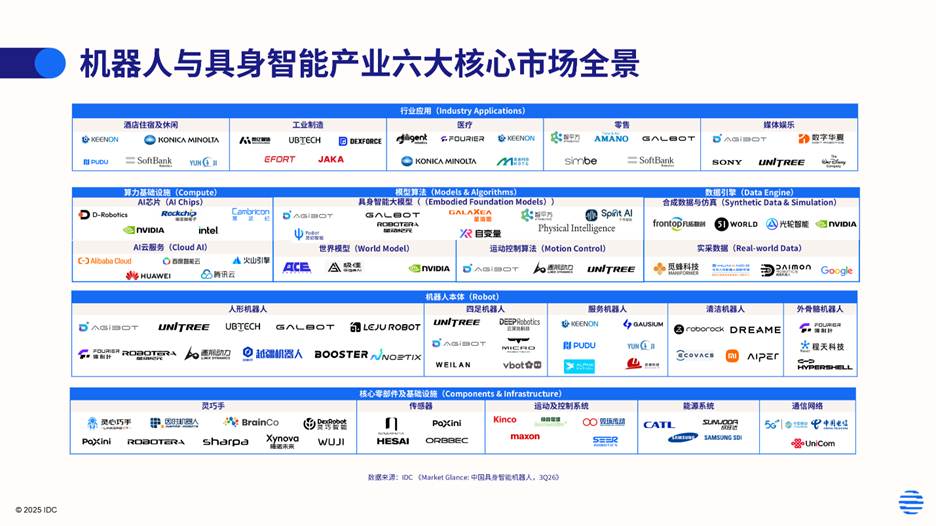
IDC最新发布的《MarketGlance: 中国具身智能机器人,3Q26 》报告,将当前机器人与具身智能产业划分为六大细分市场:算力基础设施、模型算法、数据引擎、机器人本体、核心零部件与基础设施,以及行业应用智能体。六大环节共同构成具身智能机器人从自主感知、理解、学习到行动的完整产业链。

这一产业格局也在WRC 2026得到集中呈现。智合、智创、智造、智趣四大展馆覆盖从底层技术、核心零部件、机器人本体到行业应用的多个环节,呈现出机器人产业由单一整机竞争向全产业链协同和生态竞争演进的趋势。

WRC 2026值得关注的四个趋势

基于对产业链和技术发展的持续跟踪,IDC认为,今年WRC有四个趋势值得重点关注。

竞争从“技术领先”转向“交付领先”。

机器人产业真正的分水岭正在从Demo能力转向稳定运行和规模交付能力,企业能否完成从技术验证到批量部署的跨越,将成为下一阶段竞争的重要差异化因素。

机器人从“能力展示”走向“价值验证”

市场关注点正从机器人形态和单项技术能力,进一步转向任务完成能力、运行稳定性、应用效率和经济性。随着人形、四足及其他具身智能机器人加速进入真实场景,能否稳定完成实际任务并形成明确的应用价值,将成为下一阶段商业化竞争的关键。

Physical AI从“模型竞赛”走向“真实世界学习竞赛”。

模型能力只是起点,数据获取、场景泛化和持续迭代能力将成为新的技术壁垒。能够通过真实场景持续积累数据并反哺模型的企业,有望形成更强的智能化能力闭环。

产业竞争从“整机竞争”走向“生态竞争”。

随着模型、数据、本体、核心零部件与应用之间的联系不断增强,企业的竞争边界正在从单一产品延伸至产业链协同能力,生态构建能力的重要性持续提升。

IDC观点:机器人产业进入能力与商业化并重阶段

WRC 2026释放的信号表明,机器人产业正从技术能力竞争转向产业化能力竞争。随着本体、模型和核心零部件持续成熟,稳定运行、规模交付、数据积累和软硬件协同能力将成为下一阶段竞争关键。

未来2-3年将是具身智能机器人从技术验证走向规模化应用的重要窗口期,不同场景将呈现分层落地特征:服务场景率先开展探索应用,工业场景将成为具身智能机器人规模化落地的重点方向,家庭消费市场则具备长期发展潜力。与此同时,Physical AI将推动产业竞争从单一硬件能力向“模型+数据+本体+应用”的系统能力演进。

WRC 2026的开幕,是观察这一变化的重要节点。IDC分析师团队将在现场持续关注应用落地、Physical AI技术进展及产业链竞争格局,进一步复盘WRC 2026,敬请关注IDC中国后续研究与现场探展内容。

进一步交流:

机器人产业正站在从技术验证迈向规模应用的关键节点。若您关注Physical AI落地路径、具身智能场景价值或产业链竞争格局,欢迎与IDC中国分析师团队深入交流。我们将结合WRC 2026现场观察与持续研究,为您提供定制化洞察与数据支撑。点击此处联系我们。

Lily Li

Lily Li - Research Manager

Lily is the Research Manager for China Robotics and Embodied Intelligence, specializing in market research on embodied intelligent robots. She has long focused on the development trends of China’s embodied intelligence robotics industry, systematically studying the evolution of robot hardware,…

At AMD Advancing AI 2026, held on July 23, 2026, at the Moscone Center in San Francisco, California, AMD presented a broad AI strategy that spans cloud infrastructure, enterprise AI, client computing, robotics, and embedded systems. The event brought together developers, customers, ecosystem partners, and enterprise leaders to discuss how AMD’s end-to-end AI portfolio is evolving from silicon through software.

Financial Momentum Supports the AI Strategy

The announcements came shortly before AMD reported its second-quarter 2026 financial results. The company delivered record revenue of $11.5 billion, representing 50% year-over-year growth, while datacenter revenue more than doubled compared to the prior year. AMD attributed this growth to accelerating demand for EPYC processors, expanding Instinct deployments, and increasing AI infrastructure investments across the market.

A Vision Beyond Silicon

While hardware announcements often dominate AI events, the broader message from Advancing AI 2026 was AMD’s effort to create a unified AI development experience. The company’s strategy aims to enable developers to build AI applications on local systems, optimize them with a common software framework, and deploy them consistently across enterprise, cloud, edge, and robotics environments using the same foundational platform.

Building an Open AI Software Foundation

A key pillar of AMD’s strategy is its continued investment in open software. AMD reported that more than three million Hugging Face models run out of the box on AMD platforms, while many of the industry’s leading open-source AI projects now offer native AMD support. The company also highlighted significant growth in open-source contributions and ecosystem partnerships as part of its software expansion efforts.

ROCm Evolves from Platform to Development Ecosystem

AMD’s ROCm platform has evolved from a GPU programming environment into a broader AI software stack that supports frameworks, libraries, developer tools, and optimization capabilities. AMD positions ROCm as the common software layer that enables portability across its AI hardware portfolio, from client systems through hyperscale infrastructure.

Introducing ROCm.ai

Among the notable software announcements was ROCm.ai, an AI-driven development platform designed to help developers build, optimize, and deploy GPU applications more efficiently. ROCm.ai enables popular coding assistants such as Claude, Codex, Cursor, and Gemini to understand AMD hardware architectures and ROCm workflows natively, helping reduce the learning curve associated with GPU optimization.

AI-Assisted Performance Optimization

AMD also introduced capabilities that leverage AI to improve application performance. Through technologies such as Hyperloom, ROCm.ai can establish performance baselines, profile workloads, identify bottlenecks, tune serving configurations, generate optimized GPU kernels, and validate performance improvements. This represents a shift toward AI-assisted software engineering where optimization becomes increasingly automated.

Extending AI Development to the Desktop

AMD’s vision extends beyond the datacenter. With the Ryzen AI Halo developer platform and upcoming systems powered by Ryzen AI Max PRO 400 Series processors, AMD aims to make advanced AI development accessible on desktop-class hardware. These systems provide developers with local environments capable of running increasingly sophisticated AI workloads while maintaining compatibility with larger AMD compute environments.

Ryzen AI Halo developer platform, source: AMD, 2026

Developing Locally, Scaling Globally

A notable aspect of AMD’s approach is software consistency across deployment environments. AMD presented ROCm.ai as supporting systems that range from AI PCs and workstations to rack-scale AI infrastructure and datacenters. This approach creates a workflow where models can be developed and tested on local hardware before being deployed at cloud scale using the same software foundation.

Enterprise AI and Hybrid Deployment

AMD also highlighted a collaboration with Cisco designed to combine AMD AI inference platforms, including Ryzen AI Halo systems, with Cisco networking, security, observability, and management capabilities. The goal is to help enterprises deploy, govern, and manage hybrid and local agentic AI deployments while maintaining operational consistency across environments.

Extending AI into Robotics and Physical Systems

Another major theme of the event was AMD’s expansion into Physical AI. As AI moves beyond digital environments into machines that perceive, reason, and act in the physical world, AMD is positioning its technology portfolio to address robotics, industrial automation, healthcare, and autonomous systems. AMD estimates that the Physical AI silicon market could reach $200 billion by 2035.

Introducing the Kria AI Portfolio

To address this opportunity, AMD introduced the Kria AI solutions portfolio, extending its presence from traditional robotics control systems into higher-level robot intelligence. AMD describes this as bringing together perception, reasoning, decision-making, and control capabilities on a unified platform designed for demanding robotic workloads.

Ryzen AI Embedded X100 Series

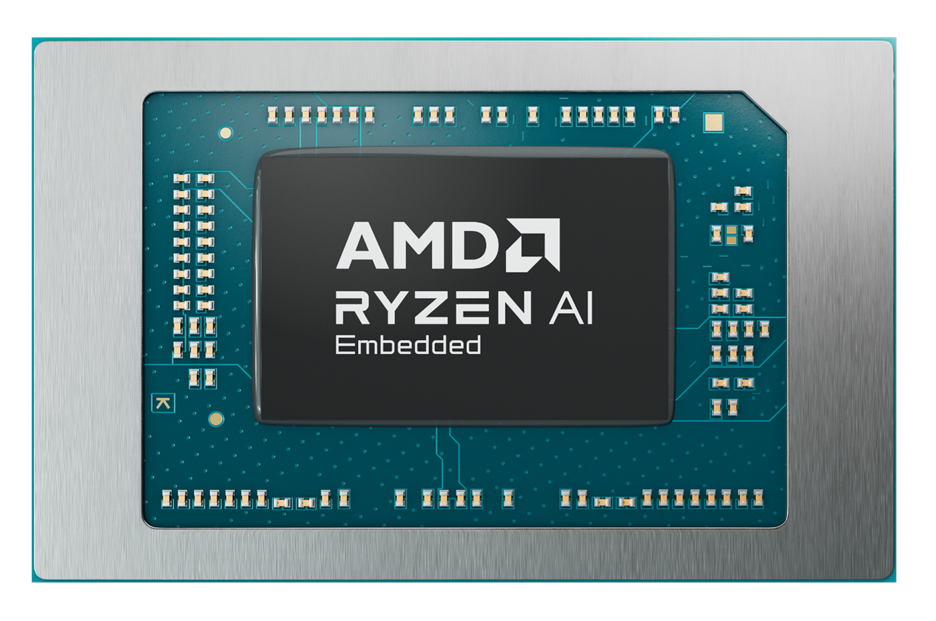
At the foundation of the portfolio is the new Ryzen AI Embedded X100 Series, which combines CPU, GPU, and NPU resources within a unified memory architecture. AMD positions these processors as platforms capable of supporting the simultaneous requirements of perception, reasoning, planning, orchestration, and real-time control that characterize modern Physical AI systems.

Ryzen AI Embedded X100 Series, source: AMD, 2026

The Kria AI Robotics Developer Platform

AMD also introduced the Kria AI Robotics Developer Platform, described as an open, turnkey robotics development environment that integrates CPU, GPU, NPU, and FPGA compute. The platform is intended to reduce development complexity while helping robotics developers move more quickly from concept and prototype to production deployment.

Kria AI Robotics Developer Platform, source: AMD, 2026

Bringing the Cloud Software Stack to the Edge

One strategically important aspect of AMD’s robotics announcements is software continuity. The new AMD Robotics Software Suite is built on ROCm, allowing developers to leverage familiar frameworks, tools, and workflows already used in cloud AI environments. AMD explicitly describes ROCm as both cloud-proven and embedded-ready, creating a common software layer between datacenter AI and Physical AI deployments.

Reducing Vendor Lock-In Through Open Standards

AMD repeatedly emphasized openness throughout its software and robotics announcements. The company highlighted support for open standards, familiar x86 development workflows, industry partnerships, and open-source technologies. In robotics specifically, AMD identified avoidance of vendor lock-in as a key priority among developers and positioned its software stack as an alternative built around portability and ecosystem flexibility.

Analyst Opinion and Conclusion

AMD’s Advancing AI 2026 announcements reflect a strategy focused on developer productivity, software consistency, and open ecosystem adoption. Rather than treating desktops, datacenters, edge systems, and robotics as separate markets, AMD is building a continuum in which applications can be developed locally, optimized through AI-assisted software tools, deployed at cloud scale, and extended into physical systems using a common architecture. This approach addresses a persistent industry challenge: the fragmentation between experimentation, production deployment, and edge execution.

Technical vision alone will not guarantee adoption, however. AMD continues to compete against an incumbent ecosystem built on years of developer investment, mature tooling, and deep integration with commercial AI applications, and shifting those established development priorities typically requires clear performance, cost, or business benefits. Pricing and total cost of ownership will matter as much as raw compute performance, particularly as enterprise buyers weigh software readiness, operational simplicity, and deployment timelines across the full lifecycle.

Success will likely depend less on hardware specifications than on ecosystem momentum: winning ISV certifications, application optimizations, framework support, and robotics middleware integrations may prove as important as introducing faster processors. The broader significance of Advancing AI 2026 is not that AMD is entering new AI segments, but that it is attempting to connect desktop, cloud, and physical AI through a common development model. Whether AMD becomes an increasingly influential platform provider across that continuum will depend on its ability to sustain software adoption and partner engagement alongside its hardware roadmap.

Mohamed Hefny

Mohamed Hefny - Senior Program Manager, Data and Analytics

Mohamed Hefny leads market research in EMEA on professional workstation PCs and solutions. He also reports on professional computing semiconductors, processors, and accelerators (CPUs and GPUs), as well as breakthroughs and trends related to the market. In addition, Mohamed is…
Malini Paul

Malini Paul - Senior Research Manager, Personal Computing Devices

Malini Paul is a research manager of Client Computing Devices team in Europe, with over 10 years of experience in the ICT industry. Currently based in London, she leads the Personal Client Computing Devices research program for Western Europe. She…

IDC Quanta launched this year with over 175 customers across the beta program: CIOs, analyst relations and communications leaders, and technology strategists who spent months telling IDC exactly what they needed.

That’s not the usual way an intelligence platform gets built. Most AI tools ship first and adjust later. IDC Quanta did the opposite, and the difference shows up in how customers describe using it.

Months of beta testing

Nick Gartner, Director of Digital Product Management at IDC, led the beta program from the ground up, handling recruiting, communications, reporting, and every round of testing in between. He described a deliberate, expanding process that ran all the way through to general availability.

Each round fed directly into the next. The goal, Gartner explained, was never to build something because it followed a trend. It was to build something people would use every day, one that made IDC’s research easier to reach and easier to act on.

That approach is baked into how IDC Quanta works today. It’s described as the technology intelligence fabric of the AI-enabled enterprise: IDC’s structured, sourced, and defensible research, built for over 60 years, now living inside the tools where work already happens instead of requiring one more portal and one more login.

What customers kept naming: Time

Across every round of beta feedback, one theme surfaced more than any other: with more than 1,000 analysts publishing continuously, it often took a lot of time to find and digest the exact data and research customers needed. Customers said they were regularly spending a week or two working through lengthy reports just to get to the specific insight they were looking for.

Gartner put it plainly: people needed to get to trusted intelligence faster, and IDC Quanta was built to close that gap. Instead of just retrieving research, it acts more like an always-available IDC consultant. Customers can question it, reason through options with it, and even upload their own business documents for a side-by-side comparison against IDC’s data.

One beta customer, Mark Terranova of Kyndryl, told IDC that work which used to take weeks now takes minutes. Beta customers across industries, from technology providers to hospitality, said something similar: the same research now takes hours instead of the week or two it used to consume.

A platform build only on verified data

That speed opened up room for a wider set of use cases. Ask customers what they use IDC Quanta for and the answers span the map: competitive intelligence, vendor landscape analysis, market sizing, technology adoption research, and benchmarking their own internal documents against IDC’s data.

IDC Quanta doesn’t search the open web, and it doesn’t learn from anything customers upload. Every response is grounded in verified IDC research, and every answer can be traced back to its source. For leaders who need to defend a recommendation in a boardroom, that traceability is the reason they can act on what the platform tells them.

Phillip Langeberg, CTO of The Resorts Companies, Inc., described that confidence directly:

“An AI platform backed by the knowledge and research of IDC gives me a lot more confidence in the answers provided.”

Eric Walk, VP of AI and Data Platform Services at Perficient, framed it as the entire point of the tool:

“The ability to ask a question and get an insight that’s backed by specific, referenceable research is really the key to the tool.”

And for some customers, the value went beyond confidence: it changed how they thought about what was even possible. Ashley Spicer, CIO of Amarok, put it this way:

“We are getting ridiculous, previously unimaginable value from IDC Quanta. If you had told me 20 years ago that I would have access to something like this in my lifetime, I would have said no way.”

Watching the reaction in real time

Gartner said the moment IDC Quanta’s value became undeniable wasn’t in a spreadsheet of feedback scores. It was in a room. He demoed the platform live to IDC’s CIO Executive Council Advisory Board and again to attendees at IDC’s CIO event in New York, walking senior IT leaders through their own real-world use cases in real time.

The reaction, he said, was immediate: people started using it and simply kept going. After using the platform, Jolene Peixoto, VP of Corporate Communications at RELEX, described it as:

“One of the most intuitive and useful AI tools I’ve seen across analyst research portals.”

A better way to work

It would be easy to describe IDC Quanta purely as a faster way to get answers. That undersells it. The deeper shift is in how people work day to day, with IDC’s research embedded directly in email, in Anthropic’s Claude, and in the custom AI tools and workflows enterprises are already building, with no new login and no new habit to learn.

That’s also where the human side of IDC hasn’t gone anywhere. Every session includes a direct path to contact an IDC analyst, something most AI research platforms skip entirely. When a customer wants to go deeper than an AI-generated answer, they can schedule time with the expert who knows the subject, based on the exact data they were just looking at.

What happens now that it’s live

Gartner was clear that the listening doesn’t stop at general availability. IDC built IDC Quanta on months of direct customer feedback, and every future feature will start the same way, with customers telling IDC’s product team what to build next.

For teams still evaluating whether an AI research platform can be trusted, that’s the difference these customers kept coming back to: not the AI itself, but what’s behind it. What’s behind it is 60 years of verified, sourced IDC intelligence, already showing up in customers’ inboxes and inside Claude.

Want the full story straight from the person who ran the beta program? Watch our complete conversation with Nick Gartner on the IDC Quanta beta, launch, and what’s next.

Christina Cardoza - Content Marketing Manager - IDC

Christina Cardoza is a Content Marketing Manager at IDC, where she specializes in brand content and social media strategy. With a background in journalism and editorial leadership, she has a proven ability to transform complex technology topics into clear, actionable insights.

On July 28, 2026, the FCC quietly added “advanced robotic devices” to its Covered List, the roster of tech it has flagged as a national security risk, blocking new equipment authorizations for foreign-made robots. The headlines were about humanoids, the walking machines from Chinese vendors like Unitree. Within 24 hours, the story took a stranger turn: the ban also covers your vacuum.

Ban, or something narrower?

Most coverage calls this a “ban,” and we will too, because that’s the word everyone is searching for. But read the fine print and it is more of a chokepoint than a wall: already-certified models can keep shipping new units, not just running out what’s already sold, though the FCC has reserved the right to revoke that status later, there is a Conditional Approval pathway that lets vendors keep selling if they shift manufacturing to the US, and a long list of exclusions, road, rail, aircraft, underwater vehicles, medical and mobility devices, and fixed industrial arms, sit outside the rule entirely.

The FCC’s definition sweeps in any foreign-made mobile robot over roughly 4.4 pounds that senses its surroundings, moves along the ground, and connects wirelessly, a description that fits a humanoid, a quadruped, and a robot vacuum, lawnmower, or window cleaner equally well. Already-certified models keep shipping new units, not just running out what’s on shelves. It’s the next hardware refresh that’s cut off.

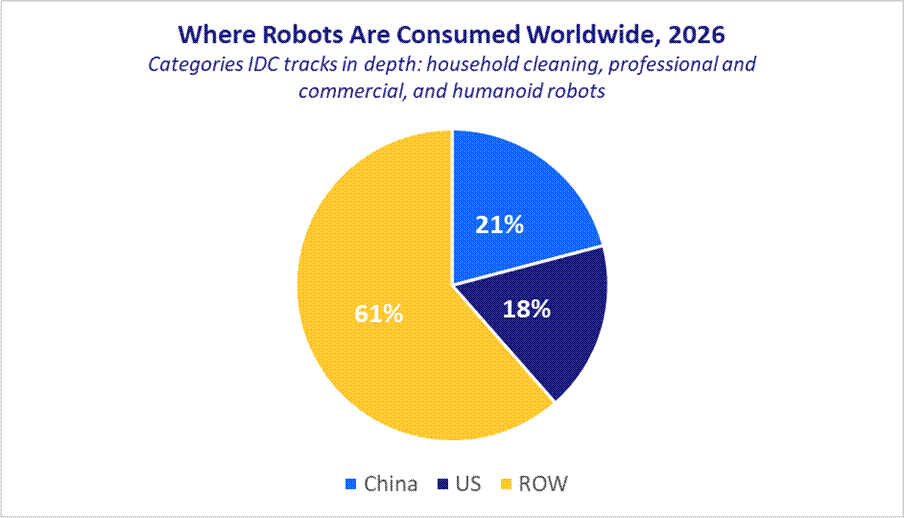
IDC is launching research into Physical AI across four layers of the ecosystem: Infrastructure, Software and Platforms, Services, and Devices. Robotics sits inside Devices, and today it is, by a wide margin, the biggest draw in that layer. That is why a rule written around “robots” ripples so far. The figures below cover the robot categories IDC tracks in depth, household cleaning, professional and commercial, and humanoid, not the entire global robotics market. We ran those numbers against IDC’s latest worst-case scenario, current as of August 2026, and the results flip a lot of the conventional wisdom about who is actually impacted by this restriction.

Where Robots are Consumed Worldwide 2026 chart - Shows China (21%) and US (18%)...the rest of the world (61%)

Source: IDC Worldwide Robotics Trackers, Q2 2026 (If Ban Stays Till 2030 Scenario). Household cleaning, professional and commercial, and humanoid robots combined, the categories IDC tracks in depth.

Within these tracked categories, Europe, not the US or China, is the largest robot market by consumption, at more than double America’s share. The US and China combined still do not outbuy the rest of the world here.

The US Hit, If the Restriction Holds

Put the US robot categories IDC tracks in depth on one chart, household cleaning, professional and commercial, and humanoid combined, and the picture is more forgiving than the headlines suggest: these categories still grow every year through 2030, just off a lower trajectory. The gap opens gradually, reaching about 4% below the published baseline in 2027 and 18% by 2030. On IDC’s baseline, this US total compounds at around 13% a year through 2030; under this scenario, that cools to 9%, a real deceleration, but nowhere close to the growth story stalling out.

Using IDC’s blended average selling price assumptions, that growth gap between the restriction scenario and IDC’s published baseline compounds into more than $6 billion in foregone US robotics revenue between 2026 and 2030, with the single worst year, 2030, alone accounting for above $2 billion of it.

That softer trajectory rests on a specific assumption: already certified models do not disappear. The FCC’s rule only blocks new equipment authorizations, so IDC’s scenario assumes overseas vendors keep selling models that cleared certification before the rule took effect, refreshing appearance, hardware configurations, and software features rather than filing for new authorizations. For household cleaning specifically, IDC expects those extended models to stay competitive at least through 2027, since US demand for the newest generation of features runs lower than in Europe or China, and expects vendors to lean harder on wet and dry vacuums, a category this rule does not touch, to offset lost robot vacuum volume while protecting their premium positioning. A sharper decline is still expected within two to three years once those extended product cycles run out.

Not Every Category Takes the Same Hit

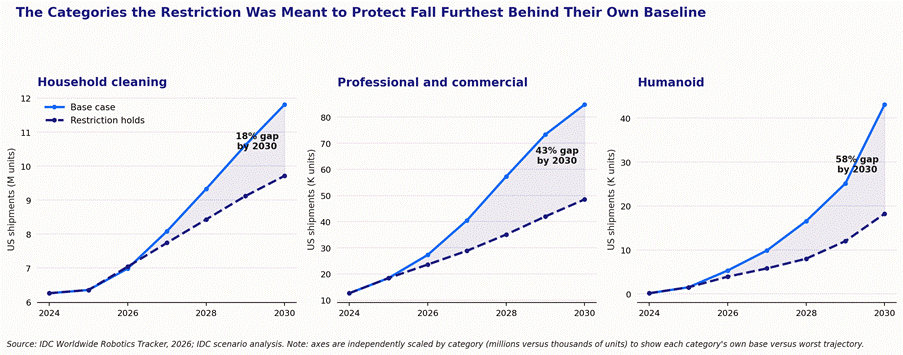
The instinct is to assume this rule protects the humanoid and commercial robot builders it was written for, while consumer cleaning brands, already dominated by Chinese vendors, absorb the pain. The final numbers say the opposite. Look at each category’s own base case line against its own worst-case line, and the ones expected to benefit from this policy are the ones falling furthest behind where they would otherwise be:

The categories the Restriction was meant to protect fall furthest behind their own baseline chart.

Source: IDC Worldwide Robotics Trackers, 2026 (If Ban Stays Till 2030 Scenario). Each panel uses its own scale (millions versus thousands of units) to show the category’s own trajectory, not a comparison of absolute volume across categories.

Household cleaning is nearly the entire US volume across these tracked categories, and it is also the most resilient category in relative terms, trailing baseline by just 4% in 2027 and 18% by 2030. Professional and commercial robots fall further behind, from a 29% gap in 2027 to 43% by 2030. The same lifecycle extension approach applies here too, incremental hardware and software upgrades on already deployed fleets rather than new authorized models, but higher stakes deployments and shorter replacement cycles make it a thinner cushion than in household cleaning, though a commercial robot’s higher price tag makes a real US manufacturing commitment worth pursuing for some vendors under the FCC’s Conditional Approval process.

Humanoid robots, the category this restriction was ostensibly designed to protect, see the deepest cut of all: a 41% gap in 2027 widening to 58% by 2030. Look at the dollars and it is starker still: nearly four out of every five dollars of the category’s projected 2030 US revenue evaporates under the worst case. Volumes are still small, which is also why the percentage swings look so dramatic, so this is not a story about finished robots piling up at customs. It is about how dependent even vertically integrating US builders, Figure, Apptronik, Boston Dynamics, still are on China for the motors, actuators, batteries, and rare earth materials that go into every unit. Overseas humanoid vendors have the same shelf life extension playbook available, keeping already approved units in the field and iterating through incremental hardware, software, and AI upgrades, but it buys far less cover here: IDC does not expect US based humanoid builders to reach scaled mass production until the end of 2028, so there is no domestic backstop ready to absorb the growth that foreign models can no longer supply. IDC estimates China accounts for 82% of global humanoid shipments today. Until US builders reach that scale, whatever badge sits on the chassis, the bill of materials behind it still reads China.

Europe Absorbs the Redirect, Not China

The scenario does not just subtract US demand; it has to send that displaced hardware somewhere. IDC’s model nudges professional and commercial and humanoid forecasts higher across EMEA and other parts of the world, particularly the UK, France, Germany, and Eastern Europe, as Chinese vendors redirect resources toward markets open to them. China’s own domestic forecast barely moves. It is a story about Europe, already the largest buyer of these tracked robot categories, getting a little larger still.

What It Means for Vendors

Reshoring consumer robotics specifically is unlikely given thin margins; this accelerates a supply chain diversification trend already in motion rather than starting a new one. Tesla sourcing its own AI chips for Optimus across TSMC and Samsung’s Texas fab is one model other vendors may follow: hedge the component that carries the most geopolitical risk, chips today, magnets and actuators next, rather than moving final assembly to the US.

Expect that hedge to widen the gap inside devices rather than close it. Humanoid and commercial builders have the margin and the government backing to build out US supply for the parts that matter most. Household cleaning vendors do not have that room, so the category most exposed today stays exposed, even as it turns out to be the one best riding out the restriction. And expect more vendors trying to maintain a US foothold to pair with independent US software partners rather than their own bundled stack, since a software partner is far cheaper to Americanize than an entire supply chain. Tennant’s hardware running on Brain Corp’s independent BrainOS is one example of that model.

The Bottom Line

The vacuum detail is what makes this restriction legible to a general audience, a strange, sticky hook for a story about industrial policy. But it’s not the point, and neither is the word “ban.” The point is that a single trade rule, applied evenly on paper, lands completely unevenly in practice, and not in the direction most people assumed.

Household cleaning, already dominated by foreign brands and squarely in the crosshairs, shrugs this off best. Humanoid robotics, the category built with US flags on the marketing decks, takes the deepest percentage hit, because protecting the badge on the finished robot does nothing to protect the motors, actuators, and rare earths inside it. And the biggest beneficiary of the US-China standoff is not the US or China, it is Europe, already the largest buyer of these tracked robot categories, absorbing the redirected volume without a policy of its own.

So, what does the restriction really mean? Not that the US is closing its doors to robots, and not that China’s lead breaks, because China was never actually leading global consumption in the first place. It means the market is quietly sorting into two tracks: mass market categories that keep growing around the US, and higher value categories where the appearance of protection outpaces the reality of supply chain independence. The vendors and the policymakers who read that correctly get a head start on everyone still parsing what the FCC actually wrote.

Update: See how IDC’s modeling holds up against outside expert debate in our follow-up, FCC Robotics Ban: Checking the Expert Debate

Getting a Head Start of Your Own

Reading this restriction correctly is one edge. Having a full view of where Physical AI is headed next is another. Two ways to build on it:

Upcoming Webinar: How the US Ban is Reshaping the Robotics Market: Global Robotics Outlook
The July 2026 restriction is already reshaping who wins in robotics — and not in the direction most people expected. Join IDC live on October 14 (11 AM EDT | 5 PM CET) for the full 2026–2030 forecast across humanoid, autonomous mobile, and commercial service robots, plus the regional and competitive shifts this policy is setting in motion. Can’t make it live? Register anyway — the recording will be sent to you after.

Fragmented data. Blind forecasts. Competitive gaps.
If any of that sounds familiar, you’re not alone — it’s what every robotics manufacturer, systems integrator, and enterprise tech leader runs into once they start taking Physical AI seriously. IDC is the only research firm covering the full value chain, platforms and software, infrastructure, services, and devices, as one coordinated program. Explore the Physical AI Hub to see the whole picture, or Contact us to talk through what it means for you

Ryan Reith - Group Vice President, WW Device Trackers - IDC

Ryan Reith is the Group Vice President for IDC's Worldwide Device Tracker suite, which includes mobile phones, tablets, wearables, and most recently AR/VR. His teams research focuses on the quantitative aspects of the mobile device industry, including market sizing, forecasting, vendor market share analysis, and technology trends. His current responsibilities include engaging with mobile device OEMs, supply chain, distributors, and the financial industry to discuss market trends and forward looking analysis.

Navkendar Singh - Associate Vice President - IDC

Navkendar Singh is a Associate Vice President with IDC India, based in Gurgaon. His research domains encompass deep-dive research and insights in and around mobile devices, smart homes, PCs, tablets, wearables, and the printing market in India, Bangladesh, and Sri Lanka. He is also involved in building IDC's successful channel research programs for these domains at city and state levels. Navkendar also leads research related to analyzing the role of devices, emerging business engagement models, the impact of emerging technologies on devices, and emerging personas related to Future of Work.

Your adtech spider-sense should be tingling. BMW spent 2023 promising owners a private dashboard, then spent this July breaking that promise in front of all of them.

A broken promise, and the ambient advertising it wasn’t

Starting in late July, drivers in more than 70 countries turned on their vehicles to find a full-screen animation for Spider-Man: Brand New Day on the iDrive display, complete with its own soundtrack and matching ambient lighting. BMW framed it as a Festive App tie-in connected to a film in which two of its vehicles appear. Owners framed it as something closer to a violation. In December 2023, BMW’s own leadership had described the dashboard as “a private space” that would never carry commercials. That promise lasted two and a half years, until the Spider-Man rollout arrived this July.

The heated-seat subscription controversy from a few years earlier hadn’t helped. BMW had asked owners to pay monthly for hardware already built into the car, backed off after a similar backlash, and never fully closed the door on the model. The Spider-Man rollout landed on the same nerve, and it’s worth asking why BMW keeps finding this particular one.

Here’s where the story gets more interesting than the outrage suggests. IDC’s FutureScape 2026 Chief Marketing Officer predictions include a forecast on exactly this category of screen.

Screens everywhere are becoming ad-eligible surface area, and vehicles were always going to enter that picture eventually.

Read the prediction closely, though, and the BMW campaign doesn’t actually match it. Ambient intelligence works because it responds to context: a shelf tag that adjusts price by time of day, or a store display that reacts to who’s walking past. What BMW pushed was the opposite of ambient. One static animation went to every eligible car across 70 countries regardless of driver, location, or moment, landing on a screen BMW’s own leadership had promised would stay ad-free. The tie-in itself was ordinary marketing. Automakers do this constantly when their vehicles appear on screen. What made this one land as an interruption rather than an ad was the missing context: no signal telling BMW which car, which driver, or which moment actually called for it.

IDC’s consumer research backs this up. In our Pre- and Post-Purchase Promotional Demands study, 64% of consumers say ads have no or limited influence on their decisions, but 52% would click a shoppable connected TV ad when it’s actually targeted to them. The same study found that a brand’s guarantee not to resell shared data ranks among the top incentives for engagement, which is just a data-era version of the same private-space promise BMW made and broke: people let a brand into something personal only when they trust exactly what happens with it next.

IDC has been flagging this exact risk in guidance to technology buyers for nearly a year: brands need to work through real privacy and experience concerns around personalized advertising, or risk this kind of blowback.

What has to be true before ads belong in the car

The dashboard won’t stay ad-free forever, but two conditions have to be met before that shift is earned. One is economic. Streaming’s free tier, ad-supported search, and a discounted Kindle all run on a bargain consumers understand going in: pay less, or pay nothing, and ads come with it. No such bargain exists yet in the automotive category. A BMW owner paid full price, in some cases more than $100,000, for a vehicle sold on an explicit promise that the interior stayed private, so paid still means ad-free by default until automakers offer something else, an ad-supported tier or a discounted lease in exchange for opted-in content. The other condition is attentional, and it’s a moving target. A driver at SAE Level 2 has no attention to spare for a screen, ad or otherwise. A passenger at Level 4 or 5, hands off entirely, is functionally riding in a moving living room, closer to a train passenger than a driver. As the fleet climbs that ladder over the next decade, the cabin becomes a legitimate leisure environment. Entertainment content still has to earn its place there, but the case against it gets harder to make with each level of autonomy the fleet adds.

Vehicle category matters just as much, and BMW picked close to the worst one to test this on. A luxury sedan sells exclusivity, the same reason a private villa doesn’t run ads on its own television. A family minivan on a road trip is a different proposition entirely: kids already watch movies on rear-seat screens, parents already pay for anything that buys 20 quiet minutes, and a timed movie promotion might land as a genuine perk rather than an intrusion. The same content, in the wrong vehicle segment, reads differently to the person watching it, which is exactly the mismatch BMW ran into by testing a Marvel tie-in on a luxury sedan lineup instead of the family vehicles where in-cabin entertainment already sells.

The industry already learned a version of this lesson in television. IDC’s research on the collapse of the upfronts found that premium content never automatically buys a premium audience; precision targeting does. BMW bet on the content, a splashy Marvel tie-in riding a halo launch, and skipped the targeting altogether. This is a common pattern among brand leaders who came up in a Mad Men-era playbook and haven’t fully adapted to data-driven, let alone agentic, automation methods.

What decides whether the next attempt lands is whether automakers match the format to the moment: the autonomy level, the vehicle category, and a business model the owner actually opted into. Skip any of those, and the next backlash won’t be about the ad. It will be about the same broken promise, running on whichever screen BMW decides to test next.

The brands that get this right over the next five years won’t be the ones with the splashiest tie-in. They’ll be the ones who bothered to ask whether the driver actually wanted to see it.

Roger Beharry Lall

Roger Beharry Lall - Research Director, Advertising Technologies and SMB Marketing Applications

With over 25 years' experience leading technology driven marketing programs, Mr. Beharry Lall is now a Research Director with IDC covering Advertising Technologies and SMB Marketing Applications. He brings a unique multidisciplinary perspective, evangelizing the innovative and pragmatic use of…

Worldwide tablet shipments fell to 33.6 million units in the second quarter of 2026, down 5.2% from the prior quarter and 12.3% from a year ago, according to IDC’s Worldwide Quarterly Personal Computing Device Tracker. That’s the category’s steepest year-over-year decline in this cycle. Almost the entire drop traces back to one root cause, but the more interesting story is what happens once that cause eventually clears.

RAMmageddon finally lands on tablets

The memory supercycle that’s been reshaping PCs and phones all year has now fully hit tablets, as AI infrastructure buildouts continue to pull DRAM and NAND capacity away from consumer devices. IDC’s own PCD Forecast Assumptions had already flagged this inflection point across two consecutive quarterly cycles, projecting shipment declines accelerating from 2026Q2 onward. This quarter confirms that thesis rather than surprising it.

The pass-through, based on vendor list-price changes IDC tracked, has been fast and visible. Samsung raised list prices $40 to $280 across nearly its entire Galaxy Tab lineup in April. Lenovo followed with $30 to $70 increases on the Tab One, Tab Plus, and Yoga Tab during the same month. Then Apple raised the entire iPad line globally in June, with multiple models costing an additional 20% or more, explicitly citing memory costs rather than tariffs or a hardware refresh. When your three biggest vendors all raise prices inside ten weeks of each other, consumer demand doesn’t shrug it off.

That’s exactly what happened: consumer shipments fell 13.5% year over year, while commercial held up far better at -5.9%. Commercial and education buyers are typically locked into multi-year refresh cycles that don’t get renegotiated quarter to quarter, so they absorbed less of the shock. Consumers, buying at list price with no contract to hide behind, took almost the entire hit.

The US got the worst of both worlds

No region suffered like the United States, where shipments collapsed 31.6% year over year (even as they rebounded 7.1% sequentially off a depressed base). The US is the one market where memory costs and tariffs land at the same time. One of the largest vendors, Amazon, also saw shipments decline in its tablet lineup, compounded by a difficult comparison against 2025Q2, when many brands pulled forward inventory ahead of anticipated tariffs. As tariffs continue to pinch the supply, brands such as Samsung and Lenovo are likely going to be in noticeably better shape thanks to production outside China.

Beyond the memory shock: a harder question

Here’s the part that should worry the category more than any single bad quarter. Even before RAMmageddon, tablets were fighting for relevance in a device market that’s rearranging itself around AI. AI PCs are absorbing the productivity use case tablets spent a decade trying to own. Phones keep getting bigger, and foldables, still a rounding error in unit terms, are growing fast and pulling casual browsing and media consumption further into the smartphone. Foldables are starting to serve as a drag on 8-to-10-inch tablet demand, and cheap mini-PCs and laptops are peeling off would-be buyers at the sub-$200 end. A memory shortage clears eventually. A device that’s lost its reason to exist doesn’t recover just because supply does, and this quarter is a reminder that tablets can’t just wait out the crunch. The vendors still winning share, mostly through productivity and enterprise deals, are the ones already treating that as the real problem.

Where the silver linings are

The data isn’t uniformly bleak, and the bright spots point toward where that case might be built:

  • Detachables are holding the line. Slate tablets fell 19.8% year over year, concentrated at the low end where price hikes bite hardest. Detachables fell only 6.1%, because that mix skews toward commercial and productivity buyers who are far less price-sensitive. The market’s mix shift, forced or not, is toward tablets that behave more like PCs.
  • Lenovo is the standout. Lenovo grew shipments 26.2% year over year, the best result among any major vendor, on the strength of its productivity-leaning lineup. Huawei (+9.1%) and OPPO (+10.5%) also grew.
  • Emerging markets are picking up slack. While the US and Western Europe (-13.3%) cratered, APeJC grew 2.6%, the Middle East and Africa edged up 0.7%, and Japan jumped 5.8% year over year. Chinese vendors, in particular, are pushing volume aggressively into these regions, helped by the fact that tablets carry a smaller share of memory in their bill of materials than smartphones do, giving them more room to defend share.
  • Scale is consolidating, not collapsing. The top five vendors (Apple, Samsung, Lenovo, Huawei, Xiaomi) now control roughly 79.8% of the market, up from 77.9% just one quarter earlier. Bigger vendors have the procurement leverage to secure memory allocation that smaller players simply can’t match, so the category is concentrating around the players best equipped to weather the storm.

What to watch next

The pace of these price increases is expected to ease in the coming quarters, but supply relief isn’t immediate, and tablets will likely keep riding out elevated prices for a while longer. The vendors who use that time to push harder on productivity, AI features, and enterprise deployments, rather than just waiting for cheaper memory, will set the terms for what a smaller tablet market looks like next year. The ones who don’t are betting that a supply cycle can fix a relevance problem. That’s a bet this quarter’s data doesn’t support.

Jitesh Ubrani

Jitesh Ubrani - Director, Consumer Devices Research

Jitesh Ubrani is a Director at IDC leading a team of analysts within the Worldwide Consumer Device Trackers group, covering wearables, augmented reality (AR), virtual reality (VR), tablets, phones, PCs, gaming, and smart home devices, with a focus on market…

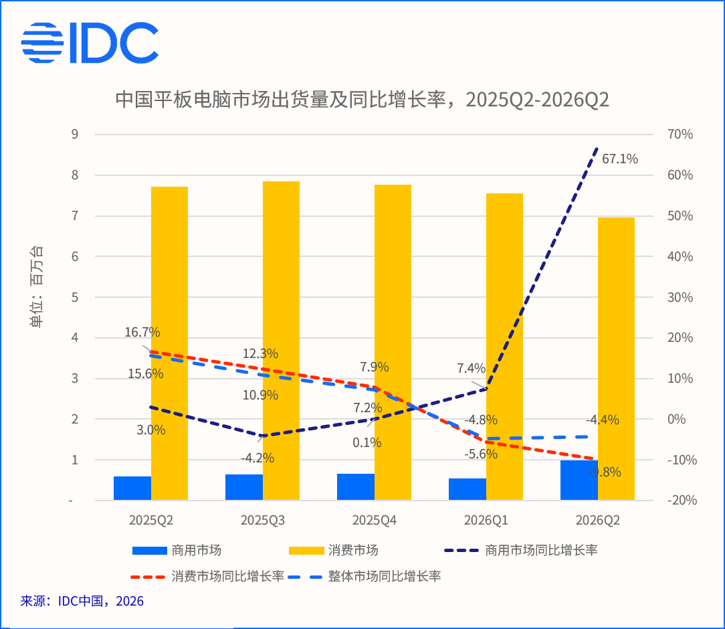
二季度平板出货量同比下滑4.4%,跌幅看似收窄,但水面之下的结构变化比数字本身更值得关注。商用高增长与消费疲软形成鲜明反差,成本压力正从供应链末端加速传导至前端市场。本文将结合IDC最新季度跟踪报告,梳理几个关键信号。

国际数据公司(IDC)发布了2026年第二季度中国平板电脑市场季度跟踪报告。数据显示,2026年第二季度,中国平板电脑市场出货量为796万台,同比下降4.4%,降幅较第一季度小幅收窄。但从市场表现来看,市场压力并未缓解,反而进一步放大。商用市场的大幅增长主要来自涨价预期下的需求前置,而消费市场则在成本上涨、需求提前释放等因素影响下同比下降9.8%。表面上市场跌幅收窄,实际上成本上涨正在加速向需求端传导。

商用市场高增长背后,需求前置特征明显

2026年第二季度商用平板市场出货量同比增长67.1%,成为支撑整体市场的重要力量。但本轮增长更多来自厂商延迟涨价及价格持续上涨预期下的提前采购,企业客户和渠道商集中备货,推高了第二季度单季出货量。随着7月起商用市场开启全面涨价,后续渠道库存及交付节奏将成为影响第三季度市场表现的重要变量。

“618”难以抵消价格上涨影响,消费市场进入调整期

2026年第二季度消费平板市场出货量同比下降9.8%。尽管厂商和渠道积极布局“618大促”,通过新品和促销刺激需求,但价格上涨的影响已经明显超过促销带来的拉动。同时,去年国补推动需求提前释放,低价与涨价之间的鲜明对比也进一步抑制了消费者购买意愿。

成本上涨加速头部厂商分化,市场格局出现新变化

伴随低价备料逐步消耗,成本上涨对厂商的影响进一步显现。不同厂商的产品布局、渠道能力及应对涨价的节奏有所差异,本季度市场排名和表现也出现一定变化。

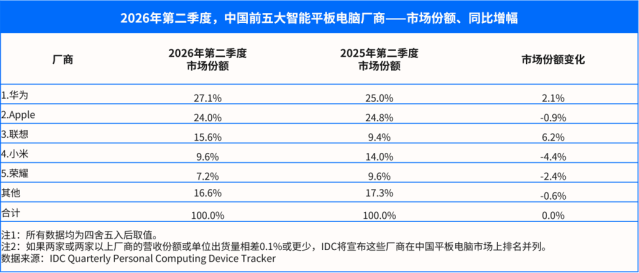
  • 华为继续位列中国平板电脑市场出货量第一位,整体表现相对稳健。消费端通过MatePad Pro Max完善高端产品布局,并深化学习场景合作;商用端则受益于渠道提前备货,出货量实现较快增长。
  • Apple位居市场第二。第二季度主要销售期仍维持原有价格,在涨价前形成一定价格优势,但受成本压力逐步传导影响,6月底Apple上调其平板产品售价,后续市场挑战将增加。
  • 联想出货量上升至市场第三,是本季度头部厂商中排名变化较为明显的厂商。拯救者、小新系列新品推动其消费产品结构升级,商用端凭借大客户市场积累及需求前置同样保持较快增长,共同带动整体出货量提升。
  • 小米排名市场第四位。尽管成本压力下平板出货量仍同比下降,但降幅有所收窄。“618大促”期间小米平板7系和8系促销获得较好销售反馈,同时Redmi K Pad 2和Redmi Pad 2 SE两款新品覆盖不同价位段,对市场形成一定刺激。
  • 荣耀位列市场第五。低端消费平板市场受到成本上涨冲击,出货量明显收缩;与此同时,教育行业渠道提前备货推动其商用平板延续高速增长,成为其当季平板市场表现的重要支撑。

整体来看,第二季度头部厂商的竞争已经不再单纯取决于产品和价格。在涨价的大环境下,厂商的布局结构、渠道能力及运营效率正在成为影响市场份额变化的重要因素。

后续展望:成本上涨延续,厂商寻求价位升级与需求平衡

成本上涨对平板市场的影响预计将在今年下半年进一步显现,并持续至明年。价格上涨将一定程度上延长消费者换机周期,厂商也可能通过调整新品上市节奏和产品结构应对成本压力,市场供需双方的变化将共同影响整体规模。

在成本压力持续的背景下,夯实2000-3000元主流价位段的产品竞争力是稳定市场规模的基础。尽管成本迫使平板售价不断上涨,大量消费者对平板的价值定位仍然锚定在2000-3000元档位,在这一区间的布局和提升是稳固出货量规模的关键。

引导需求向3000-5000元中高端价位段升级,将成为厂商改善产品结构、缓解成本压力的重要方向。相比单纯涨价,厂商更需要通过性能升级、使用场景拓展及AI能力增强,为中高端产品创造更充分的溢价空间。

长期来看,成本上涨或将成为平板市场的持续变量,厂商需要在成本传导、产品升级与消费承受能力之间寻找新的平衡。未来市场走势不仅取决于厂商能否通过产品创新支撑更高价格,也取决于消费者是否愿意为更高端的产品和新的使用场景支付更多。

IDC结论

2026年第二季度,中国平板市场出货量同比降幅有所收窄,但成本上涨带来的实际市场压力进一步放大。商用市场高增长更多体现为需求前置,消费市场则已明显受到价格上涨影响。未来,成本压力将推动市场结构升级,厂商能否通过产品创新和场景拓展引导消费升级,将成为实现规模与效益平衡的关键。

进一步交流:

本文数据及观点均源自IDC《中国平板电脑市场季度跟踪报告,2026Q2》。如需了解细分价位段、渠道库存、行业垂直场景等详细数据,或针对特定厂商策略进行定制化分析,敬请联络IDC中国终端系统研究团队。

Quorra Liu

Quorra Liu - Research Manager

Quorra Liu is a Research Manager for the Client Systems Research team at IDC China. She is responsible for China's smart home device research. Her responsibilities include tracking the monthly and quarterly market development, conducting research in fully managed services market,…

写在“依赖”之上的“主权”

2026年7月16日,Noetra Inc.与NVIDIA共同宣布,将启动一个国家级AI计算平台项目,用于开发日本自主的多模态基础模型。

Noetra是一家基础模型开发公司,由44家日本大型企业联合出资,涵盖IT、制造、材料、建筑、出行、金融、电信等多个行业,其中索尼集团、软银、NEC和本田扮演核心角色。该平台隶属于日本经济产业省主导的大型计划——FRONTia项目,总投资规模达1万亿日元,仅首年投入就高达3,873亿日元。平台被定位为全球首个面向“物理AI”的国家级AI基础设施。

其核心采用NVIDIA Vera Rubin AI Factory,理论AI性能(FP8)至少是日本现有顶尖AI计算平台ABCI 3.0的30倍。项目计划于2027年4月动工,2028年6月投入运营。做个直观对比:仅首年投资额,就已超过日本2025年国内AI基础设施市场整体规模的一半(数据来源:IDC《全球季度AI基础设施追踪报告》,2026年Q1)。这笔投入大概率集中在硬件建设上,而非后续的持续运营。

这里的关键词是“物理AI”,而最直接的落地场景就是机器人。FRONTia项目的全称——“面向AI机器人与物理AI的多模态基础模型开发”——已经把机器人写进了使命里,不是配角。就在Noetra发布消息的同周,发那科、安川电机、川崎重工等日本机器人及制造业巨头也承诺,将基于同一套开放模型栈(NVIDIA Cosmos、Isaac GR00T)进行开发。该平台的算力将帮助这些模型规模化,应用场景覆盖工业自动化、养老照护、手术辅助和零售。机器人和基础模型之间是相互成就的关系:机器人需要模型变得更智能,模型也需要从多样化的真实应用中获取反馈来迭代。根据IDC Robotics Tracker的数据,日本商用人形机器人市场预计将从2027年的142亿日元增长至2030年的470亿日元以上,出货量增长超过五倍。当然,人形机器人只是冰山一角,整个市场还包括工业机械臂、物流机器人,以及清洁、园艺等服务类机器人。可以说,这场国家级物理AI布局,本质上是对“机器人将成为日本下一个AI大市场”的一次战略押注。

消息一出,市场反应两极分化:有人盛赞它是“全球首创、自主可控、全日本协同”的壮举,也有人讥讽它是“对单一供应商的过度依赖”。但这两派可能都没说到点子上。日本把物理AI基础能力建设中的“算力主权”交给了外部伙伴——NVIDIA,因为后者确实掌握着最前沿的算力与架构。与此同时,44家民企各自持有Noetra少量股权,并贡献各自的实际数据和试验场,日本则希望掌握这些数据以及基于它们构建的模型。目前,日本既不是完全独立,也不是彻底受制于人——真正的难题还在后面。这种模式确实可能加深依赖,但日本并非只能被动接受,它仍有空间去塑造这种关系的走向。现在,比主权分配更关键的成败因素是:这套安排究竟能不能产出真正可用的成果。

关键不是主权,是执行

从执行层面看,曾主导日本本土基础模型Sarashina开发的负责人将出任本项目经营管理负责人,而PLaMo背后的Preferred Networks负责人将担任联合研发主管,并借调工程师参与实际开发。两者构成管理与技术的双支柱。日本国内屈指可数的、真正有从头构建基础模型经验的人,被放在了指挥链的核心位置,技术上算是有底子。

但风险也恰恰来自同一处。模型能做成什么样,前提是那44家企业愿意交出真金白银的现场数据。但对任何一家公司来说,现场数据都是核心机密,是差异化竞争力的来源。要让大家把数据和竞争对手放进同一个池子里,首先得建立一套完善的数据治理与安全机制——数据存在哪、谁能看、怎么保护,这些必须事先说清楚。即便跨过了信任这道坎,如果每家公司都要求模型优先照顾自己的需求——这家要针对自家产品做优化,那家要优先覆盖自己的业务领域——最后很可能搞出一个“对谁都不够好”的基础模型。关键在于,项目能不能始终坚持把基础模型作为一个统一整体来推进,有没有足够的战略定力。

最终成败,取决于执行质量

衡量这个项目成败的,不是GPU数量、公共资金规模,甚至不是是否“完全自主”,而是能否在保持统一基础模型方向的同时,协调好44家企业的个性化诉求,并且不被各自的最优需求带偏。技术执行能力是必要条件。剩下的关键是:一种能抵御外部干扰、保护项目长期发展的治理模式。相比“44”这个数字,真正影响走向的,是决策重心究竟落在哪。

开发路线图分为三步:2026财年推出推理基础模型,2028财年推出全模态基础模型,2030财年实现“真实世界原生AI”。这项计划有没有自律性,首先就看2026财年的推理基础模型阶段——它会选择“不做什么”。是能克制范围,还是一开始就铺得太开?此外,物理AI落地时,尤其涉及人身安全的场景,验证工作耗时漫长。怎么在AI本身的快速迭代和必要的谨慎之间找到平衡?怎么控制节奏?这些都是难题。

随着公告落地,日本国内首屈一指的AI计算平台将于2028年6月正式上线。而在此之前的这段等待期——对日新月异的AI行业来说绝非短暂——将重点考验平台如何主导模型构建。而整个项目能否产生真正的价值,分水岭就在于那44家企业是否真的愿意拿出核心数据。如果提供的数据范围不足,预期影响势必大打折扣。

但做一个好模型,和做成一个有实效的国家级项目,是两回事。归根结底,还得看每一家参与企业能不能在自己的领域真正用起来。虽说各家的参与度有深有浅是常情,但要避免的是,大家还没想清楚对自己意味着什么,就稀里糊涂地往前走。这种观望和犹豫,背后是巨大的机会成本。我们认为,只有那些能提前想明白“怎么用”的企业,才能在物理AI的竞争中站稳脚跟。

如需进一步了解IDC关于“基础设施如何成为AI发展底座”的洞察,以及未来十年将塑造日本市场的关键选择,请下载IDC Directions Tokyo相关演示资料。若希望了解您的企业如何顺应日本快速演进的AI基础设施格局,并在下一阶段变革中保持竞争力,请填写此表单,与IDC分析师交流。

本文作者:Shinya Kato —— IDC日本,AI与自动化高级研究经理

IDC推荐的相关资源:

Shinya Kato

Shinya Kato - Senior Research Manager, AI and Automation, IDC Japan

Shinya Kato is a Senior Research Manager at IDC Japan, focusing on AI infrastructure and related computing technologies in the Japanese market. Even before the recent surge in AI demand, he had been tracking GPU as accelerators and has since…

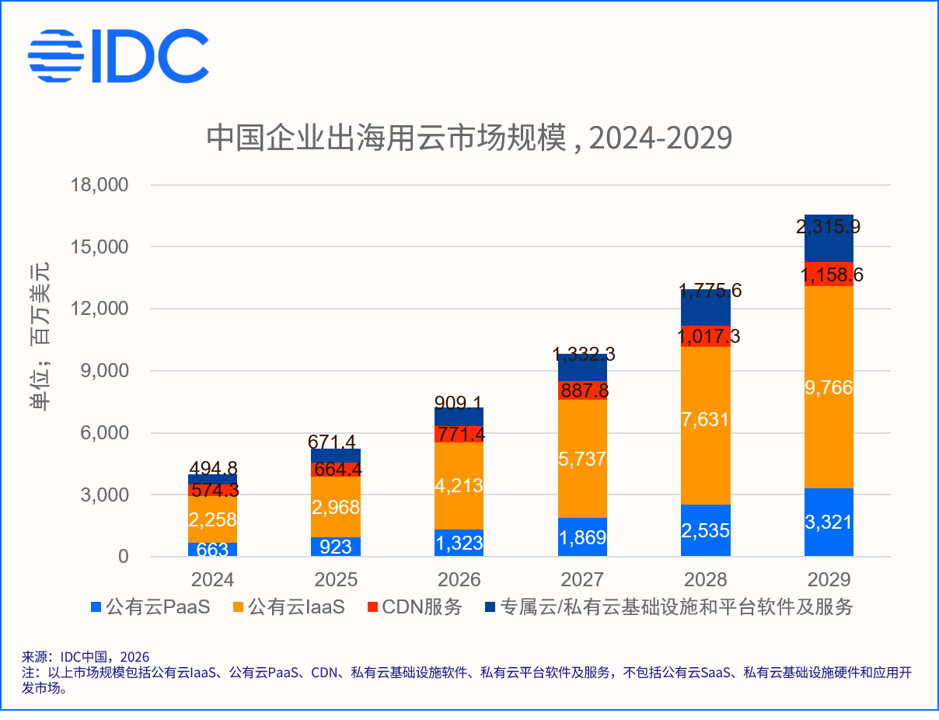
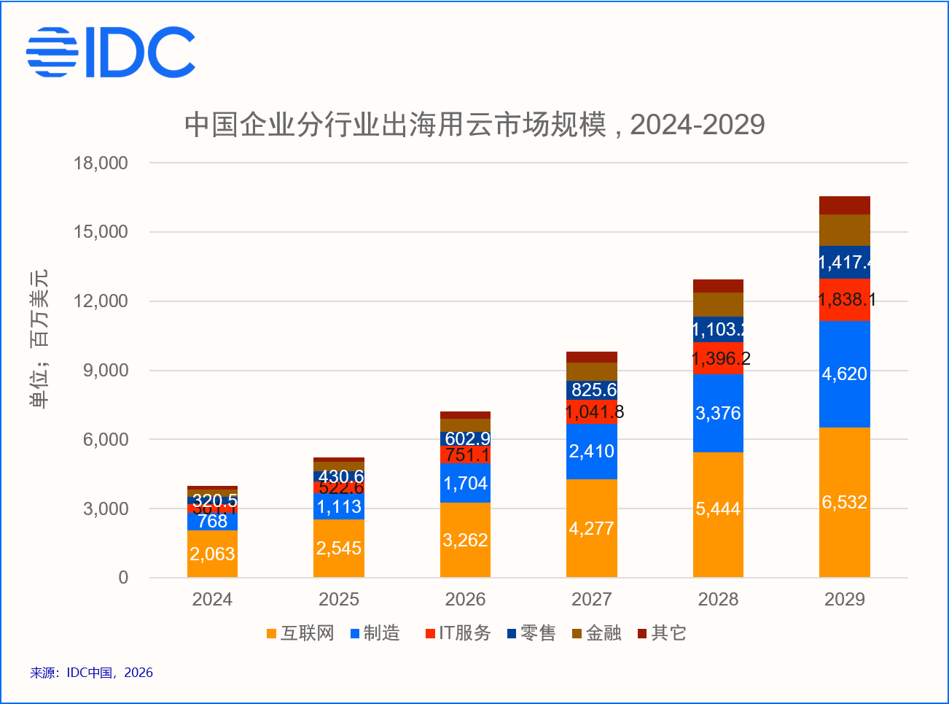
中国企业出海用云早已不是”把服务器搬到海外”,而是一场关于全球经营能力的军备竞赛————某种意义上,它正在开辟中国企业全球化的“云上第二战场”,不亚于一场数字时代的诺曼底登陆。云厂商正在助其将全球经营能力、合规能力和AI能力同步迁移到海外数字底座上。国际数据公司(IDC)最新发布的《中国企业出海用云市场预测,2026—2029》显示:2025年中国企业出海用云市场规模达到52.3亿美元,同比增长31.0%,远高于中国企业的整体IT支出增速,以及中国本土云计算市场增速。到2029年,这一市场将增长至165.6亿美元,四年翻三倍。

但真正值得关注的,不是”蛋糕有多大”,而是”蛋糕怎么分、谁来分、根据什么分”。结合IDC近期对120家中国出海企业的用云情况调研,我们试图回答一个问题:在这场165.6亿美元的暗战里,赢家和输家将被如何决定?

出海用云的本质变了:从“买资源”到”买全球经营能力”

早期企业出海上云,核心诉求是IDC机房、服务器、带宽——先把业务跑起来再说,是”成本导向”的逻辑,谁便宜买谁。而如今进入深水区,企业关心的是全球业务能否稳定运营、快速复制、持续增长,用云逻辑已切换为”业务导向”:全球基础设施覆盖、网络优化、安全合规、数据治理、容灾备份,乃至数据库、AI、大数据等PaaS能力,一个都不能少。

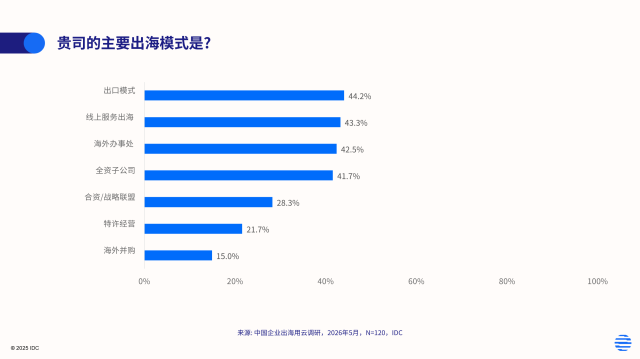
调研数据佐证了这一点:44.2%的出海企业采用出口模式,42.5%设有海外办事处,41.7%已建立全资子公司——出海模式高度复合。这意味着市场需要的是覆盖部署、运维、合规和本地支持的一揽子方案,而不是只满足单一“建站”需求。

还停留在”卖资源”逻辑的云厂商,竞争优势将持续下滑。未来市场的增量,不只来自”更多企业开始采购海外云”,更来自”已出海的企业开始采购更深、更重、更长期的云能力”。客单价和黏性的密码,藏在能力深度里,而不是机架数量里。

多云是默认选项,中国云攥着“主钱包”,本地化服务能力是关键

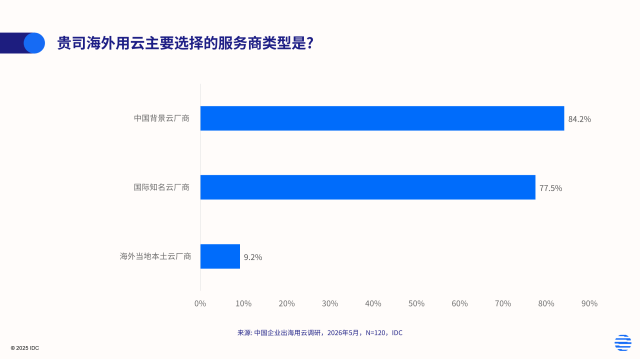
IDC调研显示:84.2%的出海企业正在使用中国背景云厂商,同时77.5%的企业也在使用国际知名云厂商——两者并不互斥;61.7%的出海企业已经是多云用户,其中又有62.2%的企业将50%以上的云支出给了中国云;未来两年42.5%的中国企业海外用云支出将继续增加,54.2%的企业将优选中国背景云厂商,其次是国际云厂商。

再看购买决策因素,调研结果几乎颠覆了传统认知:中国企业海外用云选择服务商时,最高比例(53.3%)的企业优先考虑的因素是本地化服务能力,技术实力(49.2%)、服务稳定性(46.7%)紧随其后,而品牌知名度仅15.8%。

这是一个重要信号:在出海用云市场,”认知资产”让位于”可落地能力”。客户不为Logo付费,只为”你能不能在我的目标市场帮我把事办成”付费。品牌换不来订单,本地交付团队才换得来。

区域不是选择题,是战略布局题:东南亚要速度,中东非要规格,欧洲要合规,北美要本地化

从区域来看,2024-2029年中企出海用云市场规模增长引擎极其清晰:中东非将以40.0%的CAGR领跑,亚太区(36.8%)紧随其后,再次是欧洲(31.5%)和美洲(26.1%)。不同区域的云服务商优先选择偏好分化:东南亚、中东非优先选择中国背景云厂商,而北美、拉美优先选择国际云厂商,欧洲区域参半。

东南亚是最重要的增量市场。制造转移、跨境电商、消费互联网、金融科技在同一时期同步爆发,形成叠加效应。调研显示:出海东南亚的中国企业中,有53.7%的表示未来会增加云投入,57.4%的优先选择中国背景云,但它的关键词不是”容易做”,而是”碎片化”:多国家、多语言、多支付、多税制、多监管,云架构必须天生支持多地区、多币种、多合规配置。

中东非是”高规格、高投入的第二增长极”。主权资本和政府主导投资持续加码数据中心与AI基建,需求偏项目型——大项目多、订单大,但销售和交付高度依赖本地伙伴网络和认证体系。

欧洲则是”要求最高但粘性也强的市场”:数据隐私、数据驻留、消费者保护的要求全球顶尖,前期投入大、培育周期长,但一旦跨过合规门槛,客户稳定性、复购率和长期价值通常高于其他区域市场。

相比之下,北美对中企而言切入最难,54.4%的出海北美的中国企业未来优先选择国际云,难点不只在竞争,更在于监管与合规风险、品牌门槛和技术成熟度要求。

最大的黑马不是互联网,是制造业

论存量,互联网行业仍以20.6亿美元占据2024年出海用云的半壁江山。但论增速,制造业以43.2%的CAGR位居最高——到2029年,制造业出海用云规模将达46.2亿美元,逼近互联网行业的七成。

背后的逻辑是制造业出海正在经历从”卖设备”到“建厂、建渠道、建服务网络“的转型。汽车、新能源、动力电池、消费电子、智能硬件和IoT等制造型行业,正逐步成为中企出海云市场的关键增量来源。汽车与新能源产业链的全球化,带来车联网、远程诊断、全球供应链协同等复合型云需求;消费电子和IoT行业则通过设备接入、远程控制、数据分析和多语言运营,推动端云协同和后端服务价值提升。这类产业型需求比互联网需求释放更稳健、预算周期更长、客户黏性更强,是云厂商”长期支柱”所在。

终局变量:从“上云”到”上AI云”

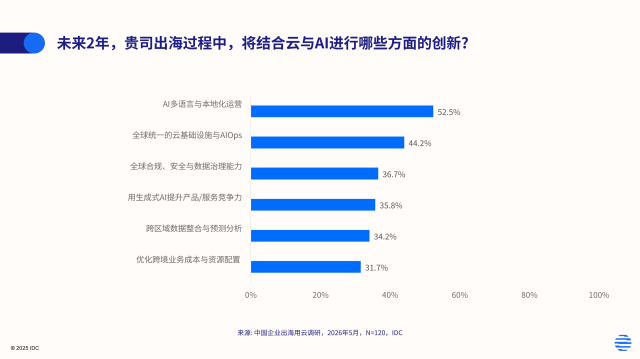
AI是这份预测中最大的增量变量。随着大模型能力增强、推理成本下探,中企海外用云将从”计算、存储、网络为主”升级为“以智能算力和AI平台能力为核心“,GPU资源、推理服务、向量数据库、MaaS的需求将在海外持续放量。从云+AI支撑的应用场景来看,AI多语言与本地化运营将是最先落地的创新场景。

165.6亿美元的市场里,不会有”躺赢者”。成本压力(61.7%的企业视其为最大挑战)与数据主权合规(70%的企业靠”选择具备当地合规资质的云服务商”降险)是两道硬约束,会持续把需求推向头部云厂商,未来五年纯资源售卖者出局,综合能力提供商上位。谁能把”本地化运营 + 合规治理 + 多云管理 + AI应用“打包成标准化、可复制的组合方案,谁就能在这场云上诺曼底里率先抢滩。

IDC 相关研究

围绕中企出海用云相关行业需求、典型案例、区域特点等,IDC 将持续开展系统性研究,包括但不限于:

  • 《中国企业出海用云市场预测,2026-2029》(DocC#CHC54275926,2026年5月)
  • 《中国泛互联网行业出海案例洞察,2026》(即将发布)
  • 《中国企业出海用云调研,2026》(即将发布)

进一步交流:

如需进一步了解中企出海用云相关研究内容,或咨询 IDC 在云计算、AI 基础设施及数字化转型领域的其他研究成果,欢迎与我们联系。

Rachel Liu

Rachel Liu - Research Director

Rachel Liu is a research director for China’s Cloud and Services group. Her research covers public cloud, private cloud, edge cloud, industrial cloud, intelligent computing, and IT services. She is responsible for research plans, research execution and management, data tracking…