This is the final post in Meet IDC Quanta, a short series showing what the product actually does, starting with the portal, then your inbox, and now when you’re already working in Claude.
Imagine you’re the account executive on a procurement software deal, and leadership on the buyer’s side just reached out: they want twenty minutes before the broader vendor review starts. Real conversation. No marketing slide deck, no long product tour. They’ll expect you to know their IT spending trajectory, where the competitive field is moving, and why now is the moment to act.
A fast reply won’t cut it here. You need an actual plan, reports pulled, trackers cross-referenced, findings stitched together. You could do that by hand, or you could open the AI tool sitting in front of you and ask it to build the whole thing.
One tool, every surface you’re already in
Most people assume IDC Quanta is a portal you visit. It’s actually a fabric: the same IDC intelligence, methodology, and research base, running everywhere you work. That’s Claude Chat, Cowork, and Code. It’s Claude for Chrome and the Microsoft Office add-ins, too. The deepest workflow integration lives in Cowork, which is where both scenarios below happen. One connection, live through Claude’s MCP integration (the open standard that lets Claude connect directly to outside data sources), with an IDC skill built in to handle the jobs sellers and buyers actually run.
You don’t switch tools to get IDC data into your work. You just ask.
Ask for the plan
Open Cowork and type it straight to Claude:
Build an account plan for a call with <your target account’s> procurement team, grounded in IDC’s data on their IT spending trajectory, the competitive landscape for procurement software, and any buying signals worth flagging.
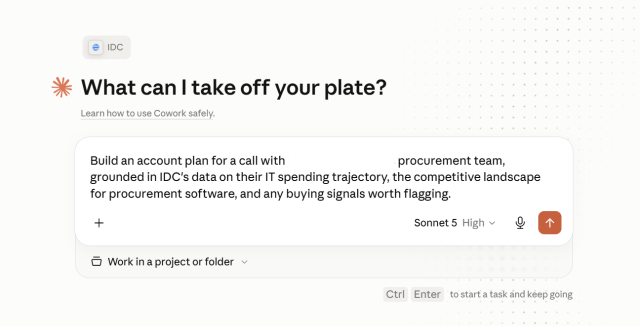
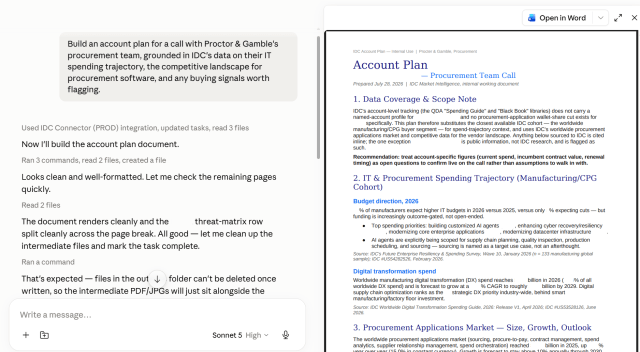
Claude comes back with a couple of quick multiple-choice questions, like which vertical cut or which time horizon. Pick your answers, and it gets to work. A few minutes later, a fully structured account plan is sitting in a Word document. Spending trends are mapped out. Competitive positioning gets a clear read. Buying signals surface where they matter. The kind of document that used to take an analyst half a day now takes the length of your coffee.
Watch it show its work
Here’s the part that actually matters. Open the document and you’ll notice something most AI tools never bother to do: it tells you which parts came from where. IDC-sourced data sits clearly apart from what Claude reasoned on top of it. Nothing blends together into an unlabeled wall of confident-sounding text.

That distinction is the whole point. When your VP asks where a number came from, you’re not guessing. You can point to the line and say exactly what it is: IDC research, or Claude’s synthesis. The document already told you.

IDC’s 2025 Worldwide C-Suite Tech Survey found that excessive time spent on forecasting and reporting ranks among sales leaders’ top three operational pain points (IDC #US54377226, March 2026). A sourced, labeled account plan is built to cut exactly that kind of drag.
Same intelligence, the other side of the table
Now flip seats. You’re the buyer, evaluating procurement software vendors, and you need an independent shortlist, not a vendor’s pitch deck dressed up as analysis.
Same tool, same Cowork window. Ask Claude:
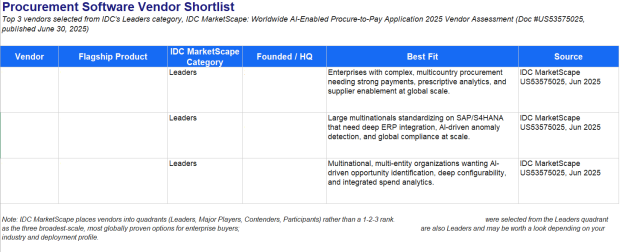
Give me a shortlist of the top three options based on IDC’s worldwide procurement applications research, and generate an Excel evaluation scorecard I can share with my team.
Claude builds the scorecard from the same shortlist of the three vendors actually leading the field, sourced from IDC’s Worldwide Procurement Applications Market Shares, 2025 (IDC #US53723426, June 2026). The IDC-grounded data and Claude’s analysis are labeled separately again. Your team sees exactly what’s evidence and what’s reasoning, no matter which side of the deal they’re sitting on.
Everything You Need, in the Tab You’re Already In
Our first blog showed you a portal built for hard questions with real citations. Our second blog put that same intelligence in your inbox. This closes the series on the biggest move yet: IDC Quanta living inside the tools you use, Claude included, where the work happens. A seller and a buyer can each walk into the same negotiation better prepared, neither one leaving the screen in front of them.
If you’re already using Claude, the IDC Quanta connector is one prompt away. If you’re not yet a customer, book a demo and bring the account you’re working right now.