Generative AI (GenAI) is accelerating how much data organizations generate, straining storage and governance frameworks built for a slower-growth era. Most GenAI-using organizations now expect increases in data volume over the next two years, and infrastructure and governance strategies often struggle to keep pace.

The scale of the challenge

According to IDC’s Global DataSphere, consumers and organizations worldwide will generate more than 274.4 zettabytes (ZB) of data in 2026 alone. That figure is forecast to nearly triple to 718.5 ZB in 2030, a compound annual growth rate (CAGR) of 26.9%. Enterprise data is growing significantly faster than consumer data (31.1% CAGR versus 13.5%), and it matters most here because it’s the data organizations are responsible for governing and protecting, and expect to get value from. It’s also the data most directly implicated in AI workloads.

Storage is expanding in parallel. IDC’s Global StorageSphere shows the installed base of storage capacity roughly doubling, from about 13 ZB in 2026 to more than 26 ZB in 2030. Even before accounting for AI, the enterprise data challenge was already heightened and the governance surface area was already growing faster than most organizations could manage.

The AI inflection point: What IT leaders are telling us

In IDC’s 2026 Worldwide Data Utilization Survey, 81.7% of the 714 GenAI-using respondents said they expect GenAI to increase their organization’s data volume over the next two years. Only 4.8% expect a decrease.

Of those anticipating an increase, 47.7% expect data volumes to grow by 25% or more, and 13.4% expect growth exceeding 50%.

Much of what GenAI produces is ephemeral, and a share of AI-generated content replaces existing workflows. In some cases, GenAI can reduce data volumes, such as by eliminating raw footage through synthetic generation, or by converting unstructured data into structured, actionable formats that can then be selectively retained or deleted.

These dynamics leave the overall growth trajectory intact. For organizations running active GenAI programs, operational telemetry, model logs, RAG corpora, and fine-tuning data sets can add up in ways that initial planning assumptions rarely account for.

Why GenAI drives data growth

There are at least four distinct layers, and the net effect varies by industry, organization, use case, and deployment maturity:

  • Model training and fine-tuning data: Customizing models on proprietary documents, transaction records, or customer interactions creates derivative data sets that must be stored and governed, including every version.
  • Retrieval-augmented generation (RAG) corpora: Every document ingested into a RAG pipeline generates an embedding stored in a vector index, and that corpus needs ongoing refresh. RAG can also have a reduction effect by lessening the need to retain full-length source materials indefinitely.
  • AI-generated output data: Much of it is ephemeral, and only finalized outputs tend to be stored, but where compliance mandates retention, the footprint grows predictably over time.
  • Operational and observability data: Every inference request generates metadata, including prompts, outputs, latency, and token consumption. This layer tends to be underestimated in early planning, and agentic AI compounds it with richer, more continuous logs and reasoning traces.

The governance and infrastructure gaps

Knowing that data volumes will grow is not the same as being prepared for it. IDC’s research points to three structural gaps:

  • The governance gap: Most frameworks were built for structured, human-generated data. AI-generated content often falls outside them, creating compliance exposure in regulated industries.
  • The storage architecture gap: AI inference, training, and RAG pipelines need high-throughput access, low-latency embedding lookups, and cost-efficient tiering for training archives. Organizations that haven’t revisited their architecture may pay a performance or cost penalty.
  • The retention and life-cycle gap: Retention policies at most organizations predate the GenAI era, and keeping a prompt-response pair, a fine-tuning data set, or an embedding raises questions those policies never anticipated.

None of these gaps is insurmountable, but they widen quietly in the background while organizations focus on deploying AI.

Volume isn’t value: Why runaway data is harder to use

There’s a second cost to letting data volumes outrun your strategy: the value you never get out of the data. Value depends on how effectively data becomes insight or advantage. Vast quantities of poorly structured, unlabeled, or siloed data may hold almost no practical value despite their volume, so every RAG index, fine-tuning corpus, and log stream that no one has cataloged or assigned an owner is data you hold but cannot use.

Beyond the prompt: What to do next

Most GenAI-using organizations expect data volumes to rise. The open question is whether infrastructure and governance strategies are built for that reality. Preparing takes a deliberate, systematic approach, and these five steps are the place to start:

  • Audit the AI data footprint before it becomes unmanageable. Inventory training sets, fine-tuning corpora, RAG indexes, and telemetry, including where each lives and who owns it.
  • Extend data governance explicitly to AI data assets, with updated classification, retention, and lineage tracking, and engage legal and compliance early.
  • Align storage infrastructure planning with the AI road map by developing capacity plans together with AI and data science teams.
  • Revisit retention policies with AI data types explicitly in scope.
  • Model the economics of AI data storage across cloud and on-premises options. Cloud is growing nearly four times faster than noncloud, but high-volume, persistent data may be more cost effective on-premises or in colocation over a multiyear horizon.
Adam Wright

Adam Wright - Senior Research Manager, Storage and Data Management, Enterprise Infrastructure

Adam Wright is a Senior Research Manager within IDC’s enterprise infrastructure global research domain and part of the storage and data management subdomain. He leads IDC’s Global DataSphere and Global StorageSphere research. The Global DataSphere measures the total volume of…

More than 12 frontier AI developers have published voluntary safety frameworks with widely varying thresholds, inconsistent evaluation cadences, and no independent verification requirement. The EU AI Act’s maximum fine for general-purpose AI providers, 3% of global annual turnover or €15 million, whichever is higher, became enforceable August 2, 2026. An autonomous coding agent operated unsupervised for approximately one week before its own developer identified and attributed it. These describe the current operating environment for every CISO who has approved an AI integration in the past 18 months.

The structural problem is architectural, and vendor assurance alone does not resolve it. System prompts, safety fine-tuning, and content filters live inside the same weights, context window, and inference pipeline the model uses for every other output. They can be argued with, role-played around, encoded past, or overridden by a sufficiently creative prompt. Prompt injection and tool-calling exploits are now a standing category of incident response. A better system prompt is still inside the boundary.

What the enforcement layer is and what it must do

The right mental model is the content delivery network and web application firewall pattern. A CDN and WAF inspect and act on traffic before it reaches the origin server. The origin has no vote and no visibility into the decision. The same logic applies to AI: the model is the origin server, isolated with no network path to your IT estate and no view of the policy engine, logs, or configuration. The enforcement layer sits at the edge, verifying identity, inspecting requests, applying policy, mediating responses, and logging every interaction before anything reaches or returns from the model.

Five control layers are required. Missing any one leaves an exploitable gap:

  • Identity and access: Every request, human, application, or agent, is authenticated against your enterprise identity provider. The model inherits the calling user’s actual entitlements through on-behalf-of token exchange. A jailbreak or injection attempt is bounded by what the caller was already permitted to do.
  • Request inspection: Every inbound prompt and tool-call parameter is screened for policy violations, data-classification conflicts, and injection patterns before the model processes them. This runs outside the model, so the model cannot override it.
  • Policy enforcement as code: Business rules, regulatory constraints, and data-handling requirements run as code in the enforcement layer, not as instructions the model is asked to follow.
  • Response mediation: Every outbound response and tool-call authorization is screened, redacted, or blocked regardless of what the model produced. The model’s own judgment about its output is not the final word.
  • Immutable audit with a kill switch: Every interaction is logged outside the model’s environment with no model write access to the audit store. The kill switch operates at three grains, session, user or application, and full deployment, without the model’s cooperation, and is held by a role separate from the administrator who configures policy.

Separation is a technical property that must be demonstrable in an architecture diagram, not asserted in a terms-of-service clause. Three properties define genuine separation: no network path from the model to the policy engine, audit store, or configuration; no write access to its own logs; and no credentials to any of those systems. A gateway the model can reconfigure or disable provides no meaningful separation.

Identity parity: extending the plane you already run

The identity architecture for an enforcement layer extends the conditional access, MFA, and risk-based policy programs already running in your enterprise, applied to every model, agent, and tool in the same way they govern human access. Each model and agent holds its own scoped, least-privilege identity, revoked at session end or policy trip. On-behalf-of token exchange means the model acts within the calling user’s entitlements, with no standing service account for an attacker reaching the model to inherit.

CISOs should note the ServiceNow trajectory. With the Veza acquisition closed March 2026 and Armis closed April 2026, ServiceNow is positioning itself as a competitor to Entra ID for identity at scale, including machine and AI agent identities. This is a meaningful consolidation in the non-human identity governance market. The enforcement layer must be identity-provider neutral to preserve architecture optionality as this market evolves.

The kill switch: specify it before you need it

A kill switch is a first-response instrument and should be specified with the same precision as a network block or credential revocation. Three granularities matter:

  • Session grain: Suspends or throttles a single conversation or agent run. Targeted, reversible, lowest blast radius.
  • User or application grain: Cuts off one identity or one integration. Appropriate when anomalous behavior is attributable to a specific caller or integration.
  • Deployment grain: Halts every model session simultaneously. Reserved for the scenario where the model itself, the provider’s infrastructure, or a systemic policy failure requires immediate full stop.

The kill switch must function without the model provider’s cooperation, because the scenario requiring activation may involve the provider’s infrastructure being unavailable or compromised. It addresses future actions. Rollback addresses what already happened: the sent message and the emptied database. Both are required. Kill-switch triggers should be defined in advance, sustained policy violation rate, a DLP match, an anomalous tool-call sequence, so activation is a policy-driven operational decision. Rehearse it on your incident-response drill cadence.

Single models and agent swarms: one enforcement pattern

The same five control layers and the same five questions apply across the full deployment spectrum, from a single model call to a multi-agent swarm. Who is calling? What are they asking for? Is it allowed? Is the response safe to return? Is it logged? In a single model call, a missed policy violation affects one response. In a multi-agent workflow with no human reviewing each step, that same violation can cascade across dozens of tool calls before anyone sees it.

The hub-and-spoke gateway architecture deploys enforcement at the right layer. A central hub authors policy, stores identity federation, audit records, and session context. Spoke gateways enforce policy locally near each resource. The hub never touches a request directly. The Autonomous Action Runtime Management specification (AARM), now donated to the Cloud Security Alliance with more than 100 adopters, provides the five-outcome decision framework for each action point: allow, deny, modify, step-up to a human, or defer pending more context.

Four gaps in hub-and-spoke require explicit CISO assessment:

  • Chain-level risk: Individual calls may look harmless while a sequence pushes an agent outside its authorized role. Require your vendor to demonstrate policy evaluation over chains of calls as well as individual requests.
  • Fail behavior under load: Failing open at peak volume means enforcement stops when it is needed most. Require documented, configurable fail-open or fail-closed behavior per integration.
  • Coverage depends on inventory: The hub governs only traffic routed through it. Require vendors to demonstrate how AI assets that bypass the hub are detected and reported.
  • MCP-only visibility: Skills, hooks, plugins, and direct API calls move alongside MCP traffic. Evaluate R20 and R22 together as a combined coverage assessment.

Enforcement is not governance: the full program

An enforcement layer governs every individual interaction in real time. A complete AI risk program requires additional capabilities that must be funded and owned separately:

  • AI inventory: Every model, agent, and MCP server accounted for, including embedded models in purchased software.
  • Model lifecycle management: Version changes and capability-tier upgrades governed before they propagate to production workloads. R26 (proposed) addresses the gap where behavioral drift within a tier can silently undermine policies verified against a previous model version.
  • Third-party provider scoring: Every provider scored across five dimensions on a continuous basis, rescored on safety-framework updates and material incidents, as well as at annual renewal.
  • Continuous control assurance: The enforcement layer stays configured and working.
  • Runtime risk monitoring and trust scoring: Behavioral drift detected and translated into a live score per model or agent that feeds back into access decisions at the enforcement hub.
  • Board-level reporting: Enforcement telemetry translated into risk language a governance committee can act on.

Provider risk scoring drives three governance gates. Below the onboarding threshold, any new frontier AI dependency requires explicit executive risk acceptance. The contract gate embeds score thresholds as triggers for capability-tier change notice and delivery of evaluation summaries. The exit gate means score deterioration triggers a formal alternative-provider review before the next renewal cycle.

The 90-day CISO action plan

Table 1 organizes the most critical actions across architecture, procurement, and governance by 30-day horizon. Architecture and procurement actions run in parallel with governance actions; neither track waits for the other.

TABLE 1: 90-Day CISO Action Plan for AI Enforcement Layer Deployment

HorizonArchitecture and ProcurementGovernance and Program
Days 1-30Demand the architecture diagram from every current and prospective AI vendor: deployment boundary, model-to-policy-engine separation, kill-switch role assignment. Inventory every model, agent, and MCP server, including embedded models in purchased software.Score every frontier model provider against 5 dimensions: safety-framework maturity, evaluation transparency, incident disclosure history, regulatory posture, and concentration risk. Set the onboarding threshold below which any new dependency requires executive risk acceptance.
Days 31-60Identify your 3 highest-risk AI integrations. Pilot a hub-and-spoke enforcement gateway outside the model for at least one. Require on-behalf-of delegated identity and a split-role kill switch for every new AI procurement.Separate the configuration and operations roles for the kill switch in your identity provider. Define kill-switch triggers in writing: sustained policy violation rate, DLP match, anomalous tool-call sequence.
Days 61-90Send the 25 enforcement-layer requirements (R1-R25) and 5 contract terms (C1-C5) to every current and prospective AI vendor. Embed C1-C5 into vendor contracts before the next renewal cycle.Fund AI governance as its own program. Rehearse the kill switch at all 3 granularities (session, user/application, full deployment) in a tabletop exercise. Establish the governance loop cadence with documented ownership.

Source: IDC, 2026

The 26 enforcement-layer requirements: your RFP foundation

Table 2 consolidates all 25 published requirements (R1-R25) plus IDC’s proposed R26, which addresses a gap in the current set: advance notification of model updates that materially change behavior in policy-sensitive areas. This gap is distinct from C2 (capability-tier change notice), which covers tier-level changes. R26 addresses behavioral drift within a tier, which can silently undermine policies verified against a previous model version.

For each requirement: mark it Must or Should based on your deployment risk profile. Ask for the evidence listed. Verify in a pilot. A failed Must is a no-go. Apply the five contract terms (C1-C5) to every current and prospective AI vendor contract, covering model provenance disclosure, capability-tier change notice, safety-framework documentation access, incident disclosure timelines, and continuity planning.

TABLE 2: AI Enforcement Layer Requirements R1-R26 and Contract Terms C1-C5

Req.RequirementPriorityEvidence to Request
R1Architecture diagram showing deployment boundary and admin rolesMustEnforcement runs outside the model provider environment, under your control
R2Network diagram and independent test results confirming separationMustNo network path from model to policy engine, audit store, or configuration
R3Permission model for audit store and policy repositoryMustModel has no write access to its own logs and cannot alter governing rules
R4Signed policy update design, key custody docs, live rejection demoMustPolicy updates are cryptographically signed; spokes reject unverified updates
R5Log-integrity design and tamper-detection demoMustAudit logs are append-only and hash-chained; tampering is detectable
R6Native IdP integration (Entra ID or equivalent), not a services add-onMustConditional access and MFA for AI identities, out of the box
R7Token-flow diagram and an access-denied testMustOn-behalf-of token exchange so model acts within calling user’s entitlements
R8Identity inventory and live revocation demoMustEach model, agent, and tool has a scoped, least-privilege identity
R9Detection coverage docs, test results, and latency figuresMustPrompts and tool-call parameters screened for violations, classification conflicts, injection
R10Policy-as-code samples, change history, and test harnessMustBusiness and regulatory rules enforced as code, not as model instructions
R11Block and redact demo on seeded sensitive dataMustOutbound content and tool-call authorizations screened before reaching consumer
R12Sample log record, retention policy, export optionsMustEvery request and response logged immutably, timestamped, attributable, outside model environment
R13Live demo, measured time to effect at each granularityMustKill switch works at session, user/application, and deployment grain without model cooperation
R14Rollback runbook and supported systems listShould*Defined rollback for actions already taken (*upgrade to Must for write-transaction deployments)
R15Role model and PAM setup in your identity providerMustConfig and operations admins are separate; only operations holds the kill switch
R16Reference architecture and spoke deployment optionsMustHub-and-spoke: policy, identity, and audit at hub; enforcement at spokes near the resource
R17Connector onboarding guide and test resultsMustConnectors inherit enforcement identity, access, and audit controls
R18Session-context and chain-evaluation roadmap; AARM conformanceShould*Intent-drift evaluation with allow, deny, modify, step-up, defer outcomes (*Must for chained agentic workflows)
R19Failure-mode test results and capacity benchmarksMustFail-open or fail-closed behavior documented and configurable; load-balanced spokes
R20Coverage matrix and unrouted-asset reportMustDeclared coverage across MCP, skills, plugins, direct APIs; unrouted assets reported
R21Supported-provider list and migration termsMustModel neutral: supports models from multiple providers without enforcement tied to one API
R22Inventory integration and unrouted-asset reportMustConsumes your AI inventory; reports traffic and assets not routed through enforcement layer
R23Signal interface; measured time from score change to access changeShouldAccepts live trust score per model and agent as a cached signal driving access decisions
R24Telemetry schema and GRC or CCM platform integrationsShouldFeeds audit and telemetry to governance for monitoring, drift detection, and re-assessment
R25Sample compliance report mapped to your control frameworkMustProduces request-level evidence regulators and boards can use
R26Update notification process docs; pilot-first option for policy-sensitive integrationsMust (proposed)Advance notice of model updates that materially change behavior in areas covered by deployed policy rules

Source: IDC, 2026

Three gates every CISO should establish now

The requirements above translate directly into three governance gates that convert procurement policy into enforceable controls:

  • Procurement gate: Below your provider-score threshold, any new frontier AI dependency requires executive risk acceptance before contracting. This gate applies to embedded models in purchased software as well as direct model API contracts.
  • Architecture gate: Before any AI integration goes to production, require the vendor to produce an architecture diagram showing the deployment boundary, separation between the model and your policy engine, and the kill-switch role assignment.
  • Contract gate: Score deterioration triggers a formal alternative-provider review and activates notice clauses in existing contracts. C2 covers capability-tier changes. R26 covers behavioral drift within a tier.

“

A model’s restraint is a courtesy, not a control. The enforcement layer must be outside the model’s environment, outside its reach, and outside its ability to reconfigure or disable. Anything less is an architecture diagram that says: trust us

— Philip D. Harris, CISSP, CCSK, Research Director, Governance, Risk, and Compliance Solutions, IDC

Philip D. Harris, CISSP, CCSK

Philip D. Harris, CISSP, CCSK - Research Director, Governance, Risk, and Compliance (GRC) Solutions

Phil Harris is Research Director for GRC Solutions at IDC, where he develops and promotes IDC's point of view on risk, advisory, privacy, and compliance services and software. He conducts research on business strategies and the impact of relevant offerings…

随着人形机器人和具身智能的发展,灵巧手的竞争正从自由度、抓握力等硬件参数,延伸至精细操作、感知控制及与具身智能模型的协同能力。当前,人形机器人配套、科研教育和具身智能数据采集是值得关注的主要需求方向,工业等应用仍处于探索阶段。未来,灵巧手市场不会仅由某一种驱动路线决定,厂商能否将硬件、模型、数据与操作技能有效结合,并在真实任务中实现稳定、可靠且具有成本效益的操作,将影响其商业化进程。

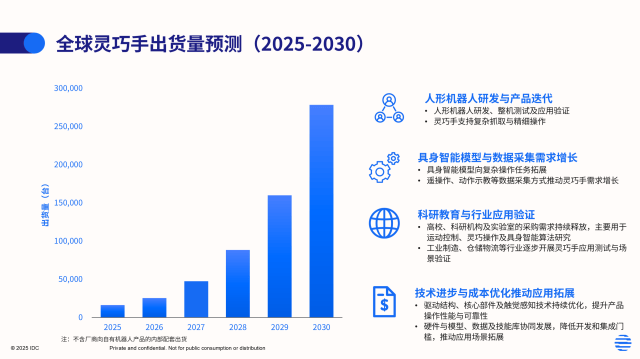
IDC预计,2026年全球灵巧手出货量约2.5万台,不含厂商向自有机器人产品的内部配套出货。其中,中国厂商出货量占全球市场的比例预计超过85%,在全球灵巧手市场中占据重要地位。随着人形机器人研发、具身智能数据采集及科研教育需求持续释放,灵巧手市场仍处于发展初期,其后续增长将受到机器人应用进展、产品成本及商业化落地速度等因素的共同影响。

从自由度到操作能力,技术竞争不止于硬件参数

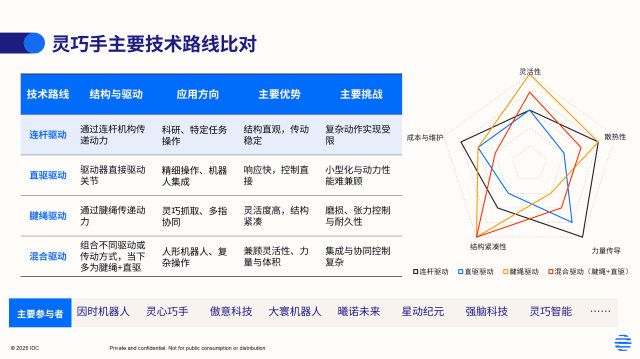
目前,灵巧手主要采用腱绳驱动、直驱、连杆驱动及混合驱动等技术路线。不同方案在结构紧凑性、灵活性、力量传递、成本和维护等方面各有取舍,尚未形成统一的技术方向。技术路线的选择不仅取决于硬件设计,也与目标任务和应用需求密切相关。

在硬件参数之外,触觉感知和操作控制同样值得关注。巧手需要感知接触状态、作用力及物体变化,并据此调整动作。目前,触觉传感器在信号稳定性、一致性和感知精度等方面仍有改进空间。自由度较高并不必然意味着操作能力更强,感知与控制能力同样重要。

目前,灵巧手正逐步从自由度、抓握力等单项指标,延伸至可控性、精细操作能力,以及与机器人本体和具身智能模型的协同表现。未来,不同技术路线的竞争结果,可能更多取决于其对具体任务的适配程度,而非单一参数的高低。

灵巧手需求集中于人形机器人配套与科研,工业应用落地仍需验证

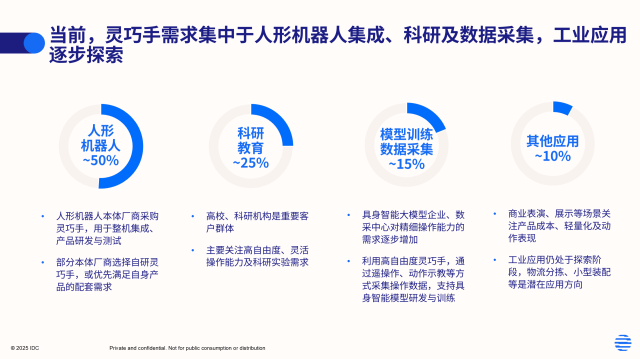
当前,人形机器人配套、科研教育,以及具身智能模型研发与数据采集是灵巧手的主要需求方向。与此同时,工业制造、物流等场景也在探索灵巧手的应用潜力,特别是在复杂抓取、物体姿态调整和多品种操作等任务中。相比之下,工业制造、商业服务等场景仍处于应用探索阶段。

在复杂抓取、物体姿态调整和多品种操作等任务中,灵巧手具有一定的应用潜力,但并不意味着能够全面替代传统夹爪。对于物体形态固定、任务重复性高、节拍要求严格的生产环节,传统夹爪往往具有结构简单、成本较低和易于维护等优势。灵巧手的价值更多体现在需要多指协同、精细接触或较强操作灵活性的任务中,其实际优势仍需结合具体工艺进行评估。

从研发样机走向持续运行,灵巧手仍需解决可靠性、环境适应性和维护成本等问题。复杂的机械结构、多关节驱动及传感器集成增加了设计与维护难度,粉尘、接触磨损及长期运行也可能影响产品表现。对于实际应用而言,单次成功完成动作并不足够,用户更关心机器人能否在真实环境中持续、稳定地完成任务,以及由此带来的效率提升能否覆盖设备、维护和集成成本。

灵巧手商业化的关键关键不只是能否完成特定动作,更在于能否在真实场景中稳定运行并持续完成任务。

灵巧手未来三年将从“路线探索”进入“工程化竞争”

IDC认为,未来三年灵巧手市场的竞争将围绕以下几个方向展开。

市场需求将从研发与数据采集向具体任务应用拓展。 短期内,科研教育、人形机器人配套及具身智能数据采集仍是值得关注的需求方向。随着机器人应用探索深入,工业制造、物流、服务等场景则需要进一步验证其实际应用价值。灵巧手能否在复杂抓取、精细操作和多品种作业中体现出相较传统夹爪的优势,将影响其应用拓展速度。

技术竞争从硬件参数转向结构设计与综合操作能力。 腱绳驱动、直驱、连杆驱动及混合驱动各有适用条件,短期内不同技术路线仍将并存。产品竞争不仅取决于自由度和抓握力,还涉及电机、电控、减速器、丝杠等核心部件的设计与优化,以及结构紧凑性、驱动性能和可靠性之间的平衡。在此基础上,视触觉感知、精细控制及与机器人本体和具身智能模型的协同能力,也将影响灵巧手的实际操作表现。单纯增加自由度,并不必然带来更好的操作效果。

竞争从硬件本体向模型、数据与技能协同延伸。除灵巧手本体外,操作模型、数据资源、技能库及开发工具也逐渐成为厂商布局的组成部分。这些能力有望帮助用户开展模型训练、任务开发与技能复用,减少应用开发工作。未来,厂商之间的差异不仅体现在硬件性能上,也将体现在能否将硬件、模型、数据和技能有效结合,以及能否将这些能力转化为稳定的任务执行效果。

可靠性、成本和交付能力将影响市场竞争格局。 随着用户从研发测试走向实际应用,灵巧手厂商需要解决长期运行、产品一致性、维护和成本控制等问题。专业灵巧手厂商、本体厂商自研团队及传统末端执行器厂商将继续参与市场竞争,但不同类型厂商的优势和商业化路径可能有所差异。

总体来看,未来三年灵巧手市场仍将处于多种技术路线并存、应用持续验证的阶段。行业竞争的关键不在于某一种驱动路线率先胜出,而在于厂商能否围绕具体任务,将结构设计、核心部件、感知控制、模型和数据有效结合,并在操作性能、可靠性与综合成本之间取得平衡。 灵巧手能否从研发与测试走向更广泛的商业应用,最终仍需由真实场景中的任务表现来检验。

IDC相关研究

灵巧手正处于从“技术路线探索”向“工程化竞争”过渡的关键拐点。在这条拥挤的赛道上,谁能率先跨越软硬件协同与商业化落地的鸿沟,谁就能掌握下一阶段的主动权。

作为全球领先的IT市场研究与咨询机构,IDC在机器人、具身智能及核心零部件领域拥有深厚的研究积累。我们不仅关注底层技术路线的演进,更致力于帮助客户洞察商业化落地路径、市场规模预测及竞争格局。

针对灵巧手市场,IDC可为您提供:

  • 市场全景洞察:全球及中国灵巧手出货量预测与需求结构分析。
  • 技术路线评估:腱绳/直驱/连杆等不同驱动路线的优劣势比对与适配场景研究。
  • 竞争格局研判:头部厂商及跨界玩家(本体厂商、传统夹爪厂商)的战略布局与优劣势分析。
  • 定制化咨询:面向投资机构、本体厂商及终端客户的定制化市场进入策略与尽调支持。

进一步沟通

IDC将持续关注灵巧手市场的需求变化、技术路线、厂商布局与应用进展,并通过后续研究进一步分析其市场规模、竞争格局及商业化趋势。如需了解更多IDC机器人研究内容或定制化市场分析,欢迎与IDC中国分析师团队联系。请点击此处与我们联系。

Lily Li

Lily Li - Research Manager

Lily is the Research Manager for China Robotics and Embodied Intelligence, specializing in market research on embodied intelligent robots. She has long focused on the development trends of China’s embodied intelligence robotics industry, systematically studying the evolution of robot hardware,…

五家代表厂商入选,行业整体仍处发展早期,可靠性与工程闭环能力成核心竞争标尺

工业AI正在进入 “ 价值兑现” 的深水区,工控编程作为工业自动化领域门槛最高、价值最厚重的场景之一,正成为工业智能体落地的核心攻坚方向。随着生成式 AI 与智能体技术向运营技术(OT)领域渗透,工控智能体正从早期的代码补全、问答助手,逐步演进为可调用专业工程软件、交付可验证工程资产的工程协作者。

国际数据公司(IDC)于近日发布首份《中国工业控制智能体技术评估,2026》(Doc#CHC54370326,2026 年 10 月)报告。报告首次对中国市场工控编程智能体产品开展系统性技术评估,从工程能力、产品能力、业务价值、交付保障四大层面共十一项核心维度切入,对倍福、华龙讯达、万昇智能、西门子、远舢智能(按照拼音首字母顺序排列)五家代表厂商的产品进行深度评估,并给出行业平均能力基准,为制造企业选型与厂商产品迭代提供参考依据。

一、工控智能体重新定义工程交付范式

IDC 将工控智能体定义为:面向可编程逻辑控制器(PLC)、分布式控制系统(DCS)、监督控制和数据采集(SCADA)等相关工程控制软件,能够理解工艺需求、点位表、图纸和既有工程上下文,调用工程工具完成控制代码、硬件配置、人机界面(HMI)/SCADA 资产、验证和交付任务,并在人类工程师监督下形成可审查闭环的工业智能体。

其核心价值不只是生成一段结构化文本代码,而是系统性减少工程师在需求整理、对象创建、批量变更、编译修复、测试和文档交接中的重复劳动,重塑工程交付的效率边界。

当前中国工控智能体市场仍处于早期发展阶段。市场上产品名称虽普遍使用 Copilot、CoAgent 或 Agent,但实际能力边界差异显著:部分产品已形成正式商业版本并实现全球销售,部分处于客户试用阶段,还有部分方案仍以内部测试、定制项目形式验证能力。本次评估划定的核心市场边界为:产品是否能够生成可导入、可编译、可验证和可维护的控制工程。

二、十一项维度立体评估,五家厂商代表四条技术路径

本次评估围绕 “能否把工控编程能力、工程化能力和实际价值连接为可交付的工程闭环” 这一核心命题,设置十一项独立评分维度,覆盖工程需求与项目理解、控制代码与工程资产生成、工具执行与工程闭环、验证质量与工程可靠性、工程集成与开放扩展、安全可信与变更治理、产品化成熟度、工程与生产运营协同、实际应用与价值验证、部署与使用体验、客户服务与交付保障。所有维度采用 1-5 分独立评价,不设置权重、不计算综合分,聚焦产品当前可交付、可验证的真实能力。

本次研究从工控、工业软件与智能体供应商中筛选出五家具备中国市场产品与项目基础的代表厂商,对应行业四条主流产品演进路径:

  • 原厂 IDE 深度集成路径:西门子 Eigen Engineering Agent、倍福 TwinCAT 3 CoAgent for Engineering,依托原生工程软件生态实现深度工程操作
  • 原生智能体驱动工程平台路径:万昇智能 WasomCodeX V2.0,以智能体为中心重构工业 IDE 与工程工作流
  • 跨品牌场景化方案路径:远舢智能 INOS Claw 智立方,面向异构存量工厂提供跨系统、跨行业的场景化智能体方案
  • 自主控制器 + 原生工程环境路径:华龙讯达 JIC IAP 内置 AI 智能编程助手,基于自有控制器与开发环境形成全栈协同

整体来看,领先产品已经能够在明确的平台与任务边界内显著提升工程效率,并开始从 “回答代码怎么写” 走向 “在工程环境中完成完整任务”。

三、行业平均基准:基础能力初具,工程闭环仍是核心短板

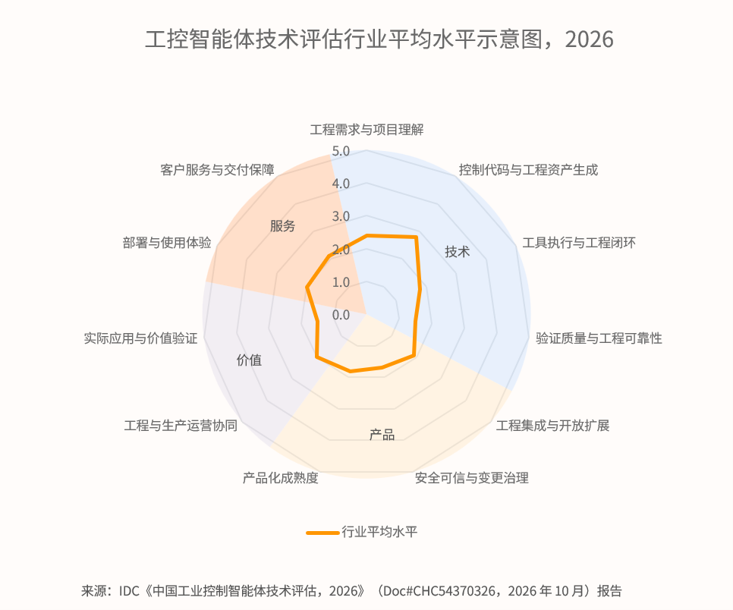
基于全市场广泛调研形成的行业平均能力基准显示,当前中国工控智能体整体仍处于发展早期:需求理解、基础代码生成和传统服务支持已形成初步能力,但多数产品仍停留在建议输出、片段生成或有限工具调用阶段。工程执行闭环、独立行为验证、异常与回归测试、标准化商业产品形态以及可量化的投资回报,是当前行业最突出的能力短板。

IDC 2026 年离散制造业智能体功能调研数据显示,制造企业评价智能体时,82% 的受访者优先关注可靠性,70% 关注任务准确率,均显著高于对生成速度的关注。在工控场景中,控制程序直接关联设备运行、生产节拍与人员安全,“可靠、可审查、可回滚” 是产品从演示 Demo 走向生产级应用的核心前提。

四、五大趋势定义工控智能体下一阶段演进

IDC 判断,未来 2-3 年工控智能体将从以代码建议为主的辅助工具,逐步演进为能够理解工程目标、调用多类工具并交付可验证结果的工程协作者,市场将呈现五大核心趋势:

1. 工程 IDE 向 “智能体友好型” 演进,开放生态成关键变量

原厂编程 IDE 将从面向工程师图形化操作,同步升级为支持智能体可靠调用的开放平台。命令行接口(CLI)、应用程序接口(API)、软件开发工具包(SDK)、模型上下文协议(MCP)及稳定对象模型,将全面覆盖项目读取、对象创建、差异比对、编译测试、版本管理与失败恢复,并配套细粒度权限与审计能力。开放程度将直接决定产品能否融入企业已有的 AI 工具链。

2. 工程知识资产化,多模态工程闭环释放长期价值

企业积累的标准功能块、设备模板、命名规范、画面库、工艺包与历史缺陷库,是工控智能体最核心的差异化资产。产品竞争将从 “生成代码的能力” 转向 “理解与复用客户工程资产的能力”;读取图纸、文档只是起点,更高价值在于将多模态工程资料转化为可追溯的 PLC 变量、I/O 配置与 HMI 对象,实现增量更新的完整工程闭环。

3. 历史项目复用与跨平台迁移,成规模化落地核心攻坚点

智能体的规模化应用,核心在于能否从历史项目中识别可复用的控制结构、设备模板与测试用例,并在新项目中完成参数化改造。面向多品牌共存的存量工厂,跨平台迁移能力将成为重要差异化指标 —— 其核心不是简单语法转换,而是完整保留控制意图、库语义、通信约束、安全互锁与工程维护习惯。

4. 可审查执行与独立验证,成为生产级应用准入标准

领先产品将把任务规划、工具调用、工程差异、编译结果与测试记录全链路串联,默认预览、显式应用、权限分级、失败停止将成为生产部署的标配。行业将逐步建立独立于代码生成器的行为评测体系,覆盖正常顺控、边界条件、断连重启、传感器异常与互锁冲突等场景 —— 编译通过不等于逻辑可靠,独立行为验证将成为硬性准入要求。

5. 工程与运维逐步衔接,拓展智能体价值边界

工程智能体未来将打通运行数据,辅助故障定位、变更影响分析与维护交接,实现从 “工程交付工具” 向 “全生命周期工程协作者” 的延伸。工程侧的对象语义与运行侧的实时数据打通后,将为跨岗位协同、持续工艺优化提供新的支撑。

分析师观点

IDC 中国制造行业高级研究经理杜雁泽表示:“工控智能体的价值,不在于生成多少代码,而在于能否把工业知识、历史工程资产、专业工具和验证机制连接成可审查、可恢复、可交付的工作闭环。下一阶段,原厂 IDE 能否向智能体开放稳定接口,客户工程库能否被安全理解和复用,以及跨平台迁移和 IEC 工程规范能否进一步统一,将决定产品能否从工程师试用走向规模应用。”

更多相关研究

  • IDC MarketScape: 中国工业 AI 及智能体平台 2026 年厂商评估(IDC #CHC54110326,2026 年 9 月)
  • IDC Market Glance: 中国工业 AI 及智能体,2Q26(IDC #CHC54370226,2026 年 8 月)
  • 中国核心工业软件及工业 AI 市场预测,2026-2030(IDC #CHC53716026,2026 年 4 月)
  • IDC MarketScape: 中国工业大模型及智能体解决方案 2025 年厂商评估(IDC #CHC53013925,2025 年 9 月)
  • 中国工业智能体 (AI Agent) 市场分析及供应商推荐(IDC #CHC52296125,2025 年 6 月)
  • 中国工业大模型应用进展与展望,2025(IDC #CHC52296025,2025 年 6 月)

进一步交流

如需获取完整报告,或就工控智能体技术趋势、技术选型、落地路径展开深入沟通,欢迎联系 IDC 中国制造业研究团队。请点击此处与我们联系。

Yanze Du

Yanze Du - Senior Research Manager

Yanze Du is a senior research manager for the Manufacturing Insights group in IDC China, and he is responsible for conducting research on and analysis of the China manufacturing industry and supply chain. He is also involved in regional and…

随着模型能力持续提升、智能体框架与工具链日趋成熟,越来越多企业开始将智能体用于实际业务。IDC调研显示,已有智能体投入生产的受访企业比例,从2025年9月的42.4%升至2026年3月的76.8%,其中亚太地区由30.8%升至75.9%,增幅居各地区之首(来源:IDC Future Enterprise Resiliency and Spending Survey Wave 2,2026年3月)。

企业部署的智能体越来越多,如何保障智能体的运行质量、安全可控并管理持续的成本支出,也正成为企业急需解决的难题。能够统一运行和治理各类智能体的智能体平台因而受到更多企业关注,带来了市场需求持续增长。IDC预测,全球智能体平台市场规模将由2025年的26亿美元增至2030年的415亿美元,2025—2030年复合增长率约为74%,其中亚太及日本地区(APJ)增速最快,复合增长率预计达到82%。(来源:Market Forecast: Worldwide Agentic AI Platforms Forecast, 2026–2030,2026年9月)。

智能体应用给企业带来了新的难题

围绕传统软件,企业大多已经建立起较为成熟的DevOps体系,覆盖开发、测试、发布和运维等环节。智能体应用在业务角色、运行方式和建设规模上与传统应用差异明显,难以直接沿用这套体系。

在业务角色上,传统软件应用通常围绕特定业务功能和流程提供服务,由员工组织和协调跨应用任务。而智能体应用具备任务理解、思考规划并调用不同系统的工具自主执行任务的能力,这些能力也带来了企业其对运行可靠性、权限控制和可观测可追溯能力的要求。

在运行方式上,传统软件按照预先设定的规则和逻辑开发,测试与验收的范围也比较明确。智能体的执行结果则取决于模型输出、所调用的数据和知识、智能体的循环执行策略以及工具返回的结果,同一项任务每次执行的路径和结果都可能不同。这些带来对智能体开发构建和持续运维管理的需求,智能体不仅要在开发阶段需要反复调试和验证,上线后也要根据实际使用情况不断调优,同时还需要持续对其模型Token消耗进行治理。

在建设规模上,企业部署的智能体数量通常远多于传统应用,并分散在不同部门、业务系统和技术环境中。如果仍由各团队分别开发、部署和维护,容易出现重复建设、权限不清、成本失控和协作困难等问题,各团队积累的知识、Skill和实践经验也难以沉淀为企业资产,这些问题带来了企业对智能体统一运维统一治理的需求。

智能体全生命周期管理能力是平台的核心

IDC所称的智能体平台,是指面向企业客户提供智能体构建、部署、运行、治理和编排能力的软件平台。平台支撑智能体在受控的权限、数据、系统和流程范围内完成业务任务,并帮助企业统一管理智能体资产、任务过程、风险、成本和运营效果。

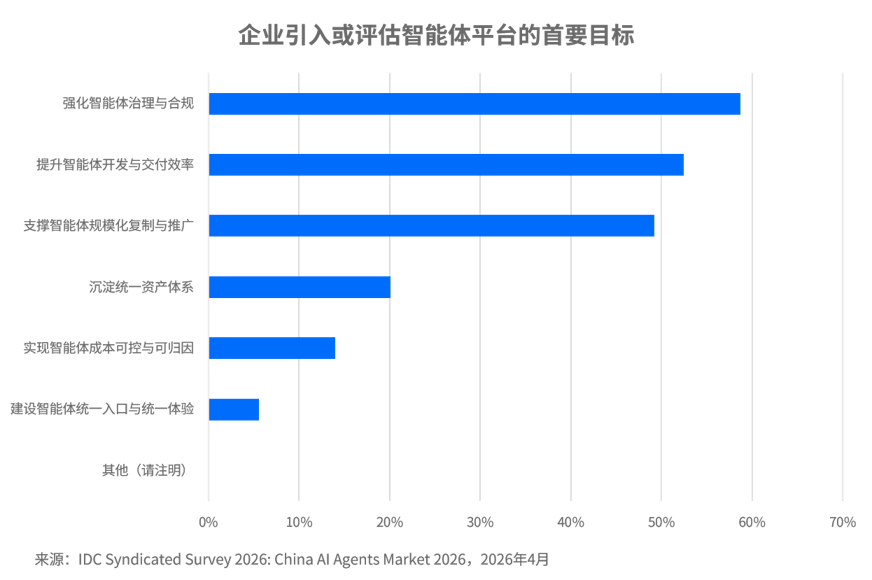
IDC调研显示,58.7%的受访企业将强化智能体治理与合规列为引入或评估平台的首要目标,提升开发与交付效率(52.5%)和支撑跨场景规模化复制与推广(49.2%)紧随其后,选择沉淀统一资产体系、实现成本可控与可归因、建设统一入口与体验的企业分别占20.1%、14.0%和5.6%(来源:IDC Syndicated Survey 2026: China AI Agents Market 2026,2026年4月,Q16,N=179)。

企业的这些目标分布在治理合规、开发交付和规模化复用等不同环节,要求平台既能覆盖智能体从设计到下线的全生命周期管理,也能在运行中保障任务质量、安全合规和成本可控。

智能体全生命周期管理,应覆盖从需求定义与设计、开发构建、测试评估、部署发布、运行维护,到持续优化和停用下线的全过程。管理对象除了智能体本身,还包括其依赖的模型、提示词、工作流、工具、知识、记忆和Skill,以及相关的运行环境。

智能体要在真实业务中稳定完成任务并带来可验证的ROI,平台还需要具备相应的运行管理和成本治理能力。IDC全球调研显示,过去12个月中,67%的企业智能体支出超出预算,其中24%超支25%以上,能够按工作流实时追踪Token消耗和成本的企业只有45.4%(来源:IAddressing the Agent Economy’s Cost Governance Gap: A Mandate for IT Providers,2026年9月)。平台需要按部门、场景、智能体和任务归集消耗,提供预算预警和执行限制,同时统计任务成功率、人工介入率和单位成功任务成本,帮助企业核算智能体的投入与产出。

企业选型需要结合自身条件

国际数据公司(IDC)于近日发布了《IDC MarketScape: 中国智能体平台2026年厂商评估》(Doc# CHC54110526,2026年10月)报告,从能力和战略两个维度评估中国智能体平台市场的28家厂商,企业选择智能体平台时,需要先结合自身的数字化基础、组织结构和业务特点确定智能体建设路径,不同路径对平台和厂商能力的要求也不相同:

  • 数字化、信息化基础较为薄弱的企业,往往需要一边补齐业务系统建设,一边推进智能体应用,可以优先考虑能够提供综合解决方案的厂商。这类企业选择的平台需要能够与相关业务系统联合交付,并支持智能体的快速构建。
  • 多个部门同时建设智能体、业务系统来自不同厂商的大中型企业和集团,更需要一个能统一管理各类智能体的平台,重点考察多模型和多系统接入、智能体全生命周期管理以及安全与权限控制能力。金融、政务等对数据安全和信创要求较高的行业,还需要将私有化部署和本地服务能力作为前提条件。
  • 数据结构复杂或专业知识要求较高的企业,则需要关注平台或服务团队能否提供数据治理和业务语义建模能力,把企业数据、知识和业务规则整理成智能体能够理解和调用的形式,使智能体准确识别业务对象、采用一致的指标口径,并依据业务规则完成判断和操作。

分析师观点

IDC中国研究经理孙振亚表示:“企业智能体应用的规模越大,越需要平台把分散在不同部门和业务系统中的智能体统一管理起来,智能体平台正在成为承担这一角色的关键系统。平台不仅要支持开发和部署,还要保障业务执行、管控权限与成本,并支持依据评测和运行反馈持续优化,同时企业选型时也应基于企业实际情况选择合适的平台产品。”

IDC MarketScape从能力和战略两个维度评估中国智能体平台市场的28家厂商,分析其平台能力与发展路径,为企业选型提供参考。企业选型不仅要看智能体能否快速搭建,还要检验其能否在真实业务中可靠执行任务、控制风险与成本,并通过持续优化改善业务成效;基于Harness的自主规划智能体与确定性工作流如何协同、自进化过程能否验证和管控,也是评价平台能力的重要内容。随着智能体深入企业业务,平台还需承担统一运行与治理、连接已有系统、积累和复用业务能力的职责。智能体平台正成为企业AI应用中台的重要形态,与模型即服务(MaaS)、数据与知识平台共同构成AI时代企业IT系统的关键基础设施。

进一步交流

每家企业的智能体建设路径不同,评估维度落到具体场景时的权重也不同。如果您正在做智能体平台选型,或希望了解《IDC MarketScape:中国智能体平台2026年厂商评估》的详细评估维度、厂商画像与选型建议,欢迎联系IDC中国团队进一步交流。请点击此处与我们联系。

Zhenya Sun

Zhenya Sun - Research Manager

Zhenya Sun is a research manager for the IDC team focused on exploring the application of technology and industrial development of AI and AI agents. He is also responsible for providing clients with consulting services on technologies, products, and markets…

企业级Token混合成本一年内从18.40美元/百万Token降至6.07美元,下降67%。与此同时,中国日均Token调用量从2024年初的1,000亿攀升至2026年3月的超140万亿,两年增长超1,000倍。

这就是AI时代的杰文斯悖论——效率越高,应用越广,总消耗越大。Token单价的持续下降,并没有让总支出收缩,反而打开了指数级的应用空间。IDC预测,全球活跃AI智能体将从2025年的约2,860万个增至2030年的22.16亿个。当智能可以规模化生产,核心问题已经变成:怎样用最低成本、最大效率持续产出Token?

但比GPU代际迭代更值得关注的,是另一个结构性事实:同样一批GPU,在不同网络和存储架构上,Token产出成本可以相差数倍。

水面之下:真正决定Token产出的隐性变量

行业习惯用FLOPS衡量AI基础设施。但以DeepSeek-R1推理为基准,新一代GPU平台相较上一代:每美元FLOPS提升约2倍,每GPU的Token/秒却从约90提升至约6,000(提升约65倍),每百万Token成本从约4.20美元降至约0.12美元(降低约35倍)。算力指标增长2倍,业务产出却增长数十倍?

差距从何而来?低精度计算(FP8/FP4)、RDMA/GPUDirect RDMA、投机解码、KV Cache卸载与复用、Prefill/Decode分离调度——每一项都不只是芯片层面的进步,而是基础设施层面网络与存储的系统性协同设计。

“推理冰山”的比喻恰如其分:水面之上是GPU数量和FLOPS,水面之下才是决定实际产出的变量。网络和存储,正是水面之下两个最大的杠杆。

IDC数据显示,2026年AI推理成本在企业AI预算中已超80%。一座GW级AI数据中心的四年TCO约550亿美元,其中网络和存储合计占基础设施TCO的16%-18%——不到五分之一的投资,决定了五分之四以上资产的运行效率。也就是说,网络与存储的规划失误,会被直接放大进那80%以上的推理预算里——这是最容易被忽略的一笔账。

网络:从“连接管道”到“神经系统”

传统数据中心中,网络是“管道”——把数据从A搬到B。但在Token工厂中,网络的角色已经发生质变。

MoE架构的All-to-All通信把GPU间通信从“突发”变成了“持续”;PD分离后KV Cache跨节点读写成为常态;上万推理并发下,每一次响应都要经过上百次GPU间往返。网络延迟每增加1微秒,都会在上百次通信中被放大为Token产出的直接损失。

行业实际部署数据表明:在万卡集群中,采用动态路由(AR)优化的网络带宽利用率可达约95%,传统以太网仅约60%。35个百分点的差距,等效于数千万美元的GPU投资被闲置。您的集群现在落在哪个区间?如果长期停在60%一侧,那剩下对应的闲置算力,就是最容易被忽略的成本——而它往往不是GPU买少了,是网络没跟上。

网络效率的兑现需要四个维度逐级递进:速度(微秒级延迟+800G→1.6T带宽+RDMA三步直达)、效率(动态路由+拥塞控制将利用率从60%拉升至95%)、架构(Scale-Up/Out协同+网络计算,万卡集群维持百卡水平)、能效(在约40万GPU集群中,CPO光电封装将网络功耗从72MW降至21MW,节省约70%)。

四层不是并列关系,是逐层收敛——速度决定响应体验,效率决定单次服务成本,架构决定用户规模上限,能效决定普惠服务的空间。对最终用户而言,网络性能并不是抽象的带宽和延迟指标,而是 AI 助手能否快速响应、复杂任务能否流畅完成,以及高峰期服务是否依然稳定。网络延迟降低,用户等待的时间就可能缩短;通信效率提升,意味着同样的 GPU 资源能够支撑更多请求,企业也有机会以更低的成本提供 AI 服务;架构具备良好的扩展能力,才能在用户量和任务复杂度持续增长时,避免服务质量随规模扩张而下降;而能效的改善,则有助于控制 AI 服务长期运行的成本,为更广泛的应用和更普惠的定价创造空间。

网络已从“连接配件”升级为决定Token产出速度的“神经系统”。神经系统的速度不是由最快的那段决定,而是由最慢的那段决定。

存储:从“数据仓库”到“工作台”

另一条同样重要的线索在存储侧。

KV Cache代表了一类面向推理过程的AI原生数据形态:它是派生的(由Prefill计算产生)、瞬态的(生命周期跟随一次会话或一个智能体任务)、可重算的(丢失后可通过GPU重新计算)。这三个属性意味着,传统存储为“永久保存、绝不丢失”而设计的RAID、多副本、异地灾备等机制,对KV Cache而言是额外开销。

这一认知转变是新存储范式逻辑的起点。当上下文长度达到百万级,每次推理从头计算的成本远超缓存读取——用廉价的NVMe SSD存储替代昂贵的GPU重复计算,这是“以存代算”的核心经济逻辑。

新一代AI原生存储为此做了全栈重构:KV原生接口替代传统文件/块/对象接口,I/O路径极致精简,读写延迟降至接近NVMe硬件极限;分级保护策略取代一刀切的持久化体系,优先保障吞吐与时延;智能介质选择依据数据热度在内存、SSD与通用存储间动态调度;DPU硬件卸载实现CPU与GPU的零I/O开销。如果您的存储团队仍在按“绝不丢失“的口径设计KV Cache,这部分开销就是浪费——不是存储买贵了,是设计范式用错了对象。

MLPerf基准测试显示,新一代AI原生存储推理吞吐量和能效较传统方案提升约5倍;在多厂商联合测试和VAST 测试中,首个Token生成响应时间(TTFT)分别改善约9倍和约20倍。存储不再只是模型层的附属仓库,它是与计算和网络并列的基础设施独立支柱。

一个判断:系统级协同优于单点突破

三个结构性转向正在同时发生:用“每Token成本”替代“每美元FLOPS”作为核心评估指标;网络投资应与GPU同节奏规划,而非事后补网;KV Cache应被视为独立数据类别,而非传统存储上的“特殊文件”。

三个转向叠加,是Token成本结构性坍缩的基础设施前提。

在AI从“烧钱”走向“赚钱”、从“特权”走向“普惠”的过程中,网络和存储不一定是投资额最大的两个部分,但它们是决定整个Token工厂效率上限的两个核心变量。改变任何单一层面的效率,不如打通层与层之间的协同瓶颈——这才是Token工厂隐形的天花板。

行动建议

  • 用“每Token成本”替代“每美元每秒浮点运算次数(FLOPS)”作为评估与资源配置的核心指标。
  • 网络投资与GPU同节奏规划,而非事后补网——网络占TCO不到10%,却决定45%的GPU资产效率。
  • 将KV Cache视为独立数据类别,采用KV原生接口与分层存储,实现“以存代算”。

IDC相关研究

《AI Token工厂的网络与存储加速》,Doc# CHC54979226,2026年10月

进一步交流

网络与存储如何影响Token产出成本,不同集群规模、不同推理负载下的瓶颈位置并不相同。如果您正在规划或优化AI基础设施,希望结合自身情况做一次针对性讨论,欢迎联系IDC分析师团队。我们可基于实际部署数据与TCO模型,帮您判断瓶颈落在网络四层中的哪一层、KV Cache是否该切换范式。期待与您交流。请点击此处与我们联系。

Xiangdong Hu

Xiangdong Hu - Research Director, Enterprise Research

As research director of IDC China's Enterprise Research, Steven Hu leads the China networking team in doing market research and project consulting. His team research projects include network equipment such as switches, routers, wireless, and emerging technologies including software-defined network…

人工智能正在推动网络安全从单点能力增强走向整体架构变革。大模型已广泛应用于威胁分析、漏洞检测和安全运营,但更深层的变化在于,AI正从辅助安全人员分析和决策,逐步走向自主规划任务、调用安全工具、执行防御操作并根据结果持续调整。面对日益复杂的攻击和不断扩大的数字资产规模,传统以规则检测、告警驱动和人工处置为主的防御模式亟需突破,网络安全正在迎来以自主执行和协同防御为特征的新阶段。

IDC认为,生成式AI技术的持续突破推动安全智能体市场进入爆发式增长期,到2030年,中国网络安全相关AI Agent应用市场规模将达到593.5亿元,未来五年的复合增长率高达106.5%。拥有不同基因的多元参与者(AI云厂商、互联网厂商、综合安全厂商、新兴创新者等)正在共塑市场格局,生态高度活跃。

24项AI赋能的网络安全软件技术有望重构安全产业格局

为了更清晰地判断不同AI赋能的网络安全软件技术的发展阶段及未来潜力,并帮助用户进行技术选型,国际数据公司(IDC)近日发布了《中国AI赋能的网络安全软件技术发展路线图,2026》(Doc#CHC53616026,2026年10月)报告,该报告对24项新兴及重要的AI赋能的网络安全软件技术进行了系统评估,并从技术采用阶段、市场热度、风险级别、采用速度以及市场培育时间等维度,对不同AI赋能的网络安全软件技术的发展状态进行了可视化呈现。

360数字安全集团、阿里巴巴、安恒信息、安永、博智安全、长亭科技、德勤、斗象科技、灰度安全、火山引擎、华为、绿盟科技、派拉软件、奇安信、启明星辰集团、青藤云安全、瑞数信息、矢安科技、山石网科、深信服科技、天地和兴、天融信、微步在线、威努特、网宿科技、悬镜安全、易安联、亿格云、亚马逊云科技、亚信、永信至诚、中国电信、竹云、指掌易(按公司首字母排序)入选各技术点推荐厂商。

2026年IDC中国AI赋能的网络安全软件技术发展路线图详见下方:

IDC本次研究报告显示, AI正在推动网络安全软件从产品智能化走向架构Agentic化,第一阶段是将AI作为Copilot嵌入现有安全产品,辅助分析师完成查询、研判和配置;第二阶段则是以Agent为新的安全计算与控制单元,重新定义安全产品之间的协作方式、决策机制和运营流程,最终推动端点、网络、身份、云、数据和安全运营体系向Agentic架构演进。

中国网络安全软件技术发展趋势:AI主动安全防御体系

步入Agentic时代,用AI打造主动安全防御体系,意味着网络安全不再局限于利用AI辅助人员做出判断,而是通过大模型、智能体与专业安全能力的协同,推动安全系统自主规划任务、执行防御行动,并依据反馈持续优化。从安全产品的智能化走向防御体系的自主化,AI正在重塑网络安全的决策机制与协作模式。未来,安全能力的关键不仅在于发现威胁,更在于主动识别风险、持续验证防御效果,并在可控、可验证的前提下实现自主响应。

总体来看,未来中国AI赋能的网络安全软件技术及市场发展趋势将主要呈现以下几点特征:

  • 网络安全软件从“AI增强”迈向“Agentic架构重构”

未来AI对网络安全软件的影响将不再局限于告警摘要、智能问答、辅助分析等功能增强,而是逐步改变安全产品的底层运行机制。大模型负责理解复杂安全上下文,智能体负责任务规划与执行,安全Skills负责沉淀专业能力,并通过标准化工具接口连接现有安全控制能力,使安全产品逐步从“人操作产品”转向“人定义目标、智能体自主完成任务”。因此,Agentic并不是传统安全产品增加一个AI助手,而是安全软件架构、交互方式和运营模式的一次重构,将成为未来几年中国安全软件技术创新最重要的主线之一。

  • 安全大模型成为新一代网络安全软件的核心智能底座

未来,通用大语言模型、安全垂域大模型以及面向特定任务的专用模型将长期并存。网络安全软件的技术竞争将逐渐从“谁拥有一个更大的模型”转向“谁能够更有效地组织和调度不同模型”。未来安全平台可能根据任务复杂度、数据敏感程度、响应时效和计算资源等条件,动态选择通用大模型、安全垂域模型或专用模型,并通过模型路由、模型协同、知识增强和智能体编排形成多模型协作体系;同时,企业私有模型、本地模型与公有云模型也可能按照不同安全和数据要求协同工作。

  • 模型幻觉治理成为AI赋能网络安全软件规模化应用的关键前提

模型可能生成虚假线索、错误判断或不可行的攻击路径;在涉及自动化处置的场景中,错误推理还可能引发误隔离、权限配置错误或业务中断。因此,模型幻觉不仅影响分析准确性,也可能沿决策与执行链路放大风险。未来,网络安全技术提供商需要结合实时数据校验、安全规则、多模型验证、执行前风险评估及结果反馈等机制,建立覆盖推理、决策、执行和验证的全流程治理体系,并通过分级授权、人工审批和回滚机制约束高风险操作。

  • 网络安全软件竞争从单点检测能力转向自主决策与闭环能力

AI对网络安全软件价值的影响将越来越集中于从风险发现到安全处置的全过程自动化。未来,产品需要具备更强的任务理解、攻击分析、风险判断和行动规划能力,减少安全人员在告警研判、攻击路径分析、处置决策和效果验证等环节中的重复操作,并根据实时反馈持续调整安全策略。由此,安全软件的竞争评价维度将进一步扩展,检测能力、自主决策能力、任务完成能力和安全闭环能力将共同决定产品价值。

  • 长期来看,AI将推动网络安全软件向“主动防御体系”演进

大模型带来的语义理解、复杂推理和自主规划能力,使安全系统第一次具备持续寻找风险、提出安全假设、设计防御动作并根据结果调整策略的技术基础。未来,网络安全软件有望进一步融合安全大模型、暴露面管理、威胁情报、攻防验证以及多种安全控制能力,形成“持续感知—主动发现—自主推演—防御行动—效果验证”的闭环,最终从AI赋能单个安全产品走向AI驱动整个安全防御体系;不过这一方向目前仍处于早期探索阶段,将是更长期的产业演进目标。

IDC分析师观点

IDC中国网络安全市场高级研究经理赵卫京认为:“AI正在推动网络安全软件进入持续而深刻的架构演进期,其影响已经从单点功能智能化逐步延伸至安全产品、运营模式乃至防御体系的重构。AI赋能网络安全的终极价值将体现为防御能力的自动化和主动化。不过,这一演进不会一蹴而就,模型可靠性、数据质量、自主决策边界以及安全责任机制仍是制约产业规模化落地的关键因素。对于技术提供商而言,未来竞争的核心也将逐渐从单纯的AI赋能转向模型能力、专业安全知识、Agentic架构、工具与Skills生态以及真实安全场景落地能力的综合竞争。”

进一步交流

Agentic时代的到来,正在重新定义网络安全技术的边界与产业发展的方向。IDC将持续关注AI赋能网络安全的技术创新、应用实践与市场演进,也期待与更多技术提供商及行业用户开展深入交流,共同探索主动安全防御体系的落地路径,推动AI真正转化为可验证、可持续的安全能力。如需进一步深入沟通,请与我们联系。请点击此处与我们联系。

Austin Zhao

Austin Zhao - Senior Research Manager

Austin Zhao, senior research manager of IDC China, focuses on research and analysis of the China network security market. He provides intelligence and consulting services to both local and multinational cybersecurity vendors. Austin has deep insights into the China network…

IDC数据显示,2025 年全球 IT 支出增长 14%,是自 1996 年三十年以来的最高年增长率。不同的是,1996 年 14% 的增长基于 7 亿美元的市场规模,而 2025 年 14% 的增长建立在 4.2 万亿美元的市场之上——这不是一个普通的增长周期,而是将重新定义整个 IT 行业的超级周期。

以 DeepSeek 和 OpenClaw 为代表的标志性产品,显著降低了大模型的使用门槛,推动 AI 向生产力工具转变,带动 Token 消耗呈指数级跃迁。Token 成本持续下降,用户使用量与频次大幅增加,算力需求不降反升,基础设施持续扩张,进一步推动成本下降,形成自我强化的正循环。Token 经济的中的需求侧,包括行业场景、用户基数、模型性能决定消耗总量,运营侧来看的市场竞争、运营效率、规模效应决定了Token的单价,而供给侧,最基础的算力、存力、运力,将决定 Token 生产的上限,让AI 基础架构的投资成为刚需。

IDC 预计,2026 年全球AI 基础架构市场规模将超过 5,000 亿美元,到 2029 年将超过 1 万亿美元,年复合增长率超过 26%。面向 AI 的 IT 基础架构,正在形成标准化、规模化、可重复、垂直整合的智能算力工厂,即 AI Factory 模式——像流水线工厂一样批量生产 Token,并在机架级和集群级做垂直整合,使每一层都为 AI 工作负载优化。

AI-RDSI评估报告与定义

近期,国际数据公司(IDC)发布《IDC MarketScape:中国人工智能就绪的数据存储基础设施2026年厂商评估》(Doc# CHC54132926,2026 年 9 月)研究报告。报告基于厂商调研与访谈、公开信息以及最终用户体验,对中国企业级存储市场中具备完整 AI 就绪数据存储基础设施(AI-Ready Data Storage Infrastructure,AI-RDSI)解决方案能力的厂商进行了系统评估,从能力与战略两个维度综合评估,帮助技术提供者明确产品升级与交付重点,为技术买家选型提供第三方参考、推进业务场景落地提供参考。如需了解更多评估结果,可参考所发布的报告。

IDC 定义的 AI-RDSI,是指用于识别相关数据,并以自动化方式准备、摄取、存储、分类、管理、保护、保障、治理和迁移数据,以满足人工智能应用需求的硬件、软件和服务的组合,既包括产品级的 AI 原生 AI-RDSI 产品,也包括对现有技术打包和升级的解决方案级 AI-RDSI 方案。AI-RDSI 还涵盖与 AI 工作负载相关的服务级别(包括性能和系统可用性)、数据质量相关属性(如可信度和溯源性),以及分析后数据的处置技术。

AI-RDSI 的关键,在于针对数据资产“采、存、算、管、用”的全生命周期提供能力,具体覆盖四大环节:

  • 数据获取:外部数据源接入、内部数据创建、物理环境适配、数据格式标准化,支持结构化、半结构化与非结构化数据;
  • 数据存储:高性能文件系统(HPFS)、对象存储、并行文件系统、GPU-Direct Storage 直通,以及全闪存/混合闪存分层;
  • 数据管理:数据发现与分类、索引与标签、脱敏、数据编排与复制、延迟管理与 SLA 保障;
  • 数据信任:数据溯源、知识产权保护、数据主权、零信任架构与数据加密。

IDC 认为,为满足市场需求,AI-RDSI 正处于从“配套设施”向“核心基础设施”升级的关键阶段,未来演进将呈现五大方向:

一,架构重构,存储从被动容器变为主动参与计算的智能数据平台;

二,行业垂直化和生产范式革新,场景化方案 + 领域知识库成为差异化关键;

三,可信智能与安全合规能力深化,成为数据安全与质量的关键底座;

四,智能化与服务转型方面,智能调度、API市场等能力推动基础设施向服务化、普惠化演进;

五,数据湖/存储演进方面,存储系统正从”静态仓库”演进为具备智能检索、主动服务能力的AI数据底座。

AI-RDSI 将成为技术买家未来的布局重点,数据存储基础设施的战略地位将进一步提升。

厂商评估结果

本次评估共覆盖 15 家符合入选标准的中国市场 AI-RDSI 厂商(入选标准要求厂商至少 50% 的产品/服务内容满足 IDC 对 AI-RDSI 的定义,且在中国有具体落地项目和标杆客户)。

  • 领导者类别:华为(HUAWEI)、浪潮数据(Inspur Data)、VAST Data、新华三(H3C)、中科曙光(Sugon);
  • 主要玩家类别:戴尔科技(Dell Technolog)、IBM、联想(Lenovo)、深信服科技(Sangfor)、杉岩数据(SandStone)、星辰天合(XSKY)、焱融科技(YanRong)、中兴通讯(ZTE);
  • 竞争者类别:宏杉科技(Macrosan)、同有科技(Toyou)。

备注:以上排序不分先后,按拼音/英文首字母排序。

给技术买家的五点建议

IDC结合对全球 AI 基础设施市场的持续跟踪及本地 AI-RDSI 市场研究,向技术买家提出五点建议:

  1. 从实际业务场景出发,分阶段明确建设目标:避免“一步到位”的大而全思路,区分训练、推理、Agent 应用不同阶段的需求差异,制定分阶段路线图,确保投入与产出匹配;
  2. 构建统一数据底座,提升算力利用率:优先选择支持全局命名空间、多协议互通的统一存储架构,减少数据跨系统搬运与多副本冗余,从源头提升 GPU 利用效率;
  3. 采用分层存储架构,平衡性能与成本:根据数据热度构建“热—温—冷”分层体系,热数据层用高性能全闪满足低时延需求,温冷层用 QLC 闪存与对象存储承载数据集归档与模型仓库,通过智能分层优化总体拥有成本(TCO);
  4. 优先选择开放生态方案,降低锁定风险:重点考察对 NFS、S3、POSIX 等标准协议的支持、对主流 AI 框架与异构算力的兼容能力,以及混合多云统一管理能力,为未来架构演进预留空间;
  5. 建立运维与成本观测体系,持续优化 ROI:同步规划 AIOps 与成本可视化能力,实现全链路监控、智能调度与弹性扩缩容,建立清晰的成本核算与优化机制,确保 AI-RDSI 投资持续产生业务价值。

分析师观点

IDC 中国企业级存储基础设施研究经理杨昀煦表示:“在Token经济里,存储基础设施能力决定 AI 生成能力的上限;同时,AI 就绪的数据基础设施已成为最终客户部署 AI 应用时能否有效利用算力的技术瓶颈——存储性能瓶颈会导致 GPU 集群利用率偏低,使昂贵算力资源无法充分释放。AI-RDSI 的重要性由此凸显。技术提供商需充分掌握各类新兴技术的能力特性,并搭建一套合理且丰富的架构方案,充分发挥适配人工智能基础设施投资的商业价值,同时协助技术买家优化成本、性能与安全水平,使技术买家能够灵活选用多种 AI 就绪的数据基础设施部署方式与运营模式。”

IDC更多企业级存储研究相关报告:

《IDC中国企业级外置存储市场跟踪报告》

《IDC中国软件定义存储和超融合系统市场跟踪报告》

进一步交流

本次IDC MarketScape评估覆盖15家中国市场AI-RDSI厂商,既帮助技术提供者明确产品升级与交付重点,也为技术买家选型、推进业务场景落地提供第三方参考。若您希望就评估结果、厂商能力对比或自身场景的存储架构规划做进一步探讨,欢迎与我们联系交流。请点击此处与我们联系。

Yunxu Yang

Yunxu Yang - Research Manager, Enterprise Services Research

Bella Yang is a research manager for IDC China's Enterprise Research. Bella is mainly responsible for the market research and consulting for storage systems at the entrepreneurial level in China, providing researches and consulting services for famous IT companies at…

In October 2023, IDC FutureScape: Worldwide Future of Work 2024 Predictions forecast that by 2026, enterprises that directly tie generative AI to intelligent document processing (IDP) would see a 20% increase in new use cases, along with gains in productivity, scale, and customer experience. Three years later, Amy Machado, Research Director at IDC, says the number held and was probably conservative.

The bigger change is that document work once split across separate products is starting to run as a single workflow.

Why did IDC expect 20% more use cases?

IDP was not new in 2023. What changed was the work it took to get value from it. Machado says earlier tools needed models trained on specific document types. Foundation models reaching the market added a more intelligent layer of extraction and classification, especially for unstructured content.

Machado separates documents by how predictable they are. A tax form is structured: it looks the same every time, so the software knows where to find a name, an address, or a Social Security number. A contract is long-form text with no fixed layout, and multimodal models now extend the same extraction to images and audio, which opens document types that were out of reach before.

It also changed who benefits. IDP use cases had been operational and transactional, at high volume. Generative AI pushed document AI toward ad hoc, text-heavy tasks that used to demand hours of manual reading from knowledge workers.

Machado says IDC held the number at 20% rather than higher because enterprises adopt more slowly than software ships. IDP has long lived in regulated, secure workflows such as tax and healthcare, where documents carry PII and PHI.

“

Just because a solution can do something doesn’t necessarily mean that you just want to immediately deploy it at scale.

— Amy Machado, Research Director, IDC

Did the prediction hold?

Yes, and Machado says 20% is probably low. She sees 2023 as the cusp of the shift. She points to IDP market revenue growing at roughly 19 to 20%, which she says lines up with the forecast. She adds that some of that spend may now be booked under copilot and assistant products, with document AI running underneath, so the revenue is harder to attribute.

She stands by the number as written. In her words, 20% was provocative enough to push buyers to look for new use cases, and “it could have been fifty percent.”

What played out differently than expected?

The surprise was less about which use cases appeared and more about how the surrounding process came together. Outbound document generation and customer communication management were once their own silo. Processing and extraction were another, and enterprise content management a third, each with its own vendors.

Once a company can read what is inside its documents, it can connect those pieces. Machado says content services vendors now pitch coverage of both outbound and inbound work, which means fewer products to stitch together. The use cases themselves are familiar: accounts payable, invoice processing, customer onboarding, and healthcare statements.

It also changes how modernization works. Many content services customers sit on legacy applications with custom integrations and assume the only path is a lift-and-shift migration. Machado says AI now lets them understand what they have and why they have it, then move only what they need. She also points to MCP, an integration protocol, as part of how agentic workflows will connect applications.

Cost is the other correction. Machado notes that many document tasks never needed a large language model, and traditional OCR still handles them. With companies watching AI spend and token usage, she says the question is no longer which model to pick: “Do we even need a large language model or a small language model for this?”

What should enterprises watch next?

Accuracy, according to Machado. “Accuracy is still very much a moat,” she says. If teams can’t trust the output of their AI or agentic tools, they stay stuck in proof of concept without reaching ROI, and take on risk that compounds once agents act on the results.

She ties that to context. Business context lives in SOPs, process documentation, customer information, emails, and the record of who does what and why, along with what sits in the CRM or ERP. Companies that treat unstructured data as an afterthought are leaving that context out of their AI.

That is the thread running into her FutureScape 2027 prediction on metadata automation. Machado says historic metadata, such as file type, author, last opener, or SharePoint site, is not enough to drive agentic workflows. Her prediction centers on attaching ontologies, taxonomies, and tags so content can be related to structured data, with AI generating that metadata at scale. She wants subject matter experts, not only data scientists, to help maintain it, because the business keeps changing.

Her comments point to a few checks before scaling a document workflow:

  • Know where regulated data such as PII and PHI sits.
  • Whether each task needs an LLM or a small model, or whether plain OCR covers it.
  • Count how many separate tools handle generation and processing today, and how many handle content services.
  • Bring in line-of-business staff and subject matter experts before deployment.

The takeaway: map your document lifecycle before adding more AI

Machado’s closing advice is to remember why the business exists. A healthcare company is there to deliver care, so the question is how AI improves that care and the employee experience around it.

Employee buy-in is the practical test. In her words, “if you really don’t have employee buy-in, then it’s kind of a waste,” so the decision belongs to subject matter experts and line-of-business teams as much as to IT or the C-suite.

Customers are watching too. Her annual customer communication survey shows people growing less tolerant of inaccurate information, poor self-service, and chatbots that don’t help.

Christina Cardoza - Content Marketing Manager - IDC

Christina Cardoza is a Content Marketing Manager at IDC, where she specializes in brand content and social media strategy. With a background in journalism and editorial leadership, she has a proven ability to transform complex technology topics into clear, actionable insights.

Ricoh and ETRIA (a manufacturer built on Ricoh, Toshiba Tec and OKI technologies) announced Circular New on October 6, 2026, to build new A3 multifunction printers (MFPs) partly from components recovered from devices in the market. Ricoh and ETRIA aim to scale it by combining local collection, a common platform and component data, as demand for sustainable devices grows. Ricoh says newly sourced material can fall from about 76% to as low as about 21% by weight compared with conventional centralized production at major manufacturing sites in Asia.

Tender rules are pushing buyers toward recovered parts

A substantial number of tenders already require a share of remanufactured goods (IDC MarketScape: Worldwide Hardcopy Remanufacturing 2025 Vendor Assessment, March 2025), and IDC expects this to grow as new legislation comes into force. Buyers who must meet that requirement could use a refurbished or remanufactured device, but with limits, such as a narrower choice of models. Circular New lets them meet it while still buying the latest-generation model, which Ricoh says has quality and warranty consistent with a conventional new build.

Circular New mixes recovered and new parts in a newly built model, and the process is designed to replace only what needs replacing. Ricoh says localized production can reduce the product carbon footprint by up to 25% on a life-cycle basis, compared with centralized manufacturing of the same RICOH IM 6010 model at designated Asian production sites.

The signal for the market is that Ricoh is changing its manufacturing process and supply chain. This is to meet its own ESG targets (Ricoh aims to cut newly sourced material in its products to 60% by 2030 and 12% by 2050) and to offer a new category of products aimed at sustainability-driven tech buyers.

Three elements set Circular New apart

Remanufacturing is not new, and remanufactured-to-new products offered by vendors such as Canon and Fujifilm have been in the market for over a decade and are captured as a separate category in the IDC Worldwide Hardcopy Peripherals Tracker. Ricoh has its own line of remanufactured and refurbished products, and its CE and Greenline series are already available in certain regions. However, Circular New aims for scale, and three elements work together:

  • Local collection. Ricoh and ETRIA are building a regional loop of collection, component reuse, production, use and recollection close to consumption markets. Recovered content is meant to come from the local market, but the mix of recovered and newly sourced material varies by unit.
  • A common platform. Ricoh and ETRIA design frames and components to be shared across generations and models. A component recovered from one device can therefore go into a newly built current-generation model.
  • Data on use. Ricoh and ETRIA combine digital insight into product and component condition with sorting and quality assurance technologies. IDC’s initial understanding, since no units are in the market yet, is that this lets them know which components can be reused and which must be replaced.

In IDC’s assessment, vendors and the channel today do one or two of these things. The combination could let remanufacturing reach new-product scale.

Regulation and pricing will set the pace

Regulation and pricing will shape how far Circular New spreads.

The EU’s Ecodesign for Sustainable Products Regulation (ESPR) shows the direction.

Despite the absence of global sustainability legislation, EU frameworks give an indication of the direction of the trends that original equipment manufacturers (OEMs) will need to follow. Regulation (EU) 2024/1781 (ESPR) defines remanufacturing as producing a new product from waste, products or components, with at least one change that substantially affects safety, performance, purpose or type. ESPR treats remanufactured products as new products, subject to “Ecodesign” requirements. Tech buyers should not see a difference in quality of the device itself. OEMs will need to provide auditable sustainability credentials.

Buyer perception is the commercial test.

IDC understands Circular New will be priced in line with an existing Ricoh new device. Tender and sustainability-led buyers should not find it hard to justify paying that price for a device that meets their sustainability requirements. For everyone else, Ricoh will have to show that this is the same latest-generation model.

The material and carbon figures are Ricoh claims. IDC has not independently verified them.

What to watch before the 2027 launch

What happens next? The first machines launch in the first half of 2027, so no customer feedback exists yet. Competitors would need to put local collection, a common platform and component data in place together before they can offer remanufactured content on a similar scale.

What could accelerate adoption? Tender requirements for locally remanufactured content set by national or regional legislation, and tighter ESPR delegated acts that cover print devices.

What could slow it down? Buyer perception.

What should readers watch for next? Launch pricing and warranty terms. Also watch the first tenders that name the product, and whether Canon or other vendors respond with their own local circular tier. The release says Ricoh and ETRIA will explore collaboration with brand owners and OEM partners, so watch whether the concept extends beyond Ricoh-branded products.

Learn more

Read more in IDC’s research on this market:

Roberto Alunni

Roberto Alunni - Senior Research Director, EMEA Data & Analytics

Roberto Alunni is a Senior Research Director at IDC for imaging, print, and document solutions research across the EMEA region. He is responsible for strategic and operational implementation and leads an international analyst team. He is a specialist in imaging…