国际数据公司(IDC)在持续跟踪中国PC 市场与端侧AI 发展过程中观察到,在过去两年,AI PC 从概念逐步走向落地。随着端侧算力持续提升、本地大模型能力不断成熟,以及Agent开始具备理解任务、规划步骤并执行任务的能力,PC 正进入一个新的发展阶段。

在这一背景下,“智能体电脑(Agentic Computer)”正在成为PC 产业新的发展方向。它以本地AI算力为基础,以自主Agent 为核心,通过模型、工具与应用的协同,让AI 从“辅助用户操作”进一步走向“理解目标、自主规划并执行任务”。

在 IDC 看来,智能体电脑带来的变化,并不是简单地“给PC增加AI 功能”,而是PC 价值逻辑的重构:PC 正从AI 辅助工具,逐步转变为AI任务执行和生产力入口。

从AI辅助到自主执行,智能体电脑改变了什么?

从 AI 辅助到自主执行,智能体电脑正在改变 PC 的交互方式

传统PC的交互逻辑相对明确:用户发出指令,PC根据指令完成操作。AI PC 在此基础上增加了自然语言交互、生成式AI 等能力,但用户仍然需要参与任务拆解和具体操作。

智能体电脑则进一步改变了这一模式。简单来看,两者的交互逻辑可以概括为:
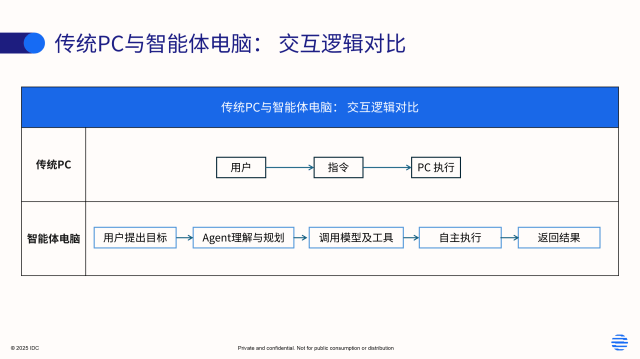
IDC认为,这种变化的关键,并不只是增加了一个“执行”环节,而是改变了用户与 PC交互的基本方式。过去,用户需要告诉电脑“怎么做”;未来,用户可以更多地告诉电脑“我要完成什么”。

这意味着,PC 的使用方式将逐渐从围绕“点击、命令和操作”,转向围绕“目标、任务和结果”。相应地,AI 在PC 上的应用范围也将从单点功能进一步扩展到办公、研发、创作、知识管理和个人助理等连续任务场景。与此同时,PC的评价标准也会随之发生变化。

过去消费者选择PC,关注的是处理器、显卡、内存和屏幕等传统硬件参数。当Agent 成为PC 的重要工作负载之后,用户可能更关注另外一组问题:本地模型能不能稳定运行?响应速度够不够快?Agent 能不能真正把一项连续任务完成?

IDC建议,PC厂商下一步需要把产品重心从“提供算力与功能”转向“保证任务被真正完成”——本地模型的稳定运行、Agent的连续执行能力与响应效率,将取代部分传统参数,成为产品定义的新起点。

为什么是现在?端侧算力、模型与Agent开始同时成熟

智能体电脑并不是单纯由硬件升级推动出来的产品概念。它之所以在当前阶段受到关注,是因为端侧算力、模型能力和Agent 软件生态正在逐渐具备落地条件。

首先是端侧算力。新一代 PC 平台的竞争重点正在从传统 CPU性能逐步扩展到AI 计算能力。Intel Panther Lake、AMD Strix Halo/Gorgon Halo、NVIDIA GB10/N1X 和Qualcomm X2 Elite/Plus等具备端侧AI 能力的平台陆续出现,为本地大模型和Agent 的运行提供了更强的硬件基础。

其次是模型。随着模型效率不断提升,本地模型的规模开始与PC的硬件能力逐渐匹配。对于智能体电脑而言,30B级模型正在成为重要的参考基准。但在实际推理过程中,单纯提升AI算力并不足够。模型运行效率还受到内存容量和内存带宽的影响。当前智能体电脑的基础门槛需至少实32GB内存和135GB/s 内存带宽;面向更高阶的本地AI工作负载,则需要进一步向64GB以上内存和250GB/s以上带宽提升。

最后是Agent 软件。AI 的交互方式正在从“对话”向“任务执行”演进。本地RAG、代码助手、自动化办公、个人助理和本地多模态应用,都可能成为智能体电脑较为明确的落地场景。同时,Agent对本地文件、网络资源及外设的调用,也对权限管理、数据安全和使用边界提出了更高要求。

因此,智能体电脑真正需要解决的问题,已经从过去的“PC 能不能运行模型”,进一步变成了“模型能不能在 PC 上持续、稳定地完成任务”。随着算力、模型和 Agent 应用逐渐形成闭环,智能体电脑才真正具备从概念走向产品的基础。

IDC认为,厂商需要把端侧算力、本地模型与Agent 软件作为一个整体来定义产品,只有三者形成闭环,智能体电脑才真正具备可持续的用户价值。

从 TOPS 到实际 AI 工作负载效率,智能体电脑正在改写硬件标准

智能体电脑带来的变化,首先会反映在硬件设计上。与单纯强调某一种芯片不同,智能体电脑更强调适配级异构算力、充足的内存带宽以及大容量统一内存之间的协同。

IDC基于对本地模型运行效率和 Agent任务负载的跟踪,提出以下入门级参考门槛:

从基础配置来看,入门级智能体电脑建议具备80TOPS 以上AI 算力、32GB 以上内存、135GB/s 以上内存带宽,并配置至少1TB NVMe SSD。异构算力将成为智能体电脑重要的底座,CPU、NPU和GPU 将承担不同类型的 AI 任务,其中,NPU更适合持续、高吞吐、低功耗的推理任务,GPU则更适合大规模矩阵计算和复杂推理。

对于本地Agent 而言,模型加载和Token生成速度同样直接影响用户体验。当前阶段,Token生成速度不应低于10 Token/s。

IDC建议,PC厂商应将上述门槛视为产品定义的起点而非终点——在按场景分层规划配置的同时,把从算力、内存带宽到Token 生成速度的整链路效率作为验证标准,确保规格最终能转化为用户可感知的Agent使用体验。

硬件只是入场券,Agent 应用决定智能体电脑的市场空间

如果说硬件能力决定智能体电脑“能不能进入市场”,那么真正决定用户是否愿意持续使用和购买的,则是Agent能否解决真实、高频的问题。

目前来看,智能体电脑已经呈现出几条较为明确的应用路径,包括办公自动化、代码开发、本地知识库、个人助手以及多模态处理等。这意味着,PC 产业的商业逻辑也可能从过去的“卖AI 能力”,逐步转向“卖AI 生产力”。

对于个人用户而言,Agent可以围绕本地文件、资料和应用完成信息整理、内容生成和任务协同,让用户从逐项操作转向以目标驱动任务。

对于企业用户而言,本地Agent 则有机会成为员工的个人 AI 助手。当Agent 能够调用企业知识库、内部文件以及部分业务流程时,PC 不再只是访问企业软件和云服务的终端,也可能成为企业AI 能力真正进入员工工作流的重要载体。

因此,从产业链角度来看,智能体电脑并不只是一次硬件升级,而更接近于PC 软硬件协同模式的一次变化:硬件提供本地AI工作负载的基础,模型提供智能能力,Agent 应用则决定这些能力能否真正转化为生产力。

IDC认为,PC厂商需要从“卖AI 能力”转向“卖AI 生产力”:以办公自动化、代码开发、本地知识库等高频场景为切入点定义产品,并与模型及软件伙伴共建Agent 生态,把可感知的效率提升转化为用户持续使用与复购的理由。

IDC观察:智能体电脑还在早期,市场已进入验证阶段

从出货规模来看,未来几年中国智能体电脑市场有望进入加速增长阶段。IDC预测,中国智能体电脑出货量将从2026年的77万台增长至2030年的2,080万台,5年 CAGR 预计达到127%。
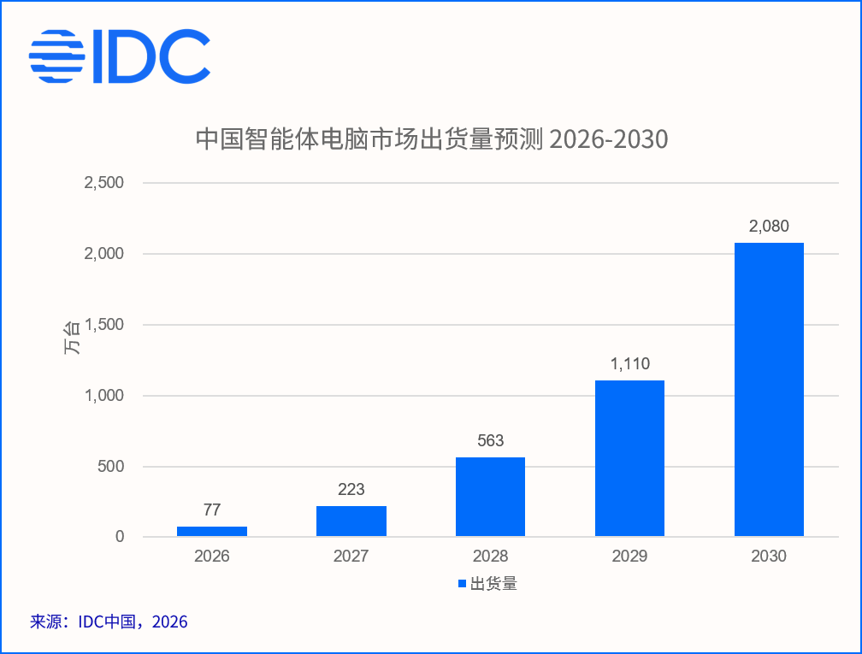
这一增长并不会呈现一条平滑的曲线。随着本地模型能力、硬件算力和 Agent 应用逐步成熟,市场规模化进程有望进一步加速。尤其是2028年之后,出货量增速明显提升,意味着智能体电脑有望逐渐从先锋产品成为更主流的产品品类。

IDC总结与展望

随着 AI Agent 能力不断成熟,PC 的竞争逻辑也将逐步发生变化。硬件性能仍是基础,但 AI 工作负载效率、本地模型运行能力与 Agent 生产力体验,将共同构成新的竞争维度。智能体电脑的长期发展,不仅取决于算力的提升,更取决于硬件、模型、Agent 软件与安全体系能否协同发展,形成成熟的本地 AI 生态。

IDC 认为,对于 PC 厂商而言,下一阶段的关键在于推动竞争从“参数领先”走向“价值交付”:通过优化算力调度、完善 Agent 与工具生态,并将安全与隐私融入底层架构,让 AI 能力真正转化为用户可感知的效率提升。

当用户与 PC 的交互方式从“操作电脑”转向“定义任务、获取结果”,智能体电脑所带来的将不只是产品形态的演进,更是 PC 价值体系的重塑。谁能率先打通“硬件—模型—Agent—安全”的协同链路,并将技术能力转化为可持续的用户价值,谁就更有可能在智能体电脑的发展进程中建立差异化优势。

本文相关参考报告:

IDC Quarterly Personal Computing Device Tracker

进一步沟通

本文梳理的 PC 市场数据、行业发展趋势及厂商策略,可支撑您的业务研判。欢迎与我们对接,获取完整版季度跟踪报告和定制化研究服务。期待开展深度交流,携手把握 PC 市场结构性机会。请点击此处与我们联系。


In October 2024, IDC’s FutureScape: Worldwide Cloud 2025 Predictions forecast that by 2026, 75% of organizations would use specialized accelerated cloud computing services to speed up deployment and scale their AI and other accelerated applications. Two years later, Dave McCarthy, Group Vice President of Cloud and Data Center Infrastructure at IDC, says the number still holds and may run a little low.

He reads the 75% as organizations that are somewhere on their AI journey. Two things shifted along the way: some AI work went to private cloud, and the field of providers widened beyond the three hyperscalers.

Why did IDC put a 75% number on it?

McCarthy points to three forces that gave the team confidence.

The first was application modernization. After years in the cloud, companies are revisiting decisions they made inside it, and that now counts as modernization alongside moving a legacy app out of a datacenter.

The second was AI. As McCarthy puts it, “the type of services that you would use for an AI application look very different than the ones that you would use for a more traditional general purpose workload.”

The third was who organizations trusted. When IDC asked which partners were most strategic for AI services, cloud providers typically ranked first.

What played out differently than expected?

Because IDC’s prediction did not specify a type of cloud, it left room for a shift McCarthy describes. Public cloud still appears to be a primary destination because providers make it easy to start and carry the latest hardware and software. Concerns about data privacy and corporate information also drove some AI work into private cloud.

More companies have entered the market, and McCarthy says, “It’s not just the three hyperscalers anymore.” IDC already knew a new class of specialized cloud provider was arriving, he says, but two years ago many of them were bare-bones, handing over hardware to customers with the expertise to use it. IDC did not expect much enterprise adoption outside the big AI labs. Since then, those providers have been building the tooling and support that enterprise workloads need. Capacity pressure adds to the pull: some customers who prefer their usual hyperscaler struggle to get the capacity they want when they want it, and that gives other providers room to fill the gap.

Recent IDC research on specialized cloud services, often called neoclouds, covers one slice of the prediction, since the major hyperscalers also sell GPU-enabled cloud servers. It shows both the pull and the limits:

  • In IDC’s AI Tech Trends Survey (July 2026, n=493 in Europe), high performance for specialized workloads was the top reason for using or considering neocloud services, cited by 42% of respondents
  • In IDC’s Cloud Pulse Survey, neocloud providers such as CoreWeave, Nebius, Vultr, Lambda, and Crusoe each landed in the middle single digits when organizations named providers important to their cloud strategy over the next two years. The established hyperscalers dominated those road maps.
  • IDC’s June 2026 guidance on the neocloud decision advises weighing more than price. Neoclouds generally offer lower GPU pricing, but they typically have fewer datacenter locations and are a poor fit for generic IT workloads.

Does 75% still hold?

McCarthy stands by the number: “I still feel the number is fairly confident… maybe it’s a little bit low in some ways.”

The figure does not mean companies have moved 75% of their workloads to AI. Many organizations reach accelerated compute indirectly, through managed services and tools that run on it behind the scenes, rather than by buying GPU services directly.

IDC’s public cloud IaaS market share research (September 2026) found that the overall market grew 24.6% to $172 billion in 2025, as AI workloads reached production and drove demand for scalable and specialized infrastructure.

What should enterprises watch next?

McCarthy sees the first wave of AI as focused on training. That is changing. “When you hear about AI agents, that’s all inference,” he says, meaning the work of putting existing models into operation.

Inference follows a different deployment pattern than training: it favors infrastructure distributed closer to users and to where data is created. McCarthy notes that some companies once seen as content delivery networks are now retooling themselves as AI inference clouds. The same IDC market share research identifies inference as a growing infrastructure investment area. As enterprises weigh latency, utilization, and cost per inference, that is driving spending on inference-optimized chips and distributed infrastructure.

Whether driven by regulation or corporate governance, McCarthy says, organizations want more control and more specificity about where their AI runs. Two other predictions in the same FutureScape point the same way. IDC expected 50% of organizations to look for network infrastructure providers with sovereign controls by 2026, and 80% of CIOs to rely on cloud providers’ edge services for GenAI inferencing by 2027.

The takeaway: keep your options open

Things are moving fast, McCarthy says, and the cloud choices companies made five or six years ago may look very different today. His advice is to “design for flexibility” and review the options available, because what works best depends on each company’s needs.

Christina Cardoza - Content Marketing Manager - IDC

Christina Cardoza is a Content Marketing Manager at IDC, where she specializes in brand content and social media strategy. With a background in journalism and editorial leadership, she has a proven ability to transform complex technology topics into clear, actionable insights.

The robot arm putting parts together on a factory floor is the easy image. It’s not the whole story, and according to Sarah Lee, IDC’s Senior Research Director of Manufacturing IT Strategies, thinking it is the whole story is exactly what’s slowing companies down.

Physical AI has become one of those terms that gets stretched to cover almost anything with a sensor attached to it. Lee’s definition is narrower and more useful: It’s the convergence of AI algorithms (machine learning, computer vision, now multimodal agentic systems) with physical hardware, built into a closed loop. Sense the environment. Interpret the data. Decide. Act in the physical world. Then feed what happened back into the system so it gets better next time.

That loop is the whole point: physical AI senses the problem, decides what to do about it, and takes the action itself, inside the same system, something a traditional dashboard that just flags an issue for a person to fix was never built to do.

The pressure isn’t coming from the tech side

Knowing what counts as physical AI doesn’t explain why it’s suddenly everywhere at once. Ask most people, and they’ll point to better vision models or cheaper sensors. Lee points somewhere else first: labor.

Mining and construction companies are sitting on expensive equipment that’s idle because there’s nobody to operate it. Manufacturing floors are losing decades of tribal knowledge to retirement faster than new workers can absorb it. Add tariffs and supply chain volatility on top, and automation stops being a nice-to-have. “The urgency really isn’t coming from the tech side,” Lee said. “It’s coming from a workforce and operating environment that needs to be more resilient when hiring alone isn’t enough to solve the problem.”

Most of the equipment this has to run on wasn’t built for it. IDC’s research puts a finer point on the brownfield problem: the majority of manufacturing facilities in operation today are more than two decades old, running legacy PLCs with no native connectivity. That means the hardest bottleneck usually isn’t compute power or model quality. It’s getting clean, usable data out of machines that were never designed to share it.

The technology caught up at a useful moment. Better vision-language models, better simulation and digital twins, and edge AI that can make real-time decisions without a round trip to the cloud. All of it converged to make the closed loop actually workable at the pace a shop floor or a mine site needs.

One architecture, very different floors

The underlying loop stays consistent, but what fills it changes by industry. Discrete manufacturing is furthest along, with robots and cobots doing precision work, inspection, and material movement. Warehouses and hospitals are leaning on autonomous mobile robots and forklifts for material handling. Construction, mining, and agriculture are running autonomous drill rigs and haul trucks in harsh, disconnected environments where the failure tolerance and regulatory bar look nothing like a factory floor.

Lee frames adoption as a maturity curve rather than a single leap, because almost no operation is starting from zero:

  1. Instrumented operations: sensors feed data back, but a person still makes the call
  2. Closed-loop automation: AI starts interpreting and triggering action within bounded limits
  3. Embodied autonomy: machines perceive, plan, and act on their own
  4. Coordinated systems (still emerging): multiple machines, people, and systems sharing one context and safety state

Most companies are somewhere in the middle of that curve, and Lee’s advice for anyone earlier on it is blunt: check whether your data is actually clean and ready before you pick a pilot. “Where do you first deploy? Where do you first do the POCs? It’s where your data’s clean, your data’s ready, and it’s relevant, good data.”

Where ROI shows up (and where it stalls)

The gap between a successful pilot and real ROI is where most projects die. The gains (productivity, throughput, safety, faster commissioning) show up at fleet scale, not pilot scale. Getting there means solving for orchestration across multiple machines and sites, not just proving one robot works in one corner of the plant.

What IDC’s research is picking up right now

That orchestration problem is exactly what IDC’s own research has been tracking, and the numbers show how fast the ground is shifting underneath it. In a May 2026 survey, physical AI ranked as the second-highest AI investment priority for the next 24 months, behind only GenAI assistants and copilots. IDC’s 2026 Worldwide CEO Survey found something similar from the top of the house: 45% of CEOs named physical AI among their top three emerging technologies for investment over the next 12 to 24 months, trailing only agentic and generative AI at scale, and sustainability technology.

Digital twins are moving past visualization, and IDC’s research describes exactly how: the workflow is inverting from sim-to-real toward real-to-sim, where a plant’s own production data trains and validates the AI before it ever touches the physical environment. That turns site-specific plant data into a durable competitive asset. And the share of manufacturers running ten or more agentic AI solutions is expected to double by the end of the year.

Lee pushed back hardest on one framing: “lights out” factories. What she’s actually seeing is closer to lights transformed, with workers moving out of manual execution and into supervision, exception handling, and governance.

“

The most important automation decisions manufacturers will make over the next few years are not about which arm to buy, but about which control plane to trust, whose simulation to build on, and who owns the data their robots generate.

— Sarah Lee, Senior Research Director of Manufacturing IT Strategies, IDC

That’s the shift underneath everything else here: the arm was never the hard part. The foundation around it is.

Christina Cardoza - Content Marketing Manager - IDC

Christina Cardoza is a Content Marketing Manager at IDC, where she specializes in brand content and social media strategy. With a background in journalism and editorial leadership, she has a proven ability to transform complex technology topics into clear, actionable insights.

Application, platform, infrastructure and services each follow their own dynamics. IDC analysts Ewa Zborowska and Carla Arend explain where European demand is heading and how vendors can position for it.

Europe’s AI market is worth $105 billion, and customers are busy building their own AI stack, layer by layer, reshaping each one as they go. For vendors, the interesting question is not whether this market will grow, but where exactly the money is heading in the AI stack and how to position for it.

That was the topic of a recent webinar, where Ewa Zborowska and Carla Arend looked at AI deployments in the cloud versus on-premises, which AI platforms are winning and why, how the application layer is being reshaped, and whether AI sovereignty is realistic.

AI Application Layer: Embedded AI and Outcome-Based Selling

AI adoption has moved well past the pilot stage, and the application layer is changing first. Customers increasingly want AI as a feature of the software they already own rather than as a standalone product, alongside targeted investments in specific use cases. As buyers struggle to prove the return on AI, vendors will need to sell the outcome rather than the model, and embed AI features in the workflows customers already run.

AI Platforms and Agentic Architectures: The Fastest-Growing Layer

The fastest-growing part of the stack sits one layer below, in AI platforms and developer tooling. This layer decides which models, data and guardrails an enterprise can use at all, and it is being transformed by agentic architectures, where multi-component builds replace single-model integrations. The vendors who land the agentic build early have the chance to own the runtime, and to hold on to it through data gravity and governance. Customers will not settle on a single platform, which makes that early position even more valuable.

AI Infrastructure and Sovereignty: Cloud, On-Premises or Both?

Infrastructure tells a different story from the one many expect. In addition to the constraint imposed by raw GPU supply shortages, locality and energy supply increasingly play a role, so the title question has a clear answer: AI will not live in the public cloud alone. Customers will choose a mix of deployments that reflects where their data must sit and what power is available. Vendors competing here will do better selling sovereign capacity and efficiency than selling price per unit of compute. Sovereignty itself is turning from a debate into a deployment, yet there is still no single definition of it. Vendors may label AI as sovereign, but it is the customers who decide what that actually requires, and we will look at what that means for cloud providers, telcos and anyone selling into sovereign requirements.

AI Services: Getting Customers from Pilot to Production

Running across every layer are services, because few buyers get from pilot to production alone, and that is exactly where adoption tends to stall. Automation is also resetting expectations, with buyers now looking for the same work faster and cheaper. Services providers who lead with fast, automated delivery, price on outcomes and SLAs, and keep customers through governance and managed AI operations will be best placed.

What This Means for Vendors in the European AI Market

Across all of this there is opportunity at every layer, and every layer has its own dynamics. Vendors who understand those dynamics will be much better placed to grow.

If you missed our recent webinar The European AI Stack, the on-demand recording takes you through every layer in detail, including what AI sovereignty means for cloud providers and telcos. Watch it at any time here.

For your go-to-market planning, our new IDC playbook tests six common assumptions about the European AI market, from market size to buyer behaviour, against European data and sets out what to do differently. Download the eBook here.

Carla Arend

Carla Arend - Associate Vice President, Cloud and Datacenters, Enterprise Infrastructure

Carla Arend is Associate Vice President within IDC’s enterprise infrastructure global research domain and part of the cloud and datacenters services subdomain. She leads IDC’s Worldwide cloud adoption research. In this capacity, she leads a team of analysts that provides…
Ewa Zborowska

Ewa Zborowska - Research Director, AI, Europe

Ewa Zborowska is an experienced technology professional with 25 years of expertise in the European IT industry. Since 2003, she has been a member of the IDC team, based in Warsaw, researching IT services markets. In 2018, she joined the…

On Monday, you open an email from your CFO: They want to modernize one of the company’s critical technology platforms. They need a proposal with a viable shortlist. And they want a defensible technology recommendation by Friday.

By the afternoon, the vendor decks are already piling up. Each has a compelling story with an impressive client list and convincing reasons their platform should make the shortlist.

Your challenge isn’t finding information. It’s figuring out how the options fit your organization, who to trust, and whether your recommendations will withstand scrutiny from your CISO and the board.

Technology leaders and buyers face this tension every day. Building enough intelligence to make a confident decision can take too long. But making a choice too quickly leaves a lot riding on unsubstantiated information.

As the technology intelligence fabric of the AI-enabled enterprise, IDC Quanta for Tech Leaders helps close that gap. It brings structured, sourced, and defensible IDC intelligence directly into the tools and workflows you already use, helping you turn a question into a recommendation you can stand behind.

Start with the market, directly in your inbox

Say the platform your CFO wants to modernize is supply chain, and you’re in manufacturing.

Before you can decide which platform is right for your organization, you need a clear picture of the market. Who are the credible vendors? Who holds what market share? How does that change across discrete and process manufacturing? And how do IDC experts assess the major players?

You can start where you’re already working: your inbox.

Email your question to IDC Quanta, and within minutes you’ll receive an answer with IDC research and sources to back it up. If that leads to another question, click through to IDC Quanta and continue the conversation in the portal.

From there, you can go deeper. IDC Quanta can show who holds market share, how vendors compare, and where IDC analysts place the leading players. A multi-agent validation system checks the response against IDC’s proprietary research and data, with citations linking you directly to the source, analyst, and date. Each claim is checked before it surfaces, and anything that can’t be substantiated is dropped. The AI platform validate’s its qualitative research against quantitative data, which adds another layer of confidence in the results.

Instead of relying on what vendors tell you about themselves, you can build a view of the market grounded in independent, validated intelligence.

Intelligence grounded in the context of your business

Knowing the market narrows the field, but it still doesn’t answer the question that matters most: Which option is best for your organization?

This is where IDC Quanta’s analysis gets contextual.

Upload an RFP, requirements document, or other internal material to IDC Quanta. If you already run a particular enterprise resource planning (ERP), manufacturing execution system (MES), product lifecycle management (PLM), or other connected system, IDC Quanta can consider that alongside IDC market intelligence.

Now the conversation can move from “Who are the market leaders?” to “How do the leading vendors solve what we need?”

That could mean comparing shortlisted vendors against your specifications and benchmarking your own vendor contracts and costs against IDC’s data.

IDC Quanta securely combines your data and documents with IDC research, while persistent memory builds context around your role and priorities, helping make subsequent answers more relevant.

You also have access to the logic behind the results. An expandable reasoning panel shows the progression from answer to reasoning to source, giving you the evidence to explain how you arrived at a recommendation when someone inevitably asks, “How do you know?”

Your documentation and sensitive information are always protected. Queries, documents, and outputs stay in a private workspace with AES-256 encryption, malware scanning, automatic deletion after 90 days, and zero model training on your data. SOC 2 certified, enterprise-ready security controls and single sign-on provide additional governance for deployment at scale.

The evaluation draws on IDC’s independent market intelligence and your insights into your own business.

Keep the evaluation moving, wherever you work

A significant technology decision rarely happens in one sitting.

An answer leads to another question. Procurement gets involved. The CISO wants a closer look. The CFO challenges the return on investment.

And the discussion is influenced by more than the decision makers inside your organization. IDC Quanta’s intelligence includes anonymized peer insights that provide perspective on how similar buyers are approaching the same technology or topic.

IDC Quanta keeps the conversation moving, no matter where you are or who you’re talking to. Persistent memory carries the context of your previous work forward so you don’t have to repeatedly explain your requirements, shortlist, or previous findings. IDC Quanta also suggests follow-up questions, so you always have a next step, even when you’re not sure what to ask.

Start a question from your inbox. Go deeper in IDC Quanta. Continue working in Claude with integrations designed to connect IDC intelligence to your team’s AI tools and custom workflows. The interface can change, but the underlying context, rigor, and sourcing is constant.

IDC Quanta for Tech Leaders weaves our trusted research into the workflows and tools you use every day.

Make a decision you can stand behind

Friday arrives.

You walk into the meeting with a market view built on IDC data and research. You have a shortlist evaluated against your requirements and existing technology environment. You understand the risks and peer signals.

A process that can take months can now take days.

IDC’s tech leader and buyer framework centers on making every technology investment defensible: charting strategy with independently verified market intelligence, building the evidence to meet internal mandates, and proving impact against real data and benchmarks.

The goal is to bring intelligence into the decision-making process itself, so you can make a recommendation you can explain and defend.

Turn technology options into a clear path forward. Book a demo to learn what’s possible with IDC Quanta for Tech Leaders, the technology intelligence fabric of the AI-enabled enterprise.

IDC - -

International Data Corporation (IDC) is the premier global market intelligence, data, and events provider for the information technology, telecommunications, and consumer technology markets. With more than 1,300 analysts worldwide, IDC offers global, regional, and local expertise on technology and industry opportunities and trends in over 110 countries. IDC’s analysis and insight help IT professionals, business executives, and the investment community make fact-based technology decisions and achieve their key business objectives.

Every procurement team knows the moment. The signature page is turned, and the vendor’s negotiation team quietly disappears. What’s left is a contract, a renewal date circled two or three years out, and a procurement lead who now owns every consequence of a deal someone else helped negotiate.

That handoff has always felt like the cost of doing business. In IDC’s 2025 CIO Sentiment Survey, 57% of respondents said they measure vendor performance with no consistent, enterprise-wide vendor benchmark. It doesn’t have to work this way. IDC Quanta for Tech Leaders keeps the benchmarks in reach after signature.

Negotiation is a sequence of decisions, each one needing its own proof. What should this renewal cost given usage trends over the last 18 months? Is the vendor’s proposed ramp realistic? The evidence often exists somewhere, buried across analyst reports, pricing databases, and past deal files nobody has time to cross-reference in the three days before a renewal call.

IDC Quanta for Tech Leaders puts the evidence where the question is. Ask it in plain language, from your email or Claude (the IDC web portal works too), and it answers from IDC’s own first-party research, with citations back to the underlying evidence. Upload your contract terms, RFP requirements, or vendor shortlist, and it checks them against IDC’s pricing evaluations, built on real peer deal data.

Picture a procurement lead three weeks out from a renewal on a core software platform. The vendor has proposed a 14% increase, citing “market conditions.” She uploads the renewal terms and asks IDC Quanta how they compare. It benchmarks them against peer deals of similar size and term, and flags above-market rates and auto-renewal clauses before they lock in for another cycle. In this example, comparable renewals are landing in a much tighter band than 14%. She books an analyst to stress-test the terms before the counterproposal goes out, while the evidence still has time to change the outcome.

Then she asks IDC Quanta for an export-ready brief the negotiation team can take into the room, and for an RFP template if the renewal goes to market.

Most vendors treat the signature as the finish line. IDC treats it as the point where the real work of managing a tech investment begins. IDC Quanta is there for all of it, whether the question comes up in week one of an evaluation or three years into a contract you’re trying to renegotiate on better terms. It alerts you to vendor price changes and new entrants in your sourcing categories, so you hear about them before the next negotiation. You choose the analyst who fits the question, and your whole team can join the inquiry.

Ready to see what that looks like for your next renewal? Book a demo and bring your own numbers.


Ryan Smith - Content Marketing Director - IDC

Ryan Smith is the Director of Content Marketing at IDC, where he leads brand-level content and social media strategy, aligning research insights with compelling storytelling to engage technology decision-makers. With a background in both IT and marketing, Ryan brings a unique blend of technical understanding and creative strategy to his work. He’s also a seasoned storyteller, speaker, and podcast host who believes the right message, told the right way, can drive both trust and transformation.

How do you decide, in an afternoon, whether a drone program is worth a government’s time? For Andrew Shipe, that’s a real, recurring question.

As an Innovation Strategist on Sourcewell’s innovation team, Sourcewell Ventures, Shipe helps a government cooperative serving public agencies across the country figure out which ideas are worth pursuing, and which ones need to wait. Sourcewell itself is unusual as a government entity: it can’t tax to raise revenue, so everything it does has to justify itself as a service governments want. Ventures exists specifically to find opportunities beyond Sourcewell’s core cooperative-purchasing business, new ways to serve public agencies that the private market isn’t equipped, or motivated, to solve on its own.

With a small, focused team, Shipe doesn’t have the luxury of researching every idea that comes in. Every idea has to earn its place quickly, on the strength of the evidence behind it.

The problem with comparing the incomparable

The hardest part of that job is finding a shared yardstick. A county fleet services department’s problem doesn’t look anything like a fire department’s wildfire response, even though both are government agencies wrestling with urgent, resource-constrained work. There’s no obvious way to weigh one against the other. Without a consistent way to evaluate opportunities across such different contexts, good ideas were easy to misjudge, or simply lose to timing while something else got prioritized.

Shipe has come to rely on IDC for this kind of cross-context clarity: understanding where technology is going, and how different types of agencies are adopting it, so that a fleet department’s technology curve and a fire department’s technology curve become at least a little more comparable.

A vague pain point, made concrete

Nowhere did that gap between “everyone says this is a problem” and “we understand why” show up more clearly than with drones.

Agencies at the city and state level had been telling Sourcewell the same thing for a while: drone-based first-responder programs were powerful. They changed how a community could be kept safe. But they weren’t affordable, and nobody seemed to have a clear, specific answer for why. Shipe’s team didn’t have a good sense of where the cost was coming from, which meant they couldn’t tell whether it was a problem Sourcewell could realistically help solve.

Working with IDC and IDC Quanta, Shipe put real numbers behind what agencies had only been able to describe anecdotally, turning a vague complaint into a defined, structural problem a government partner could plan around.

The trust problem underneath every other problem

None of that research would have mattered if Shipe couldn’t trust the numbers behind it. Trust was exactly where every other AI tool he’d used had fallen short.

“That’s kind of always been one of my challenges with other AI tools,” he said, “what is real and what is hallucinated.” It’s a familiar frustration for anyone who has asked a chatbot for a statistic and then had to go verify it independently anyway. At that point, the tool hasn’t saved any time. It’s just moved the work later.

IDC Quanta changed that with inline footnotes tied directly to source articles. A list of links at the bottom of a response never told Shipe which claim came from which source, so he’d never been able to trust those either. IDC Quanta showed him exactly which sentence was backed by exactly which footnote. If a number looked interesting or surprising, he could open the source immediately, in context, and check it against the original article before he ever used it in front of a decision-maker.

“

The appeal of IDC Quanta, he said, was that it’s backed by specific articles, and I could read them and make sure that the numbers I’m getting are correct.

That capability sounds small, but it changes what you can trust the tool to do. Shipe could finally build a real decision on top of what it told him, instead of just using it to get started.

Faster research means more shots on goal

Drones were one example. The same problem (a real question with no fast, trustworthy way to answer it) comes up constantly for a team fielding ideas from every direction.

The Sourcewell Ventures team doesn’t have a shortage-of-ideas problem. Ideas arrive from so many directions that time to evaluate them is the real constraint.

That’s what made IDC Quanta useful beyond any single research question. Shipe could plug in a new idea and get enough grounded, source-checked information back to make a real call: yes, this has potential, worth spending more team time on. Or no, this isn’t the right fit for the market right now, worth setting aside. Multiply that across every idea competing for a small team’s attention, and the value goes beyond accuracy on any one question. It’s the ability to run through far more ideas than the team could have researched manually, without sacrificing confidence in the answers.

Shipe called it a genuine leap forward from every other AI tool he’d used. The reason had nothing to do with flash. It was the first tool he felt he could build a real decision on top of.

Shipe’s team still gets more ideas than it has hours to research. IDC Quanta just means more of those hours go toward the ideas worth the time.

Christina Cardoza - Content Marketing Manager - IDC

Christina Cardoza is a Content Marketing Manager at IDC, where she specializes in brand content and social media strategy. With a background in journalism and editorial leadership, she has a proven ability to transform complex technology topics into clear, actionable insights.

随着生成式AI和智能体加速进入企业生产环境,AI正在从辅助工具逐步转变为参与业务决策和执行的关键基础设施。与此同时,Prompt注入、数据泄露、模型供应链、智能体权限滥用和工具调用等新型风险不断出现,传统网络安全体系已经难以完全覆盖AI应用带来的安全挑战。

在AI应用规模化落地的推动下,AI安全市场也进入快速发展阶段。IDC预测,到2030年中国AI安全市场规模将达到340亿元,未来五年复合增长率超过50%。在市场快速增长的同时,不同AI安全技术的成熟度和落地节奏也开始出现分化,企业面临的核心问题正在从“是否需要AI安全”进一步转向“应该优先建设哪些AI安全能力”。

23项AI安全技术进入不同发展阶段,技术路线开始分化

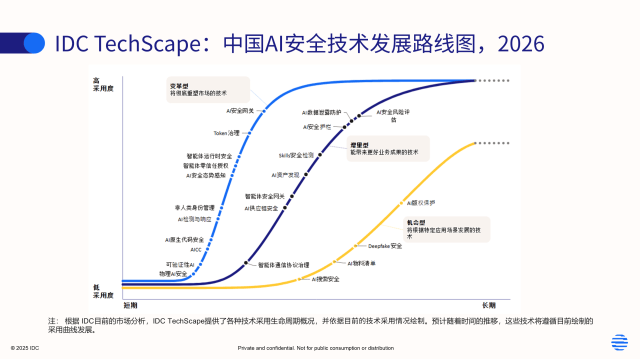
为了更清晰地判断不同AI安全技术的发展阶段及未来潜力,并帮助用户进行技术选型,国际数据公司(IDC)近日发布了《中国AI安全技术发展路线图,2026》(Doc#CHC54918225 ,2026年10月)报告,该报告对23项新兴及重要的AI安全技术进行了系统评估,并从技术采用阶段、市场热度、风险级别、采用速度以及市场培育时间等维度,对不同AI安全技术的发展状态进行了可视化呈现,360数字安全集团、安华金和、阿里巴巴、安恒信息、长亭科技、硅基流动、火山引擎、华为、君同未来、绿盟科技、领信数科、蚂蚁数科、奇安信、启明星辰集团、深信服科技、腾讯、网宿科技、网易智企、新华三、悬镜安全、亿格云、亚信、中国电信、竹云(按公司首字母顺序排列)入选各技术点推荐厂商,2026年IDC中国AI安全技术发展路线图详见下方:

报告显示,当前AI安全技术尚未成熟,整体市场处在多条技术路线并行发展的阶段。不同技术在市场需求、技术成熟度和企业采用节奏上存在明显差异。这意味着,AI安全市场正在从“技术概念期”逐步进入“技术成熟期”。对于企业而言,未来AI安全建设的关键并不是简单追求技术覆盖,而是根据自身AI应用成熟度和业务风险,判断哪些技术需要立即部署,哪些技术需要持续观察,以及哪些技术值得提前布局。AI安全建设也不再是简单增加一套安全产品,而需要逐步形成覆盖AI资产、身份权限、数据、模型、智能体、供应链、运行时以及安全运营的完整治理体系。

AI安全正在进入一个新的阶段:从保护AI,走向治理AI;从发现风险,走向理解和验证风险;最终从被动防御走向AI驱动的主动安全。具体的技术发展趋势如下:

1. AI安全建设开始从“单点防护”走向体系化治理新阶段

随着企业AI资产快速增长,传统围绕单个模型、单个应用进行安全防护的方式已经难以覆盖企业的AI安全防护需求。企业首先需要解决“用了多少AI、有哪些模型和智能体、连接了哪些数据和工具、存在什么风险”等基础问题,并进一步实现风险持续监测和治理。因此,AI安全正在从过去的单点检测与防护,逐渐向资产发现、风险识别、持续监测和统一治理演进。AISPM有望成为连接AI资产、风险和安全运营的重要基础能力,并推动AI安全从传统的产品能力向体系化治理能力转变。

2. 智能体安全进入快速发展阶段,AI安全的治理对象正在发生变化

从AI安全技术发展路线图中可以看到一个非常明显的变化:AI安全正在从“模型安全”走向“智能体安全”。报告中非人类身份管理、智能体零信任授权、智能体运行时安全、智能体安全网关、智能体通信协议治理和Skills安全检测等技术,正是这一变化的直接体现。IDC认为,随着Agent进入更多核心业务流程,智能体将逐渐成为AI安全治理的核心对象。未来企业需要建立覆盖智能体开发、部署、运行和退出全生命周期的安全治理体系,而不仅仅是在模型外围增加安全检测能力。

3. AI供应链正在成为新的安全边界

过去,企业更多关注软件、代码和基础设施供应链,而AI应用进一步引入了模型、训练数据、开源框架、Agent Skills、MCP Server、第三方工具以及外部AI服务等新的组成部分。这意味着,一旦其中某个环节存在安全问题,都可能通过模型调用、Agent执行或者工具链传递到最终业务系统。因此,AI供应链安全正在成为AI安全体系的重要组成部分。未来企业需要建立覆盖模型、数据、代码、工具和基础设施的全链条安全治理能力,并逐步完善AI物料清单、供应链风险评估和运行时监测等能力。

4. AI安全正在从“上线前评估”走向“持续风险管理”

AI系统与传统IT系统最大的不同之一,在于其运行状态具有较强的动态性。模型可能持续更新,Prompt会发生变化,Agent任务会动态调整,数据访问和工具调用关系也会不断变化。在这种情况下,一次性的模型安全评估很难覆盖AI系统整个生命周期的风险。IDC认为,AI安全正在逐渐形成一条完整的治理链路:AI资产发现 → 持续风险评估 → 运行时监测 → 持续检测 → 安全响应 → 审计与合规。这意味着AI安全的治理模式正在发生变化:从过去关注“上线之前有没有风险”,转向持续回答“运行过程中风险有没有发生变化”。未来,AI安全产品也将进一步从单点能力向平台化方向演进,逐渐形成围绕AI资产、风险、威胁和治理的统一安全运营体系。

5. AI安全正在从“技术中心”走向“业务中心”

过去,AI安全更多关注模型是否存在越狱、Prompt注入等安全问题。但随着AI越来越深地进入企业业务流程,仅仅判断模型“是否安全”已经不够。企业还需要知道:这个AI服务于什么业务?它访问了哪些数据?拥有哪些权限?调用了哪些工具?执行的行为是否符合业务流程?一旦发生异常,又会对业务造成多大影响?因此,AI安全正在从单纯的技术防护进一步向业务风险治理演进。未来的AI安全平台需要将AI资产、数据、身份、权限、业务流程和风险上下文关联起来,在业务场景中判断什么是正常行为、什么是异常行为。这也意味着,AI安全的最终形态可能不再是一组孤立的安全产品,而是一个能够理解AI、理解业务并持续治理AI风险的平台。

6. 从“发现风险”走向“验证与自主修复”

AI能力本身的发展,也正在改变安全防护的技术范式。随着攻击者越来越多地利用AI生成攻击Payload、实施Prompt注入、寻找漏洞和自动化攻击链,传统依赖人工分析和规则匹配的安全防御方式将面临效率瓶颈。因此,“AI对抗AI”将成为AI安全未来的重要技术范式。AI不仅是需要被保护的对象,也将逐渐成为安全检测、攻击模拟、威胁分析、风险验证和自动化响应的重要执行力量。在此基础上,可验证AI、AI红队、AI检测与响应等技术的发展,将推动安全能力从单纯的风险识别向更高程度的自动化和自主化发展。

IDC 中国网络安全领域研究经理王一汀表示,当前,生成式AI正式进入规模化应用阶段,AI安全也随之从模型与应用防护,向智能体身份权限、AI供应链、运行时安全和全生命周期安全治理等方向演进。技术范式上“AI对抗AI”将成为核心发展方向。治理模式上,模型评估将走向持续风险治理,并进一步融入业务场景进行风险管控。除此之外,可验证AI、AI自我修复等前沿技术不断涌现,推动AI安全从“发现风险、阻断风险”向“理解风险、验证安全、自主修复”迈进。

总体来看,AI 安全正在进入一个新的建设周期。技术路线虽然开始分化,但企业行动路径已经逐渐清晰:先摸清 AI 资产和智能体身份,再管住权限、运行时、数据和供应链风险,最终形成覆盖全生命周期的持续治理能力。对CIO和安全负责人而言,当前的关键不是等待技术完全成熟,而是根据自身AI应用成熟度和业务风险,确定哪些能力需要立即部署、哪些需要持续观察、哪些值得提前布局。

进一步交流

如果您的企业正在推进 AI 安全体系建设,或在智能体安全、AI 供应链、运行时治理等方面遇到选型与落地难题,欢迎与 IDC 中国网络安全研究团队进一步交流。IDC 可提供技术路线解读、市场趋势分析、厂商能力评估及定制化研究服务,帮助企业在快速变化的 AI 安全市场中明确优先级、降低选型风险。请点击此处与我们联系。

Sophia Wang, CISSP

Sophia Wang, CISSP - Research Manager

Sophia Wang is a Research Manager in IDC China. She is responsible for the analysis and research of China's cybersecurity market. Her primary focus is on China's cybersecurity appliance and services market and operational technology (OT) security market. Additionally, she…

最近Meta的Muse特别火。9月在美国正式上线之后,讨论度一直居高不下。

如果从智能体的能力来看,Muse并不是一个全新的产品。它依然采用典型的智能体架构,基于用户的指令或需求,思考规划之后,调用相关的工具或技能完成特定任务,这些也都是当前智能体产品普遍在做的事情。

但为什么是Muse?为什么国外同样在做的智能体产品,像OpenAI的ChatGPT Work、Anthropic的Claude Cowork,并没有像Muse这样引起现象级的关注和传播?

国际数据公司(IDC) 在近期发布的《中国企业级通用 Agent 产品技术评估》中,从记忆、任务执行、生态连接等维度对主流智能体产品进行了评估。这些维度同样适用于理解 Muse 和国内个人助理 Agent 的差距。

为什么是Muse

为什么是Muse,核心原因主要还是Muse的场景定位和这类产品有一定的区别。ChatGPT Work、Claude Cowork以工作场景为主且用户大多是职场人员,Muse的定位是纯粹的个人生活助理,它的目标就是帮个人完成大量日常生活中的事情。

Muse的使用案例里,更让人印象深刻的是那些人做起来既耗时又麻烦的事情。比如Muse可以帮用户给保险公司打电话完成理赔;可以根据美食视频列出采购清单并直接采购;可以帮用户以更好的价格售卖二手物品;帮用户和商家讨价还价等等。

这类琐事虽然看起来很小,但需求更普遍,也更贴近普通人的日常生活中的核心痛点。用户感受到的是AI真的可以帮助他解决生活中麻烦的事情,这种体验很容易被分享,形成传播效应。

生态是个人助理智能体的基础

要达到一个好用的个人助理Agent,当前需要具备一个非常基础的能力,就是整个服务生态的成熟度。这里讲的服务生态,是智能体完成用户日常任务所需要的各类服务系统和工具能否被智能体安全可控的调度使用。包括购物、订票、订餐、出行、支付系统,账号登录体系,以及电话、邮件、日历这些日常工具。这些系统构成了日常任务的完整闭环,如果有缺失,用户就不得不手动介入做填写点击和上下文的搬运工作,体验就会大打折扣。

在 IDC 的评估框架中,生态连接能力是衡量通用 Agent 成熟度的关键维度之一。智能体能否安全可控地调度外部服务,直接决定其任务边界。

Muse在这方面做了很多事情,在上线初Muse就已经接入了Spotify、OpenTable、Ticketmaster、Plaid等合作伙伴,覆盖音乐、餐饮、演艺票务和金融账户。支付环节Muse可以通过Stripe的Link生成一次虚拟卡号完成结账,其它包括PayPal和1Password账号系统也都接入了Muse。同时Meta也给Muse打通了WhatsApp、Facebook、Instagram这些其旗下的社交应用。

同时对于还没有合作的服务或生态,Muse也可以通过浏览器操作的方式,像人一样操作网页打通更多场景和生态。但浏览器操作也有它的边界,平台如果不认可,这种模拟用户的操作随时可能被限制,比如亚马逊就在Muse上线不久屏蔽了它的购物操作。所以生态的合作关系,以及整个服务市场For Agent的成熟度,真正决定了个人助理智能体的任务边界。

国内尝试:千问APP与豆包手机

国内我们也看到不少厂商做过相关尝试。例如千问早在今年1月就把淘宝、支付宝、闪购、飞猪、高德等阿里系业务打通,上线了400多项AI办事功能;字节跳动的豆包手机助手也尝试从操作系统底层打通App应用的生态,但是他们都还没有做得非常成功。

千问的核心问题是,它还没有真正的围绕千问APP去打造生态,还是把千问APP作为流量入口的思路,去给阿里的应用导流。所以用户在使用千问APP时仍然会有严重的割裂感,它不了解用户购物的偏好,仍然需要用户在弹出的淘宝卡片中完成最终的下单和支付,非阿里系的生态的能力也不完整。

豆包手机最开始做得是非常有野心,在25年末最初版本的能够基于系统级权限,像人一样直接操作手机上的各类应用,跨App比价点外卖、订机票,甚至帮用户回复微信消息。从跨应用自主执行任务的形态来看,它已经很接近Muse今天的样子。但随后就遭到了各个应用厂商的强烈抵制,微信出现账号异常下线,淘宝、京东和多家银行App也相继采取了风控和限制措施。豆包很快下线了操作微信的能力,并对金融类应用等场景的操作也都做了限制。

而Muse则和商家等服务方建立起了商业合作的生态,共同为用户提供服务。Muse通过推荐和分发为商家带来流量和订单,Meta则从Muse促成的交易中获得收益。

IDC 的评估显示,国内主流智能体产品在记忆和常规端到端任务上表现已经不错,差距更多体现在生态壁垒和跨平台协同上。

产品未来:从被动式助理到Agentic管家型助理

管家型助理和被动式助理的区别在于,很多常用的需求和生活习惯,你不需要告诉管家,它能够记住,并在合适的时间、合适的场合自主地帮你解决。而被动式助理还需要你告诉它要做什么。在当前我们看到,Muse已经有了一点管家的影子,它会记住用户只提过一次的细节,比如用户的购物偏好,朋友的饮食禁忌,在很多场景下不需要用户主动开口重复,就能够直接先给出合理建议。

这些能力需要产品深度了解用户日常生活的信息,也就是日常上下文才能真正实现,这一方面需要有完善的记忆系统的支持,另一方面,像Meta打通WhatsApp、Facebook、Instagram等社交应用,以及和智能眼镜等消费级智能硬件融合,也是为了更好的无缝打通用户日常生活中的上下文,以支持智能体基于用户日常的行为偏好来完成任务。

国内市场的智能体产品离Muse并不遥远

上面提到的智能体的关键能力,生态、记忆和端到端的任务能力,在IDC发布的《中国企业级通用Agent产品技术评估》报告中,都有相关评估。报告的测试场景虽然以企业场景为主,但这些能力,对面向个人助手场景的智能体同样适用。

从IDC评估结果来看,目前中国市场主流的智能体产品已经具备相关能力:

  • 在记忆方面,大部分产品已经能够很好的支持包括用户记忆在内的各种分层分类的记忆体系,可以保存用户偏好、任务上下文和关键需求。
  • 在任务方面,常规的端到端任务完成能力也非常不错,而像需要基于浏览器操作或桌面操作的的这类复杂任务,部分智能体也有较好的表现。
  • 在生态方面,有一些产品已经走出办公场景,和生活服务的生态做打通。比如WorkBuddy与美团合作,可以帮用户领取优惠券并发起交易,通过微信支付的AI专属卡完成支付。其它如百度搭子、纳米Work、Teleagent、商汤小浣熊等Agent产品也具备一定的生活服务能力。

所以中国的这些通用智能体产品离Muse并不遥远,差距主要还是在这些服务生态的壁垒上。

IDC未来建议

提高生态开放性,建立生态开放标准

当前中国市场仍以超级App为主,大量服务、数据和交易都封闭在各家平台内部。豆包手机的遭遇也说明,单靠技术手段绕过平台很难走通。行业需要建立面向智能体的开放标准,包括智能体的身份如何标识、能调用哪些服务、交易收益如何分配、出了问题由谁负责,让平台、商家和智能体厂商都能找到参与的理由,打造为智能体服务的应用生态。

构建安全可控的个人记忆系统

个人日常生活的记忆,需要更安全、更私密,同时也更智能地记录下来,形成用户的偏好、习惯和生活状态。Muse的做法可以参考,记忆和凭证都放在用户专属的虚拟机里,智能体可以使用密码和支付信息,但看不到它们,用户也可以随时让它忘掉某些内容。

打造Agentic管家型助理而非被动式助理

打造能够主动帮助用户的产品,结合用户的记忆、日程、位置、消费记录和生活节奏,帮助用户端到端地完成需求,并基于用户的习惯和偏好,洞察用户潜在的需求。比如出差前一周提醒订票,能够直接并给出符合用户习惯的航班和酒店作为参考;常买的日用品快用完时能够提前下单,只让用户做最终确认动作,最大程度减少用户的重复信息录入和操作交互。

从 Muse 到管家型助理,个人助理 Agent 的竞争正在从任务式交付,转向生态、记忆与管家式服务的综合比拼。IDC 长期跟踪企业级与消费级 Agent 的能力演进,在《中国企业级通用 Agent 产品技术评估》中已建立覆盖记忆、任务执行、生态连接等维度的评估框架,并正在推进消费级 Agent 趋势洞察。对企业而言,IDC 可以帮助判断自身产品所处的能力阶段,识别生态壁垒与提升路径,评估生态合作与开放标准策略,并提供行业对标、趋势研判和定制化研究服务。无论您是 Agent 厂商、平台方还是服务生态伙伴,都欢迎与 IDC 分析师团队交流,获取评估框架、参与研究访谈或预订相关报告。

更多研究请参考:

IDC TechAssessment:中国企业级通用Agent产品技术评估报告#(Doc#CHC54893926 ,2026年9月)

IDC Perspective:消费级Agent趋势洞察(1Q27发布)

进一步交流

从 Muse 到管家型助理,个人助理 Agent 的关键门槛在生态、记忆与端到端任务能力。IDC 相关研究已覆盖企业级通用 Agent 评估,并正向消费级场景延伸。如您想了解所在产品的成熟度、生态壁垒与提升路径,欢迎联系 IDC 分析师团队,获取评估框架或预订相关报告。请点击此处与我们联系。

Zhenya Sun

Zhenya Sun - Research Manager

Zhenya Sun is a research manager for the IDC team focused on exploring the application of technology and industrial development of AI and AI agents. He is also responsible for providing clients with consulting services on technologies, products, and markets…

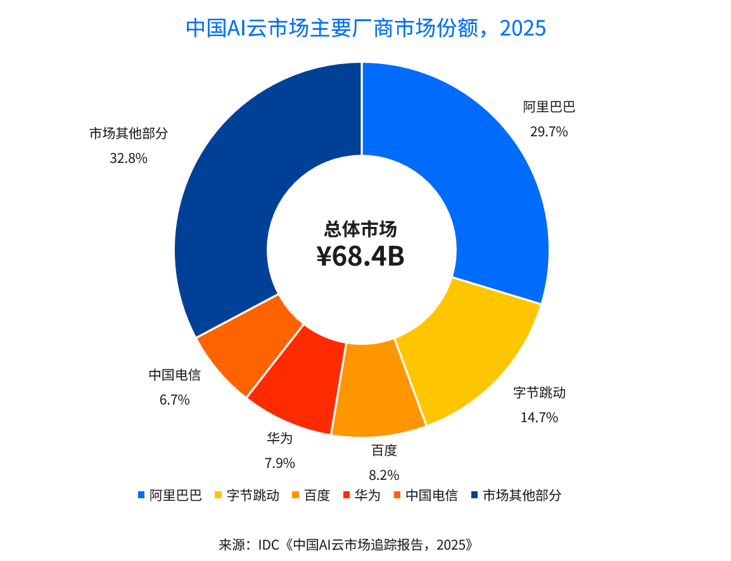
大模型时代,应用与智能体正加速进入核心生产环节,行业对云基础设施的需求发生深刻变革。企业开始用推理效率、服务链路和合规能力来衡量基础设施,一个贯通算力、数据、模型服务与安全治理的AI云市场应运而生。国际数据公司(IDC)正式将这一市场定义为“AI云市场”,并首次发布《中国AI云市场追踪报告,2025》并给出中国AI云市场规模数据:2025年,推理需求集中释放,企业级MaaS的Token调用量一年增长约16倍,推动中国AI云市场规模达到684亿元。

定价锚点从“资源”转向“业务结果”,云基础设施需要重新定义

过去十年,云计算的定价锚是资源——核时、GB月、带宽峰值。企业采购的逻辑也很直接:比价格、比SLA、比资源池规模。这套锚点在大模型时代正在急剧松动。

根据IDC调研发现,企业决定是否采购AI基础设施时,评估标准正在经历跃迁,且呈现出清晰的递进关系::

  • 资源层:算力够不够、Token成本多高、推理效率如何——这仍是最基础的门槛,但已不再是决定性因素;

平台层:模型效果好不好,数据、训练、推理能否串成一条完整链路,能否提供端到端的智能服务、为业务真正提效——这成为采购的核心考量;

  • 信任层:业务结果能否同时通过合规与审计,安全地进入核心生产系统——这决定了采购能否最终落地。

三个层次层层递进:资源是门槛,平台是价值,信任是放行条。可以看到,市场对基础设施的锚定已从“资源”转向“结果”——过往以售卖算力为主的云基础设施,难以满足大模型时代的企业需求,市场亟需新的产品形态。随之而来的,是市场结构与竞争壁垒的重新书写。

需求侧呈现“算力—数据—智能—信任”四位一体,AI云市场正在形成

那么,企业需要的“新形态”究竟长什么样?随着模型应用与智能体部署加速,需求侧的答案正日益清晰——一个“算力—数据—智能—信任”四位一体的基础设施栈::

•算力:不只是GPU卡数,而是由硬件、调度、推理效率等共同支撑的服务吞吐;

•数据:通过向量数据库、其他AI原生数据库等合理高效的数据库架构,将企业知识和数据资产输入给AI;

•智能:机器学习平台(训推平台)与MaaS,决定大模型能否被规模化地生产、调用、治理,进而为业务注入“智能”;

•信任:AI安全,决定AI能否进入各行业的高价值核心场景。

四者缺一不可。任何一环的缺口,都会让另外三环的价值无法兑现。正是在这样的需求牵引下,一个区别于传统IaaS的AI云市场,正在加速成形。

IDC正式定义AI云市场

IDC认为,AI云市场是:以云服务形态交付、支撑大模型全生命周期的完整基础设施与平台服务体系。它向下整合专为AI工作负载设计的算力与存储资源,中游提供数据处理、模型开发、训练、部署与运维的完整工具链,并以贯穿全链路的安全与治理能力。区别于以通用IT负载为中心、按资源计价的传统云市场,AI云市场的价值锚点是“智能的规模化交付”,是让企业数据与模型能力转化为可信业务结果的完整技术栈。

IDC洞察:2025年推理需求成为主导,推动中国AI云市场达684亿元。

2025年训推拐点加速到来,推理场景在支出中的占比显著上升;大模型应用场景急速拓展,广泛覆盖泛互联网(游戏、娱乐、教育)、金融、智能制造等行业,迅速渗透至角色扮演、市场营销、搜索、数据处理、数据分析与文档处理等场景。

需求的爆发直接体现在调用量上:2025年,中国企业级MaaS市场Token调用量达到1994万亿,同比增长约16倍;日均Token消耗量从年初的1.6万亿攀升至年末的9.6万亿,达到年初的6倍。

需求侧的爆发与供给侧的快速响应形成合力——技术提供商加速投入资源部署,行业用户加速落地大模型及应用——共同推动2025年中国AI云市场规模达到684亿元。

IDC洞察:AI云竞争从“资源”转向“结果”,模型、推理优化与AI安全成为关键

IDC认为,AI云的竞争维度正在从”谁能提供资源”,转向”谁能把资源转化为可交付、可信赖的结果”。根据IDC调研,企业选择AI云基础设施时,最看重的因素为:回答质量/模型效果、性能、安全合规——恰好对应着三重竞争要素:

  • 模型是入场券,但入场券的有效期正越来越短。每一次新模型的发布,都会直接转化为AI云的增长动能:更强的模型能力能够解锁此前不可行的应用场景——长上下文、多模态、Agent编排,并催生新的推理需求;企业为评测、试用和接入新模型涌入平台,带来Token调用量的跳涨与客户迁移。AI云厂商若能自研或首发、独家引入领先模型,还能借此吸引开发者生态,形成短期获客与品牌溢价。但这张“入场券”的时效正越来越短:开源模型正在快速抹平能力代差,模型领先的窗口期已被压缩到以季度计——上一个版本带来的客户与流量,往往在下一次开源更新中被追平。模型能决定客户“来不来”,却决定不了客户“留不留”。
  • 算力资源与推理优化是长期壁垒。推理已成主战场,资源优势固然有用,但竞争焦点正从“谁有更多卡”转向“谁能把每一张卡用得更稳、更快”——壁垒正从“资源壁垒”变为“工程壁垒”。
  • AI安全从成本项变为溢价来源。AI安全不是合规部门的工作,而是产品架构的工作:数据不出域、内容安全、Agent权限治理、审计与溯源,必须在架构层解决。

在上述要素上建立起综合优势的厂商——阿里巴巴、字节跳动、百度等厂商取得了优势与主要市场份额。

IDC给厂商及行业用户的建议

对厂商

  • 算力获取决定竞争上限,但投入规模与节奏需与收益对赌。​中短期内,算力资源紧缺仍是主旋律,资源获取能力依旧是决定竞争上限的关键变量,需要长期、持续地投入。但厂商也必须清醒权衡:算力是重资产,投入大、回报周期长,且受供给波动影响——当前的资源投入带有一定风险,规模与节奏都需量力而行。    
  • 算力效率优化,是与扩容并列甚至优先的路径。​智能体与大模型应用爆发,需求端快速增长,但硬件供给的增速受限,“用好存量”因此成为关键。通过调度、推理优化与平台化软件能力,厂商可以在硬件不变的情况下提高服务吞吐——相比硬件扩容更具性价比。资源到位之后,真正把资源转化为可交付服务的,正是这些工程能力。。
  • MaaS资源应向性价比端倾斜。大模型效果持续提升,已经越过了生产环境可用的阈值,预期未来会出现各类智能体应用的大爆发。在这种场景下,客户对智能上限的要求大部分已被满足,将会更看重服务的经济性、稳定性,后者是在生产环境大规模使用智能体的前提。
  • 把AI安全前置为产品能力,而不是合规成本。安全是进入政务、金融、能源等高价值场景的准入资格,也是溢价能力的来源。
  • 为智能体重构基础设施。智能体的负载特征(长上下文、高频工具调用、高并发、强成本敏感)与传统AI负载不同,需要重做调度、缓存、可观测性与权限体系。

对行业用户

  • 升级采购标准:以业务结果指标替代算力指标。用任务成功率、单位业务成本、长尾时延来约束招标,而不是只用卡数与算力峰值。
  • 用总拥有成本而非Token单价做决策。Token单价低不等于总成本低,必须按自身场景的消耗特征测算。
  • 把安全与数据边界写进采购要求。对政务、金融、能源等行业用户而言,这不是加分项,而是必要条件。

分析师观点

IDC中国高级分析师洪婉婷表示,2025年,推理时代已然到来。684亿元的AI云市场规模与16倍的Token调用量增长,宣告云计算叙事正式换轨:定价锚点从“资源”转向“业务结果”。在新赛场中,真正的长期壁垒藏在推理优化、平台工程与架构级AI安全之中。对厂商而言,算力投入须与收益对赌,工程效率优先于盲目扩容;对用户而言,则应以任务成功率与总拥有成本,替代卡数与Token单价来做决策。谁能把“智能”转化为可信、可规模化交付的业务结果,谁就能在下一阶段的AI云竞争乃至大模型商业竞争中,掌握主导权。

进一步交流

如希望就AI云市场定义厂商份额及采购评估框架进一步交流,欢迎与我们联系。请点击此处与我们联系。

Catherine Hong

Catherine Hong - Senior Market Analyst

Ms. Catherine Hong is served as the role of Senior Market Analyst in Emerging Technology sector for IDC China, and her main responsibility is conducting analysis and research for the China Blockchain market. She is also in support of regional…