Spatial intelligence is the ability to understand a physical or virtual space, and how it changes over time, well enough to reason about the likelihood of outcomes based on specific actions. As AI moves from making decisions and taking actions in business processes to doing so in the physical world, spatial intelligence is what allows it to act autonomously, safely, and effectively.

What is spatial intelligence?

Spatial intelligence is the ability to understand a physical or virtual space, and how it changes over time, well enough to reason about the likelihood of outcomes based on specific actions. It combines four capabilities:

  1. Perceive a physical space or design a representational space (such as a 3D model).
  2. Identify the objects within that space and the relationships between them.
  3. Simulate how changes to an object’s state or activity, and the order of events, alter conditions and outcomes over time.
  4. Reason about what actions to take to achieve a desired outcome.

People use spatial intelligence every day without thinking about it. Take a driver heading down a residential street.

  1. Perceive: The driver sees the street and the houses lining it.
  2. Identify: The driver identifies a child playing with a ball in a driveway.
  3. Simulate: The driver predicts that if the ball bounces into the street, the child may chase it without looking for cars.
  4. Reason: The driver slows down and keeps watching the child and the ball so they can stop if the child runs out.

Image 1: Human using spatial intelligence

That’s an example of human spatial intelligence. Hardware and software enable machines to perform the same four capabilities. Take an autonomous vehicle heading down the same street where the child is playing with the ball.

  1. Perceive: Cameras, LiDAR, and radar capture the street, and sensor fusion merges their readings into one continuously updated model of the surroundings.
  2. Identify: Computer vision models recognize the child and the ball, then track how far each is from the road and how it is moving.
  3. Simulate: Prediction models built on physics, probabilities, and patterns learned from data estimate what happens next, including the ball entering the road and the child following it.
  4. Reason: Safety rules and motion planning choose a response, and vehicle control carries it out: the car slows and keeps tracking the child and the ball so it can stop if the child runs out.

Image 2: Autonomous vehicle using spatial intelligence

Predicting outcomes requires understanding cause and effect, not just patterns. A system that has learned that this street is usually empty at 3 p.m. will be wrong the moment a ball rolls out. Spatial intelligence tracks an object’s state, what it is doing, and the sequence of events, so it can reason that the ball came first and the child may follow.

What are the technologies that enable spatial intelligence in machines?

Machines get spatial intelligence from hardware that senses, computes, and acts, and from software that models spaces, recognizes objects, predicts outcomes, and decides on actions. Each of the four spatial intelligence capabilities draws on both.

CapabilityHardwareSoftware
PerceiveCameras, LiDAR, radar, ultrasonic and sonar sensors, motion sensors (IMUs), GPS and indoor positioning (e.g., UWB), 3D scanners, IoT sensors (mounted on vehicles, robots, headsets, drones, and satellites)Sensor fusion, localization and mapping, 3D reconstruction, geospatial data (GIS), 3D design (CAD, BIM, AI-generated environments)
IdentifyAI processors in devices and edge systems, including AI built into cameras and sensorsComputer vision, object detection and classification, scene segmentation, tracking, models of how objects relate, vision-language models
SimulateOnboard AI processors for real-time prediction; data-center GPUs and high-performance computing for large-scale simulationPhysics-based, probabilistic, and learned prediction models; physics engines; simulation and digital twin software; world models
ReasonOnboard computers and real-time controllers; actuators that carry out decisions (motors, steering, brakes, robot arms)Rules and safety constraints, motion and path planning, optimization and routing, learned control policies (e.g., reinforcement learning), AI agents, control software

Note: These lists are representative, not exhaustive. In most machines, the same hardware runs Identify, Simulate, and Reason regardless of the deployment model (edge, cloud, on-premises). Actuators appear under Reason because they enable a machine to complete actions in the physical world. In virtual spaces, the “action” may be a design change or the execution of an operational process.

What are some examples of spatial intelligence use cases across industries and spatial scales?

Spatial intelligence is used across industries and at scales from celestial to molecular. Below are a few examples of the outcomes each use case targets.

IndustryUse caseScale
Space agenciesAssess the threat from near-Earth asteroids by measuring their size and tracking their pathsCelestial
Defense and militaryReduce troop and equipment loss by tracking forces and threats across continents in near real timeGlobal
InsuranceReduce loss ratios by forecasting severe weather and flood risk to improve policy pricingRegional
TelecomLower tower deployment costs by modeling signal coverage across a 3D city to place towers where they work bestCity
Retail and real estateMore revenue per square foot by predicting how a new store will perform from demographics, foot traffic, and competitor locationsNeighborhood
AgricultureIncrease yield and cut fertilizer costs by predicting how parts of a field will respond to varying inputs based on soil, moisture, and crop stress at specific locationsField
Warehousing and logisticsHigher storage density and shorter pick and pack time from testing warehouse layouts virtually before changing the floorFacility
ManufacturingThroughput gains from designing production lines in 3D to avoid collisions and physical bottlenecks before equipment is installedProduction line
Architecture, engineering, and constructionReduce cost overruns by simulating the impact of design changes before approving field changes, such as having to change the roof support beams when walls move further apartStructural element
PharmaceuticalsFaster drug discovery from simulating how compounds fit target proteins to rule out unlikely candidates before lab testingMolecular
GamingReduce design time and speed game release by automatically generating a virtual world’s terrain and the paths non-player characters use to move through itVirtual world

What kind of value does spatial intelligence deliver?

No single benefit dominated in IDC’s 2025 Power of Place survey. Asked to pick the top 3 benefits of their geospatial investments from 13 categories, 609 respondents in 12 countries most often chose increased productivity and cost savings (27% each). By industry, the leading benefit varied:

  • Financial services: respondents most often named improved compliance (31%).
  • Manufacturing: cost savings led, at 43%.
  • Retail: respondents most often named improved customer experience (31%).

Because the leading benefit varies by industry, build the business case around the benefit your industry values most.

Conclusion

Spatial intelligence gives AI the ability to understand a space as it changes over time and to reason about the outcomes of its actions, whether the space is a street, a factory floor, a building design, or a molecule. Understanding cause and effect makes predictions and reasoning more likely to hold when conditions change.

The more decisions and actions carry a spatial dimension, the more it costs to misjudge their consequences: underpriced insurance policies and autonomous vehicle collisions, to name a few. Reducing those risks starts with choosing high-value use cases and mapping the capabilities each one requires, then building a deployment roadmap you can execute. IDC can help you navigate each step. Contact IDC to learn more.


Dan Everett

Dan Everett - Research Director, Spatial Applications and World Models

Dan Everett is a Research Director in IDC’s AI & Data Management practice, covering Spatial Applications and World Models. Mr. Everett’s core research coverage includes spatial intelligence platform capabilities and generative world models, supporting geospatial analytics, 3D environment modeling, digital…

In October 2024, IDC’s FutureScape: Worldwide Future of Industry Ecosystems 2025 Predictions forecast that by 2026, 50% of marketplaces would expand community capabilities, using fair-value monitoring to incent collaboration, and grow their data and application inventory. The other 50% would see participation decline. Two years later, Jeff Hojlo, Research Vice President at IDC, says the split roughly holds.

The route there looked different from the one the prediction described, and he now expects the next couple of years to land closer to 80-20.

Why did IDC call it a 50-50 split?

The call rested on how fast ecosystems were widening. Organizations have always worked with a small, finite set of partners, but in recent years the breadth and scope of those partnerships grew sharply. IDC’s 2023 Data as a Service and Data Marketplace Survey found that more than 80% of respondents considered external data critical to the success of every enterprise.

Hojlo ties that appetite for outside data to several pressures: ESG goals and the energy transition, the need to innovate faster with fewer people and thinner skills, customer experience optimization, and the move to software development. As he puts it, “everything is becoming software defined, whether it’s a product, whether it’s a building, whether it’s a process.”

Marketplaces already supplied data and applications, along with the APIs to connect them. Using them as a place to work with partners was a smaller habit. IDC’s 2024 Future of Industry Ecosystems Global Survey found that just 22% of respondents considered the marketplace a place to work directly with their partners and customers. In Hojlo’s account, the trend lines and IDC’s conversations with end users pointed toward 50%. Wanting external data and collaborating inside a marketplace to get it are separate habits, which kept the call from going higher.

The prediction also named what would divide the two halves. According to the report, organizations often take part in several marketplaces at once, and IDC expected participation to fall wherever fair-value monitoring was missing. The report called it one of the top roadblocks to a successful ecosystem.

What played out differently than expected?

Hojlo says usage moved the way IDC expected: roughly half of organizations now use marketplaces to engage partners and customers more closely and to co-innovate, as well as to pull data and applications. Who delivered the community features is where the story changes.

Major infrastructure and platform providers have not broadly added community management and co-innovation features such as sandboxes. They expanded AI model gardens and data marketplaces for sharing and marketing applications, and they added ways to make sure participants are paid for their work. That bears on the fair-value piece of the prediction. Fair-value monitoring has not emerged as such, in Hojlo’s view: no one is checking whether revenue is allocated fairly to partners on a given project. Providers do have strong incentives to draw participants and bring them back.

Enterprise app and industry-specific providers picked up more of the collaborative features. Their customers and partners need to share data, co-innovate on products and services, and source data relevant to their own domain. Hojlo has seen this most in the industrial space, where participants want targeted contextual data to complement what they already hold.

AI sits underneath much of this growth. Hojlo describes marketplaces as the supplier of the living data model that feeds the language models behind AI tools, and organizations now look to them for external agents as well as data and applications. Beyond agents embedded in applications, companies want outside sources that support their use cases and help them respond to disruption.

Does 50-50 still hold?

For today, yes. Looking a couple of years out, Hojlo sees closer to 80-20. The 20% would be marketplaces without payment mechanisms, a fair-value sharing approach, or a rich, contextual set of data and applications.

“

I expect all marketplaces, if they want to survive, will have some level of that.

— Jeff Hojlo, Research Vice President at IDC

In his words, “I expect all marketplaces, if they want to survive, will have some level of that.”

That outlook changes what “participation decline” means. Hojlo now frames it as a stickiness question: how well a marketplace gets people to stay and come back. There is room for both kinds of marketplace, in his view. A community-oriented one is built to keep partners returning to co-innovate. A transactional one, where someone grabs a data model, an application, or a software development resource, is a quick visit by design.

What should marketplace participants watch next?

That difference in purpose shapes where marketplaces compete next. Hojlo says differentiation still comes from data sharing and from community and co-innovation environments, whether a marketplace serves one industry or runs as a transactional model garden. Both depend on the data sharing infrastructure underneath. A newer requirement is the ability to look across multiple data sets and to orchestrate agents and data models with governance, so participants can find the best next step when an opportunity or an unexpected disruption appears.

The obstacles to getting there are mostly operational. In an IDC data as a service survey from last year, the challenges he describes were predominantly operational, not technical:

  • Privacy and compliance concerns, which act as the first gate on whether data can be shared at all
  • Infrastructure cost
  • Token management and allocation across partners and participants
  • IP management and legal complexity
  • Confirming that a partner is who they say they are, through standard cybersecurity tools plus a validation mechanism and legal framework

Delivery matters just as much. On top of open APIs for connecting new data sources and models, database integrations, and data clean rooms to cleanse and operationalize data, Hojlo points to a workflow-ready approach and to monetization and incentive structures for the work partners do together.

The takeaway: decide what your marketplace is for

Hojlo notes that marketplaces have operated for hundreds of years, going back to medieval France. A successful one, physical or digital, offers breadth of options and a dynamic mix of partners serving different purposes, plus the architecture to support co-innovation and ongoing learning. For anyone building or joining one, his advice starts with privacy and compliance, which decide first whether data can be shared at all. From there, settle which need the marketplace serves and build data sharing and governance to match, with incentives that bring partners back.

Christina Cardoza - Content Marketing Manager - IDC

Christina Cardoza is a Content Marketing Manager at IDC, where she specializes in brand content and social media strategy. With a background in journalism and editorial leadership, she has a proven ability to transform complex technology topics into clear, actionable insights.

Talk of an AI correction usually starts with a change in investor sentiment. Coupled with rocky macroeconomic headwinds, this impacts company valuations, thereby straining financing for AI-specific buildouts. In short, it affects supply. IDC tracks markets, not balance sheets, so we start with the demand side, and it is strong.

The constraint is capacity. Power, memory, packaging, and site buildouts have not kept pace with demand for AI adoption; as a result, supply-side constraints will set the pace of growth through 2027 and into 2028. The IDC view is that this is not a demand bubble. A bubble is oversupply versus demand, and today, memory, power, and packaging are all in short supply.

AI demand is real and compounding

The inferencing economy has arrived and is rapidly gaining traction, driven by agentic AI. We have witnessed agentic AI move from pilot programs into production. 95.3% of enterprises run at least one agent workflow in production, with an average of about 11, according to IDC’s Future Enterprise Resiliency and Spending (FERS) survey (Wave 4, July 2026). By 2030, we forecast there will be 2.5 billion agents, with the number of active agents nearly tripling next year, according to IDC’s Worldwide Agentic AI Adoption Guide (June 2026). Enterprises also expect AI-enabled applications to account for over half of enterprise workloads within two years, according to IDC’s June 2026 Digital Infrastructure Sentiment Study.

Enterprises are also spending faster on AI initiatives than planned. In the past 12 months, 67% exceeded their agent budgets, and 24% overshot by 25% or more, according to the IDC FERS survey. We view these overruns as a demand signal. Even though organizations are consuming more tokens than they forecast, they continue to expand agent use across more workflows. Rather than reducing agent use to align with an existing budget, they are increasing budgets and pursuing technology enhancements, such as model routing and improved inference memory management, to reduce per-action costs.

Cheaper tokens will lead to increased spending

A common industry statement is that falling token prices will flatten demand. But cheaper tokens do not mean cheaper agents.

We believe that Jevons paradox is real, and we are in the midst of experiencing it today.

Efficiency gains are real. Agents confirm context, chain steps, call tools, and pass messages to other agents. In parallel, agent-driven inference delivers two to four times more throughput per GPU. Model routing cuts average cost per token by 30% to 60%. These gains will lower unit token costs. They will not slow total consumption. Volume outpaces price for structural reasons. A single business outcome can consume tens or hundreds of thousands of tokens. History shows that sharply cutting the cost of a basic unit accelerates innovation, because teams can take on a wider range of workflows.

The build-out of AI infrastructure

With strong AI demand for the foreseeable future, the question is whether enough AI infrastructure will be available to meet inference demand. Two primary groups buy that infrastructure: service providers and non-service providers (aka enterprises and governments). IDC’s AI Infrastructure Tracker projects revenue from service provider (including Hyperscalers and cloud service providers) procurement to grow from $401 billion in 2025 to $1.45 trillion annually in 2030. To keep up, datacenter facilities capex (excluding the cost of IT infrastructure) is forecast to rise from $276 billion to $655 billion over the same period. Increasingly, we see specialty cloud service providers (aka Neoclouds), frontier model makers, and extremely large hybrid enterprise/service providers emerging as a secondary source of infrastructure buyers.

Across the two principal buyer types, IDC is seeing a consistent trend toward distributed, purpose-built AI infrastructure, or “AI factories,” that are optimized for AI workloads, with specific components optimized for complex training, inference, and agent environments. Tech leaders view AI factories as a way to operationalize AI workloads by turning data into tokens and actionable intelligence at predictable costs. IDC’s AI Strategies survey shows that they prioritize security and governance controls, as well as built-in operational intelligence, over rapid deployment. These specialized systems can be deployed in various locations, including at the edge, in the datacenter, in the cloud, or on service provider infrastructure, enabling flexible deployment that scales with AI use cases.

The supply chain problem: serving AI demand has structural limitations

As agentic AI and AI inference workloads expand, especially in mainstream enterprises, capacity challenges are about more than just the strain on total available compute. They also raise the question of whether the right infrastructure can be deployed where needed, with sufficient power, cooling, and connectivity, at an economically viable cost. Shortages in these areas can coexist with underused capacity elsewhere. Two constraints stand out.

The first constraint is physical capacity, i.e., datacenter facilities. Our data shows that power, grid access, and datacenter capacity could limit near-term growth. IDC’s Datacenter Facilities Tracker shows that the number of provisioned racks will rise from 25 million to 58 million from 2026 to 2030, leading to a corresponding increase in energy consumption from 519 TWh in 2025 to 1,308 TWh. This represents an increase of about 2.5-fold and 2.3-fold, respectively (while AI infrastructure spending rises 3.35-fold, leading to a supply shortage). We find that just in the U.S., almost 7 GW of planned datacenter capacity for 2026 has been delayed or canceled due to a lack of power. U.S. colocation vacancy is at record lows, and IDC projects a 45 GW power shortfall in the U.S. by 2028.

The second constraint is the semiconductor and enabling technologies supply chain. Take the global memory shortage, for example. IDC describes it as structural because demand for AI has shifted fab capacity toward high-bandwidth memory (HBM). IDC forecasts supply growth of just 16% for DRAM and 17% for NAND in 2026, well below historical norms. HBM4 output is not expected to meet demand until mid-2027.

Another example is TSMC’s wafer-level system integration platform (CoWoS). It remains the most critical bottleneck for GPUs, CPUs, and custom ASICs. IDC expects industry wafer capacity to grow by about 80% in 2027, while demand grows close to 2x. Semiconductor packaging (ABF substrate suppliers) remains near full capacity, with no meaningful additions expected before the second half of 2027. We also find that supply shortages and long lead times have spread beyond memory, chips, and packaging to optical components, power parts, liquid cooling, and basic datacenter power equipment. We expect these shortages to persist through 2027, with memory remaining tight into 2028.

What happens next

We see AI demand hitting real-world constraints; the problem is a mismatch in time horizons. AI-ready datacenters take five to seven years to site and build, while backers want a return on investment and customers need capacity now. Investments in datacenter facilities last for decades. However, the same cannot be said for the IT infrastructure housed in them: we see a new generation of accelerators (e.g., GPUs) every 12 to 18 months.

Growing AI usage is shifting risk from demand to supply, rather than eliminating it. When demand outruns supply, history has consistently shown that scarce market capacity leads to persistently inflated per-unit prices.

Demand that cannot be served or pushed out does not disappear altogether. It spreads, shifting from segment to segment. In the past 12 months, 31% of companies have shifted at least some workloads from proprietary to open-weight models, according to the IDC AI Economics and Cost Management Survey. We expect easily adoptable open-weight models to shift inference to private, sovereign, and edge environments, diverting some inference demand away from public cloud providers. More than half of organizations globally already use sovereign cloud for AI, with another third considering it over the next 12 months, according to IDC’s Digital Sovereignty study. IDC’s HPC/AI Index shows non-service-provider spending on AI infrastructure steadily rising from $28.6 billion in 2025 to $96.4 billion in 2030, a 27.5% CAGR. This is in addition to their IT infrastructure spending for non-AI workloads. The likely outcome is a hybrid market that combines on-device processing, sovereign and private clouds, AI factories, and a marketplace of open-weight and proprietary models. This decentralized AI market also makes managing the creation, deployment, and tracking of agents, models, and data a critical challenge for enterprises, reinforcing the need for unified AI workload management and agent governance, whether delivered within AI factory solutions or as standalone platforms.

As the market matures, we expect some consolidation among specialty cloud providers. The durable assets that change hands will be newly built datacenter sites and upgraded grid connections, which will be the foundation for the next round of AI-native businesses. Accelerators age faster, and as they are refreshed and depreciated, prior-generation systems will enter the secondary market at lower prices over time, making AI infrastructure more accessible to enterprises and supporting further demand growth. Specialty cloud providers that succeed will do so by rapidly moving up the stack to model serving, sovereign AI, or full agentic infrastructure with storage, data management, and governance add-ons that improve margin and create workload stickiness. The result will be an AI ecosystem that is more distributed, dynamic, and focused on meeting the actual demands of customers, both enterprise and consumer.

What we are watching

Four signals would change our view:

  • agent and token usage flattening;
  • current-generation GPU procurement and rental prices falling while utilization also drops (in tandem with a surge in gray-market procurement);
  • memory and packaging lead times shortening;
  • and capex guidance being cut.

Beyond 2028, the question is whether supply catches up. We plan to track how supply constraints may affect enterprise and service provider spending.

We are also watching whether circular financing, in which vendors invest in the specialty cloud service providers that buy their products, holds up. A pullback in that funding, or in private equity backing, would be a macro warning sign. If that pullback happens, it will accelerate the consolidation described above, with well-capitalized Hyperscalers and profitable cloud service providers best positioned to acquire datacenter sites and grid connections at a discount.

Demand is not the risk in this market. The real risk is whether enough capacity can be sited, powered, and supplied in time, and who ends up owning it.

Meredith Whalen - Chief Research Officer - IDC

As IDC's Chief Product, Research & Delivery Officer, Meredith Whalen leads the company's global product, research and data, and delivery organizations. Under her leadership, IDC delivers cutting-edge intelligence to the world's leading technology vendors, enterprises, and investors as they navigate the evolving AI economy. Meredith sets the strategic direction for IDC's global analyst community, shaping research methodologies and agendas that generate industry-leading data and actionable insights to drive high-impact business decisions. With more than 20 years at IDC, Meredith has been a catalyst for some of the company's most transformative initiatives. She founded IDC's Industry Insights and Tech Buyer business units and pioneered the industry's first comprehensive business use case taxonomy. She also led the creation of IDC's DecisionScape methodology-a strategic framework that empowers organizations to better plan, implement, and optimize their technology investments. A recognized thought leader and sought-after speaker, Meredith regularly delivers keynotes at major global technology events and advises senior executives on the trends shaping the future of business and technology. Meredith holds a B.A. with honors from Wellesley College and an MBA with honors from Babson College's F.W. Olin Graduate School of Business.

近期,中国算力基础设施建设释放出更加明确的政策信号。国务院常务会议研究算力网建设,提出强化算电设施规划衔接,加快绿电直连、源网荷储等项目落地,促进供需更好匹配。

这些变化为观察数据中心市场提供了一个重要视角:随着AI业务对基础设施提出更复杂的要求,市场需要更加准确地识别,哪些容量能够在合适的时间、合适的地点,以可持续的成本投入使用。

衡量数据中心竞争力,需要把设施条件放回客户的业务和部署场景中。

一、企业AI部署,对物理设施提出了更具体的要求

IDC于2026年发布的中国智算云服务市场企业用户调研显示,120家已建设或使用AI专用基础设施、且使用外部AI算力的企业所提到的基础架构瓶颈中:机房物理环境受限的选择比例为45.8%,集群网络延迟为42.5%,软硬件生态适配不足为40.0%,存储I/O瓶颈为37.5%。相比之下,选择核心算力不足的比例为15.8%。

在面向未来1-3年的技术投资方向中,53.3%的受访企业选择升级数据中心物理环境,在所列选项中居首。

这些结果表明,AI落地需要设备与运行环境共同满足要求。服务器能够采购到位之后,供电、散热、机柜空间、网络与运维条件,仍然会影响部署进度和运行表现。

对数据中心厂商而言,这意味着市场机会具有不同形态:新建容量、存量设施改造、分期扩容,以及配合客户技术升级的持续服务。

二、技术变化考验数据中心厂商的持续交付能力

不同工作负载对数据中心的要求并不一致。高密度设备可能带来供电与冷却调整,异构设备部署涉及不同接口和运行条件,持续在线业务则更加关注稳定性、维护窗口和故障恢复。

值得进一步研究的能力包括:

  • 根据客户配置明确供电、冷却和空间条件,并按约完成交付;
  • 在存量改造和分期扩容中维持业务连续性;
  • 与设备及技术伙伴完成接口验证、联合调试和验收;
  • 将故障处理经验、运维流程和人员能力复制到不同项目;
  • 为后续设备更新保留合理的扩展和改造空间。

这些能力会影响客户部署的确定性,也构成数据中心厂商长期竞争力的重要部分。

三、结合实证案例,探索数据中心设施的新观察视角

围绕这些变化,IDC即将发布的《中国数据中心趋势与策略研究报告》,结合已有的市场数据、企业用户调研和技术研究,进一步通过运营商、设备与服务伙伴及客户案例,补充数据中心运营实践的证据。

研究主要聚焦几方面议题:

  • 跨行业需求变化: 不同工作负载和部署方式,将提出哪些数据中心设施要求?
  • 规模化交付与运营: 数据中心厂商如何复制项目经验,并适应设备和业务变化?
  • 能力定义与验证: 如何用一致的口径,解释设施能力、协作机制及其客户价值?

本研究将厘清:数据中心什么样的设施适合什么样的需求,哪些能力能够支持持续交付,以及这些能力如何在实际运行中得到验证。

因此,衡量数据中心竞争力,不仅需要识别设施是否具备AI就绪能力,还需要进一步回答三个问题:供给能否兑现、容量能否适配需求、资源投入能否形成持续运营价值。

四、立足区域、交付与负载适配,透视AI数据中心供需

一个规划100MW的数据中心园区,一份100MW的租赁意向,以及100MW已经运行的IT负载,代表的是三种不同的市场状态。

如果忽略这些差异,把规划、订单和实际使用直接放在一起比较,就可能误判某个地区的供需关系。对于正在选择建设地点、制定扩容计划或评估项目的企业,这种判断会影响资金投入、客户获取和交付安排。

  • 首先:需要区分数据中心设施与服务

数据中心设施为服务器等IT设备提供空间、电力、制冷、网络接入及运行保障。算力服务则进一步涉及计算设备、资源调度、软件环境和服务交付。

一家数据中心厂商可以同时经营这些业务,但研究时需要将其拆开。设施服务收入、GPU租赁收入和云服务收入,对应不同的业务范围;设施电力容量、IT电力容量与计算性能,也不能直接互相替代。同时分析上游设备和下游业务也会影响设施需求。

这种区分还会影响需求统计。例如,模型企业租用云服务,云服务商采购服务器并租用机房,设施运营商再建设园区,这可能是同一条需求链上的不同环节。若将每一环节的投入都视为独立的新增设施需求,就容易重复计算。

  • 其次,供给有多大,需要结合交付条件回答

为理解公开信息中的不同容量表述,我们提出三个供给观察层次:

  • 第一层次:规划供给。企业或地区计划建设多少容量,哪些条件尚待落实?
  • 第二层次:可交付供给。在指定时间内,多少容量能够完成建设、送电并具备客户交付条件?
  • 第三层次:适配目标需求的供给。可交付容量中,多少能够满足客户对位置、功率密度、制冷、网络、可靠性和成本的要求?

这三个层次有助于解释,为什么较大的规划规模未必能解决客户近期的资源需求,也有助于识别存量设施的改造机会。

例如,同一区域内一座已经投运的机房,能否承接新的AI负载,需要进一步确认机柜功率、制冷系统及电力配套。设施本身存在,并不意味着所有类型的业务都能直接入驻。

同时,规划容量仍有研究价值。审批、电力接入和建设进度的变化,可以帮助企业判断未来供给的兑现条件。关键是保留状态与时间信息,避免将远期规划直接计入当期可用容量。

对数据中心运营商而言,容量能否交付只是竞争力的起点。进一步的竞争力体现在能否持续获得客户需求,并将规划与建设投入转化为有效上架、稳定使用及可持续收入。

因此,评价数据中心市场时,还需要关注签约、实际使用及商业运营等不同状态,避免单纯以建设规模判断企业的发展质量。

  • 再次,区域研究,需要同时看见集群和集群外的重要市场

八大国家算力枢纽节点及其十大国家数据中心集群,为中国数据中心区域研究提供了重要框架。2026年3月23日,中国发展高层论坛演讲《深化数据赋能人工智能发展,加快培育智能经济新形态》中,逐一列举八大枢纽和十大集群,并提出加快国家枢纽算力设施集群建设、加强监测调度和提高资源使用效率。

在这一框架下,还需要进一步观察节点内、集群外的重要城市和园区,以及具备能源和业务承接条件的非枢纽地区。AI工作负载的差异,也在影响数据中心的区域布局。大规模模型训练、离线计算等任务通常更关注电力资源、能源成本和集群规模,而面向用户的实时推理、交互式AI应用等业务,则对网络时延、数据传输和接近终端用户提出更高要求。因此,数据中心的区域竞争力不能仅依据电力成本或建设规模判断,还需要结合不同AI工作负载的部署特点,评估区域资源与实际需求的匹配程度。

全面分析数据中心市场,需要从政策规划与区域布局、客户需求与部署特征,以及典型项目的建设与交付情况三个层面。区域和城市用于呈现市场分布;对具体项目,将在资料可得的情况下,参考官方规划、项目位置及建设进展,分析其区位特点和供给条件,并区分规划、在建与已投运状态。

对于企业而言,这样的区域分析能够帮助识别:哪些地方已有明确需求,哪些地方具备长期建设条件,以及两者之间还缺少哪些配套。

  • 最后,算电协同的价值,需要体现在数据中心运营中

电力资源会影响数据中心的建设和运营,但比较地区竞争力时,需要进一步看清可获得容量、送电时间、综合电价和供电保障。

单一电价数字往往不足以完成比较。电压等级、负载率、容量费用、绿电交易及补贴条件,都会影响实际成本。对于需要分期上架的项目,客户负荷增长与长期购电安排能否匹配,同样值得关注。

绿色运营也需要结合实际使用情况评价。新发布的国家绿色算力设施评价指标体系,将算力资源利用与能源、碳、水等指标共同纳入评价,为研究设施运行质量提供了更完整的观察方向。绿色竞争力正在从设计指标延伸到可核验的运营表现。

因此,关注技术配置、资源投入和运行结果之间的关系,也将影响供电、制冷及运营方案的适用条件。

综上所述,对于数据中心的分析,应该从市场定义与供需底层逻辑切入,延伸至区域布局、项目交付、AI 负载适配、算电协同等多个专题方向。

站在产业链不同参与者的角度观察:对数据中心厂商而言,核心看点在于区域选址、建设节奏与自身能力定位;对云及算力服务商,重点关注资源匹配与落地部署条件;对设备供应商与投资机构,则需要看懂技术诉求如何转化为落地建设机会,以及项目具备实际运营能力的关键节点。

伴随国内数据中心市场持续演变,我们围绕年度市场展望、区域供需与设施布局、AI 基础设施需求、技术迭代、运营效能以及可持续竞争力持续输出行业洞察,帮助运营商、云与算力服务商、基础设施供应商和投资机构建立自主的市场判断。

后续研究规划:

  • 中国数据中心市场图谱:AI开启新一轮基础设施增长周期,Q4,2026
  • 中国AI数据中心发展趋势, Q4,2026
  • 中国数据中心区域机会:从核心城市到东数西算枢纽, Q1,2027
  • 从机柜租赁到Token经济:中国数据中心运营效率与商业模式转型, Q1,2027
  • 从数据中心到算力网络:中国AI基础设施生态研究,Q2,2027
  • IDC MarketScape:中国数据中心基础设施可持续发展竞争力厂商评估,Q3,2027

进一步沟通

如果您正在评估区域布局、规划设施升级,或希望清楚理解数据中心的供需变化,欢迎联系我们,了解专题研究计划并分享您的业务问题。

Cindy Xin

Cindy Xin - Research Director

Cindy Xin is research director at IDC for the channels and partner ecosystems research practice. Based in Beijing, she is responsible for leading and developing the Greater China channels research practice. Cindy provides thought leadership and insights to technology vendors…

The FCC’s robotics rule hits hardest in the category it was written to protect. IDC’s trade policy model puts US humanoid robot revenue 58% below the pre-restriction baseline by 2030. Household cleaning robots, the category most people assumed was most exposed, land only 18% below. A rule that reads evenly on paper lands unevenly in practice, and the volume it blocks from the US finds other buyers, Europe above all.

We covered the first read of this rule in What Does the US Robotics Ban on Foreign Imports Really Mean?.

Why did 2026 become the year robots left the demo stage?

Shipments, money, and buyer intent are all moving at once. Vendors shipped roughly 25,000 humanoid robots in the first half of 2026, already more than the roughly 18,500 shipped in all of 2025. IDC expects more than 750,000 humanoid shipments by 2030, a forecast we raised by about 50%. Buyers agree: in IDC’s 2026 AI platforms survey, Physical AI ranks as the second-highest AI investment priority for the next two years, behind only GenAI assistants. The catch: most enterprises piloting embodied AI are still at proof of concept, so one rule can bend this young market’s growth curve.

Three robot categories run on three different clocks

Humanoids are early and fast. About 84% of 2025 shipments went to display and validation: research, education, performances, and government data collection. By the first half of 2026, that share dropped to about 70%, and real-world work nearly doubled its share to about 30%.

Mobile robots are where industrial money goes today. Industrial and professional buyers generated about 84% of quadruped revenue in 2025, and about 30% of organizations prioritize autonomous mobile robots (AMRs) in planned robotics investments, against about 16% for humanoids.

Commercial service robots are the most mature. Delivery and commercial cleaning units grow from about 155,000 in 2025 to about 454,000 in 2030, and cleaning robots overtake delivery robots in annual shipments in 2028.

China builds, and the world buys

Chinese vendors accounted for about 95% of global humanoid unit shipments in the first half of 2026, and Chinese brands lead household cleaning robots in most regions. On the buying side, our model of household cleaning, professional and commercial, and humanoid robots shows China at about 21% of consumption and the US at about 18%. The other 61% sits in the rest of the world, and Europe alone buys more than double the US share. Trade policy acts on the buying map, and the building map decides who can respond.

What does the FCC rule block?

On July 28, 2026, the FCC added foreign-made advanced robotic devices to its Covered List, so new foreign-made models can no longer get the equipment authorization needed to be imported, marketed, or sold in the US. The scope covers mobile robots that sense their surroundings, move on the ground, connect wirelessly, and weigh more than 4.4 pounds, which sweeps in humanoids and quadrupeds as well as robot vacuums and lawn mowers.

Three provisions limit its reach:

  • Already-certified models keep shipping new units, and software and firmware updates to them are waived through at least January 1, 2029.
  • Fixed industrial arms, vehicles, underwater robots, and medical and mobility devices are excluded, and so are federal government purchases.
  • A Conditional Approval pathway lets vendors keep selling new models if they move production to the US. Applications are due by January 1, 2028.

Most coverage calls this a ban, but in practice it is a chokepoint, not a wall. Nothing comes off shelves, but every new foreign model must clear an authorization it can no longer get.

Why do humanoids take the deepest hit?

Household cleaning robots have a deep bench of already-certified models and can refresh them with incremental updates through 2027. US buyers also chase new features less aggressively than buyers in Europe or China. Our model puts US household cleaning 4% below baseline in 2027 and 18% below in 2030, and the gap widens as those extended product cycles run out.

Humanoids turn over models faster than any other category, so there is almost no certified-model cushion. The gap reaches 41% in 2027 and 58% in 2030, which means close to three of every five dollars of projected 2030 US humanoid revenue disappear. Your exposure depends more on your product cycle and installed base than on the flag over your factory.

The rule protects the badge on the finished robot and does nothing for what’s inside it. US builders such as Figure and Apptronik depend on China for motors, actuators, batteries, and rare-earth materials, and they won’t reach scaled production before the end of 2028, so no domestic volume is ready to fill the gap. IDC’s supply chain research expects nearshoring to stay concentrated on final assembly, so a risk framework that stops there never sees the components (IDC #US50873823).

Where does the volume go?

Our model shows more than $6 billion in foregone US robotics revenue between 2026 and 2030, with over $2 billion of it in 2030 alone. US annual growth across these categories cools from about 13% to about 9% through 2030.

Chinese vendors redirect to markets that remain open, with the UK, France, Germany, and Eastern Europe taking the largest share. Europe, already the largest buyer, gets larger still without passing a rule of its own.

Vendors are hedging, because consumer robotics margins are too thin to move whole production lines. They stretch certified models, move sensitive components into trusted supply, and pair hardware with US software partners, as Tennant does with Brain Corp’s BrainOS.

What should you do in your layer of the value chain?

  • Robot makers: Treat certification as a roadmap decision, and map your bill of materials by country down to magnets and reducers. Sell outcomes through robot-as-a-service (RaaS). Heading to Europe? Budget for local service and AI Act conformity.
  • Platform and silicon players: Trusted, allied-sourced silicon is now a selling point.
  • Component makers: You sit at the chokepoint. Suppliers that qualify with US humanoid builders in the next 12 to 18 months will be hard to displace.
  • Enterprise buyers: Certified fleets keep shipping and being supported, so don’t freeze. Ask every vendor for a component and service continuity plan, and benchmark humanoid cases against AMRs and fixed arms on total cost of ownership.
  • Investors: Price policy risk by category: a 58% US gap for humanoids and an 18% gap for household cleaning are very different risk profiles.

A question for your next board meeting: if the rule extends to components or fixed industrial arms tomorrow, what breaks in our plan?

What to watch over the next 12 to 18 months

We are tracking five signposts. Early Conditional Approval decisions will show how strict the pathway is. Rule creep, meaning pressure to extend the restriction to components or fixed arms, would hit component makers and industrial automation. The certified-model cushion thins in 2027. The January 1, 2028 filing deadline should bring a rush of applications and US assembly news. Europe’s high-risk AI obligations phase in between December 2027 and August 2028, and its response will shape where volume lands next. Finally, US humanoid builders are expected to reach scaled production by the end of 2028, when the domestic gap could start to close. The rule changes the route more than the destination.

Watch the on-demand webinar

See the full category data and value chain recommendations in IDC’s Global Robotics Outlook webinar. Watch the on-demand webinar: How the US Ban is Reshaping the Robotics Market →

Use the form inside the webinar to request the slides and ask your questions. To talk through what this means for your category or your supply chain, request a complimentary meeting with IDC analysts.

Navkendar Singh - Associate Vice President - IDC

Navkendar Singh is a Associate Vice President with IDC India, based in Gurgaon. His research domains encompass deep-dive research and insights in and around mobile devices, smart homes, PCs, tablets, wearables, and the printing market in India, Bangladesh, and Sri Lanka. He is also involved in building IDC's successful channel research programs for these domains at city and state levels. Navkendar also leads research related to analyzing the role of devices, emerging business engagement models, the impact of emerging technologies on devices, and emerging personas related to Future of Work.

Ryan Reith - Group Vice President, WW Device Trackers - IDC

Ryan Reith is the Group Vice President for IDC's Worldwide Device Tracker suite, which includes mobile phones, tablets, wearables, and most recently AR/VR. His teams research focuses on the quantitative aspects of the mobile device industry, including market sizing, forecasting, vendor market share analysis, and technology trends. His current responsibilities include engaging with mobile device OEMs, supply chain, distributors, and the financial industry to discuss market trends and forward looking analysis.

What’s changing in AI infrastructure across Asia/Pacific through 2030?

In Asia/Pacific, the AI race is no longer about who has the best model. It’s about who controls the stack underneath it. Three layers are being decided at once. Compute is shifting to always-on inference running on a mix of chips. Power and placement are becoming hard limits, with Asia/Pacific excluding Japan datacenter IT power capacity reaching 70.6GW by 2030. And trust is now part of the design, not an afterthought.

Why It Matters

Agentic AI isn’t a side project anymore. It’s running inside real workflows, around the clock. Can it run nonstop? Can you afford it? Is it sitting in the right country?

If you’re a CIO, CTO, or infrastructure leader, this shapes some big calls: where your inference runs and which platforms and partners you commit to.

Here’s the part that’s easy to miss. The choices you make in 2026 and 2027 will follow you well into the 2030s, because chips get replaced every few years and power contracts, sites and sovereignty setups stick around for a decade or more.

Market Dynamics

Compute: inference is taking over. Training got the headlines, but inference is where the spending is heading. In Asia/Pacific, 94.5% of organizations were using inference infrastructure in 2025, up from 40.2% just two years earlier. IDC expects AI hardware spending in Asia/Pacific excluding Japan to quadruple, from US$66.3 billion in 2025 to US$265.4 billion by 2030. And don’t expect one standard architecture across the region. India runs the widest mix of NVIDIA, AMD, and hyperscaler chips. Korea leans on NVIDIA and AMD. Greater China is the only market where AMD is ahead of NVIDIA, and where DeepSeek and Huawei Ascend have gone mainstream.

Power and placement: location beats price. More and more, governments decide where capacity goes. Singapore has set aside a 700MW site in Jurong, and South Korea is planning 3GW of AI clusters outside Seoul. Then there’s cooling. In Singapore’s heat, cooling can take up to 40% of a facility’s energy, and typical colocation PUE (1.5–1.7) is still above the government’s 1.3 target. Microsoft’s Indonesia region shows where this is heading: it’s built for in-country inference and regulated workloads, while heavy training stays in a few global hubs.

Trust: sovereignty is now built in. IDC’s Asia/Pacific Emerging AI Technologies Survey 2025 found that security, data residency, responsible AI and open standards now matter more than model performance when organizations pick a sovereign AI partner. Most aren’t all-or-nothing on residency: 27% apply strict rules to all data, 52% only to sensitive data and 20% stay flexible. In the same survey, more than 60% of enterprises say changing privacy, security and AI rules are already disrupting their IT operations.

The catch: there’s no one-size-fits-all. Rules, power grids and buyer priorities change from one border to the next, so placement and sovereignty have to be planned market by market.

Data Callout

  • 70.6GW: datacenter IT power in Asia/Pacific excluding Japan by 2030
  • US$66.3 billion to US$265.4 billion: AI hardware spending in Asia/Pacific excluding Japan from 2025 to 2030
  • 79%: organizations that require data residency, at least for sensitive data
  • More than 60%: enterprises report IT disruption from changing regulations

Analyst Insight

The mistake I see most often is treating compute, power and trust as three separate decisions, made one after the other. They’re connected. The chips you pick set your power density. That density decides which facilities can host you. And where that facility sits decides which trust controls you can offer.

Organizations that plan all three together will scale faster. And in Asia/Pacific, placement is the decision that’s hardest to undo.

Outlook

My view is that placement will drive the next wave of growth. Big training runs will stay in a few hubs, while inference moves in-country, close to users and to data that can’t leave.

What could speed things up? Government power allocations turning into usable capacity on time, open liquid cooling standards that make retrofits cheaper, and sovereign cloud regions that make it easier to get from pilot to production.

What could slow things down? Grid delays, not enough renewable energy, chip shortages, rising power bills and a different rulebook in every country.

Three things I’ll be watching next quarter:

  • How much new capacity is built for high-density AI racks
  • Whether models like DeepSeek catch on beyond India and Greater China
  • Whether sovereign AI deals move from pilots to multiyear contracts

FAQs

If power is so tight, why is AI infrastructure investment still growing? Agentic AI turns inference into an always-on workload, so the demand isn’t going away. Tight power pushes that demand to places with power available, like Johor, Batam, India and Thailand, and into denser, liquid-cooled facilities.

Who benefits most? Service providers. Digital and cloud service providers are the fastest-growing datacenter segments through 2030. Colocation players with secured power, liquid cooling and sovereignty-ready capacity are best placed to win inference demand.

What could go wrong? Grid delays, chip shortages, rising energy costs and diverging data rules. Any one of them could push back new capacity or force country-by-country designs.

Learn more about IDC’s predictions for the next 5 years at IDC FutureScape 2027 in Singapore on 13 November 2026, where I’ll walk through IDC’s full view to 2030 in my session, “AI Infrastructure Race: The Compute, Power, and Trust Stack Reshaping Asia/Pacific.” Visit the IDC FutureScape 2027 event website for more information and register for the event today.

IDC FutureScape presents the top technology predictions for the coming 1–5 years in a particular focus area — written from a worldwide, regional (Asia/Pacific), or country-level view (China, Japan). Each report translates IDC’s market intelligence into actionable guidance, helping technology and business leaders shape their priorities, roadmaps, and investment decisions to achieve desired business outcomes. Explore how AI is rewriting the stack in the 25 IDC FutureScape 2027 reports that map every layer.

Dr. William Lee - Senior Research Director, Datacenter and Core Infrastructure Research - IDC Asia/Pacific

Dr. William Lee is Senior Research Director within IDC's enterprise infrastructure global research domain, part of the computing systems, platforms, and technologies subdomain. William focuses on IDC’s research on compute and datacenter infrastructure. He also helps sharpen IDC’s intelligence on the service provider infrastructure supply chain. William delivers market insights and strategic analysis on datacenter facilities, the infrastructure housed in them, and the evolving supply chain dynamics shaping hyperscalers, service providers, and enterprise datacenters. On the service provider front, he examines service provider infrastructure investments, AI buildouts, sovereign AI initiatives, and global ODM/OEM supply chain dynamics, supporting executive decision-making across compute vendors, service providers, and investors navigating AI-driven infrastructure transformation.

Agentic AI is changing what employees do all day. As agents take on much of the work, employees are left to scope the task, write the instructions, watch the run and check the output. That is AI orchestration.

Problem is, almost no one was hired or trained for this.

So can employees do it? The early numbers aren’t encouraging. In the IDC 2026 Global IT Skills Survey (April 2026), only 31% of IT leaders said their organizations are ready for AI. The biggest blocker they named was a lack of AI skills.

The gap reaches past technical skills. In IDC’s Future Enterprise Resiliency and Spending (FERS) Survey Wave 1 (January 2026), enterprise leaders called analytic judgment the single most essential skill for working with AI. They also placed it among the skills most lacking in their organizations. Agents make that gap expensive. They work fast, and their output reads with confidence regardless of whether it is correct.

An employee who cannot spot a hallucination or push back on AI when it is wrong or biased will just make confident-sounding mistakes at the speed of AI.

Maturity, unfortunately, doesn’t close the gap. In IDC’s Worldwide IT Practitioner Survey (June 2026), IT leaders reported that as AI maturity rises, specialized skills get harder to find. Examples include telemetry interpretation, operational governance and orchestration itself. Scaling automation does not produce the people needed to govern it.

Moreover, training budgets may be pointing at the wrong target. Half of global enterprises now invest in agentic AI technology (FERS Survey Wave 2, March 2026). Orchestration training has pooled around prompting because prompting is the easiest piece to buy. That is dangerously shortsighted. Yes, instruction writing matters. But it is the piece least likely to cause a public failure. The costly gaps sit in framing, supervision, oversight, verification and governance.

Five limbs of orchestration

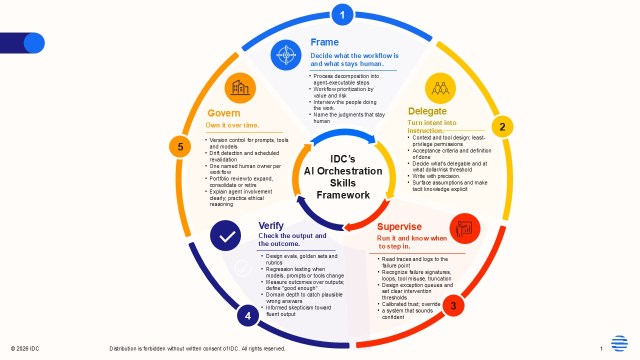
IDC’s AI Orchestration Skills Framework splits the human work into five limbs:

  • Frame: decide what the workflow is and what stays human
  • Delegate: turn intent into instruction
  • Supervise: run the workflow and know when to step in
  • Verify: check the output and the outcome
  • Govern: own the workflow over time

Each limb draws on four kinds of skills: technical, business, leadership and human. The mix shifts around the framework. Technical skills concentrate in Delegate and Verify. Business skills carry Frame. Human and leadership skills support Supervise and Govern. That unevenness is useful. It tells learning leaders which groups need which limb, so they can drop the single course for everyone.

The limbs do not run in sequence, and the framework is no maturity ladder. Every workflow in production passes through all five, which is why employees need a mix of orchestration skills to thrive in the age of AI.

Two layers of workers

The first layer is the specialists. Enterprises are staffing new hybrid roles such as workflow orchestrator, agent operations lead and AI risk monitor. These roles are visible and funded.

The second layer is larger. It includes every employee who now runs agents as part of ordinary work and has no title for it. Nobody handed these people an orchestration role. The work arrived inside the job they already had. They run production workflows with no plan at all. That is how an enterprise ends up with a solid AI training program and a serious oversight problem at the same time.

“

Every enterprise putting agents into production is quietly asking employees to orchestrate. But very few organizations I speak to have explicitly described to employees what orchestration involves. Even fewer tell me they have trained them for it.

— Gina Smith, PhD, Senior Research Director, IDC

Where to start

  • Name one owner for every agentic workflow in production.
  • Do not count prompt engineering as orchestration training.
  • Measure the process before an agent touches it. Without a baseline, any savings claim is unprovable.
  • Get verification working before scaling. Fluent, wrong output is the failure most likely to reach a customer.
  • Make it safe to halt a run. Teams punished for a false alarm go quiet.

The full report breaks each limb into skills, what those skills look like in real work and how to train them. Enterprises will deploy agents whether or not the skills are ready.

Gina Smith, Ph.D. - Senior Research Director, IT Skills for Digital Business - IDC

As a Senior Research Director at IDC, Gina Smith produces research in the IT education and skills sector. Her responsibilities include primary research, analysis, and the production of market insights worldwide. The New York Times bestselling author of Apple cofounder Steve Wozniak’s memoir, iWoz: How I Invented the Personal Computer (2006/2011) and The Genomics Age (2005), a Barron’s Book of the Year, Gina has more than 25 years of working experience in technology journalism, publishing, and tech startup management. She was CEO of Oracle founder Larry Ellison’s network computer startup in 2000, served ABC News as its first on-air technology correspondent, and was editor-in-chief of BYTE magazine.

If your most critical systems went down tomorrow because of a cyber attack, how long would it take to get running again? And when did you last test that?

Michelle Abraham, Research Vice President on IDC’s Security and Trust team, says leadership should know both answers. In a recent conversation, she explains what that takes: cybersecurity fundamentals that rarely make headlines, such as knowing what you own and who owns it, and tracking whether risk is going down.

What cybersecurity fundamentals do organizations still get wrong?

Abraham’s answer starts with what hasn’t changed. “Foundational items like asset visibility and making sure you have the data collected are as important as they always have been,” she says. Knowing what you have comes first. Identity and access controls follow: least privilege, strong authentication such as MFA, credential hygiene, and regular reviews of who has access. Then come the logs and the right detections, plus tested processes for when an incident does pop up.

She notes these topics get less airtime than newer technology, and she doubts that a tool for every threat category makes an organization secure.

Does buying more security tools make an organization safer?

Not on its own. “More tools can just mean more noise,” Abraham says. If a team can’t act on the alerts from the tools it already has, another one adds to the pile. Fragmentation adds complexity, and “complexity can be the enemy of security.” Each tool tends to see only part of the attack surface, so the data has to be connected or attackers will find the gaps between tools.

Abraham ranks backup and recovery systems above most detection tools. Before the next purchase, ask what your team can’t act on today.

How should leaders measure whether security is improving?

If tools don’t show whether security is working, something else has to. Reports that count scans run or issues found measure effort. Counting activity, in her words, “just tells you how busy your security team is, but not whether you are any harder for attackers to breach.” She adds that a count doesn’t say whether critical issues were fixed or how long they sat open.

Her alternative starts with the business: which threats matter most, how much risk the organization will accept, and whether current risk sits within that level. Useful measures include how complete your asset inventory is and how much of it controls like MFA and endpoint protection cover. Third parties belong on the list: she sees organizations attacked through vendor systems, including data warehouse and backup systems. The goal is “looking at the trends more than the counts,” with risk moving down over time.

Why do security fixes stall between teams?

In the handoffs, Abraham says. Discovery tools can count the same asset more than once, so teams need a way to deduplicate. The bigger sticking point is ownership. When a vulnerable asset turns up, the security team usually isn’t the one who fixes it. One person may own the asset and someone else the application running on it. Without a clear record, the issue ping-pongs around and the fix waits. Automated asset tagging helps, along with ownership information that matches across every system.

Prioritization matters here too. A lower-severity issue that is reachable, sits on a critical asset, and is being exploited should move to the front of the queue. A high CVSS score can send a team after an exposure that doesn’t matter in its environment. Even a well-ranked list stalls, though, if the people who own the fix don’t treat it as their job.

How do you get the whole organization to own security?

The people who fix a problem often sit outside the security team, so Abraham recommends making the work easy for them. Give fixing teams a ranked list of validated exposures, with patch information or recommended mitigations attached so nobody starts from scratch. Set deadlines by asset criticality, such as three days for one class of asset and a week or two for another, and define an exception process. “If the remediation process isn’t tracked, oftentimes it doesn’t happen.”

Then make risk visible by department in front of the management team. Organizations have told her this creates enough competition that departments want to look better in the dashboards. She has also heard of it applied to asset tagging: who has the most assets with complete tags.

What one question should every leader ask?

Abraham leaves leaders with one question to ask their security teams:

“

If our most critical systems went down tomorrow due to a cyber attack, how long is it going to be till we’re operating again?

— Michelle Abraham, Research Vice President, Security and Trust, IDC

Compare the answer with how long the business can survive without that system. A mismatch puts decisions in leadership’s hands: a change to process or IT architecture, or more funding.

Abraham also urges testing, and mapping the dependencies between systems. If your identity system is down, you may not be able to bring up the others. Start there: find out what has to be running before anything else can.

Christina Cardoza - Content Marketing Manager - IDC

Christina Cardoza is a Content Marketing Manager at IDC, where she specializes in brand content and social media strategy. With a background in journalism and editorial leadership, she has a proven ability to transform complex technology topics into clear, actionable insights.

AI spending is arriving before the business case. In IDC’s 2026 Worldwide AI Economics and Cost of Ownership Survey, 69% of organizations said there is a significant gap between AI spending and measurable financial outcomes. Only 15% had realized an AI ROI above 100% to date.

That gap is why enterprise AI deals now turn on three proofs: value that holds up with finance, trust on governance and security, and support that reaches beyond IT. Underneath sits a fourth gap, culture and operating model, because agentic AI changes how work gets done and buyers haven’t caught up. IDC’s analysts say vendors who leave any of the four open will see their deals slow down.

Agentic AI changes how work gets done, and buyers are still catching up

The gap underneath the other three shows up in the adoption numbers: IDC research found that 80% of organizations have started deploying agentic AI, yet only 17% use it enterprise-wide. Business teams find it hard to picture a way of working that doesn’t exist yet, and many business leaders can’t tell their IT counterparts how agentic AI will change their function. Buczek said IDC’s surveys and conversations show CEOs seeing agentic AI as a way to transform their business models. For vendors, that means a pitch about the tool lands on a buyer who is still working out the redesign. Olvet’s closing advice was to lead with business transformation.

Prove the value in terms finance will accept

That redesign has a price tag, and cost has moved from a worry to a risk. In an IDC survey from May 2026, 73% of respondents named excessive AI cost a significant risk. Nearly half of organizations can’t prove out AI value, in part because they’re applying digital transformation-era frameworks to agentic AI, which keeps learning and changing. Baselines are hard to set when the operating model itself is being reinvented.

The vendors who get through anchor the pitch in outcomes the customer can measure. Olvet’s test: can your customer report the result on an earnings call? Some large banks already point to net new revenue and product launches that came out of their AI investments. IDC expects infrastructure build-out to catch up with demand around 2029, which should bring costs down. Until then, the guidance is to articulate long-term value.

Governance is a sales issue, not just a compliance one

Go back to the 17% figure. The webinar’s explanation starts with governance: agentic AI is hard to govern, and trust takes time to build. Governance and security also topped the webinar’s opening poll on the gap that slows AI deals the most. Security is often the number one roadblock to implementation and to realizing value, so raise it before the buyer does and make the reduced risk easy to document in the buyer’s own governance platform.

IDC analysts built a five-pillar model for agentic AI governance. It covers areas such as explainability and auditability, and identity and access, including non-human identities. The full set is in the webinar replay. In a special IDC study, 96% of early agentic adopters governed it centrally.

A single IT champion won’t carry the deal

Governance and finance reviews bring more people into the deal. IDC’s September 2026 C-Suite Tech Survey asked who is involved in AI funding decisions. The CIO or CTO still leads at 63%, but C-level business function leaders follow at 62% and CFOs at 61%. In most organizations, business leaders now lead or share agentic AI investment decisions. A chief AI officer is joining the room too: in an IDC CEO survey, 42% of CEOs said they plan to hire one in the next 12 months.

Sellers should build contacts across IT, the business and finance, and use their champion and sponsor to open doors.

What to do next

Buyers have grown wary of AI theatre. Their top frustrations with the AI vendor community, from IDC’s C-Suite Tech Survey, are limited integration with existing systems, lack of model and data transparency, and vendor lock-in concerns (each at 34%), followed by overpromising and underdelivering and unclear pricing models (each at 31%).

Against that backdrop, sell how your product changes the way a team works, and bring a business case a CFO can defend, built on outcomes the customer can measure. Put governance and security on the table early, with a way to document the reduced risk. Plan the deal around a committee that spans IT, the business and finance.

Where does your go-to-market stand?

If these four gaps sound familiar, start with the one that slows your own deals the most. The AI Execution Gap Benchmark lets you grade your go-to-market readiness against all four, using what enterprise buyers are asking right now.

And if you want independent proof behind your AI story, explore IDC Multiplier.

Christina Cardoza - Content Marketing Manager - IDC

Christina Cardoza is a Content Marketing Manager at IDC, where she specializes in brand content and social media strategy. With a background in journalism and editorial leadership, she has a proven ability to transform complex technology topics into clear, actionable insights.

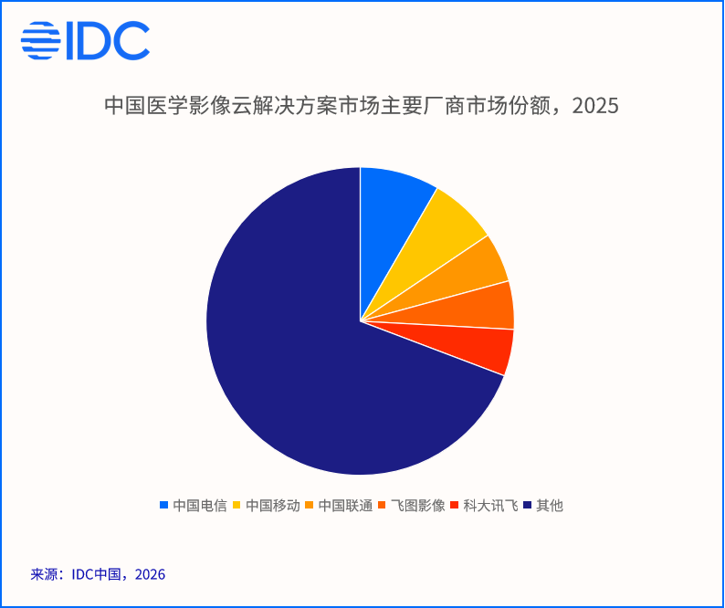
影像云、AI医疗云成为市场的新机会。国际数据公司(IDC)最新研究显示,2025年中国医学影像云解决方案市场规模达到14.5亿元,前五名厂商合计份额为30.8%。与此同时,大模型与智能体技术落地医疗场景,推动医疗云定位发生转变,从传统业务运行底座,逐步升级为 AI 应用的承载底座。两大变化共同驱动医疗云厂商的增长逻辑发生切换,竞争重心由基础设施资源比拼,转向场景落地、AI 能力建设与生态协同。

IDC结合近期发布的《中国医疗IaaS+PaaS市场份额,2025》、《Market Share:中国医学影像云解决方案市场份额,2025》及《IDC MarketScape:中国AI医疗云2026年厂商评估》等研究报告,解答三个问题:影像云市场的现实增长机遇在哪里?AI 医疗云的核心竞争门槛如何界定?不同类型厂商应当如何调整自身竞争策略。

影像云市场短期将迎来快速增长,平台及应用层是厂商是关键切入点

医保影像云索引、云胶片、跨区域影像调阅等政策持续落地,影像云正在从医院内部辅助工具,升级为区域医疗互联互通的核心基础设施。市场需求也从单纯存储备份,延伸至云 PACS、远程协同诊断、影像质控、AI 辅助诊断等多元应用。

IDC 数据显示,2025 年国内医学影像云解决方案市场规模为 14.5 亿元,市场规模有限。然而,伴随医保影像云项目陆续投入运营,未来 1-3 年行业将进入高速扩张阶段。长期来看,影像云的建设重点将转向数据价值挖掘,AI 辅助诊断、智能报告生成、全流程影像质控,会成为市场第二增长曲线。

影像云解决方案市场前五名厂商合计市场份额为30.8%,市场呈现出“底层集中、应用分散”的竞争特征。三大运营商依托网络、数据中心和政企合作资源,在底层基础设施中占据重要位置,新厂商很难在这一细分市场实现突破;而平台与应用层格局未定,各类厂商仍可凭借专业产品、医疗行业理解和本地服务能力进入市场,并建立差异化优势,从而取得更高份额。

AI医疗云需求增长在即,AI技术适配与行业属性成为核心竞争力

医疗业务持续迭代,叠加大模型、智能体技术普及,医院对医疗云平台提出新的要求。AI 应用不再局限单点辅助工具,逐步进化为可以调用业务系统、处理复杂业务任务的智能体,医院对于异构算力、模型推理、数据治理、智能体运行环境的需求持续提升。医疗云也将从传统业务系统的运行底座,逐步演进为AI应用和智能体的运行底座。

现阶段不同等级医院数字化基础、预算投入、数据治理能力差距明显,多数 AI 应用仍处于试点局部落地阶段,整体新增算力需求还未完全释放。但随着医疗智能体应用数量与覆盖场景扩张,云上运行 Agent 会成为医疗云重要增量来源。

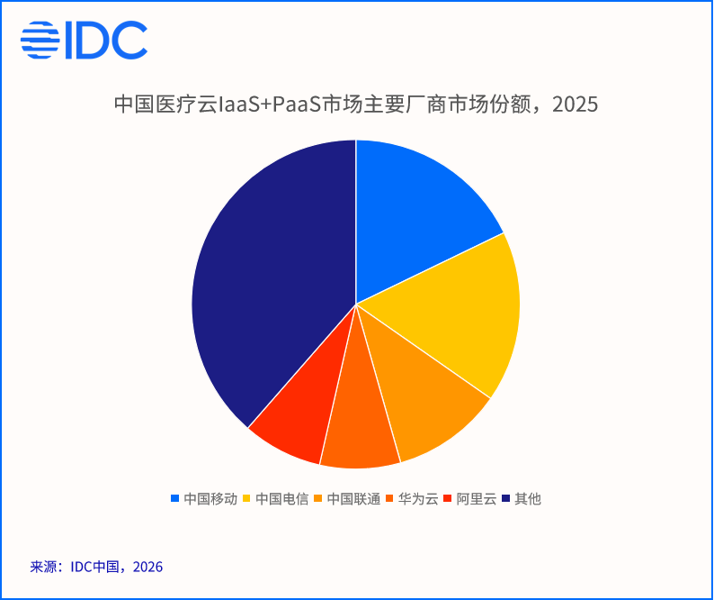
基于市场需求的变化,医疗云厂商的解决方案不再局限于服务器、存储和云资源价格,而应该逐步转向AI算力能力、数据平台、AI模型及智能体平台能力,以及医疗业务适配能力和医疗专业技术服务能力的综合能力建设。基于这一趋势,IDC发布了《中国医疗IaaS+PaaS市场份额,2025》,并推出《IDC MarketScape:中国AI医疗云2026年厂商评估》,从市场份额和厂商能力两个层面观察行业发展。

从市场格局来看,中国移动、中国电信、中国联通凭借云网融合和政企渠道优势快速崛起,占据了市场领先梯队。同时,中国移动、中国电信、中国联通、浪潮集团能够将基础设施优势转化为面向医疗AI的综合服务能力,同时深耕医疗行业,适配医院业务和法规的需求,并提供持续稳定的运营服务,从而在厂商评估中位于领导者类别。

短期内,厂商应立足自身禀赋,以合作共赢抢占横、纵向市场机会

行业竞争从底层基础设施的比拼,转向应用场景与生态层面的综合较量。各类厂商应该根据自身禀赋动态调整自身策略:

首先,横向拓展影像云等业务场景。 对具备云基础设施、网络资源和区域交付能力的云技术厂商,应关注医保影像云、县域医共体和区域医疗协同等业务机会,并通过平台运营和生态合作拓展服务范围;对具备医疗软件及专业影像产品积累的厂商,则应加强跨机构协同、数据利用和AI应用能力,提升专业产品的持续服务价值。

其次,纵向在业务中融合AI能力。云厂商需要加强异构算力、模型服务、数据处理和智能体运行环境的协同,但不应仅以算力规模或模型部署能力作为产品竞争力的衡量标准。医疗业务的高度专业性,医疗AI技术厂商可与云厂商形成互补,将自身在临床知识、影像分析、病历理解等领域的积累转化为可复用的AI服务能力,从而更好适配用户对于一体化解决方案的需求,提升整体交付效率与长期运营价值。

最后,开放生态补齐能力短板。 医疗云建设涉及基础设施、医疗软件和AI应用等多个环节,单一厂商难以覆盖全部能力。云厂商需要明确自研与合作的边界,与医疗信息化厂商、设备厂商及专业AI企业建立协同机制,综合开发解决方案,将本土化、安全、稳定性和持续运维纳入整体方案设计,逐步形成可复制、可持续的医疗云技术和服务能力。

IDC分析师林红认为,医疗云市场正在经历一次结构性切换:过去十年厂商比拼的是资源覆盖和交付能力,未来三到五年比拼的将是场景理解与AI落地能力。影像云是政策驱动下确定性最强的短期机会,但真正的长期壁垒在于能否把AI能力嵌入临床业务流,形成可持续运营的服务模式。对厂商而言,基础设施优势只是入场券,能否与医疗信息化厂商、AI企业形成互补生态,将决定其在新一轮竞争中的位置。市场格局远未定型,现在正是布局窗口期。

IDC相关研究报告:

本文核心观点来源于 IDC 报告《Market Share:中国医学影像云解决方案市场份额,2025》(Doc# CHC52955525,2026年9月)、《中国医疗IaaS+PaaS市场份额,2025》,(Doc# CHC54685326,2026年9月)、《IDC MarketScape:中国AI医疗云2026年厂商评估》(Doc# CHC54110126,2026年9月)

进一步交流

医疗云市场正处于关键转折期,影像云与AI医疗云的机会窗口正在打开。如果您的企业希望深入了解市场格局、厂商竞争态势,或需要针对自身业务进行定制化研究,欢迎与IDC中国医疗行业团队联系。我们期待与您进一步交流。请点击此处与我们联系。

Erin Lin

Erin Lin - Senior Market Analyst

Erin Lin serves as a senior market analyst of the IDC China Health Insights group. She is responsible for conducting research and analysis about the health industry for both domestic and regional markets. She is also involved in consulting and…