Artificial intelligence (AI) is flooding the world with information, raising expectations for instant answers, and reshaping how decisions are made. But faster answers don’t always mean better ones.

At IDC, we’ve been listening closely to what our customers are telling us in this moment. You want speed, but not at the expense of trust. You want tools that make it easier to access IDC intelligence, but without losing the rigor, depth, and human judgment behind it. You want insights you can act on, not just more materials to sift through.

Information is everywhere — but intelligence you can trust is not. Your choices have been a tradeoff between speed and credibility. Our goal is to change that.

The next chapter of trusted intelligence

For more than 60 years, IDC has set the standard for how the world measures, forecasts, and understands technology markets. Our intelligence spans more than 11.5 billion proprietary data points and over 115,000 pieces of published research across more than 500 technology domains and 110 countries. That depth of expertise is why leading global businesses turn to IDC to help them make confident decisions that move their organizations forward.

Now, we’re building on that foundation to unleash the true power of trusted technology intelligence in the AI era.

Our three-part AI ecosystem

Our vision is clear: combine the speed of AI with the depth and credibility of IDC intelligence.

And we’re approaching it with one principle at the center: you, our customers.

It’s a promise that demands action, not just intent. For IDC, it has meant a year-long effort to simplify how we work, rethink the products we create, and formulate a new approach for how we deliver. And it’s what makes our approach to AI innovation unique.

Rather than simply bolting generative AI tools onto existing platforms, we are going beyond the “AI as UX” approach and re-engineering our foundation to meet you where you work, on your terms, without compromising IDC’s time-tested rigor or quality.

Our new intelligence ecosystem includes three connected components:

1. AI Intelligence Platform: 
IDC’s new AI intelligence platform will make our proprietary data, research, and analyst insight conversational, contextual, and workflow-ready so you can move from question to decision faster and with more confidence than ever before.  

2. Direct Access via APIs: 
You’ve told us you want easier, more integrated access to IDC data and research. We’re making that possible through enhanced APIs and AI usage rights, so you can securely and responsibly integrate our intelligence directly into your organization’s advanced analytics, AI tools, and related workflows – expanding access to more users across your business.

3. Strategic Partnerships: 
We’re also expanding how and where you can access IDC intelligence by partnering with leading enterprise platforms to embed IDC insights directly into the applications and tools where business decisions happen every day. 
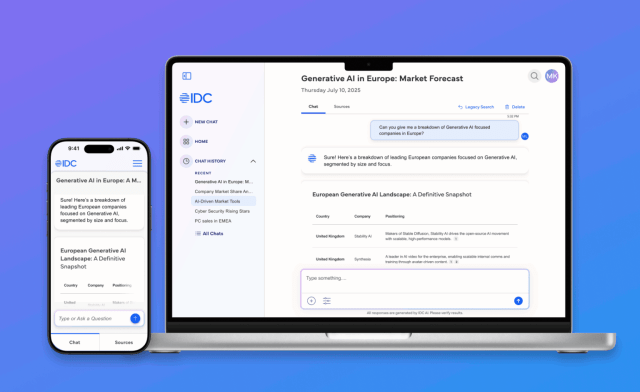
Together, these elements form an open ecosystem that makes IDC intelligence faster to access, easier to integrate, and simpler to apply. It shifts the long-standing industry dynamic from requiring you to come to us for insights, to bringing essential intelligence to you, exactly when and where you need it.

AI-fueled, human-driven

IDC’s approach to innovation is deliberate: AI-fueled but human-driven.

Our analysts see what AI can’t yet: the signals through the noise, the implications behind the data, and the “why” that turns information into strategy. Every AI capability we build is designed to amplify that human advantage and backed by years of unbiased, evidence-backed expertise from analysts who deeply understand the business of technology. The result? Answers that not only fuel faster decisions, but better ones.

We’re also using AI to strengthen how our own teams work by standardizing research processes, automating routine tasks, and freeing our experts to focus where it matters most: with you, turning intelligence into action.

This is how we’re empowering better outcomes: accelerating insight and broadening access without compromising quality, and helping every customer stay ahead of change with intelligence they can trust.

What’s ahead

We’re grateful for the feedback from our customers, the curiosity of the broader tech community, and the ingenuity of our IDC teams, which have helped bring this vision to life.

In the months ahead, we’ll share more about our expanded API capabilities and new partnerships, and the upcoming launch of IDC’s AI intelligence platform.

Watch this space for more in Q1 of 2026 — the next chapter of trusted tech intelligence is just beginning.

Genevieve Juillard - Chief Executive Officer - IDC

Genevieve Juillard is the Chief Executive Officer of IDC, responsible for leading the company’s global strategy, operations, and growth. A proven operator with nearly two decades of experience, she is known for building high-performing teams and driving transformational change across complex, data-driven businesses.

B2B engagement is at a turning point, and buyer expectations are accelerating faster than most organizations can adapt. Static campaigns, siloed systems, and disconnected handoffs no longer match the ways customers want to interact with brands.

This urgency is reflected in the market. By 2027, IDC projects companies will spend $150 billion on AI-related infrastructure, platforms, and services to compete on delivering highly personalized customer experiences.

For CMOs, this level of investment underscores a simple reality: engagement has become a decisive factor in growth, loyalty, and competitive differentiation.

To succeed in the new B2B landscape, leaders must understand:

  • How buyer expectations have shifted
  • The principles that guide effective marketing teams
  • The new AI-driven rules of engagement
  • What it looks like to put those rules into practice.

Three shifts in buyer expectations

Today’s B2B buyers are digitally fluent, AI-assisted, and more self-directed than ever. They research, compare vendors, and evaluate solutions on their own terms, often without speaking to sales until late in the process. Marketing must now own the entire journey, not just the top of the funnel.

Three shifts define this new reality.

  1. Customers expect personalization powered by real-time data to make every interaction relevant. Nearly 70% of buyers say personalization influences whether they engage with content.
  2. Buyers are relying on AI-driven tools and insights to shape decisions, with 77% of B2B buyers depending more on AI tools than traditional search engines.
  3. Trust, transparency, and agility determine brand credibility. Brands risk losing over 79% of customer loyalty by 2026 if they fail to implement digital trust practices for AI transparency and ethical data handling.

These shifts have redefined the baseline for engagement. Omnichannel orchestration isn’t just about connecting campaigns, it’s about creating journeys that grow with the buyer, foster trust, and make every interaction feel relevant.

Core principles to guide marketing teams

To meet these expectations, CMOs are embracing three guiding principles:

  • Buyer intelligence requires building a full picture of the customer journey by integrating intent signals across content, events, demos, pricing activity, and social interactions. With deep insight into the buyer experience, teams can deliver omnichannel engagement that adapts in real time instead of relying on static campaigns.
  • Intentional transitions ensure consistency across touchpoints. Consider a buyer who attends a webinar: in a standard scenario, they receive generic emails that ignore the details of the session. A strong, omnichannel approach references the session topic, offers related resources, and provides sales with context for the next conversation.
  • Cross-functional alignment creates a unified relationship with the buyer. Marketing and sales must act on the same intelligence. Integrated platforms, shared dashboards, and common definitions of success allow teams to orchestrate experiences that feel coherent across every channel.

By following these principles, marketing leaders can create the foundation for adaptive, buyer-centric engagement that moves the needle from discovery to loyalty.

The new AI-driven rules of engagement

AI isn’t just enabling marketing efficiency, it’s reshaping how buyers experience brands. New rules now define how engagement must be delivered.

  • Dynamic personalization

Static nurture paths no longer resonate with digital-first buyers who expect experiences to adapt instantly to their behavior. Instead of generic follow-ups, leading strategies trigger personalized interactions that build on a potential customer’s last action.

IDC research shows that 80% of buyers say personalized communications make it feel like a brand cares about them, a reminder that personalization isn’t just a tactic, it’s an avenue to build trust. In an omnichannel world, this means tailoring not only what content is delivered, but where and how it appears across touchpoints.

  • Conversational engagement

Modern buyers don’t want to wait for gated PDFs or delayed responses: they expect dialogue in real time. By 2026, 65% of individuals will engage with brands through GenAI, signaling a shift from static content toward dynamic, two-way engagement.

The challenge is scaling these conversations authentically. Successful organizations embed conversational AI into their omnichannel strategy, ensuring digital dialogues seamlessly transition to well-informed live sales interactions when the time is right.

  • Proactive trust and transparency

As AI becomes more integral to both the sales and buying process, buyers need clarity from brands about how AI is used. They want to know when they’re interacting with a computer or a person and how their data is being handled.

IDC research shows only about a quarter of marketing executives currently prioritize enabling trust-based marketing practices. This is a gap, and an opportunity. Brands that lead with transparency and governance will differentiate themselves in a market where credibility pays off in loyalty.

Together, these rules highlight a new reality: AI is no longer behind the scenes. In an omnichannel, buyer-led world, it is the front line of customer engagement, shaping perceptions, guiding decisions, and determining loyalty.

Practical examples of modern engagement

Principles and rules matter only when they are translated into action. These examples show how these elements work together in real-life scenarios to create connected, intelligent, omnichannel experiences that resonate with today’s buyers.

  • Turning missed clicks into seamless journeys

A buyer abandons a demo request form. Because transitions are thoughtfully designed, the system triggers a tailored follow-up referencing the product they explored and suggests next steps. Instead of losing the lead, the personalized interaction builds momentum and draws the buyer back in.

  • Powering conversations with insight

A buyer exploring pricing models engages with a GenAI chatbot. The bot responds with context drawn from centralized buyer intelligence (previous site activity, firmographic data, or content downloads) and then routes the conversation to a live expert when needed. This blend ensures the AI-driven dialogue is relevant, accurate, and supports the sales team with the knowledge they need to close the deal.

  • Building trust across the organization

A buyer interacting with AI-generated recommendations accesses the brand’s AI and data protection policies. Because the entire organization operates under consistent governance standards, transparency is embedded in every practice, reinforcing credibility and ensuring every department is in alignment.

These examples show the path to buyer-centric engagement isn’t about isolated touchpoints. It’s about executing the plays that create connected moments – where personalization, communication, and trust work together across the omnichannel journey.

The CMO’s mandate for engagement

For marketing leaders, the imperative is to orchestrate engagement by aligning the principles and rules, grounding every journey in intelligence, designing AI interactions with intention, and aligning teams and buyers around shared trust.

The rules of engagement have shifted, and buyers are moving quickly. Those who adapt now will define what success looks like in B2B marketing, building buyer journeys that not only meet expectations but set new ones.

Discover IDC’s Omnichannel Experience Playbook and learn how to align your marketing organization with the new rules of engagement and future-proof your GTM strategy. You’ll find game-changing plays and an accompanying AI Supplemental Guide to operationalize intelligence, build trust, and build winning customer experiences.

Artificial intelligence is already reshaping how work gets done, but not in the way most people imagine. The popular narrative of AI as a “co-worker” oversells its role and misunderstands its limits. AI systems are not peers; they are instruments: programmable, bounded, and entirely dependent on human judgment. Their impact will come not from collaboration, but from how effectively organizations learn to design, deploy, and govern them.

In IDC’s FutureScape Future of Work 2026 research, we see this transformation unfolding unevenly but decisively.

The success of AI at work will depend less on technical power and more on the human systems built around it, including the processes, accountability, and oversight that turn automation into advantage.

Tools for all: From developers to line-of-business teams

The notion that AI is joining the workforce as a co-worker misreads its function. AI systems are tools used by both deeply technical developers and employees across business functions. IDC forecasts that by 2026, 40% of G2000 job roles will involve direct interaction with AI systems.

For developers, this means designing, securing, and maintaining the architectures that make AI dependable and compliant. Their work defines the system’s boundaries. For business users, AI will become part of daily operations; refining analysis, monitoring performance, and automating repeatable steps. The distinction is not about hierarchy but about fluency: the ability to use AI effectively without mistaking its capabilities for comprehension.

AI agents can recognize patterns within data and past interactions, but they lack awareness of intent, nuance, or institutional goals. They do not understand the broader organizational context in which decisions are made or the values that guide them. Their reliability depends on the quality of input and the competence of the person providing it.

The practical challenge ahead is building fluency across these roles. Developers must ensure systems perform as intended, while managers and employees must learn to apply them responsibly. The future of work will depend on dual skill sets: technical mastery and the human capacity for context, critical thinking, and ethical judgment.

As these technologies become embedded in daily operations, the question is no longer who uses AI, but how its presence changes the shape and distribution of work itself.

Redefining work and work roles

Agentic AI is reshaping the workforce through both elimination and creation. Some roles are being reduced or retired as AI systems take on repetitive functions that can be performed more efficiently and at lower cost. At the same time, new roles are emerging to oversee AI operations, manage governance and compliance, and translate technical performance into business outcomes.

These jobs will not replace those lost on a one-to-one basis. Instead, they redefine where expertise and decision-making authority reside. As tasks once distributed across many functions consolidate into automated systems, organizations must confront how to rebalance reporting structures, reassign responsibilities, and revise expectations.

This transition requires more than reskilling; it demands structural redesign. Organizations must let go of long-held roles that no longer add distinct value while supporting employees in taking on new responsibilities within evolving positions. Those that handle the shift effectively will go beyond adding job titles or automation layers. They will create clearer accountability and stronger alignment between human oversight and machine efficiency.

These shifts in responsibility and reporting require an organizing mechanism. One that ensures both governance and innovation evolve together.

Building structure: Centers of Excellence as engines of transition and trust

As organizations adapt to these changes, structure becomes the mechanism that determines whether transformation succeeds or stalls. The emergence of AI and Agentic Centers of Excellence (CoEs) marks a deliberate move from experimentation toward an integrated model for governance, innovation, and value creation.

First, CoEs help organizations make the transition from traditional automation to new ways of working. Rather than viewing AI as a replacement for existing tools, CoEs define how it should extend enterprise capability. They guide the redesign of processes, clarify which roles will evolve or disappear, and establish the standards that ensure AI is deployed responsibly and with purpose.

Second, CoEs serve as hubs for systemic, cross-functional governance. They bring together data, risk, technology, and human resources leaders to define how AI is used, monitored, and improved across the organization. This alignment prevents fragmented implementation and enforces accountability for outcomes, ensuring that AI decisions are traceable, ethical, and compliant.

Finally, CoEs sustain focus on innovation and long-term value. Internally, they drive a culture of continuous improvement through shared learning and benchmarking. Externally, they ensure AI investments translate into measurable client outcomes; improved service quality, faster delivery, and more adaptive customer engagement.

IDC’s Future of Work 2026 research shows that organizations with mature AI or Agentic CoEs are 20% more capable of competing on innovation, speed, and service excellence. These centers are not symbolic. They are the connective tissue linking technology capability to human expertise, operational discipline, and customer trust.

Redesigning work for a new conversation

The integration of agentic AI is not simply a technical evolution. It is an organizational negotiation.

C-suite leaders often approach AI with a “more, faster” mindset; a drive for scale, speed, and measurable productivity. Employees across functions experience the same transformation from a different vantage point: one that involves redefining responsibilities, acquiring new skills, and navigating the uncertainty of work that no longer looks or feels the same.

Bridging these perspectives will determine whether agentic AI delivers on its potential. The future of work depends on an ongoing dialogue between those who set direction and those who carry it out. It requires leadership that sees AI not only as an efficient tool but as a catalyst for redesigning how work is structured, supported, and rewarded.

The successful adoption of agentic AI will depend on a deliberate partnership between leadership and the workforce; a recognition that innovation and adaptation must advance together.

 The future of work will not be defined by speed alone, but by how organizations align ambition with understanding, progress with purpose, and productivity with shared accountability.

Access the full IDC Future of Work 2026 report to explore all predictions, and visit our FutureScape content hub for additional insights and resources.

Amy Loomis, Ph.D. - GVP, Research - IDC

Amy Loomis is Group Vice President for IDC's worldwide Workplace Solutions. Amy leads a team of analysts focused on the evolving nature of human resources, skills development, collaboration, and leadership across the employee lifecycle. Her research into the Future of Work explores the influence of hardware and software technologies such as artificial intelligence, data analytics, augmented and virtual reality and automation on the changing the nature of work. Her research also explores how technology and business strategy influence workers' skills and behaviors, organizational culture and how the workplace itself is enabling the future enterprise.

B2B buyers have rewritten the rules of engagement. They research independently, shift effortlessly between digital and in-person touchpoints, and expect every interaction to feel connected. The customer journey is no longer linear. It’s fluid, self-directed, and omnichannel.

Seventy four percent of buyers now prefer digital-first engagement, according to IDC’s2024 B2B Tech Buyer Behavior Survey. That preference means marketing leaders must coordinate across more channels than ever before, from brand websites and social media to in-person events and sales meetings.

The challenge? Many strategies look good on paper but break down in execution. Campaigns run in parallel instead of in sync. Content lands out of step with intent. Team handoffs create gaps buyers can’t ignore.

The result: fractured engagement, wasted resources, and pipeline momentum that stalls before deals have a chance to progress.

Omnichannel excellence isn’t about doing more. It’s about orchestrating journeys that connect signals, smooth transitions, and move buyers forward with purpose. 

The most common omnichannel mistakes and how to fix them

Recognizing the pitfalls is the first step. Knowing how to counter them is what turns a disconnected approach into a system that drives real growth.

Mistake 1: Treating channels as silos instead of orchestrated journeys.

Too many organizations still manage channels in isolation. The website belongs to digital. Events sit with operations. Sales owns in-person conversations. Each team runs its own playbook. This leaves buyers to experience the brand in fragments.

Smart marketing leaders know that buyers disengage when the journey feels disjointed. In fact, more than a third of CMOs say creating a unified omnichannel journey will shape their strategy in the next 12-18 months, according to IDC’s 2024 Worldwide CMO Priorities Study.

The fix is orchestration: designing intentional transitions, linking intelligence with context, and enabling sales to activate in real time. When teams rally around the buyer—not their silos—the journey flows. And everyone wins.

Mistake 2: Over-automating without personalization.

Automation has scaled marketing, but when applied without personalization it can backfire. Too many flows and triggers run on autopilot, delivering impersonal and repetitive outreach that feels robotic.

And buyers notice. Personalized interactions consistently generic touchpoints by 30%, according to IDC’s FutureScape: Worldwide Chief Marketing Officer 2025 Predictions.

The solution isn’t to ditch automation. It’s to evolve it.

AI-powered personalization and adaptive content turn automation into a precision tool, ensuring every message is timely, relevant, and buyer-specific.

Mistake 3: Keeping marketing intelligence separate from sales.

Marketing often collects rich intent data, but sales either can’t see it, or lacks the context to act on it. Sales Development Representatives chase leads without intel. Meanwhile, buyers continue down self-directed paths.

The disconnect is expensive. Nearly 80% of buyers say they plan to use more digital sources for complex buying decisions and rely less on salespeople, according to the 2024 B2B Tech Buyer Behavior Survey. Which means every sales interaction matters even more.  

The fix is signal-based activation: turning every meaningful action, like demo requests or  pricing page visits, into a clear and contextual sales play. With insights from marketing, sales can move faster, build trust, and drive real progress.

Mistake 4: Sticking to static content sequences.

Many nurture programs still rely on rigid sequences: download an asset, get added to a drip. Attend an event, receive a standard follow-up. But buyers don’t move in neat, linear paths anymore.

Without integration and real-time intelligence, signals are missed. Someone ready to buy gets slowed down. Someone just starting out gets overwhelmed. Both disengage.

Why? Systems often don’t talk to each other.

When data flows freely and AI interprets signals in real time, content evolves with the buyer. The result? Dynamic flows that respond to behavior, reduce drop-off, and keep engagement moving forward.

From friction to flow

Each of these mistakes creates friction. Together, they derail growth.

  • Disjointed channels frustrate prospects
  • Over-automation without personalization erodes trust
  • Sales teams miss the signals that matter
  • Static content fails to keep up with today’s buyers

Fixing them takes more than ad hoc patches. It takes a disciplined approach—built on buyer intelligence, intentional transitions, and AI-driven alignment.

  • Orchestrate the journey to create flow
  • Personalize at scale to build relevance
  • Align with AI to unify teams and accelerate growth

Buyers expect more. With orchestration and AI in your toolbox, you can deliver the seamless omnichannel excellence they demand and turn every interaction into a moment that matters.