Global shipments of XR headsets and glasses rose 35.3% year over year in the second quarter of 2026, strong growth but a significant moderation from the 130.2% increase IDC tracked in the prior quarter. Much of that slowdown reflects tougher comparisons and a pause between major product cycles rather than any softening in consumer interest. Growth should pick back up as the next wave of product launches arrives later this year.

Audio glasses, the display-less category that includes devices like Ray-Ban Meta, represented the largest portion of shipments, capturing 70.3% share during the quarter, up from 61.9% a year ago. Display glasses represented 14.3% share, up from 11% a year ago, while headsets held the remaining 15.4%. Glasses overall have turned a corner and are quickly being recognized by a mainstream audience. Recent privacy backlash over always-on recording shows not all of that attention is flattering.

Who’s winning right now: Q2 2026 market share

Meta continued to dominate the market with 68.7% share. Its growth this quarter came from pushing into two additional segments: prescription eyewear, with the launch of its Blayzer and Scriber Optics lines, and lower-cost options that skip the fashion branding EssilorLuxottica normally provides. That expansion is only part of the story. Meta’s lead also rests on distribution scale, brand recognition, and AI features built across its product line, advantages that are harder for challengers to replicate than any single hardware launch.

CompanyQ2 2026 Market Share
Meta68.7%
RayNeo3.6%
Alibaba Group2.6%
XREAL2.5%
Xiaomi2.3%
Others20.4%

RayNeo ranked second with 3.6% share, up 83.3% year over year, on the strength of its low-cost, personal-theater-style devices. Alibaba, a relative newcomer to the category, ranked third at 2.6% share thanks to the popularity of Qwen and the company’s already-established presence in China. XREAL and Xiaomi rounded out the top five, though Xiaomi’s share nearly halved from a year ago as competition in its home market intensified.

What’s coming next: The launches that could reshuffle the board

A lot is going to change in the remaining months of 2026 as next-gen products arrive from multiple vendors, each chasing a similar set of goals: more capable AI experiences, lighter hardware, and use cases that go beyond entertainment into everyday productivity. Those shared priorities, more than any single launch, will shape competition through the rest of the year.

Snap is launching its Specs, which bring genuine AR capabilities packaged into the most consumer-friendly design the category has seen yet, backed by a marketing campaign built around fashion icons.

Samsung and XREAL are both readying Android XR products. XREAL’s Aura pairs the company’s personal-theater-style hardware, already strong for content consumption, with Google’s Android XR platform, putting productivity use cases on equal footing with entertainment. Samsung’s audio glasses, meanwhile, bring Google’s Gemini assistant together with the distribution and design sensibility of Gentle Monster and Warby Parker.

Meta’s upcoming Connect event is widely expected to launch a more premium mixed reality headset with better visuals and a slimmer, lighter form factor that should appeal to enthusiasts. IDC also anticipates new display and audio glasses at the show, with the display glasses aimed at broader availability and a more accessible price point.

Beyond these headline launches, products from Pico, RayNeo, Viture, and a growing list of other brands will help drive further growth in 2026 and into the years ahead.

The road ahead: Forecast 2026–2028

IDC forecasts total unit shipments will grow 26.3% in 2026, then accelerate to 40.5% growth in 2027 and another 26.4% in 2028. Audio glasses will keep leading the category, though display glasses and headsets will continue to ramp alongside them.

For consumers, that growth will be driven by a wider range of products, price points, and channels, plus the spread of AI and friction-reducing use cases like easy photo and video capture. Among businesses, training and design use cases will keep driving adoption, since IDC has tracked ROI gains in early enterprise pilots, and more businesses continue to start them.

Growing pains: Privacy and business-model tension

There are also growing concerns behind the scenes that need to be addressed, as they stand to reshape the adoption curve going forward.

Privacy and shifting consumer attitudes. Many products and services surrounding XR glasses have clear, tangible benefits, though IDC has tracked growing concern over the need for privacy controls. IDC has also observed a shift from early jokes about social acceptance to more serious concerns about the lack of meaningful notice and consent mechanisms while recording, along with AI-enabled data collection, raising the stakes for how vendors respond. Meta, the current leader, has taken action to reduce misuse of its products, but those steps came only after public backlash forced its hand. That leaves room for a competitor willing to build privacy safeguards in before launch, not after a headline forces the issue.

Competing business models. XR glasses are a relatively new category, and tech companies are quickly partnering with fashion companies to leverage their expertise in design, manufacturing, and distribution. There’s tension between these camps, though, as fashion companies often operate on higher margins while tech companies are willing to sacrifice margin in favor of ongoing subscription or advertising-based models, where the hardware can be offered at a lower upfront cost to keep the consumer inside the ecosystem. This is likely one reason Meta launched glasses without EssilorLuxottica’s branding. It also puts smaller players at a disadvantage, since they face pricing pressure on hardware from incumbents like Meta and potentially Google and Samsung, and will likely have to adjust their own business models to offer subscription services alongside their XR products going forward.

What this means for the industry

Smart glasses are genuinely being worn now, not just tested, and that changes the competitive picture. Meta still holds the lead, but the next round of launches from Snap, Samsung, XREAL, and Meta’s own Connect event will show whether that lead holds up. The rest of 2026 will be shaped as much by these launches as by the numbers themselves. Even with this quarter’s slower growth, consumer awareness keeps building and AI is unlocking new use cases — the vendors that move first on privacy may be the ones who convert that awareness into share.


Jitesh Ubrani

Jitesh Ubrani - Director, Consumer Devices Research

Jitesh Ubrani is a Director at IDC leading a team of analysts within the Worldwide Consumer Device Trackers group, covering wearables, augmented reality (AR), virtual reality (VR), tablets, phones, PCs, gaming, and smart home devices, with a focus on market…

AI PCs have been on the market for a couple of years now, with applications and use cases progressively finding ways to put local AI models to work. China’s version of that story looks different from the rest of the world’s. Since earlier this year, interest in OpenClaw-like AI agent harnesses has driven a wave of ultrasmall desktop PCs there, and unlike the high-end, DGX Spark-class boxes getting attention elsewhere, most of these are inexpensive, modestly specced machines built to host an agent rather than run a large model locally.

Where the lobster talk comes from

All of this traces back to a single piece of open-source software called OpenClaw, an autonomous AI agent that can be given a task in plain language and left to carry it out on its own, browsing the web, editing files, and calling other tools as needed. Its logo features a lobster-like claw, and Chinese users picked up on that and started calling the software 小龙虾, or crayfish, a nickname that stuck to everything that followed, including the hardware people bought to run it. Naming for that hardware hasn’t really settled, but some call it 龙虾盒子, so we’re calling them lobster boxes here for simplicity.

OpenClaw’s rise from around February through April 2026 drove a hardware surge, and it was global rather than a China-only phenomenon. Mac mini sold out in multiple markets because the software simply worked better on macOS, with tighter access to the operating system’s own apps and a quiet, low-power, always-on form factor well suited to running an agent around the clock. What was distinctive about China is how quickly it moved past that Mac dependency. Chinese startups and retailers began shipping their own inexpensive, purpose-built boxes within weeks, and those boxes worked despite modest specifications because they were calling cheap, cloud-hosted AI services rather than running a model locally, so most of them never needed the expensive memory that on-device inference requires.

Tencent and Baidu both ran free installation clinics at their headquarters in Shenzhen and Beijing, drawing crowds in the hundreds as company engineers set up the software machine by machine for anyone who showed up.

Tokens that are cheap

Part of why this took off in China specifically comes down to what it costs to keep an agent thinking. Western AI subscriptions have generally settled around $20 a month for services like ChatGPT Plus or Claude Pro. Chinese equivalents often run under $10 a month, and a large share of casual use runs through free consumer apps entirely, with paid tiers unlocking higher concurrency rather than gating basic access. There are some indications that pricing could increase soon, but this new class of hardware emerged without needing much memory in the first place, precisely because cloud-based models were affordable enough to lean on.

The rise of the OPC

Chinese researchers and businesses have started using a formal term, OPC, short for one-person company, to describe a business built around a single person making the decisions while a cluster of AI agents handles the execution and the day-to-day output. It is a notable enough trend that Lenovo’s own marketing for its lower-cost Baiying-branded AI PC, a roughly $560 Windows box, describes the product as built for OPC operators, sometimes called super-individuals, with use cases like AI content creation, e-commerce operations, and market analysis.

There is also a cultural aspect to consider. Much of the anxiety Chinese workers have felt about AI replacing their jobs pushed people toward learning to run the tool themselves, which helps explain why installation clinics and DIY tutorials found such a ready audience. That desire to learn the tool fits naturally with the OPC idea, since China already has a way to turn it into a business.

Where the growth is headed

Most of these agent-hosting devices are what IDC classifies as ultrasmall desktops, which we expect to top one million units in China in 2026 and grow to roughly 1.8 million by 2027. That is a small slice of China’s overall PC market, which IDC expects to total around 51 million units in 2026, so this remains a niche category. Lenovo has been the most visible vendor building for this category specifically, with its lower-cost Baiying and Tianxi-branded AI hosts, and Xiaomi joined in August with its own prototype, the AI Cube, built around three of its own chips. Many of the units behind that growth today are still the cheap, low-end boxes that lean on cloud AI rather than local processing, but interest in local token generation is picking up, and that points to some shift toward pricier, more capable hardware.

Likely to stay a China story

These low-end boxes look likely to stay a China phenomenon, since the conditions behind them are not really present in the same combination elsewhere. The rest of the world is increasingly exploring NVIDIA’s DGX/RTX Spark, AMD’s Ryzen AI Halo-based systems, and Microsoft’s Project Zenith, announced together with AMD at IFA earlier this month, which are all aimed at running large models locally. These are on the other end of the price spectrum but are based on the premise that generating tokens locally will be more economically effective than paying for cloud-based tokens.

Bryan Ma

Bryan Ma - Vice President, Client Devices

Bryan Ma is Vice President of Client Devices research, covering mobile phones, tablets, PCs, AR/VR headsets, wearables, thin clients, and monitors across Asia as well as worldwide. Based in Singapore, Bryan provides insights and advisory services for both vendors and…

In the second quarter of 2026 (2Q26), the worldwide Ethernet switch market reached $18.9B, growing 43.4% year over year (YoY), according to IDC’s Quarterly Ethernet Switch Tracker. The datacenter segment (covering high-speed switching infrastructure in hyperscale, service provider, and enterprise datacenters) grew 64.5% YoY to $12.3B, driven by continued build-out of AI training and inferencing infrastructure.

800GbE ports accounted for 41.2% of datacenter revenues, reflecting the relentless push toward higher speeds to meet AI cluster bandwidth demands. The non-datacenter (campus and branch) segment grew 15.7% YoY to $6.6B, supported by enterprise hardware refresh activity and higher component pricing.

The worldwide Router market reached $4.5B in 2Q26, growing 22.8% year over year, according to IDC’s Quarterly Router Tracker. Both the service provider and enterprise segments posted double-digit growth, with the Americas leading the growth across all regions.

Ethernet switch market highlights

Datacenter segment: The datacenter portion of the Ethernet switch market grew 64.5% YoY in 2Q26 to reach $12.3B, according to IDC. The AI infrastructure build-out continues to be the primary growth driver, as hyperscalers, cloud providers, and large enterprises expand capacity for generative and agentic AI training and inferencing workloads. High-speed ports dominate spending: 800GbE switches accounted for 41.2% of datacenter segment revenues, while 200G/400G speeds represented 33.6% — together making up nearly 75% of datacenter Ethernet switch spending.

Campus/branch (non-datacenter) segment: Enterprise campus and branch Ethernet switch revenue grew 15.7% YoY in 2Q26 to $6.6B, per IDC. A broad hardware refresh cycle remains the structural driver, as organizations upgrade aging switching infrastructure to support the latest wireless standard, Wi-Fi 7, and AI-capable workloads. AI-powered network management and integrated security, including post-quantum cryptographic capabilities, are other key drivers in this segment. Higher average selling prices, driven by component cost pressures, continue to contribute to revenue growth above underlying unit volumes.

Regional performance: Ethernet Switch revenues grew across all geographies in 2Q26, according to IDC. The Americas led with 50.4% YoY growth to $10.2B, reflecting robust hyperscaler and enterprise AI investment in North America. EMEA grew 36.9% YoY to $4.1B, while Asia Pacific posted 35.3% growth to $4.6B.

Router market highlights: The total Router market reached $4.5B in 2Q26, growing 22.8% year over year, driven by investment in both service provider and enterprise network infrastructure, according to IDC’s Quarterly Router Tracker.

Service provider segment: The service provider segment — including communications service providers and cloud SPs — made up 74.2% of total router market revenues in 2Q26, reaching $3.3B with 23.8% YoY growth. Cloud and telecom infrastructure upgrades, including 5G backhaul expansion and core network modernization, remain the primary growth drivers.

Enterprise segment: The enterprise router market contributed $1.2B in 2Q26, growing 20.1% YoY, reflecting sustained investment in enterprise WAN connectivity, SD-WAN-enabled infrastructure modernization, and the expansion of AI-ready branch and edge network environments.

Regional performance: The Americas router market rose 31.1% YoY in 2Q26 to $1.9B, leading all regions. EMEA grew 20.9% YoY to $1.1B, while Asia Pacific posted 15.2% growth to $1.5B.

Vendor highlights

Cisco: Cisco’s total Ethernet switch revenues grew 36.2% YoY in 2Q26 to $5.4B, maintaining a 28.7% market share and retaining the #1 market share position in the overall Ethernet switch market, per IDC. In the datacenter segment, Cisco generated $2.2B (18.2% share), growing strongly with AI networking demand. Cisco’s total router revenue grew 31.6% YoY to $1.6B, with a 34.7% share of the global router market.

NVIDIA: NVIDIA’s Ethernet switch revenues — entirely from the datacenter segment — surged 181.1% YoY to $2.5B in 2Q26, giving it a 20.4% share of the datacenter Ethernet switch segment, according to IDC. NVIDIA maintained its position as the #1 branded vendor by revenue in datacenter Ethernet switching. The Spectrum-X platform — an end-to-end AI networking solution integrating Spectrum Ethernet switches with BlueField DPUs and NVIDIA LinkX cables, purpose-built for large-scale GPU clusters — continues to win hyperscaler and AI-native cloud provider deployments at scale.

Arista Networks: Arista’s revenues grew 37.6% YoY in 2Q26 to $2.5B, per IDC, with the company holding a 13.4% share of the total Ethernet switch market and 18.7% in the datacenter segment. With approximately 90.9% of revenue from the datacenter segment, Arista continues to maintain a strong position in 400G and 800G deployments among hyperscale and cloud customers.

Huawei: Huawei’s total Ethernet switch revenue grew 28.6% YoY in 2Q26 to $1.5B, with an 8.2% market share, per IDC. Huawei’s Router revenue grew 21.6% YoY in 2Q26 to $1.3B, giving the company a 29.9% share of the global router market — underscoring continued strength in service provider networking, particularly in China and select emerging markets.

HPE: HPE’s total Ethernet switch revenue grew 1.6% YoY in 2Q26, reaching a 6.1% market share, per IDC. HPE revenues include Juniper Networks, following the July 2025 acquisition. The company’s campus and branch portfolio, which represents approximately 70.1% of its Ethernet switch business, continues to benefit from the enterprise hardware refresh cycle. HPE’s router revenues grew 25.3% YoY to $483M in 2Q26, representing a 10.7% market share.

Worldwide Top Ethernet Switch Companies

Market dynamics

AI infrastructure fuels another quarter of record datacenter spending: For the second consecutive quarter, AI infrastructure investment drove Ethernet switch market growth above 40% YoY. Hyperscalers and AI-native cloud providers are accelerating the deployment of GPU-dense AI factories, requiring ultra-low-latency, high-bandwidth switching fabric capable of sustaining the massive east-west traffic flows generated by distributed training workloads. The share of 800G ports in datacenter Ethernet switch revenues rose to 41.2% in 2Q26, up from 35.9% in 1Q26, reflecting a clear and accelerating shift toward next-generation port speeds.

Enterprise refresh and pricing dynamics sustain non-datacenter growth: Non-datacenter Ethernet switch revenue grew 15.7% YoY in 2Q26, sustained by a multi-year enterprise hardware refresh wave and persistent component-price inflation. Organizations are upgrading campus and branch switching infrastructure to support newer wireless standards, AI-capable applications, and modern digital workloads. IDC notes that supply cost pressures — particularly in memory components — continue to inflate revenue growth above underlying unit shipment trends, a dynamic that is expected to persist.

Router market accelerates on SP and enterprise investment: The router market’s 22.8% YoY growth in 2Q26 reflects broad investment across both segments. Service providers are investing in network infrastructure to support 5G expansion, cloud interconnect, and edge deployments. Enterprise demand reflects ongoing WAN modernization, SD-WAN adoption, and the expansion of AI-ready branch and edge environments. The Americas accounted for 41.9% of global router revenues in 2Q26, growing 31.1% YoY — the fastest regional growth rate — driven by strong North American SP and enterprise network investment.

AI cluster buildouts are now the single biggest driver of datacenter network spend, and the rapid move to 800GbE shows hyperscalers optimizing for bandwidth and latency more than ever before. As GPU clusters keep scaling, switching fabric and related networking has become one of the fastest-moving and most critical layers of AI infrastructure investment.

Paul Nicholson, VP, Research, Cloud and Datacenter Networks, IDC

The campus refresh cycle is accelerating as organizations modernize switching infrastructure to support Wi-Fi 7, AI workloads, and higher-speed connectivity. The convergence of networking and security—including post-quantum cryptography and rapid AI-driven threat patching—is reshaping infrastructure requirements and driving sustained upgrade momentum through 2026.

Brandon Butler, Senior Research Manager, Enterprise Networks, IDC

Why it matters

The 2Q26 results confirm that AI infrastructure demand is the defining force in the datacenter networking market, with sustained implications for vendor strategy, technology architecture, and enterprise procurement. The accelerating shift toward 800G and beyond is compressing product cycles and raising the stakes for vendors to maintain technology leadership. Outside the datacenter, enterprise networking teams face a critical decision point: legacy campus and branch infrastructure must be modernized to support AI-capable applications, next-generation wireless, and the increasing data throughput demands of digital operations. For enterprise buyers and IT leaders, the 2Q26 data underscores the urgency of aligning networking refresh cycles with a multi-year AI buildout that is accelerating, not plateauing.

Outlook

IDC expects the Ethernet switch market to continue posting strong year-over-year growth through 2026, driven by ongoing AI infrastructure investment in the datacenter and sustained enterprise refresh demand in the campus and branch segments. The pace of 800G adoption is expected to accelerate further, and early demand signals for 1.6T ports are beginning to emerge as hyperscalers plan next-generation AI cluster architectures. In the router market, service provider investment in 5G core and backhaul infrastructure, combined with enterprise WAN modernization, is expected to sustain double-digit growth. IDC will continue to track these dynamics through its quarterly tracker programs.

Paul Nicholson

Paul Nicholson - Research Vice President, Networking and Infrastructure Services, Enterprise Infrastructure

Paul Nicholson is Research Vice President within IDC’s enterprise infrastructure global research domain and part of the networking infrastructure and services subdomain. He focuses on AI, cloud, and datacenter network infrastructure. His research spans Ethernet and InfiniBand switching, application delivery…
Brandon Butler

Brandon Butler - Senior Research Manager, Networking and Infrastructure Services, Enterprise Infrastructure

Brandon Butler is a Senior Research Manager within IDC’s enterprise infrastructure global research domain and part of the networking infrastructure and services subdomain. His research covers market and technology trends, forecasts, and competitive analysis in enterprise campus, branch, and edge…
Petr Jirovsky

Petr Jirovsky - Senior Research Director, Networking and Infrastructure Services, Enterprise Infrastructure

Petr Jirovsky is a Senior Research Director within IDC’s enterprise infrastructure global research domain and part of the Networking and Infrastructure Services subdomain. He provides quantitative insights on network infrastructure for the datacenter, cloud, and campus/branch environments. He serves as…
Diego Anesini

Diego Anesini - VP Data and Analytics, Networking

Diego Anesini serves as Vice-President, Data & Analytics, Networking. Prior to this position, Diego held various roles in the company. The most recent was VP, Data & Analytics for Latin America. He has extensive experience in the Networking, Telecom and…

It’s all in the name: Real Results. IDC’s annual FinTech Rankings and Real Results program doesn’t hand out recognition for a slide of names. It looks for technology providers that made a measurable difference at real financial institutions, and this year’s winners are now live, marking the 24th year of the Rankings and the 14th year of Real Results.

We sat down with Jerry Silva, Program Vice President at IDC Financial Insights, to talk through what these programs measure, what changed in this year’s submissions, and where the money is moving next.

What is the IDC FinTech Rankings program?

The Rankings started as a straightforward ask from IDC’s institutional clients: banks, capital markets firms, and insurance carriers who wanted a clear picture of the technology landscape serving their industry. “They really wanted from us kind of what the landscape looked like in terms of technology providers,” Silva says

IDC evaluates and categorizes technology providers by prior-year revenue from financial institutions across hardware, software, and services. Two lists come out of that work. The Top 100 covers firms that specialize in financial services: more than a third of their revenue comes from the industry, and they don’t spread across more than two other verticals. The Enterprise Top 50 covers larger, broader technology firms, think Microsoft, IBM, Dell, that generate meaningful financial-services revenue without being narrowly focused on the industry.

What separates the Top 10 from the rest of the list

Making either list depends on revenue. Where a company lands within it depends on something else. Silva points to product and capability range as the real differentiator between the Top 10 and everyone below it. Companies further down tend to specialize in one function, like payments or fraud, while the leaders cover core banking, payments, risk and compliance, customer experience, and data and analytics all at once. “Those companies at the top of the list tend to be incredibly broad,” he says.

How Real Results complement the rankings

Rankings measures size and reach. Real Results measures something else entirely: whether the technology actually worked. The program was Silva’s addition, and it came from a specific frustration. After decades on the institution side of the industry, he’d grown tired of innovation awards that never tied back to a measurable outcome. “I kept seeing all these innovation awards out there that never really focused on what was the benefit,” he says. “It was always about, well, this will enable the client to do X, Y, Z in the future. Well, that doesn’t help me.”

So Real Results asks technology providers to submit case studies: real projects, at a named institution, with a verified metric attached. IDC contacts someone at the institution directly to confirm the numbers. Fourteen years later, the program covers seven categories: infrastructure modernization, omni-experience customer engagement, treasury and trade, payments, capital markets, insurance transformation, and digital trust and stewardship.

The bar is strict. “If a submission doesn’t have those numbers, doesn’t have quantifiable, measurable benefits, I disqualify it,” Silva says. Projections about future value don’t qualify. IDC only considers results that have already happened..

The biggest shift in this year’s case studies: AI, everywhere

That bar produced a clear pattern in this year’s submissions. Historically, no single technology dominated Real Results entries. The closest IDC came to a unifying trend was the cloud migration wave of 2018-2019. That’s changed. For the past two years, AI has driven nearly every entry, and this year’s winners went further than a single AI tool.

“Most of the winners, all except maybe one, used a combination,” Silva says: traditional machine learning, generative AI for content creation, and agentic AI to orchestrate the whole process, often in the same project.

The overall winner illustrates it well. A large bank had a legacy process scattered across multiple systems, and instead of stitching those systems together point to point, the technology provider used machine learning and generative AI to create usable data out of the legacy sources, with AI agents orchestrating the process end to end. The result was fewer errors and lower costs, with a process that used to take days now finishing in hours.

Where financial services technology spending is headed next

That same AI-everywhere pattern shows up in where the market is headed next, though not in the part of the business most people assume. Over the past six to nine months, investment has shifted away from front-office, customer-experience projects and toward the back office: modernizing databases, finance platforms, and HR systems.

Two forces are driving it. Most institutions don’t have their data in a state that’s ready for AI to run against multiple sources at once, so they’re investing to fix that first. And once an AI platform is in place, institutions want a more open, API-driven back office instead of stitching new tools to legacy systems one connection at a time.

The scale of that investment is notable on its own. IDC’s newest forecast puts financial services technology spending, hardware, software, and services combined, at more than a trillion dollars a year globally by 2030, growing around 12% annually. “I think you’ll see a huge shift to the back office until they start solving some of those problems,” Silva says.

Where to see the full 2026 IDC FinTech Rankings winners

The full 2026 IDC FinTech Rankings and Real Results winners are live now. Twenty-four years in, institutional clients still use the list the same way they did at the start: as a shortlist. As Silva puts it, when institutions are evaluating a project, “the list actually helps them narrow down that short list.”

Christina Cardoza - Content Marketing Manager - IDC

Christina Cardoza is a Content Marketing Manager at IDC, where she specializes in brand content and social media strategy. With a background in journalism and editorial leadership, she has a proven ability to transform complex technology topics into clear, actionable insights.

Techtember is upon us, and we’ve already seen new phones and smartwatches launch from multiple brands. I’ve spent the last few weeks trying out Google’s latest and walked away impressed yet measured in my enthusiasm. Google has never really competed on hardware specs. The pitch with Pixel has always been a clean software experience, long update support, and the best version of Google’s own AI. Competitors like Apple and Samsung offer versions of the same thing, but their scale forces a different approach. They’re serving tens of millions of buyers with a wide range of needs, so their software has to work broadly. Google doesn’t have that constraint. Pixel can stay narrow and lean all the way into AI without worrying about covering every use case.

That tradeoff shows up clearly on the latest Pixel smartphones. Consumers don’t get the best speeds and feeds, but what they do get is a well-rounded package that does a handful of things really well. And with hardware innovation maturing on the smartwatch front, Google’s software has to carry even more of the weight to keep users delighted.

What the shipment numbers show

The numbers back this up. Pixel held about 1.1% of global smartphone shipments in Q2 2026, roughly where it’s been for the past year (it ranged between 1.0% and 1.3% over the last five quarters). The Pixel 11 lineup isn’t going to move that. Pixel’s smartwatch business tells a similar story: Google’s watch brand held 0.6% of smartwatch shipments in Q2, down from a holiday-quarter spike of 1.4% in Q4 2025, and it’s been under 1% in four of the last five quarters. Apple and Huawei dominate that market instead, with a combined share of roughly 36% of smartwatch shipments in the latest quarter, and Pixel isn’t close to changing that on either device heading into a rougher stretch for both markets.

IDC’s forecast has both smartphone and smartwatch shipments declining, driven by rising component costs and tighter availability, memory in particular. This is where Google’s scale matters: it can access memory that smaller brands can’t get at any price, because suppliers prioritize volume buyers. Google will likely pay more for it, but paying more and not being able to get it at all are very different problems. In this environment, that’s the advantage carrying Google’s hardware business, even though it won’t show up in the shipment numbers.

I don’t think Google spends aggressively to chase phone or watch share even with that advantage. Doing so would put it in more direct competition with Samsung and the rest of the Android OEM base, the same partners Google depends on to keep Android’s ecosystem healthy. Pixel’s role is closer to a halo product: it shows the rest of the industry, and Google’s own partners, what good software and AI implementation looks like, without trying to out-ship them.

Hands-on with the Pixel 11 and Watch 5

I’ve spent real time with both devices, and there are standout features on each, along with a few that need another pass. On the Pixel 11, Magic Capture is a legitimately good feature. It shoots continuously and picks the best frame afterward. As the father of a one-and-a-half-year-old who’s constantly moving around, this has been game-changing, and worth the upgrade on its own for anyone coming from an older Pixel. But while Google’s camera-based features are top notch, some other AI features fall short. Smart Reply on the keyboard is the one I’d flag as not working well yet. The suggestions are often generic enough that anyone who knows you can tell they’re AI-generated, and off-target often enough to be more annoying than helpful.

Pixel Watch 5 kept the same design as its predecessor, which means bands and chargers carry over, and shifted the entire upgrade case to software: Health Guardian’s insulin resistance and blood pressure trend tracking, better GPS, and more proactive Gemini coaching are all meaningful upgrades. The catch is that Health Guardian, despite being right on trend with insulin resistance and blood pressure trends, needs about a month of data before it’s genuinely useful, so the watch doesn’t feel profoundly different out of the box from previous generations.

The most interesting feature Google showed off, one that hasn’t shipped yet, is the watch’s ability to detect that you’ve fallen asleep and stop music playback on Pixel Buds. It’s a small thing, but it’s the same instinct as Magic Capture: removing a task the user would otherwise handle manually. The obvious extension is the smart home. If Gemini already knows you’ve fallen asleep, that’s a natural trigger for a routine: locking the door, arming the security system, dimming the lights, all without extra setup. Google already has the pieces (Nest, Home routines, Gemini across devices), and this is the kind of feature that could make the ecosystem case for Pixel stronger than any single device spec, and make Google’s AI implementation something competitors will envy.

None of this changes Pixel’s position in the market. It’s not trying to be a share leader, and the forecast headwinds hitting the rest of the industry will hit Pixel too. What Pixel is doing is setting a bar for what AI-driven software should feel like on a phone or a watch. Samsung and Apple will have to answer to it eventually. So will the rest of Android, once the ecosystem catches up to where Gemini already is.

Jitesh Ubrani

Jitesh Ubrani - Director, Consumer Devices Research

Jitesh Ubrani is a Director at IDC leading a team of analysts within the Worldwide Consumer Device Trackers group, covering wearables, augmented reality (AR), virtual reality (VR), tablets, phones, PCs, gaming, and smart home devices, with a focus on market…

OpenAI’s decision to pull its models from Cursor marks an inflection point in the battle for agentic coding. OpenAI will end Cursor’s direct access to its models on November 12, 2026, following SpaceX’s acquisition of Cursor. The decision will remove OpenAI models from Cursor’s managed model-selection experience, although developers can continue using supported models through their own API keys. Cursor will also lose contractual access to future OpenAI models such as Astra.

The withdrawal turns model access into a competitive instrument and pushes the agentic coding market toward tighter integration between models and harnesses. OpenAI strengthens Codex by removing a leading alternative harness for its models. SpaceX gains a stronger incentive to combine Cursor’s outstanding harness with Grok and establish Grok as a direct competitor to the leading coding models. Anthropic’s continued support for Cursor preserves Claude’s distribution through the platform and deepens an alliance shaped by compute, distribution, and the companies’ respective competitive interests. OpenAI, SpaceX, and Anthropic now enter the next phase of the competition with different combinations of models, harnesses, infrastructure, and developer adoption.

IDC’s Point of View

Model distillation has become a first-order competitive risk for technology suppliers

OpenAI’s dispute with Cursor shows that model distillation has become a first-order competitive risk for technology suppliers. OpenAI cited a prior contractual violation by Twitter, and Elon Musk’s acknowledgment under oath that xAI used OpenAI outputs to train Grok in violation of its terms. SpaceX now controls both Cursor and Grok. This ownership structure gives OpenAI grounds to assess whether Cursor-managed access could generate outputs for developing a competing model. Cursor itself has not been accused of misusing OpenAI models.

Model distillation uses responses from a capable model as training data for another model. The process can transfer aspects of the original model’s performance without access to its weights or original training data. Cursor can generate a large and concentrated stream of OpenAI outputs across code generation, debugging, code review, tool use, and complex software-development tasks. Those outputs could provide valuable training data for Grok, particularly if Cursor received access to future models such as Astra.

Allegations that Chinese model developers used outputs from U.S. models to improve their own systems first drew broad attention to this risk. The Cursor dispute brings the same issue into a commercial relationship between U.S.-based technology companies. Commercial integrations can magnify the exposure because they generate model outputs at scale and within structured workflows. The risk becomes particularly significant when the customer also owns a competing model.

OpenAI’s decision illustrates why technology suppliers increasingly treat control over model outputs as part of their competitive strategy. Developer-supplied API keys will establish a direct contractual relationship between OpenAI and each API customer. That relationship could improve attribution and enforcement relative to a Cursor-managed integration. Technology suppliers will increasingly need to evaluate customer ownership, the volume and structure of expected outputs, and the potential value of those outputs to a competitor.

Ending direct model access strengthens Codex’s competitive position

OpenAI’s withdrawal will strengthen Codex by removing Cursor as a leading agentic coding harness with native, managed access to OpenAI’s models. Codex is designed to optimize GPT-5.6 Sol and future models across context management, task planning, tool use, repository interaction, and code execution. Cursor currently gives developers another outstanding harness for applying OpenAI models to software-development tasks. Removing that option will make Codex a more important destination for developers who want OpenAI’s strongest models combined with a harness optimized specifically for them.

Native, managed access to OpenAI’s strongest models will give Codex a clearer source of differentiation in agentic coding. This advantage helps explain why OpenAI is willing to sacrifice revenue from Cursor-managed model usage. Some usage could shift to developer-funded API access or Codex, but the decision shows that OpenAI assigns strategic value to controlling how its strongest models reach developers.

The withdrawal will weaken Cursor’s competitive position by narrowing its native access to frontier models. Developer-supplied API keys will preserve access to supported OpenAI models but will not replicate Cursor-managed model selection, billing, routing, and integration. Cursor will become more dependent on Anthropic, while pressure grows on SpaceX to advance Grok 4.6 and its successors as coding models that can compete with GPT-5.6 Sol, Astra, and Claude Opus 5.

Grok 4.6 is underestimated in agentic coding

Grok 4.6 is underestimated as a competitor to OpenAI and Anthropic for agentic coding. The model has gained meaningful adoption in Cursor since its release, which suggests that developers increasingly consider it viable for demanding software-development tasks. Its use across code generation, debugging, repository analysis, tool use, and long-running agentic tasks indicates that its practical standing among Cursor users exceeds its broader industry reputation.

SpaceX has an opportunity to convert this adoption into a more durable competitive position. Grok 4.6 benefits from direct integration with Cursor, which lets SpaceX optimize the model and harness as a combined system. The model has not established the developer mindshare or production track record of GPT-5.6 Sol and Claude Opus 5. OpenAI’s withdrawal nevertheless gives SpaceX a stronger incentive to advance Grok into a direct competitor to the leading coding models. A more capable Grok will give SpaceX greater control over model availability, cost, optimization, and integration with Cursor’s harness.

Anthropic’s support cushions Cursor and may reflect the value of SpaceX compute

Anthropic’s decision to preserve Claude access cushions Cursor from the effects of OpenAI’s withdrawal. Cursor will retain an important model family for software development after OpenAI models leave its managed model-selection experience. That continuity gives Cursor flexibility as SpaceX improves Grok and evaluates its broader model strategy. Anthropic preserves distribution through a leading coding platform, while SpaceX avoids the immediate loss of another major model provider.

Anthropic’s willingness to preserve this relationship may also reflect the strategic value of its broader relationship with SpaceX, including access to compute. Anthropic restricted Windsurf’s access to Claude when OpenAI moved to acquire the company, which demonstrated its willingness to limit model access after a competitor gained control of a coding platform. Its different treatment of Cursor suggests that the SpaceX relationship materially influences its decision. Access to SpaceX’s compute resources provides a plausible reason for Anthropic to preserve that relationship. The value of that access may outweigh concerns about competition from Cursor and Grok.

The Musk-Altman conflict now shapes enterprise agentic coding

The conflict between Elon Musk and Sam Altman now shapes the competitive landscape for enterprise agentic coding. SpaceX’s acquisition of Cursor gives Musk control of a leading coding harness and places it within the same corporate group as Grok. OpenAI’s withdrawal strengthens Codex, reduces Cursor’s direct access to OpenAI models, and increases the importance of SpaceX’s relationships with other model providers. The dispute now affects model distribution, product integration, and competitive alignment across the market. Musk’s statement that he “couldn’t care less” about OpenAI’s decision understates its significance.

What this means for the market

OpenAI’s withdrawal shows that the battle for agentic coding remains wide open because competition increasingly occurs between combinations of models and harnesses. OpenAI can tightly couple Codex with GPT-5.6 Sol and future models such as Astra. SpaceX can deepen the coupling between Cursor and Grok, while Anthropic can optimize Claude for Claude Code. Each company can align model behavior with context management, task planning, repository interaction, tool use, code execution, and validation. None of these positions establishes a decisive market leader.

Tight coupling gives providers greater control over model access, optimization, cost, and product development. OpenAI can develop future models with Codex workflows in mind, while SpaceX can optimize Grok for Cursor. Anthropic can coordinate the development of Claude and Claude Code as a combined system. These relationships can produce performance and product advantages that are more difficult to achieve when the model and harness are developed independently.

Loose or semi-loose coupling creates a different source of value. Cursor can give developers access to Claude, Grok, and supported open models through a common environment, which allows them to select different models for particular tasks. This flexibility also exposes the platform to changes in model access, pricing, and competitive alignment. The same questions about model-harness coupling will shape GitHub Copilot, Google Antigravity, Cognition’s Devin, and other agentic coding platforms. The market will therefore test how different degrees of model-harness coupling affect performance, flexibility, cost, and control. OpenAI’s withdrawal brings that architectural question to the center of agentic coding competition and leaves its answer wide open.

Arnal Dayaratna

Arnal Dayaratna - Research Vice President, Software Development

Dr. Arnal Dayaratna is Research Vice President, Software Development at IDC. His research focuses on agentic AI, generative AI, foundation models, agentic coding technologies, and low-code and no-code developer technologies. He also examines the broader technology stack around foundation models,…

The security services market in Asia/Pacific (excluding Japan and China) is on track to grow from $10.8 billion in 2024 to $16.6 billion by 2029, a 9.1% CAGR, according to IDC’s 2026–2029 forecast. The market is changing internally as AI takes over routine tasks, a shift that used to increase staffing and spending in managed security services. Now the focus is moving toward advisory, integration, and governance work instead.

What’s Driving the Shift from Managed to Advisory Services?

AI-powered threats, tightening data governance rules, and a persistent skills gap are turning security services into a critical business requirement rather than a technology cost center organizations can cut when budgets tighten. Growth is concentrating in advisory and integration work in countries like India and South Korea, where digital transformation is accelerating alongside demand for AI applications. That’s pulling security services growth away from more mature technology hubs like Singapore and Hong Kong.

As AI reduces labor needs in managed security services, IDC suggests cybersecurity service providers can succeed by implementing outcome-driven pricing models, developing advisory and governance capabilities, and getting established early in the region’s emerging market segment.

The region’s security services market is shifting from traditional operations to advisory. Every buyer needs security services, but fewer are willing to pay for headcount when AI can do the routine work. The goal is to move toward outcome-based delivery, integration, and governance — and the providers who can reprice around outcomes while leading with compliance and sovereignty readiness are the ones who will win this cycle.

Segment Landscape: Where Is the Growth?

Asia/Pacific* Security Services Spending by Segment, 2024–2029 (US$M)
Segment2025 Spending2029 Spending (Forecast)CAGR 2025–2029
Managed security services$4,879$6,4067.0%
Project-oriented services$5,011$7,49210.6%
Support services$1,838$2,72410.3%
Total$11,727$16,6229.1%
*Excludes Japan and China.  Source: IDC’s Asia/Pacific (excluding Japan and China) security services forecast, July 2026

IDC Outlook: What’s Next?

Growth is shifting toward the region’s emerging-tier economies. By 2029, India, Korea, and other emerging markets are expected to surpass the broader region, rising from about a third to over 40% of revenue. Growth in Singapore and Hong Kong will stabilize in the meantime. Australia remains the largest market, accounting for nearly a third of regional revenue, but its growth rate will lag the overall growth rate. IDC forecasts that security services providers will prioritize deepening existing accounts over winning new customers.

From an industry perspective, financial services and the public sector together account for roughly half of regional revenue, driven by ongoing regulations and threat exposures that keep both industries investing steadily in security. Manufacturing and resources are expanding rapidly as industrial and operational environments evolve. Healthcare remains the smallest and slowest-growing sector, held back by limited budgets.

What Could Accelerate This Shift?

  • Agentic AI is moving the SOC from human-run to machine-assisted. Autonomous AI agents are transforming purchasing and delivery models. Short-term security services spending is focused on governance, trust frameworks, and integration, while the labor intensity of managed services keeps falling over the medium term.
  • Digital sovereignty is becoming a persistent regional requirement. Government policies on data governance and localization are making compliance a continuous expense that spans budget periods, which benefits cybersecurity providers with local presence, expertise, and sovereignty capabilities.
  • Pricing is shifting from headcount resources toward automation and outcomes. With AI now handling tasks L1 analysts in a SOC used to perform, headcount-based pricing no longer makes sense — cybersecurity providers can keep expanding despite the persistent talent shortage.

What Could Slow It Down?

  • A reactive security posture hinders strategic security investments. If security is still treated as an incident-response function rather than a strategic pillar of business resilience, security budgets stay tactical and reactive.
  • Fragmented security environments within an organization slow adoption. Fragmented and isolated security solutions erode buyer trust and lengthen evaluation periods, delaying investment commitments even as integration demands grow.
  • A persistent talent shortage constrains delivery and absorption alike. A shortage of qualified security and automation talent limits how quickly cybersecurity providers can staff projects and how rapidly buyers can adopt new solutions.

Key Indicators to Watch

Three things will shape how far and how fast this shift goes: how quickly organizations trust autonomous AI actions in the SOC, how much national data-sovereignty rules diverge from country to country, and how quickly the security talent pool grows.

See the full 2026–2029 market sizing, segment breakdowns, and growth forecasts behind this analysis. Download the IDC Market Forecast. Talk to IDC about what’s next for security services in your market. Contact Us.


Yih Khai Wong - Senior Research Manager - IDC

Yih Khai Wong is a senior research manager for IDC Asia/Pacific's Cybersecurity practice, supporting cybersecurity research and client engagements through the Asia/Pacific Security Opportunities: Trust and Resilience program. Yih Khai's area of focus is on security technologies, including cloud-native application protection, identity, endpoint and network security. He works closely with technology vendors and buyers, delivering actionable market insights and advice within the cybersecurity ecosystem. Before rejoining IDC, Yih Khai was a principal analyst covering the cloud, datacenter, and edge computing market with ABI Research. Prior to that, Yih Khai was in EY, in his capacity as an assistant director at EY's research and insights group. Yih Khai started his analyst career with IDC Malaysia as an analyst covering the enterprise applications market.

很多人聊保险业的生成式 AI,第一反应都是 “省人力、提效率、降成本”,把它当成存量周期里的运营优化工具。但 IDC 的核心判断是:这是对技术价值的严重低估。生成式 AI 真正重塑的,从来不是单点运营效率,而是保险业整条价值链的价值边界 —— 它正在推动行业从被动赔付的“风险兜底者”,向主动干预风险的“价值创造者”跃迁。

2026 年作为规模化落地的关键拐点,最终比拼的不是大模型的技术能力,而是找对场景、走对节奏的判断力。本文我们就从市场逻辑、价值穿透、落地误区与建议三个维度,拆解这场正在发生的产业范式变革。

  1. 存量周期下,生成式 AI 是保险业少数能算清 ROI 的技术投入

很多人觉得当下保险业数字化投入在全面收缩,但 IDC 看到的真相是:预算不是在降,而是在精准分化。

2025 年中国保险业站在深度转型的关键路口,利率持续下行、赔付支出高企、人力成本上涨的三重压力并未消解,行业经营逻辑已从规模扩张转向精细化运营。这一阶段最鲜明的特征是:数字化投入全面 “有保有压”—— 能降本控险、满足监管要求的项目投入保持稳定,无法量化收益的项目被严格管控,行业从“被动收缩” 转向“主动取舍”,投入产出比成为筛选 IT 项目的核心标准。

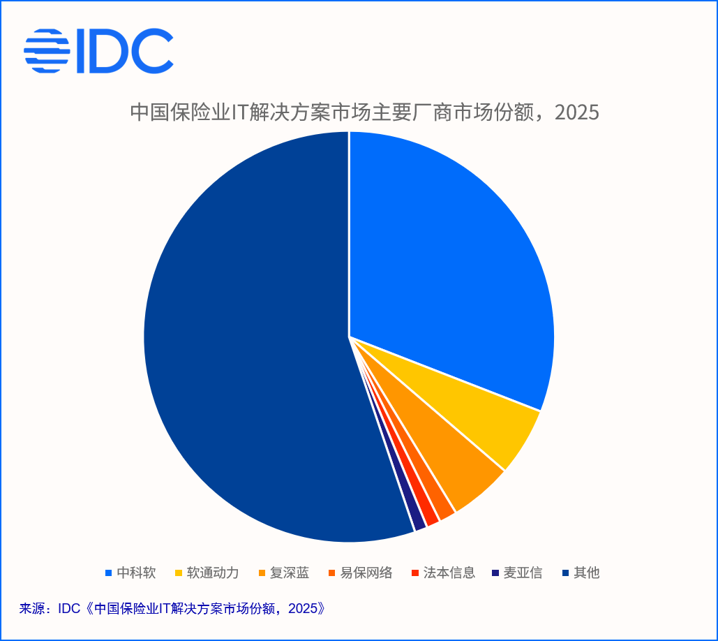
从市场基本面看,国际数据公司(IDC)近日发布的《中国保险业IT解决方案市场份额,2025》报告显示,2025 年中国保险行业 IT 解决方案市场规模达 100.6 亿元,降幅已明显收窄,正式进入企稳分化与存量竞争新阶段。市场呈现“一超 + 长尾”格局:一方面头部集中度持续提升,龙头厂商的客户、产品与服务壁垒不断加厚;另一方面长尾市场体量依然庞大,垂直细分场景与技术创新应用仍存在大量生存空间。

在这样的周期下,生成式 AI 成为少数既能契合监管 “防风险、促合规、降成本、提质量”主线,又能量化产出价值的技术方向。当保费增速放缓、人力规模收缩,通过 AI 提升人均产能、优化运营成本、创新服务模式,已经成为险企穿越周期的核心战略,而非可选项。

27.5 倍增速绝非概念泡沫,生成式 AI 已从“试点品”变为 “硬刚需”

市场上至今还有声音认为生成式 AI 仍是噱头、投入多产出少,但 IDC 报告显示:2025 年中国保险业 IT 投资规模达 517.3 亿元,其中硬件板块增幅显著,核心驱动力来自自主创新与 AI 基础设施建设。长期来看,2030 年中国保险行业 IT 投资规模将达 805.5 亿元,年复合增长率为 9.3%。

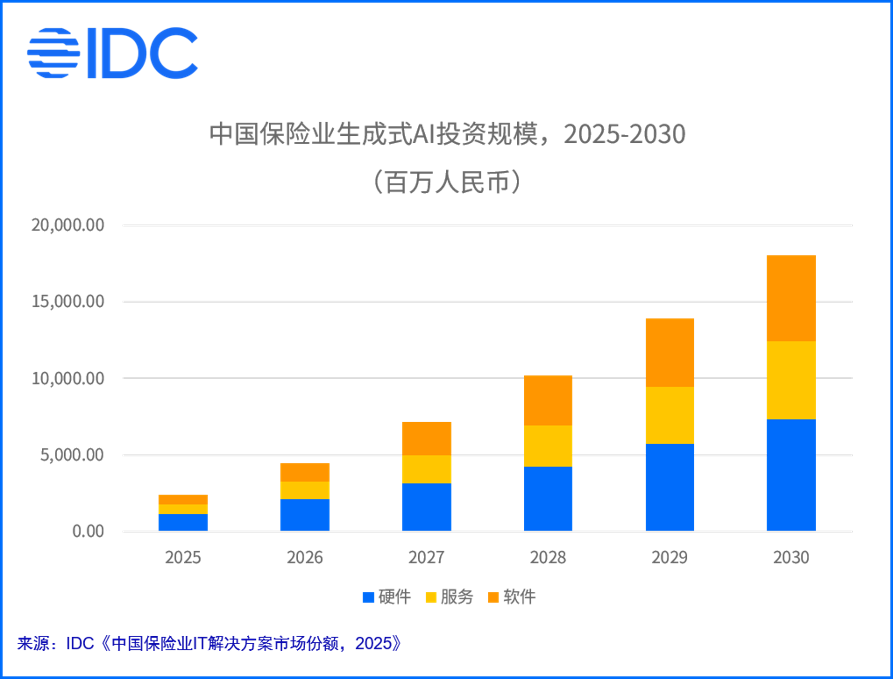
而生成式 AI 领域的增长远超整体大盘:投资规模从 2025 年 24.22 亿元升至 2030 年 180.05 亿元,五年增长近 7.5 倍,年复合增长率超 49%。这意味着生成式 AI 已彻底走出概念验证阶段,正式进入规模化投资周期,是当前保险科技领域最具确定性的增长引擎。

3AI 穿透全价值链,改写的是每个环节的价值定义

很多人对 AI 在保险业的价值认知还停留在 “客服机器人”“自动核保省工时”,但 IDC 认为,生成式 AI 的改造是深入骨髓的 —— 它正在改写定价、核保、理赔、服务、风控的每一个底层逻辑,从辅助工具进化为核心生产系统,在每个环节都在拓展行业的价值边界。2026 年将是保险行业生成式 AI 从“试点” 走向 “规模化”的关键之年,保险 IT 系统内置 AI 能力将成为行业标配。

产品定价:从静态精算走向个体实时风控

传统定价依赖历史数据与静态模型,本质是群体层面的风险均摊,难以反映个体风险动态变化。生成式 AI 正在把定价变成随个体行为实时波动的变量:车险 UBI 模式通过车联网数据实现驾驶行为定价,健康险通过可穿戴设备将保费与健康管理挂钩。未来的核心竞争力将是基于客户实时行为与外部风险信号的动态定价能力,推动行业从 “群体定价” 向 “个体定价” 演进。

核保理赔:智能决策重构效率与信任双重底座

生成式AI对于核保理赔的真正改变是把依赖人工经验的风险判断,变成了标准化、可追溯的智能决策。智能核保系统自动解析病历、体检报告,将数小时人工核保压缩至分钟级;图像识别自动定损车辆,OCR 快速提取医疗票据,大模型辅助责任判定。这不仅大幅缩短理赔周期、降低查勘成本,更从根源上压缩了人为操作空间与欺诈风险,重构了投保人与理赔端的信任机制 。

客服营销:对话式 AI 把渠道系统变成产能放大器

IDC预测,到 2026 年险企与投保人超 60% 的交互将通过数字自助服务实时完成。智能客服已升级为具备多轮对话、意图识别、情感分析能力的对话式 AI,大幅提升服务体验与响应效率。营销端的改变在于重塑作业模式:生成式 AI 基于客户画像生成个性化保障方案,智能问数让业务人员通过自然语言即可查询业务数据。渠道 IT 系统的价值从 “支持运转” 变为 “产能放大器”。

风险减量:推动行业从被动赔付转向主动价值创造

传统保险业的价值终点是出险赔付,本质是“风险兜底者”。但生成式 AI 正在把行业的价值边界往前移。农业领域用气象大数据与卫星遥感指导防灾减损,财险领域用物联网监控安全生产,健康险领域用平台引导健康管理。大模型在其中扮演核心角色 —— 海量数据实时分析、风险模型动态迭代、预警信号精准推送,均依赖生成式 AI 的能力支撑,推动行业从“事后赔付” 向 “事前预防”延伸,真正成为“价值创造者”。

4、转型的真正瓶颈不是技术,而是三个被高估的难题

生成式 AI 的规模化落地并非坦途,数据治理、组织能力、合规风控是公认的三大挑战。但在 IDC 看来,挑战并非都是长期壁垒,其中有短期可突破的关口,有被过度放大的伪命题,更有被忽视的增量机会。

第一,数据治理:“先治理后落地” 是最大的转型伪命题。数据治理不是 AI 落地的前置条件,而是与 AI 场景落地相互驱动的长期工程。IDC建议,短期优先补齐数据质量、数据血缘、元数据管理能力,优先保障核心场景 AI 输出的一致性和可信度,用小切口场景快速验证价值;中长期通过战略合作推进数据架构重构。而IFRS17 全面实施与生成式 AI 场景落地,本身就是倒逼数据治理加速的强大动力。

  • 组织转型:组织重构与“ROI闭环”才是真挑战。技术与组织的错位是主要矛盾——多数银行在组织重构、流程再设计建设方面明显滞后于技术演进速度。真正的组织挑战是如何建立组织信任、设计人机分工模式、培养全员人机协作能力。IDC 判断,到 2029 年 40% 的保险从业者需要掌握人机协作技能。此外,存量竞争下,生成式 AI 是少数能清晰量化 ROI 的技术方向,险企需要把 AI 当作“直接绑定业务成果的能力”,而不仅仅是工具的使用。
  • 合规风控:监管不是绊脚石,是差异化壁垒与全新赛道。很多人把强监管当成 AI 落地的最大阻碍。但我们认为,合规正是筛选玩家的竞争壁垒,甚至是全新的增量赛道。IDC建议,短期从数据、模型、流程、人才四个层面推进负责任 AI(RAI)建设,把合规要求嵌入 AI 全流程,筑牢落地底线;中长期全面改革治理、风险与合规框架,适配 AI 规模化应用的管理需求。

IDC总结与展望

生成式AI之于保险业,不是工具升级,是价值重塑。2026年是规模化落地的分水岭——技术能力已不是门槛,真正的较量在于:谁能率先找准场景、跑通ROI闭环、完成组织适配。

IDC判断,未来三年行业将呈现明显分化:头部险企通过AI重构定价、核保、风控全链路,把“风险经营”变为核心竞争力;观望者将困在降本增效的浅层,错失价值跃迁的窗口期。这场转型,比的不是算力与模型,而是价值边界拓展的速度与决心。

IDC更多相关研究:

进一步交流

如您希望深入了解保险业生成式AI的落地路径、场景优先级、ROI测算框架或组织转型实践,欢迎随时与我们联系。IDC金融研究团队可提供定制化数据研判、厂商对标与策略建议,助力您在关键拐点精准布局。期待与您深度对话。请点击此处联系我们。

Siri Si

Siri Si - Research Manager

Siri Si is a Research Manager for IDC Financial Insights. His core research scope includes the latest development models and trends in the financial industry, and the development and application status of various technologies in the financial technology field, focusing…

Somewhere in the last twelve months, a lot of B2B marketing leaders noticed the same unsettling thing: website traffic quietly dropped. As one tech CMO put it in a recent conversation, “Overnight our website traffic tanked. Buyers have shifted to AEO and engage with us much later in the decision journey.”

That single sentence captures a shift IDC has been tracking closely.  Buyers haven’t stopped researching. They’ve stopped researching on your website.

The vendor website is no longer the front door

For years, marketing built its funnel around a predictable first move: a prospect lands on your homepage, browses a few pages, and eventually fills out a contact us form. That assumption no longer holds.

IDC’s research on B2B tech buying describes AI answer engines as becoming the new front door to a brand. Buyers are increasingly turning to AI tools to discover and research complex purchase decisions, often ahead of, or entirely instead of, a visit to a vendor’s website. This isn’t a niche behavior confined to one function or region. AI-mediated discovery is becoming a core practice in how tech buyers navigate the buyer journey.

AI is redefining the early stages of engagement.  Buyers enter vendor conversations more informed, and often further along, than ever before. By the time a prospect might have clicked “Contact Us,” they’ve frequently already formed an opinion, shaped by an AI agent that never visited your homepage.

Conversational AI is disrupting the interface itself

The bigger shift isn’t only where research happens.

Matthieu Houle, CIO at ALDO Group, described this well:

Consumers now rely on assistants that feel almost human, know their preferences, and offer neutral, best-for-me advice that reshapes how they validate and decide what to buy.

Matthieu Houle, CIO at ALDO Group

That’s not a fringe behavior anymore, and it isn’t limited to consumer categories. In B2B, buyers are beginning to delegate real portions of the research and shortlisting process to AI agents, sometimes even early sourcing and comparison work, before a human on either side gets involved. The traditional search bar or browse-and-click interface many of us have designed our entire digital experience around is quietly being displaced by conversation. Buyers ask an assistant a question and get a synthesized, cited answer, often without ever seeing a vendor’s homepage, navigation, or carefully crafted hero message.

Discovery no longer behaves like a single moment; it’s becoming a continuous feedback loop. And discovery does not simply equal SEO. Visibility inside an AI-generated answer is only one output of a much larger shift. Buyer research has been diversifying for years, spreading across social platforms, communities, and industry expert content well before AI entered the picture. AI accelerated that fragmentation and gave it a new interface.

It’s worth being honest about where the shift stops, too. IDC’s research is clear that human engagement still matters most at the moments of highest stake: negotiating price and contract terms, finalizing complex purchases, and building trust during evaluation. AI is disintermediating discovery and early-stage research. The human relationships that close deals haven’t gone anywhere, at least not yet.

Marketing’s response: becoming the conductor, not just the funnel owner

The old model had marketing owning a channel mix that fed a linear funnel ending in a form fill.  That model no longer describes what’s happening. Marketing’s evolving role is closer to conducting in real-time, agent-mediated, orchestrated journey, where content, channels, intelligence, and automation work in concert. The buyer, and increasingly the buyer’s AI agent, moves fluidly across all of them at once, not following a single predictable path.

One global CMO I spoke with put it simply:

Our primary objective is to move beyond using AI as a set of discrete tools and instead build integrated, AI-enabled systems that can orchestrate end-to-end marketing workflows.

It’s not about bolting an AI chatbot onto an existing website. It’s about rebuilding the underlying systems so that whoever, or whatever, is doing the research finds a consistent, structured, trustworthy story no matter which door they come through.

That same CMO also pointed to a shift in how marketing and sales work together. Marketing used to generate a lead and hand it to sales in sequence. Now the two functions share an AI-orchestrated approach to revenue execution. AI agents coordinate targeting, timing, and messaging in real time based on buyer behavior, while humans concentrate on strategy and the relationship-building moments that still require a person in the room.

Marketing’s own operating model has to evolve alongside this. The organizations furthest ahead have stopped managing channels and started engineering the systems that shape discovery, interpret buyer intent, and influence decisions before a brand enters the conversation. Some describe this as a shift toward a more autonomous, adaptive, and agentic marketing function.

What this means for marketing leaders

None of this means your website is irrelevant, or that buyers have vanished. The moment of first contact has moved upstream, into AI-mediated research that most marketing teams cannot yet see, measure, or influence directly. Marketing’s job has expanded from managing a channel mix to orchestrating a machine-and-human journey.

A few implications worth sitting with:

  • Content needs to be built for machines to cite, not just for humans to browse. Structured, specific, and authoritative content is more likely to surface inside an AI-generated answer than a beautifully designed but ungated PDF.
  • Marketing is becoming the conductor of a real-time, agent-mediated journey. That requires connected data and intelligence underneath every touchpoint, from chat to video to community, tied to the same underlying data set.
  • The org chart may need to catch up. Most tech marketing organizations still don’t have an enterprise AI roadmap that transforms how the business operates, rather than simply layering AI tools on top of existing workflows.
  • Sales resources should concentrate where humans still win. Pull early qualification effort back. Reinvest it in negotiation and complex deal-closing, where buyers still consistently prefer a person.

The prospects who matter most to your pipeline are still out there, researching and comparing. The organizations that earn visibility and trust inside that AI-mediated research phase get a shot at the deal long before “Contact Us” is ever pressed.

Laurie Buczek

Laurie Buczek - Group Vice President, Market & Business Intelligence

Laurie Buczek is Group Vice President of Market & Business Intelligence at IDC, leading global team of researchers and executive advisory on AI-fueled business transformation, market dynamics, channel, ecosystem and go-to-market strategy. She oversees the analysis of external forces—economic, regulatory,…

随着生成式 AI 快速普及,国内云计算市场已经不再单纯比拼算力规模。结合国际数据公司(IDC)最新市场数据以及近日发布的《中国主流云服务商数智化转型能力评估》报告观察,企业上云的关注点正在发生变化:除基础资源之外,大家越来越看重数据处理、AI 落地、行业生态、服务交付以及整体投入产出水平。

多云、混合云已成为不少企业的现实选择,但很多组织在实际选型中仍面临不少困惑:评估维度不好把握,算力投入后业务价值难以显现,行业落地路径不清晰,各家云厂商能力差异较难甄别。如何结合自身实际,客观对比云平台能力,平衡技术、生态、安全与成本,是当下政企数字化、智能化转型过程中值得关注的现实问题。

重新审视云选型:5个打破惯性思维的现实发现

  1. 云选型评估从单一资源对比,升级为全栈综合能力评估

企业的云支出不再只投向 IaaS 基础设施,数据平台、AI 赋能、行业方案、运维服务的占比持续提升。企业采购云服务,本质是采购一套完整数字化底座,而非单纯的服务器、存储资源。本次评估报告从基础设施、数据中台、AI 智能化赋能、垂直行业落地、生态资源、安全与信任、综合服务能力、成本性价比八大维度建立评估框架,帮助企业跳出 “只比硬件参数、只看标价” 的误区,完整识别厂商在产品、交付、生态、服务层面的真实实力。

  1. 各家云厂商各有所长,并不存在普适的最优选择

通过对各云厂开展逐项打分评估,可以清晰看到各家的能力分化:

阿里云:综合能力均衡,国内基础设施底座规模领先,数据中台、AI 工具链、安全合规体系完善,在政务、互联网、通用企业服务领域沉淀深厚,适配绝大多数国内企业通用数字化建设需求。

腾讯云:场景特色优势突出,深耕互联网、游戏、金融科技、音视频 AI 等领域,C 端数字化能力向 B 端赋能转化能力强,生态资源丰富、场景落地灵活。

华为云:底层软硬件自研体系完整,全栈本土化能力突出,在央企、政务、制造行业项目实践积累丰富,混合云架构能力较强。

天翼云:依托国资背景,具备高安全、高可信、全栈本土化的核心优势,在大型政企、能源、国家级赛事等关键场景落地成果突出,智算与高性能算力服务能力增长迅速。

移动云:运营商体系算力资源充沛,全国属地化服务网点覆盖广,国资安全合规属性突出,政务、央国企项目增长较快,算力网络与5G+云计算能力是核心竞争力。

火山引擎:依托内部大规模业务淬炼,AI 算力、大数据、模型工程化能力突出,AI 原生场景、互联网创新业务适配度高。

AWS:全球基础设施布局完善、产品矩阵成熟,海外生态与全球化部署能力优势显著,适合有出海、多地域布局需求的企业。

微软云:依托办公协同生态与原生 AI 技术积淀,在智能化办公、企业知识管理、跨国协同场景适配度高,AI 底层技术扎实。

IDC洞察:并非一款云能够适配全部行业场景。海外厂商强于全球部署、标准化产品;国内厂商强于本土交付与适配、行业生态。企业选型需要匹配自身业务地域、行业属性与合规要求,而非简单选择综合得分最高厂商。

  1. AI 落地瓶颈不在于算力有无,而在于端到端配套与场景化能力

很多企业在 AI 转型中盲目采购智算资源,但算力利用率偏低,模型难以落地业务流程。头部云厂商之间的差距,不只体现在 GPU 规模,更多体现在数据治理工具链、行业预训练资产、项目交付实施能力。报告中多行业标杆案例印证,能够把算力、数据、行业知识、实施服务打通的云平台,才能真正把 AI 能力转化为业务收益。

  1. 多云混合架构成为主流,综合服务与生态资源决定落地成败

多数大中型企业已经采用多云策略,兼顾本土合规与全球业务诉求。此时厂商的行业生态资源、迁移工具、运维支持、培训体系、问题响应效率,会直接影响多云架构运行效果。部分项目效果不及预期,并非产品本身能力不足,而是缺少持续交付与生态伙伴的有效支撑。

  1. 成本评估不仅关注公开报价,也要关注全生命周期综合性价比

云成本陷阱集中在流量、存储、运维人力、迁移改造成本、长期订阅支出等隐性环节。建议企业以全生命周期视角测算总体拥有成本。评估体系中把长期综合性价比独立作为核心维度,结合厂商案例真实实施情况,帮助企业识别显性与隐性成本,规避后期预算超支风险。

行动建议

  1. 建立多维度选型评估清单,避免单一指标决策

企业在云选型立项阶段,建议 IT、业务、安全、财务多方共同参与,参考报告八大评估维度建立打分表,将 AI 工具链、行业案例、交付服务、安全合规、长期运维成本纳入评估,不把算力规格、产品数量作为唯一评判标准。

  1. AI 项目优先验证场景落地能力,不要优先比拼硬件规模

开展 AI 相关云采购前,可优先做 POC 验证,重点考察数据接入、模型适配、业务系统对接、运维监控整套工具链能力,优先参考同行业真实案例,重点关注算力实际利用率,而非单纯追求更大规模算力资源。

  1. 规划多云 / 混合云架构,重视迁移与运维服务保障

如果计划采用多云架构,建议提前评估跨云迁移工具、数据流转方案、统一运维能力;将厂商实施交付、技术培训、故障响应 SLA 作为重点考量,同时梳理自身数据分级分类,明确公有云与本地部署的业务边界。

  1. 构建云成本治理机制,做全周期成本管控

建立云资源标签管理、成本告警、定期资源优化审计机制,开展 FinOps 相关实践,综合核算迁移、人力、流量、存储等全部投入,客观评估 TCO,规避只看初始报价带来的后续风险。

  1. 借鉴行业生态资源,借力合作伙伴加速落地

优先选择具备丰富行业生态资源的云厂商,充分调用厂商生态合作伙伴的行业经验,减少从零开发的成本压力;选型阶段即了解其集成、咨询、实施伙伴资源,判断是否匹配自身业务需求。

IDC分析师观点及展望

云计算正在从基础资源供给,逐步走向 “云 + 数据 + AI + 行业方案” 一体化服务。大模型会更深融入业务流程,企业的关注点也将从 “能用云” 转向 “用好云、产生业务价值”。

云厂商焦点也将从基础设施规模竞争,转向数据工具链、AI 工程化、行业落地、综合服务能力。混合多云、智算底座、本土适配、全生命周期成本优化,会持续成为企业云建设的关键词。企业需要持续跟踪厂商能力迭代,定期复盘云底座运行效果,让云平台更好支撑业务创新与智能化转型。

IDC《中国数智化转型报告》相关研究:

IDC《中国数智化转型报告》帮助技术买家和技术提供商更好地了解政府相关政策以及业务和技术发展趋势,深入了解数字转型支出增长和数字业务,以及人工智能生态系统的变化,掌握数字业务和AI转型的用例和路线图,并了解跨行业或同行的最佳实践。
《中国主流云服务商数智化转型能力评估》

《中国数字化转型市场预测,2026—2030》

《中国数字化转型市场份额,2025》

《中国AI驱动的业务创新之厂商实践-2026》

进一步交流

云选型并没有绝对标准答案,但选型判断一旦出现偏差,带来的影响不只是预算的额外消耗,业务运行受阻、AI 项目推进不及预期、后期迁移改造成本抬升等问题,都有可能在 1‑2 年后逐步显现出来。如需获取完整报告、定制化厂商对比分析,或针对您所在行业的具体落地方案,欢迎留下您的联系方式,我们的分析师团队将为您提供一对一的深度解读与选型建议。点击此处联系我们。

Nicholas Guo

Nicholas Guo - Senior Research Manager

Nicholas Guo is a senior research manager in IDC China, responsible for research and analysis of the entire China ICT market. His primary focus is on the overall China ICT market trends covering enterprise-level hardware, software, and services, and ICT…