The worldwide enterprise application market grew 11.5% in 2024. It grew 12.1% in 2025. Halfway through 2026, verified earnings across 60 public application software vendors (20 large-cap, 20 mid-cap, and 20 small-cap) put blended growth at roughly 13%, confirmed against the most recently reported quarters. On a market approaching $700 billion, that is real money amounting to tens of billions of dollars in incremental annual spend. It is also, by any honest reading, not the inflection point the AI narrative promised.

That gap is the whole story. If agentic AI were about to remake enterprise software the way cloud remade it a decade and a half ago, the aggregate growth rate should be bending upward. It isn’t bending. It’s creeping. However, therein resides the lie.  An average of a market pulling apart in opposite directions is not a measurement. It’s a number that happens to be both true and useless at the same time.

The reason is not that AI has failed to show up. It is that the aggregate number is the wrong place to look for it. AI capability moves into specific application categories at different speeds, and until it does, it has no reason to move the blended average at all. The businesses waiting for the aggregate number to justify the investment will be years behind the ones who read the dispersion first.

Where the disruption is actually showing up

The real signal was never the aggregate. It is the dispersion beneath it, and 2026 earnings confirm the pattern is holding, not reversing. Atlassian grew 28% in its most recent fiscal quarter. ServiceNow grew 24%. BILL Holdings, an accounts payable and receivable automation platform, grew core revenue 16%. These are workflow-heavy, automation-friendly businesses. This is exactly where agentic AI should add value fastest, and the real numbers agree with the theory.

Customer Service Applications and Human Capital Management tell the opposite story. Sprinklr, a customer experience platform, grew just 6.8% in its most recent quarter, with guidance pointing toward roughly 1% next quarter. LivePerson, sitting in the same customer operations orbit, saw revenue decline 12% year over year. Workday’s total revenue growth held at 13.5% in early 2026, in line with IDC’s full-year 2025 HCM category rate of 13.0%. Not the reacceleration bulls were hoping for.

That is the part worth pausing on. Customer service and HR are arguably the two categories most exposed to AI disruption. Support agents replacing chat queues. AI-driven recruiting replacing manual sourcing and screening. Growth in both is stagnant, not accelerating. The explanation is not that AI failed to show up. Rather, the combination of usage-based, outcome-based, and other agentic pricing models may be cannibalizing legacy per-seat license revenue faster than new AI spend is replacing it. Both could be true, but our research suggests the scale tips toward it being a pricing issue rather than a value issue.

The strongest market cluster is actually not even specifically AI-labeled. It is collaboration software. Atlassian’s 28% and Monday.com’s 22% sit inside this space, and IDC’s 2025 data already showed Enterprise Portals accelerating to nearly 17%.

This is the part akin to the early cloud transition, playing out in real time. The categories with the most surface area for embedded AI agents and assistants moved first, years before analysts had a clean line item to point to. Slack and Teams did not wait for a “collaboration AI” category to exist before AI showed up inside them. Neither will the rest of the market.

What this means now

None of this shows up if the aggregate number is the only thing anyone checks. The categories and the pricing decisions made within them are where the real signal lives, and that holds for tech leaders and software vendors alike.

For tech leaders, the practical version of “don’t trust the aggregate” is to stop asking vendors how their AI roadmap looks and start asking how it will be priced. Before you standardize on any AI feature, ask a specific question: Is this bundled into your current subscription, or will it eventually be metered or split into its own tier? Get the answer in writing. A feature that ships free today can become a paid add-on once your team depends on it, and the time to negotiate a price lock or grandfather clause is before that dependency forms, not after. If a vendor will not commit to how an AI feature will be priced going forward, that ambiguity itself is worth noting and potentially pushing back on in the contract.

The performance of the app category your vendor sits in is a second number worth checking. It tells you something about the pressure that the vendor is under. A vendor in a category where growth has stalled, like customer service software or HCM, is likely facing margin pressure across its customer base, which shapes how it negotiates. First, they may be more willing to discount to retain you. Second, there is a real chance they will get more aggressive about raising prices over time to compensate. Knowing which situation you are in changes how you approach renewal, regardless of how the vendor’s AI roadmap is marketed.

For suppliers, the lesson is direct, and it is the same lesson in reverse. The categories where growth has stalled are not short on AI investment. They are short on pricing models designed to capture the value AI creates rather than giving it away. If your AI features are seeing real adoption and your revenue has not moved, that is not a messaging problem to fix with better marketing. It is a sign your pricing model is absorbing the value your product now creates rather than charging for it. Fix the pricing before you fix the pitch. The vendors in accelerating categories, collaboration and finance automation among them, are not simply better at building AI. They have found ways to attach a price to it.

Both sides are better off treating a vendor’s pricing structure as a more honest signal than its AI messaging, for the same reason the aggregate market number is a less honest signal than the category data underneath it. A vendor confident that its AI is delivering real value usually shows that confidence in how it charges for it. A vendor still bundling AI in for free, indefinitely, may be telling you something about how differentiated that AI actually is, whether or not that is the story in the pitch deck.

The aggregate number will keep lying for as long as it’s the only number anyone checks. Category-level dispersion and the pricing signals underneath it is where the truth actually lives.
Eric Newmark

Eric Newmark - Group Vice President & General Manager of IDC's SaaS, Enterprise Software, CX and Workplace Solutions Division

Eric Newmark is Group Vice President & General Manager of IDC’s SaaS, Enterprise Software, CX, and Workplace Solutions Division, which includes several teams of analysts covering SaaS, 18 enterprise application markets, software monetization, business platforms, marketplaces, and services firms focused…

Your adtech spider-sense should be tingling. BMW spent 2023 promising owners a private dashboard, then spent this July breaking that promise in front of all of them.

A broken promise, and the ambient advertising it wasn’t

Starting in late July, drivers in more than 70 countries turned on their vehicles to find a full-screen animation for Spider-Man: Brand New Day on the iDrive display, complete with its own soundtrack and matching ambient lighting. BMW framed it as a Festive App tie-in connected to a film in which two of its vehicles appear. Owners framed it as something closer to a violation. In December 2023, BMW’s own leadership had described the dashboard as “a private space” that would never carry commercials. That promise lasted two and a half years, until the Spider-Man rollout arrived this July.

The heated-seat subscription controversy from a few years earlier hadn’t helped. BMW had asked owners to pay monthly for hardware already built into the car, backed off after a similar backlash, and never fully closed the door on the model. The Spider-Man rollout landed on the same nerve, and it’s worth asking why BMW keeps finding this particular one.

Here’s where the story gets more interesting than the outrage suggests. IDC’s FutureScape 2026 Chief Marketing Officer predictions include a forecast on exactly this category of screen.

Screens everywhere are becoming ad-eligible surface area, and vehicles were always going to enter that picture eventually.

Read the prediction closely, though, and the BMW campaign doesn’t actually match it. Ambient intelligence works because it responds to context: a shelf tag that adjusts price by time of day, or a store display that reacts to who’s walking past. What BMW pushed was the opposite of ambient. One static animation went to every eligible car across 70 countries regardless of driver, location, or moment, landing on a screen BMW’s own leadership had promised would stay ad-free. The tie-in itself was ordinary marketing. Automakers do this constantly when their vehicles appear on screen. What made this one land as an interruption rather than an ad was the missing context: no signal telling BMW which car, which driver, or which moment actually called for it.

IDC’s consumer research backs this up. In our Pre- and Post-Purchase Promotional Demands study, 64% of consumers say ads have no or limited influence on their decisions, but 52% would click a shoppable connected TV ad when it’s actually targeted to them. The same study found that a brand’s guarantee not to resell shared data ranks among the top incentives for engagement, which is just a data-era version of the same private-space promise BMW made and broke: people let a brand into something personal only when they trust exactly what happens with it next.

IDC has been flagging this exact risk in guidance to technology buyers for nearly a year: brands need to work through real privacy and experience concerns around personalized advertising, or risk this kind of blowback.

What has to be true before ads belong in the car

The dashboard won’t stay ad-free forever, but two conditions have to be met before that shift is earned. One is economic. Streaming’s free tier, ad-supported search, and a discounted Kindle all run on a bargain consumers understand going in: pay less, or pay nothing, and ads come with it. No such bargain exists yet in the automotive category. A BMW owner paid full price, in some cases more than $100,000, for a vehicle sold on an explicit promise that the interior stayed private, so paid still means ad-free by default until automakers offer something else, an ad-supported tier or a discounted lease in exchange for opted-in content. The other condition is attentional, and it’s a moving target. A driver at SAE Level 2 has no attention to spare for a screen, ad or otherwise. A passenger at Level 4 or 5, hands off entirely, is functionally riding in a moving living room, closer to a train passenger than a driver. As the fleet climbs that ladder over the next decade, the cabin becomes a legitimate leisure environment. Entertainment content still has to earn its place there, but the case against it gets harder to make with each level of autonomy the fleet adds.

Vehicle category matters just as much, and BMW picked close to the worst one to test this on. A luxury sedan sells exclusivity, the same reason a private villa doesn’t run ads on its own television. A family minivan on a road trip is a different proposition entirely: kids already watch movies on rear-seat screens, parents already pay for anything that buys 20 quiet minutes, and a timed movie promotion might land as a genuine perk rather than an intrusion. The same content, in the wrong vehicle segment, reads differently to the person watching it, which is exactly the mismatch BMW ran into by testing a Marvel tie-in on a luxury sedan lineup instead of the family vehicles where in-cabin entertainment already sells.

The industry already learned a version of this lesson in television. IDC’s research on the collapse of the upfronts found that premium content never automatically buys a premium audience; precision targeting does. BMW bet on the content, a splashy Marvel tie-in riding a halo launch, and skipped the targeting altogether. This is a common pattern among brand leaders who came up in a Mad Men-era playbook and haven’t fully adapted to data-driven, let alone agentic, automation methods.

What decides whether the next attempt lands is whether automakers match the format to the moment: the autonomy level, the vehicle category, and a business model the owner actually opted into. Skip any of those, and the next backlash won’t be about the ad. It will be about the same broken promise, running on whichever screen BMW decides to test next.

The brands that get this right over the next five years won’t be the ones with the splashiest tie-in. They’ll be the ones who bothered to ask whether the driver actually wanted to see it.

Roger Beharry Lall

Roger Beharry Lall - Research Director, Advertising Technologies and SMB Marketing Applications

With over 25 years' experience leading technology driven marketing programs, Mr. Beharry Lall is now a Research Director with IDC covering Advertising Technologies and SMB Marketing Applications. He brings a unique multidisciplinary perspective, evangelizing the innovative and pragmatic use of…

Worldwide tablet shipments fell to 33.6 million units in the second quarter of 2026, down 5.2% from the prior quarter and 12.3% from a year ago, according to IDC’s Worldwide Quarterly Personal Computing Device Tracker. That’s the category’s steepest year-over-year decline in this cycle. Almost the entire drop traces back to one root cause, but the more interesting story is what happens once that cause eventually clears.

RAMmageddon finally lands on tablets

The memory supercycle that’s been reshaping PCs and phones all year has now fully hit tablets, as AI infrastructure buildouts continue to pull DRAM and NAND capacity away from consumer devices. IDC’s own PCD Forecast Assumptions had already flagged this inflection point across two consecutive quarterly cycles, projecting shipment declines accelerating from 2026Q2 onward. This quarter confirms that thesis rather than surprising it.

The pass-through, based on vendor list-price changes IDC tracked, has been fast and visible. Samsung raised list prices $40 to $280 across nearly its entire Galaxy Tab lineup in April. Lenovo followed with $30 to $70 increases on the Tab One, Tab Plus, and Yoga Tab during the same month. Then Apple raised the entire iPad line globally in June, with multiple models costing an additional 20% or more, explicitly citing memory costs rather than tariffs or a hardware refresh. When your three biggest vendors all raise prices inside ten weeks of each other, consumer demand doesn’t shrug it off.

That’s exactly what happened: consumer shipments fell 13.5% year over year, while commercial held up far better at -5.9%. Commercial and education buyers are typically locked into multi-year refresh cycles that don’t get renegotiated quarter to quarter, so they absorbed less of the shock. Consumers, buying at list price with no contract to hide behind, took almost the entire hit.

The US got the worst of both worlds

No region suffered like the United States, where shipments collapsed 31.6% year over year (even as they rebounded 7.1% sequentially off a depressed base). The US is the one market where memory costs and tariffs land at the same time. One of the largest vendors, Amazon, also saw shipments decline in its tablet lineup, compounded by a difficult comparison against 2025Q2, when many brands pulled forward inventory ahead of anticipated tariffs. As tariffs continue to pinch the supply, brands such as Samsung and Lenovo are likely going to be in noticeably better shape thanks to production outside China.

Beyond the memory shock: a harder question

Here’s the part that should worry the category more than any single bad quarter. Even before RAMmageddon, tablets were fighting for relevance in a device market that’s rearranging itself around AI. AI PCs are absorbing the productivity use case tablets spent a decade trying to own. Phones keep getting bigger, and foldables, still a rounding error in unit terms, are growing fast and pulling casual browsing and media consumption further into the smartphone. Foldables are starting to serve as a drag on 8-to-10-inch tablet demand, and cheap mini-PCs and laptops are peeling off would-be buyers at the sub-$200 end. A memory shortage clears eventually. A device that’s lost its reason to exist doesn’t recover just because supply does, and this quarter is a reminder that tablets can’t just wait out the crunch. The vendors still winning share, mostly through productivity and enterprise deals, are the ones already treating that as the real problem.

Where the silver linings are

The data isn’t uniformly bleak, and the bright spots point toward where that case might be built:

  • Detachables are holding the line. Slate tablets fell 19.8% year over year, concentrated at the low end where price hikes bite hardest. Detachables fell only 6.1%, because that mix skews toward commercial and productivity buyers who are far less price-sensitive. The market’s mix shift, forced or not, is toward tablets that behave more like PCs.
  • Lenovo is the standout. Lenovo grew shipments 26.2% year over year, the best result among any major vendor, on the strength of its productivity-leaning lineup. Huawei (+9.1%) and OPPO (+10.5%) also grew.
  • Emerging markets are picking up slack. While the US and Western Europe (-13.3%) cratered, APeJC grew 2.6%, the Middle East and Africa edged up 0.7%, and Japan jumped 5.8% year over year. Chinese vendors, in particular, are pushing volume aggressively into these regions, helped by the fact that tablets carry a smaller share of memory in their bill of materials than smartphones do, giving them more room to defend share.
  • Scale is consolidating, not collapsing. The top five vendors (Apple, Samsung, Lenovo, Huawei, Xiaomi) now control roughly 79.8% of the market, up from 77.9% just one quarter earlier. Bigger vendors have the procurement leverage to secure memory allocation that smaller players simply can’t match, so the category is concentrating around the players best equipped to weather the storm.

What to watch next

The pace of these price increases is expected to ease in the coming quarters, but supply relief isn’t immediate, and tablets will likely keep riding out elevated prices for a while longer. The vendors who use that time to push harder on productivity, AI features, and enterprise deployments, rather than just waiting for cheaper memory, will set the terms for what a smaller tablet market looks like next year. The ones who don’t are betting that a supply cycle can fix a relevance problem. That’s a bet this quarter’s data doesn’t support.

Jitesh Ubrani

Jitesh Ubrani - Director, Consumer Devices Research

Jitesh Ubrani is a Director at IDC leading a team of analysts within the Worldwide Consumer Device Trackers group, covering wearables, augmented reality (AR), virtual reality (VR), tablets, phones, PCs, gaming, and smart home devices, with a focus on market…

7月以来,2026年中国上半年宏观经济数据陆续发布。根据中国国家统计局数据,中国软件和信息技术服务业保持了两位数的平稳增长,展现出信息产业的行业韧性。在宏观数据和企业技术投入上升的背后,国内部分ICT市场已从快速增量期进入存量优化期,拓展海外市场、布局全球化成为中国企业寻找新增长点的关键选择。

对于寻求增量空间的企业而言,出海已从可选项变为必选项

然而,面对全球9个地区、53个国家、28个行业的复杂格局,企业最常陷入三个决策困境:该优先去哪片市场?该带什么产品去卖?该主攻哪些行业客户?

本文基于国际数据公司(IDC)最新发布的《全球ICT支出指南:行业与企业规模》(2026V2版),用一组对比数据和三个核心判断,为中国企业的全球化布局提供量化参照系。核心结论浓缩为一句话:逐步降低硬件规模化的优先级,拥抱新兴市场的云化与软件红利,优先在金融与政务两大高预算领域建立标杆

坐标一:将目光从存量红海转向增量蓝海

(核心问题:去哪儿?)

从全球大盘来看,企业级数字化转型与智能化投入仍在加速。IDC数据显示,全球整体ICT市场预计到2030年将增长至9.67万亿美元,五年复合年增长率(CAGR)为9.6%;其中企业级ICT市场到2030年规模将达7.44万亿美元,增速达12.4%,是驱动整个市场增长的核心引擎。

在进行全球化选址时,中国IT厂商需要将视角从“只看绝对规模”转向“寻找高增长增量”:

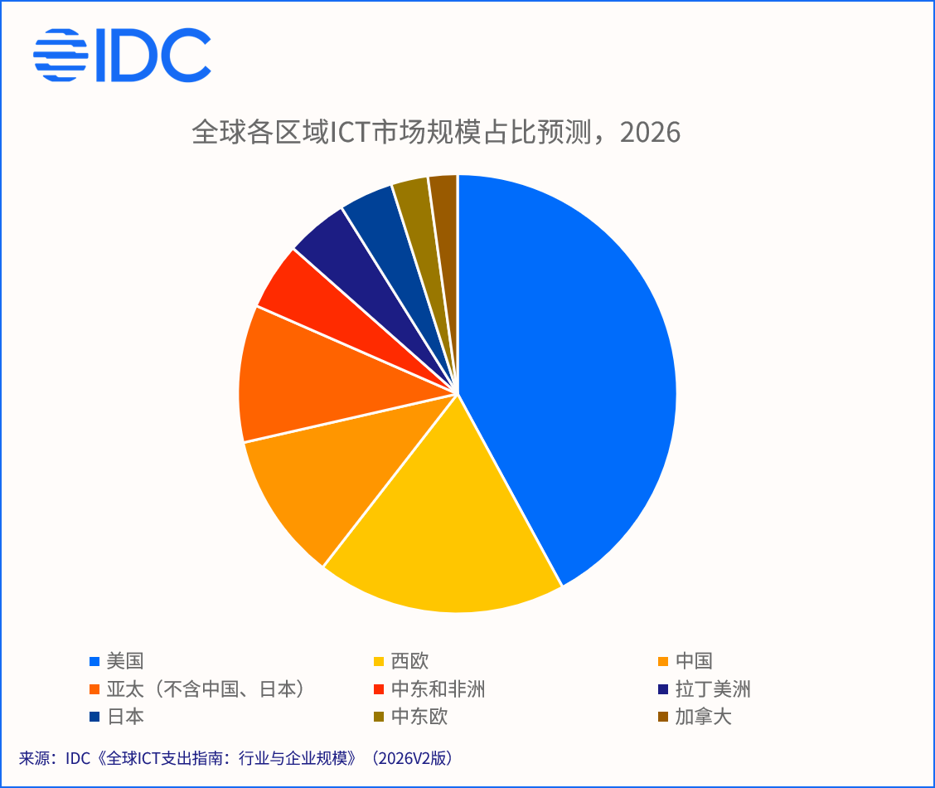
  • 成熟市场规模巨大,但增速分化:2026年美国在全球企业级支出中占比近五成,五年复合增长率达14.8%,这主要由其高科技与算力投入拉动;西欧以约两成份额位列全球第二,但受到合规与政策监管影响,其企业级增速相对温和。
  • 新兴市场份额有限,但韧性极强:2026年亚太(不含中日)在全球企业级ICT支出中占比8.1%,份额位列全球第三;拉丁美洲在全球企业级支出中占比为3.5%,但其五年复合增长率达10.4%,是理想的业务落地突破口。从细分国家看,巴西占拉美大盘的三成以上,且拉美的阿根廷、巴西、智利均展现出两位数的企业级增长;中东的土耳其、沙特和阿联酋的五年企业级增速也分别高达12.5%、11.1%和10.9%。

针对出海企业的行动建议:中国企业应采取区域分轨战略。对于美欧等高壁垒成熟市场,可将其作为技术对标;对于东南亚、中东及拉美等高成长区域,则应作为规模化扩张的主战场。企业应当结合自身优势,优先深耕土耳其、沙特、智利、巴西等政策红利持续释放、企业级投入跨过两位数增长的核心国家。

坐标二:跳出硬件主导惯性,顺应海外云化轻装趋势

(核心问题:卖什么?)

选定了区域,接下来必须厘清:在这些市场上,中国企业的产品形态应该如何调整?一个关键的结构性差异值得高度关注。

拆解硬件、软件、IT服务等技术板块可以发现,海外新兴市场与中国本土存在本质的技术结构差异:

  • 新兴市场以软件与云服务为主导:IDC数据显示,中国市场呈现显著的“硬件主导”特征(占比达54%)。然而在海外,亚太(不含中日)的软件占比已达30%,超过其硬件;拉丁美洲与中东和非洲的硬件占比仅为18%和23%,软件和服务则占据了核心份额。这表明海外新兴市场正跳过传统的重资产硬件堆叠,直接进入以软件驱动和云服务为主的轻资产模式。
  • 软件增速全面领跑:未来五年,全球九大区域中只有中国和美国呈现硬件增速高于软件的特征。而在亚太(不含中日)、拉美、中东和非洲,软件的增长速度都在16%以上,远超其硬件增速。其中,位于应用开发与部署市场中的人工智能核心软件在各个新兴区域均实现了超过50%的爆发式五年增速。同时,中东和非洲的硬件需求大量以“云服务”形式重塑,其基础设施即服务(IaaS)市场的五年CAGR高达21.1%。

针对出海企业的行动建议:中国企业出海应顺应海外的云化与轻资产趋势。硬件及基础设施厂商应考虑将产品与海外本地的云平台深度集成,提供“硬件+本地化运维”的打包服务。软件与方案商则应顺应当地软件高增速红利,将国内沉淀的成熟应用方案进行云化移植,把海外企业级市场对前沿软件的刚性需求作为业务突破口。

坐标三:聚焦金融与政务两大预算高地,兼顾零售增长红利

(核心问题:卖给谁?)

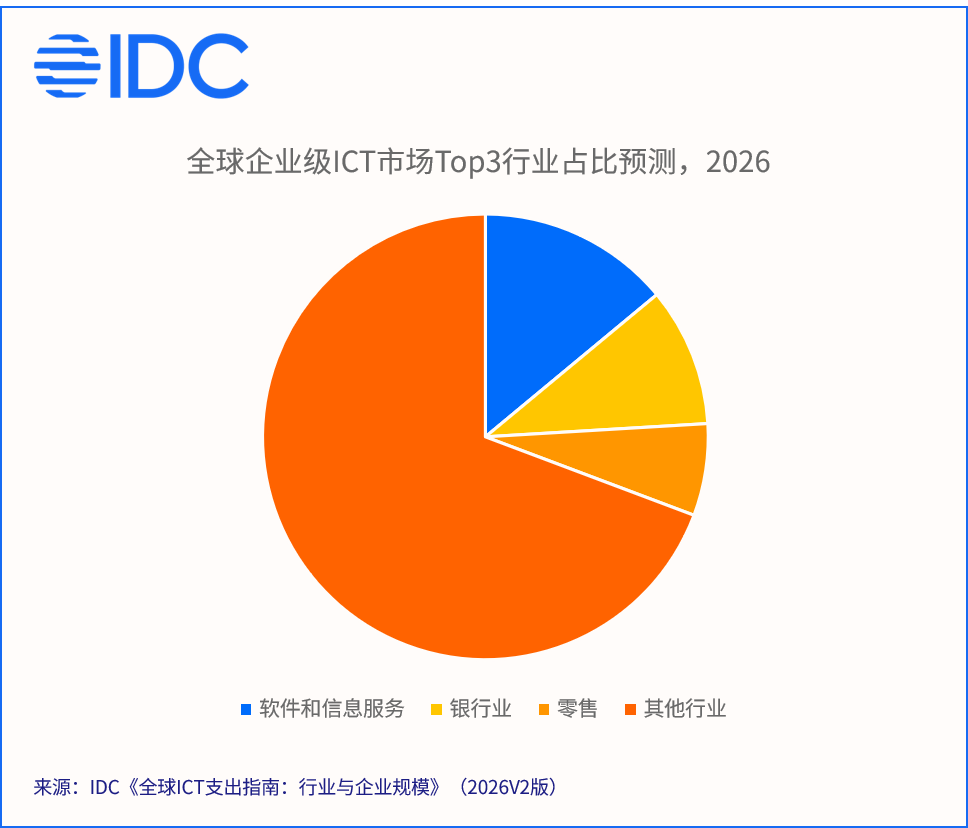
企业全球化布局落地的关键在于“卖给谁”。对比全球与中国市场,虽然软件和信息服务行业都是绝对的支出主力,但当视线转向新兴市场时,海外传统实体行业与公共服务部门的IT预算体量表现出更强的确定性。

  • 金融与政务构成海外核心预算支柱:在亚太(不含中日),银行业和中央/联邦政府的IT支出紧随软件与信息服务行业之后;零售业五年增速达11.7%。在拉丁美洲,银行业以15.1%的份额成为企业级ICT投资的龙头行业,专业和个人服务行业增速领先。在中东细分市场,银行业和中央/联邦政府合计占据了近四分之一的市场份额,且中东银行业在保持高体量的同时,仍拥有11.1%的强劲增速。

针对出海企业的行动建议:中国IT厂商应应兼顾体量与增长潜力筛选目标行业。在国内具备成熟“智慧银行”或“数字政务”解决方案的厂商,应优先聚焦亚太和中东的头部传统行业,尤其是数字化预算密集投入的中东金融业。面向拉美市场,IT厂商则应紧扣其银行业的Top级体量,顺应当地专业及个人服务行业的增长红利,输出相应领域的轻量化软件与服务方案。

IDC分析师展望与观点】

展望2025-2030年,随着全球AI技术的行业渗透与数字化转型的深化,全球IT支出的边界将进一步模糊,跨国界、跨行业的数字化协同将成为常态。

在这一进程中,中国企业需要回答的已不仅是“要不要出海”,更重要的是“以怎样的数字化能力出海”。全球化的下半场,核心竞争力不再是成本优势或产品交付能力,而是企业对海外客户业务痛点的深度理解、对当地数据合规与生态规则的敏捷适应,以及对全球技术趋势的前瞻性卡位。

在全球化新阶段,出海已不是简单的地理位置转移,而是企业综合数字化生存能力的全球化延伸。值得注意的是,AI正在成为重构全球IT支出结构的最强变量。那些率先将AI能力嵌入行业解决方案(如智能风控、自动化运维、精准营销)的企业,将在新兴市场获得远超平均水平的议价能力和客户粘性。换言之,出海不是产品的语言转换,而是用全球化的技术能力适应海外市场,提升对客户的价值回报

数据是这一切决策的底层支撑。利用量化的支出指南,企业可以不再仅凭历史经验或行业热潮做判断,而是在复杂的全球市场中锚定属于自己的确定性增长路径。

IDC《支出指南》致力于为IT厂商、行业用户和投资/金融机构在战略规划、产品研发、IT支出及投资规划等方面提供数据支撑。《支出指南》系列产品聚焦IT热门领域,从多个维度预测市场规模和增速,助力厂商发掘市场潜力;引导行业用户根据热点技术及应用场景进行IT规划;通过分析特定市场的发展前景,帮助投资和金融机构更好地做出决策。

IDC《支出指南》相关研究:

China Provincial Cloud Solutions Spending Guide

Worldwide ICT Spending Guide Enterprise and SMB by Industry

Worldwide AI and Generative AI Spending Guide

Worldwide Software and Public Cloud Services Spending Guide

进一步交流:

如您希望进一步了解中国省级及云解决方案支出、全球AI及生成式AI支出、企业级ICT支出等行业细分数据,或需要针对贵公司目标市场进行定制化数据解读,欢迎联系IDC中国分析师团队。

Wendy Zhang

Wendy Zhang - Research Analyst

Wendy Zhang is a research analyst in the Data and Analytics group at IDC China. She is responsible for business operations and spending guide in China Enterprise Team. She provides dynamic forecasts of future China and global ICT market development.…

As the Middle East war persists, we wanted to provide an update on what this means for the business. It was our original thinking that it would wind down by the second half of 2026, but instead a ceasefire was announced and then broke down, military activity has picked back up, and oil prices are back near $100 a barrel. We sat down with Stephen Minton, Group Vice President, IDC’s Data and Analytics Group, to get an updated read on where things stand and what it means for technology spending.

Q: Last time we spoke, we were hoping this war would wind down heading into the second half of the year. Instead, it looks like a stalemate. What’s the latest, and how are things looking?

It’s kind of been a moving target since March. Initially we assumed things would start slowing down by the end of June, and now it’s the end of July. We had a peace agreement announced and then broken, with escalating military activity since. Just when we thought we were getting to the end of this war, things got worse again, and it’s becoming harder to see exactly how and when this ends.

What’s important is that it’s not just about when the war ends. It’s about what comes after: specifically, where that leaves oil prices and how long it takes supply chains to normalize. We’re not in the business of predicting government decisions or military outcomes, but we do need assumptions that drive our forecasts and, in turn, our clients’ business planning. Those assumptions now have to account for a scenario where the war continues, in some form, for longer than we expected.

The one thing that hasn’t changed is the uncertainty itself. This could end tomorrow, or it could drag on for the rest of the year, and that uncertainty has become a defining feature of this war in its own right. We’re also starting to see signs that could have real consequences: the economy has been resilient for the past year and a half, but that resilience is showing cracks. Q2 GDP growth in the U.S. came in at 1.5%, well below the forecast of over 2% and down from 2% growth in Q1. Government spending and exports were both down, likely the first real sign the war is starting to drag on the economy. China’s Q2 GDP was soft as well.

We’re moving from the initial risk of a short, sharp shock to the global economy into something more gradual: inflation dragging on activity, but over a longer period.

Q: With all this uncertainty, how should organizations plan their budgets? What are you seeing with clients?

We’re now in a period of volatility that’s increasingly about inflation uncertainty. So far, this has hit other sectors of the economy harder than IT. Underlying demand for technology and AI in particular is still very strong. But the longer this goes on, the greater the risk that inflation becomes entrenched and spills over into more sectors. It starts with oil prices and ripples outward, and once those effects take hold, they’re harder to reverse. We saw the same pattern with COVID: six years later, we still have elevated inflation in areas like services and labor costs.

Entrenched inflation also affects interest rates, which directly affects financing, and a lot of AI deals require financing. If rates rise again by year-end, that has a direct impact on spending.

This is compounding price pressures that were already in place before the war started. Back in January, we already expected AI demand and constrained manufacturing capacity to push up prices on PCs, phones, and AI infrastructure, and that’s exactly what’s happening. Average notebook prices are back above $1,000 for the first time in years, and most IT vendors have implemented significant price increases.

That’s going to weigh on demand in the second half of the year. Right now it’s not obvious in the data. Earnings are up, and our IT spending forecast has actually increased over the last couple of months, but that’s largely inflation, especially on hardware. We’re forecasting a decline in unit shipments even as spending rises, because buyers pulled purchases forward into Q1 and Q2 to get ahead of prices that are expected to climb even higher by year-end.

Prices aren’t going to moderate or reverse anytime soon, and the longer the war goes on, the worse this could get. It’s also piling on top of existing supply chain pressure. Components like helium and other semiconductor manufacturing inputs sourced from the Middle East are in short supply, adding more pressure to ICT inflation. So the war isn’t the root cause of IT inflation, but it’s exacerbating and complicating it. The more that inflation spills over into the broader economy through higher energy costs, the harder it becomes for businesses to keep stretching their IT budgets to cover it.

We’ve seen amazing elasticity in IT budgets over the past year, with buyers stretching to pay more just to keep pushing forward with AI deployments, but that can’t go on forever. At some point those budget conversations get harder, and how quickly AI is generating ROI and efficiency gains versus revenue becomes a bigger factor in that math.

Q: What advice are you giving clients on how to prepare, especially with 2027 planning already starting?

Three things.

First, prices are likely to keep rising through the rest of this year. 2027 is a more open question, but if you have budget to spend before year-end, you’re unlikely to regret spending it now. Waiting for a Q4 price drop is a risky bet, and that risk grows the longer the war continues. There’s also a case for pulling forward some spending planned for the first half of next year, though that’s a tougher call since prices are more likely to moderate by the end of 2027 than by the end of this year. Either way, don’t leave all your spending exposed to price increases; diversify the timing of your investments.

Second, look for ways to protect against near-term inflation exposure, for example, shifting from CapEx to OpEx. There are strong “IT spending as a service” offerings from vendors now that build more predictability into budgeting and help offset some of that uncertainty. Depending on your industry, diversifying supply chains and suppliers also reduces exposure if the war worsens rather than improves.

Third, get serious about measuring AI ROI. You need to prove your AI investments are generating returns that offset the broader inflation and uncertainty. Everybody has to prove it to someone: the CFO to the CEO, the CEO to the board and shareholders. AI maturity varies widely right now, and not every company is generating returns at the same pace. This isn’t the time to keep funding investments that aren’t working. Put better gating in place so you can reallocate spend quickly. There’s a lot of talk about capping token usage, but the more important question is whether your tokens are generating returns. If they are, why limit them? The real challenge is targeting spend in the right places, not deciding in advance that AI spending needs to go up or down by some fixed percentage.

So: spend early where it makes sense, hedge your exposure, and get better at measuring where AI spend is actually paying off.

Q: What’s one thing clients should watch, and how can they rely on IDC to navigate this?

It’s all about data. Data is the light in the coal mine. It’s the only way to understand what’s actually happening beneath all this uncertainty, and we need to stay close to it. Uncertainty is high enough right now that it’s not viable to plant a flag on a second-half forecast, walk away, and expect it to still be accurate in September. The tide is coming in, and that flag is going to get washed away.

That’s where we can help. We update our IT spending forecasts every month in our Black Book, and our quarterly trackers give granular, current numbers on how the market is actually performing. That rapid iteration matters, and the same discipline should apply internally to how organizations measure their own AI performance metrics as they build next year’s budgets.

But data needs context. That’s why having people with the experience to interpret the numbers and turn them into decisions is just as critical as the data itself. AI can help with that, but the judgment still matters. Downturns are often marked by companies losing that kind of expertise from their workforce. There’s a real opportunity right now to equip people with both the AI tools and the data to interpret them well, and hopefully navigate this period of volatility more successfully than in past cycles.

Christina Cardoza - Content Marketing Manager - IDC

Christina Cardoza is a Content Marketing Manager at IDC, where she specializes in brand content and social media strategy. With a background in journalism and editorial leadership, she has a proven ability to transform complex technology topics into clear, actionable insights.

The word “cloud” carries an aura of weightlessness and a borderless ether that is beyond geography or gravity. However, in the world of technology, cloud runs on physical concrete, undersea fiber-optic cables, complex power grids, and real people who keep it running.

How the Middle East War has redefined enterprise resilience

The geopolitical conflict across the Middle East in early 2026 has stress-tested cloud adoption and digital transformation road maps like never before. However, the defining narrative is not collapse; it is resilience. What has emerged is a region doubling down on its cloud and AI ambitions, even as the ground beneath it shifts.

For years, CIOs managed risk through a digital-first lens: ransomware defenses, data breach protocols, and distributed denial-of-service (DDoS) mitigation. This baseline changed with the Middle East War. What makes this conflict unusually disruptive to enterprise IT is that datacenters and cloud regions are not collateral damage; they are direct targets.

The issue is bigger than any single provider, facility, or location. Even when infrastructure remains physically intact, enterprises face fragile connectivity, dangerous concentration risk, vendor lock-in, and energy price volatility. Critical workloads still depend on a narrow set of providers, transit paths, and subsea and cross-border cable routes.

The real risk, then, is not whether a single site goes dark. It is whether a geographic cluster, supply route, carrier path, or a set of interdependent providers is simultaneously disrupted. For enterprise leaders, this was a stark, irreversible realization: the risk profile has shifted from cyber resilience to infrastructure resilience.

Round-the-clock continuity

IDC spoke with senior leaders from end-user organizations, hyperscalers, regional cloud providers, and partners across the Middle East. In the first weeks of the disruptions, one goal dominated everything: keeping the lights on for financial institutions, public sector bodies, and private enterprises.

The work happening behind the scenes was extraordinary. Engineering, operations, and management teams ran 24/7 shifts with a mandate to prevent data loss, stabilize systems, and migrate business-critical workloads to secure alternative regions as quickly as possible. Cloud providers and partners collaborated directly with key customers to execute rapid migrations, moving workloads out of conflict zones to global landing zones in Europe and Asia.

This all unfolded under severe physical constraints, such as closed airspace and a supply chain that halted the movement of critical tech talent and replacement hardware. Teams operated under intense mental strain and operational uncertainty, making high-stakes decisions with incomplete information.

Despite these conditions, the results were striking. Enterprises with structured multiregional failover architectures recovered rapidly, preserving database integrity and minimizing service interruptions. The organizations that fared the worst were those still operating inside single-region designs, adding a vulnerability that will take years to fully address across the region.

A resilient region, despite challenges

The severity of the conflict has not derailed broader cloud adoption. IDC’s ICT Spending Black Book (May 2026) reveals that the Middle East and Africa’s (MEA) digital economy has hit a speed bump, but it is not stopping:

  • Sustained growth: MEA IT spending is projected to grow by approximately 5% year over year (YoY).
  • Resilient floor: Even in an extended downside scenario, in which prolonged regional conflict dampens consumer and enterprise confidence, MEA IT spending is expected to hold at 3–4% growth.

These are not figures from a region in retreat. They are figures from a region that is recalibrating.

The AI-cloud mandate

The structural demand for cloud and AI infrastructure remains fundamentally intact. As per IDC’s March 2026 Tech Buyer Survey, infrastructure and IT operations, alongside AI, are the two investment areas most shielded from budget cuts in the current environment.

Enterprises are not abandoning cloud migrations; they are redesigning their architectures to build greater resilience. Four strategic shifts now define how regional technology buyers approach cloud:

  • Multiregional and distributed architectures are the new baseline. Cloud security and multiregional backup (56%) is the fastest-accelerating strategy across the Middle East, Turkey, and Africa (META). Multipath connectivity (38%) and multiregional, multi-availability zone design (30%) are close behind.
  • Energy resilience has moved to the core of cloud decisions. Energy-resilient infrastructure (44%) now ranks among the highest-priority investments, a direct response to the power grid volatility exposed during the conflict.
  • Workload portability and provider diversification are nonnegotiable. Enterprises are actively designing architectures that span multiple providers and environments to reduce lock-in (37%).
  • Sovereign cloud has become a boardroom priority. Deploying workloads in local sovereign datacenters has risen to a top-tier spending priority (31%), driven by both regulatory pressure and a deeper understanding of geopolitical risk.

The long-term play: Strategic investments in the Gulf

The turbulence of 2026 has not altered the long-term economic transformation ambitions of Gulf nations. UAE Vision 2031, Saudi Vision 2030, Qatar National Vision 2030, and similar national agendas remain firmly on course. Global and regional technology providers are matching this resolve with capital at scale.

Table 1: Strategic Investments by Cloud Providers in the GCC

ProviderInvestments
Amazon Web Services (AWS)US$5.3 billion for a Saudi Arabia region; US$5 billion for its United Arab Emirates (UAE) region through 2036; US$5 billion for the AI Zone with HUMAIN in Saudi Arabia
MicrosoftUS$15 billion in the UAE across 2023–2029, including the US$1.5 billion G42 investment; new Saudi Arabia datacenter region
GoogleA US$10 billion AI hub with Saudi Arabia’s Public Investment Fund (PIF), connected to the Dammam region; a US$2 billion, 10-year commitment in Turkey
OracleUS$14 billion in Saudi Arabia over 10 years, building on existing regions in Riyadh and Jeddah, with further expansion plans, including with NEOM and Dammam.

Note: Selected investments; not a comprehensive list. Source: IDC, 2026

These investments focus on common themes such as cloud regions, AI infrastructure, sovereign cloud, partner enablement, and skills development. These commitments carry a clear signal. Providers do not make multibillion-dollar, decade-long bets on unstable ground. The Gulf is being built as a tier-1 pillar of global digital infrastructure, not a regional afterthought.

Building the skill pipeline

Physical datacenters are only half the equation. A genuinely resilient digital economy requires a skilled local workforce, one that can build, maintain, and protect critical systems without depending on international talent flows that a closed airspace can instantly sever.

Major cloud providers have responded by investing heavily in grassroots workforce development across the UAE, Saudi Arabia, Qatar, and other Gulf states. Rather than waiting for talent to emerge through traditional pathways, they are reaching university students and young graduates early, putting them through intensive cloud and AI bootcamps and ensuring they hold recognized certifications before entering the workforce.

The urgency is real. The skills gap ranks as the region’s third-largest technology risk, cited by 56% of tech buyers, according to IDC’s study. Closing this gap is not only a workforce development challenge but also a national security imperative.

What comes next for regional cloud strategy

The Middle East War has fundamentally changed how enterprise leaders think about cloud architecture. High-availability models confined to a single region are no longer sufficient. Going forward, cloud strategy will demand cross-border diversification, automated cross-continental failover, and a genuine commitment to shared regional resilience.

What the past months have demonstrated is that the region’s digital infrastructure, when built with a multiregional design, local talent, and committed provider partnerships, can withstand extraordinary pressure and continue operating. The regional cloud is not going anywhere. It is simply learning how to survive the sandstorm.

Jebin George

Jebin George - Senior Research Manager, Cloud and Datacenters, Enterprise Infrastructure

Jebin is a Senior Research Manager within IDC’s enterprise infrastructure global research domain and part of the cloud and datacenters subdomain. He focuses on cloud infrastructure and software adoption trends across the Middle East, Türkiye, and Africa, with particular emphasis…

The fitness tracker on your wrist has quietly been turning from an electronic watch with a few cool features into something closer to a medical device, and AI is accelerating this change. Sensors such as those tracking heart rate, sleep, and body temperature have been increasing in accuracy for years, but for the most part the data they produce has been interesting yet largely non-actionable. What does the average user really get out of knowing their heart rate is 65 bpm and their readiness score is 80 out of 100? AI is changing that. For the first time, this vast and increasingly accurate data stream can be analyzed at scale, and the insights that are emerging are quietly revolutionary.

Detecting illness Before symptoms appear

Research has documented that even a common illness can produce early warning signs a full day before a person feels ill. Some of the most common signals are elevated core temperature and disrupted sleep patterns, both of which today’s smartwatches can already detect. So why does a single day’s warning matter? Because you may already be contagious. For nurses, doctors, and others who care for vulnerable people, the implications are striking. Imagine a doctor working in a small practice, seeing 25 patients a day. They’re uniquely exposed to infection, and when infected, uniquely positioned to pass it on to the most vulnerable people they treat. Now imagine that doctor had been wearing a device that flagged the infection, so they didn’t spend the day passing their illness to every patient who came in. Multiply this across a national healthcare system, and the number of preventable infections and deaths each year would be significant. AI improves this by making detection more accurate. Sleep patterns and core body temperature fluctuate for many reasons, including alcohol, caffeine, a heavy meal before bed, and jet lag, all of which create noise. But as AI evaluates ever larger volumes of data with increasing accuracy, that noise becomes easier to see through, and false positives and false negatives continue to decrease.

The longer horizon: Alzheimer’s and chronic disease

But why settle for a single day’s warning when wearable devices might soon detect the onset of illness years, even decades, before the first noticeable symptom? A 2025 review of sleep research links Alzheimer’s and other forms of dementia to detectable changes in sleep patterns more than a decade before recognizable symptoms begin. The link appears to run through deep slow-wave sleep, the part of the sleep cycle where the brain clears out metabolic waste, including the proteins that clump into Alzheimer’s plaque. Newer treatments can now help remove this plaque buildup and slow the disease’s progression, extending a person’s healthy lifespan. While major wearable manufacturers don’t yet claim to detect Alzheimer’s, Apple Watches have tracked sleep-cycle stages since 2022, and that measurement has grown more accurate over time. If that trend continues, it seems likely that Alzheimer’s will be detectable through a smartwatch within the next several years.

The data problem AI solves

These use cases are just the beginning. Sensors on smartwatches grow more precise with each generation, and hundreds of millions of people wear them every day. IDC’s Worldwide Quarterly Wearable Device Tracker counted 164 million smartwatches sold worldwide in 2025 alone. That volume of health data would have been unmanageable in 2020; analyzing it at any meaningful scale or accuracy would have verged on impossible. But with the buildout of data centers and advances in AI, today’s models can process this data efficiently, surfacing patterns no human could have spotted. If a person’s near-continuous stream of health data spanning years could be matched with their health records, and that approach scaled to tens of millions of people, the resulting insights would be substantial. Faint warning signs never considered before could be matched to the diseases they precede, long before the first noticeable symptom emerges. Integrating constant health monitoring and early detection into the medical system would shift it from reacting to emergencies to preventing them. Catching issues early is almost always the cheaper option, both financially and in terms of suffering. It’s the difference between finding cancer early, when a minor procedure can treat it, and finding it once it has spread, requiring grueling chemotherapy and years of costly treatment.

The barriers worth naming

Clearly there are legal, ethical, and logistical barriers to tracking a person’s health data for years, especially when matching it to their medical records. Many people will justifiably have concerns about companies accessing their health data, viewing the risk of data leaks and Big-Brother-style surveillance as not worth the upside. But many people already buy these devices for the health benefits they believe they offer, and deeper integration would only make that benefit more powerful. Data accuracy and AI hallucinations remain real concerns, but both sensor quality and AI reliability have improved rapidly and should continue to do so.

Where this is heading

In the long run, it seems inevitable that wearable devices and AI-generated insights will be deeply integrated into healthcare. Today’s system relies on overworked doctors who know little about the patient in front of them, glancing at a medical history before deciding how to proceed. Instead, healthcare should run on a system that holds a deep well of medical data on each patient, understands their individual baseline, and uses that data to inform diagnosis and next steps. That shift would turn healthcare from a point-in-time reaction to a crisis into a continuous, preventative system, one that saves both money and lives.

Frederick Stanbrell

Frederick Stanbrell - Research Analyst, IDC Europe Wearables

Frederick Stanbrell joined IDC in 2022, as an associate research analyst based in London, leading the European Wearables tracker. As head of the European Wearables tracker he collates guidance, tracks market trends and provides insight and forecasts into the region,…

Global spending on digital transformation (DX) software is on pace to hit $640 billion by 2029, and where that money goes is shifting fast. IDC’s latest Worldwide Digital Transformation Spending Guide shows AI pulling value out of infrastructure and into applications, with the pace of that shift varying sharply by sector.

Software is becoming the primary engine of digital transformation

Digital transformation (DX) is the broad shift by organizations to embed technology into every layer of their operations, customer experiences, and business models. It spans hardware, services, and software. Data shows software is increasingly where DX investment is concentrating.

Among the three technology groups that make up DX spending, software is the fastest growing. Its share of total DX spend rises from 32% in 2026 to 36% by 2029, with a 21.7% CAGR, leading both services (10.6% CAGR) and hardware (19.8% CAGR). This momentum is increasingly driven by the scaling of AI, which is rapidly shifting value from infrastructure into applications and accelerating demand for AI powered software capabilities.

By 2029, AI will account for roughly 40% of worldwide DX software investment, which is a significant shift from today. The other 60% still flows into business applications, system infrastructure, and development and deployment platforms. The AI investments showing up across every sector in this analysis do not stand alone. They run on top of foundational layers already in place, and in many cases they depend on those layers to deliver value at all. Across the six sectors, the pace of AI adoption varies considerably, and that variation tracks closely with how mature the underlying software stack already is. AI is coming everywhere, but it is arriving on top of what organizations have already built.

Six sectors. Significant scale. Different priorities.

IDC’s Worldwide Digital Transformation Spending Guide (V1 2026) tracks DX software spend across six major industry sectors. Overall software investment is growing strongly in all six, and AI’s share within it is rising – but the pace, scale, and use case priorities differ considerably by sector. What drives DX spending in retail and services is not what drives manufacturing or financial services. Sector context matters.

“The growth in DX software is broad-based. This is not simply an AI spending wave. Organizations are investing across the full software stack to transform how they operate, and AI is an accelerating part of that — not the whole of it.”Mariya Yahnyuk, Research Analyst, Data and Analytics

#1 Retail and services

The Retail and Services sector leads all sectors in total DX software spend. This sector covers both retailers and a range of activities such as hospitality, travel, services, and more. Customer management tops the list of investment priorities: engaging customers across every channel, in real time, with personalized and consistent experiences. Omnichannel commerce and service delivery platforms come second, as both retailers and service providers now operate across physical, digital, and mobile simultaneously.

The third priority is operational intelligence: energy management, workforce scheduling, and efficiency tools that apply equally to store environments and service operations. Many of these investments sit in the applications and infrastructure layers of DX software – the customer data platforms, workforce systems, and integration layers that make AI useful when it arrives. AI is projected to grow to 42% of this sector’s DX software spend by 2029, building directly on that operational foundation.

#2 Financial services

Financial services have the highest existing AI share of any sector, and the broader DX investment picture explains why it got there. Security leads the use case list: detecting cyber threats and preventing fraud are areas where software investment delivers clear, measurable returns, making them natural anchors for DX spending early. Automating core business operations comes next, as financial institutions replace manual, rules-based processes with systems that can adapt and scale.

The pattern here is integration. AI is being built into existing DX programs, the same core applications and infrastructure platforms institutions have been modernizing for years. That is why the spending is sustaining: it is tied to operational outcomes that financial institutions already care about.

#3 Manufacturing and resources

Manufacturing currently has the lowest AI share of any sector in DX terms, which also makes it one of the most interesting to watch. DX investment here is driven by very practical pressures: aging equipment, fewer experienced engineers, and increasingly complex supply chains. The largest spending area is autonomic operations, production environments moving toward systems that can monitor and adjust on their own, recovering from most faults without needing a person in the loop.

Self-healing assets and augmented maintenance follow closely. A third priority, less obvious but growing, is customer and client management: manufacturers are increasingly investing to understand and serve end customers directly, not just to optimize internal operations. Together, these priorities describe a sector using DX investment to reduce operational risk, extend asset life, and build closer market relationships.

“Manufacturing’s lower AI share today should not be read as lower ambition. The use cases driving DX investment are autonomic operations, asset health, customer proximity, that’s exactly where AI delivers durable, measurable value. The growth trajectory reflects that.” —Mariya Yahnyuk, Research Analyst, Data and Analytics

Three actions for technology providers

The DX software data carries clear implications for technology vendors and platform providers. These are not passive trends to monitor – they are signals that should shape how you position, sell, and support your customers.

Help your customers understand where they stand. Most organizations do not have a clear view of how their software investment compares to peers in their sector. Use sector-level DX spending data to show them where investment is concentrating, where they may be behind, and what use cases are driving results for similar organizations. Then recommend tools that fit where they are in their journey.

Make the case for platform integration using evidence. Organizations that rely on fragmented point solutions face growing complexity as DX programs scale, and slower AI outcomes as a result. Many of your customers have not made that connection yet. Use the spending data trends to show them concretely that platform integration is delivering better results and why consolidation is the more practical path forward.

Treat data readiness as a customer success issue, not a prerequisite. DX outcomes and AI outcomes depend on the quality and accessibility of underlying data. Offer data quality and governance support as part of the engagement, so customers build data readiness while the work is underway.

Want the full picture?

This analysis draws on IDC’s Worldwide Digital Transformation Spending Guide (V1 2026), which covers DX investment across all six industry sectors, further detailed by 27 industries, 12 technology markets, and geographies through 2029. The full research covers Healthcare, Infrastructure and Energy, and Public Sector in depth alongside the three sectors featured here.

Mariya Yahnyuk

Mariya Yahnyuk - Research Analyst, Data and Analytics

Mariya Yahnyuk has been a research analyst in IDC’s Worldwide Data and Analytics team since 2022. Yaknyuk supports the development of IDC's Spending Guide portfolio, assuring alignment with technology and market changes, relevancy, and business value for customers Mariya directly…

President Trump’s Executive Order on quantum innovation establishes the most comprehensive U.S. federal commitment to quantum technology leadership since the National Quantum Initiative Act of 2018, directing coordinated investment across national laboratories, industry, academia, and the intelligence community to develop the first quantum computer capable of enabling a new era of scientific discovery. By mandating an updated national strategy, workforce development, domestic supply chain resilience, and quantum-enabled sensor and network deployment within five years, the Order creates a structured federal demand signal that will accelerate commercialization timelines, attract private capital, and intensify competitive pressure on U.S. technology companies to deliver quantum-ready solutions. IDC views this Executive Order as a market-shaping policy event that will define quantum investment priorities, procurement patterns, and go-to-market strategies for technology vendors across computing, cryptography, sensing, and national security for the decade ahead.

What the order does and why it matters

President Trump’s Executive Order on quantum innovation represents a decisive escalation of the federal government’s commitment to securing and extending U.S. leadership in quantum technologies at a moment when competing nations — including adversarial states — are accelerating their own quantum programs. The Order updates the National Quantum Strategy to prioritize quantum-enabling technologies and industry partnerships, establishes a national effort to build the first quantum computer powerful enough to initiate an era of quantum-enabled scientific discovery, and directs coordinated action across the Departments of Energy and Commerce and the intelligence community. In the quantum computing market, this policy action serves as both a demand catalyst and a strategic roadmap, signaling sustained federal investment, procurement intent, and the organizational infrastructure needed to translate laboratory-stage quantum capabilities into commercial and national security applications at scale.

The Order’s workforce and supply chain directives are among its most commercially significant provisions for technology market participants. By prioritizing the expansion of registered apprenticeships, credentials, and the creation of National Quantum Workforce Development Institutes, the Executive Order directly addresses the talent gap that has constrained quantum program scaling across both government and private sector organizations. The simultaneous directive to develop domestic supply chain and manufacturing capabilities for quantum technologies signals federal intent to reduce dependence on foreign components and subsystems — a move that will create procurement advantages for U.S.-based quantum hardware and materials suppliers while pressuring global supply chains to realign around domestic sourcing requirements. For technology vendors, these provisions create a structured pathway to federal partnership that rewards early investment in workforce alignment and domestic manufacturing capacity.

The Order’s directive to deploy quantum-enabled sensors and networks within five years, combined with the reconstitution of the National Quantum Initiative Advisory Committee and the expansion of the Quantum Counterintelligence Protection Team, signals that the federal government is treating quantum not merely as a future computing paradigm but as an active national security and infrastructure priority that requires immediate operational planning. This framing has direct implications for the cybersecurity market, where the prospect of quantum computers with cryptographic relevance has already driven post-quantum cryptography standardization efforts, and where the expanded Quantum Counterintelligence Protection Team signals heightened federal attention to quantum-enabled espionage and supply chain integrity risks. Building on the Trump Administration’s $625 million investment in national quantum research institutes and the November 2025 Genesis Mission executive order on AI-accelerated scientific discovery, this latest Order positions quantum as a foundational layer of U.S. technological and economic dominance for the decade ahead.

Key benefits for the technology marketplace, citizens, and technology customers

  • Federal demand signal accelerating quantum commercialization timelines. The Executive Order establishes structured federal procurement intent and investment priorities that provide quantum technology vendors with a clear roadmap for aligning product development with government requirements and accelerating the transition from research-stage to commercially deployable quantum systems.
  • National workforce development infrastructure reduces the quantum talent gap. The creation of National Quantum Workforce Development Institutes and the expansion of registered apprenticeships and credentials will begin to address the critical shortage of quantum-skilled engineers, scientists, and technicians, which has been the primary constraint on quantum program scaling across both public and private sectors.
  • Domestic supply chain investment creating competitive advantage for U.S. vendors. Federal directives to develop domestic quantum manufacturing and supply chain capabilities will create procurement preferences and partnership opportunities for U.S.-based quantum hardware, materials, and component suppliers — reducing foreign dependency while building industrial capacity.
  • Quantum-enabled sensor and network deployment opening new commercial markets. The five-year directive to deploy quantum sensors and networks across government applications will create early reference deployments that validate commercial use cases in precision navigation, environmental monitoring, medical imaging, and secure communications — accelerating civilian market development.
  • Post-quantum cryptography urgency driving enterprise security investment. The Order’s national security framing and expansion of the Quantum Counterintelligence Protection Team will intensify enterprise awareness of quantum-enabled cryptographic risks, accelerate the adoption of post-quantum cryptography standards, and create near-term commercial opportunities for cybersecurity vendors.
  • AI and quantum convergence are unlocking transformational scientific and industrial applications. By building on the Genesis Mission’s AI-accelerated scientific discovery framework, the Order positions quantum-AI convergence as a strategic national priority, creating commercial opportunities in drug discovery, materials science, energy optimization, and advanced manufacturing for vendors operating at this intersection.
  • International partner engagement strengthening global quantum market access. The Order’s directive for appropriate engagement with international allies on quantum matters establishes a framework for allied-nation quantum collaboration, opening export opportunities for U.S. quantum technology vendors in trusted partner markets.
  • $625 million federal research investment seeding long-term commercial ecosystem development. The Trump Administration’s existing investment in national quantum research institutes, combined with new funding directives in this Order, provides an academic and laboratory pipeline that will produce the talent, intellectual property, and start-up formation activity that sustains long-term commercial quantum ecosystem growth.

What this means for the market

IDC views President Trump’s quantum Executive Order as the most consequential U.S. quantum policy action since the National Quantum Initiative Act, and one that will materially reshape investment patterns, procurement priorities, and competitive dynamics across the quantum computing market. The Order’s establishment of a national effort to build a scientifically capable quantum computer provides the clearest federal articulation to date of what the government expects quantum computing to achieve — and by implication, what capabilities vendors must demonstrate to compete for federal contracts and partnerships. This specificity of ambition, combined with coordinated cross-agency execution authority, is precisely the governance structure the quantum market has needed to move from research investment to programmatic deployment at scale.

The workforce and domestic supply chain directives are the provisions IDC considers most structurally important for the long-term health of the U.S. quantum industry. Quantum program scaling has been constrained less by fundamental physics than by the availability of engineers, technicians, and program managers who can operate and integrate quantum systems in real-world environments. The National Quantum Workforce Development Institutes and the expansion of apprenticeships directly address this constraint. Simultaneously, domestic supply chain investment addresses a vulnerability that has become increasingly visible as geopolitical tensions have exposed the fragility of global semiconductor and advanced materials supply chains — a risk that applies with equal or greater force to the specialized components required by quantum hardware.

The quantum-AI convergence embedded in this Order — building explicitly on the Genesis Mission’s AI-accelerated scientific discovery framework — signals that the federal government views quantum and AI not as parallel programs but as mutually reinforcing capabilities that will together define the next wave of U.S. technological advantage. For technology vendors, this framing has immediate strategic implications: organizations that can demonstrate integrated quantum-AI solutions will be positioned advantageously for federal partnership, research funding, and procurement consideration. IDC expects this policy environment to accelerate M&A activity, joint venture formation, and strategic partnership announcements among quantum hardware, quantum software, and AI platform vendors as they move to align their portfolios with the federal strategic direction.

The primary challenge for U.S. technology companies responding to this Executive Order is the gap between federal ambition and the current state of quantum hardware maturity. The Order’s directive to build the first scientifically capable quantum computer and deploy quantum sensors and networks within five years sets extremely demanding timelines, given the engineering challenges that remain in error correction, qubit coherence, and system integration. Technology vendors risk over-committing to federal program requirements that outpace achievable hardware milestones, creating execution risk that could damage both commercial credibility and federal partnership relationships if quantum capability targets are missed at the program level.

Philip D. Harris, CISSP, CCSK

Philip D. Harris, CISSP, CCSK - Research Director, Governance, Risk, and Compliance (GRC) Solutions

Phil Harris is Research Director for GRC Solutions at IDC, where he develops and promotes IDC's point of view on risk, advisory, privacy, and compliance services and software. He conducts research on business strategies and the impact of relevant offerings…

IDC recently brought together 20 senior technology executives for an invitation-only dinner with analysts Carla Arend, Andrew Buss, Duncan Brown, and Rahiel Nasir to discuss digital sovereignty in Europe. Here’s what came out of the room.

Sovereignty is real. The conversation around it isn’t.

IDC opened with a provocation: the word “sovereignty” is doing more harm than good. It’s politically loaded, definitionally contested, and vendors have been guilty of “sovereign washing”. Meanwhile, IT departments struggle to translate the concept into something their internal stakeholders actually care about.

What European organisations do care about is entirely concrete: protection against extra-territorial data requests, regulatory compliance, and supply chain resilience. According to IDC research, these are operational risk priorities, not political statements. The vendors making progress in this space have figured out how to speak to that gap. Those still foisting their own definitions of sovereignty on to the market and/or offering nothing more than so-called solutions for data localisation/residency largely haven’t.

The cloud strategy picture is more nuanced than the headlines suggest

Europe is re-assessing its options for cloud and technology providers. Global hyperscalers remain part of the picture, but how they are used is increasingly open to question. IDC’s data points to a clear shift toward layered architectures that combine global scale with local control. A specific model is emerging as the dominant pattern, and the vendors positioned within it are seeing very different conversations than those sitting outside it.

The regulatory picture adds another layer of complexity. NIS2, DORA, the AI Act: each creates compliance obligations that directly shape how organisations think about their technology infrastructure and provider relationships. Navigating that landscape without a clear positioning is increasingly difficult.

Private cloud is not the safe harbour it looks like at first glance

IDC commonly emphasizes that private cloud is the ultimate sovereign cloud, and this remains strongly the case as very few companies wish to exit all their datacenters and move wholesale to the public cloud. As adoption of private cloud has grown and evolved, it has moved from bespoke private cloud implementations towards being built on end-to-end private cloud stacks from major providers, with popular options being Microsoft Azure Local, Google Distributed Cloud, AWS Outposts, or VMware Cloud Foundation. This has resulted in unprecedented capability for enterprises running their own applications and services – but with this has also come a co-dependency on external providers for the ongoing operations of the control plane of the private cloud.

Should any serious technology or political issues arise that interrupts the connection between the public cloud based control plane and the private cloud, services deployed and delivered on the private cloud infrastructure may remain static, degrade over time, or even stop working. The end result is a bought and paid for sovereign physical infrastructure that is unable to operate effectively due to a non-sovereign operations management dependency – and this is a major risk today that a few years ago seemed unthinkable.

European customers have been providing forceful feedback to private cloud stack providers that this public cloud control plane dependency is untenable, and the market is beginning to respond. Most, but not all, providers of private cloud stacks have begun to offer an on-premises approach to the control plane, allowing fully disconnected management of applications or digital services deployment and operations, as well as of licencing tracking and billing, or updates and patching from offline sources.  The big challenge though is that these disconnected options are often limited when it comes to go to market, with vendors limiting access to the largest companies or critical national infrastructure providers or the defense industrial complex. While this may be acceptable initially as solutions come to market and are proven, for the longer-term vendors will need to make disconnected operations a core part of their value proposition across the whole customer base.

AI sovereignty: the new frontier

AI sovereignty has been part of the digital sovereignty debate for some time. But it has now emerged as the new frontier: the question of who controls the models, the data used to train them, and the inference infrastructure is becoming as contested as data residency was five years ago. The general read in the room: AI sovereignty is harder to achieve than data or infrastructure sovereignty, and the messaging across the industry remains inconsistent.

Dig deeper into the research

The dinner was one part of a broader IDC programme on digital sovereignty across Europe. If the themes above are relevant to your positioning or go-to-market strategy, here is where to go next.

Digital Sovereignty Beyond the Label – IDC’s Strategic Guide cuts through the definitional noise and explains what buyers actually evaluate when assessing sovereign solutions and providers. Download free.

From Sovereignty Claims to Credible Positioning – A customer case study on how technology providers are turning sovereignty into a commercially viable proposition. No form required.

Missed the webinar? Rahiel Nasir and Duncan Brown covered buyer expectations, sovereign washing, and practical go-to-market guidance on June 18. The on-demand recording is available here.

IDC’s Digital Sovereignty research covers cloud strategy, data governance, regulatory compliance, and infrastructure sovereignty across European markets. Research presented at the dinner was drawn from IDC’s European Digital Sovereignty Survey and the Semiannual Public Cloud Services Tracker.

Rahiel Nasir

Rahiel Nasir - Research Director, Cloud and Datacenters, Enterprise Infrastructure

Rahiel Nasir is Research Director within IDC’s enterprise infrastructure global research domain and part of the Cloud and Datacenters subdomain. Rahiel is IDC’s global lead on digital, cloud, and AI sovereignty. In this capacity, he covers emerging sovereignty initiatives and…
Duncan Brown

Duncan Brown - Group Vice President, Global Domain Lead: Worldwide Security & Trust

Duncan Brown leads IDC’s worldwide Security and Trust research, encompassing cybersecurity hardware and software products as well as professional and managed services. His analysis and opinions on security, cyber-resiliency, sovereignty and AI governance are widely sought by industry leaders and…