長年にわたり、国内IT市場の成長は、大企業、公共部門の既存システムのモダナイゼーション、そして消費者のPC、スマートフォンといったデバイス更新サイクルによって牽引されてきました。また、国内においてデジタルトランスフォーメーション(DX)関連支出は主に大企業が中心というのが、これまでの一般的な見方でした。
しかし、その前提を見直す必要があります。


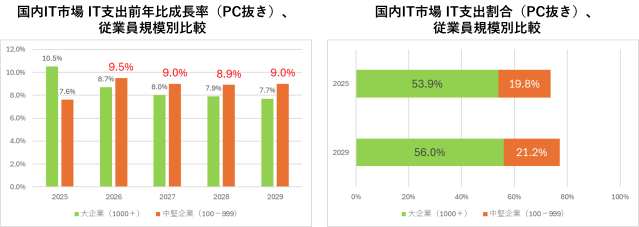
IDCは、2026年の国内IT市場規模が28兆4,189億円に達し、前年比3.3%増、2024年から2029年までのCAGRは6.4%になると予測しています。大企業は引き続き市場を主導し、その構成比は2025年の53.9%から2029年には56.0%へと拡大する見込みです。日本のIT市場拡大において、大企業の影響力は依然として中核を成しています。
しかし、構造的に重要なのは、中堅企業の同時的な存在感の高まりです。
従業員数100~999名の中堅企業は、IT支出全体に占める割合を2025年の19.8%から2029年には21.2%へと拡大する見込みです。さらに2026年には、中堅企業のIT支出(PCを除く)は前年比9.5%増と予測されており、大企業の8.7%増を上回ります。

2026年以降、日本のIT市場は「デュアルエンジン構造」によって特徴づけられることになります。すなわち、大企業による持続的な拡大と、中堅企業におけるデジタル化の加速です。

なぜ中堅企業はIT投資を加速させるのか

1. 生産性向上と人材コストの問題が経営課題に

国内の人手不足は、もはやマクロ経済の問題ではありません。とりわけ中堅企業にとっては、日々の事業運営に直結する制約要因となっています。

大企業も同様の課題を抱えていますが、強力なブランド力、人材採用体制、成熟したデジタル基盤を持ち、すでに自動化やデータ統合、生産性向上を目的にしたデジタルプラットフォームに多額の支出を行っています。

一方で中堅企業は、人材面やデジタル成熟度に課題を抱えている場合が多く、給与水準やブランド力での人材採用競争も容易ではありません。2026年に向けて人材不足がさらに深刻化する中、デジタル化は戦略的選択肢ではなく、事業継続の前提条件となります。

さらに、大企業や官公庁/地方自治体からのデジタル化対応の要請がサプライチェーンを通じて波及しています。デジタル化に遅れた中堅企業は、取引機会を失うリスクに直面します。

2026年以降、生産性向上を目的としたデジタル化は構造的な潮流となります。

2. 中堅企業には外部ベンダーのデジタル化支援が必要

大企業は内製化やIT子会社の設立、ハイパースケーラーや先端企業との直接連携を進めており、自社内でのITリソースを高度化させています。

しかし中堅企業は異なる制約下にあります。

多くの中堅企業は社内IT人材が限られており、大規模なシステムモダナイゼーションプロジェクトを自力で推進する能力を十分に持っていません。2026年にデジタル化プロジェクトが本格実行段階に入るにつれ、ITベンダーやSIerへの依存度は高まります。

中堅企業が求めるのは:

・エンドツーエンドの導入支援
・ユースケースベースのパッケージソリューション
・運用面まで含めたスケーラビリティ
・AIおよびクラウド活用に関する専門知識

ただし、この市場に対応するには、提供モデルの構造的な見直しが必要です。案件規模は比較的小さく、予算も限定的です。より軽量で成果志向のアプローチが求められます。

3. 中堅・地域系ベンダーの構造的優位性

国内IT市場の成長の重心が中堅企業に移る中、ITベンダー自身のポジショニングも重要になります。

大手および準大手ベンダーは大企業における大規模プロジェクトに不可欠ですが、中堅企業には異なるデリバリーモデルが求められます。より現場密着型で、地域性を踏まえた、柔軟な導入を重視するアプローチです。

中堅・地域系SIerは、この環境において構造的な優位性を持つ可能性があります。

規模、コスト構造、組織体制が中堅企業のニーズに適合しやすく、より密接な関係性を築きやすいからです。大規模プロジェクトに最適化された大手ベンダーとは異なり、スピード、アプローチの優位性、柔軟な導入の容易性に強みを持つプレイヤーは、中堅企業のデジタル化の拡大局面で成長機会を獲得しやすいでしょう。

4. クラウドが変革のハードルを下げる

大企業はレガシーシステムや高度にカスタマイズされたアーキテクチャにより、モダナイゼーションに時間とコストを要するケースが多くあります。

中堅企業は、相対的にシステム構造が単純であり、クラウド移行の障壁が低い傾向にあります。

IaaSやクラウドネイティブ基盤の拡大により、以下が可能になります:

・新システムの迅速な導入
・初期投資の抑制
・スケーラブルなIT基盤
・AI関連機能との容易な統合

2026年には、AIモデル、データ基盤、エージェント型AIプラットフォームを含むAI関連支出が急拡大する見込みです。クラウド環境は、中堅企業が大規模なシステム再構築プロジェクトを行わずにこれらを導入することを可能にします。

クラウドは既存システムと新しいシステムとの間の摩擦を減らします。迅速な成果を求める中堅企業にとって、これは特に重要な要素です。

2026年以降:成長は集中へ

国内IT市場は分散しているのではなく、多くの企業、公的部門において拡大傾向で収斂しています。

大企業は引き続き市場シェアを拡大し、中堅企業は構造的な成長エンジンを持つことで国内IT市場での存在感を強めます。

次の成長フェーズは:

・大企業の継続的なモダナイゼーション
・中堅企業のデジタル化の加速
・大企業、中堅企業の両セグメントでのAI活用拡大
・クラウド基盤への依存度の上昇

を軸に展開されます。

ITベンダーにとっての示唆は明確です。

今後の成長は、大企業による超大型プロジェクトだけではありません。システムモダナイゼーション、デジタル化プロジェクトに着手する中堅企業へのビジネス規模の拡大が鍵となります。

国内IT市場におけるデュアルエンジンでの市場拡大の構造を早期に把握し、提供ソリューション、パートナー戦略、デリバリー体制を中堅市場に適応させたベンダーこそが、日本のIT市場における次の持続的な成長フェーズを取り込むことができるとみています。

図表: 国内IT市場(PCを除く)前年比成長率、並びにIT支出割合比較:大企業、中堅企業

関連する調査やご相談について

より詳細なインサイトや市場動向については、当社アナリストへお気軽にご相談ください。

Hitoshi Ichimura - Senior Research Manager, Software, Services, and IT Spending, IDC Japan - IDC Japan

Hitoshi Ichimura is responsible for the market analysis of overall Japan IT spending, based in Tokyo. In this role, he is responsible for the market analysis of IT Spending research by vertical, company size and region. His main area of research involves IT Spending market forecast and trends for the Japan financial industry local area and SMB segment. Ichimura is also involved in various custom research projects in the area.

As enterprises push toward faster and more automated decision making, traditional data architectures are starting to show their limits. The gap between when data is generated, analyzed, and acted on is becoming a critical challenge, especially as AI moves closer to real time operations.

In this conversation, Devin Pratt, Research Director for Data Management at IDC, explores what this shift means in practice, from converged workloads to the growing importance of real time data for agentic AI, and how organizations can take a practical approach to modernizing their data environments. Recent platform announcements in the market have reinforced this shift toward more unified, real time data architectures.

You recently outlined converged workloads as a framework for the real time enterprise. How should leaders think about this model alongside traditional separated architectures?

Devin Pratt: When I say converged workloads, I mean bringing transactions, analytics, and AI closer to the same live data so businesses can respond faster. I would not frame this as an old versus new or rip and replace decision. Separate transactional and analytical systems were built for good reasons, and those reasons still matter.

What has changed is the speed the business now expects between an event, an insight, and an action. This is why leaders should think in terms of selective convergence. Where timing matters, converged workloads bring live operational data together with the analytics needed to understand it in real time. That helps organizations respond faster and make better decisions.

It is especially important for agentic AI. If you want real ROI from agentic AI, it cannot run on stale data. It needs live operational data to understand what is happening now, and it needs analytics to interpret that data and guide the right action in real time.

The goal is not convergence for its own sake. It is to converge where faster insight, faster action, and AI driven automation create real business value.

IDC’s 2026 FutureScape predicts that by 2029, 60% of enterprise data platforms will unify transactional and analytical workloads. What is driving that shift?

Devin Pratt: The shift is really about speed. Organizations want to reduce the delay between an event, the analysis of that event, and the action that follows. Converged workloads help make that possible by bringing operational data and analytical processing closer together in real time.

AI is obviously a big part of why this is happening now.

That puts real pressure on architectures built around delayed copies and handoffs, because agentic AI depends on current operational data and analytical context.

The technology is also much more ready than it used to be.

The bigger point is that convergence is becoming a mainstream way to support real time decision making, continuous intelligence, and agentic AI.

When would separate transactional and analytical systems still make sense?

Devin Pratt: They can still make sense where organizations want stricter workload isolation around critical systems, or where a phased approach is more practical. Not every business process needs a real time response.

If acting immediately does not materially change the outcome, a more traditional approach can still be the right one. So this is not all or nothing. The practical path is to converge where latency really matters and let the rest evolve over time.

Databricks recently announced Lakebase as generally available. What does this tell you about how the market is evolving?

Devin Pratt: It tells me the lines between categories are blurring. Lakehouse vendors are adding more transactional database capabilities, while traditional database vendors are adding more analytics, automation, and AI directly into their platforms.

The bigger point is that buyers want fewer copies, fewer handoffs, less data movement, and stronger governance across the entire environment. They are looking for platforms that are simpler to run and better suited for real time intelligence and AI.

So I see this as another sign that the market is moving away from rigid categories and toward more unified, AI ready data platforms.

How should organizations evaluate whether to move toward convergence or maintain a traditional model?

Devin Pratt: I would start with one simple question: where does stale data hurt the business? If it is not affecting revenue, customer trust, resilience, or speed, then there is no reason to force convergence.

Then I would look at operating model readiness. Can we run mixed workloads reliably with strong governance and clear visibility into performance and cost? That matters, because most enterprises are already operating across hybrid and multi cloud environments.

My advice is to keep this practical. Start with a few high value real time use cases, take a phased approach, re architect for scale where needed, put governance and observability in early, prove performance and trust, and then expand.

What does the real-time enterprise actually mean beyond faster dashboards?

Devin Pratt: To me, the real-time enterprise is not about better dashboards. It is about sensing what is happening and responding while the moment still matters.

That could mean stopping fraud in the moment, predicting equipment issues before failure, or changing a customer interaction while it is still underway. This is very different from just reporting faster.

This is also where AI agents come in. IDC expects that by 2027, 40 percent of the Global 2000 will adopt modern event streaming and pre built real time data views to support AI agents.

I would describe the real-time enterprise as a shift from looking back at what happened to acting while it is happening.

As AI adoption grows, what architectural considerations should CIOs prioritize right now?

Devin Pratt: First, make trusted data available to AI in real time, even if that data stays in different systems.

Second, build the real time foundation: streaming data, change data capture, event driven workflows, and open interfaces that let AI work from live business context instead of stale copies.

Third, put governance, observability, identity, and access at the center. Trust and control have to be built into the architecture from the start, especially as agentic AI becomes more operational.

Finally, keep AI close to the data. Organizations want AI capabilities embedded into the broader data platform, not pushed into another silo.

The goal is to create a trusted, real time data environment where AI can reason, decide, and act with the right context and guardrails. This is not about putting every workload into one platform. It is about reducing the distance between a business event, a trusted insight, and an action without giving up governance, performance, or control.

Christina Cardoza - Content Marketing Manager - IDC

Christina Cardoza is a Content Marketing Manager at IDC, where she specializes in brand content and social media strategy. With a background in journalism and editorial leadership, she has a proven ability to transform complex technology topics into clear, actionable insights.

国内AIインフラ市場は、いま大きな転換点を迎えています。これまで市場の成長を牽引してきたのは、AIモデルの「学習」を支えるAIインフラ投資でした。しかし今後は、推論を軸とした社会実装フェーズへの移行が進むとIDCではみています。AI活用がPoC(概念実証)から本番運用へと広がる中で、AIインフラの役割や求められる要件も大きく変化しつつあります。IDCでは、2026年を学習から推論への転換点と位置づけています。

1. 急成長する国内AIインフラ市場と「学習中心」からの転換

ここ数年、国内AIインフラ市場は急速な拡大を遂げました。ハイパースケーラーや国内クラウド事業者による大規模投資を背景に、2023年、2024年は共に前年比100%以上の成長を記録し、市場規模は2年連続で倍増以上となりました。国内AIインフラ市場の支出額は2025年には6,946億円に達し、今後は年間平均成長率(CAGR:Compound Annual Growth Rate)7.3%で成長し、2030年には約1兆円規模に迫るとIDCでは予測しています。

一方で、今後の成長を牽引する要因は大きく変化します。これまで中心だった学習用途に加え、業務の中で継続的にAIを活用する推論需要が拡大し、市場の主軸が移行していきます。IDCでは、2027年には国内AIサーバー市場において推論向けの支出が学習向けを上回ると予測しています。また、2025年から2030年のCAGRは推論向けが学習向けを10ポイント以上も上回る予測です。

2. 推論の拡大がもたらすAIインフラ利用の変化

IDCによる最新の調査「Japan Digital and AI Infrastructure Strategies and Investment Survey 2026」では、推論用途で利用予定のAIインフラはパブリッククラウドが過半を占める一方で、専有型インフラやエッジ環境といった「プライベートAIインフラ」も20~30%台に達しています。

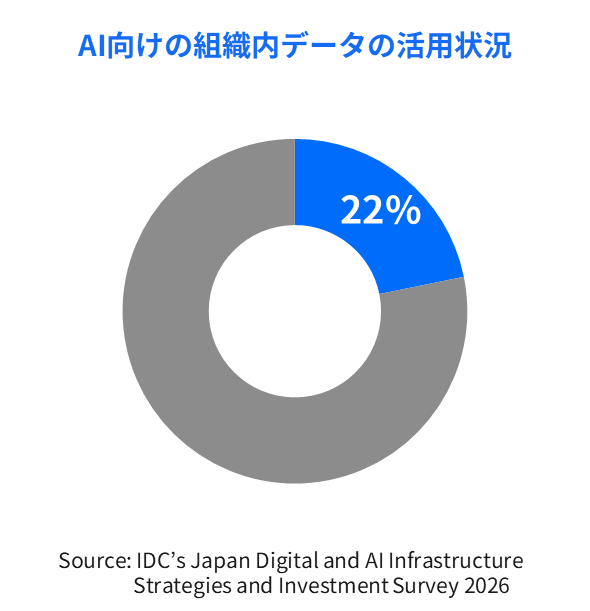
一方で、AI向けに組織内データを本格的もしくは高度に活用している企業は22%にとどまっています。現在は先行企業が中心となって、機密情報や個人情報を含む組織内データの AI での活用に取り組み始めている段階にあることを示しています。

IDCの調査では、こうした先行企業は今後、プライベートAIインフラを利用する意向が強くなっています。その背景には、自社のニーズに最適な構成の採用や、可用性やコストの予測可能性の高さ、さらに、法規制やソブリンAIへの対応を重視していることがあります。事業の安定的な継続性を考慮したうえで、コスト競争力と信頼性の高いAI基盤の整備を進めています。

  • AI向けに組織内データを本格的もしくは高度に活用している企業は22%にとどまっている。
  • 組織内データ活用の先行企業は、コストの競争力と予測可能性を向上し、ソブリンAIも考慮した信頼性の高いAI基盤の整備を進めるために、今後、プライベートAIインフラを利用する意向が強い。

AIインフラが国家戦略や企業競争力にも直結する基盤となるにつれて、ソブリンAIやデータ主権への対応も重要視されます。データの保護や所在管理、地政学リスクへの備えといった観点から、専有環境やソブリンクラウドの活用も拡大する見通しです。

3. AIインフラ向けサービス市場の拡大と競争軸の変化

AIインフラの導入拡大に伴って、構築・運用・保守を担うITインフラサービス市場も急成長しています。国内AI向けITインフラサービス市場は2025年の957億円から2030年には2,320億円へと拡大し、CAGRは19.4%に達する見込みです。AIインフラは設計や運用が高度化しており、液冷対応やデータセンター設備を含めた専門的な対応が求められることが、サービス需要を押し上げています。

市場の競争軸は、従来のハードウェア性能中心から、柔軟なインフラ選択やサービス提供能力、AIの本番実装を支援する総合力へとシフトしています。これまでは高性能GPUを軸としたAIインフラ製品や構築・運用サービスで先行したベンダーが市場を牽引してきましたが、今後はAI導入からアプリケーション開発、ハイブリッド環境の構築・運用、さらにはソブリンAI対応までを包括的に支援できる企業が競争優位を確立するとIDCはみています。

IDCが提供するレポートのご紹介

IDCでは、国内AIインフラ市場の変化を詳細に分析したレポートを発行しています。

本調査レポートでは、国内AIインフラ市場の構造変化を把握するため、2025年から2030年の市場予測をセグメント別に分析しています。サーバー/ストレージ別、サービスプロバイダー/エンタープライズ別、配備モデル別、産業分野別に加え、AIサーバー市場について、学習/推論別やアクセラレーテッド/ノンアクセラレーテッド別に予測しています。

また、国内AI向けITインフラサービス市場についても、顧客タイプ別およびサービスタイプ別に予測しています。さらに、AIインフラ需要の変化や主要ベンダーの動向も整理しており、今後の市場機会や競争環境の変化を明らかにしています。

これらの分析によって、学習から推論へのシフトに伴うAIインフラの需要構造の変化や、サービスプロバイダーとエンタープライズの投資動向の違い、今後拡大するサービス市場の機会を包括的に把握できます。

関連する調査やご相談について

より詳細なインサイトや市場動向については、当社アナリストへお気軽にご相談ください。

Yukihisa Hode - Research Manager, Infrastructure & Devices, Research, IDC Japan - IDC Japan

Yukihisa Hode is a research manager covering digital infrastructure strategies as well as AI infrastructure, IT infrastructure services, IT operations, hybrid/multicloud and hyperconverged infrastructure (HCI). He leads the research program on digital infrastructure strategies, providing insight and advice on the digital infrastructure through research reports, marketing content, and presentations to support IT and digital decision-making.

近两年,具身智能正成为人工智能领域的重要发展方向,并推动机器人产业进入新一轮创新周期。从技术探索走向商业落地,越来越多企业开始关注具身智能机器人。然而,在产业热度持续升温的同时,一个更为关键的问题也逐渐凸显:企业用户真正需要什么样的机器人?

为了更好理解市场需求,IDC对中国企业用户进行了专项调研,从企业认知、应用需求、采购意愿和落地挑战等多个维度进行分析。总体来看,中国企业用户对具身智能机器人与人形机器人等新兴方向保持较高关注,并已开展试点探索,普遍看好其在中长期通过灵活协作和高场景适应性释放应用价值。

企业整体态度偏积极,正从关注走向探索

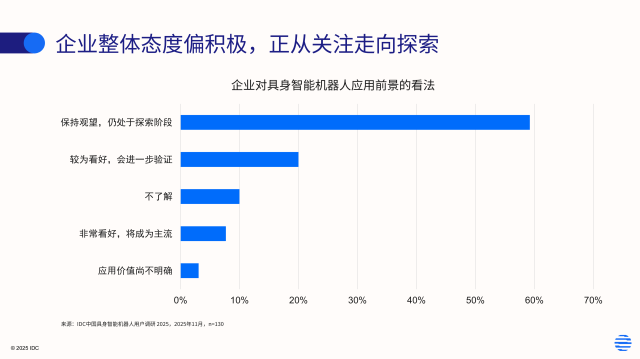
从企业整体态度来看,当前市场呈现出以“关注与探索”为主的结构。约27.7%的企业已表达出明确的积极态度,超过一半的企业虽仍处于观望阶段,但已开始关注并评估相关技术。

这一结构符合新技术商业化早期特征:少数企业率先布局,更多企业处于验证与观望阶段。随着技术成熟度提升及应用案例的不断积累,企业对具身智能机器人的接受度有望进一步提升。

感知能力优先提升,执行与安全能力成为关键支撑

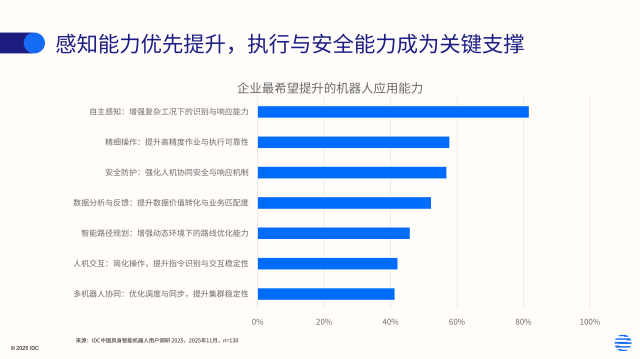
在能力需求方面,企业对具身智能机器人的优化方向呈现出明显的递进结构:首先是环境感知能力,以实现“看得清、反应快”;其次是执行与安全能力,确保“做得准、运行稳”;在此基础上,再逐步向决策与协同能力升级,推动机器人向更高水平的智能化发展。

这一趋势表明,具身智能机器人的能力演进正从单点能力优化,走向“感知—执行—决策”一体化能力体系。

企业选型更加理性:可靠性、ROI与生态能力成为核心

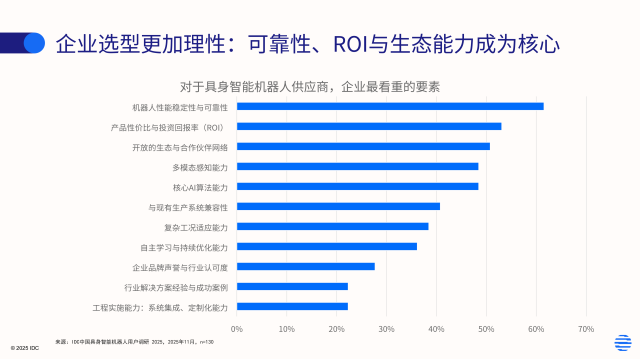
在具身智能机器人供应商选择方面,企业最看重的三大因素分别是:设备稳定性与可靠性(61.5%)、产品性价比与投资回报率(53.1%)以及生态与合作伙伴网络(50.8%)。

与此同时,具身智能相关技术能力同样受到高度关注。约48.5%的企业关注核心AI算法能力与多模态感知能力,说明企业在关注硬件性能的同时,也 持续重视机器人在感知、决策与协作方面的智能化水平。

与此同时,企业对具身智能技术能力关注度持续提升。近半数企业看重核心AI算法与多模态感知能力,表明其在关注硬件性能的同时,也重视机器人在感知、决策与协作方面的智能化水平。

整体来看,企业在评估具身智能机器人供应商时,正在从单纯的硬件性能评估,逐步转向综合能力评估,包括设备可靠性、投资回报、智能化能力以及生态协同能力等多个维度。这一结果表明,当前企业在选择具身智能机器人供应商时呈现出 “可靠性优先、经济性驱动、智能化能力并重” 的特点。

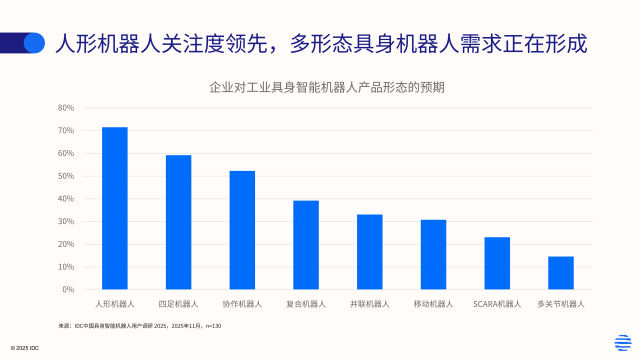
人形机器人关注度领先,多形态机器人需求正在形成

从期望形态来看,人形机器人获得了最高关注度。用户对引入人形机器人的核心期望集中在仓储物流(76%)、生产制造(68%)、安防巡检(51%)等对人力依赖度高、任务标准化程度强的领域,期望其通过承担重复性、高强度或高风险工作,释放人力资源并提升整体运营效率。

同时,中国工业企业用户对具身智能机器人载体形态的需求正呈现出多样化趋势。除人形机器人外,四足机器人与协作机器人等在特定场景中同样具备较高应用价值。未来,多形态并行发展有望成为具身智能机器人市场的重要特征。

资产化采购仍占主导,RaaS模式加速渗透

从采购模式来看,直接购置仍是主流方式(54.6%),多数企业仍将机器人作为固定资产进行投资与管理。

分企业规模来看,小型企业更倾向于一次性购置,而中大型企业对融资租赁的接受度更高(39.4%),体现出其在资本支出上的灵活性与金融工具应用能力。

相比之下,RaaS模式正处于加速发展阶段(12.3%),较2024年的6%实现显著提升。尽管整体渗透率仍有提升空间,但企业已开始逐步接受按使用付费的模式,随着服务体系、计费模式及运维能力的持续完善,RaaS有望进一步加快普及。

三个值得关注的产业趋势

趋势一:工业率先验证规模化路径,多场景应用同步推进

具身智能机器人的商业化落地将呈现“分场景推进”的特征。其中,制造与物流等工业场景由于具备更强的标准化程度与明确的投资回报,更有可能率先跑通规模化应用路径。

与此同时,服务类场景(如导览迎宾、康养服务等)也在持续推进,但更依赖交互体验与场景适配能力,其落地节奏与路径将有所不同。

趋势二:多任务能力成为具身智能机器人规模化应用的关键门槛

机器人竞争正在从“能否完成单一任务”,转向“能否适应多任务与复杂环境”。单点能力已难以支撑企业长期投入,企业更关注机器人在不同任务与场景间的复用能力。

趋势三:产业竞争向生态迁移,体系化能力成为核心竞争力

随着应用复杂度提升,机器人已不再是单一硬件产品,而是融合AI模型、软件平台与系统集成的综合解决方案。企业对生态能力的重视,意味着厂商竞争正从“产品”走向“体系”。

整体来看,具身智能机器人正进入从“技术验证”走向“规模落地”的关键阶段,场景突破、能力升级与生态构建将成为产业演进的三大主线。

本文核心观点来源:

 《具身智能与人形机器人:中国工业落地新机遇》(Doc# CHC53325326,2026年2月)

《中国具身智能机器人应用市场分析与典型应用实践,2025》(Doc# CHC53183625,2025年12月)

具身智能机器人正从技术探索迈向商业落地,中国企业在认知、需求与采购模式上的变化,正在深刻影响这一新兴市场的演进方向。IDC将持续追踪具身智能及机器人领域的最新动态,深入洞察用户需求变化与产业趋势。如需获取更多报告详情、数据洞察或安排分析师访谈,欢迎随时与我们联系。

如需进一步了解与研究相关内容或咨询 IDC其他相关研究,请点击此处与我们联系。

Geopolitical crises rarely arrive with clear warning. When they do, the pressure on digital infrastructure, supply chains, and technology operations becomes immediate. 

The war in the Middle East is a structural stress test for the modern digital economy and for the CIOs responsible for keeping businesses running through disruption. 

Unlike earlier periods of conflict, today’s enterprise IT environment depends heavily on cloud infrastructure, subscription-based services, and globally interconnected supply chains. Disruption is no longer contained. It can extend quickly across regions, systems, and partners. 

For CIOs, the challenge is not only managing risk. It is sustaining operations while adapting to changing conditions and maintaining the ability to support the business.

IDC Perspective: From Conflict to Continuity: How CIOs Can Respond to Disruption from the Middle East War.

Why this crisis is different for CIOs 

Enterprise IT has shifted from internally controlled environments to highly distributed ecosystems. 

Organizations now depend on: 

  • Cloud providers and platform services  
  • Distributed infrastructure and operations  
  • Global supply chains for technology components and delivery  

This dependency introduces new forms of exposure. 

Regional instability can affect: 

  • Application availability and performance  
  • Hardware deployment timelines  
  • Cyber threat activity  
  • Infrastructure and energy costs  

These pressures are already testing the assumptions built into many digital strategies. 

The priority for CIOs is to understand where exposure exists and how it could affect operations. 

Start with exposure mapping and scenario planning 

The first step is to identify where the organization is most exposed. 

CIOs should map dependencies across four dimensions: 

  • Employees and contractors located in or near affected regions  
  • Customers and revenue streams tied to impacted markets  
  • Suppliers and logistics routes connected to disrupted corridors  
  • Applications, data, and support operations dependent on regional infrastructure  

This exposure map becomes the foundation for decision making. 

Scenario planning builds on that foundation. It provides a structured way to prepare for multiple outcomes rather than relying on a single forecast. 

IDC outlines two scenarios that CIOs should actively consider: 

  • A period of sustained regional instability  
  • A broader escalation that introduces energy and cyber shocks  

Each scenario changes how organizations prioritize resilience, security, and investment decisions. 

See how the Middle East conflict is reshaping global IT spending.

What CIOs should prioritize now 

CIOs should focus on five immediate priorities. 

Revalidate cloud and infrastructure resilience 
Assess dependency on single regions or providers and identify gaps in failover readiness. 

Strengthen cyber readiness 
Expect increased threat activity and reinforce detection, response, and recovery capabilities. 

Diversify technology supply chains 
Identify potential points of disruption and reduce reliance on single suppliers or routes. 

Review data sovereignty and compliance exposure 
Geopolitical tension often accelerates data localization and regulatory requirements. 

Prepare workforce continuity plans 
Ensure employees and teams can continue operating under disrupted conditions, including remote work and alternative communication channels. 

These priorities are not new. What is changing is the need to address them simultaneously and at speed. 

Leading through disruption 

Resilience is not only a technical challenge. It is a leadership challenge. 

CIOs must provide clarity and direction during periods of uncertainty. The organizations that respond most effectively are those where teams understand the mission and are able to act quickly. 

Effective leadership actions include: 

  • Establishing a clear operational focus on protecting critical systems  
  • Enabling faster decision making across teams  
  • Breaking large challenges into manageable objectives  
  • Identifying opportunities to simplify and strengthen existing environments  

Periods of disruption often accelerate changes that were already needed. They expose technical debt, operational inefficiencies, and gaps in resilience. 

The organizations that make progress during these moments treat disruption as a point of action rather than a pause. 

Explore the Middle East conflict resource center.

From disruption to operational readiness 

The current environment reflects a broader shift in how geopolitical events interact with digital operations. 

CIOs are no longer preparing for isolated incidents. They are operating in conditions where disruption can affect multiple parts of the enterprise at the same time. 

This requires a more continuous approach to resilience: 

  • Ongoing visibility into dependencies and risk exposure  
  • Planning that accounts for multiple possible outcomes  
  • Integration of resilience into everyday operations  

Organizations that build this capability will be better positioned to sustain performance through uncertainty. 

Explore the full scenario framework 

Understanding exposure is the starting point. Acting on it requires a structured approach. 

The IDC Perspective expands on these scenarios and outlines how CIOs can translate them into operational decisions, including: 

  • Scenario-specific implications for IT spending and AI investment  
  • Infrastructure, cybersecurity, and workforce continuity considerations  
  • Key risk signals to monitor as conditions evolve  

Want deeper insight into how these shifts are affecting technology investment? Watch how the Middle East conflict is reshaping global IT spending.

Rick Villars - Group VP, Worldwide Research - IDC

Rick is IDC's chief analyst guiding research on the future of the IT Industry. He coordinates all IDC research related to the impact of Cloud and the shift to digital business models across infrastructure, platforms, software, and services. He helps enterprises develop effective strategies for using their diverse portfolio of cloud investments and applications. He supplies early guidance on implications of critical innovations such as the shift to cloud-based control platforms for deploying/managing infrastructure, data, and code delivery as well as the emergence of AI as a critical IT workload and part of all IT products/services.

Daniel Saroff - GVP, Consulting and Research Services - IDC

Daniel Saroff is Group Vice President of Consulting and Research at IDC, where he is a senior practitioner in the end-user consulting practice. This practice provides support to boards, business leaders, and technology executives in their efforts to architect, benchmark, and optimize their organization's information technology. IDC's end-user consulting practice utilizes our extensive international IT data library, robust research base, and tailored consulting solutions to deliver unique business value through IT acceleration, performance management, cost optimization, and contextualized benchmarking capabilities.

Lars Goransson - Vice President, Research, Worldwide Services - IDC

Lars Goransson is Vice President of Research, Worldwide Services at IDC. He leads IDC’s global research and advisory for IT and business services, focusing on how technology suppliers and buyers can navigate market shifts, innovation, and business transformation. Lars’s research explores the evolving dynamics of the worldwide services landscape, providing clients with trusted tech intelligence and evidence-based insight to make confident decisions in a fast-changing digital economy. His work illuminates the path forward for organizations seeking to anticipate demand, validate investments, and seize new opportunities.

Linus Lai - Group Vice President, Research - IDC

Linus Lai is a distinguished member at IDC Asia/Pacific, in which he spearheads research in digital business, trust, infrastructure, and services. With over 25 years of industry experience, Linus is based in Sydney and serves as the chief analyst for Australia and New Zealand (ANZ). He is a founding member of IDC's Emerging Technology Advisory Council and a respected senior member of the region's CIO100, CSO, and Future Enterprise awards. In his role, Linus provides strategic insights for digital leaders and the technology sector, focusing on sourcing strategies and emerging technology across Asia/Pacific. His expertise has earned him numerous accolades for his contributions to country, regional, and quality research. Previously, as the head of research in Southeast Asia, Linus was instrumental in expanding IDC's presence and influence in the region. His thought leadership is frequently sought after through regular features in various publications and media outlets. He is also a prominent speaker at industry forums, keynote events, and strategy workshops. Before joining IDC, Linus worked with a leading outsourcing service provider with a digital banking focus. He holds a Master of Science degree from the University of Lincoln, United Kingdom.

Mary Johnston Turner - Research VP - IDC

Mary Johnston Turner is Research Vice President within IDC's worldwide infrastructure research organization and global research lead the Digital Infrastructure Strategies practice. Mary's coverage tracks enterprise tech buyer sentiment related to compute, storage, edge, operations and cloud platforms and deployment models. Current research priorities emphasize the impact of rising requirements for data-driven AI-Ready Infrastructure, Fit-for-Purpose Hybrid and Multicloud Architectures, Autonomous Operations, Edge Integration, and collaborative business and IT governance. Her practice emphasizes the voice of the enterprise customer, based on surveys and in-depth analysis of best practices and infrastructure investment priorities. Mary's research emphasizes consideration of topics related to AI-ready infrastructure, tech debt avoidance, data center modernization, mainframe modernization, infrastructure governance, staffing and skills priorities, and infrastructure operating models. Within the infrastructure research organization, Mary collaborates with other practice leads to ensure coherency and alignment of insights and published research.

Laurie Buczek - GVP, Research - IDC

Laurie Buczek is the Group Vice President of Executive Insights at IDC, where she spearheads the global research initiatives that shape the industry's understanding of digital business transformation, evolving buying behaviors, and technology investments. She leads IDC's premier research practices, including the CMO Advisory Practice, C-Suite Tech Agenda, and Digital to AI Business Transformation. As the principal analyst for the CMO Advisory Practice, Laurie advises senior marketing leaders on driving business growth through deeper customer connections and the strategic evolution of the marketing function, with a keen focus on AI's transformative impact. Her expertise and thought leadership empower executives to navigate the intersection of technology, business strategy, and customer engagement in today's dynamic digital landscape.

Michelle Abraham - Sr. Director, Research Cybersecurity - IDC

Michelle Abraham is a Senior Research Director in IDC's Security and Trust Group responsible for the Security Information and Event Management (SIEM), Exposure Management and Related Artificial Intelligence Technologies practice. Ms. Abraham's core research coverage includes SIEM platforms, exposure management platforms, attack surface management, breach and attack simulation, cybersecurity asset management, and device vulnerability management alongside AI-related security topics.

Craig Robinson - Research Vice President , Security Services - IDC

Craig Robinson is a Research Vice President within IDC’s Security Services research practice, focusing on managed services, consulting, and integration. Coverage areas include Managed Detection and Response services, Cyber Resilience, and Incident Readiness & Response services.

Agentic AI is moving from experimentation toward enterprise orchestration. Early deployments emphasized efficiency. As systems scale, the more significant shift lies in how enterprises redesign value creation, capture, and long-term advantage.

IDC’s FutureScape 2026 predictions identifies this transition as one of four strategic imperatives shaping the agentic future. Unlocking innovation beyond productivity defines how organizations translate AI maturity into new business models, revenue streams, and sustained competitive position.

Innovation beyond productivity refers to the structural redesign of business models, industry boundaries, and economic logic enabled by agentic AI operating across enterprise portfolios and ecosystems. It reflects how organizations convert AI maturity into scalable growth, differentiated customer value, and durable competitive advantage.

This is the focus of Pillar 4 within FutureScape 2026.

The productivity plateau

The first wave of AI delivered measurable gains. Contact centers reduced handle times. Back-office operations automated repetitive tasks. Sales and marketing teams improved throughput. These gains were important because they made AI investment tangible.

However, efficiency advantages diffuse quickly. What creates competitive differentiation in one quarter becomes standard capability the next. Productivity improvements, when layered onto existing operating models, eventually reach saturation.

Productivity-first strategies constrain long-term impact in three ways:

  1. They reinforce functional silos. AI is deployed by department, and each team optimizes local objectives.
  2. They lock in current assumptions. Optimization strengthens workflows designed for earlier market conditions.
  3. They produce linear gains. Efficiency improvements reach saturation when underlying structures remain unchanged.

The constraint is not AI capability. The constraint is operating design. When AI is layered onto legacy structures without structural redesign, outcomes remain incremental.

Innovation as the structural payoff of agentic AI

Innovation occurs when AI reshapes enterprise structure rather than simply accelerating task execution. Agentic AI enables coordinated decision-making across marketing, supply chain, finance, service, and ecosystem partners. Systems move from isolated automation toward orchestration embedded in enterprise operating models.

Innovation beyond productivity highlights three requirements for structural innovation in the agentic era:

  • Redefined industry boundaries. Agentic AI facilitates collaboration between domains that previously operated independently, reshaping competitive landscapes.
  • New economic logic. When agents operate autonomously at scale, assumptions about capacity, cost, and output change. Business cases designed for linear improvement do not capture compounding value created through coordination.
  • Governance as infrastructure. Governance must support cross-domain orchestration while embedding accountability into operating design.

Where value models are being rebuilt

FutureScape research identifies structural pressure points where value creation is already evolving. These signals reflect changes in pricing structures, industry organization, and coordinated delivery models.

Pricing model evolution
Traditional pricing frameworks were built around human labor and seat-based licensing. As agent interactions increase, value shifts from access to measurable outcomes. Enterprises and providers are redesigning pricing logic to reflect agent-mediated execution and results. This indicates a change in value capture, not simply a change in delivery.

Life sciences reinvention
Agentic AI is transforming pharmaceutical research and development. By 2030, 80 percent of pharmaceutical companies are projected to partner with TechBios, leveraging agentic AI and quantum computing to reduce R&D costs and failure rates. This signals new industry architectures built on coordinated discovery and ecosystem collaboration.

Healthcare system coordination
Healthcare has traditionally operated through linear care pathways. Agentic AI enables continuous orchestration across diagnosis, treatment, monitoring, and escalation. By 2030, one in three top-tier hospitals is expected to deploy AI agents delivering real-time decision support and autonomous workflows with high levels of accuracy. Clinical value becomes embedded in system coordination rather than isolated interventions.

Consumer ecosystem realignment
Immersive digital environments and gaming platforms are evolving into coordinated ecosystems for engagement and commerce. By 2026, two-thirds of Gen Z and Gen Alpha are projected to spend more time gaming than on social media. This signals movement toward platforms designed for persistent interaction and orchestrated value creation.

Rethinking AI ROI

As AI becomes integral to enterprise operating logic, traditional ROI metrics require reassessment. Leaders must reconsider three assumptions:

  • Short-term cost savings do not define strategic value.
  • Pilot programs do not create durable advantage without integration.
  • Model accuracy does not guarantee enterprise impact if objectives remain unchanged.

Legacy metrics focus on time saved and expenses reduced. Structural innovation requires evaluation of adaptability, cross-functional coordination, and long-term growth potential.

This shift aligns AI outcomes with enterprise design and economic logic, not isolated task performance.

Innovation as portfolio and ecosystem strategy

Agentic AI generates the greatest impact when managed as a coordinated portfolio rather than discrete initiatives. Each deployment should strengthen enterprise adaptability, improve cross-functional coordination, and expand future strategic options.

Unified governance frameworks support this model by embedding oversight into operating systems and enabling autonomous action within defined boundaries.

As agents operate across organizational and ecosystem boundaries, value creation becomes interdependent. Competitive advantage becomes systemic and embedded within enterprise design.

Defining the next horizon

Productivity remains necessary. Structural innovation determines sustained advantage.

The transition highlights a pivotal transition within the agentic journey. Agentic AI is redefining economic models, industry boundaries, and enterprise architecture. Organizations that redesign for orchestration, portfolio coordination, and ecosystem alignment position themselves for long-term growth in the AI-fueled economy.

Explore innovation beyond productivity in depth

FutureScape 2026 includes detailed research, analyst perspectives, and events that expand on the innovation beyond productivity theme.

Core Research

Analyst perspectives

On-demand webinars

IDC - -

International Data Corporation (IDC) is the premier global market intelligence, data, and events provider for the information technology, telecommunications, and consumer technology markets. With more than 1,300 analysts worldwide, IDC offers global, regional, and local expertise on technology and industry opportunities and trends in over 110 countries. IDC’s analysis and insight help IT professionals, business executives, and the investment community make fact-based technology decisions and achieve their key business objectives.

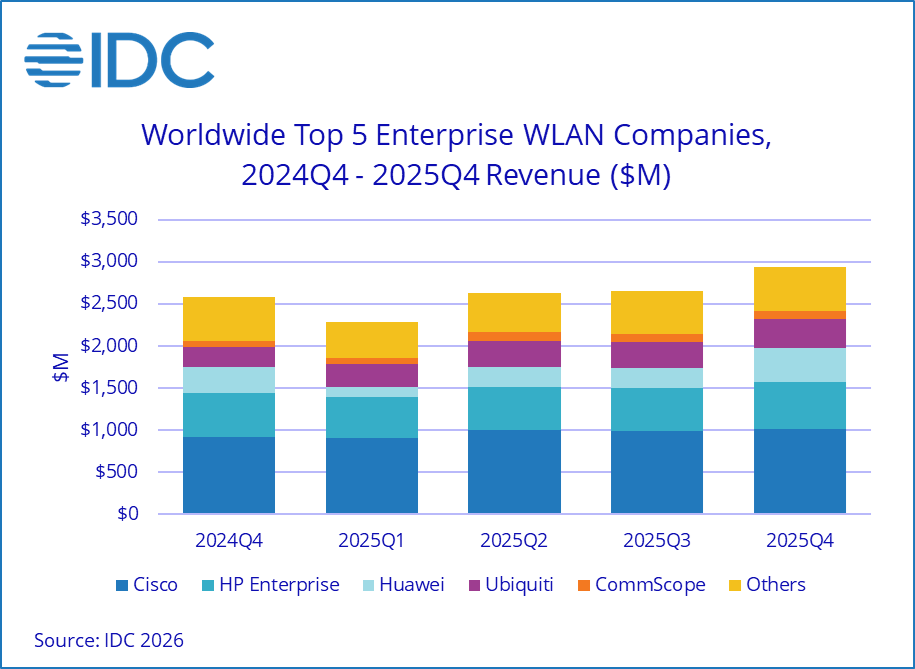
In the fourth quarter of 2025 (4Q25), the worldwide enterprise WLAN market reached $2.9B, growing 13.9% year over year. The primary driver was the rapid adoption of Wi-Fi 7, which accounted for 39.7% of dependent access point segment revenue, up from 10.25% a year earlier. For full-year 2025, the market totaled $10.5B, with 11.4% annual growth, reflecting ongoing demand for advanced wireless standards.

Why enterprise WLAN matters in the AI era

In the AI era, connectivity is no longer just infrastructure—it is a strategic foundation for digital business. Enterprise WLAN plays a critical role in delivering secure, reliable, and high-performance connectivity across enterprise campuses, branches, and edge environments. At the same time, AI-driven applications, video traffic, and the rapid growth of IoT devices are placing unprecedented demands on network capacity, latency, and efficiency, pushing organizations to rethink and modernize their wireless networks.

IDC’s 4Q25 WLAN Tracker highlights a clear inflection point: 60% of global enterprise WLAN spending is now directed toward Wi-Fi 6E and Wi-Fi 7. This shift reflects a move from early adoption to mainstream deployment, as enterprises invest in next-generation WLAN technologies to support higher performance requirements and enable emerging AI-driven and distributed business models.

Market dynamics: WiFi 7 and AI drive upgrades

The enterprise WLAN market is being shaped by continued innovation, evolving architectures, and the growing influence of AI. The expansion of 6GHz spectrum with Wi-Fi 6E and the accelerating adoption of Wi-Fi 7 are driving a new wave of upgrades.

At the same time, AI is improving how WLANs are designed and operated through greater automation and optimization, while enterprises adopt platform-based approaches that integrate WLAN with broader networking, security, and observability tools. Combined, these trends are driving strong growth in the enterprise WLAN market, both in 4Q25 and for full-year 2025.

From a geographic perspective, in 4Q25, the Americas saw a 13.9% year-over-year increase, while Europe, the Middle East & Africa experienced robust growth of 25.2% YoY. In contrast, the Asia Pacific region saw a slight revenue decline of 0.9% YoY, highlighting regional disparities in technology adoption and investment priorities.

Vendor performance: Cisco leads as growth accelerates

Cisco maintained its leadership in the enterprise WLAN market, with revenue rising 10.8% year over year to $1.0B and a market share of 34.6% in 4Q25. For the full year, Cisco’s revenue increased 4.9% to $3.9B, giving the company a market share of 37.2% at year-end.

HPE, now including Juniper following its July 2025 acquisition, grew 4.7% YoY to $552.8M, capturing 18.8% of the market in 4Q25. For the full year, HPE’s revenue increased 7.6% to $2.0B, giving the company a market share of 19.7% at year-end.

Ubiquiti saw the highest growth among major vendors, increasing 49.0% YoY to $344.5M and holding 11.7% market share in 4Q25. For the full year, the company’s revenue grew 53.1% to $1.2B, maintaining an 11.7% share in 2025.

Huawei posted strong growth, up 32.1% YoY to $409.8M, with a 14.0% share in 4Q25. For the full year, revenue rose 18.4% to $1.0B, giving the company a 9.6% share.

CommScope (Ruckus Networks) grew 13.4% YoY to $88.8M, representing 3.0% of the market in 4Q25. For the full year, revenue rose 26.0%, giving the company a 3.4% share.

Outlook: Wi-Fi 7 momentum and AI-driven networks

IDC expects continued momentum in enterprise WLAN upgrades as organizations pursue higher performance, greater automation, and tighter integration with AI-driven and distributed workloads. Wi-Fi 7 adoption is likely to accelerate further—alongside increased deployment of tri-band APs—particularly in regions with strong digital transformation initiatives.

Growth will also be supported by rising adoption of AI-driven network operations, platform-based networking approaches, and cloud-managed architectures, as enterprises seek more scalable and flexible environments. At the same time, evolving security requirements, including zero trust frameworks, will remain a key driver, while supply chain constraints or macroeconomic headwinds may temper growth in certain regions. Watch for continued innovation in AI capabilities, architectural models, and vendor strategies in the coming quarters.

For deeper analysis and IDC research on enterprise WLAN trends, visit IDC’s Worldwide Quarterly WLAN Tracker or contact IDC for the latest market insights.

Brandon Butler - Sr. Research Manager - IDC

Brandon Butler is a Senior Research Manager with IDC's Network Infrastructure group covering Enterprise Networks. His research focuses on market and technology trends, forecasts and competitive analysis in enterprise campus and branch networks. His coverage includes technologies used in local and wide area networking such as Ethernet switching, routing/SD-WAN, wireless LAN, and enterprise network management platforms. While contributing to ongoing forecast and market share updates, he also assists in end-user surveys, interviews and advisory services and contributes to custom projects for IDC's Consulting and Go-To-Market Services practices.

Petr Jirovsky - Senior Research Director, Network Infrastructure and Services - IDC

Petr Jirovsky is a Senior Research Director within IDC's Enterprise Infrastructure global research domain. He provides quantitative insights on network infrastructure for the datacenter, cloud, and campus/branch environments as part of the Network Infrastructure and Services subdomain. Petr serves as the global lead for IDC's Network Infrastructure Trackers, which track Ethernet switches, routers, wireless equipment, and application delivery appliances and services. He also contributes to numerous custom data projects and supports the publication of market share and forecast documents for the subdomain.

Diego Anesini - VP D&A, LatAm & Director Enterprise and Telecom - IDC

Diego Anesini serves as Research Vice-President, Data & Analytics for IDC Latin America, overseeing all the Information and Communications Technologies. Prior to this position, Diego held various roles in the company. The most recent was Enterprise Infrastructure and Telecom Director for Latin America. He has extensive experience in the Telecom and IT markets, due to his more than 25 years in the industry.

在刚刚落幕的英伟达GTC大会和阿里巴巴组织架构调整的双重催化下,“AI Token预算”已从科技圈的前沿话题,迅速演变为企业管理层案头的必答题。随着AI智能体(Agent)开始替代传统软件执行复杂任务,Token不再仅仅是技术计价单位,而是企业参与未来竞争的“数字石油”。

IDC最新研究显示,2025年中国AI相关IT支出预计将达到约380亿美元,并将在2027年前保持超过25%的年复合增长率,其中生成式AI推理相关支出占比快速提升,成为企业数字化投资中增长最快的子项之一。这一趋势表明,Token作为AI消费的核心计量单位,正在从“技术指标”转变为“财务指标”。

对于中国市场而言,凭借独特的成本优势与政策红利,为企业设立独立的Token预算科目,已不仅是财务精细化的需求,更是一场抢占“AI定价权”的战略博弈。

指数级消耗倒逼财务变革:Token是新型“生产力采购”

过去一年,全球日均Token消耗量增长近300倍,IDC中国追踪的企业级Token年度总消耗量过去一年也增长了近20倍,这一数字背后是AI从“辅助工具”向“生产力主体”的身份转变。

IDC调研进一步指出,已有超过60%的中国头部企业开始将生成式AI纳入核心业务流程(如研发、客服、营销自动化),其中超过30%的企业已经出现“AI调用成本不可控”的问题,这正是Token预算缺失的直接表现。

对企业而言,忽视Token预算的风险正在显现。一方面,若沿用传统的软件订阅制预算逻辑,企业将面临难以预测的“成本黑洞”——例如,一个重度使用的工程师,其年度AI推理支出可能突破10万美元,占其总人力成本的20%以上;另一方面,缺乏独立核算将导致投入产出比失真,无法精准衡量“每一美元Token究竟换来了多少业务价值”。

因此,将Token支出从“软件采购”剥离,升级为与人力、供应链同等重要的“核心生产资源”进行独立核算,已成为企业财务管理的必然选择。这标志着企业采购逻辑的转变:从购买“软件工具”转向购买“生产力服务”。

中国市场的“弯道超车”:性价比即竞争力

对于中国公司而言,制定Token预算具有特殊的地缘战略意义。当前,中国AI大模型市场正凭借极致的性价比在全球竞争中抢占先机。

IDC数据显示,中国大模型市场呈现出“高性价比+高调用量”的双重特征:2025年中国生成式AI模型调用量预计将占全球约35%以上,且增长速度显著高于北美市场。

得益于“东数西算”工程带来的绿电成本优势(西部数据中心电价仅为欧美的1/3至1/5),国产模型在Token单价上展现出碾压性优势。目前,中国主流大模型的Token单价仅为国外竞品(如Gemini)的1/6至1/10。

这种成本红利直接转化为市场数据:2026年初,中国大模型的周调用量已在全球主要API聚合平台上历史性地反超美国市场。

这意味着,中国公司若能充分利用本土模型的“价格洼地”,其Token预算的每一分钱都将具备更高的购买力。这不仅是降本增效的手段,更是中国企业在全球AI应用层竞争中实现“弯道超车”的关键窗口。

未来竞争的关键,不只是“谁用AI”,而是“谁用更低成本的Token创造更高密度的业务价值”。

如何编制你的Token预算?分层配置与动态调整

面对Token经济的浪潮,企业应如何着手准备预算?结合行业实践,建议从以下三个维度入手:

1. 分层设置消耗配额:

  • 基础层:保障高频、轻量级应用(如内部知识库、客服机器人),预算编制可参考历史消耗量,并叠加行业年均降价预期(预计年降本约30%)。
  • 战略层:预留高价值场景预算(如视频生成、AI自主编程、智能体编排),并将预算额度与具体的业务增长目标挂钩,确保高投入带来高回报。

2. 响应国家“算力通胀”治理:

国家数据局已将“降低社会算力总成本”列为重点任务。

IDC预计,到2027年,中国数据中心算力规模将增长超过2倍,其中AI算力占比将超过40%。在此背景下,Token成本管理将成为企业参与“算力资源配置”的关键能力。

企业设立独立的Token预算科目,不仅便于合规申报深圳等地推出的“算力券”补贴,也有助于满足ESG(环境、社会和公司治理)披露要求,如追踪单位Token的碳足迹。

3. 配置弹性对冲机制:

鉴于Token成本受地缘政治(如算力出口限制)和电力波动影响显著,建议企业在总预算中配置约20%的弹性空间,以应对不确定性。

IDC建议

IDC中国研究总监卢言霞表示,正如工业时代的企业必须预算电力成本,AI时代的企业必须学会预算Token成本。阿里巴巴成立“Token Hub”事业群、英伟达高呼“推理拐点已至”,这将提醒所有企业:Token不仅是成本,更是未来企业竞争力的量化指标。

IDC认为,未来3年内,是否具备“Token精细化管理能力”,将成为企业AI成熟度的重要分水岭。领先企业将呈现出三大特征:

  1. 将Token纳入核心财务指标体系
  2. 建立跨部门的AI成本治理机制(财务+IT+业务)
  3. 实现Token消耗与业务价值的实时映射

每个公司都应该现在就开始思考:你的年度预算表里,准备好“Token”这一项了吗?

关于Token预算、AI投入或相关实践,如果您有更多思考或问题,欢迎与我们交流。IDC也将持续分享最新研究与市场洞察,与您一起探索AI时代的增长机会。

如需进一步了解与研究相关内容或咨询 IDC其他相关研究,请点击此处与我们联系。

生成式AI和智能体的快速普及,正在改变网络安全的攻防模式。企业不仅要利用AI提升安全能力,也必须应对AI带来的新型风险。

近期,中国类OpenClaw应用快速发展,市场上出现了许多不同的龙虾智能体,如火山引擎的的ArkClaw、腾讯的QClaw等。阿里巴巴近日也发布了企业级Agent平台 “悟空” 。大模型、智能体的快速发展为千行百业带来众多机遇,网络安全产业也不例外。

一方面,AI正在赋能安全检测、漏洞分析和自动化修复,大幅提升安全运营效率;另一方面,AI应用本身也正在成为新的攻击入口。IDC在《IDC Link:中国网络安全技术前瞻,2026Q1》中指出,当前网络安全技术的发展正呈现出明显的 “All in AI”趋势。

以下是IDC观察到的七个关键技术趋势。

趋势一:安全智能体有望替代部分传统安全产品,成为安全团队协作者和“运营者”

2026年2月,Anthropic发布 Claude Code Security。这款安全智能体能够通过语义理解分析代码逻辑,并在真实环境中发现 500多个此前未被识别的高危漏洞。事实上,Google和OpenAI早在2025年就推出了类似的安全研究智能体,并将其应用于漏洞识别、代码审计和漏洞验证等场景。

与传统SAST、DAST或SCA工具相比,代码安全智能体在以下方面具有明显优势:

  • 更强的上下文理解能力
  • 更复杂的场景识别能力
  • 自动化修复能力

IDC认为,在任务重复度较高、难度较低的安全场景,智能体会快速落地,并替代掉部分安全工具和产品。但短期来看,AI并不会取代安全专家。当前主流安全智能体仍然保留 人工审批机制(Human in loop),因为在风险决策、责任归属和异常处理方面,人类仍然是关键环节。

趋势二:AI智能体应用正在成为新的攻击入口

OpenClaw龙虾爆火全球,其具备长期记忆能力,在本地运行,可以主动通过用户偏好的现有消息应用向用户发送消息并在后台持续运行,受到了全球用户的广泛关注并引发安装潮。但这类能力与高度自主性息息相关,意味着助手在实现目标时可能表现出异常强大的资源整合能力,这既带来了益处,也会大幅扩大威胁暴露面,“裸奔”的小龙虾会造成巨大的安全风险,给个人、企业带来难以挽回的巨大损失。

具体来说,OpenClaw存在如公网暴露+弱认证、Skill供应链风险、Agent权限失控风险、提示注入风险、敏感信息明文存储风险等。国家信息安全漏洞库(CNNVD)发布通报,2026年1月到3月9日,共采集到82个OpenClaw漏洞,存在极大的安全隐患。

为此 IDC 建议:禁用公网直接暴露,改用 127.0.0.1 并加密远程访问;最小化权限,关闭高危命令并启用二次确认;加密敏感数据,杜绝明文存密;仅安装官方可信插件;定期自查安全配置,及时整改风险。IDC《全球CIO议程2026年预测——中国启示》报告预测,到2030年,中国500强企业中15%的组织将因对AI智能体的管控与治理不足,引发高关注度的运营中断,进而面临诉讼、高额罚款及CIO被解雇的情况。企业管理者亟需构建一套智能体安全和治理体系来帮助企业安全地用好智能体,规避安全风险。

趋势三:非人类身份管理将成为现代身份管理体系的核心

在AI和自动化环境中,企业身份体系正在发生变化。除了员工身份外,越来越多 非人类身份 正在出现,如AI智能体、API密钥、服务账号等,这些身份推动企业自动化运行,但同时也扩大了攻击面。

IDC观察到,非人类身份管理平台(NHIM 正成为企业安全架构的重要组成部分,非人类身份管理平台(NHIM)可为多云和代码环境中的机器身份提供基于AI驱动的自动化生命周期管理,具体能力如下:

  • 非人类身份的自动发现和分类
  • 最小权限管理
  • 动态密钥轮换
  • 身份归属管理
  • 态势监控与管理

IDC认为,通过整合这些功能,NHIM平台可实现一致的治理和安全性,使身份管理实践与零信任框架保持一致。未来,非人类身份管理将弥补IAM体系中的关键缺口,通过主动安全控制措施增强企业机器身份管理能力,降低机器身份相关事件发生的概率。

趋势四:AI-ready data成为AI安全的关键基础设施

在推进AI项目时,企业往往面临一个核心挑战:如何在推动AI应用落地的同时保护敏感数据。

IDC提出 AI-ready data 概念,即经过整理、清洗、脱敏和合规化处理的数据。

构建AI-ready data通常需要:

  • 用于AI训练推理的数据识别和分级分类治理
  • 跨场景统一安全策略
  • 细粒度访问控制

IDC认为,AI-ready数据既能保障数据安全与数据质量,消除 AI 项目推进的关键障碍,又能通过分层安全机制降低数据泄露与合规风险,为企业安全、高效、规模化落地 AI 应用提供稳定可靠的数据基础。

趋势五:PCC技术将推动企业数字化架构向更高的安全性、灵活性和智能化演进

当前许多企业在落地大模型应用时面临一个典型困境,即自建大模型成本过高,但使用公有云模型又担心数据隐私。PCCPrivate Cloud Compute)私密云计算 正成为解决这一问题的重要技术路径。

PCC通过 端到端加密和硬件级安全隔离 构建 “数据可访问但不可见” 的运行环境,使企业能够在云端运行AI模型的同时保护核心数据。其既保留了云计算能力对复杂大模型任务的支持能力,又避免了传统公有云数据流的泄漏风险。

IDC认为,PCC可让企业在安全使用云端大模型能力的同时保护自身数据隐私,加速 AI 从试点探索走向规模化落地,并推动数据治理从静态合规评估转向动态隐私保护,实现大模型全生命周期安全管控。同时,PCC 能够拓展 AI 应用场景、提升用户信任,助力企业以轻资产模式快速部署合规的云 AI 服务。

趋势六:Deepfake防护需求快速增长

生成式AI正在让身份欺诈变得更加复杂。攻击者可以利用AI生成:深度伪造视频、合成身份以及自动化攻击脚本,这些攻击可能导致账户接管、财务损失和声誉风险。

为应对这一挑战,基于 AI 的生物识别和活体检测的多层身份验证技术正在成为关键防护手段,其主要功能包括:

  • AI生物识别
  • 活体检测
  • 分层身份认证

这些技术可以通过SDK或API集成到业务系统中,在提升安全性的同时保持用户体验。

IDC认为,多层身份验证技术可以帮助企业获得针对高级身份欺诈的认证保护,降低财务与声誉风险,满足全球合规标准,同时以快速无密码验证的方式提升用户体验与转化率,通过自动化降低运营成本,构建安全、合规且无摩擦的身份生态系统,为企业抵御不断演变的威胁提供未来保障。

趋势七:智能防偷拍技术补充了传统数据防泄漏技术在应对手机偷拍场景下的防护不足问题

传统DLP系统在防止文件外泄方面效果明显,但在手机偷拍场景中存在明显不足。例如2025年台积电数据泄露事件中,攻击者通过手机拍摄终端屏幕获取核心技术信息,并将相关信息外泄给竞争对手,造成了巨大损失。

智能防偷拍技术结合端侧AI能力和业务场景化设计,能够识别并阻断各类偷拍风险,通过终端侧AI模型,这类技术在不依赖特定手机型号的背景下可以:

  • 识别偷拍摄像头
  • 检测偷拍行为
  • 实时报警和阻断

IDC认为,随着AI技术的发展以及手机算力性能的不断提升,智能防偷拍技术将不断演进,在准确性、性能上不断提升,并进一步得到广泛应用。

IDC建议:以AI应对AI,构建面向未来的安全能力


IDC建议,企业应充分认识到AI正在重塑网络安全产业,并据此调整安全策略与技术路径。
一方面,随着众多安全智能体的出现,企业应逐步引入并应用安全智能体能力,对传统安全工具和产品进行AI化升级,在提升检测与防护能力的同时,优化安全软件体系与产品组合。


另一方面,随着OpenClaw等AI智能体应用的快速发展,AI自身的安全防护正成为全新的网络安全攻防战场。企业在延续传统网络安全手段的基础上,应重点关注AI应用带来的新型风险,并加强相关安全防护能力建设。


在此背景下,IDC建议企业逐步构建“以模治模”的安全防护体系,利用AI技术对抗AI驱动的攻击,通过AI赋能安全检测与防护能力,形成适应AI时代的网络安全产品与技术体系,从而更有效地保护用户在AI环境下的网络安全。

IDC更多相关研究

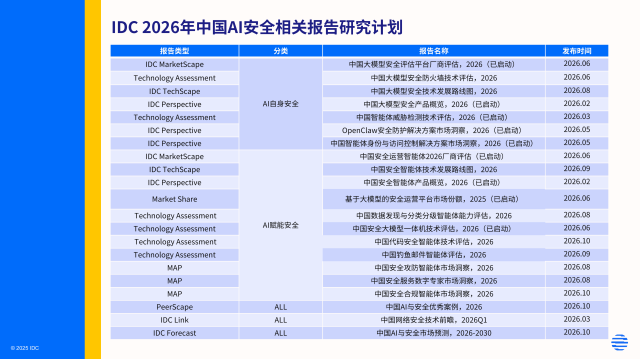
IDC已于2026年启动AI安全技术系列研究,围绕AI原生安全架构、安全智能体成熟度评估、AI驱动DevSecOps实践路径及企业级AI治理框架展开深入分析。

如需进一步了解与研究相关内容或咨询 IDC其他相关研究,请点击此处与我们联系。

Sophia Wang - Research Manager - IDC

Sophia Wang is a Research Manager in IDC China. She is responsible for the analysis and research of China's cybersecurity market. Her primary focus is on China's cybersecurity appliance and services market and operational technology (OT) security market. Additionally, she provides related research and consulting services for regional and global IT customers and supports their business development. Prior to joining IDC, Sophia worked in several consulting companies. She was independently responsible for consulting projects in fast-moving consumer goods (FMCG), internet, and other industries. Through market analysis and benchmarking analysis, she helped many clients solve problems in the different stages of their development. Sophia graduated from the University of Southern California with a master's degree in econometrics. She also majored in human resource management and journalism for her bachelor's degree.

随着生成式AI、大模型及Agent能力持续演进,围绕“AI是否会取代SaaS”的讨论正在快速升温。基于当前企业采用进度、软件支出变化、AI规模化落地情况以及企业工作方式转型趋势的综合观察,IDC的判断是:AI不会在中短期内取代SaaS,但将推动SaaS进入新一轮结构性重构周期。 企业软件市场未来的主要变化,不是SaaS的消失,而是SaaS从“功能交付工具”向“智能执行平台”演进。

当前,AI与SaaS之间并非替代关系,而更接近于“能力叠加”与“价值重定义”关系。随着企业客户从模型试点走向业务落地,从当前市场需求变化看,企业对软件平台的要求,正在从基础数字化和AI集成能力,进一步延伸至以AI Agent为代表的智能能力,包括任务执行、流程协同、系统连接、治理承接及业务结果支撑。

在明确 AI 与 SaaS 并非替代、而是能力叠加的核心关系后,我们可以从企业预算与市场结构的维度,进一步拆解这一演进趋势的现实表现 ——AI 技术的渗透并未削弱软件市场的基本盘,反而在重构企业对软件价值的判断标准与采购逻辑。

观点一:AI预算快速增长,但软件支出并未被替代

IDC数据显示,2025年全球生成式AI支出将达到 1843亿美元,同比增长151.6%。与此同时, 2025年全球IT总支出将达到 6.8万亿美元,其中软件支出将达到1.3万亿美元,同比增长 14.2%。这表明,AI投资扩张并未系统性挤压企业软件预算,反而正在推动企业重新定义软件的能力边界。

从市场结构看,企业并没有因为AI出现而停止采购软件,而是在加速采购“具备AI能力的软件”。这意味着,SaaS的需求基础并未减弱,但产品标准正在提升。未来,缺乏智能能力、缺乏AI与业务流程融合能力以及缺乏数据壁垒的传统SaaS产品,竞争压力将加大;而能够承接AI任务并支撑流程执行的平台型软件,战略重要性将持续提升。

观点二:AI采用率提升很快,但规模化价值兑现仍处于早期阶段

IDC的数据显示,2025年,亚太地区企业平均每年开展17.9个生成式AI概念验证(PoC)项目,PoC转入生产环境的比例为34.5%,也就是说,每10个PoC项目中约有3至4个最终进入生产阶段。在KPI达成率方面,亚太地区平均为36.8%,意味着进入生产环境的GenAI服务中,约37%能够实现预期业务目标。这些最新数据表明,企业对AI试点的热情依然高涨,但从PoC走向规模化生产的转化率,以及业务成效的实际达成率,仍有较大提升空间。

这表明,AI要从“具备生成与回答能力”进一步走向“具备执行能力、可审计性、可复制性和规模化应用能力”,仍需经过持续的场景验证与业务实践。仅依靠AI模型本身,尚不足以形成完整的企业级价值闭环,企业仍需要由业务系统与平台能力持续提供数据访问、权限控制、复杂流程编排、主数据管理及合规治理等关键支撑能力。也正因为如此,SaaS在AI时代并不会被削弱,反而将在任务执行、流程承接与治理支撑等方面承担更加重要的角色。

观点三:AI正在改变企业应用软件的交互方式与价值交付逻辑

传统SaaS的核心价值,在于以模块化、标准化的方式承载企业流程,并通过菜单、表单、权限和审批机制推动业务数字化落地。但随着生成式AI和AI Agent能力不断渗透,企业软件的交互逻辑正在发生明显变化:从过去的 “用户操作功能” , 逐步转向 “用户提出需求、系统理解意图并执行任务” 。在这一变化过程中,软件价值的衡量标准也在同步改变。企业关注的重点,正在从功能是否齐全,转向任务完成效率、流程自动化水平,以及对实际业务结果的支撑能力。

IDC预测,到2027年,约有50%的企业将在核心业务流程中引入AI agents,重塑人与机器之间的协作方式。这一趋势表明,AI agents正在从辅助工具逐步演变为企业工作体系的重要组成部分,而不再只是单点能力的补充。这也意味着,未来的软件平台,无论是SaaS还是企业级PaaS,都不再只是承担数据录入和流程流转的基础角色,而将进一步承担任务编排、系统集成、过程留痕和治理支撑等职责,成为AI执行任务时所依赖的业务底座。

与此同时,AI也正在重塑企业软件的交付方式与商业模式。基于用量的定价、智能体驱动的交互界面,以及基于结果的价值衡量,正在对传统的按席位订阅模式形成冲击。这种变化并不只停留在概念层面,而是已经在市场中逐步发生。

观点四:将被替代的更可能是低壁垒、浅流程的SaaS产品

从竞争格局变化看,AI对SaaS市场的影响并非均匀分布。预计首先受到冲击的,将是那些功能相对单一、流程嵌入程度有限、差异化不足,且主要依赖界面交互提供价值的轻量型SaaS产品。随着AI Agent逐步具备任务理解、流程拆解与自动执行能力,这类产品的独立价值空间可能被进一步压缩。

相比之下,深度嵌入企业核心流程、掌握关键业务数据、具备权限控制与合规支撑能力,并拥有行业知识积累的平台型软件,在AI时代更可能提升其战略重要性。这类平台不仅更有条件承接AI Agent的任务执行与流程协同,也更有可能在未来企业软件架构与采购体系中占据核心位置。

IDC中国企业级应用软件市场高级研究经理徐文婷认为,未来2-3年,企业将不会简单以AI替代现有软件系统,而是要求软件平台具备AI原生能力,并能够支撑AI Agent在业务场景中的应用。预计市场竞争焦点将逐步从功能覆盖转向任务执行、流程自动化和业务结果支撑能力。对SaaS厂商而言,关键不在于是否面对AI技术本身,而在于能否将AI有效嵌入企业级数据、业务流程和治理框架。从当前市场发展看,AI正在重塑SaaS的产品定义,但尚未改变企业对系统平台的根本需求。随着AI Agent从试点走向生产环境,SaaS将进一步向平台化和智能化演进,并承担更多任务执行与治理支撑职能。

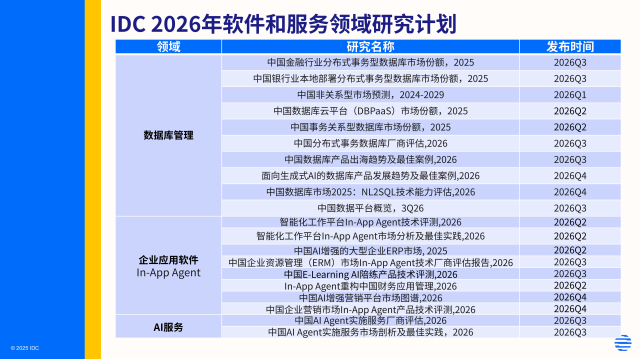
为了更好的帮助用户了解企业级软件AI的发展动态和未来趋势,IDC正式启动《中国AI-Enable ERP市场份额研究,2026》报告、《中国企业资源管理(ERM)市场AI Agent技术厂商评估报告,2026》报告研究,欢迎大家与我们保持沟通交流,与IDC共同开展更多前瞻性与实践性研究。

IDC相关研究报告

Worldwide AI and Generative AI Spending Guide 2025

Worldwide Black Book 2025

Automation, AI, and Agentic AI for FoW: Worldwide Tech Buyer Perspective Doc#EUR154249426

IDC Survey: Enterprise AI Trends – the Latest Survey Insights Doc#AP53632426

IDC 2026年软件和服务领域研究计划:

如需进一步了解与研究相关内容或咨询 IDC其他相关研究,请点击此处与我们联系。