IDC Directions 2026 brought together more than 700 technology and business leaders for a single day of focused, analyst-led intelligence on where enterprise AI is heading and what to do about it.

The scale tells part of the story: 82 IDC analysts, 56 speakers, and 29 sessions across marketing, data, emerging technology, and AI-ready infrastructure. The attendee response tells the rest. In IDC’s post-event attendee survey, 98% said the day was worth their time and 96% left with insights they could act on.

Catch up on what you missed at IDC Directions 2026.

IDC built this year’s Directions around a question most technology executives are wrestling with right now: AI ambition is everywhere. How do you turn it into enterprise results? Every session pointed toward an answer.

Three Conversations That Set the Agenda

Chief Product & Research Officer Meredith Whalen opened with her keynote on the AI Supercycle, IDC’s term for the once-in-three-decades technology expansion cycle now underway, driven by AI infrastructure investment and the enterprise adoption wave that follows. The infrastructure buildout is already underway. The enterprise adoption wave is next. Whether your organization captures value as it shifts to new layers of the stack depends on decisions being made right now.

IDC CEO Lorenzo Larini brought the broader context into sharp relief. The volume of information is now growing at 17 petabytes per second. That’s not a backdrop — it’s the challenge. Making confident decisions in that environment requires a different kind of intelligence infrastructure, one built for speed and clarity rather than volume alone.

Lorenzo Larini speaking about the volume of data growth
Alessandro Perilli looks to the future in his Directions presentation

Vice President of Enterprise AI Strategies Alessandro Perilli put a number on what’s coming: by 2029, IDC forecasts that enterprises will collectively be running more than one billion AI agents. The organizations now designing cross-functional, multi-agent environments for orchestration and resiliency will have a structural edge over those that aren’t.

IDC Quanta: A New Platform for the AI Era

Directions was also where we shared more about IDC Quanta, our AI platform that puts IDC’s research and market intelligence directly into the tools enterprise teams already use. Built on 60+ years of IDC data and developed with input from more than 65 customers, Quanta is contextual, secure, and built to surface the signals that matter to your business before you think to ask.

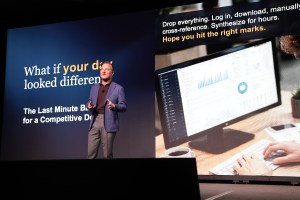
Joe Bradley encourages the audience to join the waitlist for IDC Quanta, IDC's new AI platform

Early access is now full. The next window is coming. Reserve your spot now to be first in line when it opens, and get exclusive updates as the platform evolves.

 Visit our AI platform page to stay in the loop on IDC Quanta.

Everything Is Now Available on Demand

Whether you attended and want to revisit what you saw, or couldn’t make it and want to see what you missed: it’s all there. Sessions available include:

  • General sessions and mainstage keynotes
  • Breakouts across the Marketing, Data, Emerging Technology, and AI-Ready Infrastructure tracks
  • Analyst perspectives from across IDC’s research practice

The sessions were designed to give you something to take back to your team, your planning process, your next conversation about where to invest. They still will.

Don’t wait. See IDC Directions on Demand.

Ryan Smith - Content Marketing Director - IDC

Ryan Smith is the Director of Content Marketing at IDC, where he leads brand-level content and social media strategy, aligning research insights with compelling storytelling to engage technology decision-makers. With a background in both IT and marketing, Ryan brings a unique blend of technical understanding and creative strategy to his work. He’s also a seasoned storyteller, speaker, and podcast host who believes the right message, told the right way, can drive both trust and transformation.

An AI system flags a high-value customer for fraud and blocks a transaction.
The customer churns within days. The business cannot explain why the decision was made.

A regulator asks for an audit trail of an autonomous workflow.
The organization cannot trace how the outcome was generated.

These are not edge cases. They are early signals of a broader shift.

As AI systems move into core operations, decisions are faster, workflows are more autonomous, and consequences are more visible. What changes is not just scale. It is accountability.

The challenge is no longer whether AI works.
The challenge is whether it can be trusted to work reliably, transparently, and at scale.

The new reality: scale without trust creates instability

Enterprise AI is entering high-stakes environments.

  • Decisions are automated
  • Workflows are autonomous
  • Data moves across systems and partners

This creates new pressure points:

  • Limited visibility into AI-driven decisions
  • Increasing regulatory and compliance exposure
  • Vulnerabilities across data, models, and agents
  • Erosion of customer and stakeholder confidence

Expectations are rising at the same time. Customers, regulators, and employees demand accountability, explainability, and control.

Without trust, scale introduces instability.

The shift: from AI adoption to trusted AI systems

IDC’s FutureScape 2026 predictions highlight a critical transition.

Organizations are moving from deploying AI systems to embedding trust into those systems.

This requires a new operating model:

  • Trust is built into workflows, not added after deployment
  • Governance operates continuously, not periodically
  • Security spans the full AI ecosystem, not isolated components

In practice, this means an AI-driven decision is no longer a black box.

A financial services firm deploying agentic AI for credit decisions can trace how a decision was made, validate the data used, demonstrate compliance, and apply human oversight where needed. That level of visibility allows AI to operate in regulated environments with confidence.

Trust, in this context, is operational.

To get there, organizations must move from principle to execution.

Charting the path: four moves to build trust and resilience

To succeed in this environment, leaders must take a deliberate approach to governance, transparency, security, and organizational readiness.

1. Embed governance into everyday operations

AI governance must move beyond policy frameworks.

Leading organizations are integrating governance directly into workflows through automated compliance checks, continuous monitoring, and embedded controls.

Without this:
Governance becomes reactive. Issues surface after failure, increasing regulatory risk and slowing adoption.

2. Establish transparency and accountability at scale

Autonomous systems require visibility.

Organizations must ensure that AI decisions can be traced, audited, and explained, with clear ownership for outcomes.

Without this: Decisions cannot be defended to regulators, customers, or internal stakeholders, limiting the use of AI in critical operations.

3. Strengthen security across the AI ecosystem

AI expands the attack surface across data, models, and agent interactions.

Organizations are adopting unified approaches to security, risk, and compliance that operate continuously across the AI lifecycle.

Without this: Vulnerabilities scale with adoption, exposing organizations to breaches, manipulation, and operational disruption.

4. Build a resilient, AI-ready organization

Resilience extends beyond systems to people and processes.

Organizations must prepare for workforce shifts, system disruptions, and evolving regulatory requirements.

Without this: AI-driven operations become fragile, with disruptions cascading across workflows and slowing response to change.

The payoff: trust as a foundation for scale

When trust is embedded into AI systems, organizations unlock consistent and measurable impact.

They gain:

  • Confidence in scaling AI initiatives
  • Stronger relationships with customers and stakeholders
  • Faster adoption of new capabilities
  • Greater resilience in uncertain environments

Trust enables organizations to move forward with clarity and control.

From control to confidence

The agentic future introduces new forms of risk alongside new opportunity.

Organizations that cannot explain, govern, or secure their AI systems will encounter increasing friction as they scale. Those that embed trust into their operations will move with greater confidence, expand into higher-value use cases, and sustain performance over time.

FutureScape 2026 makes the trajectory clear.

AI adoption is accelerating.
Trust will determine who can sustain it.

Those who operationalize trust will define the next phase of competitive advantage in the agentic economy.

Explore the FutureScape 2026 predictions behind trusted AI systems

FutureScape 2026 includes detailed research, analyst perspectives, and events that expand on building trust, resilience, and prosperity in the agentic future

Core Research

Analyst perspectives

On-demand webinars

IDC - -

International Data Corporation (IDC) is the premier global market intelligence, data, and events provider for the information technology, telecommunications, and consumer technology markets. With more than 1,300 analysts worldwide, IDC offers global, regional, and local expertise on technology and industry opportunities and trends in over 110 countries. IDC’s analysis and insight help IT professionals, business executives, and the investment community make fact-based technology decisions and achieve their key business objectives.

Organizations today are navigating powerful crosscurrents. Economic uncertainty, regulatory shifts, and workforce disruption are intensifying at the same time that AI is moving from experimentation to enterprise scale. Many leaders have responded by launching pilots, testing use cases, and investing in new tools.

A gap is emerging.

AI is present across the enterprise, yet measurable value remains limited.

Across industries, organizations are finding that experimentation does not automatically lead to impact. Pilots stall. Use cases remain isolated. Investments increase, but outcomes remain uneven.

The challenge is no longer whether to adopt AI. The challenge is how to operationalize it at scale.

The hidden barrier: From pilots to fragmentation

Most organizations are now well into their AI journey, yet many are unable to move beyond early deployments.

Isolated use cases create pockets of progress, but they do not transform the enterprise. Teams deploy agents, automate workflows, and generate insights, but these efforts are not connected to core operations.

This creates a new layer of complexity:

  • AI tools that do not integrate
  • Data that does not move in real time
  • Agents that operate without shared governance
  • Workflows that cannot scale across the organization

At the same time, the number of AI agents is increasing rapidly, introducing new demands for coordination, lifecycle management, and oversight.

Without a unifying approach, organizations face rising costs, inconsistent results, and delayed returns on investment.

In this environment, fragmentation becomes the primary barrier to progress.

The inflection point: From experimentation to orchestration

IDC’s FutureScape 2026 predictions highlight a clear shift.

Organizations that achieve impact will move beyond experimentation and adopt enterprise-wide orchestration.

This shift changes how the enterprise operates.

AI becomes embedded into the way decisions are made, work is executed, and systems interact.

Enterprise-wide orchestration includes:

  • Agents coordinating work across functions
  • Continuous data flow across systems
  • Applications evolving into AI-driven platforms
  • Governance integrated into daily operations

This is the transition from isolated deployments to connected systems that operate as a unified whole.

Charting the path: Four moves to scale AI with confidence

Reaching enterprise-wide orchestration requires deliberate action across strategy, architecture, and operations.

Based on FutureScape 2026 insights, four moves define this path.

1. Establish a control plane for AI orchestration

Scaling AI requires centralized coordination.

Leading organizations are building orchestration layers that manage agents, workflows, and governance across the enterprise. This creates consistency, reduces duplication, and enables AI systems to function together.

Without this coordination, complexity increases as deployments expand.

2. Re-architect for real-time, event-driven operations

Agentic AI depends on timely and contextual data.

Organizations must shift from batch-based systems to event-driven architectures where data flows continuously. This enables faster decision-making and allows agents to respond in real time.

In this model, data becomes an active component of operations rather than a static resource.

3. Build an AI lifecycle, not just deployments

Deploying AI is only the first step.

Organizations need structured lifecycle management that includes development, deployment, monitoring, and governance. This ensures that AI systems remain reliable and aligned with business objectives as they scale.

The adoption of formal lifecycle practices is becoming essential as agent usage expands.

4. Align the workforce to an orchestrated future

Enterprise orchestration requires changes in how work is performed.

As AI agents take on execution tasks, human roles shift toward oversight, coordination, and innovation. New responsibilities emerge in managing outcomes, ensuring accountability, and guiding AI systems.

Organizations that prepare their workforce for these roles will be better positioned to scale AI effectively.

The payoff: Enterprise impact at scale

When orchestration is achieved, organizations begin to see consistent and measurable impact.

AI supports coordinated operations across functions. Decision-making improves through real-time insights. Automation becomes more efficient and scalable. Innovation becomes a continuous process.

Organizations also gain greater adaptability. They can adjust workflows, reallocate resources, and respond to change more effectively.

From navigation to execution

The crosscurrents shaping the global economy will continue to evolve.

Navigation remains essential. Execution determines outcomes.

Organizations that adopt enterprise-wide orchestration can maintain direction, manage complexity, and scale their AI investments with confidence.

FutureScape 2026 makes the path forward clear.

AI adoption alone is not enough.
Operationalizing AI at scale is what drives results.

Those who take this step will define the next phase of the agentic future.

Explore the predictions behind charting the path to enterprise-wide orchestration

To move from AI experimentation to enterprise-wide orchestration, leaders need a coordinated view across applications, data, infrastructure, and operating models. The following FutureScape 2026 reports provide deeper insight into the predictions shaping this transition:

Core Research

Analyst perspectives

On-demand webinars

eBooks

IDC - -

International Data Corporation (IDC) is the premier global market intelligence, data, and events provider for the information technology, telecommunications, and consumer technology markets. With more than 1,300 analysts worldwide, IDC offers global, regional, and local expertise on technology and industry opportunities and trends in over 110 countries. IDC’s analysis and insight help IT professionals, business executives, and the investment community make fact-based technology decisions and achieve their key business objectives.

AI is starting to be framed as a price war. Vendors are cutting costs, model access is becoming more competitive, and the market is beginning to assume that cheaper AI will decide the winners.

That view is not wrong. It is just not deep enough.

What is happening now is bigger than pricing pressure. The market is not simply resetting the cost of AI. It is resetting the enterprise application model. And in that shift, price matters, but outcomes matter more.

From an IDC perspective, this is the real issue: enterprises are moving from a world where employees use applications to do work to one where agents increasingly become the work layer itself. That is a major change in how software is consumed, how value is created, and how buying decisions will be made.

In the old model, users opened applications, navigated workflows, triggered tasks, and completed processes. Automation improved parts of that model, but people still sat at the center of execution.

In the new model, employees express intent, and agents increasingly interpret, orchestrate, and act across systems, with guardrails in place. The application does not disappear, but it fades into the background. The workstream becomes the interface.

That is why the AI price-war narrative misses the point. Enterprises are not buying AI because it is cheap. They are buying AI to improve productivity, accelerate decisions, reduce friction, strengthen customer experiences, drive better business outcomes, and increase sustained economic value. The real competition is not over lowest-cost intelligence. It is over who can deliver trusted, measurable outcomes at scale.

The technology is moving faster than enterprise readiness

Enterprise software vendors have responded quickly to the AI push. They are embedding assistants, conversational interfaces, agentic capabilities, and tools for building new AI-driven workflows. At the same time, AI-native platforms are offering alternatives that promise faster innovation and, in some cases, lower cost.

But the key issue is not whether the technology is available. It is whether enterprises are ready to use it now.

In many cases, they are not. This is the gap that matters most right now. Organizations may be eager to adopt AI, but many are not yet prepared to move from human-led application workflows to agent-driven operating models. Lower prices will encourage experimentation, but they will not fix the operational weaknesses that limit scale and business value.

That is where the market will be won or lost.

Four issues will decide who gets value

Skills must shift from usage to orchestration
The move to agent-driven work demands a different set of skills. Employees need to do more than know how to use software. They need to define intent clearly, manage exceptions, understand workflow dependencies, and evaluate AI-driven outputs.

IDC research finds that 44% of organizations have prioritized an AI-ready workforce in 2026 to enable employees to use AI assistants and agents.

(IDC Future Enterprise Resilience and Spending Survey, Wave 1, March 2026 )

This raises the importance of prompt design, orchestration thinking, API awareness, and analytical judgment. These are not side skills. They are becoming essential to turning AI into real performance improvement.

Governance becomes the scaling mechanism
Agentic systems raise the stakes on trust. These systems do not just assist; they can take action across systems, shape decisions, and influence business outcomes. That creates new challenges around security, identity, explainability, compliance, and control.

IDC research continues to show that weak governance and unclear ROI are among the top reasons AI initiatives stall.

IDC research also finds that 39% of organizations are prioritizing AI governance in 2026 to establish trusted AI decision and risk frameworks, while 35% report difficulty quantifying and demonstrating AI ROI to stakeholders.

(IDC Future Enterprise Resilience and Spending Survey, Wave 1, March 2026 )

In an agent-driven model, governance is not a back-office exercise. It becomes the operating discipline that allows organizations to scale AI with confidence and trust.

Operating models need redesign
Enterprises cannot simply layer agents onto existing workflows and expect transformation. Agent-driven execution changes the role of the employee, the structure of the process, and the logic of oversight.

IDC research finds that 46% of organizations are prioritizing their AI business strategy in 2026 to increase the adoption of AI use cases tied to business goals.

(IDC Future Enterprise Resilience and Spending Survey, Wave 1, March 2026 )

Organizations need to rethink where humans stay in the loop, how exceptions are handled, how performance is measured, and how trust is maintained. This is not a feature upgrade. It is an operating model change.

Data and integration still decide the outcome
Agents are only as good as the systems and data they can access. If data is fragmented, APIs are weak, and workflows are disconnected, agent-driven execution will break down quickly.

This is why the most visible AI layer is rarely the hardest problem. The real challenge is below the surface: trusted data, strong integration, clear lineage, high-quality metadata, and resilient process connectivity. Without that foundation, outcome-based AI models collapse under complexity.

 IDC research finds that 46% of organizations are focused on AI data-ready architecture in 2026, implementing controlled access to all enterprise data, whether structured, unstructured, or event streams.

(IDC Future Enterprise Resilience and Spending Survey, Wave 1, March 2026 )

This market is shifting from features to outcomes

That is the real strategic change now underway.

The winners will not be the vendors with the most AI features or the lowest-cost model access. They will be the ones that help enterprises reduce manual effort, improve process completion, increase productivity, and deliver measurable business value.

For enterprise application vendors, embedded AI is becoming table stakes. Buyers will increasingly ask not whether AI is in the product, but whether it improves outcomes across workflows. Vendors that can orchestrate across systems, support trusted execution, and align pricing to measurable value will have the stronger position.

For services providers, the opportunity is also shifting. Enterprises need help redesigning workflows, modernizing integration, strengthening governance, and measuring value. The market will reward providers that can connect AI strategy to operating reality.

For enterprises, the message is simple: buying tools is not enough. Organizations that succeed with AI will invest in operational readiness. They will build new skills, strengthen governance, redesign workflows, and improve data discipline. They will treat AI as a new execution model, not just another feature set.

Price matters, but it is not the main event

None of this means pricing is irrelevant. Lower-cost AI will matter. It will pressure incumbents, expand experimentation, and change software economics.

But price is not the endgame. It is the opening move.

In enterprise markets, the cheapest AI does not automatically win. The AI that wins is the AI that works consistently, securely, and at scale. This is why AI pricing should be viewed less as a race to the bottom and more as a race to the outcome layer.

Bottom line

The market is right to watch AI pricing. It is wrong to make pricing the center of the story.

What is really happening is a shift in the enterprise software model, from users operating applications to agents increasingly executing work across them. That changes how enterprises buy, how vendors compete, and how value is measured.

The winners will not be the ones with the cheapest AI. They will be the ones that help enterprises achieve trusted outcomes at scale.

Price may open the door. Outcomes will decide who stays in the room.

What to watch

There are several signals that will confirm or challenge this shift over the next year.

First, watch buyer conversations. If enterprises start focusing less on AI feature breadth and more on cycle time, productivity, workflow completion, customer experience, and financial impact, that will confirm that outcome-based competition is taking hold.

Second, watch pricing models. If vendors move toward transaction-based, workflow-based, or value-based pricing, rather than simply charging for seats or usage, that will be a clear sign that the market is reorganizing around outcomes.

Third, watch deployment patterns. If organizations continue to pilot AI widely but struggle to scale it across core workflows, it will reinforce the point that operational readiness, not price, is the real constraint.

Finally, watch where value accrues. If the market rewards vendors and providers that can orchestrate across ecosystems and deliver measurable business outcomes, then the real battleground has shifted to the outcome layer. If value moves mainly to the lowest-cost providers, then the price-war thesis will prove stronger than this view suggests.

Mickey North Rizza - Group Vice President - IDC

Mickey North Rizza is Group Vice-President for IDC's Enterprise Software. She leads the Enterprise Applications & Strategies research service along with a team of analysts responsible for IDC's coverage of next generation of enterprise applications including digital commerce, employee experience, enterprise asset management and smart facilities, ERP, financial applications, HCM and payroll applications, procurement, professional services automation and related project-based solutions software, supply chain automation, and talent acquisition and strategies. In her role, Mickey and the team advises clients on these intelligent, modern, and modular enterprise applications for businesses of all sizes with an emphasis on the key trends, opportunities, innovation and the IT and Business Buyer concerns, requirements, and buyer behaviors.

Global disruption is not caused by an isolated event. It is continuous, multidimensional, and increasingly interconnected. Economic volatility, geopolitical fragmentation, regulatory expansion, workforce transformation, and rising customer expectations are converging to reshape how organizations operate and compete.

IDC’s FutureScape 2026 identifies this convergence of forces as Navigating the Crosscurrents of Disruption. This defines how organizations can respond to these overlapping pressures with deliberate strategy rather than reactive adjustment. At the core of that response is agentic AI, not as an isolated capability, but as a governed, strategy-aligned force that converts disruption into momentum.

Without deliberate navigation, leaders risk being dragged sideways by disruption, leaving them unprepared to capture the benefits of the agentic economy.

A framework for navigating compounding disruption

Crosscurrents are not independent variables that can be managed in sequence. They have a cascading effect.

A regulatory shift in one market affects supply chain strategy. Geopolitical instability reshapes technology sourcing decisions. Workforce disruption intersects with AI adoption. Leaders acting on one pressure are already absorbing consequences from several others.

This is the decision environment mapped by FutureScape. Not as a catalog of threats, but as an analytical lens for understanding how simultaneous forces compound and where deliberate action creates leverage.

Leaders must balance competing priorities while maintaining forward momentum. Success depends less on predicting disruption and more on navigating it effectively.

AI sits at the intersection of these crosscurrents. It is subject to regulatory and sovereignty constraints and is often limited by fragmented implementation. Yet it can also serve as a mechanism for coordination, enabling organizations to integrate data, align decisions, and respond more dynamically to economic and operational complexity at scale.

When governed and aligned with enterprise strategy, AI transforms the crosscurrents into momentum. Deployed without that alignment, it can amplify the complexity leaders are already facing.

The structural impact of disruption

The crosscurrents are no longer hypothetical pressures on the horizon. They are already reshaping infrastructure decisions, cost structures, and leadership accountability across technology suppliers and enterprise buyers.

Disconnected systems, duplicated investments, and uneven execution are introducing new layers of cost and operational burden that organizations must actively manage.

Architecture is being reshaped by sovereignty and regulation

This shift is most visible in AI architecture. Sovereignty laws and evolving regulatory requirements are forcing organizations to make deliberate decisions about where data resides, how models are deployed, and which systems can operate across jurisdictions.

Compliance fragmentation is becoming a defining constraint. Organizations must navigate inconsistent regulatory frameworks across regions, often requiring localized architectures, governance models, and data environments. This limits standardization and increases structural complexity.

IDC predicts that 60% of global firms will split their AI stacks across sovereign zones by 2028. Enterprise architecture is no longer designed for global uniformity. It must accommodate regulatory divergence while maintaining cohesion across the organization.

Implementation complexity is slowing outcomes

As AI adoption scales, the focus is shifting from experimentation to execution. Disconnected investments across business units, regions, and use cases are creating duplication, inefficiencies, and inconsistent results.

This increases cost and slows progress. Organizations must fund parallel initiatives, manage overlapping capabilities, and invest in integration to connect systems separated by region and function.

According to IDC research, 40% of organizations will miss their AI goals due to implementation complexity in 2026. The issue is rarely the technology itself. It is the gap between AI deployment and the enterprise structures, governance models, and integration required to make it work at scale.

Complexity becomes the primary constraint

As these forces converge, complexity becomes the defining constraint on progress.

For leaders, this translates into rising costs, slower execution, and reduced strategic flexibility. Organizations must coordinate across architectural boundaries and operational silos while managing regulatory demands and investment trade-offs.

Those that build alignment across architecture, investment, and execution will be better positioned to sustain momentum. Those that do not risk being constrained at every layer of the enterprise.

Maintaining direction in a shifting environment

Navigating the crosscurrents requires getting three foundational areas right. These areas are interdependent, and gaps in any one limit what is possible in the others.

To move forward, leaders must:

1. Define ownership and strategic direction
Crosscurrents do not respect organizational boundaries. Economic risk, AI governance, regulatory compliance, and technology investment are converging into the same course of decision making. Leaders must ensure the right stakeholders own these decisions and that CIO and CFO mandates are aligned around shared outcomes rather than managed in parallel.

2. Evolve workforce models for new operating realities
Workforce fragmentation is increasing across regions, regulatory environments, and technology stacks, creating inconsistencies in execution and decision-making. Navigating at the pace of change requires unifying this environment through human–AI collaboration as a core operational capability.

3. Strengthen foundations for integration and adaptability
Infrastructure decisions made today define future strategic options. Data foundations, integration architecture, and sovereignty-ready systems are not simply IT priorities. They are decisions about where the organization can operate and how quickly it can adapt.

Deliberate navigation across these three fronts separates organizations positioned to capture the agentic economy’s upside from those that lose direction in the crosscurrents.

The stakes of standing still

The crosscurrents shaping the agentic economy are not temporary conditions. Economic and geopolitical volatility, regulatory fragmentation, and workforce disruption are structural features of the environment in which leaders now operate.

Leaders who build strategic alignment, workforce capability, and infrastructure readiness will not only maintain direction within this changing environment but also convert external pressures into coordinated progress. That preparation cannot happen at the point of disruption. It must be in place before challenges arise.

Navigating the crosscurrents is where that work begins. Understanding the crosscurrents, mapping their interactions, and identifying where deliberate action creates the most leverage are the first steps to success in the agentic economy.

Explore navigating the crosscurrents of disruption in depth

Explore navigating the crosscurrents of disruption in depth

FutureScape 2026 includes detailed research, analyst perspectives, and webinars that expand on the themes within navigating the crosscurrents.

Core research

Analyst perspectives

On-demand webinars

eBooks

IDC - -

International Data Corporation (IDC) is the premier global market intelligence, data, and events provider for the information technology, telecommunications, and consumer technology markets. With more than 1,300 analysts worldwide, IDC offers global, regional, and local expertise on technology and industry opportunities and trends in over 110 countries. IDC’s analysis and insight help IT professionals, business executives, and the investment community make fact-based technology decisions and achieve their key business objectives.

IDCの最新レポートでは、今回の中東での戦争が2026年に向けてクラウドのレジリエンス、サイバーリスク、サプライチェーン、IT計画にどのような影響を及ぼすかを考察しています。
地政学的危機は、明確な予兆なく発生することがほとんどです。そして一度発生すれば、デジタルインフラ、サプライチェーン、テクノロジー運用に即座に大きな負荷がかかります。
今回の中東での戦争は、現代のデジタル経済、そして混乱下でも事業継続を担うCIOにとって、構造的なストレステストとなっています。
過去の紛争と異なり、現在の企業IT環境はクラウドインフラ、サブスクリプション型サービス、そしてグローバルに相互接続されたサプライチェーンに大きく依存しています。そのため、影響は局所的にとどまらず、地域・システム・パートナーを横断して急速に拡大します。
CIOにとっての課題は、単なるリスク管理ではありません。変化する状況に適応しながら事業運営を維持し続けることです。

IDC の見解:From Conflict to Continuity: How CIOs Can Respond to Disruption from the Middle East War.

なぜ今回の危機はCIOにとってこれまでと異なるのか

企業ITは、従来の内部完結型環境から、高度に分散されたエコシステムへと移行しています。

現在の企業は以下に依存しています:

  • クラウドプロバイダーおよびプラットフォームサービス
  • 分散型インフラおよび運用
  • テクノロジー供給および提供におけるグローバルサプライチェーン

この依存構造は、新たなリスクを生み出しています。

地域の不安定化は、以下に影響を与えます:

  • アプリケーションの可用性およびパフォーマンス
  • ハードウェア導入スケジュール
  • サイバー攻撃の増加
  • インフラおよびエネルギーコスト

これらの圧力は、既存のデジタル戦略の前提をすでに揺るがしています。

CIOにとっての優先事項は、自社のリスク露出(エクスポージャー)を把握し、それが業務にどう影響するかを理解することです。

エクスポージャーマッピングとシナリオプランニングから始める

最初のステップは、どこにリスクが集中しているかを特定することです。

CIOは以下の4つの観点で依存関係を整理すべきです:

  • 影響地域に所在する従業員・契約社員
  • 影響市場に関連する顧客および収益源
  • 混乱が発生している物流ルートやサプライヤー
  • 地域インフラに依存するアプリケーション、データ、運用

このマッピングが意思決定の基盤となります。

その上で、シナリオプランニングにより複数の展開に備えることが可能になります。

IDCは、CIOが検討すべき2つのシナリオを提示しています:

  • 地域の不安定状態が長期化するケース
  • エネルギーやサイバー領域に波及する広範なエスカレーション

シナリオごとに、レジリエンス、セキュリティ、投資の優先順位は変化します。

CIOが今優先すべきこと

CIOは以下の5つを直ちに見直す必要があります:

1. クラウドとインフラのレジリエンス再評価

単一リージョンや特定プロバイダーへの依存度を確認し、フェイルオーバー体制のギャップを特定する。

2. サイバーセキュリティの強化

脅威の増加を前提に、検知・対応・復旧能力を強化する。

3. テクノロジーサプライチェーンの多様化

供給のボトルネックを特定し、単一供給源への依存を低減する。

4. データ主権とコンプライアンスの見直し

地政学的緊張はデータローカライゼーションや規制強化を加速させる。

5. 人材・業務継続計画の整備

リモートワークや代替コミュニケーション手段を含め、業務継続を確保する。

これらは新しい課題ではありませんが、「同時に、かつ迅速に」対応する必要性が高まっています。

IDC アジアウェビナー(英語):Asia Pacific IT Spending Outlook 2026: Where to Win Amid Market Volatility

混乱下でのリーダーシップ

レジリエンスは技術課題であると同時に、リーダーシップの課題でもあります。

CIOは不確実性の中で明確な方向性を示す必要があります。成功する組織は、チームが目的を理解し、迅速に行動できる組織です。

有効なリーダーシップ行動には以下が含まれます:

  • 重要システム保護への明確なフォーカス
  • 意思決定の迅速化
  • 課題の分解と優先順位付け
  • 環境の簡素化と強化の機会特定

こうした局面では、技術的負債や運用の非効率、レジリエンスの欠如が顕在化します。

優れた組織は、混乱を「停止」ではなく「行動の契機」として捉えます。

混乱からオペレーショナル・レディネスへ

現在の状況は、地政学とデジタル運用の関係が変化していることを示しています。

CIOはもはや単発のインシデントに備えるのではなく、複数領域に同時影響が及ぶ前提で対応を進めなくてはなりません。

そのためには、継続的なレジリエンス強化が必要です:

  • 依存関係とリスクの可視化の継続
  • 複数シナリオを前提とした計画
  • 日常業務へのレジリエンスの組み込み

この能力を構築できた組織は、不確実性の中でもパフォーマンスを維持できます。

シナリオフレームワークの活用

リスクの把握は出発点に過ぎません。重要なのは、それを意思決定に落とし込むことです。

IDCのレポートでは以下について詳述しています:

  • IT支出やAI投資への影響
  • インフラ、サイバーセキュリティ、人材継続性への考慮点
  • 状況変化を把握するためのリスク指標

執筆者(Authors)

Rick Villars – Group VP, Worldwide Research – IDC

原文:2026年3月23日公開(英語)|日本語版監修:寄藤 幸治

関連する調査やご相談について

より詳細なインサイトや市場動向については、当社アナリストへお気軽にご相談ください

IDC在2025年下半年实施的一系列消费者研究显示,伴随着“国补”政策的逐渐退坡,日益增长的价格使得消费者对终端商品的选择更加理性。端侧AI与智能体能力的不断增强一方面推动AI渗透率与使用率的提升,另一方面也促使智能体验成为影响用户NPS的关键因素。

通过IDC对消费终端市场最为核心的笔记本、平板以及手机市场主要厂商NPS排名与市场动态的解析,可以看到智能体验等因素如何影响消费者对终端厂商的评价,以及在2026年智能终端消费市场,厂商应该聚焦哪些方面来达成用户NPS的提升。以下为本次研究的主要发现:

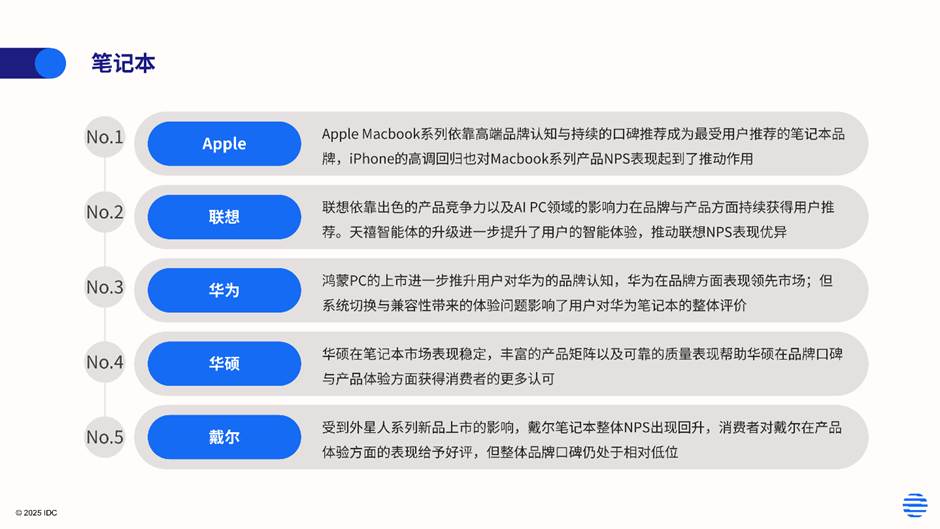
笔记本市场

笔记本市场消费者在2025年下半年仍处于价格敏感期,普遍升高的到手价格对大部分品牌都产生了一定的负面影响。产品体验对于用户对品牌的推荐意愿影响力提升,笔记本产品能否提供最佳的日常使用体验以及超出预期的智能体验成为影响用户口碑的关键

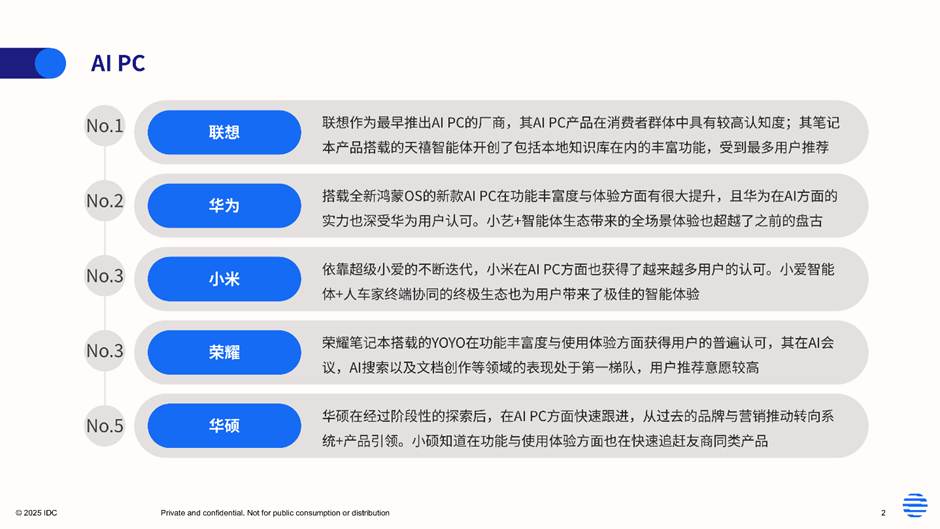
AI PC细分市场

由于用户对笔记本智能体验关注的的持续提升,IDC针对AI PC市场开展了独立的调研。根据研究,AI PC消费者重视设备是否搭载有功能丰富的AI助手。本地知识库与大模型,AI创作与研究能力等功能的可用性及使用体验均对用户NPS有直接影响。是否与系统深度融合,能否跨生态智能互联或将成为AI PC竞争的新高地。

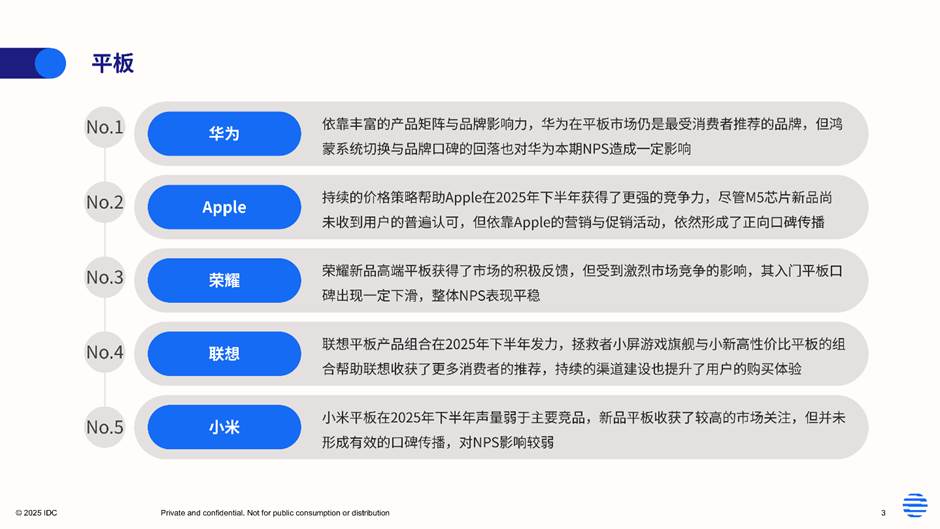
平板市场

平板市场厂商通过不断推出新品拉动消费者热情,2025年下半年密集上市的新品也提升了用户对于产品体验的关注度。差异化的使用场景使得不同平板群体的关注因素存在差异,但性能与高性价比是平板消费者共同关注的重点。能否通过AI功能进一步提升使用体验将是影响用户选择的关键因素。

手机市场:

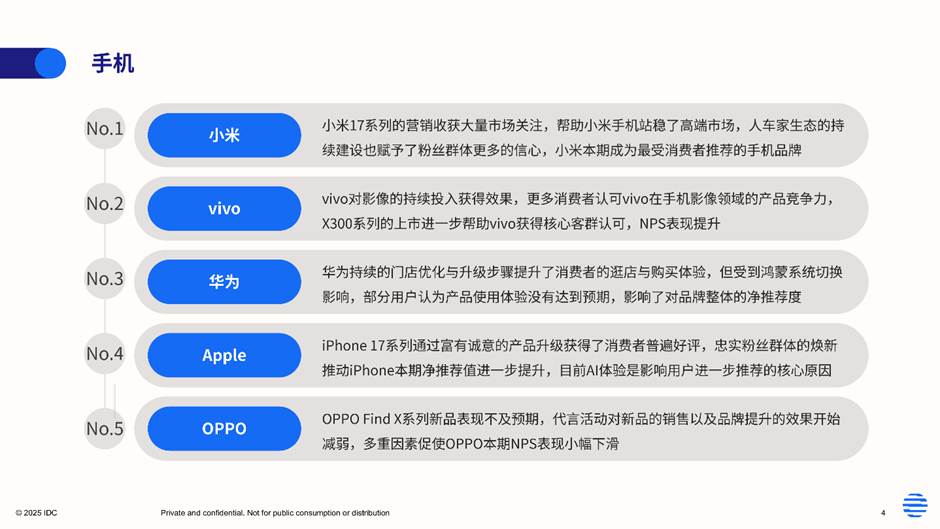
手机市场延续数年的产品“内卷” 出现缓和迹象,不断上升的成本促使厂商对新品迭代更加精打细算。但消费者对于手机产品体验的预期也在不断提升,任何因素导致的负向体验都会对品牌NPS产生较大影响。消费者对手机端AI与智能体体验的关注度快速提升,并且显著高于其他终端市场。

市场洞察与建议

洞察一:消费逐渐回归理性,务实主义有望回归

2026年,关键元器件成本的持续上涨将推动终端产品价格持续上行,用户的购买决策将趋向理性与谨慎。产品功能,使用体验,品牌口碑以及价格因素将成为用户未来购买消费终端产品的首要考虑因素

洞察二:智能需求升级,端侧AI将成为关键要素

AI智能体认知率与使用率不断提升,“AI PC”与“AI手机”等概念被更多消费者熟知。用户对于智能体验的需求也将快速迭代。端侧搭载AI能力将逐渐成为市场标配,而能否为用户提供跨场景,无缝的智能体验将成为厂商成功的关键

洞察三:体验决定价值,场景痛点更受关注

用户的价值感受中枢将回归到场景与体验,用户的高频痛点更加具象化,且与场景深度绑定。如果厂商提供的产品与服务能够帮助用户解决高频场景下的核心体验问题,将能为用户带来最强的价值感受。同时,更多的用户开始期待AI智能体在特定场景下的表现与体验,在垂类场景深度优化的智能体验有望快速形成正向口碑传播。

分析师观点

IDC中国研究经理王楷表示,中国智能终端消费市场处于持续变化阶段,涨价与AI体验升级预计将成为影响2026年市场的核心要素。更高的购买成本将进一步提升用户对于“买的值”的期待,能否在保证产品的基础体验过硬的同时,通过AI与智能体为用户带来实质性的体验升级,将成为厂商能否获得更多用户推荐的关键。

如需了解更多IDC相关研究或进一步与我们沟通,欢迎识别二维码与 IDC 联系,我们将安排专人与您对接,为您提供定制化的市场洞察与咨询服务。


如需了解IDC在智能终端领域的最新研究报告、数据产品及行业分析,请扫描二维码,在线获取完整研究目录与内容简介,助您精准把握市场脉动。

请点击此处与我们联系。

Across industries, AI has already delivered measurable operational gains. Workflows have been automated. Processes have accelerated. Teams have improved efficiency and reduced costs. Early AI adoption focused on productivity because leaders needed clear, measurable returns.

These early results were important. Contact centers reduced handle times. Back-office operations automated routine tasks. Sales and marketing teams improved throughput. AI proved it could enhance performance across multiple business functions.

However, productivity advantages diffuse quickly.

What creates competitive differentiation in one quarter often becomes standard capability the next. Productivity improvements layered onto existing operating models eventually reach saturation. Organizations find themselves optimizing processes that competitors can easily replicate.

The result is what many leaders are beginning to recognize as a productivity plateau.

Why productivity gains plateau

Productivity-first strategies hold organizations back in three ways.

They reinforce functional silos.
When AI is deployed function by function, each team focuses on optimizing its own objectives. Marketing automates campaigns, finance improves reporting cycles, and service teams reduce response times. Gains develop in isolation rather than reinforcing enterprise-wide value.

They lock in current assumptions.
Optimization strengthens existing workflows and metrics. As markets evolve, organizations that invest heavily in refining legacy models often find themselves constrained by the very systems they improved.

They produce linear gains.
Efficiency improvements inevitably plateau. AI becomes an improvement layer rather than a growth engine.

The limitation is not the technology itself. AI capabilities continue to advance rapidly. The constraint lies in operating design.

When AI is layered onto legacy structures without rethinking how value is created, outcomes remain incremental.

The limits of efficiency as a strategy

Early AI adoption naturally focused on the most immediate and measurable gains. Automation reduced costs and accelerated execution. These results helped organizations justify investment and build confidence in the technology.

Over time, however, efficiency becomes table stakes.

Competitors implement similar automation. Vendors integrate comparable capabilities into standard platforms. What once provided differentiation becomes a baseline expectation.

Organizations then face a strategic choice.

They can continue optimizing existing models—capturing smaller, incremental gains—or begin redesigning the systems that define how value is created.

This transition marks a shift from productivity to innovation.

Innovation as the structural payoff of agentic AI

Innovation occurs when AI reshapes enterprise structure rather than simply accelerating task execution.

Agentic systems enable coordinated decision-making across marketing, supply chain, finance, service, and partner ecosystems. Systems move from isolated automation toward orchestration embedded within enterprise operating models.

This shift changes how organizations capture value.

When agents operate autonomously at scale, assumptions about capacity, cost, and output evolve. Business cases designed for linear improvement fail to capture the compounding value created when systems coordinate across portfolios and ecosystems.

Innovation beyond productivity requires organizations to rethink economic logic, governance models, and even industry boundaries.

Moving beyond the productivity plateau

Organizations that remain focused exclusively on efficiency risk becoming highly optimized versions of yesterday’s operating model.

Those that move beyond productivity gains begin to redesign enterprise systems around coordination, adaptability, and growth.

The shift from productivity to innovation does not eliminate the importance of efficiency. It clarifies its limits.

Efficiency improves performance.
Innovation reshapes advantage.

In the agentic era, leaders who understand the difference will position their organizations to capture the next wave of AI-driven value.

IDC - -

International Data Corporation (IDC) is the premier global market intelligence, data, and events provider for the information technology, telecommunications, and consumer technology markets. With more than 1,300 analysts worldwide, IDC offers global, regional, and local expertise on technology and industry opportunities and trends in over 110 countries. IDC’s analysis and insight help IT professionals, business executives, and the investment community make fact-based technology decisions and achieve their key business objectives.

Public sector senior leaders, such as mission and program executives, CIOs, CTOs, and CAIOs, have always faced a dual mandate: drive technology-enabled innovation while controlling risk. Private sector IT and business leaders have historically leaned more toward innovation, although leaders in regulated industries have faced pressures similar to those in the public sector.

That tension has escalated over the past twelve to eighteen months. The potential benefits and disruptive impact of AI have raised new questions about how to manage its risks. At the same time, geopolitical turbulence has made strategic autonomy in technology choices, control over data, and operational resilience paramount. These forces have converged in the sovereign AI debate.

In a recent conversation with senior government officials in a major Asian country, IDC found that the country’s vision is to build national AI infrastructure capabilities that they can “control in time of crisis.” While they recognize they cannot manufacture everything overnight, they “cannot accept dependency without a plan.” At the same time, their goal is “not to lock data away so tightly that no one can innovate,” but to find the right balance.

How the sovereignty debate is evolving from control to strategy

That tension between speed and control, and between innovation and sovereignty, sits at the heart of today’s digital and AI strategies. It also reflects how the conversation around sovereignty has evolved.

Early digital and cloud sovereignty discussions were driven by a specific concern: that sensitive data could be accessed by foreign jurisdictions. That narrow focus has now expanded into something much broader. Sovereignty has become a strategic imperative that shapes how organizations design their entire technology stack.

Today, sovereignty is no longer just about where data resides. It is about control over data, infrastructure, operations, and even the supply chain. AI sovereignty extends this further, encompassing control across the entire AI lifecycle, from model development to deployment and governance.

IDC research shows that market signals are clear. Governments are investing in sovereign AI capabilities, from national cloud infrastructures to domestic AI ecosystems. They are incentivizing local data centers, funding native-language AI models, and defining guidelines that will shape how sovereign solutions are acquired and deployed. For policymakers, AI is no longer just a technology. It is an instrument of economic competitiveness and national security.

For organizations, this creates a new reality. Senior business and IT leaders are no longer designing a single global architecture. They are navigating a fragmented, multi-sovereign world.

Choosing the right sovereign AI deployment approach

Faced with this complexity, many leaders look for a single answer: which deployment model is the most sovereign?

The reality is that the market offers a spectrum of deployment archetypes, ranging from public cloud to fully air-gapped environments. Each comes with different levels of control, agility, innovation speed, and cost. There is no one-size-fits-all approach.

A highly regulated AI workload may require a sovereign or even air-gapped environment. A customer-facing application may benefit from the scalability of the public cloud, combined with added sovereign controls.

The real challenge is selecting the right model for different use cases, or even different components of the same use case. For example, one deployment model may be used for AI training, another for retrieval-augmented generation, and a third for an agentic AI orchestration layer.

This is why hybrid architectures are emerging as the dominant pattern across both the public and private sectors. According to IDC’s 2025 Digital Sovereignty survey of more than 900 IT and business leaders, 37% of respondents say on-premises is currently their main environment and that sovereign cloud is, or will be, the only type of cloud they use. At the same time, 55% say sovereign cloud is, or will be, part of a multicloud or hybrid strategy.

IDC predicts that by 2028, CIOs at multinational organizations will increase investments in modular, sovereign-ready cloud and data localization environments by 65% to future-proof operations against rising sovereignty demands. Additionally, by 2026, 55% of governments will adopt hybrid sovereign cloud stacks, blending hyperscaler scale with national control to ensure compliance, security, and strategic autonomy for AI.

Public and private sector leaders are not retreating from the cloud. They are reshaping it. By combining global hyperscaler capabilities with local control layers, they are creating what IDC describes as sovereign-ready environments.

This approach reflects a deeper truth: sovereignty is not about isolation. It is about choice and control.

What leaders need to know about sovereign AI strategy

The conversation around digital and AI sovereignty is often framed as a trade-off between control and innovation. The organizations that will succeed are those that reject this binary thinking. They understand that sovereignty is not about limiting innovation, but about enabling it on their own terms.

In a world where AI is becoming the backbone of economies and societies, IDC research helps connect the dots between technology providers offering cloud and AI solutions and the business and IT leaders who must select the right deployment approaches to achieve their sovereignty goals.

Massimiliano Claps - Research Director - IDC

Massimiliano (Max) Claps is the research director for the Worldwide National Government Platforms and Technologies research in IDC's Government Insights practice. In this role, Max provides research and advisory services to technology suppliers and national civilian government senior leaders in the US and globally. Specific areas of research include improving government digital experiences, data and data sharing, AI and automation, cloud-enabled system modernization, the future of government work, and data protection and digital sovereignty to drive social, economic, and environmental outcomes for agencies and the public.

Rahiel Nasir - Research Director, European Cloud Practice, Lead Analyst, Digital Sovereignty - IDC

Rahiel Nasir is responsible for leading and contributing to IDC's European cloud and cloud data management research programs, as well as supporting associated consulting projects. In addition, he leads IDC's worldwide Digital Sovereignty research program. Nasir has been watching technology markets and writing about them throughout his professional life.

Tim Cook might have just given Apple its single most disruptive launch since the iPhone. Apple introduced the MacBook Neo earlier this month, just ahead of Apple’s 50th anniversary, at a striking price point: $599 at retail and $499 for education. My initial reaction, like many others, was, “Wow. This is a killer price.”

For years, Apple has remained disciplined at the premium end of the PC market, rarely launching a brand-new product at what could genuinely be considered entry-level pricing. Seeing Apple move this decisively into the sub $700 segment is an aggressive play that clearly signals an intent to capture share.  It brings a Mac into the hands of users who’ve aspired to own a Mac but have historically been priced out. But it also raises other important questions. What compromises did Apple make to achieve this and mor importantly, will it dilute the Apple brand?

After spending a few weeks with the device, the answer was clear.

First impressions: Neo feels anything but budget

The MacBook Neo immediately feels like a Mac, not a compromised or stripped-down version. It is thin, exceptionally light at roughly 2.7 pounds, and the aluminum build delivers the solidity consumers associate with Apple’s premium notebooks. The keyboard is comfortable, the touch track pad feels precise, and the display is noticeably bright and sharp – standing out instantly in this price band.

Day-to-day performance is fluid. App launching and switching are smooth and responsive, which is notable given the modest hardware configuration: 8GB of RAM paired with Apple’s A18 Pro processor, previously used in iPhones, which I wager may soon become a trend to be followed by other PC makers.  Apple, yet again, demonstrates vertical integration can matter more than raw specifications.   Apple has found a way to expand its reach without undermining its product quality, user experience and core brand promise.

Design also plays a critical role in the Neo strategy. The brighter color options give the Neo a sense of personality that resonates strongly with younger users. It feels modern, expressive, and distinctly non-generic. Simply put, very little about the MacBook Neo feels “budget.”  Rather than diluting the Mac brand, Apple has effectively extended its premium perception into a lower price tier – something very few PC vendors have managed successfully.

Why MacBook Neo resonates with younger users

What stood out even more than my own reaction as an IDC analyst was what I observed at home. I have three teenage children-squarely within Apple’s target demographic for this device-who quickly attempted to claim ownership of the Neo.

None of them asked about the processor, memory, or benchmark performance. There were no questions about architecture or specifications. Instead, they focused on how much better it looked and felt compared with the Chromebooks and low-cost Windows laptops they currently use for school. They noticed the display quality. They liked the keyboard. They commented on how light it was.

Then came the reaction that captured everything: “This would look so cool at school.”

That “cool factor” is often underestimated in market analysis, but in a school environment it is a powerful driver of preference. Within minutes, the verdict was clear-they wanted it, and it landed immediately on their birthday wish lists. 

MacBook Neo hits the sweet spot

That reaction highlights a broader market reality. Buyers in the sub $700 notebook segment are overwhelmingly not current Mac users, nor are they making decisions through a spec-driven lens. Their purchases are constrained by budget and centered on core experience: design, ease of use, battery life, and overall feel.

In that context, MacBook Neo stands apart. It provides a compelling option for education institutions approaching refresh cycles after the COVID-era buying surge, for students purchasing their first personal notebook, and for small and midsize businesses operating with tighter cash flows.

While the Neo does make trade-offs relative to the MacBook Air, particularly in performance headroom and features such as external multi-display support, these limitations are largely irrelevant for this target market and first-time Mac buyers. In the areas that matter most to this audience, Neo delivers a meaningfully differentiated experience. That positions Apple to directly disrupt a segment long dominated by Windows and ChromeOS devices-and should be a legitimate concern for incumbent vendors.

What opportunity does the MacBook Neo unlock for Apple?

To understand the scale of the opportunity, it is important to frame the broader PC market. Global PC shipments totaled roughly 285 million units in 2025, with Apple holding just under a 10% share. Within that, the sub‑$700 notebook segment accounted for approximately 75 million units, nearly 40% of total notebook volume, and has historically been dominated by Microsoft Windows and Google ChromeOS, which together account for more than 95% of shipments in this tier. 

Geographically, Neo also positions Apple for expansion beyond its traditional strongholds. Today, Mac shipments remain heavily concentrated in the U.S. and Western Europe. With Neo, Apple has a credible pathway to reach more price‑sensitive buyers in emerging markets where Macs have historically seen limited penetration.

In my opinion, the opportunity extends beyond grabbing existing Windows or Chrome users.  I believe MacBook Neo will further expand Apple’s addressable market by enticing users who have deferred notebook purchases altogether. Those unwilling to compromise on experience with low-cost Windows systems but unable to justify the price premium of a MacBook Air.  By bridging that gap, Neo has the potential to both drive share gains and unlock incremental demand.

MacBook Neo: Perfect timing and long-term strategy

To top it off, the timing of this move also worked out in Apple’s favor. The broader PC industry is entering a challenging period as DRAM and NAND pricing pressures intensify. Rising memory costs are pushing many vendors upstream toward higher-priced systems or forcing them to cut specifications to defend lower price points. Apple, in contrast, is moving in the opposite direction – delivering a premium-like product at a budget price.  This move will send competitors back to the drawing board to defend their share in this massive segment and I am eager to see their response.   

Strategically, Neo represents far more than a near-term share grab.  It advances one of Apple’s long-term objectives: increasing ecosystem penetration earlier in the user lifecycle. By introducing macOS to younger users-often as their first personal Mac, Apple strengthens platform stickiness and maximizes lifetime value. Once users are embedded in Apple’s ecosystem through iMessage, FaceTime, iCloud, and AirDrop, across multiple devices, they are less likely to switch to another platform across any device. As younger Neo users transition into higher education and into professional roles with greater purchasing power, upgrading to a MacBook Air becomes a natural progression rather than a competitive evaluation. In this sense, Neo serves as a feeder into Apple’s higher-margin Mac portfolio over time.

That dynamic is already visible in my own household. My children live on their iPhones and iPads, and a MacBook that is finally within financial reach simply extends that ecosystem into the notebook category. Once that level of integration is established, switching away becomes far less likely. This is where the real strategic value of MacBook Neo lies-not in short-term unit volume alone, but in locking in demand across multiple device cycles.

Final thoughts

MacBook Neo might just be the best 50th‑anniversary gift Tim Cook could have given Apple. The device is not just about a lower-priced Mac but represents a long-term ecosystem lever. Viewed through that lens, it has the potential to be one of Apple’s most disruptive launches since the iPhone-not because it introduces breakthrough technology, but because it will significantly alter the competitive landscape of the PC Market for the foreseeable future.

Great news for Apple, less so for me, as I now need to figure out how to buy three Neos.

Nabila Popal - Sr. Director, Data & Analytics - IDC

Nabila Popal is Senor Director with IDC's Data & Analytics team, specializing in Mobile Phones, PC Monitors and other consumer devices. Ms. Popal is responsible for the global research and quality and timely delivery for her respective technologies, coordinating with regional and worldwide research teams. She continuously engages with global vendors and key market players to discuss the latest industry trends and dynamics. Ms. Popal is also responsible for future product planning and evolution whilst managing client relationships and providing thought leadership and executing custom engagements. She also manages communications with the media and is often published in leading local and international media outlets. Ms. Popal has been with IDC since 2013, and prior to her role with the Worldwide team, she was with IDC MEA, leading the research for Middle East, Africa, and Turkey, based out of Dubai, UAE.